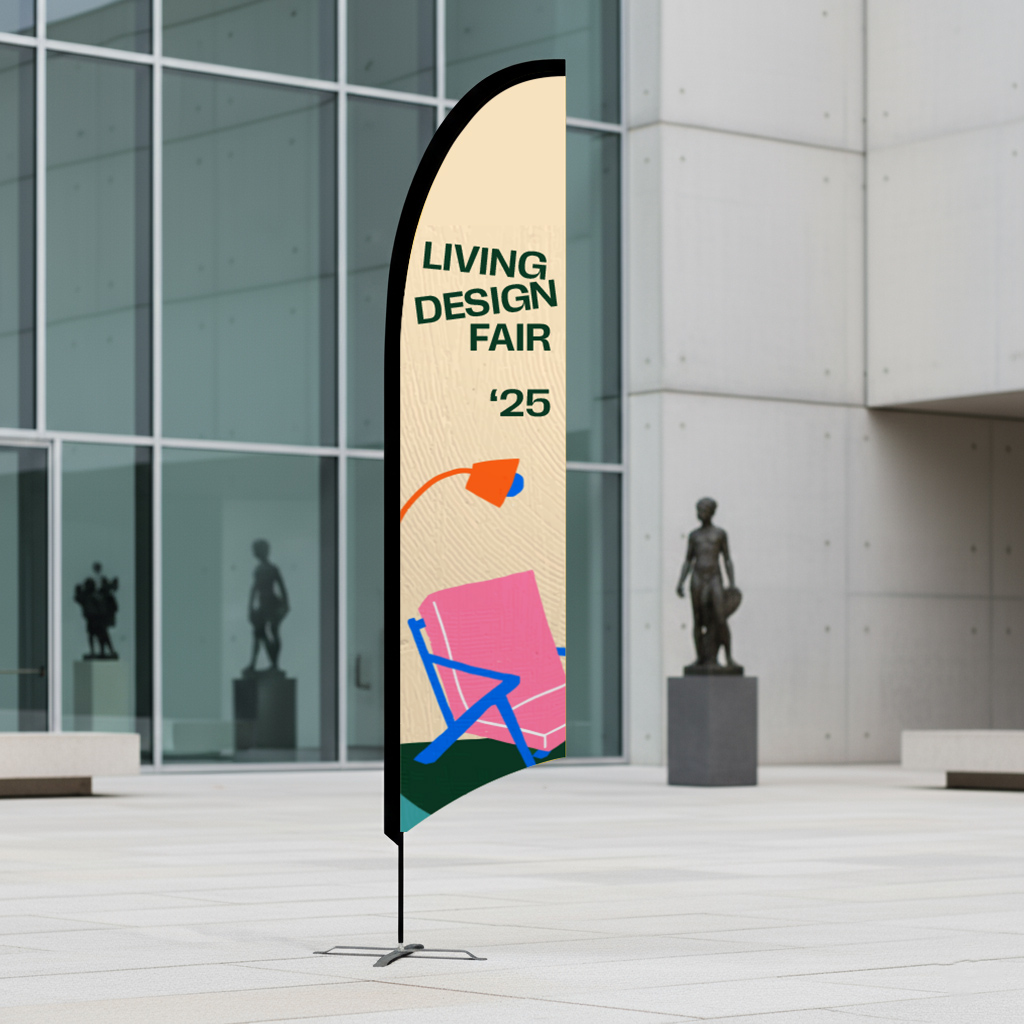
Bow banners are one of the most effective tools in the outdoor brand toolkit. Their tall, sweeping curved silhouette draws the eye from a distance, and because they move with every breath of wind, they stay visible even when static signage blends into the background. Whether you are marking a retail entrance, activating at an expo, or anchoring a sports ground presence, bow flags deliver height, movement, and full-colour print impact in a format that packs down to a carry bag.
This guide covers everything you need to know before ordering: how bow banners differ from teardrop and feather flags, which sizes suit which settings, how to choose between single and double-sided, what base hardware actually holds up outdoors, and how to get the most from your order.
At a glance
Bow banners: quick facts
- Shape: Curved/arched leading edge with a sweeping, sail-like silhouette
- Sizes: Typically 2.5m, 3.5m, and 4.8m pole height (small, medium, large)
- Sided: Single-sided (125gsm trilobal) or double-sided (145gsm blockout fabric)
- Base options: Pole, Spike, Bag (included), Cross Base + Water Bag, Square Base Plate (10kg)
- Best for: Retail forecourts, sports events, expos, brand activations, outdoor markets
- Wind: Fibreglass pole flexes under load; movement creates attention even in light breeze
What Is a Bow Banner?
A bow banner (also called a bow flag or bow head flag) is a tall vertical fabric flag with a curved, arched profile along its leading edge. The curve is created by the tensioned fibreglass pole system: the pole bends from vertical at the base up through a sweeping arc at the top, pulling the fabric taut into a distinctive sail shape.
That curved silhouette is what sets bow banners apart from straight-edged flags. The shape gives the flag a sense of forward motion, and because the fabric is under constant tension, your artwork stays readable even when the wind is light. In still air, most flat banner flags hang limp. A well-tensioned bow flag holds its form.
The fabric panel is printed via dye sublimation, which bonds ink directly into the polyester fibres. The result is full-colour, high-resolution graphics that resist fading under UV and do not peel or crack like vinyl prints. A quality outdoor bow banner, properly stored between events, will typically last 6 to 18 months of regular use.
How the Pole System Works
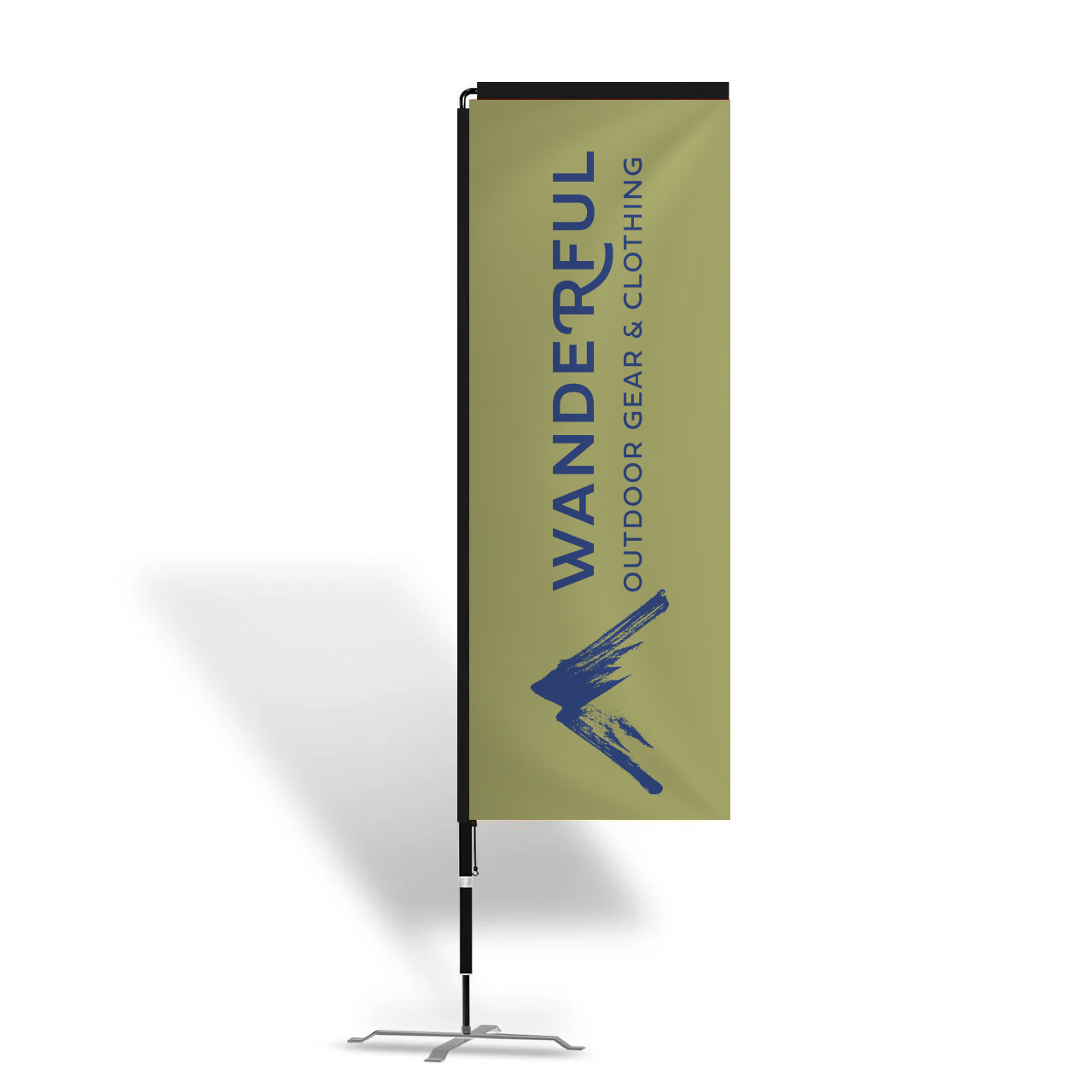
Most bow banner kits ship as sectional fibreglass poles that slot together and thread through a sleeve or attach to a webbing at the top of the fabric. Setup typically takes under five minutes for one person. The fibreglass flex is an asset outdoors: when a gust hits, the pole bends rather than snapping, and the flag returns to shape once the wind eases. All Paperlust bow banners ship as complete kits with carry bag included.
Bow Banner vs. Teardrop vs. Feather Flag: What Is the Difference?
These three flag shapes are often used interchangeably in conversation, but they each have a distinct profile.
Bow Banners
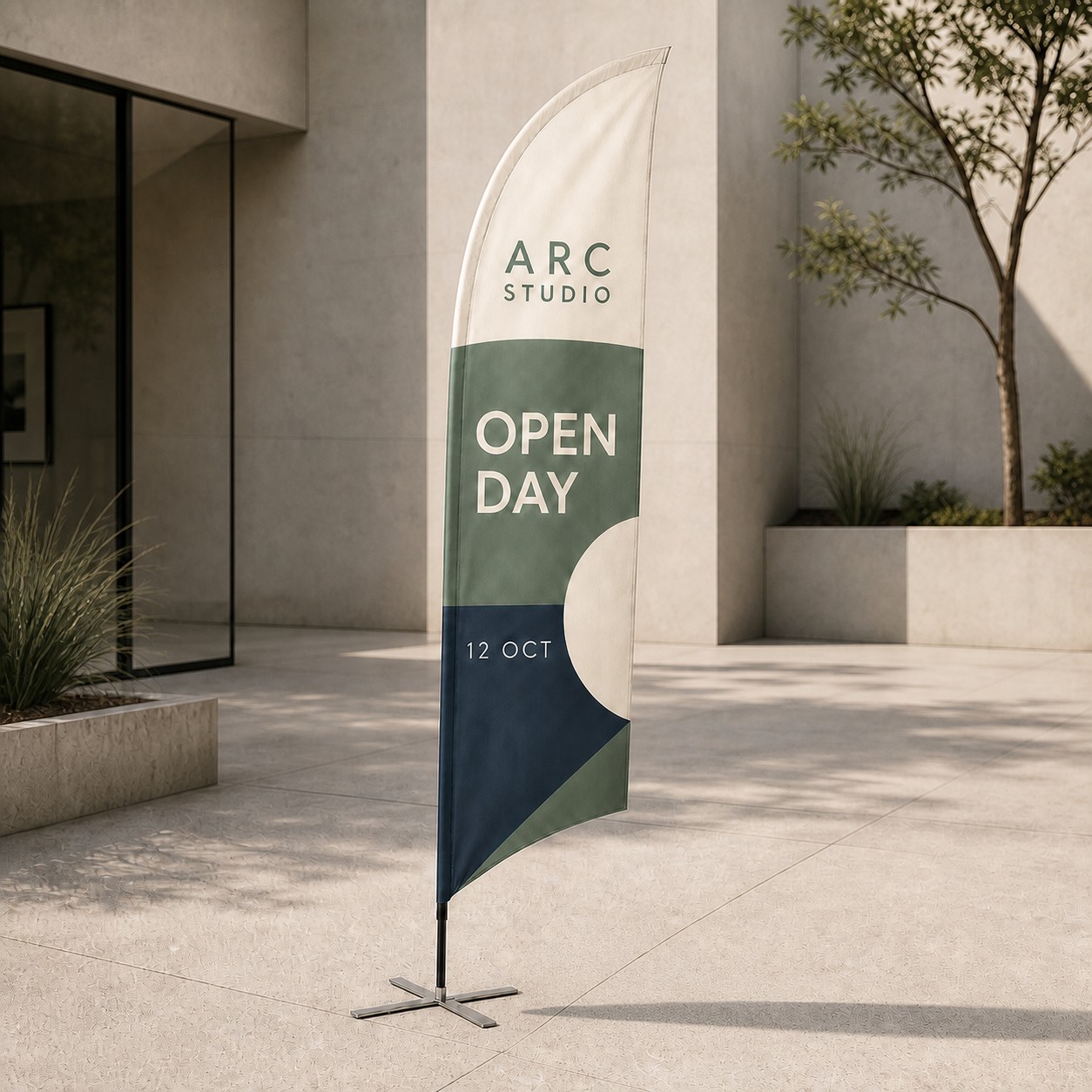
The leading edge curves outward in a smooth arc, creating a crescent-like silhouette from the front. The curve is most pronounced at the top, giving the flag a forward-leaning stance. Bow banners tend to be taller than teardrop flags of comparable printable area, which helps them clear crowd heads and low fencing. The sweeping movement in wind creates a visual signal effect, which works well for attracting foot traffic across distance.
Teardrop Banners
A teardrop flag has a rounded, egg-shaped top that tapers down the leading edge at roughly 45 degrees. The key functional advantage is that the taut teardrop geometry means the fabric almost never wraps around the pole, so your message stays readable even in gusty conditions. If wind stability and consistent legibility are the priority (think a roadside real estate flag or a stadium border flag that runs for hours unattended), teardrop tends to outperform bow on that metric. See our teardrop flags for a full comparison of sizes and specs.
Feather Flags
Feather flags have a nearly straight leading edge with a slight curve, more like a tall narrow rectangle with a pointed top. They maximise printable height for vertical text or portrait logos. The trade-off is that feather flags flutter more freely in wind, which can rotate the face away from the viewer.
| Feature | Bow Banner | Teardrop Banner |
|---|---|---|
| Shape | Curved/arched leading edge | Rounded teardrop top, tapered leading edge |
| Relative height | Taller for same printable area | More compact footprint |
| Wind performance | Movement creates attention; pole flexes | Taut geometry; fabric rarely wraps pole |
| Best use | Brand activation, retail, events | Roadside, long-run outdoor, real estate |
| Aesthetic | Dynamic, forward-leaning | Clean, modern, stable |
Bow Banner Sizes: Which Height Should You Choose?
Paperlust bow banners are available in three core sizes. Pole height is the measurement from ground to tip.
| Size | Pole Height | Best For |
|---|---|---|
| Small | 2500mm | Indoor expos, smaller retail bays, tabletop zones |
| Medium | 3500mm | Forecourt retail, outdoor markets, sports sidelines |
| Large | 4800mm | High-traffic activations, carparks, roadside brand presence |
The medium (3500mm) is the most versatile choice for most commercial applications. It clears crowd heads and vehicle rooflines, photographs well at ground level, and fits through standard roller-door entries when horizontal. The large (4800mm) is the right call for open outdoor sites where you need visibility across 50+ metres, such as a car yard, agricultural show, or road-frontage activation.
For indoor trade show use, the small (2500mm) generally stays within ceiling clearance for most Australian exhibition centres (minimum floor-to-truss is usually 3-3.5m at major venues, but always check your specific event’s height restrictions before ordering the large).
Single-Sided vs. Double-Sided Bow Banners
This is one of the most common questions, and the answer depends on your site and budget.
Single-Sided
Single-sided bow banners are printed on 125gsm trilobal polyester fabric. The image is readable from the front, and a mirror-image ghost appears on the reverse. For most single-direction traffic situations (a shopfront with footpath to the front, a trade stand with visitors approaching from one direction), single-sided is the cost-effective choice and delivers excellent print clarity.
Double-Sided
Double-sided banners use 145gsm blockout fabric: two separately printed panels are sewn back-to-back with an opaque interliner that prevents bleed-through. Each side carries independent artwork, so logos, directional text, and phone numbers read correctly from both directions. Double-sided is the right choice for island sites (a roundabout, a median-strip placement, an outdoor expo island stand), or anywhere traffic approaches from two opposing directions.
The weight difference is marginal in practice; both versions attach to the same pole hardware.
Base and Hardware Options
Every Paperlust bow banner kit ships with a complimentary ground spike, which is suitable for most grass and soft-ground applications. Additional base hardware options cover hard surfaces and higher-wind situations.
Pole, Spike, Bag
A steel spike that drives directly into grass or compacted soil. Lightweight, compact, and the fastest setup. Not suitable for concrete, paving, or decking.
Cross Base + Water Bag
A flat cross-foot base that sits on any hard surface. The attached water bag fills on-site (10-15 litres) to ballast the flag against wind. This is the go-to for shopping centre forecourts, paved outdoor areas, and internal trade stands where ground penetration is not permitted. The water drains for transport and refills at the next location.
Square Base Plate (10kg)
A solid steel base plate, pre-weighted without any fill required. Better for permanent or semi-permanent installations where you do not want to refill the water bag. Also useful when water availability is limited on-site.
For coastal or high-wind sites, the cross base plus water bag is generally preferred over the spike because the cross-foot spreads the load across a wider footprint, reducing the leverage effect of a strong sidewind.
Fabric and Print Quality
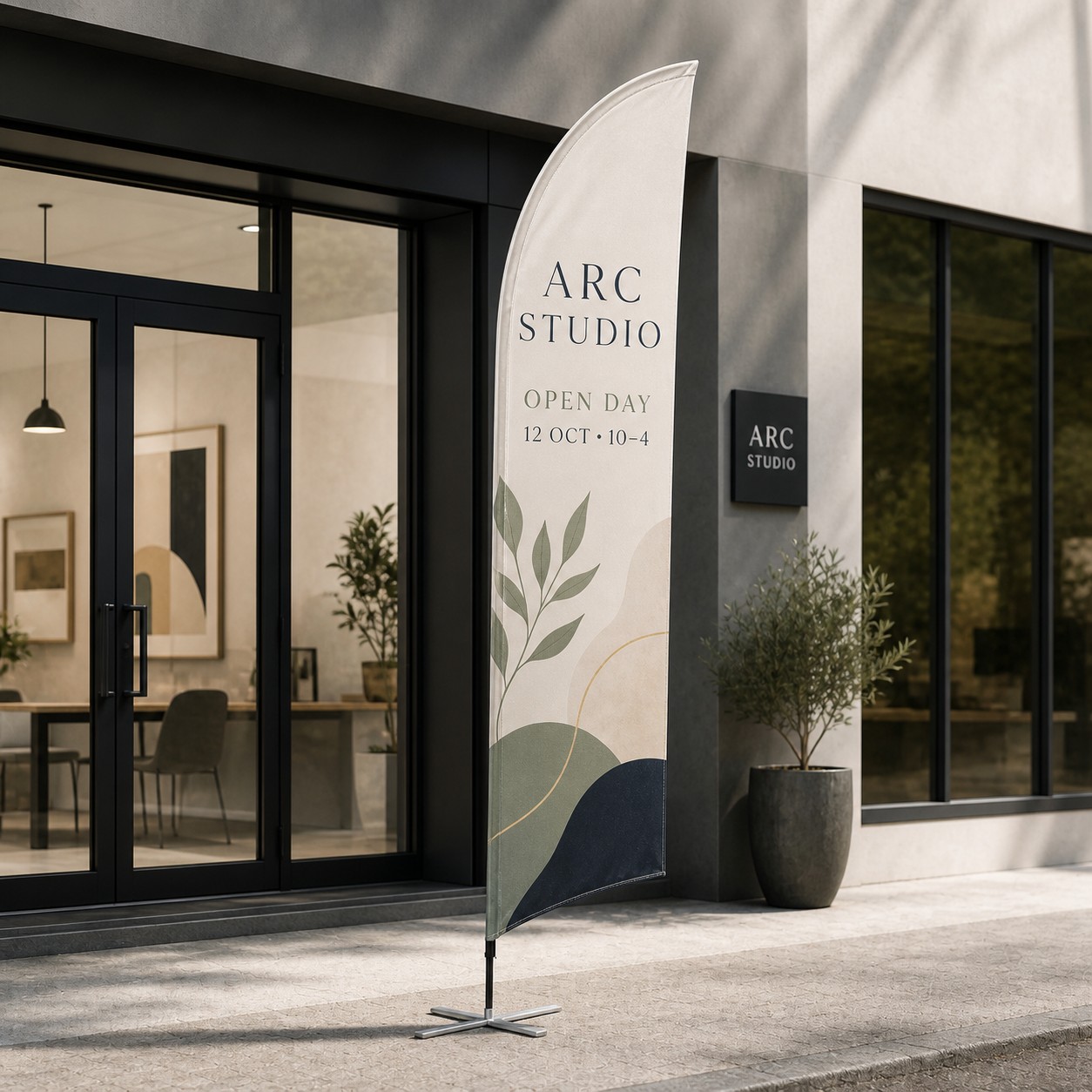
Paperlust bow banners are printed by dye sublimation on polyester fabric. Dye sublimation is the industry standard for soft-signage because the ink becomes part of the fibre rather than sitting on top; there is no layer to peel, crack, or flake.
Key fabric specs:
– Single-sided: 125gsm trilobal polyester
– Double-sided: 145gsm blockout polyester (opaque interliner)
– Poles: fibreglass (rated for coastal/high-wind conditions)
– Print finish: full colour, edge-to-edge, with vivid colour saturation
For artwork, supply print-ready PDF, AI, or EPS files at the correct dimensions with 5mm bleed. PNG or JPG are accepted at minimum 300dpi at final print size. Each order goes through a proof review before production, so you will see your artwork on the actual flag template before anything is printed.
Production and Shipping
Production runs 2-3 working days after artwork approval. All orders ship Australia-wide with flat-rate delivery, and carry bags are included with every complete kit. International shipping is available on request.
If you are ordering for a specific event date, allow at least a week from artwork submission to account for proof rounds, production, and transit.
Use Cases: Where Bow Banners Work Best
Retail and Hospitality
Bow banners are a staple at retail forecourts because they broadcast brand presence before a customer crosses the threshold. A pair of medium flags flanking an entrance doubles visual impact without requiring any fixed installation. The cross-base-plus-water-bag setup means they move between locations (multiple stores, seasonal pop-ups) without tools.
Sports Events and Sponsor Activations
At sports grounds, bow flags perform well along fence lines, behind goals, and at team entry points. Their height means they read over hoardings and temporary structures. Double-sided printing is worthwhile here because spectators approach from both inside and outside the ground.
Expos and Trade Shows
For indoor expo stands, the small or medium bow banner functions as a back-wall height element or stand locator. Combined with a retractable banner and a printed table cloth over the stand’s trestle table, a pair of bow flags turns a basic shell scheme into a branded environment. At the rear or on the returns of that stand, custom printed fabric banners in 610gsm woven outdoor polyester hang smooth without a frame and fold down compactly between events.
Brand Activations and Outdoor Markets
Pop-up brand activations, food and beverage stalls, and outdoor markets are where bow banners earn their keep. They establish territory quickly, signal from a distance, and pack down fast when the event wraps.
How to Set Up a Bow Banner
Assembly takes under five minutes for a single flag once you have done it once.
Step 1: Assemble the Pole
Slot the fibreglass pole sections together in sequence. Each section connects via a push-fit or pin joint; most kits are colour-coded or numbered. Thread the pole through the top webbing loop or sleeve on the flag fabric.
Step 2: Attach the Flag
Slide the fabric sleeve over the pole from the bottom, or clip the flag attachment to the pole depending on your kit’s design. Make sure the fabric tension is even before proceeding.
Step 3: Insert the Pole into the Base
For a ground spike, push and rotate the spike into the ground first, then insert the pole. For a cross base, slot the pole into the base hub and tighten the clamp. Add water to the bag if using the cross base.
Step 4: Tension and Check
Adjust the fabric tension until the bow curve sits symmetrically. Check that the print faces the intended direction and that the base is stable.
FAQs
What is a bow banner?
A bow banner is a tall fabric flag with a curved, arched leading edge created by a tensioned fibreglass pole system. The curved profile pulls the fabric into a sail-like shape that holds its form in wind and creates visible movement. They are commonly used for outdoor brand activations, retail signage, and event marketing.
What is the difference between a bow banner and a teardrop flag?
A bow banner has a sweeping curved leading edge that gives it a dynamic, forward-leaning profile. A teardrop flag has a rounded top that tapers down to a point along the leading edge. Teardrop flags tend to hold their shape more consistently in gusty wind because the tight teardrop geometry prevents the fabric from wrapping the pole. Bow banners are generally taller for a comparable print area and create more movement in a breeze. For a full comparison see our teardrop banners Australia page.
Can I use a bow banner indoors?
Yes. The small (2500mm) and medium (3500mm) sizes suit most Australian exhibition centre ceiling heights. Always check the venue’s maximum height clearance before ordering. Use the cross base or square base plate indoors as ground spikes are not suitable for hard flooring.
What base should I use on concrete or paving?
Use the cross base with water bag or the 10kg square base plate. Both sit on any hard surface without ground penetration. The cross base with water bag (10-15 litres) is better for windy outdoor sites because the filled bag lowers the centre of gravity. The square base plate is more convenient when water access is limited.
How long do bow banners last outdoors?
Expect 6 to 18 months of regular outdoor use. Lifespan depends on sun exposure, wind frequency, and how the flag is stored between uses. Dye-sublimation printing holds colour well under UV. Packing the flag into the carry bag when not in use significantly extends its life.
Do bow banners come with a carry bag?
Yes. Every complete Paperlust bow banner kit includes a carry bag for the flag and poles, making transport between sites straightforward.