Custom Labels
Give plain bottles, jars and packs a look people recognise at a glance, with custom labels printed from your artwork.




Shop by
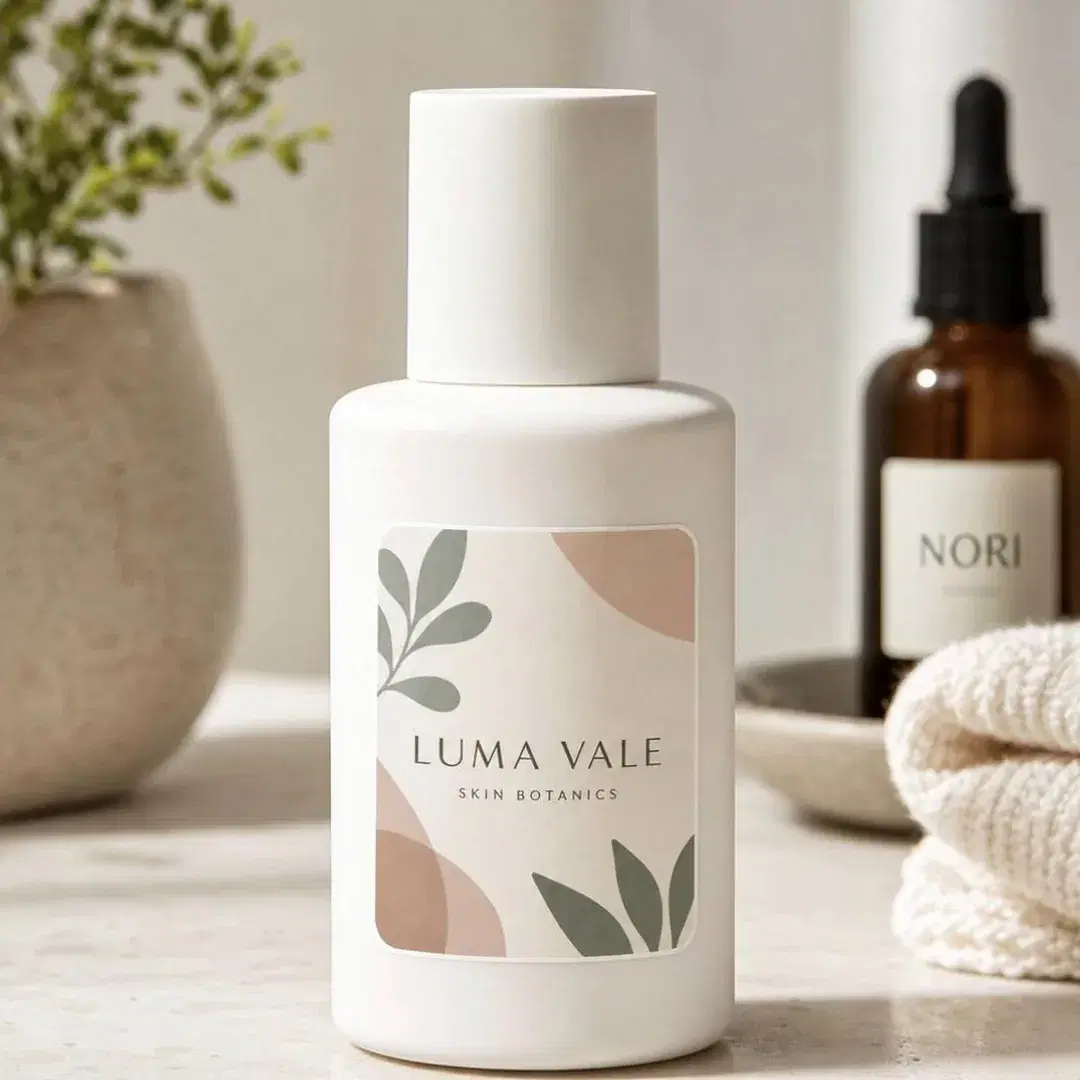
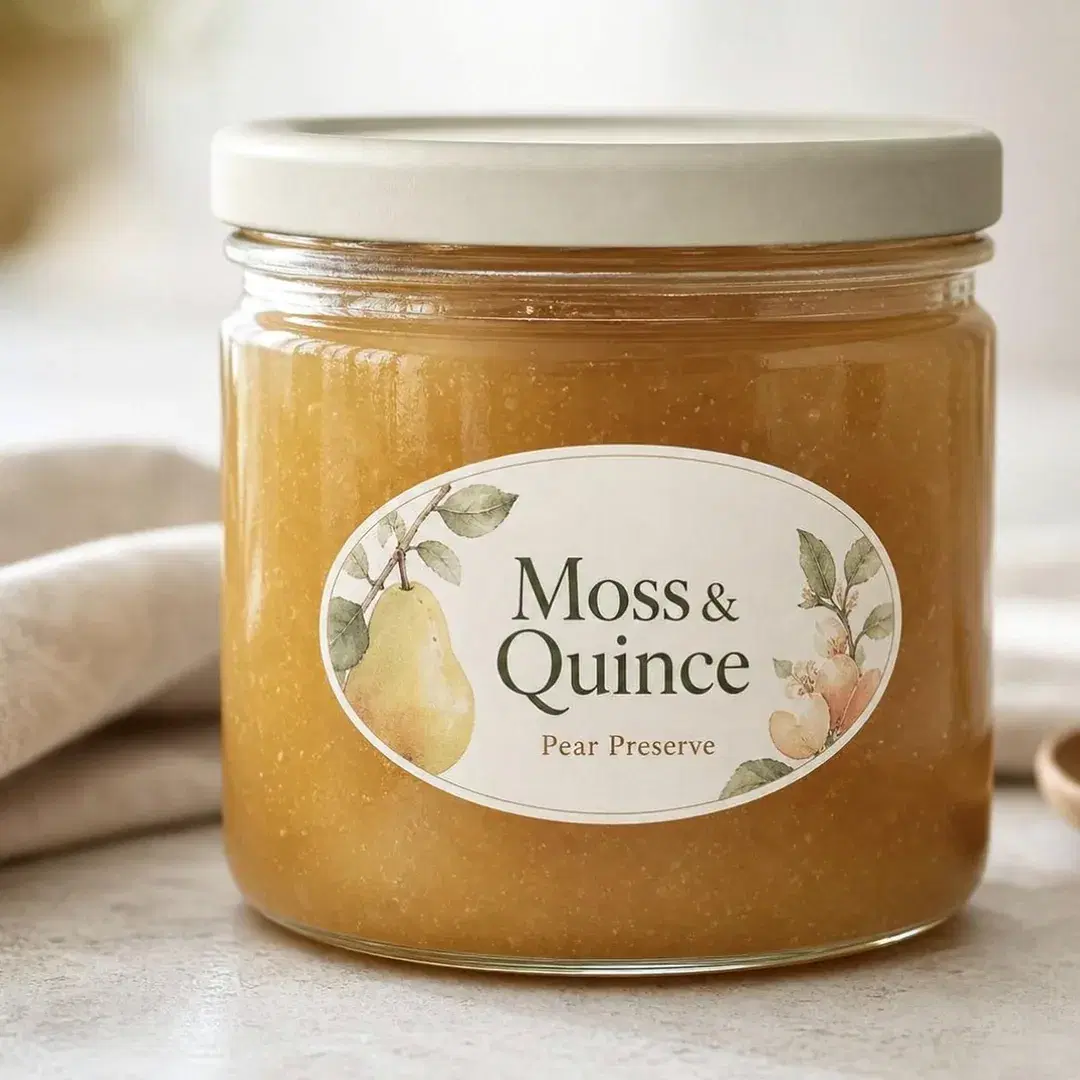
Label Shapes and Sizes
Pick the cut first, then the stock and finish. Every shape prints on white cast paper or white synthetic.
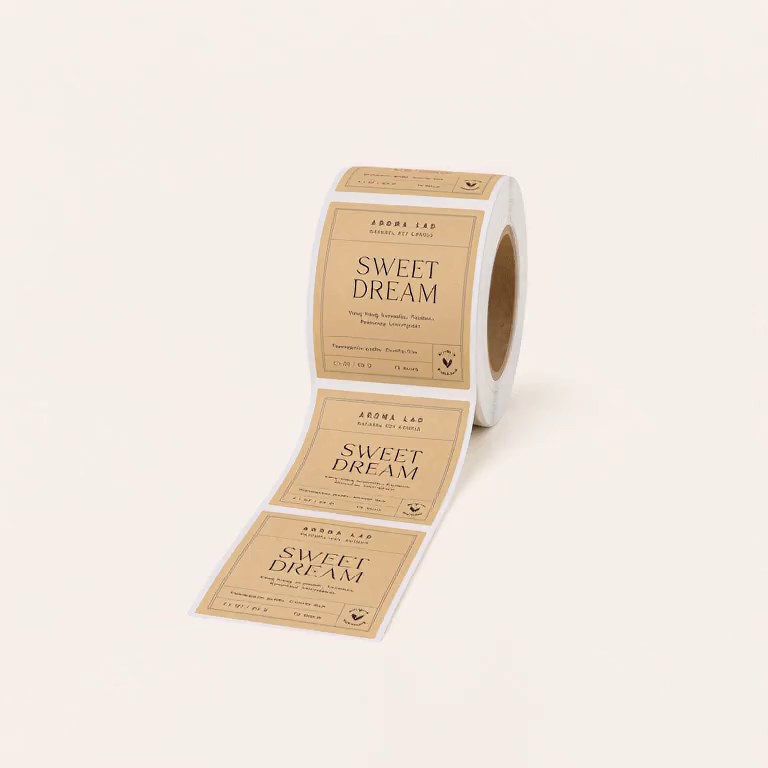
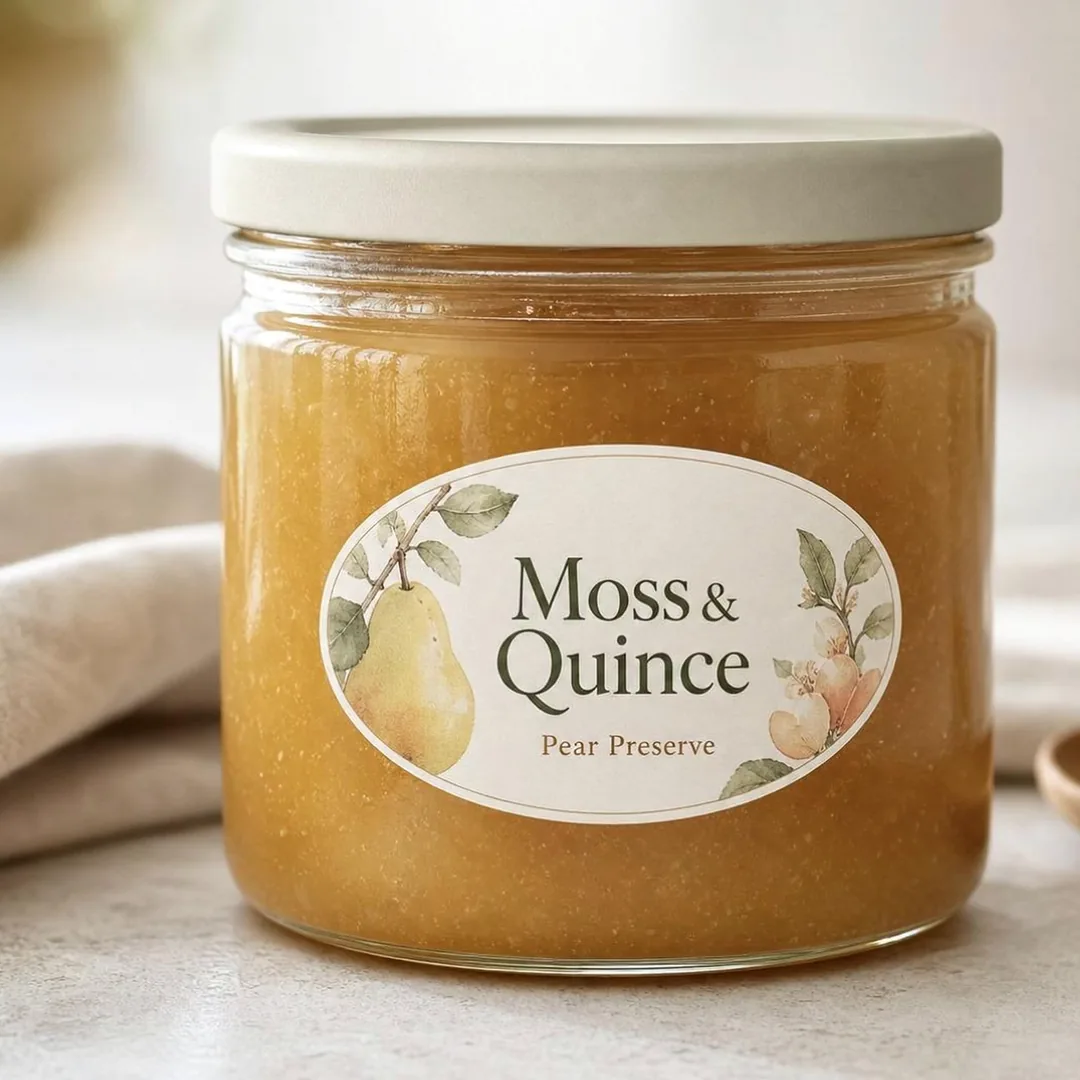
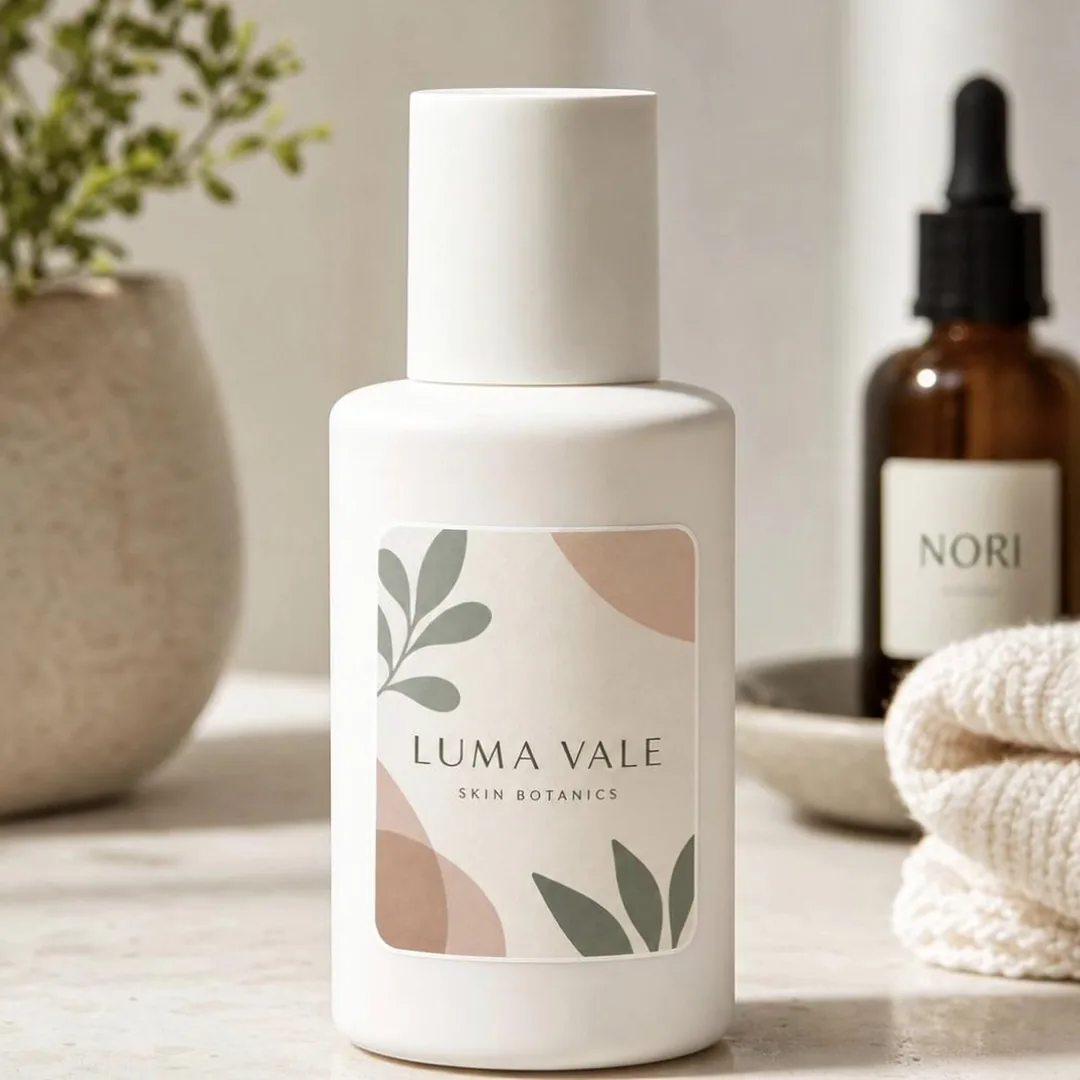
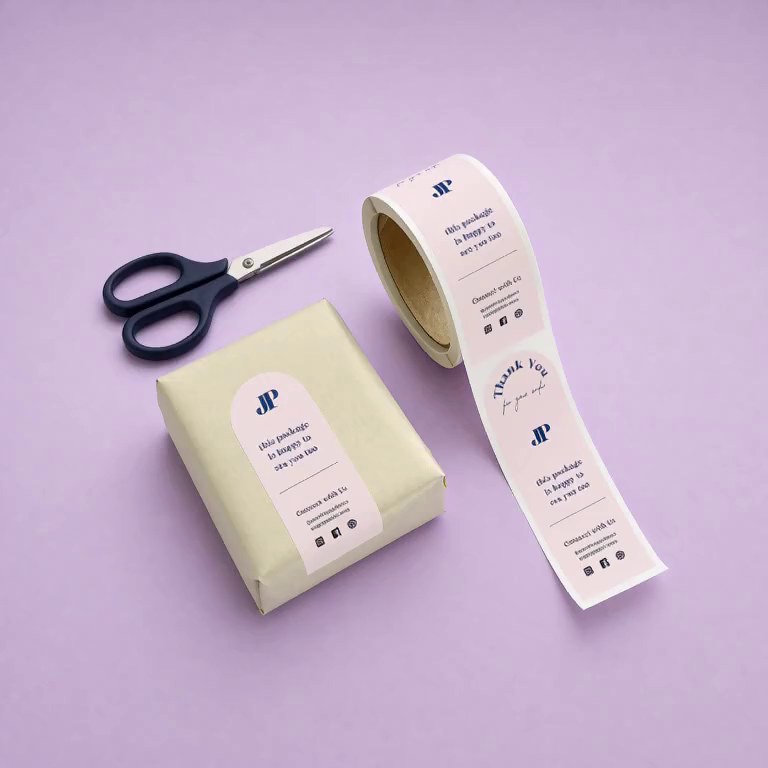
Shop by
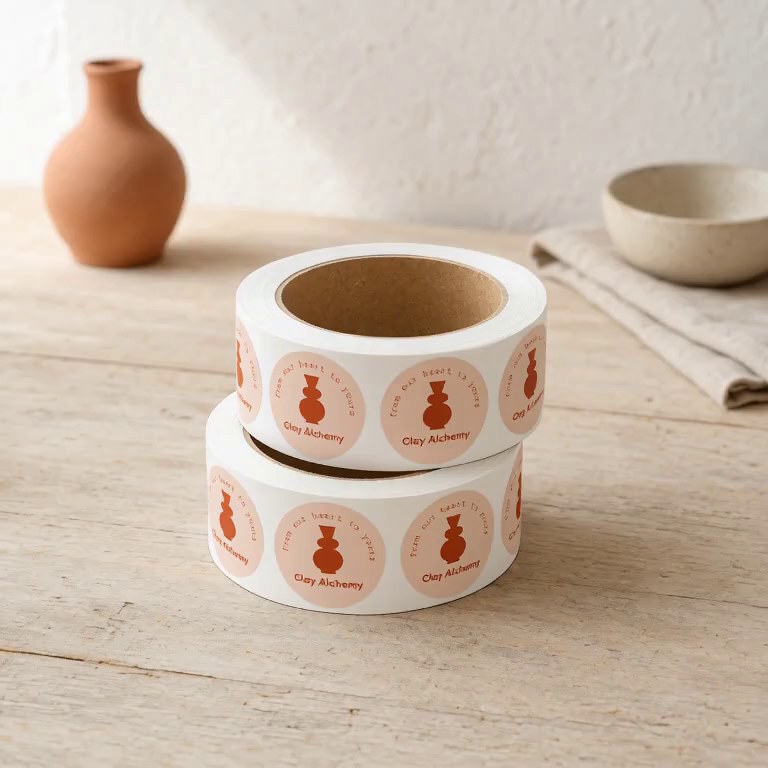
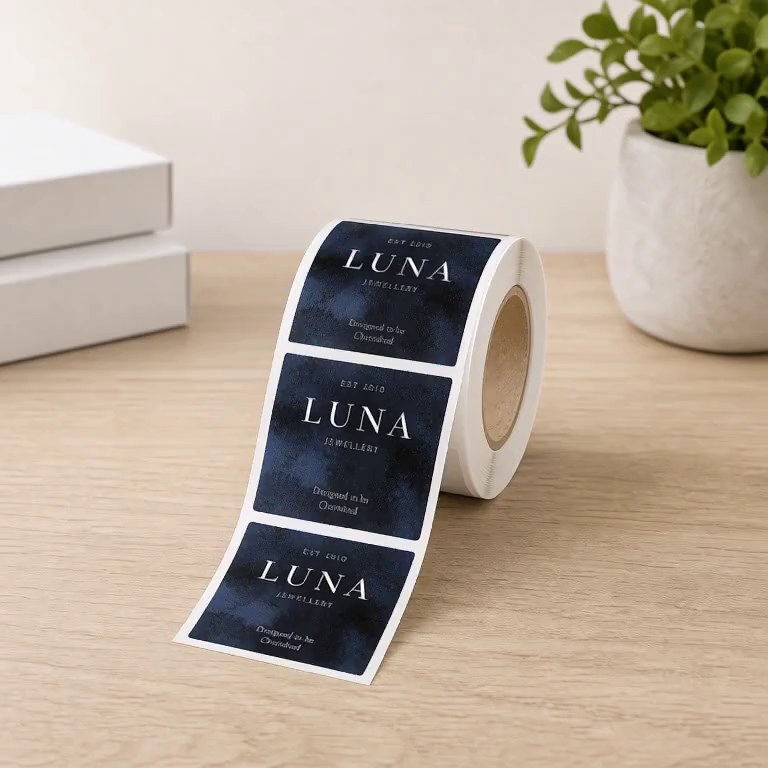
Label Stock
Paper for dry goods, synthetic film for anything that meets water, clear for the no-label look.

Shop by
Finish
Size guide
Label Sizes and Roll Format
| Label | Sizes | Stocks | From, 500 labels |
|---|---|---|---|
| Circle | 30, 40, 50, 60, 75, 90, 100 and 150mm across | White cast paper, white synthetic | $163.02 |
| Square | 30, 40, 50, 60, 75 and 100mm | White cast paper, white synthetic | $163.02 |
| Rectangle | 25 x 50, 25 x 70, 50 x 100, 70 x 40, 70 x 120, 100 x 150mm | White cast paper, white synthetic | $196.50 |
| Oval | 30 x 100, 50 x 100, 75 x 150, 100 x 200mm | White cast paper, white synthetic | $201.59 |
| Rounded corner | 30 x 30, 30 x 100, 50 x 50, 50 x 150, 75 x 75, 75 x 200, 120 x 120mm | White cast paper, white synthetic | $160.16 |
| Custom cut | Your outline, inside the same seven sizes as rounded corner | White cast paper, white synthetic | $160.16 |
| Clear | Eight sizes, 30 x 30 to 120 x 120mm | Clear synthetic, gloss varnish | $223.08 |
| Waterproof vinyl | All six shapes, 20 sizes | White synthetic | $163.02 |
| Foil | Seven sizes, 30 x 30 to 120 x 120mm | Cast paper, synthetic, clear, silver metallic film | $367.60 |
Every label comes on a roll of 500 wound on a 76mm (3 inch) core, with permanent adhesive. Order 500 to 5,000 labels. A second design needs 1,000 labels, up to five designs per order.
Not the right fit?
Fewer Than 500, or More Than 5,000
Under 500 Pieces
Custom stickers start at 50: die cut stickers from $32.00 for 50.
Shop custom stickersHand Applied on a Sheet
Sticker sheets for hand application, from $72.00 for 10 sheets.
Shop sticker sheetsArtwork
Design Help and Artwork Templates
Download a Template
Print-ready templates for every shape and size, with bleed and safe zone marked.
Templates by sizeFree Pre-Press Check
Every order gets a file check and a digital proof. Proofs approved by 8am Melbourne time go into production that day.
How proofing worksWe Can Set It Up
Send a logo and a rough idea and our design team builds the print-ready file, including ingredient panels and barcode placement.
Ask for a set-up quoteReviews
Rated by the People Who Print With Us
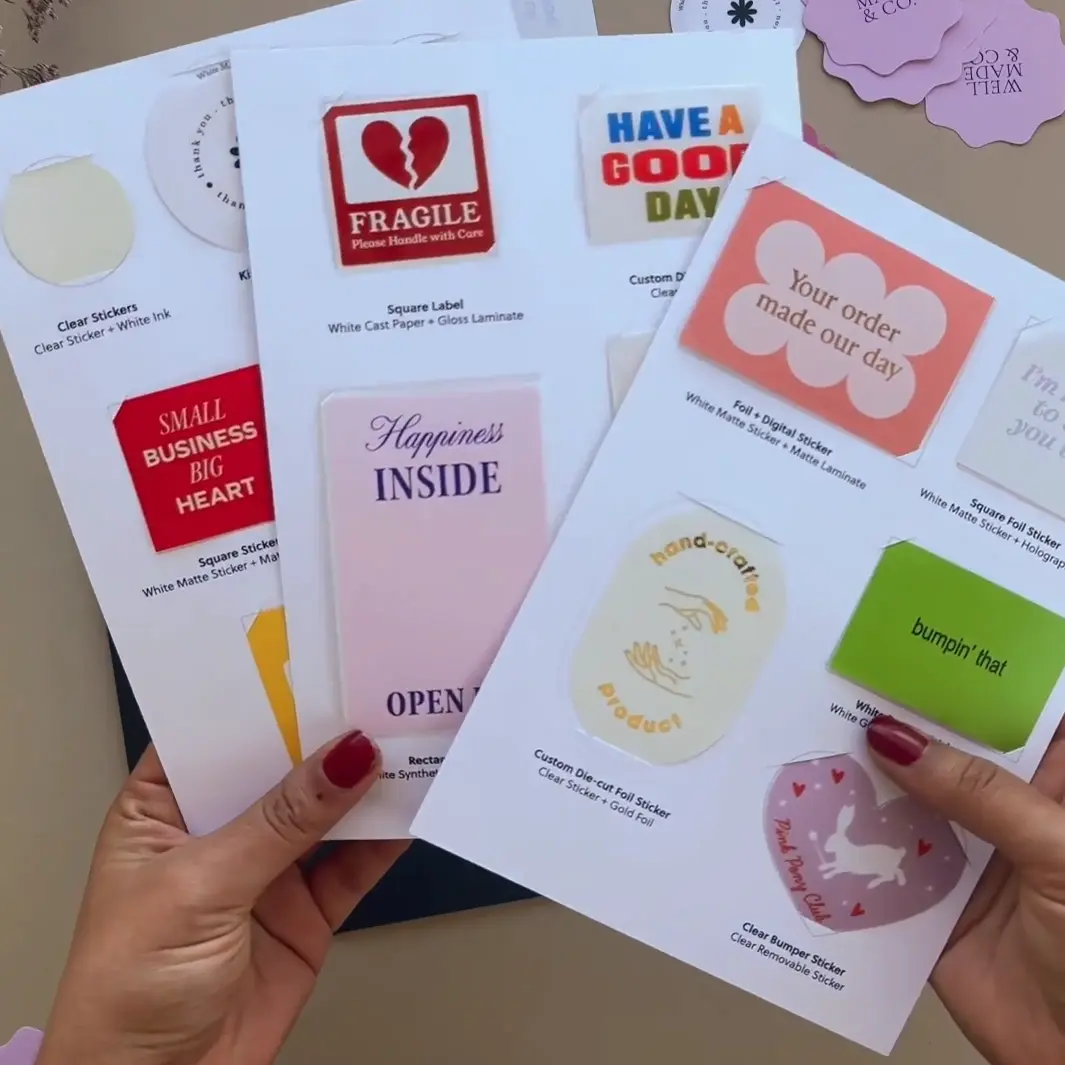
Feel the stock first
Sticker and Label Sample Pack
Printed samples of our custom cut, clear, circle, square, rectangle, rounded corner, oval and foil labels, plus the sticker range, posted Australia wide for $5.00.
Order the Sample PackBefore you print
Australian Labelling Rules by Product
A starting point, not legal advice. Each rule comes from the regulator that owns it, and we print the artwork you supply.
Delivery
Printed in Melbourne, Delivered Australia Wide
Standard delivery is a $10 flat rate, express is $15, and pickup from Oakleigh South is free.
Our commitments
Why Paperlust Print Shop Stands Apart
Quick Turnaround
We take pride in our lightning-fast turnaround times. We understand the importance of deadlines, ensuring your orders are delivered promptly and efficiently.
Dedicated Customer Service
With us, you’re more than just a client; you’re a valued partner. Our dedicated team is here to assist you every step of the way, ensuring your complete satisfaction. Simply reach out via, and we’ll get back to you as quickly as possible
Low Minimum, Wholesale Price
We ensure that you can access high-quality printing services without the burden of large orders, making us the ideal choice for businesses of all sizes.
Die-cut vs kiss-cut, which is right for product labels?
Every label in this category is die-cut and supplied on a roll. Each label is cut to its shape with the surrounding waste stripped away, so it lifts off the liner one at a time, by hand or through a semi-automated applicator.
Kiss-cut is the sticker format: cut through the face stock only, so several pieces sit on one backing sheet. We do not run kiss-cut on this range. If that is the format you want, order from our custom stickers range, which also has no 500 minimum.
Are your custom labels waterproof and fridge-safe?
Synthetic labels, white or clear, are water-resistant and suit fridge, cool room, bath, and short-to-medium outdoor exposure. Once bonded, white synthetic holds a service range of minus 20 to 80 degrees Celsius and clear holds minus 40 to 120, so chilled and frozen retail storage is fine, provided the label goes on at room temperature and not onto an already-frozen container. Cast paper is not water-resistant and is best kept to dry-product use such as pantry goods, gift wrap, candle vessels, and apothecary tinctures. We do not recommend any of the stocks for dishwasher cycling.
What is the minimum order quantity for custom labels?
One roll of 500 labels. Every label in this category is supplied on a roll and 500 labels is a single roll, so that is the minimum for any size, shape, or material.
Larger runs are ordered as additional rolls on the same job and the unit cost drops as the roll count rises. The exact tier breaks are listed on each product page, and the live calculator at quote stage shows the unit and total cost for every quantity step. If 500 is more than you need, our die-cut stickers give you the same custom shapes with no 500 minimum.
How long does production take?
Most label orders are produced within 48 hours when the design proof is approved by 8am Melbourne time, then released for shipment the following business day. Foil labels take 4 to 5 working days after proof approval; we confirm the exact timeline on the digital proof before printing.
If you have a hard deadline (product launch, event date, retail rollout), flag it at order stage and our team will confirm whether the spec hits the timeline before you commit.
Can you print to a custom shape?
Yes, custom shapes are standard for die-cut labels. Upload your shape file (vector preferred, AI or EPS) with the order, or include a clearly defined cut path on a PDF. Our pre-press team confirms the shape on the digital proof before printing.
For shapes with very fine internal detail or narrow connecting bridges, our team will advise on the minimum stroke width that survives the cutter cleanly.
What artwork file formats do you accept?
Vector formats are preferred: AI, EPS, PDF, or SVG, with all fonts outlined and at 100% scale. We also accept high-resolution PNG and TIFF files at 300 DPI minimum at print size.
RGB files are converted to CMYK for press; we flag any colour-shift risk on the digital proof. If your artwork is below resolution, missing bleed, or carries an unreadable barcode, our pre-press team contacts you before production starts.
What sizes do you offer?
Standard sizes range from small 25mm round seals through to large A4 single-piece die-cuts, with custom sizing available across the range. Most product label sizes between 50mm and 150mm are stocked sizes; outside that range we set up to your exact dimensions.
For sizing recommendations by container type (bottle, jar, pouch, tin, mailer) the size guide on each product page lists the most common label-to-container ratios.
How much do custom labels cost?
Pricing scales by material, finish, size, quantity, and shape complexity. A synthetic rectangle works out to a few cents per label at bulk volume; foil and specialty finishes carry a small per-unit premium. The most accurate quote is the live calculator on each product page.
Volume pricing favours brands ordering in retail-rollout quantities. Pricing starts at one roll of 500 labels and the unit cost falls as you add rolls to the order.
Will the labels fade or peel over time?
Cast paper labels hold colour for years indoors where the stock stays dry. Synthetic with a laminate resists water, oil, and scuffing, and carries a service range of minus 20 to 80 degrees Celsius once bonded.
Every stock in the range uses a permanent adhesive. Once cured, removal needs heat or a citrus-based solvent and the label is not designed to peel away cleanly, so treat placement as final. We do not offer a removable grade.
Can I see a sample or get a digital proof first?
Every order receives a digital proof before printing, you sign off on colour, sizing, cut path, panel layout, and copy before we go to press. Physical sample packs of common label substrates are available on request for first-time orders or large-volume tenders.
For premium retail launches we recommend ordering a small physical proof run before committing to the full retail quantity, especially when foil or specialty finishes are part of the spec.
Do you offer label design or templating help?
Yes, if you have a logo or rough concept, our design team can build print-ready label artwork for a small additional fee, including ingredient-panel layout, barcode placement, and panel hierarchy on bottle and pouch labels.
We also provide blank templates for common label shapes and sizes; download from the relevant product page or contact our team and we will send the format that matches your container.
What adhesive do your labels use?
Permanent, on every stock. Cast paper runs a rubber-based hot melt adhesive, white synthetic runs an emulsion acrylic, and clear synthetic runs a general-purpose acrylic. There is no removable, freezer-grade, high-tack, or food-contact grade to select, so the spec decision is material and finish. Apply cast paper at 0 degrees Celsius or above, white synthetic at 5 degrees Celsius or above, and clear down to minus 5. After bonding, cast paper holds minus 40 to 70 degrees Celsius, white synthetic minus 20 to 80, and clear minus 40 to 120, which covers chilled and frozen storage. We do not certify regulatory or food-contact compliance.
Do your labels come on rolls or sheets?
Rolls. Every label in this category is supplied on a roll wound on a standard 76mm, 3 inch, core, which suits hand application and semi-automated applicators alike. Custom sticker rolls are the same product as the roll labels in this category. We do not supply this range as flat or kiss-cut sheets.
If you need sheets or single hand-applied pieces, our custom stickers range is the better fit.
What is the difference between labels and stickers?
Labels are supplied on rolls with a liner, made for dispensers, applicators and packaging lines at volume. Stickers are individual die-cut or kiss-cut pieces, or sheets, applied by hand at lower minimums. If you need hand-applied pieces, see our custom stickers range.
What is the difference between pre-printed labels and thermal labels?
Pre-printed labels are printed in full during manufacture with your artwork, colours and finish, ready to apply. Thermal labels are blank rolls you print in-house for barcodes, dates or variable data. The labels on this page are custom pre-printed labels.
What size core are your label rolls wound on?
Our custom labels are supplied on a standard 76mm (3 inch) core, which fits the most common benchtop and inline label dispensers and applicators. If your applicator needs a different core size, let us know when you order and we will confirm what we can accommodate.
Do you provide a proof before printing my labels?
Yes. Once you place your order and upload artwork, we prepare a digital proof within one to two business days so you can check size, colour and layout. Your order includes two rounds of revisions, and printing only begins once you approve the proof.
Can I design my own labels online?
Yes. Upload a print-ready PDF, AI or EPS file, or download a blank template for your shape and size from the product page and create the artwork inside it.
If you would rather not do it yourself, our design team can build print-ready label artwork from a logo or a rough concept for a small additional fee.
How do I order labels online?
Pick the shape you need, set the size, stock, finish and quantity on that product page, and the calculator shows the unit price and the total before you buy. Artwork is uploaded with the order.
A free pre-press file check runs within one business day and a digital proof follows within one to two. Printing starts only once you approve that proof, and production takes 48 hours when the proof is approved by 8am Melbourne time.
Frequently Asked Questions
Die-cut vs kiss-cut, which is right for product labels?
Every label in this category is die-cut and supplied on a roll. Each label is cut to its shape with the surrounding waste stripped away, so it lifts off the liner one at a time, by hand or through a semi-automated applicator.
Kiss-cut is the sticker format: cut through the face stock only, so several pieces sit on one backing sheet. We do not run kiss-cut on this range. If that is the format you want, order from our custom stickers range, which also has no 500 minimum.
Are your custom labels waterproof and fridge-safe?
Synthetic labels, white or clear, are water-resistant and suit fridge, cool room, bath, and short-to-medium outdoor exposure. Once bonded, white synthetic holds a service range of minus 20 to 80 degrees Celsius and clear holds minus 40 to 120, so chilled and frozen retail storage is fine, provided the label goes on at room temperature and not onto an already-frozen container. Cast paper is not water-resistant and is best kept to dry-product use such as pantry goods, gift wrap, candle vessels, and apothecary tinctures. We do not recommend any of the stocks for dishwasher cycling.
What is the minimum order quantity for custom labels?
One roll of 500 labels. Every label in this category is supplied on a roll and 500 labels is a single roll, so that is the minimum for any size, shape, or material.
Larger runs are ordered as additional rolls on the same job and the unit cost drops as the roll count rises. The exact tier breaks are listed on each product page, and the live calculator at quote stage shows the unit and total cost for every quantity step. If 500 is more than you need, our die-cut stickers give you the same custom shapes with no 500 minimum.
How long does production take?
Most label orders are produced within 48 hours when the design proof is approved by 8am Melbourne time, then released for shipment the following business day. Foil labels take 4 to 5 working days after proof approval; we confirm the exact timeline on the digital proof before printing.
If you have a hard deadline (product launch, event date, retail rollout), flag it at order stage and our team will confirm whether the spec hits the timeline before you commit.
Can you print to a custom shape?
Yes, custom shapes are standard for die-cut labels. Upload your shape file (vector preferred, AI or EPS) with the order, or include a clearly defined cut path on a PDF. Our pre-press team confirms the shape on the digital proof before printing.
For shapes with very fine internal detail or narrow connecting bridges, our team will advise on the minimum stroke width that survives the cutter cleanly.
What artwork file formats do you accept?
Vector formats are preferred: AI, EPS, PDF, or SVG, with all fonts outlined and at 100% scale. We also accept high-resolution PNG and TIFF files at 300 DPI minimum at print size.
RGB files are converted to CMYK for press; we flag any colour-shift risk on the digital proof. If your artwork is below resolution, missing bleed, or carries an unreadable barcode, our pre-press team contacts you before production starts.
What sizes do you offer?
Standard sizes range from small 25mm round seals through to large A4 single-piece die-cuts, with custom sizing available across the range. Most product label sizes between 50mm and 150mm are stocked sizes; outside that range we set up to your exact dimensions.
For sizing recommendations by container type (bottle, jar, pouch, tin, mailer) the size guide on each product page lists the most common label-to-container ratios.
How much do custom labels cost?
Pricing scales by material, finish, size, quantity, and shape complexity. A synthetic rectangle works out to a few cents per label at bulk volume; foil and specialty finishes carry a small per-unit premium. The most accurate quote is the live calculator on each product page.
Volume pricing favours brands ordering in retail-rollout quantities. Pricing starts at one roll of 500 labels and the unit cost falls as you add rolls to the order.
Will the labels fade or peel over time?
Cast paper labels hold colour for years indoors where the stock stays dry. Synthetic with a laminate resists water, oil, and scuffing, and carries a service range of minus 20 to 80 degrees Celsius once bonded.
Every stock in the range uses a permanent adhesive. Once cured, removal needs heat or a citrus-based solvent and the label is not designed to peel away cleanly, so treat placement as final. We do not offer a removable grade.
Can I see a sample or get a digital proof first?
Every order receives a digital proof before printing, you sign off on colour, sizing, cut path, panel layout, and copy before we go to press. Physical sample packs of common label substrates are available on request for first-time orders or large-volume tenders.
For premium retail launches we recommend ordering a small physical proof run before committing to the full retail quantity, especially when foil or specialty finishes are part of the spec.
Do you offer label design or templating help?
Yes, if you have a logo or rough concept, our design team can build print-ready label artwork for a small additional fee, including ingredient-panel layout, barcode placement, and panel hierarchy on bottle and pouch labels.
We also provide blank templates for common label shapes and sizes; download from the relevant product page or contact our team and we will send the format that matches your container.
What adhesive do your labels use?
Permanent, on every stock. Cast paper runs a rubber-based hot melt adhesive, white synthetic runs an emulsion acrylic, and clear synthetic runs a general-purpose acrylic. There is no removable, freezer-grade, high-tack, or food-contact grade to select, so the spec decision is material and finish. Apply cast paper at 0 degrees Celsius or above, white synthetic at 5 degrees Celsius or above, and clear down to minus 5. After bonding, cast paper holds minus 40 to 70 degrees Celsius, white synthetic minus 20 to 80, and clear minus 40 to 120, which covers chilled and frozen storage. We do not certify regulatory or food-contact compliance.
Do your labels come on rolls or sheets?
Rolls. Every label in this category is supplied on a roll wound on a standard 76mm, 3 inch, core, which suits hand application and semi-automated applicators alike. Custom sticker rolls are the same product as the roll labels in this category. We do not supply this range as flat or kiss-cut sheets.
If you need sheets or single hand-applied pieces, our custom stickers range is the better fit.
What is the difference between labels and stickers?
Labels are supplied on rolls with a liner, made for dispensers, applicators and packaging lines at volume. Stickers are individual die-cut or kiss-cut pieces, or sheets, applied by hand at lower minimums. If you need hand-applied pieces, see our custom stickers range.
What is the difference between pre-printed labels and thermal labels?
Pre-printed labels are printed in full during manufacture with your artwork, colours and finish, ready to apply. Thermal labels are blank rolls you print in-house for barcodes, dates or variable data. The labels on this page are custom pre-printed labels.
What size core are your label rolls wound on?
Our custom labels are supplied on a standard 76mm (3 inch) core, which fits the most common benchtop and inline label dispensers and applicators. If your applicator needs a different core size, let us know when you order and we will confirm what we can accommodate.
Do you provide a proof before printing my labels?
Yes. Once you place your order and upload artwork, we prepare a digital proof within one to two business days so you can check size, colour and layout. Your order includes two rounds of revisions, and printing only begins once you approve the proof.
Can I design my own labels online?
Yes. Upload a print-ready PDF, AI or EPS file, or download a blank template for your shape and size from the product page and create the artwork inside it.
If you would rather not do it yourself, our design team can build print-ready label artwork from a logo or a rough concept for a small additional fee.
How do I order labels online?
Pick the shape you need, set the size, stock, finish and quantity on that product page, and the calculator shows the unit price and the total before you buy. Artwork is uploaded with the order.
A free pre-press file check runs within one business day and a digital proof follows within one to two. Printing starts only once you approve that proof, and production takes 48 hours when the proof is approved by 8am Melbourne time.
Learn More
Labels or Stickers? How to Tell Them Apart
Labels are supplied on rolls with a liner backing, made for dispensers, applicators and packaging lines at volume. If you are looking for custom sticker rolls, this is the right category, because every label here is printed, cut and supplied on a roll. Stickers are individual pieces or sheets applied by hand at lower minimums. If you want single hand-applied pieces, our custom stickers range is the better fit.
Choose Your Label Shape
Pick the cut shape first, then layer material and finish on top. Each shape links to its own product page with pricing and options:
- Circle labels for jars, candles, lids and brand seals.
- Square labels for boxes, cosmetics and gift sets.
- Rectangle labels for bottles, info panels and shipping.
- Oval labels for artisan food, preserves and wine.
- Die-cut labels for custom-shape hero labels and premium packaging.
- Clear labels for the no-label look on glass and cosmetics.
- Foil labels for premium retail, wine, spirits and beauty.
Custom Pre-Printed Labels vs Blank Thermal Labels
The labels on this page are custom pre-printed labels: your artwork, colours and finish are printed in full during manufacture, so every roll arrives ready to apply. Blank thermal labels are unprinted rolls that you print in-house on a thermal printer for barcodes, expiry dates or variable data. Many brands use both, pre-printed labels for the branded front-of-pack, thermal for the changing back-of-pack detail.
Custom Labels for Product Packaging, Food & Beverage, and Brand Seals
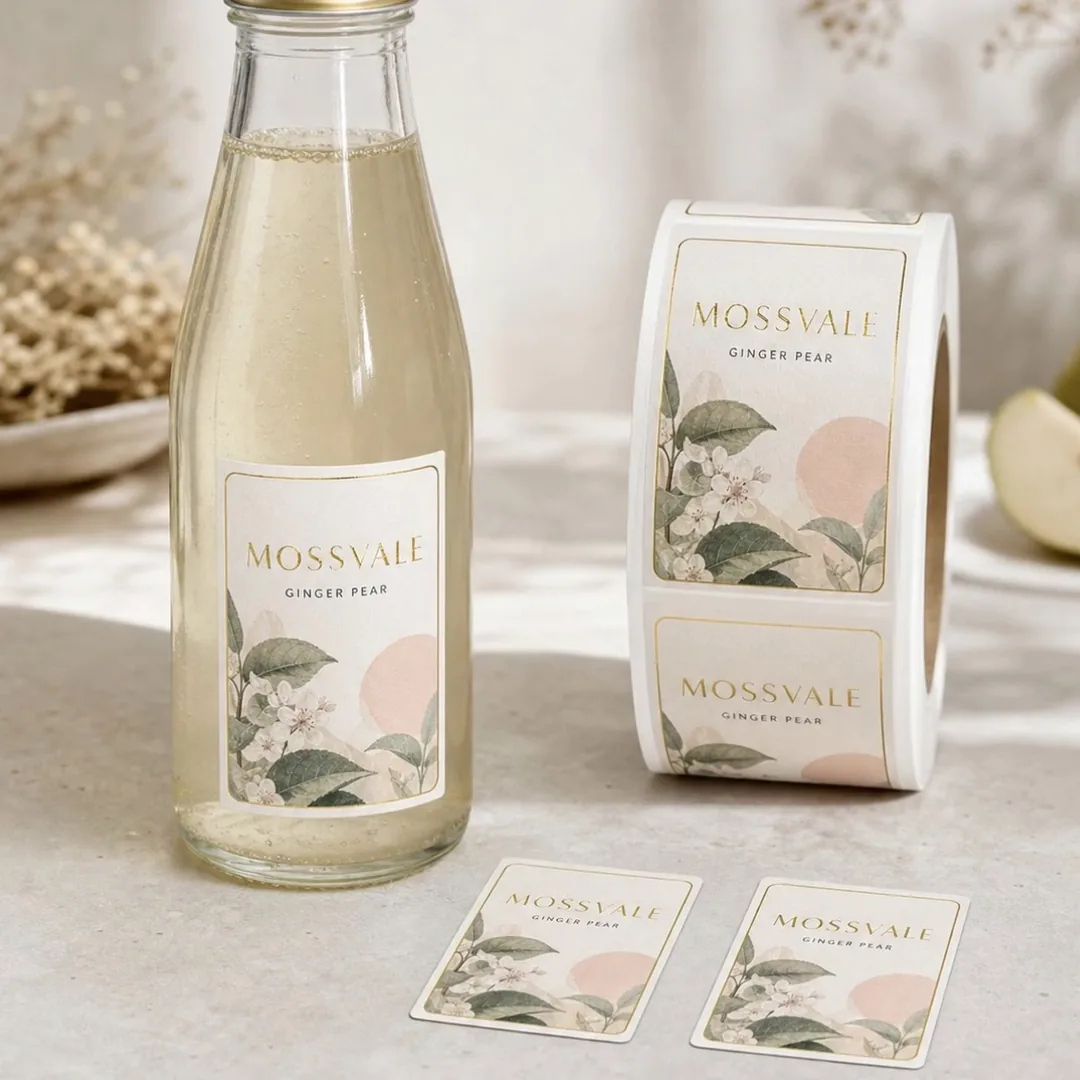
Our custom labels are printed in Australia on three base stocks, bright white cast paper, water-resistant synthetic film, often called vinyl, and clear synthetic film, with foil accents available across the range, engineered to bond cleanly to bottles, jars, tins, pouches, candle vessels, cosmetic packaging, soap wraps, apparel hang tags, and shipping cartons. Where a sticker is often a loose hand-out, a label has a job: it has to identify the product, carry the brand, survive the shelf, and in many cases pass through a fridge, a cool room, a bath, or a courier scan without lifting or fading.
The range covers eight cut and finish families, circle, rectangle, square, oval, rounded-corner, custom die-cut, clear, and foil, supplied on rolls wound on a 76mm core, ready for hand or semi-automated application. Every order ships with a free pre-press file check, a digital proof for sign-off, and a minimum of one roll, 500 labels, which suits indie food and skincare brands and small-batch product launches. Bulk pricing tiers kick in fast for retail rollouts, subscription-box programs, and corporate logistics labelling. If you are still weighing the substrate, the complete guide to label and sticker types walks through every option side by side.
The three levers that drive a great label order, material, finish, and cut style, are explained in the sections below. Every stock runs the same permanent adhesive, so there is no adhesive grade to choose. Pick the material first; the rest cascades from there. For brands shipping product to customers, the product packaging label playbook is worth a read before you choose.
Shop Custom Labels by Shape
Shape sets the visual signature of your label and constrains the artwork layout. The eight shape families on the page below cover almost every packaging brief; pick the cut style first, then layer material and finish on top.
Circle and Oval: the classic seal and jar profiles
Circle labels are the default for jar lids, candle vessels, soap rounds, beer caps, brand seals on mailers, and the closing sticker on tissue-wrapped orders. The geometry centres the brand mark cleanly and reads as a stamp of authenticity. Oval labels work where the package face is wider than tall, skincare bottles, hot-sauce labels, beer and wine front panels, and apothecary tinctures. Both shapes suit centred wordmarks and round-radius logos better than rectangles do. Under that seal, the tissue can be custom printed tissue paper, so the closing sticker and the wrap read as one branded piece.
Rectangle and Square: the workhorse for ingredient panels and product faces
Rectangle labels carry the bulk of the world's product packaging. The geometry suits wraparound bottle labels, ingredient panels, nutrition tables, side-of-box brand statements, and rectangular cosmetic tubes. Square labels are the default for box-top seals, gift packaging, candle bases, and Instagram-friendly packaging where the symmetry photographs cleanly. Both stocks accept dense typography and barcodes without crowding.
Rounded-Corner: softer than square, more durable than sharp-edge
Rounded-corner labels are a small geometry choice with a big functional payoff. The radiused corners do not lift on contact the way 90-degree corners can after a few months of bag-jostle, fridge-door knock, or shelf-handling. Designers also prefer the softer silhouette for cosmetic, wellness, and craft food brands where a hard corner reads as too industrial. Available across cast paper and synthetic stocks, with foil accents optional.
Die-Cut: cut to the exact silhouette of your brand mark
Die-cut labels are cut to the precise outline of your artwork, logo silhouette, illustrated character, custom badge shape, with no surrounding white border. The format is the strongest fit for brand seals, hang-tag stickers, fruit and produce labels, and any packaging element where the shape itself is the logo. The die-cut vs kiss-cut breakdown explains when to choose each cut style, in short, die-cut labels come off the roll one at a time, while kiss-cut is a sticker-sheet format rather than a label format.
Clear and Foil: the finish-driven specialty options
Clear labels print on a clear polypropylene film so the package surface shows through, which is why they are the default for glass bottles, see-through cosmetic jars, premium spirit packaging, and minimal-design skincare where the formula colour is part of the brand story. Clear runs the same permanent adhesive as the white stocks and holds minus 40 to 120 degrees Celsius once bonded, the widest service range in the line. The full spec is in our clear label and sticker guide. Foil labels add reflective gold, silver, or rose gold to logos, borders, or entire label faces, the highest perceived-value finish in the range, and the format that defines premium product launches. The foil label production guide covers artwork prep and the cost premium honestly.
Material Comparison at a Glance
Side-by-side spec table for the label material families on this page. Use this as a quick filter before drilling into the deeper sections.
| Spec | White Cast Paper | White Synthetic (often called vinyl) | Clear Synthetic | Foil-Accented |
|---|---|---|---|---|
| Water resistance | Low, pantry, dry-goods, gift-wrap only | High, fridge, cool room, bath, splash | High, fridge, cool room, condensation, splash | High on a synthetic or clear base, low on cast paper |
| Best brand fit | Craft, artisan food, candle, soap, apothecary | Skincare, beverage, chilled and frozen product | Glass bottles, serums and oils, spirits, minimal skincare | Premium launches, wine and spirits, gifting |
| Finish look | Soft matte, tactile, handmade signal | Gloss or matte laminate, or gloss or matte varnish | Transparent face, the no-label look, gloss or matte varnish | Reflective metallic accent on logo or full face |
| Surface compatibility | Smooth glass, card, paperboard, tin | Glass, plastic, metal, painted, curved bottle | Glass, clear plastic, curved bottles, smooth painted surfaces | As per the underlying base stock |
| Adhesive | Permanent, the only grade offered | Permanent, the only grade offered | Permanent, the only grade offered | Permanent, same as the base stock |
| Service temperature, once bonded | Minus 40 to 70 degrees Celsius | Minus 20 to 80 degrees Celsius | Minus 40 to 120 degrees Celsius | As per the underlying base stock |
| Cost tier | Standard, lowest unit cost | Standard to mid, small premium for laminate | Mid, priced above the white stocks | Premium, small per-unit add for foil layer |
Custom Labels by Industry and Use
This hub is organised by shape and material, but custom labels are also grouped by the object being labelled in the product labels category, with more use pages to be added. Everything other than bottles, candles and jars is ordered from this page.
Food & Beverage
Beer, spirit, sauce, oil and drink bottles go to wine and bottle labels, honey, jam and preserves go to honey and jam labels, spreads and other jar products go to jar labels, and pouch labels for granola, coffee and tea take synthetic film for cold-chain products or white cast paper for dry goods.
Cosmetic & Beauty
Skincare bottles, serum droppers, lipstick bases and palette seals are the typical items. Clear synthetic film suits serums and oils, foil accents suit premium repositioning, and synthetic film suits sheet masks and refrigerated displays after room-temperature application.
Candle, Soap, and Apothecary
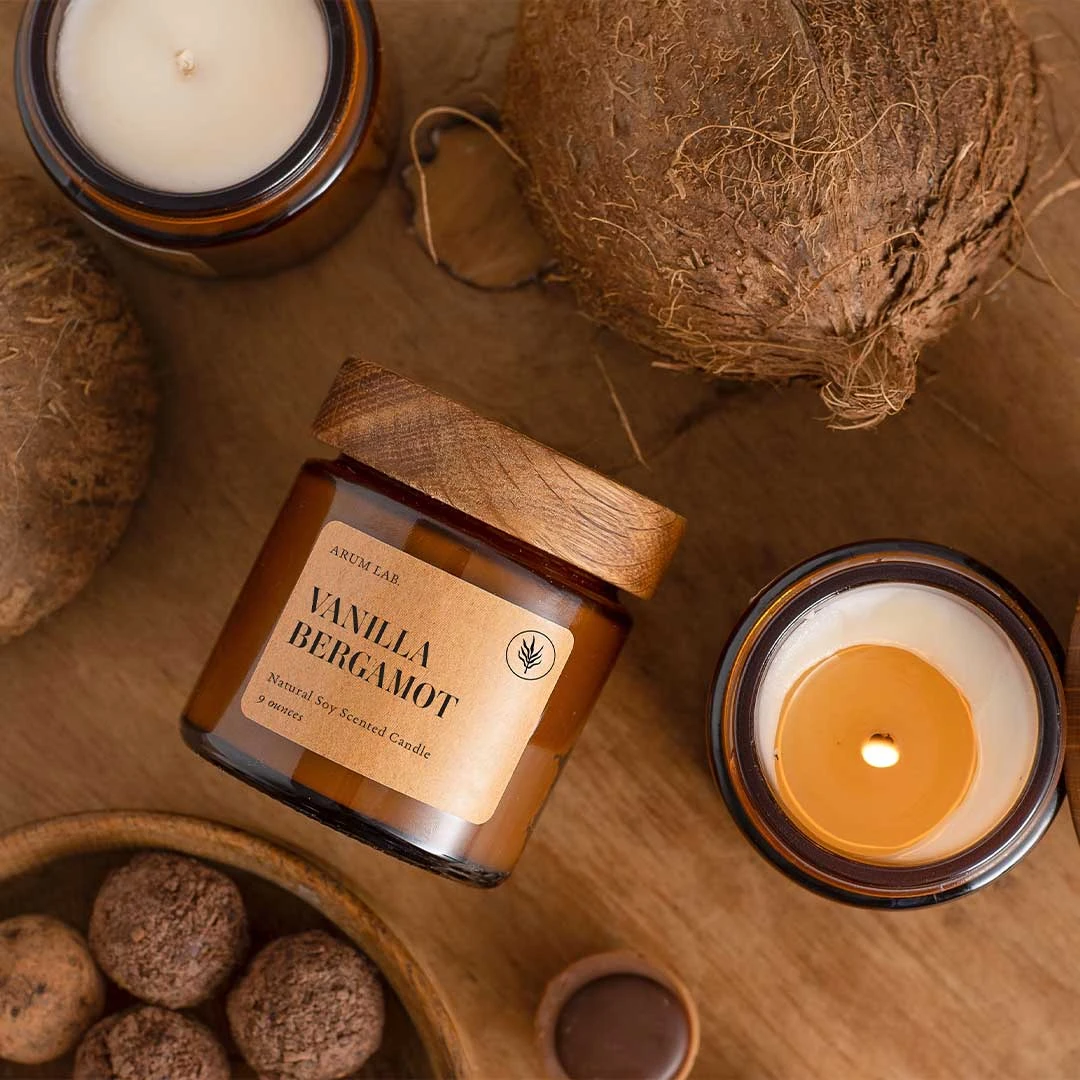
For candle vessels, tin lids and jar bases, see candle labels. Wraparound soap labels and apothecary tincture labels suit cast paper, and the vinyl vs paper guide helps compare stocks.
Apparel & Accessories
The typical items are clothing hang-tags, garment care labels, mailer pack seals and box-closing brand stickers for online apparel orders. From 500 boxes, apparel brands can print their logo in one or two spot colours on natural kraft board, and the seals and labels can finish custom kraft boxes. See the thank-you label playbook for unboxing ideas.
Pharmaceutical & Medical
Supplement, over-the-counter and medical packaging labels are typical items. We advise on substrate and adhesive class for legibility, durability and lot numbering, but we do not certify regulatory compliance.
Logistics & Shipping
Carton, batch, lot-number, address, return-to-sender and outer-pack branding labels are pre-printed roll labels. Synthetic film with permanent adhesive survives courier handling, rain and cold storage, and we do not supply blank thermal-transfer rolls for in-house printing.
How to Choose: A Quick-Pick Guide
If you are unsure which combination fits your label brief, the quick-pick below maps the most common applications to a recommended starting spec. These are defaults, the digital proof and quote stage is where we tighten the spec to your exact use.
If your job is...
Beer, kombucha, or cold-drink bottle labels: white synthetic, gloss laminate, applied at room temperature before chilling.
Skincare or serum bottle labels: clear film, matte finish.
Artisan jam, honey, or candle labels: white cast paper, matte, oval or rounded-corner shape.
Brand seal on mailer or unboxing closure: die-cut cast paper or synthetic, matte.
Wine, spirits, or premium product launch: foil-accented stock, custom shape.
...the recommended spec is
Logistics, address, or batch labels: white synthetic, gloss, rectangle labels off the roll.
Garment hang tags or apparel branding: rectangle or rounded-corner cast paper, matte.
Pharmaceutical or supplement bottle labels: white synthetic, matte, spec to your regulatory framework at quote stage.
Event labels or short-run promotional seals: cast paper or synthetic. Note the adhesive is permanent, so plan for the label to stay where you put it.
Frozen-product labels (ice-cream, frozen meals, sheet masks): white synthetic, matte laminate, applied at room temperature before the product goes into cold storage.
Material Grades and Substrate Detail
Three base stocks cover every label in this category. The difference matters when the label has to live on a fridge shelf, in a bathroom, or through courier handling for weeks before it reaches the customer.
White Cast Paper
A coated cast paper face stock that takes ink with rich saturation and a soft matte feel. The natural fibre signals craft, small-batch, and apothecary, the right read for boutique food, candle, soap, and skincare brands. It runs a permanent rubber-based hot melt adhesive, goes on at 0 degrees Celsius or above, and holds a service range of minus 40 to 70 degrees Celsius once bonded. Cast paper is not water-resistant, so fridge condensation, wash-down, and sustained outdoor exposure will lift it. Choose synthetic if any of those apply.
White Synthetic, often called vinyl
A polypropylene film face stock that resists water, oil, scuffing, and the swing from cold storage to warehouse-warm. It is the workhorse for opaque labels on coloured containers and the correct call for anything chilled, humid, or handled with wet hands. It runs a permanent emulsion acrylic adhesive, goes on at 5 degrees Celsius or above, and holds a service range of minus 20 to 80 degrees Celsius once bonded. Cast paper and white synthetic both take a gloss or matte laminate, or a gloss or matte UV varnish, and the waterproof and outdoor materials guide covers the durability spec by environment.
Clear Synthetic
A clear, top-coated polypropylene film that prints CMYK and leaves the container visible through the label, the no-label look that suits glass bottles, see-through cosmetic jars, serums and oils, and premium spirits. It runs a general-purpose permanent acrylic adhesive, goes on at minus 5 degrees Celsius or above, and holds the widest service range in the line, minus 40 to 120 degrees Celsius once bonded. Clear takes a gloss or matte varnish rather than a laminate, and a white ink layer behind the artwork is what stops a design disappearing against a dark or coloured container. Clear is ordered through its own page, clear labels, which carries its own shape and size set.
Foil Accents
Foil is a decoration layered onto a base stock, not a stock of its own. Reflective gold, silver and rose gold foils go onto a logo, a border, or the full label face, the highest perceived value in the range for a small per-unit premium. Because the foil sits on cast paper, white synthetic, or clear, the durability spec follows whichever base you pick. Live pricing is on the foil labels page.
Adhesive and Roll Format
There is one adhesive across the whole label range: permanent. There is no removable, freezer-grade, or high-tack option to select, so the spec decision is material and finish, not adhesive class.
Permanent, on every stock
Cast paper runs a rubber-based hot melt, white synthetic runs an emulsion acrylic, and clear synthetic runs a general-purpose acrylic. All three bond permanently. Removal after curing needs heat or a citrus solvent, and the label is not built to come away cleanly, so treat artwork and placement as final.
Apply at room temperature
Cast paper applies at 0 degrees Celsius or above, white synthetic at 5 degrees Celsius or above, and clear synthetic down to minus 5. Once bonded the label holds through cold storage, minus 40 to 70 degrees Celsius on cast paper, minus 20 to 80 on white synthetic, and minus 40 to 120 on clear, so frozen retail stock is fine. What does not work is applying a label onto an already-frozen or wet container.
Rolls of 500, 76mm core
Every label in this category is supplied on a roll, wound on a standard 76mm, 3 inch, core that fits most benchtop and inline dispensers and applicators. One roll of 500 labels is the minimum order, and larger runs are ordered as additional rolls on the same job.
Die-cutting included
The cut to shape is included in the roll price, whether that is a stock circle, oval, square, rectangle, rounded corner, or a custom silhouette from your own dieline. Labels come off the roll one at a time, ready for hand or semi-automated application.
Custom Label Printing on a Digital Press for Short Runs
Custom label printing on a digital press gives product, food, beverage, cosmetic and candle brands an economical way to order short runs without committing to large print volumes. Full colour artwork costs the same as one colour, so a small batch can carry the same brand detail as a long production run.
Choose from cast paper, synthetic polypropylene and clear film. All three materials are supplied on rolls for product packaging, food, beverage, cosmetic and candle brands, and for retail and ecommerce, so the label material can be matched to the packaging.
To order label printing online, choose a shape such as circle, oval, square, rectangle, rounded corner, die-cut, clear, vinyl or foil, then choose cast paper, synthetic polypropylene or clear film. Every order is supplied on rolls of 500, so labels arrive ready to apply to product packaging. The rolls are printed in Australia and shipped across Australia including Sydney and Melbourne, with a 4.9 out of 5 rating from more than 800 customers.
Order Custom Labels Online
Every label in this range is ordered online. Pick the shape you need, set the size, stock, finish and quantity on that shape's product page, and the calculator returns the unit price and the total before you buy. Online label printing here means no quote request in the way and no minimum beyond a single roll of 500.
Design your labels or upload finished artwork
Three routes work. Upload a print-ready PDF, AI or EPS and it goes straight to pre-press. Download a blank template for your shape and size from the product page and create the artwork inside it. Or send a logo and a rough idea and our design team builds the print-ready file for a small additional fee, including ingredient-panel layout, barcode placement and panel hierarchy.
Order, proof, then print
Once the order is placed and the artwork is uploaded, our pre-press team runs a free file check within one business day and returns a digital proof within one to two. Your order includes two rounds of revisions and nothing goes on press until you approve it. The whole path stays online, from artwork upload through to proof approval. Printing takes 48 hours after proof approval by 8am Melbourne time.
Small quantities and repeat runs
One roll of 500 is the entry point for every size, shape and material, so a first run for a product launch and a 5,000-label reorder follow exactly the same ordering path. Additional rolls on the same job drop the unit cost, and the tier breaks are printed on each product page.
Printing labels yourself is a different job
If you want to run labels through your own desktop or thermal printer, that is not what this range is. Everything here arrives with your artwork, colours and finish already applied during manufacture. Brands that need both usually order pre-printed labels for the branded front of pack and keep a blank thermal roll in-house for dates and barcodes.
How a Custom Label Order Moves Through the Press
Every custom label order moves through a structured production pipeline from artwork upload to dispatch. Knowing what happens at each stage helps you plan timelines and spot the right moments to review the work.
1. File check
Within one business day of order placement, our pre-press team opens your artwork and checks resolution, bleed, font outlining, colour profile (RGB vs CMYK), barcode legibility, and cut path integrity. Any flagged issues come back to you with specific notes; clean files move straight to proof.
2. Digital proof
You receive a digital proof showing the print output at exact sizing, with the cut path overlaid and the ingredient panel or barcode at full readable scale. Sign off on colour, sizing, shape, copy, and panel layout. No production starts until you confirm.
3. Press
Approved files run on production digital presses for most jobs, with dedicated foil and specialty equipment for premium finishes. Production typically takes 48 hours after proof approval by 8am Melbourne time.
4. Lamination, cut, and quality-check
Synthetic orders pass through the laminator for the chosen finish (gloss or matte) before the cutter applies the die-cut path. Labels are wound onto rolls, counted, and quality-checked against the proof, misregistration, ink density, and cut accuracy are all spot-audited at this stage.
5. Pack and dispatch
Rolls are boxed with the wind protected against crush, sealed in protective packaging, and dispatched via tracked Australia Post or courier. Tracking link comes by email at dispatch.
Application, Care, and Expected Lifespan
A clean application is the difference between a label that lasts the rated life and one that lifts at the corners within weeks. Our standard recommendation:
- Clean the surface with isopropyl alcohol and let it dry fully, no oils, no dust, no condensation trapped between film and substrate.
- Peel back a corner of the backing, align the label against your registration mark or container seam, and apply gradual pressure from the centre outward to push air bubbles to the edges.
- For larger bottle wraps, use the wet-application method (a light mist of soapy water on the surface) to allow repositioning before the adhesive cures.
- Apply at room temperature, cast paper at 0 degrees Celsius or above and synthetic at 5 degrees Celsius or above, and let the bond settle before the product moves into cold storage or gets handled hard. The service temperatures below all assume the adhesive has bonded first.
Cast paper labels hold colour for years indoors where the stock stays dry, and carry a service range of minus 40 to 70 degrees Celsius once bonded. Synthetic runs minus 20 to 80 degrees Celsius, which covers chilled display, freezer storage, and a hot delivery van across the same product line. Stock is best used within 12 months of delivery, stored around 20 degrees Celsius and 50 percent humidity. The label and sticker size guide includes recommended dimensions by container type.
Why Print Custom Labels With Paperlust
Australian-printed with fast turnaround and locally-stocked substrates, so you avoid the freight delay and customs uncertainty of overseas label print services. Free pre-press file checks on every order, our team flags low-resolution artwork, missing bleed, RGB conversion issues, barcode legibility, and font outline problems before printing rather than after, which avoids the most common reprint scenarios.
Every order receives a digital proof showing the exact print output, cut path, and material before press, so colour, sizing, and panel layout are signed off before any production cost is committed. Volume pricing tiers favour brands ordering in retail-rollout quantities, for the tier-by-tier breakdown across the Australian market, see the label and sticker printing cost guide. The unit cost typically halves between the 100 and 500 quantity break, and halves again between 500 and 2,500.
Starting Prices for Labels
These starting figures show the order total for the smallest size on each custom labels page, in Australian dollars with GST included, for one design printed on that page's lowest priced stock. They are a guide only. Size, material, finish, quantity and the number of designs all change the final number, which is calculated live on the product page.
| Label page | Smallest size | 500 labels | 1,000 labels |
|---|---|---|---|
| Circle Labels | 30mm x 30mm | $163.02 | $178.75 |
| Square Labels | 30mm x 30mm | $163.02 | $178.75 |
| Rectangle Labels | 25mm x 50mm | $196.50 | $218.53 |
| Rounded Corner Labels | 30mm x 30mm | $160.16 | $174.46 |
| Oval Labels | 30mm x 100mm | $201.59 | $235.47 |
| Custom Cut Labels | 30mm x 30mm | $160.16 | $174.46 |
| Clear Labels | 30mm x 30mm | $223.08 | $237.38 |
| Foil Labels | 30mm x 30mm | $262.57 | $281.20 |
| Waterproof Vinyl Labels | 30mm x 30mm | $160.16 | $175.89 |
Each price is for one roll of 500 labels. A quantity of 1,000 is two rolls, and the cost per label falls as the quantity rises.
Order a Label Sample Pack
Our Sticker and Label Sample Pack is posted to your address for $5.00. It holds printed samples of the custom cut, clear, circle, square, rectangle, rounded corner, oval and foil label range plus the sticker range. Each piece uses a different substrate, adhesive and finish, so you can compare matte and gloss surfaces in the hand. No artwork is needed to order.
Customers who print with our label range give it 4.9 / 5 across 600+ five-star reviews on Google.
Artwork and Setup Checks
Send artwork as PDF, SVG or Illustrator with 3 mm bleed and crop marks, fonts outlined and images embedded. A die line belongs on the top layer in 100 per cent magenta. Pre-press checks each file, flags low resolution, missing bleed or unreadable barcodes and converts RGB to CMYK, noting colour shift risk. A digital proof is emailed before printing and includes two revision rounds. For a logo or rough idea, the design team can prepare print-ready files for an extra fee, covering ingredient panels, barcode placement and panel hierarchy.
Australian Labelling Rules by Product
This is a starting point, not legal advice. The rules below belong to the named regulator, not to Paperlust, and we print the artwork you supply without checking or certifying that a label complies.
Wine, beer and spirits
Wine Australia's labelling guide sets out that a beverage over 1.15 per cent alcohol by volume must state the percentage of alcohol by volume, carry a standard drink statement and a pregnancy warning mark. Allergen declarations use the prescribed terms 'sulphites', 'egg' and 'milk'. Lot identification is mandatory under the Food Standards Code. The supplier name and Australian business address must appear, not a postal address. Vintage, variety and origin claims are not mandatory, but an auditable Label Integrity Program trail is required.
Wine Australia: guide to labelling requirements · Wine Australia: Label Integrity Program
Packaged food
Under the Food Standards Code, published by Food Standards Australia New Zealand, ingredients must be listed in descending order (by ingoing weight). Allergens must be declared in the ingredient list using the exact name and bolded text, with a nearby summary statement starting with the word 'contains'. Where a cereal containing gluten is present, the summary uses the word 'gluten'. Date marking uses use-by and best-before dates. The nutrition information panel shows average quantity per serving and per 100 g, or 100 mL for a liquid. Food must carry supplier contact details in New Zealand or Australia. Country of origin labelling is set by the Country of Origin Food Labelling Information Standard 2016 under the Competition and Consumer Act 2010, and is administered separately from that Code.
Food Standards Australia New Zealand: labelling information · FSANZ: allergen labelling · FSANZ: country of origin labelling
Cosmetics and skincare
The Consumer Goods (Cosmetics) Information Standard 2020, administered by the ACCC, requires product ingredients to be listed on the container or product. Ingredients may be listed in descending order by volume or mass, or with ingredients at 1 per cent or more first, then those below 1 per cent and colour additives in any order. Where the container or product size prevents this, the information should be prominently displayed alongside cosmetic products. The standard does not require quantity or percentage of each ingredient.
ACCC Product Safety: cosmetics ingredients labelling
Trusted by 800+ Australian Customers
★★★★★ 4.9 / 5
600+ five-star reviews on Google · 4.9/5 on Trustpilot · 4.9/5 on ResellerRatings from 63 reviews
Popular Products in this Range
- Circle Labels
- Rectangle Labels
- Square Labels
- Oval Labels
- Rounded Corner Labels
- Die-Cut Labels
- Clear Labels
- Foil Labels
Label Sizes Across All Shapes
Choose the cut shape first, then the stock, since the cut shapes print on white cast paper or white synthetic, on rolls of 500 per design and size. Clear and Foil label pages are listed at the end with their own stocks.
| Label page | Sizes | Stocks | Finishes |
|---|---|---|---|
| Circle Labels | 30, 40, 50, 60, 75, 90, 100, 150 mm diameter | White Cast Paper, White Synthetic | Matte Laminate, Gloss Laminate |
| Square Labels | 30 x 30, 40 x 40, 50 x 50, 60 x 60, 75 x 75, 100 x 100 mm | White Cast Paper, White Synthetic | Matte Laminate, Gloss Laminate |
| Rectangle Labels | 25 x 50, 25 x 70, 50 x 100, 70 x 40, 70 x 120, 100 x 150 mm | White Cast Paper, White Synthetic | Matte Laminate, Gloss Laminate |
| Oval Labels | 30 x 100, 50 x 100, 75 x 150, 100 x 200 mm | White Cast Paper, White Synthetic | Matte Laminate, Gloss Laminate |
| Rounded Corner Labels | 30 x 30, 30 x 100, 50 x 50, 50 x 150, 75 x 75, 75 x 200, 120 x 120 mm | White Cast Paper, White Synthetic | Matte Laminate, Gloss Laminate |
| Custom Cut Labels | 30 x 30, 30 x 100, 50 x 50, 50 x 150, 75 x 75, 75 x 200, 120 x 120 mm | White Cast Paper, White Synthetic | Matte Laminate, Gloss Laminate |
| Clear Labels | 30 x 30, 30 x 100, 40 x 40, 50 x 50, 50 x 150, 75 x 75, 75 x 200, 120 x 120 mm | Clear Synthetic | Gloss Varnish |
| Waterproof Vinyl Labels | Circle, Square, Rectangle, Oval, Rounded Corner, Die-Cut; 20 sizes from 30 x 30 to 150 x 150 mm | White Synthetic | Matte Laminate, Gloss Laminate |
| Foil Labels | 30 x 30, 30 x 100, 50 x 50, 50 x 150, 75 x 75, 75 x 200, 120 x 120 mm | White Cast Paper, White Synthetic, Clear Synthetic, Silver Metallic Film | Matte Laminate, Gloss Laminate, Gloss Varnish |
Stock Choices for Each Label Page
White cast paper suits dry goods, candles, soap and gifts. White synthetic resists water for fridges and splash zones, clear synthetic gives glass and plastic a no-label look, and Silver Metallic Film is a mirror silver base printed with full colour over a white layer on the Foil Labels page.
| Stock | Label pages that offer it |
|---|---|
| White Cast Paper | Circle Labels, Square Labels, Rectangle Labels, Oval Labels, Rounded Corner Labels, Custom Cut Labels, Foil Labels |
| White Synthetic | Circle Labels, Square Labels, Rectangle Labels, Oval Labels, Rounded Corner Labels, Custom Cut Labels, Waterproof Vinyl Labels, Foil Labels |
| Clear Synthetic | Clear Labels, Foil Labels |
| Silver Metallic Film | Foil Labels |
Label Quantities Outside 500 to 5,000
For fewer than 500 labels, custom stickers start at 50 pieces, with die cut stickers at $32.00 for 50. Stickers arrive as separate pieces rather than on a roll.
Sticker Sheets print several designs on one sheet for hand application, starting at $72.00 for 10 sheets.
For runs above 5,000 labels, our team provides a custom quote once you send your label size, stock and quantity.
Label Delivery and Pickup Options
Standard delivery is $10 flat per order, tracked across Australia. Express delivery is $15 per order. Pickup is no charge from our Oakleigh South studio in Melbourne, and you can select delivery or pickup at checkout.