At a glance
Paperlust Print Shop stocks two stretch fabric media wall sizes, both 2200 mm high. This guide matches each to crowd size, camera distance and floor space in about two minutes.
- Small 2400 mm x 2200 mm suits solo portraits, couples and groups of up to about four people in tighter venues.
- Large 3000 mm x 2200 mm works for groups of around 4 to 6, press lines and wider sponsor walls.
- Anything more than about six people, or any width beyond 3000 mm, is a custom order. Contact the team before you commit, because custom sizing can affect production lead times.
- Logos need to be at least 46 cm wide on the physical wall to read cleanly in a phone photo from 6 m away.
- Allow at least 1.2 m of depth clearance behind the frame and 0.6 m on each side for setup and anchoring.
Ordering the wrong size is the most common media wall mistake, and a reprint costs more than a clear brief upfront. This guide covers the two stocked sizes, maps each to crowd size and camera framing, and explains when a custom size is the better route. You can check the current options and prices at the stretch fabric media wall product page as you work through the decisions below.
Standard Media Wall Size Catalogue
Paperlust Print Shop carries exactly two stocked stretch fabric media walls. Both share the same 2200 mm standing height, so width is the main decision.
| Size | Dimensions | Best use | Minimum ceiling height |
|---|---|---|---|
| Small | 2400 mm (W) x 2200 mm (H) | Boutique events, solo and couple portraits, tight venues, small brand activations | 2400 mm recommended |
| Large | 3000 mm (W) x 2200 mm (H) | Corporate press walls, sponsor grids, wedding receptions, galas and trade shows | 2400 mm recommended |
Dimensions are listed width by height. Both sizes use the same 230 gsm Expo stretch polyester fabric, printed by dye-sublimation, and the same lightweight aluminium push-fit frame. The frame packs into the included carry bag and assembles without tools.
You can order a complete wall with frame and fabric, or replacement fabric only if you already own the frame. Printing is available one side or two sides. For reference, the complete Small wall is $492.35 including GST for one unit with frame and fabric printed one side, and the complete Large wall is $580.44 including GST. Replacement fabric only is $289.75 for Small and $377.83 for Large. Ten Small walls work out to $422.22 each including GST.
Matching Crowd Size to Wall Size
The number of people posing at once determines how much wall width you need. A wall that feels full with two people will leave obvious empty space with six. Use the table below as a starting point.
| Group size at wall | Recommended size | Rationale |
|---|---|---|
| 1 to 3 people | Small 2400 x 2200 mm | Full width fills the frame without dead space at the edges. |
| 4 to 6 people | Large 3000 x 2200 mm | Extra 600 mm of width keeps every face inside the branded area without stacking rows. |
| 7 or more people, or a stage band | Custom size | A wider custom wall keeps sponsorship and branding continuous behind the full group. Contact the team with your maximum group size and venue width. |
When your event mixes solo portraits with large group shots, choose the larger wall. It is easier to crop a photo tighter than to ask six people to squeeze into a frame that is too narrow. The 2200 mm height stays the same, so moving from Small to Large is about buying more width. Once the group is framed, give guests something to hold with our printed selfie frames.
Logo Legibility at Distance
Every media wall brief includes a logo, but a logo that reads on a laptop screen can disappear when a photographer shoots from the back of the room. The rule is simple: design for the worst-case shot, usually a wide establishing frame from the longest camera position.
| Viewing distance | Minimum logo width on wall | Notes |
|---|---|---|
| 3 m (close photo call, single portrait) | 30 cm | Logo fills roughly 15 percent of frame width in a tight portrait. |
| 6 m (standard red carpet or event photographer) | 46 cm | Logo must still read in phone photos shared on social media. |
| 9 m (wide room, broadcast or livestream camera) | 61 cm | Test with a screenshot at production resolution, not in a browser preview. |
Step and repeat layouts solve the legibility problem by repeating the logo across the wall, so at least one full logo always appears behind the subject. If your design is a full-bleed single image, check that the main logo in the top centre is large enough for your longest camera distance.
For more on tiled logo grids versus full-print designs, see our guide on step and repeat vs media wall.
Camera Framing for Press, Red Carpet and Influencer Content
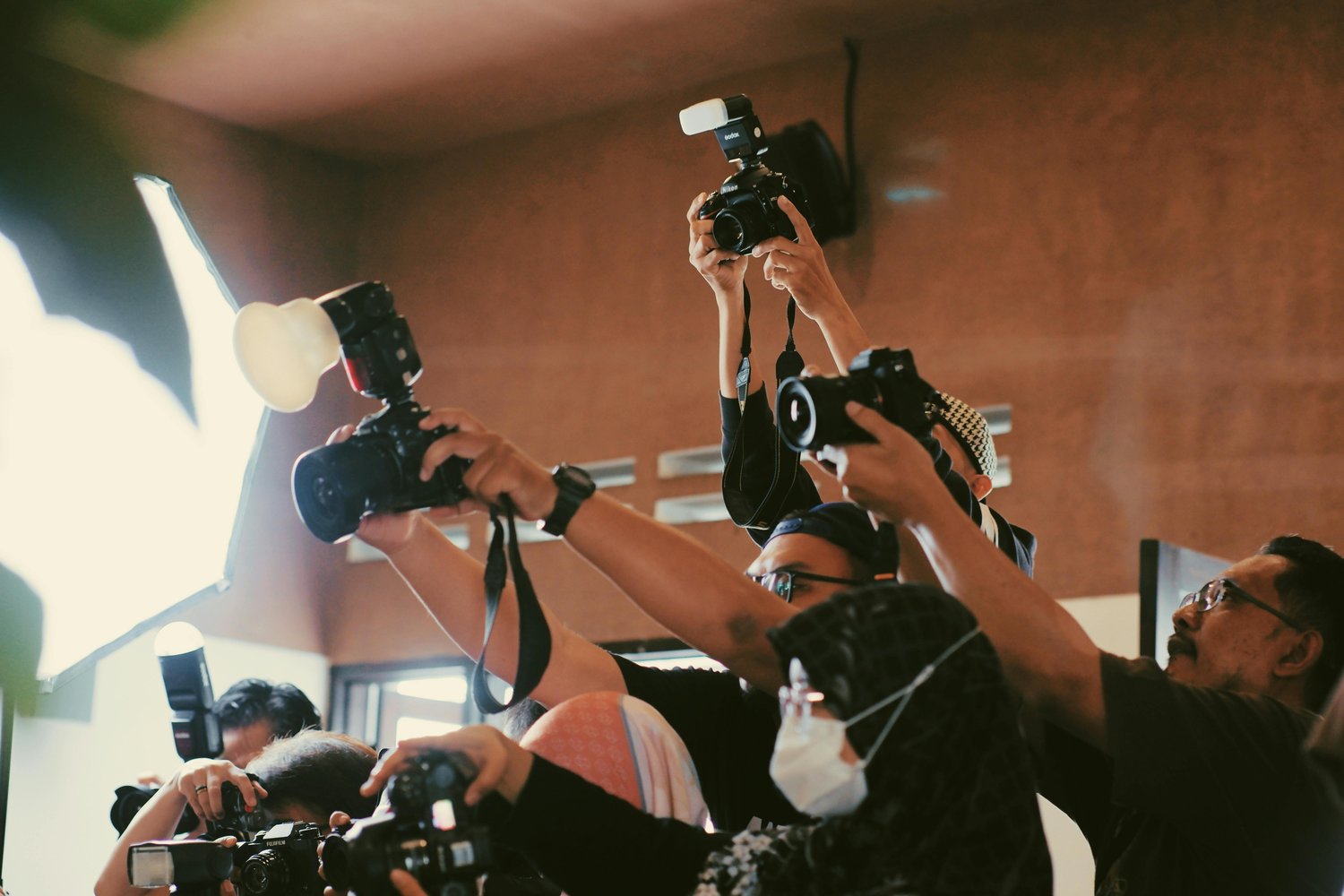
Different photo formats need different amounts of wall width. Knowing which format dominates your event helps you choose between the Small and Large wall before you order.
Press and editorial shots
Press photographers typically frame a 3:2 horizontal shot from about 4.5 m to 7.5 m. For full branding coverage, the wall should be at least 1.5 times the width of your widest group. The Small 2400 mm wall works for solo and couple editorial portraits, while the Large 3000 mm wall holds groups of four to six without cropping the edges.
Red carpet portrait format
Red carpet and awards photography often uses a tighter 4:5 vertical crop. Here the 2200 mm height matters more than extra width. Both stocked sizes share the same height, so the Large 3000 mm wall gives more breathing room either side of a floor length outfit or tall headwear while keeping the subject framed.
Influencer and social content
Influencer content usually shoots in 9:16 vertical for Stories, Reels and TikTok. At 1.5 m to 3 m away, the camera sees only the centre of the wall. Size is less critical in this format, but logo placement in the central 900 mm band is essential. A Small 2400 mm wall positioned so the main logo sits at head height works well for solo creator content.
Setup Footprint, Anchors and Clearance
The printed dimension is not the full floor space the wall occupies. The frame extends past the fabric edge, the legs need room, and you need buffer space for the photographer and the guest queue. Use the clearances below as a hard minimum when scouting a venue.
| Wall size | Floor width needed | Depth needed | Anchor method |
|---|---|---|---|
| Small 2400 x 2200 mm | 3600 mm (3.6 m) | 1200 mm to 1500 mm (1.2 to 1.5 m) | Push-fit aluminium frame, no drilling required. One-person setup. |
| Large 3000 x 2200 mm | 4200 mm (4.2 m) | 1200 mm to 1500 mm (1.2 to 1.5 m) | Push-fit aluminium frame, no drilling required. Easier with two people. Add sandbag ballast for outdoor use. |
The aluminium push-fit frame assembles in around 5 to 10 minutes without tools. The Small wall is a one-person setup, and the Large wall is easier with two. The stretch fabric frame is cable free by design. If you add LED lighting bars, run power cables along the outside leg and tape them flat at floor level before guests arrive. For outdoor installs, add sandbag ballast at each leg regardless of the forecast.
When a Standard Size Does Not Fit: Custom Sizing
The two stocked sizes cover most event briefs. A custom size makes sense in a few situations.
- Irregular venue footprints: corner installations, curved walls or venues where a 3000 mm wide wall would block an exit path.
- Stage backdrops wider than 3000 mm: conference stages or permanent installs that need a continuous branded run wider than the Large wall provides should be quoted as a custom size.
- Exact sponsor grid maths: a sponsor grid that must show a precise number of logo rows and columns at a set logo size can require a non-standard overall dimension.
Custom stretch fabric media walls use the same 230 gsm Expo stretch polyester fabric, the same aluminium push-fit frame system and the same dye-sublimation print quality as the stocked sizes. The difference is sizing, and custom sizing can affect production lead times. A proof is issued before production, so if you have a fixed event date, mention it when you enquire so the team can confirm the timeline. See the full range and contact the team through the stretch fabric media wall product page.
For design direction before you settle on a size, browse our 15 media wall design ideas.
Order Your Media Wall from Paperlust Print Shop
Paperlust Print Shop prints both standard sizes and accepts custom dimensions. Each wall uses 230 gsm Expo stretch polyester printed by dye-sublimation, with a lightweight aluminium push-fit frame that assembles in around 5 to 10 minutes and packs into the included carry bag. Delivery is a flat $15 standard or $60 express per order, Australia wide, with pickup available from Oakleigh South, VIC. Complete Small walls are $492.35 including GST for one unit with frame and fabric printed one side, and complete Large walls are $580.44 including GST.
Related Guides in This Series
- What Is a Media Wall: Complete Guide for Events, Weddings and Branding
- Stretch Fabric vs Vinyl Media Walls: Which Material Wins?
- Step and Repeat vs Media Wall: Choosing the Right Event Backdrop
- 15 Media Wall Design Ideas: Weddings, Brand Launches and Corporate Events
Frequently Asked Questions
What are the standard media wall sizes at Paperlust Print Shop?
Paperlust stocks two sizes, both 2200 mm high. The Small is 2400 mm wide and the Large is 3000 mm wide. Both use the same 230 gsm Expo stretch polyester fabric and aluminium push-fit frame. Anything outside those two dimensions is a custom order.
What size media wall do I need for a wedding?
For couple portraits and small bridal party photos, the Small 2400 mm x 2200 mm wall is usually enough. If the wedding party is larger or you want group shots with six or more people, the Large 3000 mm x 2200 mm wall gives extra width. Check the venue ceiling height before ordering, and allow at least 2400 mm of clearance for either standard height.
What size backdrop do I need for a step and repeat?
Step and repeat walls follow the same sizing logic. The Large 3000 mm x 2200 mm wall is the safer choice for galas and brand activations because the extra width keeps repeated logos visible when photographers spread out. The Small 2400 mm x 2200 mm wall works for intimate photo calls. Test your logo size against the longest camera distance you expect.
How much floor space does a media wall need?
Allow about 0.6 m on each side and about 1.2 m to 1.5 m of depth behind the printed wall. The Small wall needs about 3.6 m of floor width and the Large wall needs about 4.2 m. Always check the full setup footprint against the venue floor plan before you order.
Can I get a media wall in a custom size?
Yes. Custom dimensions are available for stage installs, wide conference backdrops and venues with unusual geometry. Contact Paperlust Print Shop with your exact dimensions and event date. Custom sizing can affect production lead times, so raise the event date as early as possible.
How big does a logo need to be on a media wall to show up in photos?
At a 3 m shooting distance a logo should be at least 30 cm wide. At 6 m, the standard event photographer distance, use at least 46 cm. At 9 m for broadcast or livestream, use at least 61 cm. A step and repeat tiled grid is the most reliable way to keep a logo visible wherever the subject stands.