
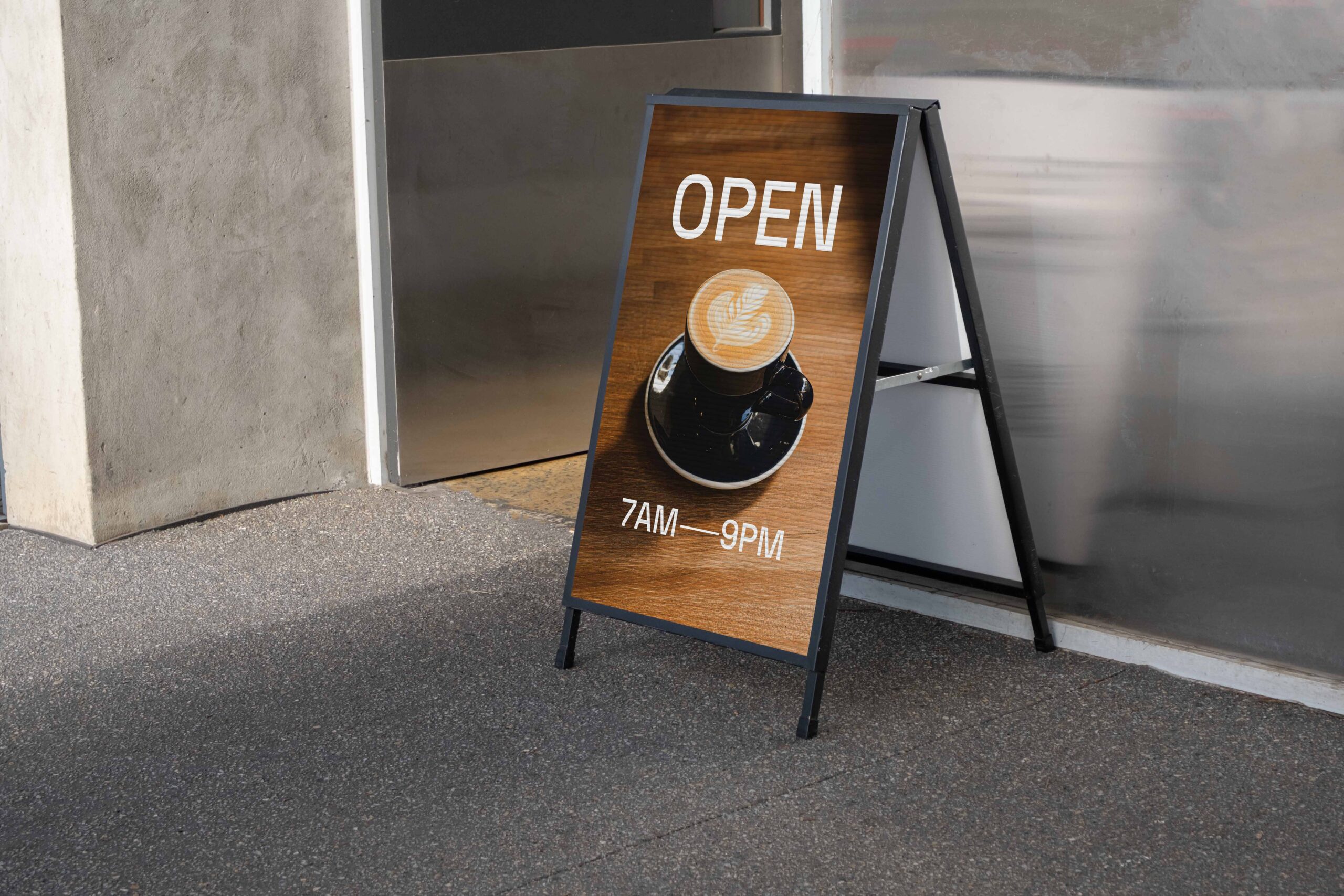
A-frame signs are one of the most cost-effective street-level marketing tools available to Australian businesses. Whether you run a cafe, retail boutique, real estate agency, or pop-up market stall, a well-placed A-frame stops foot traffic and converts curious passers-by into customers. This guide covers everything you need to know before you order: sizes, materials, corflute vs. other options, design rules, setup tips, and how to get the most from your investment.
- The standard corflute A-frame insert size in Australia is 600 x 900mm (double-sided).
- Corflute (corrugated polypropylene) is lightweight, waterproof, and UV-resistant: ideal for outdoor use year-round.
- 5mm corflute suits permanent outdoor displays; 3mm suits frequently swapped inserts.
- Full-colour UV direct printing means your artwork stays vivid even in high-sun Australian conditions.
- A-frames are also called sandwich boards: the frame holds two printed panels, one facing each direction.
- Turnaround from Paperlust Print Shop is 2-3 working days after artwork approval, with Australia-wide delivery.
What Is an A-Frame Sign?
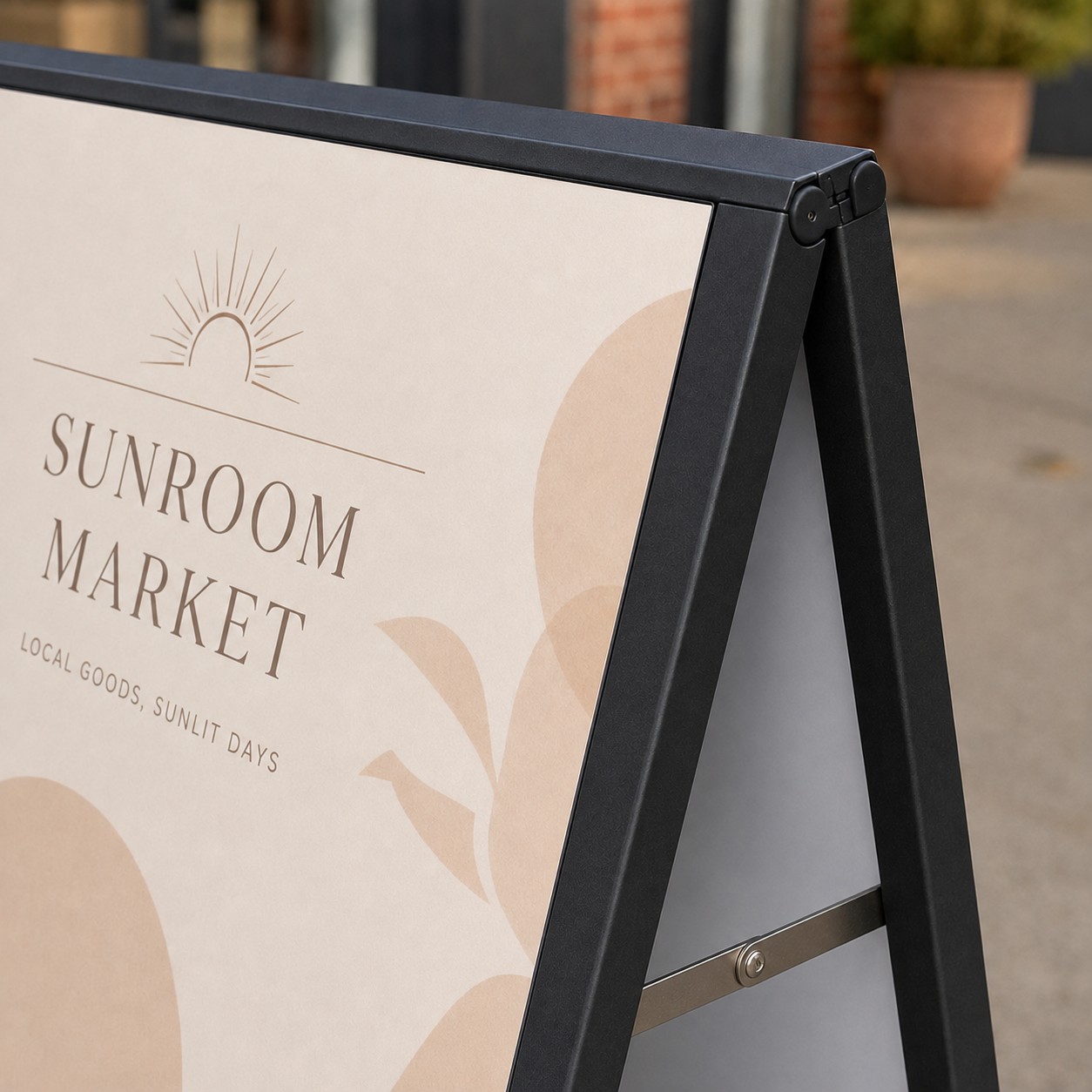
An A-frame sign, also called a sandwich board, is a freestanding two-sided display board shaped like the letter A when viewed from the side. The frame, typically powder-coated metal or heavy-duty plastic, holds one printed panel (or insert) on each face, so your message is visible from both directions on a footpath or entrance area.
The “A-frame” name comes from the triangular profile the folded frame creates. “Sandwich board” is the older term, originally referring to boards worn front-and-back by a person walking through a crowd. Today the terms are used interchangeably for freestanding street-level signage.
A-frames are popular because they are portable, reusable, and inexpensive relative to other outdoor signage formats. Unlike a fixed wall sign, you can move them to wherever foot traffic is heaviest, bring them inside overnight, and swap inserts whenever your offer changes.
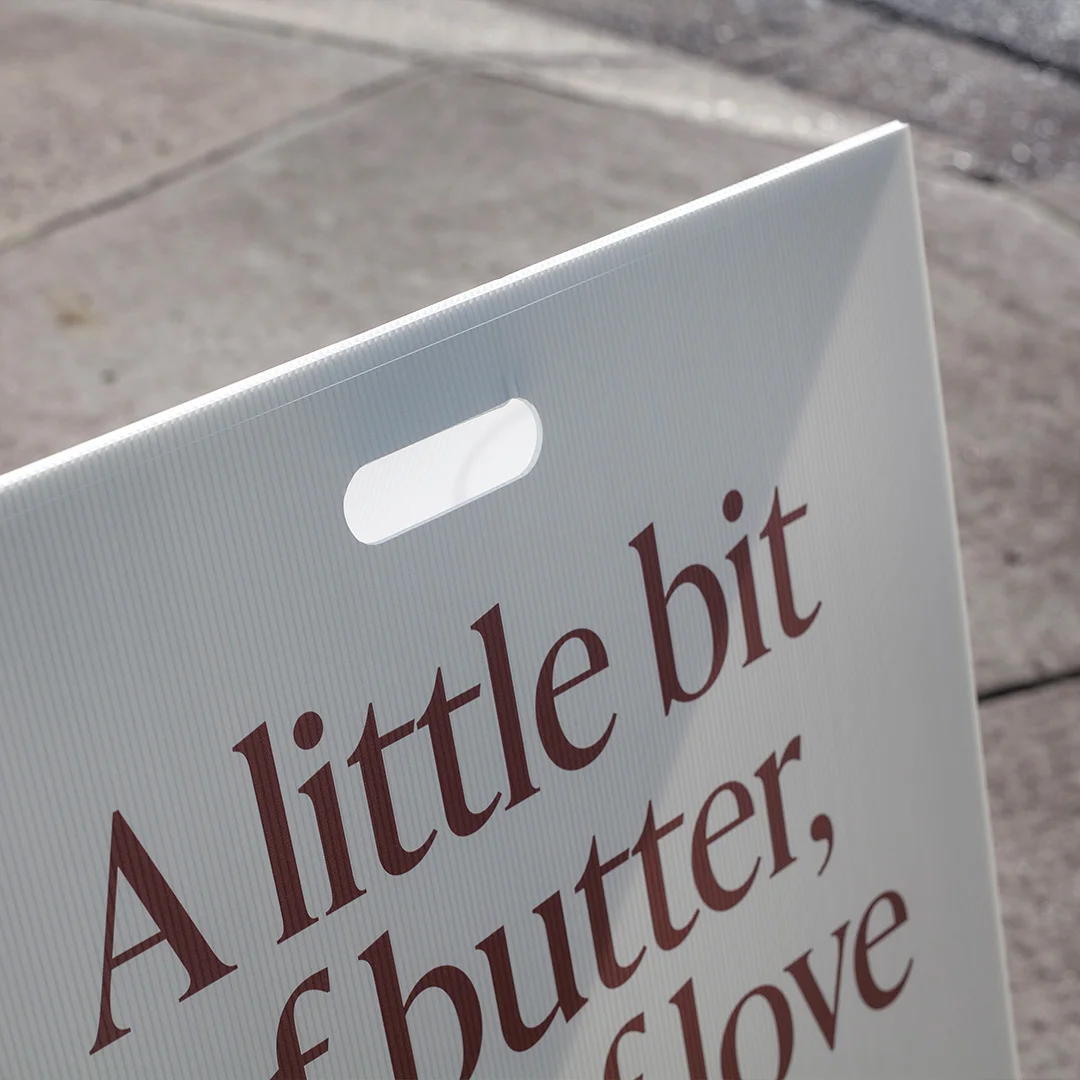
A-Frame Sign Sizes in Australia
The most widely used A-frame insert size in Australia is 600 x 900mm. This fits the majority of standard metal frames sold by signage suppliers and hardware stores. If you are ordering inserts, confirm your frame’s insert slot dimensions before designing, as frame tolerances vary slightly between manufacturers.
| Size | Dimensions | Best for |
|---|---|---|
| Standard insert | 600 x 900mm | Cafes, retail, hospitality, general promotions |
| Compact insert | 450 x 600mm portrait, 600 x 450mm landscape | Real estate open homes, tight footpaths, indoor lobbies, market stalls |
| Large insert | 900 x 1200mm | Forecourts, car yards, events with high viewing distance |
| Custom | On request | Non-standard frames, heritage streetscapes, bespoke installs |
If you are purchasing a complete A-frame unit (frame plus printed insert), the overall frame height is typically 600-650mm taller than the insert to account for the frame legs. A 600 x 900mm insert sits inside a frame with an approximate footprint of 600mm wide x 1,500mm tall.
Corflute vs. Other A-Frame Insert Materials
Corflute (corrugated polypropylene) is the most common insert material for Australian A-frame signs, and for good reason. It is lightweight, fully waterproof, resistant to UV fading, and rigid enough to hold flat inside the frame without bowing. It is also inexpensive to produce, which makes it practical to print multiple inserts and rotate them by promotion or season.
| Material | Weight | Durability (outdoor) | Swappable? | Relative cost |
|---|---|---|---|---|
| Corflute 3mm | Light | 6-12 months | Yes | Lowest |
| Corflute 5mm | Light-medium | 12-18 months | Yes | Low |
| Foam PVC (Foamex) | Light | 12-24 months | Yes | Medium |
| Dibond (aluminium composite) | Medium-heavy | 3-5+ years | Less practical | High |
| Poster/paper | Lightest | Days to weeks (indoor only) | Yes | Lowest |
For most Australian small businesses, 5mm corflute is the right call. It survives rain, UV, and the occasional windy day without cracking or delaminating. If you want to swap inserts frequently (daily specials, rotating promotions), print a batch of 3mm inserts at lower cost and keep spares on hand.
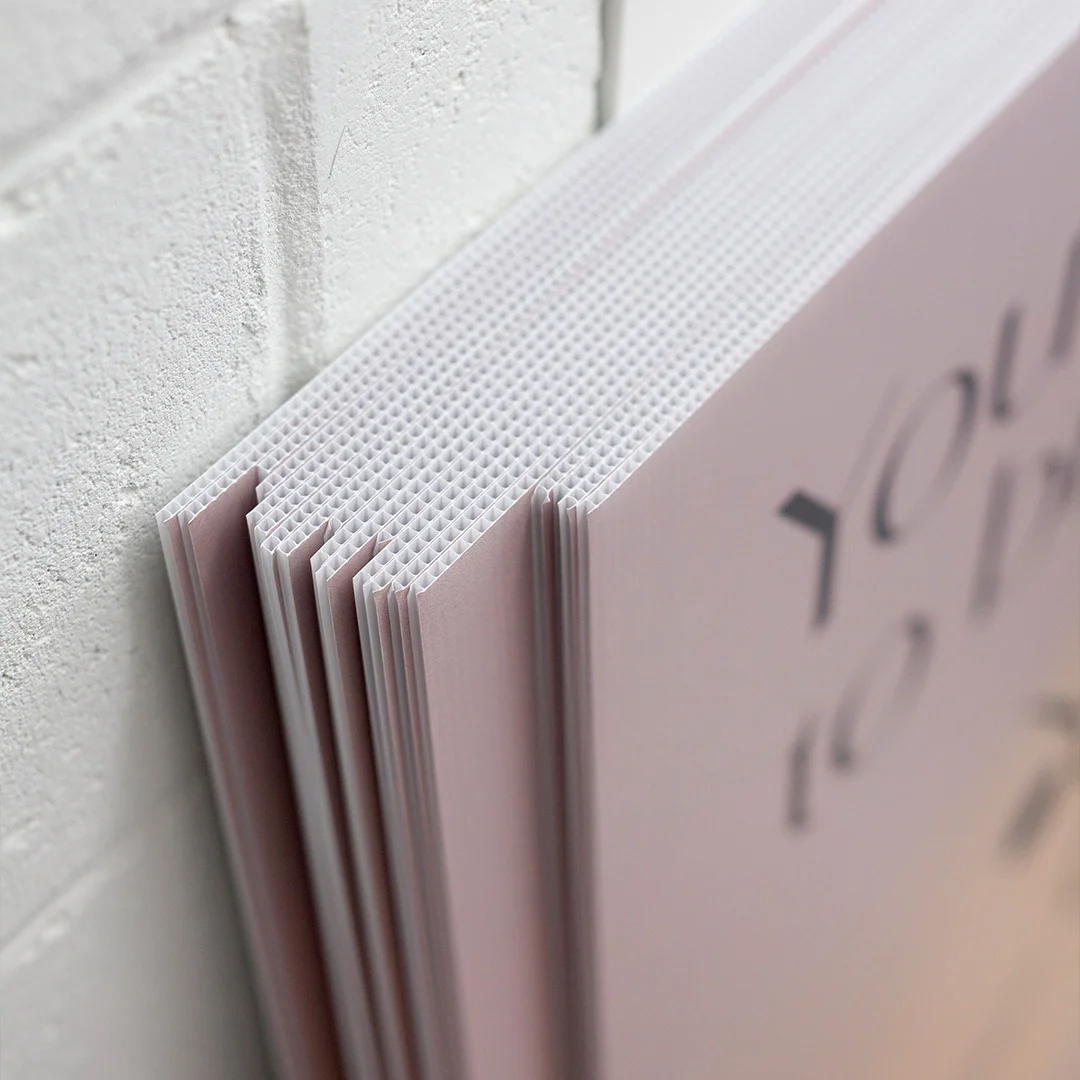
3mm vs. 5mm Corflute: Which Should You Choose?
3mm corflute
- Best for: indoor use, covered walkways, trade show displays, high-rotation promotions
- Lifespan outdoors: 6-12 months under normal Australian conditions
- Handling: lighter and easier to post or carry in bulk
- Cost: lower per unit, making large batches affordable
5mm corflute
- Best for: permanent outdoor A-frames, shopfronts, high-UV environments (Queensland, northern WA)
- Lifespan outdoors: 12-18 months
- Handling: slightly heavier but still easy to carry and swap
- Cost: marginally higher, still very affordable compared to rigid alternative materials
If you are placing an A-frame on an exposed footpath in a high-UV state such as Queensland or the Northern Territory, opt for 5mm. The thicker flute channels resist compression from wind pressure and the substrate holds its colour longer under intense sun.
A-Frame Signs vs. Sandwich Boards: Is There a Difference?
No functional difference exists between an “A-frame sign” and a “sandwich board” in modern usage. Both terms describe the same product: a freestanding, two-sided folding display. “Sandwich board” is the older colloquial term, still used widely in hospitality and retail. “A-frame” is the more common term in signage and print industry contexts.
In some supplier catalogues you may also see “pavement sign” or “forecourt sign” used as synonyms, particularly for metal-framed units with clear plastic lens covers rather than insertable corflute panels.
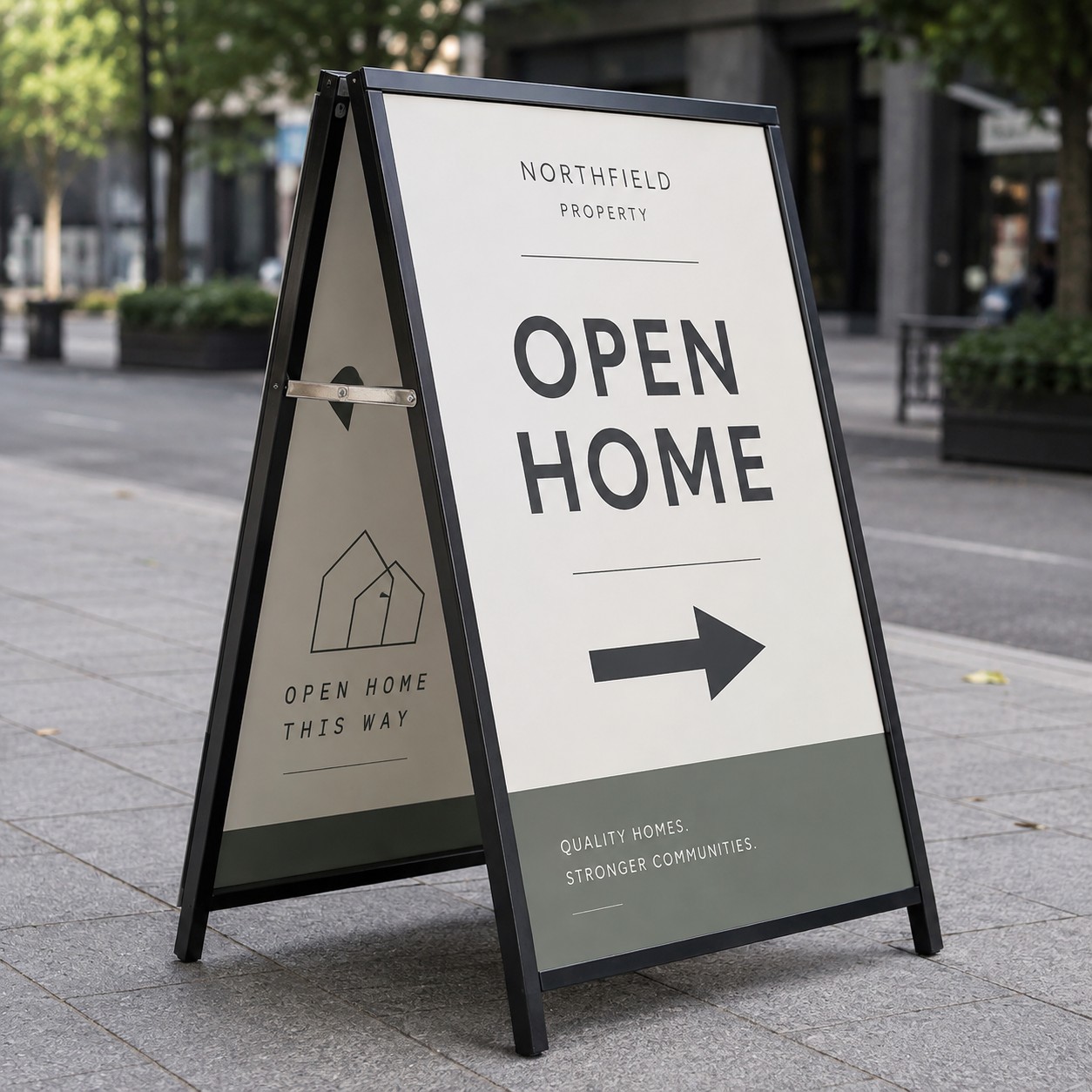
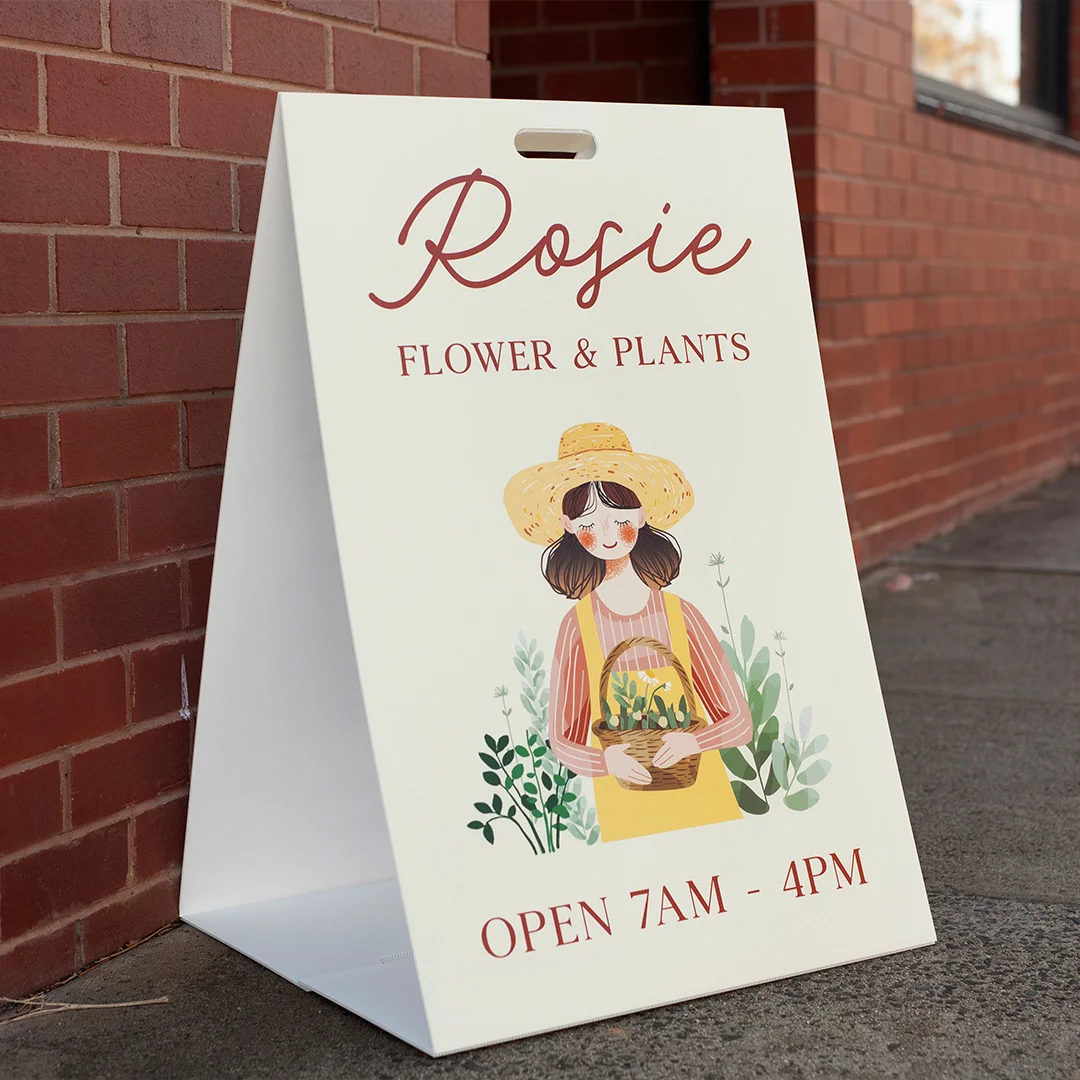
The name you use matters less than the format you choose, and Paperlust Print Shop prints three sandwich board formats. Its sandwich board signs are shown side by side so you can compare a steel-framed display with replaceable corflute panels, a frameless corflute option and a real estate A-frame.
Real Estate A-Frame Signs
Real estate is the largest single use-case for A-frame signs in Australia. Open-home signs are placed at road junctions to guide prospective buyers to a property, and they need to be weather-resistant, legible from a moving car, and easy to carry and erect quickly. If you would rather buy a complete unit than an insert, real estate A-frame signs combine a moulded plastic frame with your artwork on waterproof vinyl stickers on both faces.
Open-home and directional signs are landscape rather than portrait, and the usual size is 600 x 450mm rather than the general-purpose portrait insert. That shape suits a large address number, the open home time, and a high-contrast arrow read from a moving car, and it is the size the Paperlust Print Shop unit is built to, 600mm wide x 450mm high. Many agencies print a batch of blank directional arrows and keep a separate stack of address signs to mix and match.
Key real estate A-frame design rules:
- Use at least 90pt font for address numbers
- High-contrast colour scheme (dark text on light background or vice versa)
- Limit to three lines of text maximum
- Keep directional arrow large and unambiguous
- Lamination is optional, 5mm corflute with UV inks holds up without it
How to Design an Effective A-Frame Sign
An A-frame sign has a very short attention window. The average pedestrian gives a footpath sign roughly 2-3 seconds of attention. Your design must communicate the core message in that window.
Design principles that work
One offer, one action. Do not try to fit your entire menu or product catalogue on one panel. Choose a single compelling offer (“$8 breakfast until 10am”) and one call to action (“Step inside”).
Legibility from 5 metres. Your primary headline text should be readable from at least 5 metres away, roughly the distance from the kerb to the shopfront on a standard Australian footpath. A safe minimum for primary copy is 80-100pt on a 600 x 900mm panel.
Contrast is more important than colour. A bright, low-contrast sign is invisible. Black on white, white on dark navy, or yellow on black all outperform colourful low-contrast combinations.
Rotate the message. Regulars stop noticing the same A-frame after a week or two. Budget for a second set of inserts and alternate them fortnightly to maintain attention capture.
Allow a bleed margin. When supplying artwork for printing, include a 5mm bleed on all four sides and keep critical text and logos at least 10mm from the trim edge.
Where to Place Your A-Frame Sign
Placement determines roughly 50% of an A-frame’s effectiveness. A beautifully printed sign in the wrong spot is ignored.
Best placement principles
Place at the decision point, not the destination. The ideal position is where a pedestrian naturally pauses or turns, the corner before your street, the entrance to a shopping precinct, or a gap between two buildings that creates a natural funnel.
Face the dominant flow. If foot traffic on your side of the street predominantly walks in one direction, orient the most important panel face toward approaching traffic, not away from it.
Council and body corporate rules apply. Many Australian councils have footpath trading guidelines that specify where signs can be placed, how far from the kerb, and whether permission is required. Check with your local council before placing a sign on public footpath. Body corporate buildings may have their own rules for signs in shared areas. This is your responsibility as the business owner; signage suppliers cannot advise on local council requirements.
Safe sight lines. Do not place A-frames where they obstruct pedestrian paths (particularly for wheelchair or pram access), hide traffic signs, or block sight lines at driveways. This is both a safety requirement and a legal obligation in most Australian jurisdictions.
Bring it in overnight. Leaving an A-frame on the footpath overnight exposes it to theft and weather damage. Most frames fold flat in seconds and can be stored inside each evening.
What Does an A-Frame Sign Cost in Australia?
Pricing for corflute A-frame inserts depends on quantity, size, and whether you are buying inserts only or a complete frame-plus-insert package.
As a general guide for corflute insert panels (600 x 900mm, full colour, double-sided):
- Single insert: typically $50-90 AUD inc. GST depending on supplier
- 5-pack: typically $35-60 per insert as quantity discounts apply
- 10+ inserts: typically $20-40 per insert
Complete A-frame units (metal frame + one set of inserts) typically start from around $120-150 AUD inc. GST for a standard 600 x 900mm configuration.
Paperlust Print Shop corflute A-frame signs start from $95.00 inc. GST. Volume pricing applies for larger orders.
Note: pricing from online suppliers in Australia varies considerably. Budget providers may use thinner frames and lower-resolution print processes. Look for UV direct printing (not laminated inkjet) and a powder-coated metal frame for the best lifespan.
Ordering Corflute A-Frame Signs: The Process
Step 1: Confirm your frame insert dimensions
If you already own a frame, measure the insert slot (height x width) before ordering. Most Australian frames take a 600 x 900mm insert, but some older or imported frames have slightly different tolerances.
Step 2: Prepare your artwork
Supply a print-ready PDF or high-resolution PNG/JPEG. Minimum resolution is 150dpi at full print size (higher is better). Include a 5mm bleed on all sides and use CMYK colour mode. RGB files will be converted to CMYK by the printer, which can shift vibrant colours, design in CMYK from the start to avoid surprises.
Step 3: Choose single or double-sided
If your frame is in a corner location or at a road junction where traffic approaches from two directions, double-sided printing is worth the small additional cost. For a position with a clear single-direction footpath flow, single-sided is usually sufficient.
Step 4: Select corflute thickness
3mm for indoor or high-rotation use. 5mm for permanent outdoor display or high-UV environments.
Step 5: Approve the proof and place your order
Paperlust Print Shop provides a digital proof before going to print. Review colour, text, bleed, and panel orientation carefully before approving. Turnaround is 2-3 working days after approval, with delivery metro 1-2 business days and regional 2-4 business days.
Caring for Your A-Frame Inserts
Corflute is low-maintenance but a few habits extend its lifespan:
- Wipe down with a damp cloth to remove dust and grime. Avoid abrasive cleaners.
- Store inserts flat and dry when not in use. Stacking vertically under weight can compress the flute and reduce rigidity.
- Bring inserts inside during extreme weather events (hail, storm-force winds) even if the frame itself stays out.
- Do not use sharp objects to clean dried-on residue, a plastic scraper or warm water soak works without scratching the print surface.
Order A-Frame Signs from Paperlust Print Shop
Paperlust Print Shop prints corflute A-frame signs in Australia with full-colour UV direct printing on 5mm TEKflute corflute. Double-sided artwork, Pantone colour matching, and custom sizes are all supported. Orders are produced in 2-3 working days with nationwide delivery.
If you need a complete setup with frame and inserts, the insertable A-frame sandwich board comes as a ready-to-use unit.
Frequently Asked Questions
What is the standard size for an A-frame sign in Australia?
The most widely used insert size is 600 x 900mm, which fits the majority of standard powder-coated metal frames. Smaller 450 x 600mm and larger 900 x 1200mm options are available for specific applications. If you already own a frame, measure the insert slot before ordering to confirm the exact dimensions.
What is the difference between a sandwich board and an A-frame sign?
No practical difference exists. Both terms describe the same freestanding two-sided folding display. “Sandwich board” is the older colloquial term; “A-frame” is the more common term in print and signage contexts. You may also see “pavement sign” or “forecourt sign” used as synonyms.
How long do corflute A-frame signs last outdoors?
3mm corflute panels typically last 6-12 months in standard outdoor conditions. 5mm corflute panels last 12-18 months. Lifespan is shorter in very high-UV environments such as northern Queensland, if you are in a high-sun location, choose 5mm and expect to replace inserts every 9-12 months rather than 12-18. UV direct printing (as used by Paperlust Print Shop) holds colour better than laminated inkjet, which can peel at the edges in humid conditions.
Can I use an A-frame sign anywhere on the footpath?
Placement is subject to local council rules. Most Australian councils allow footpath signs within certain distance limits from the building entrance and require a minimum clear pedestrian path width to remain unobstructed (commonly 1.5 metres). Some councils require a permit or payment of a footpath trading fee. Check with your local council before placing a sign on public footpath, as the rules vary significantly between LGAs.
Should I order single-sided or double-sided A-frame inserts?
Double-sided is recommended for most outdoor positions. If your A-frame is placed on a corner or at a junction where pedestrians approach from two directions, you get two impressions from one sign. If you have a clear single-direction footpath flow and foot traffic only passes from one side, single-sided is fine and reduces the per-insert cost slightly.
What file format do I need to supply for printing?
Print-ready PDF is ideal. High-resolution PNG or JPEG at 150dpi minimum (at actual print size) is also accepted. Use CMYK colour mode and include a 5mm bleed on all sides. Keep critical text and logos at least 10mm from the trim edge. If you do not have a print-ready file, Paperlust Print Shop can provide design assistance, contact the team before placing your order.
What is TEKflute corflute?
TEKflute is a brand of corrugated polypropylene (corflute) sheet manufactured for signage applications. It uses a tighter flute pitch than standard corflute, which gives a smoother print surface and slightly improved rigidity at the same sheet thickness. Paperlust Print Shop uses TEKflute for corflute A-frame inserts to ensure a clean, flat print surface and consistent colour reproduction.