Choosing between kraft and full-colour mailer boxes comes down to more than aesthetics. The two options use different print methods, suit different artwork, start at different minimums, and carry different per-box costs at scale. Getting the decision right before you order saves you from discovering the mismatch when the first run arrives.
This article runs through each factor honestly, including the places where kraft falls short and the places where full-colour costs more than it needs to. At the end you will find a short “choose kraft if / choose full colour if” section designed to give you a clear answer in under a minute.
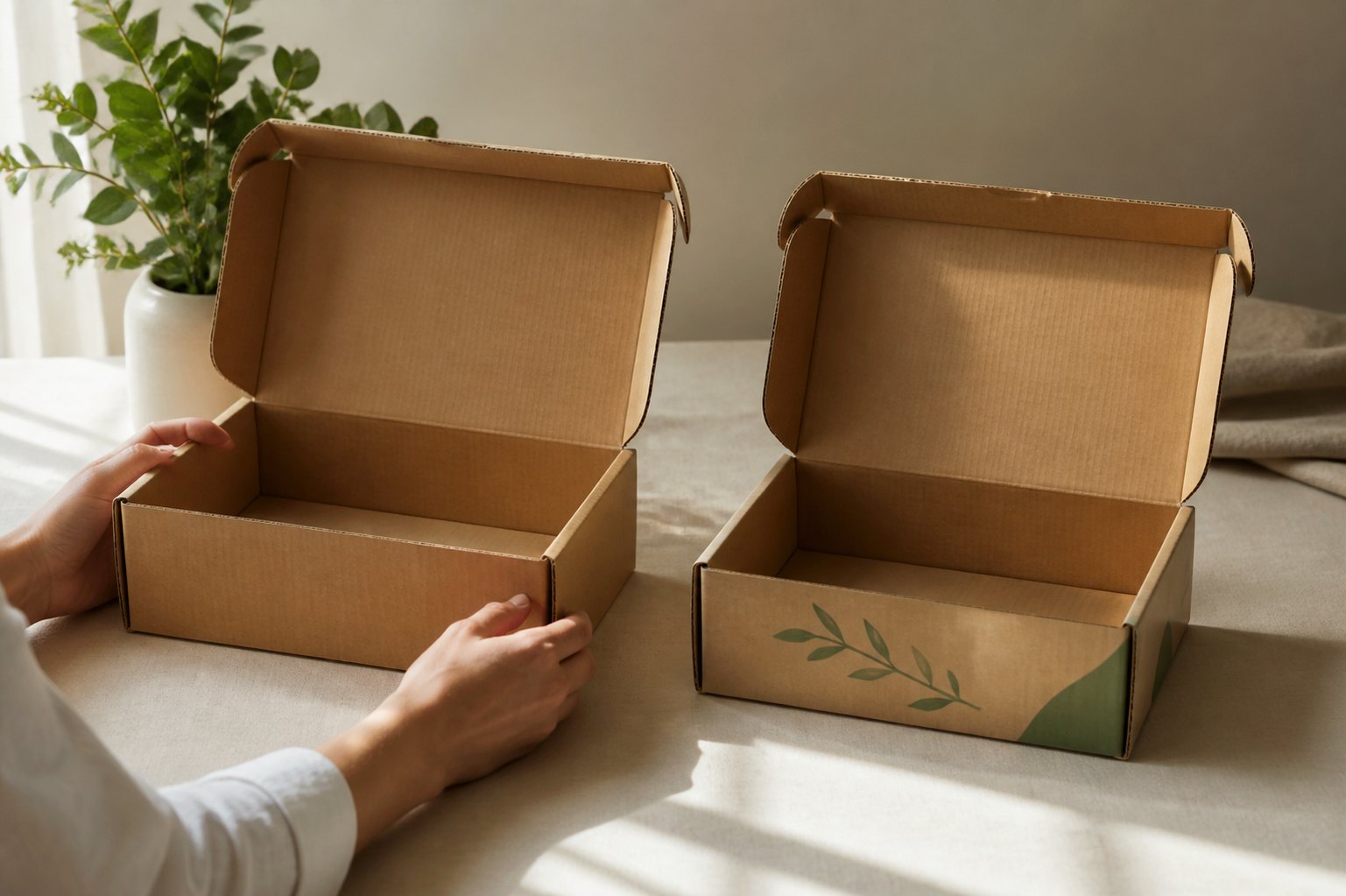
Both options are B-flute corrugated, roll end tuck front, self-locking, and made in Australia. The board, the shipping format, and the structural specs are the same. What differs is the surface and everything that surface determines.
The short version
- Full-colour boxes start at 10 units and print CMYK on a smooth white liner, so photos, gradients and complex logos reproduce accurately.
- Kraft boxes start at 500 units and use one or two spot colours flexographically printed on natural brown board, so ink sits over the kraft tone.
- If your artwork includes photography, gradients, or any pale or light element, kraft is the wrong choice.
- Kraft costs less per box than full colour at the same quantity because there is less ink and no white-liner coating to account for.
- If you need boxes for a launch or a small run, kraft’s 500-unit minimum may rule it out before aesthetics come into it.
- Medium and Large sizes differ between the two ranges, so check the exact internal dimensions before designing around a particular size.
Side-by-side: how kraft and full-colour compare
The table below sets the key decision factors next to each other. The sections that follow unpack the ones that matter most.
| Factor | Custom Kraft | Custom Full Colour |
|---|---|---|
| Print method | Flexographic spot colour (1 or 2 colours) | CMYK digital (10 to 250 units) or offset (500 to 1,000 units) on white liner |
| Board surface | Natural unbleached brown kraft | Smooth white liner on all exterior panels |
| Artwork suitability | Logos, wordmarks, line art, simple patterns | Logos, photos, gradients, complex artwork, pale colours |
| Colour behaviour | Ink sits over brown tone; white ink not available | Accurate, vivid reproduction on white surface |
| Minimum order | 500 | 10 |
| Lead time | 2 to 3 weeks from proof approval | 3 to 7 working days (small batch) or 2 to 3 weeks (volume) |
| Relative cost per box | Lower at equivalent quantity | Higher at equivalent quantity |
| Size: Small | 265 x 200 x 90mm | 265 x 200 x 90mm |
| Size: Medium | 300 x 230 x 115mm | 310 x 240 x 110mm |
| Size: Large | 400 x 270 x 90mm | 425 x 295 x 110mm |
| Brand fit | Natural, artisanal, sustainability-led | Bold, brand-forward, unboxing-focused |
How the print method shapes the outcome
The most important difference between the two box types is not the colour of the board. It is the print method, and the print method determines almost everything else.
Custom full-colour mailer boxes are printed edge to edge in CMYK on a smooth white liner that covers all exterior panels. Small-batch quantities (10 to 250 boxes) run on a digital press; volume quantities (500 and 1,000) run offset. The white liner is the key variable: it gives the ink a neutral, consistent surface, so colours reproduce accurately and vividly regardless of how complex or how pale the artwork is.
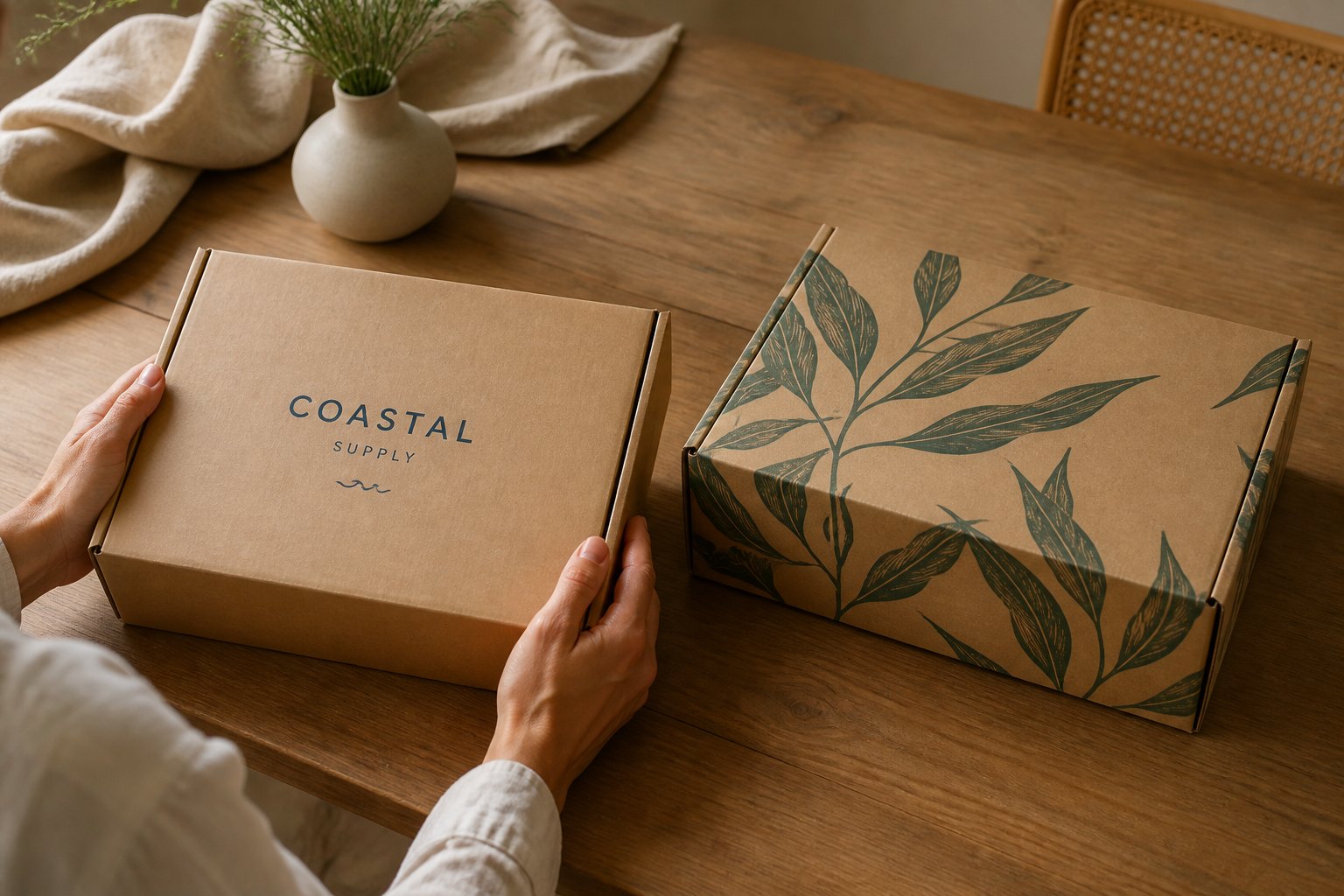
Custom kraft mailer boxes use flexographic printing, which presses one or two spot colours directly onto the natural brown board. Flexo is well-suited to this application: it handles clean logos, wordmarks and simple line art with consistency across a large run. It is not a good fit for anything requiring precise colour gradations, smooth transitions between tones, or light ink applied over a dark background.
That difference in method explains why this comparison is not simply “brown box versus coloured box”. It is a different printing relationship between ink and substrate, with different artwork rules, different run sizes, and different economics built in from the start.
What artwork works on each box
Full-colour boxes handle almost any artwork a brand might supply. Photography, detailed illustration, gradients, multiple brand colours, fine type at small sizes, reversed text out of a dark background: all of these reproduce cleanly on a white liner under CMYK. The practical limit is how well your artwork is prepared for print, not what the press can handle.
Kraft boxes are built around simplicity by design. One or two spot colours on unbleached brown board is the natural territory of this format. A clean black or dark navy logo looks striking on kraft. A two-colour wordmark works. Simple geometric patterns hold.
What does not work is equally important to understand before you order:
- Photography. The brown board absorbs lighter tones and muddles mid-tones. Photographic artwork does not reproduce on kraft.
- Gradients. Smooth transitions from one colour to another require CMYK. Flexographic spot printing cannot produce a gradient.
- Pale or light colours. Yellow, pink, light blue, or any colour lighter than the kraft board itself will not show clearly. The ink sits over the brown tone; it does not block it out.
- White ink. There is no white ink option in spot-colour flexo on kraft. If your design relies on white elements, full-colour printing on a white liner is the right choice.
This section matters most. Brands that choose kraft for the natural look and then supply artwork with gradients or light colours end up with a box that looks nothing like the design file. The artwork has to suit the process, not just the aesthetic.
Supply vector artwork (AI, EPS or SVG) for kraft spot-colour printing. Full-colour boxes accept PDF, SVG or Adobe Illustrator files with a 3mm bleed, dieline on the top layer, fonts outlined, and images embedded.
Sizes: where the two ranges differ
The Small size is the same for both ranges: 265 x 200 x 90mm internal (length x width x height). If Small fits your product, the dimensions are identical regardless of which option you choose.
Medium and Large differ between the ranges.
| Size | Custom Kraft (internal) | Custom Full Colour (internal) |
|---|---|---|
| Small | 265 x 200 x 90mm | 265 x 200 x 90mm |
| Medium | 300 x 230 x 115mm | 310 x 240 x 110mm |
| Large | 400 x 270 x 90mm | 425 x 295 x 110mm |
The differences are not large, but they matter if you have a product insert designed to a specific cavity size or a product that sits close to the boundary between sizes. The full-colour Medium is 10mm longer and 10mm wider than the kraft Medium; the kraft Medium is 5mm taller. They are not interchangeable.
The sizing guidance from both ranges: measure your product as it will be packed, including any tissue or padding, and allow roughly 15 to 25mm of clearance on each side. Custom sizes are available on request for either range if the standard options do not suit your dimensions.
Minimum order and lead time
This is where kraft loses the most ground for smaller or newer brands.
Full-colour boxes start at 10 units. That makes them practical for a product launch, a small-batch seasonal drop, a limited run, or a design test before committing to volume. Small-batch digital orders (10 to 250 boxes) ship in 3 to 7 working days from proof approval. If you need to get a design into customers’ hands quickly, or if you want to validate an unboxing experience before ordering at scale, that turnaround is a significant advantage.
Volume full-colour orders (500 and 1,000 boxes, offset-printed) take 2 to 3 weeks from proof approval, the same lead time as the kraft range.
Kraft boxes start at 500 units, with better per-box pricing at 1,000, 2,500 and 5,000. The lead time is 2 to 3 weeks from proof approval at every quantity. There is no small-batch or quick-turn option in the kraft range.
The practical consequence: if you are not confident you will move 500 boxes in a reasonable time, the minimum order makes kraft a high-commitment decision. If you are launching a new product, the 10-unit minimum on full-colour lets you test the box before scaling.
How cost scales at volume
Neither product page quotes a price without a quantity and size selection, and both pages carry a live calculator. Use that calculator for a real comparison at your specific quantity. What follows is the cost structure, not a number.
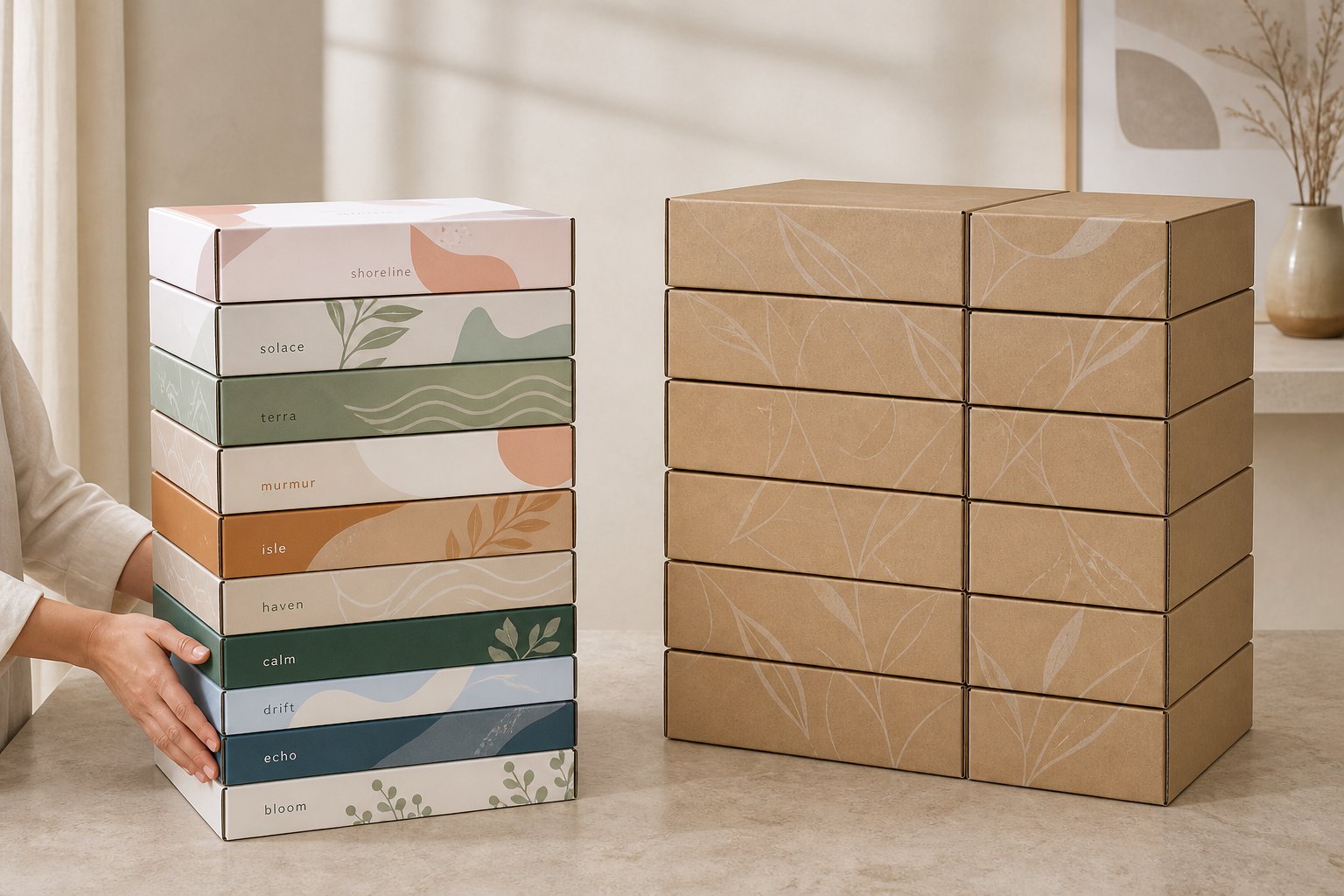
Kraft is cheaper per box than full colour at the same quantity. The reason is direct: one or two spot colours on unprinted board uses far less ink than CMYK edge-to-edge coverage on a white-lined surface, and there is no white-liner coating to account for. That cost gap exists at every comparable quantity point.
Setup cost is spread across the run for both processes. The plate or press setup is a fixed cost that does not change with quantity, so the per-box price falls at every quantity break. A run of 10 costs several times per unit what 1,000 does, for the same reason that any short print run costs more per copy than a long one.
The biggest single price step in full-colour is the press change. Small-batch digital (10 to 250) carries minimal setup but a higher per-box cost. Volume offset (500 and 1,000) carries real setup but a much lower per-box cost. The per-box price drops sharply between the 250-unit and 500-unit rungs because the press changes. That step is worth understanding before you stop at 250.
At equivalent volume (500 or 1,000 boxes), kraft will cost less per box than full colour. The trade-off is simpler artwork and the natural brown look. For brands where that look is the point, kraft delivers the lower unit cost. For brands that need CMYK reproduction, full colour is the only option regardless of the cost comparison.
Both pages carry a live calculator. Pick a size and a quantity and the per-box price updates as you go. That is the right tool for a real comparison.
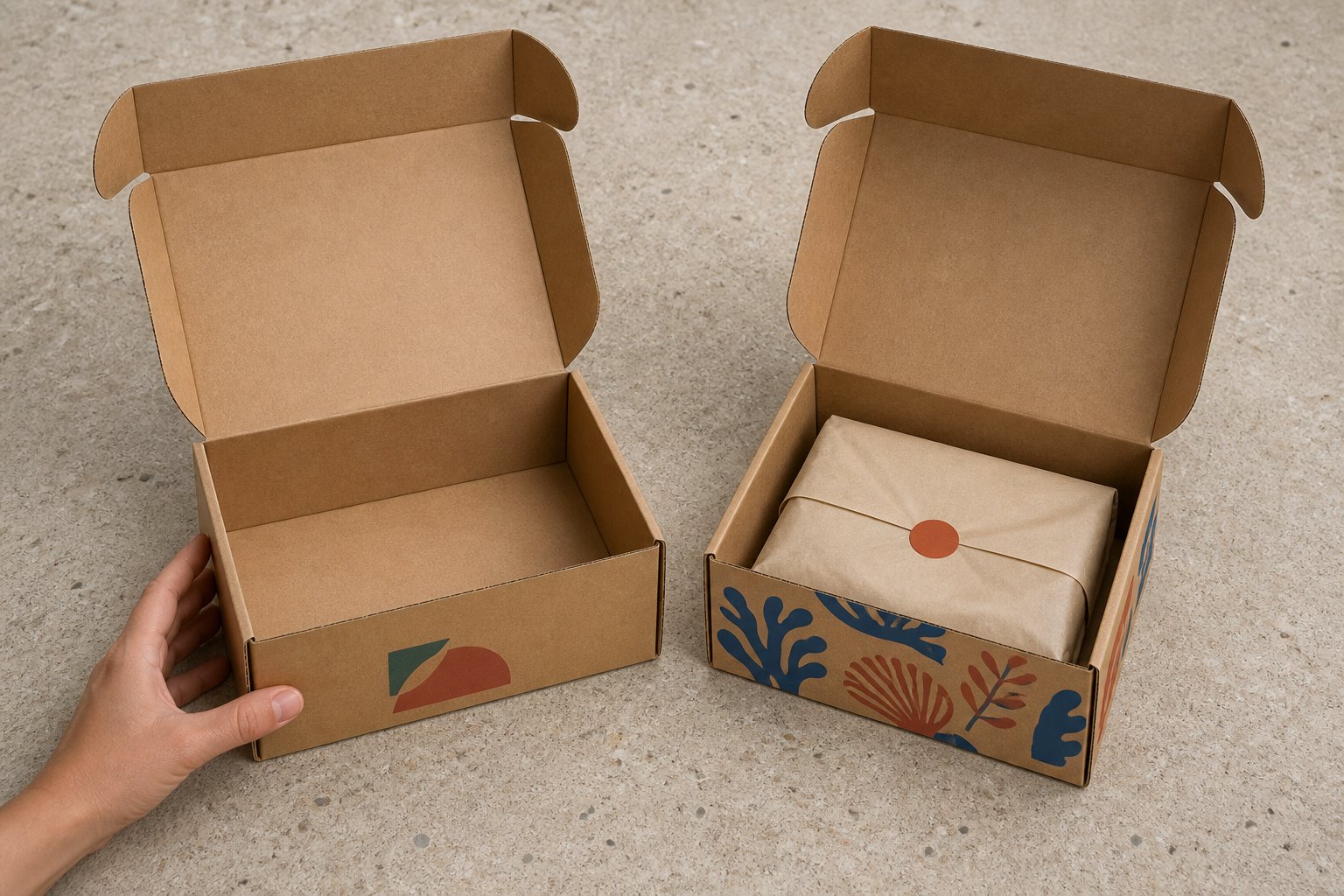
Brand fit and visual language
The material choice sends a signal before the customer opens the box.
Kraft reads as natural, considered and artisanal. It suits brands in food, wellness, homewares and independent maker categories, and any context where a clinical polish would feel at odds with the product inside. The brown board is not a limitation for those brands; it is part of the language. The uncoated surface also carries character as it moves through the supply chain in a way that tends to read as honest rather than damaged.
Full colour reads as intentional and brand-forward. It suits brands where the unboxing moment is part of the customer experience, where strong colour or complex visuals are central to the brand identity, and where the packaging needs to perform visually in a gifting or subscription context. The white liner keeps brand colours accurate regardless of what those colours are.
Neither is inherently the premium choice. A skincare brand with earthy tones can run kraft and look considered and expensive. A fashion brand with a bold graphic identity can use full colour and look exactly right. The choice is about alignment with the brand, not about a quality hierarchy.
Both ranges are B-flute corrugated, kerbside recyclable, and made in Australia. If sustainability is part of your brand story, it is worth understanding what recyclable actually means before making it a centrepiece of your packaging copy.
If you want to understand what B-flute means for crush resistance and transit performance, the article on corrugated flute grades covers the comparisons.
Choose kraft if / choose full colour if
Choose kraft if:
- Your logo or wordmark reproduces clearly in one or two dark spot colours
- Your brand identity is natural, artisanal or sustainability-led and the brown board fits the story
- You are ordering 500 or more boxes and the 2 to 3 week lead time works for your planning cycle
- Lower cost per box at volume is the priority and you are willing to work within the spot-colour artwork constraints
Choose full colour if:
- Your artwork includes photography, gradients, multiple brand colours, or any pale or light element that requires a white background to show correctly
- You need a small quantity for a launch, a seasonal drop, or a design test (as few as 10 boxes)
- You need boxes in 3 to 7 working days rather than 2 to 3 weeks
- Your brand colours need to reproduce accurately and vividly across every exterior panel
If you are still undecided, starting with custom full-colour mailer boxes at a small-batch quantity is the lower-risk move. The 10-unit minimum exists so you can test the box before committing to volume. Once you know the design works, scaling up is a straightforward decision.
For brands that have done the artwork check and confirmed their logo suits spot-colour flexo printing, custom kraft mailer boxes carry a live calculator where you can compare the per-box cost at 500, 1,000, 2,500 and 5,000 units.
For a broader look at packaging options and where cost sits across the range, the guide to packaging on a budget covers more of the decisions.
Frequently asked questions
Can I use the same artwork file for kraft and full-colour boxes?
Probably not without changes. Full-colour boxes use CMYK on a white liner and accept PDF, SVG or Adobe Illustrator files. Kraft boxes use flexographic spot printing on brown board and require vector artwork in one or two flat colours. Even if your logo is already a vector file, a file designed for CMYK output will typically include gradients, drop shadows, or light elements that cannot be reproduced in spot-colour flexo and must be removed or redrawn before the file suits kraft printing.
What is the minimum order for each box type?
Full-colour mailer boxes start at 10 units. Kraft mailer boxes start at 500 units.
Do the Medium and Large sizes match between the two ranges?
No. The Small is the same for both (265 x 200 x 90mm internal). Medium and Large differ. Full-colour Medium is 310 x 240 x 110mm; kraft Medium is 300 x 230 x 115mm. Full-colour Large is 425 x 295 x 110mm; kraft Large is 400 x 270 x 90mm. Check the exact internal dimensions before designing packaging inserts or committing to a cavity size.
How long does production take for each option?
Full-colour small-batch orders (10 to 250 units) take 3 to 7 working days from proof approval. Full-colour volume orders (500 and 1,000 units) and all kraft orders take 2 to 3 weeks from proof approval.
Can I print white on a kraft mailer box?
No. Spot-colour flexographic printing on unbleached kraft board does not include a white ink option. If your design requires white elements, full-colour printing on a white liner is the correct choice.
Is it possible to get inside printing on either box?
Inside printing is available on full-colour mailer boxes on request and adds 50% to the box price. Outside print on all exterior panels is included as standard. The kraft range is printed in one or two spot colours on the exterior panels; if you want inside print on kraft, ask our team to confirm it before you order.
Will kraft or full colour cost more at the same quantity?
Kraft costs less per box at an equivalent quantity because one or two spot colours on unprinted board requires far less ink and no white-liner coating. The exact difference depends on your size and quantity; use the live calculator on each product page to compare for your specific run.