Packaging claims have never been more creative. Open any supplier’s catalogue and you will find a dense thicket of eco-credentials: recyclable, recycled, compostable, biodegradable, carbon neutral, plastic-free, sustainably sourced. Some of these terms are precise and verifiable. Some are vague. Some are technically true in a narrow laboratory sense that has nothing to do with what happens to a parcel in a yellow-lid bin on a Tuesday morning in Frankston.
This article works through the key terms, explains what they mean and, more importantly, what they do not mean, and then focuses on the one claim that actually describes what happens to most corrugated mailer boxes in Australia: kerbside recyclable. It also covers why box design and box sizing are the two variables a seller directly controls that have the most practical impact.
If you are an online seller choosing packaging and you want to say something honest to your customers, this article helps you work out what you can actually say.
The short version
- Corrugated board is kerbside recyclable in Australia. That is the claim with the clearest, most practical meaning for a standard parcel box.
- “Compostable”, “biodegradable”, “recycled content” and “carbon neutral” are different claims that require different evidence. None follow automatically from “recyclable”.
- Plastic tape is the most common thing that turns a recyclable box into a recycling bin miss. A self-locking RETF box that closes without tape removes that variable entirely.
- Right-sizing your packaging is the biggest environmental lever most sellers actually control: an oversized box wastes board, requires void fill, and adds cubic freight weight to every single shipment.
- Uncoated natural kraft is a simpler, less processed material. Full-colour corrugated board is still kerbside recyclable. The two are not in different categories.
- Both our kraft and full-colour mailer boxes are made in Australia, which shortens the freight leg before they reach your packing bench.
What the terms actually mean: a plain-English table
The terms below appear most often on packaging supplier websites and in brand copy. Each has a real meaning, but that meaning is frequently stretched, softened, or misapplied. The table is the reference to keep before you write anything about your packaging for your customers.
| Term | What it actually means | What to check before using it on your packaging |
|---|---|---|
| Recyclable | The material can, in principle, be collected and reprocessed into a new material. This is a material property, not a guarantee that the item will actually be recycled. | Whether the item is accepted in the household yellow-lid bin, or only in a drop-off or take-back programme that most customers will never use. |
| Kerbside recyclable | The item can go in the household yellow-lid recycling bin and be successfully sorted and reprocessed through standard council-run material recovery facilities (MRFs). This is the most practically meaningful claim for a parcel box in Australia. | Whether the item is clean and uncontaminated. Plastic tape, heavy laminate, wet board and mixed materials can all cause MRF rejection even if the board itself is recyclable. |
| Recycled content | A percentage of the material came from previously used stock, typically post-consumer or post-industrial fibre. Recycled content and recyclability are independent properties: a box can have neither, one, or both. | The verified percentage and whether it is post-consumer or post-industrial. “Recycled” without a number or a verified source is not a meaningful claim. |
| Compostable | The material breaks down into non-toxic components under composting conditions within a defined timeframe. Industrial compostable and home compostable are different standards requiring different conditions. These are not the same thing. | Whether the item is certified to an Australian composting standard, and whether your customer has access to the right composting environment. Most corrugated board is not certified compostable, even though uncoated cardboard will break down in a pile over time. |
| Biodegradable | The material will eventually break down biologically. Almost everything biodegrades at some rate. Without a defined timeframe and a tested condition, “biodegradable” is not a meaningful environmental claim and is among the most scrutinised terms in the ACCC’s guidance on Australian green marketing. | The timeframe, the conditions required, and whether any certification backs the claim. “Biodegradable” on its own is unlikely to satisfy the ACCC’s requirements for a truthful and substantiated environmental claim. |
| Plastic-free | The packaging contains no plastic materials. As a description of a specific material fact (no plastic tape, no poly bag, no laminate), it is useful shorthand. As a certification, it is not standardised in Australia. | Whether you are describing a specific, verifiable material fact or using an umbrella term. Name the fact rather than the label: “no plastic tape required” is stronger and more honest than “plastic-free packaging”. |
| Carbon neutral | Emissions from producing and transporting the packaging are offset by equivalent reductions elsewhere. This requires a full lifecycle analysis and a recognised offset mechanism. It is a business-level claim, not a property of the box itself. | Whether you or your supplier holds a verified, current offset programme for the product’s full lifecycle. If the answer is unclear, the claim is not available. |
| FSC certified | The timber fibre was sourced from forests managed under Forest Stewardship Council standards. This requires maintained certification across the mill and the entire supply chain, not just a claim on a website. | Whether your supplier holds an active, current chain-of-custody certificate number for that specific product. Claiming FSC without a verifiable certificate is a misuse of the scheme. |
The practical takeaway: if you want to make an environmental claim about your packaging to your customers, “our boxes are kerbside recyclable” is the claim with the clearest, most verifiable practical meaning for a standard corrugated mailer box in Australia. Everything above it in ambition requires more evidence.
Why “kerbside recyclable” is the right claim for a corrugated box
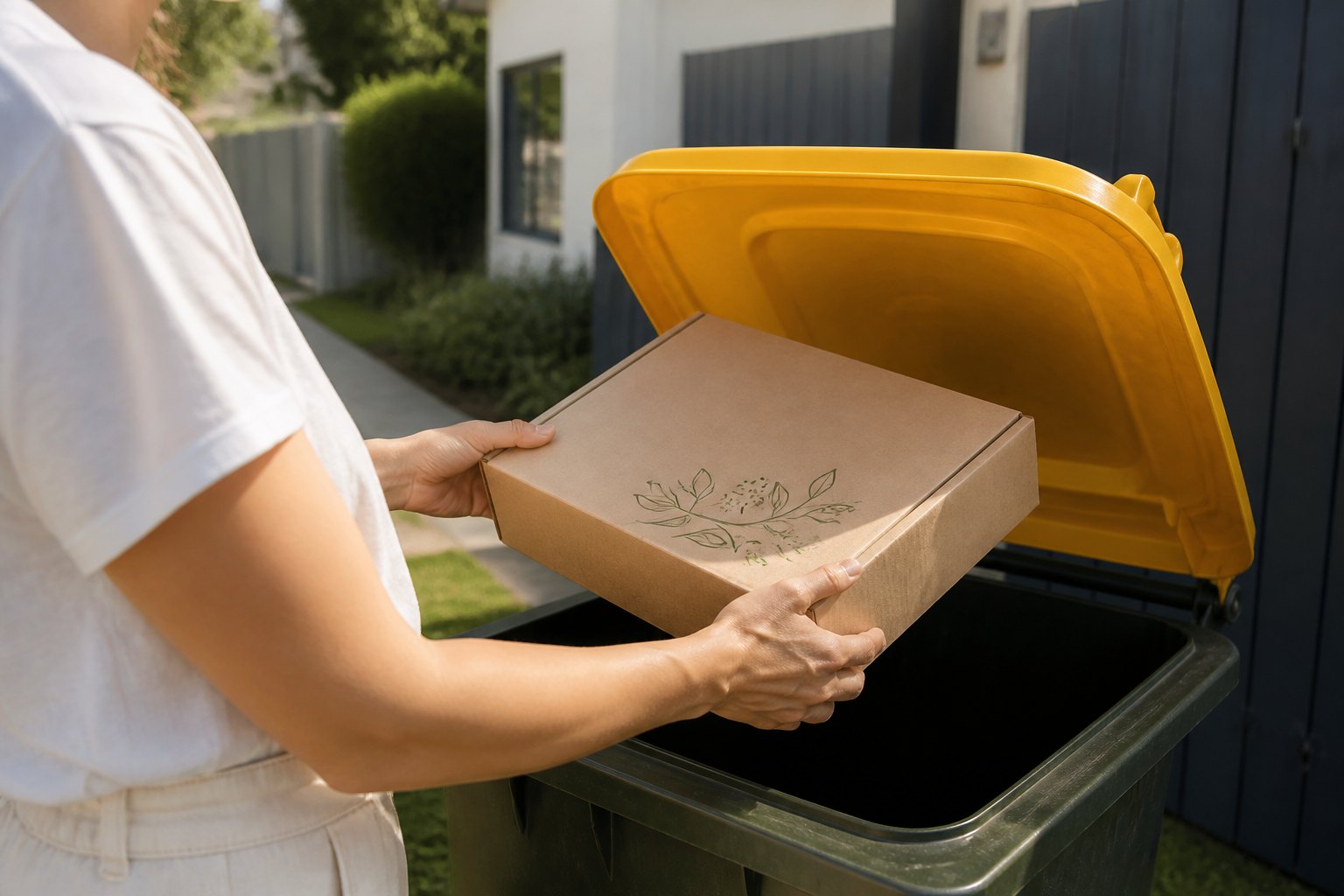
Corrugated board has been recycled through municipal collection in Australia for decades. When your customer puts an empty box in the yellow-lid bin, it goes to a material recovery facility where it is sorted, baled, and sent for reprocessing into new fibre products. The fibre recovery rate for corrugated board is strong compared with most other packaging materials. The infrastructure is in place and in use.
That is what makes “kerbside recyclable” the right claim for a corrugated mailer box: it is a description of where the box goes after it is used, through a system that already exists in nearly every council area in the country.
The claim is not unconditional. It applies to the box when your customer puts it in the bin in a clean, dry, uncontaminated state. Several common packaging choices work directly against it.
What stops a corrugated box being recycled in practice
A box being technically kerbside recyclable and a box actually being recycled are two different things. The gap between them is usually one of the following.
Plastic tape. Wide polypropylene packing tape is the most common issue. It cannot be cleanly separated from the fibre at a standard MRF. A single strip of tape across a closure seam is generally manageable. The problem is heavy, wide taping across multiple panels of a box. A box that has been fully strapped creates a contamination risk for the entire bale.
Heavy applied laminate. A corrugated box with a thick plastic film laminate on the exterior can be difficult to process in the same fibre stream as uncoated board. Standard surface printing on corrugated board does not cause this problem. An adhered plastic film layer does.
Wet or greasy contamination. Board that has been saturated or heavily contaminated is rejected by most MRFs because wet fibre degrades the output quality. The condition the box arrives in matters as much as what it is made of.
Mixed materials that cannot be separated. Foam inserts bonded to the board, polystyrene void fill left inside, or large plastic-film labels can all cause problems if a customer bins the whole assembly without separating materials.
The practical design question is: what removes the most likely failure points? Fewer materials, no plastic tape, no heavy laminate, and no contamination. A self-locking box removes the most common variable entirely.
The RETF design and the no-tape claim
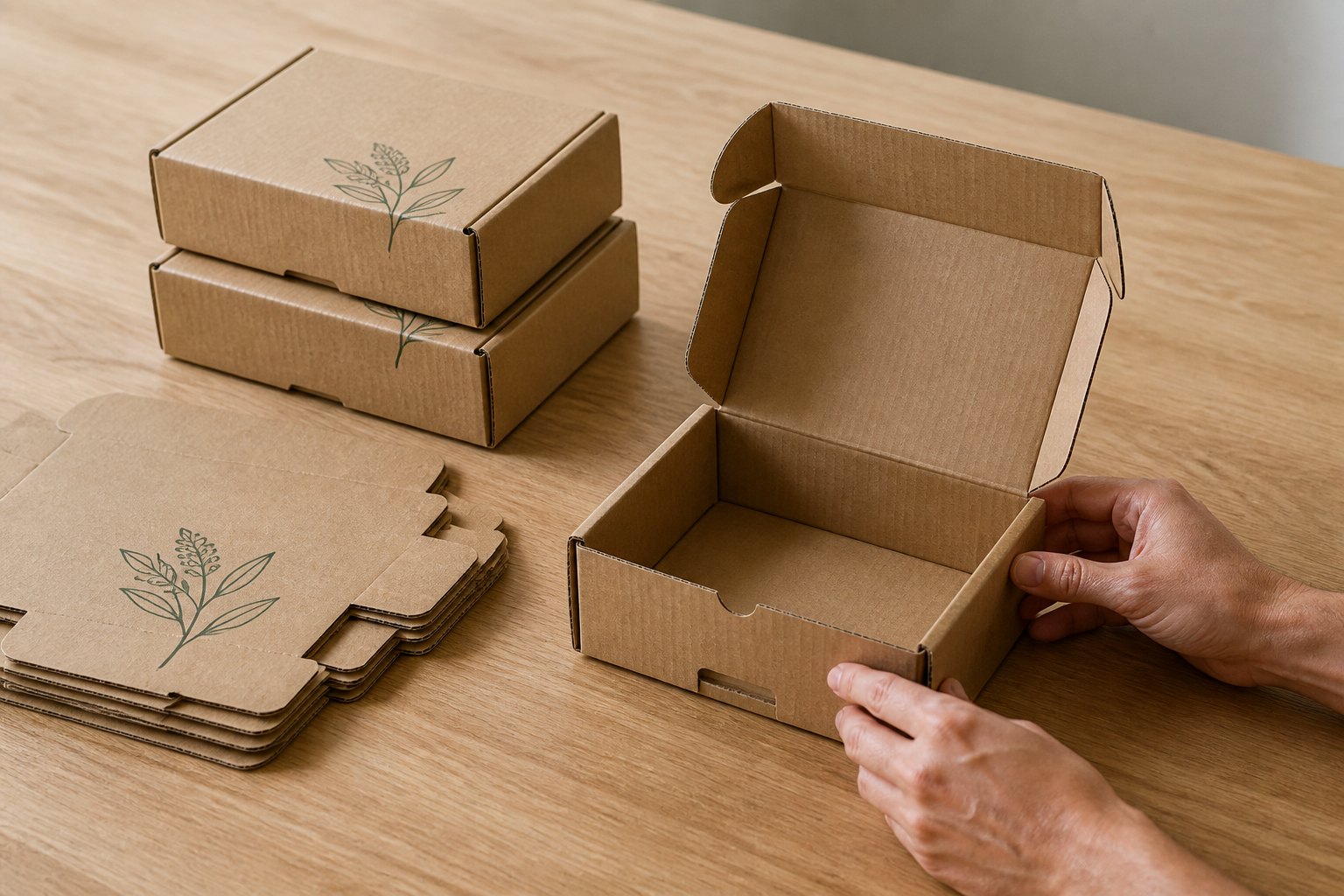
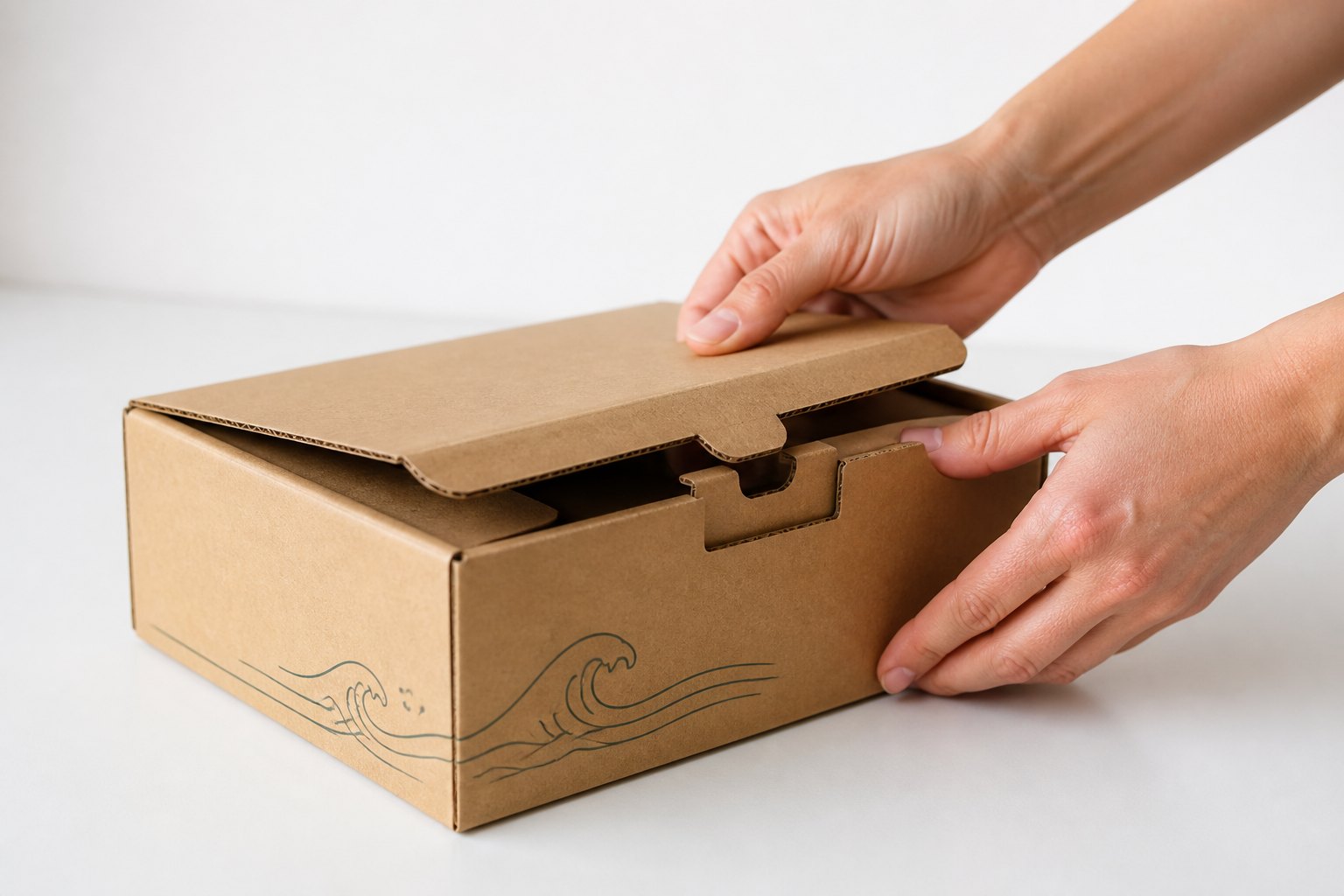
A roll end tuck front (RETF) box closes via a tuck-front flap that locks into the end panels without needing any adhesive or tape. The flap creates enough mechanical resistance to stay closed under normal handling, and your customer can open and reseal it cleanly.
This matters for the recycling claim in a specific way. If the box does not need plastic tape to stay closed during packing, you do not need to use plastic tape. That is a variable you directly control, and it is the one that most commonly degrades a corrugated box’s real-world recyclability. For items shipped through a carrier, a single strip of tape across the tuck-front seam is sensible to prevent the flap opening in transit. That is very different from wrapping a box in multiple rounds of polypropylene strapping.
The RETF format also ships and stores flat, which means far more boxes in the same storage footprint and fewer truck movements for the same volume of packaging. For your customer, a flat RETF box is easy to break down before recycling, and a flattened box takes up less bin space and is simpler for MRF conveyor systems to handle.
Right-sizing: the lever that is entirely in your hands
Packaging category descriptions are full of environmental language. What they rarely address is the most obvious question: are you using more box than the product needs?
An oversized box wastes corrugated board in manufacturing, adds cubic freight weight per item, and needs void fill to stop the product shifting. None of that extra material is doing any protective work. It is filling space that should not exist.
The right-sizing guidance on our product pages is to measure your product as it will be packed (including any tissue, padding, or inserts) and allow roughly 15 to 25mm of clearance on each side. That clearance is enough for the board to absorb a drop or corner impact. More than that, and you are burning board and freight for no protective gain.
Right-sizing also reduces cost per shipment: a correctly sized box is often a smaller size with lower board weight, and it may drop you into a lower quantity tier. The guide to packaging on a budget covers cost mechanics in detail, including how setup costs are amortised across a run and where the price per box changes most sharply.
If you are planning volume around peak season, the article on ordering ahead of Christmas covers Australian lead times and what to lock in before the November rush.
Kraft versus full colour: what the material difference actually is
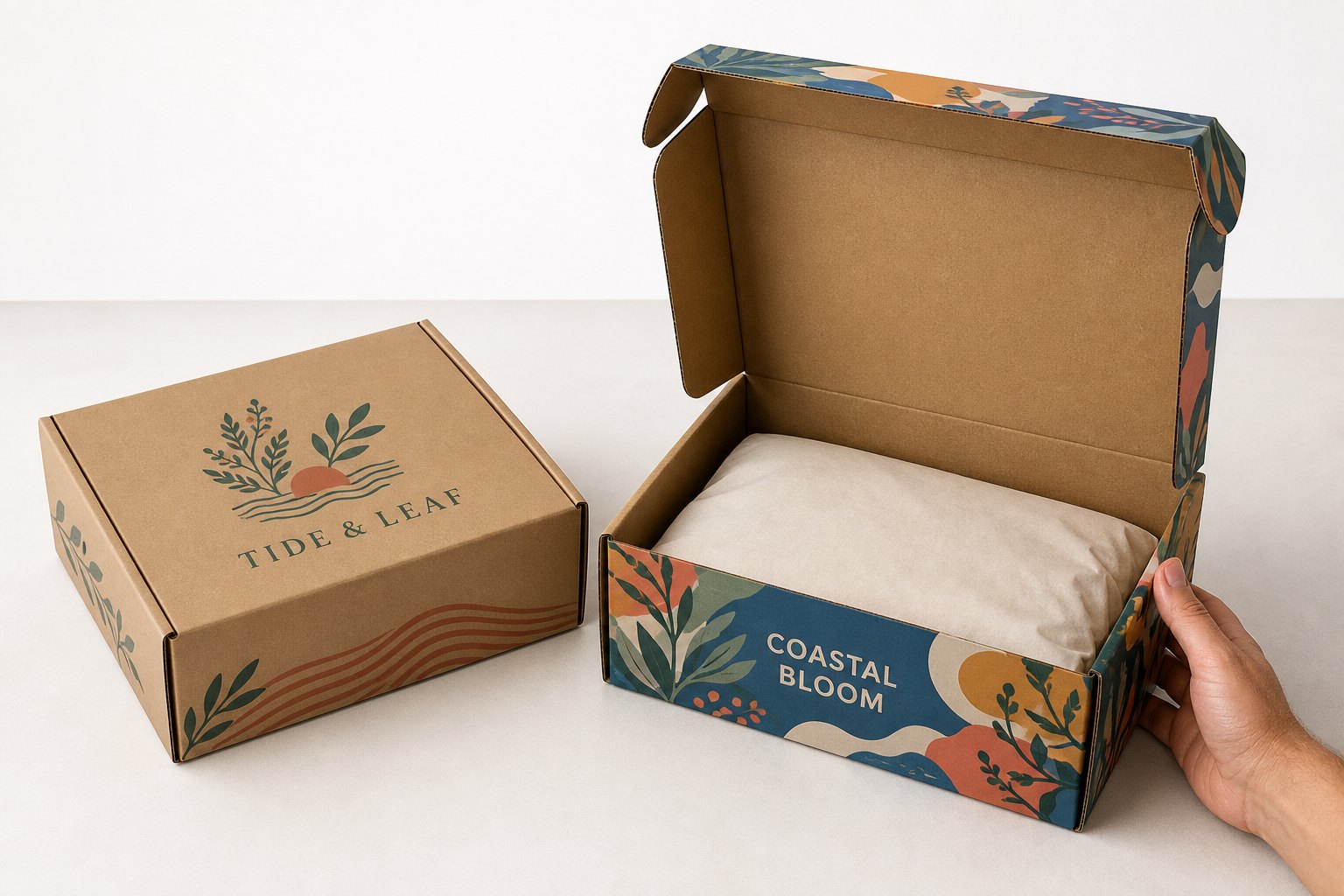
A natural kraft mailer box is made from unbleached brown corrugated board and printed in one or two spot colours using flexographic printing. Full-colour mailer boxes use a smooth white liner on the exterior panels as the base for edge-to-edge CMYK printing.
In recycling terms, both are corrugated board and both are kerbside recyclable in Australia. Full-colour CMYK printing does not prevent kerbside collection. If a supplier suggests kraft is “more recyclable” than full-colour corrugated, that is not an accurate claim.
Uncoated kraft is the simpler material. It has less print coverage, no white liner, and the natural brown board comes through as part of the design. That is why it reads as the more “natural” option: it is what the material actually looks like without a surface treatment applied. Brands that want their packaging to signal simplicity or a low-intervention aesthetic tend to choose it, and the signal is honest because it matches the material.
The design consideration for spot colours on kraft: ink colours sit over the brown substrate, so a deep navy on kraft reads differently to the same navy over a white-lined board. That is the aesthetic trade-off, and part of the look. Vector artwork performs best for spot-colour flexographic printing because edges stay crisp and consistent at scale.
For sellers choosing between the two, the honest framing is: kraft is a simpler, lower-coverage print on a natural substrate that signals that simply. Full colour gives you vivid, full-surface branding on a white-lined base. The recyclability is the same either way. For a direct comparison of artwork requirements, cost structure, and use cases, the article on kraft against full colour goes through both side by side.
If you want to look at the kraft option now, the custom kraft mailer boxes page carries the size and quantity options with a live price calculator.
What you can honestly say to your customers
The table above gives you the full breakdown, but the short version for an online seller deciding what to write is this.
You can say your box is kerbside recyclable. For uncoated kraft, you can specifically say it is easy to recycle through kerbside collection.
You can say the box is made in Australia. That is a factual statement about manufacturing location, not an emissions claim, but shorter supply chains are a real and honest thing to note.
You can say the box ships flat and needs no plastic tape to close, and explain why both matter at the recycling bin.
What you should not say, unless you have independently verified it, is anything borrowing the language of compostability, certified recycled content, carbon neutrality, or biodegradability. The ACCC’s guidance on environmental marketing makes clear these terms carry evidentiary requirements. Using them loosely is a compliance risk and a credibility risk with customers who read labels carefully.
The honest story for a well-chosen, correctly sized corrugated mailer box is already a good one. To see size and print options across both ranges, the custom mailer boxes in Australia category page carries live calculators for both kraft and full colour.
Frequently asked questions
Is corrugated cardboard actually recycled in Australia, or does it go to landfill?
Corrugated board has one of the stronger material recovery rates of any packaging type in the Australian recycling system. It is a valuable input fibre for reprocessing, and MRFs actively sort for it. The main reasons it ends up in landfill are contamination (wet, greasy, or heavily taped boxes), items that jam sorting machinery, or incorrect bin placement. A clean, flat, uncontaminated corrugated box in the yellow-lid bin is very likely to be recycled.
What is the difference between kerbside recyclable and just recyclable?
“Recyclable” means the material can be processed into a new material in principle, without specifying where or how. “Kerbside recyclable” means the item is accepted in the household yellow-lid bin and can be sorted and reprocessed through standard Australian council MRF systems. The kerbside qualifier is what matters for your customer, because it tells them exactly which bin to use and confirms the infrastructure is already in place at their location.
Does plastic tape on a box stop it being recycled?
Heavy polypropylene strapping tape applied across multiple panels of a box can cause problems at the MRF because it cannot be cleanly separated from the fibre. A single strip of tape at a closure seam is generally manageable. The safest outcome for recyclability is a self-locking design that does not need tape at all, or limiting tape to one closure strip if your carrier requires it for transit security.
Are full-colour mailer boxes less recyclable than plain kraft?
No. Both are corrugated board and both are kerbside recyclable in Australia. CMYK printing on a smooth white liner does not prevent the board from being recycled through standard kerbside collection. The difference between the two is in appearance and print process, not in recyclability. A supplier claiming kraft is “more recyclable” than full-colour corrugated is not making an accurate claim.
Can I say my packaging is eco-friendly?
“Eco-friendly” is not a defined or regulated term in Australia, which means it can be used broadly but also means it carries limited information for a customer trying to make an informed choice. The ACCC recommends being specific: name the attribute rather than using umbrella terms. “Kerbside recyclable”, “made in Australia”, “no plastic tape required” are all specific, verifiable statements. “Eco-friendly” on its own is harder to substantiate.