

Most brands discover the Christmas packaging crunch in October. By that point, the offset press queue is filling up, the comfortable design-revision window has closed, and the choice has already narrowed from “what suits our brand” to “what we can still get in time.” This guide was published in August because that is when a real plan still has room in it.
The critical fact, the one that changes the maths completely, is that production lead time starts at proof approval, not at order. The clock does not start when you place your order or submit your artwork. It starts the moment you sign off on a digital proof of your design. Every artwork revision before that approval, every day you take to review the proof, every back-and-forth on colour or layout, is time that sits outside the stated lead time. A three-week lead time with two weeks of pre-approval revisions is a five-week timeline.
This article works backwards from the two AU peak events that drive most e-commerce revenue: Black Friday in late November and Christmas dispatch in December. Both matter. A brand that only plans for Christmas has effectively already missed the bigger AU sales event, and their branded boxes will arrive in December when the campaign is over. If you are reading this in August, you are in the right place at the right time.
The short version
- Lead time starts at proof approval, not at order. Artwork revisions before that approval are entirely in your hands.
- Full-colour small-batch digital (10 to 250 boxes): 3 to 7 working days from proof approval.
- Full-colour volume offset (500 or 1,000 boxes): 2 to 3 weeks from proof approval.
- Kraft mailer boxes (500 and up): 2 to 3 weeks from proof approval.
- To receive a volume run before Black Friday, proof approval needs to happen by late October. September is safer.
- Peak is when every other brand is also ordering. Allow extra lead time during September through November.
- Check your carrier’s published Christmas cut-off dates and plan your dispatch schedule behind them.
The fact that changes everything: proof approval starts the clock
When you order custom-printed mailer boxes, a digital proof is emailed to you after we receive your artwork. That proof is your chance to check colours, layout, dimensions, and logo placement before anything goes to press. We do not print until you approve it.
The lead time window opens the moment you send back your approval. Not before. A brand that orders in early September but spends three weeks cycling through artwork revisions does not get three weeks refunded to their delivery date. They arrive at proof approval in late September and the clock starts there.
This matters most during peak planning because the temptation is to start a job and assume the timeline is running. It is not running until the proof is approved. The most reliable thing you can do for your Christmas packaging plan is treat “proof approved by” as the hard deadline in your calendar, and then schedule backwards to your artwork submission date from there.
As a practical guide, allow one to two weeks between “artwork finalised” and “proof approved” to give yourself at least one revision round without pressure. If your artwork is already print-ready in the correct format, that window can compress. If you are starting from a rough logo and no dieline, it needs to be longer.
Lead times by format
These are the production lead times for custom corrugated mailer boxes, all stated from proof approval.
| Format | Quantities | Lead time from proof approval |
|---|---|---|
| Full colour digital | 10, 25, 50, 100, 250 | 3 to 7 working days |
| Full colour offset | 500 or 1,000 | 2 to 3 weeks |
| Kraft spot colour | 500, 1,000, 2,500, 5,000 | 2 to 3 weeks |
Full-colour digital and offset runs are printed on different presses. Digital has virtually no setup cost and a fast turnaround, which is why it suits quantities from 10 upward. Offset carries real press setup but produces the crispest result at the lowest per-box cost, which is why it only makes sense above 500 boxes. The per-box cost drops substantially between the 250 rung and the 500 rung precisely because the press changes.
Our product pages note that peak periods such as Christmas may extend lead times. This applies to both presses. Plan behind the upper end of each range during peak, not the lower end.
If your Christmas pack includes printed tissue, plan that leg separately. Branded tissue paper runs to a 16 to 18 working day production window from artwork approval, longer than either box press, so a seasonal design should be approved 5 to 6 weeks out rather than alongside the box.
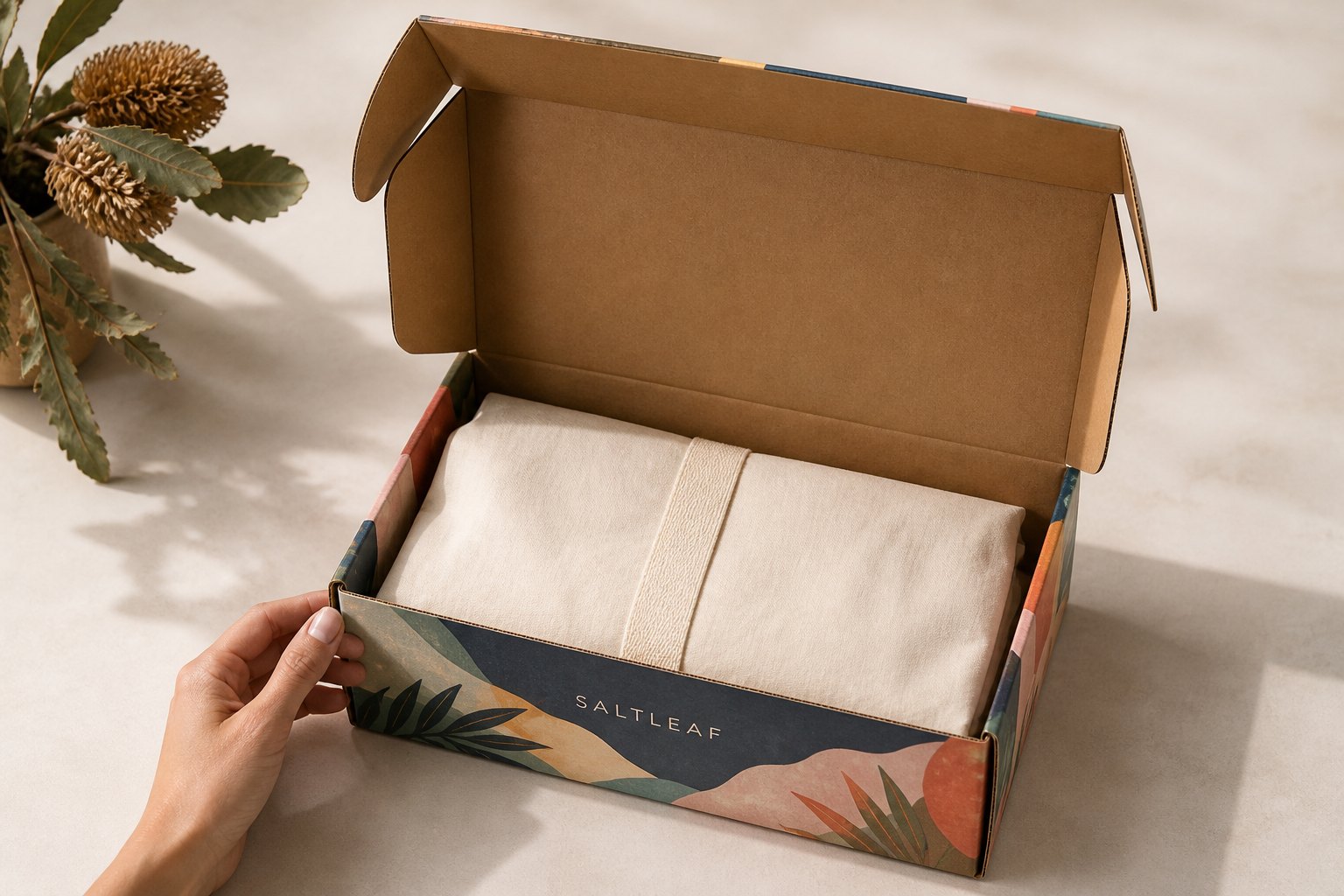
Counting back from Black Friday and Christmas
The table below maps the key planning dates for each peak event. Freight transit time is not included, because it depends on your carrier, your destination, and conditions on the day. Add your own transit estimate and verify your carrier’s published Christmas cut-off dates separately. The dates below are derived from the lead times in the table above plus a seven-to-ten day packing buffer before each event.
| Event | Packing window | Production complete by (volume/kraft) | Proof approved by (volume/kraft) | Proof approved by (digital, up to 250) | Artwork submitted by |
|---|---|---|---|---|---|
| Black Friday (late Nov) | 18 Nov onward | Early to mid November | Late October | Early to mid November | Mid October (volume) / Late October (digital) |
| Christmas dispatch (mid Dec) | 10 Dec onward | Late November to early December | Mid November | Late November to early December | Late October (volume) / Mid November (digital) |
Note on “production complete”: this is when boxes leave production, not when they arrive with you. Add your freight transit time on top. During the Christmas peak, carrier networks are under their heaviest load of the year. Do not assume standard transit times apply unchanged between late November and mid December.
For carrier cut-off dates: these are set by each carrier and published fresh each year. Check the current schedule from your carrier before you lock in your dispatch calendar. Plan your last dispatch date behind their published cut-off, not against it.
The four buffers most plans miss
Artwork revision time. As above: proof approval is the start of production, not the start of planning. Budget one to two weeks between “artwork ready” and “proof approved,” and treat that window as a calendar commitment, not a rough estimate. If your designer is also busy in October, that window needs to land earlier.
A small trial run before the volume order. If you are ordering 500 or 1,000 boxes with a new design, a small digital batch of 10 to 25 boxes is worth running first. You receive the finished box in your hands, check that the internal dimensions fit your product as packed, and confirm the artwork looks right at full scale before committing to the full run. Digital (3 to 7 working days from proof approval) and offset runs print slightly differently because they use different presses, so a small-batch digital run is an accurate preview of a digital result, not an exact preview of the offset result. Even accounting for that, you will confirm fit, finish, and first impression before the volume run goes to press. Build this into your schedule: a small trial run needs its own proof-approval cycle, typically three to five weeks before your main order deadline.
Freight transit within Australia. Once production is complete, boxes need to travel from production to your packing location. Flat-packed corrugated boxes are efficient to freight, but transit from production to a Melbourne or Sydney warehouse, or further to Queensland, South Australia, or Western Australia, adds days to your timeline. Regional destinations take longer. During November and December, freight networks are at capacity. Treat “boxes in hand” and “production complete” as two separate dates in your plan.
Peak-season congestion on both sides. The production queue and the freight network are both under maximum load during the same window. Ordering in September when others have not yet started is consistently less stressful and more reliable than ordering in late October when every other brand has also reached their deadline. The lead time window is the same either way. The experience is not.
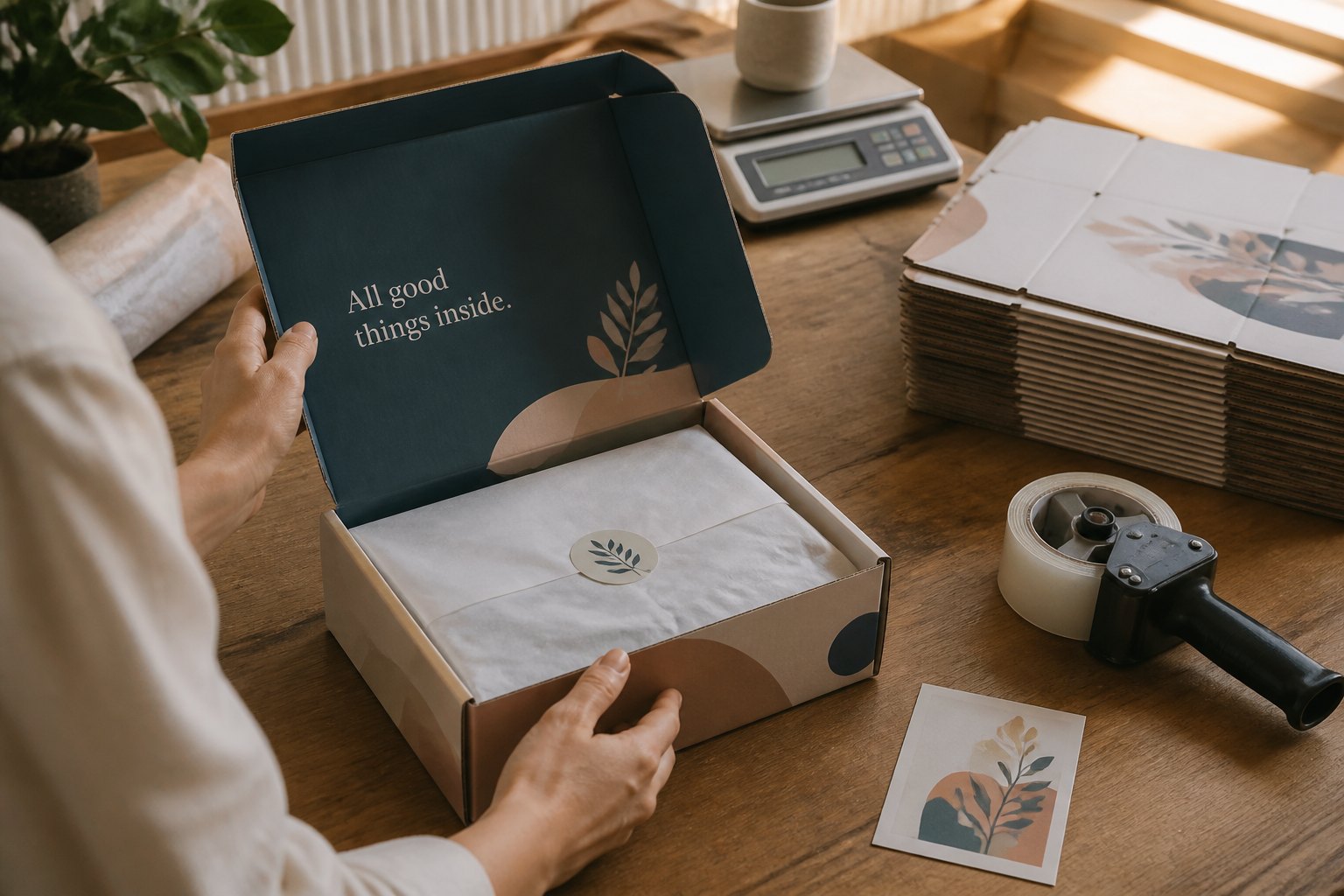
Your month-by-month ladder
August – the most comfortable position you will have. This is the time to lock in your design and artwork. If your brand packaging is not yet designed, commission it now. If you have existing artwork, confirm it is in the correct format: PDF, SVG, or Adobe Illustrator, with 3mm bleed, all fonts outlined, all images embedded, and a dieline on the top layer. August is also the right time to run a small digital batch (10 to 25 boxes) as a physical proof of your design before you commit to volume. If you are not yet sure about quantity, read our guide on how many boxes to order before you lock in a number for the volume run.
September – get the volume order moving. For a run of 500 or more boxes (full colour or kraft), proof approval in September gives you production completion in mid to late October, freight transit time in late October, and boxes in hand comfortably before Black Friday. This is the target window for any brand planning a full-season volume run. If your artwork is still in progress, make finalising it your immediate priority. Submitting imperfect artwork and revising through the proof stage is faster than waiting until the artwork is perfect before you start. The proof stage exists for that feedback loop.
October – options are narrowing. If you are in early October, a volume run can still land before Black Friday if you approve your proof immediately and move without delays. If you are in mid to late October, a volume run before Black Friday is unlikely. The realistic path is a digital small batch (up to 250 boxes, 3 to 7 working days from proof approval) to cover the Black Friday campaign, with the volume run landing in December for Christmas. For what a supplier needs to quote you on a volume run, have your confirmed dimensions, quantity, and print-ready artwork available before you reach out.
November – small-batch digital is your only realistic option for Black Friday. A batch of up to 250 full-colour boxes with proof approval in the first week of November can still arrive before the Black Friday weekend. After that, the Christmas dispatch window becomes the new target, and even then you are working within tight margins for a volume run. If your budget has also narrowed because the peak window is nearly here, our packaging on a budget guide covers the trade-offs between format, quantity, and cost.
Why Black Friday matters more than you might think
Most AU brands plan packaging around Christmas. Fewer plan specifically for Black Friday. The practical gap is significant: Black Friday sits four to five weeks before Christmas, and for most e-commerce categories in Australia it now generates more concentrated revenue than Christmas week. A brand that only plans for Christmas dispatch is using plain or generic packaging for the biggest sales weekend of the year, then switching to branded boxes in December when the volume is lower.
The other reason Black Friday is harder to plan for is the tighter countback. To receive a volume run before Black Friday in late November, proof approval needs to happen in late October. That is the hard date. It does not slide with wishful thinking. By contrast, Christmas dispatch gives you until mid November for proof approval on a volume run, which creates more room but is still a November commitment, not a December one.
Publishing this guide in August was deliberate. For a volume run targeting Black Friday, August is not when the planning needs to finish. It is when the planning needs to start.
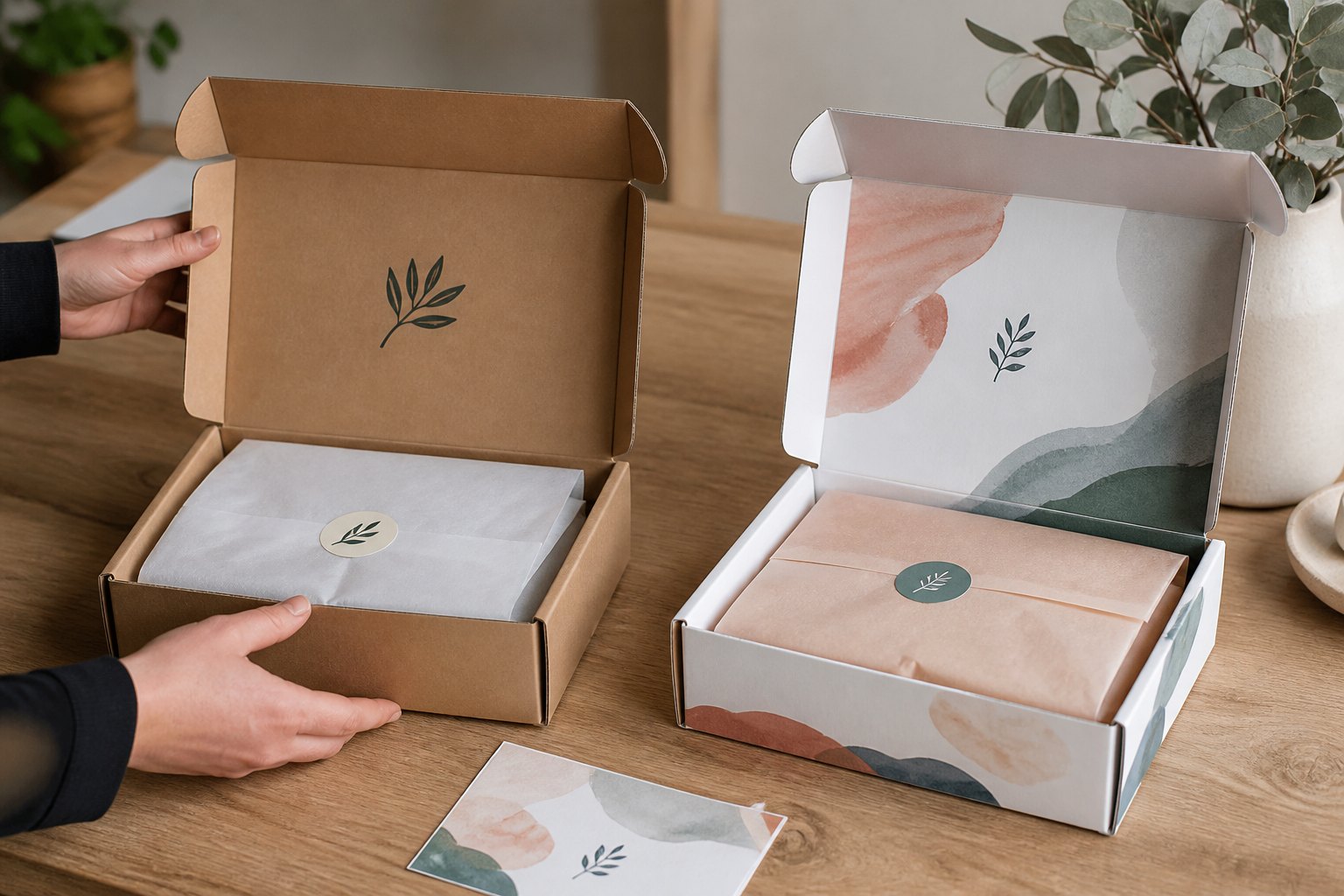
Kraft or full colour for your peak run
The format choice affects design flexibility more than it affects lead time. Both full-colour offset and kraft boxes run at 2 to 3 weeks from proof approval for volume orders, so neither has a production-time advantage over the other for peak season planning.
For brands whose visual identity suits a simpler palette, kraft mailer boxes are printed in one or two spot colours using flexographic printing on natural unbleached brown board. The board itself is part of the aesthetic: logos, wordmarks, and line art in black, white, or a single brand colour sit over the natural kraft tone. If your brand identity works in that register, the result is clean and direct. Unbleached kraft corrugated is easy to recycle through kerbside collection, which matters to a significant portion of Australian shoppers. The minimum order is 500 boxes.
Full-colour boxes print edge to edge in CMYK on a smooth white liner, so your full palette, photography, detailed illustrations, and any text-heavy panels all reproduce with accuracy. The small-batch digital option starts at 10 boxes, which makes it practical for a limited-edition Christmas design, a product launch, or testing a design before a volume run. The volume offset option (500 or 1,000 boxes) gives you the lowest per-box cost and the crispest print result.
Both options ship flat-packed, which keeps freight costs lower than shipping assembled boxes and makes storage before peak straightforward.
Start with the basics
The most useful action today is to confirm two things: the box size that fits your product as it will actually be packed (measure the product including any padding or tissue, then allow roughly 15 to 25mm of clearance on each side), and whether your artwork is print-ready or still in progress. Those two answers determine which timeline applies to you.
For a side-by-side view of both formats with live per-box pricing, the custom mailer boxes in Australia category page carries both products and the live calculator. Pick a size and quantity and the per-box cost updates as you go.
Frequently asked questions
How far in advance should I order Christmas packaging in Australia?
For a volume run of 500 or more boxes, aim to have your proof approved by late October for Black Friday delivery or by mid November for Christmas dispatch. Both of those proof-approval dates require artwork to be ready and submitted one to two weeks earlier. For a small digital batch of up to 250 full-colour boxes (3 to 7 working days from proof approval), the December dispatch window stays open into late November for Christmas, but the Black Friday window closes in early November.
When does the production lead time actually start?
It starts when you approve the digital proof, not when you place the order. A digital proof is emailed to you after we receive your artwork. Any revisions you request and the time you take to review are outside the lead time window. For peak-season orders, treat proof approval as the hard calendar deadline and count your artwork submission date backwards from there.
What is the lead time for kraft mailer boxes?
Kraft mailer boxes have a production lead time of 2 to 3 weeks from proof approval. The minimum order is 500 boxes. During peak periods such as Christmas, build in additional time above the standard lead time rather than planning against the lower end of the range.
Can I order a small trial batch before committing to a volume run?
Yes. Full-colour digital boxes are available from 10 to 250 boxes, with a lead time of 3 to 7 working days from proof approval. A trial batch of 10 to 25 boxes lets you assess the finished box in your hands before committing to 500 or more. Note that digital and offset runs print on different presses, so the small-batch digital result is an accurate preview of a digital print outcome, not an exact preview of the offset result.
Do lead times change during the Christmas peak?
Our product pages note that peak periods such as Christmas may extend lead times beyond the standard range. Plan against the upper end of the lead time window during September through November, and wherever possible approve your proof earlier in the season rather than later.
What are the last cut-off dates for Christmas delivery in Australia?
Carrier cut-off dates are set by each carrier and published fresh each year. Check your carrier’s current Christmas schedule and plan your dispatch window behind their stated cut-offs. Do not assume the standard transit times from earlier in the year apply unchanged during the December peak.
Is the lead time the same for all box sizes?
Yes. The small, medium, and large internal sizes within each format have the same lead time. What varies is the quantity tier: small-batch digital (10 to 250 full-colour boxes) runs at 3 to 7 working days from proof approval, while volume offset (500 and 1,000 full-colour boxes) and all kraft quantities run at 2 to 3 weeks from proof approval.