A kookaburra lands on the fence post, a banksia cone opens by the front path, and you want to know whose hand put them on paper. Two names do most of that work. Ellis Rowan carried her watercolours into the bush and painted wildflowers where they grew, and John Gould turned the country’s birds into a printed record in seven volumes.
What follows follows both of them: Rowan’s travels and the flowers she painted on the way, the volumes Gould issued between 1840 and 1848, the drawings his wife and Henry Constantine Richter made for them, and then the practical part, which is how a botanical illustration or a bird plate behaves on a modern wall and where our own prints come from. The shop talk stays at the end.
The short version
- Ellis Rowan (1848 to 1922) painted wildflowers in the field as she travelled, and took up birds late in life.
- The Commonwealth bought 947 of her paintings in 1923, and the National Library of Australia holds most of them today.
- John Gould’s The Birds of Australia ran to seven volumes and 681 plates between 1840 and 1848, each plate coloured by hand.
- Elizabeth Gould drew 84 of those plates before her death in 1841, and Henry Constantine Richter took on most of what remained.
- Botanical and bird plates settle down when they share a size and a frame style, whether in a row of three or a larger grid.
- Our prints come from public collection files, cleaned but never repainted, and every piece is printed in Australia.
Ellis Rowan took her watercolours into the field
Marian Ellis Ryan was born in Melbourne in 1848 and died in 1922. Her marriage in 1873 to Frederic Rowan, a soldier in the British army, gave the paintings the name they carry. Wildflowers filled her working life, along with insects and butterflies, and birds came late, including on her travels. Her method was to go to the plant and paint it where it grew, which took her right across Australia: six trips to Queensland, and twice to Papua and New Guinea between 1916 and 1918. Melbourne’s 1888 Centennial International Exhibition gave her its highest honours.
In 1923 the Commonwealth government bought 947 of her paintings from her sister, Blanche Ryan. In 1933 the collection passed to the institution we know today as the National Library of Australia, which cares for 919 of them, because some went missing after being lent out. That is the body of work behind the name: not a few pleasant sheets but a record of the country’s flora made on the road, in watercolour and gouache, between 1870 and 1920. Our Ellis Rowan prints take their files from public museum and library collections, and every piece is printed in Australia.
The wildflowers she brought back from the bush
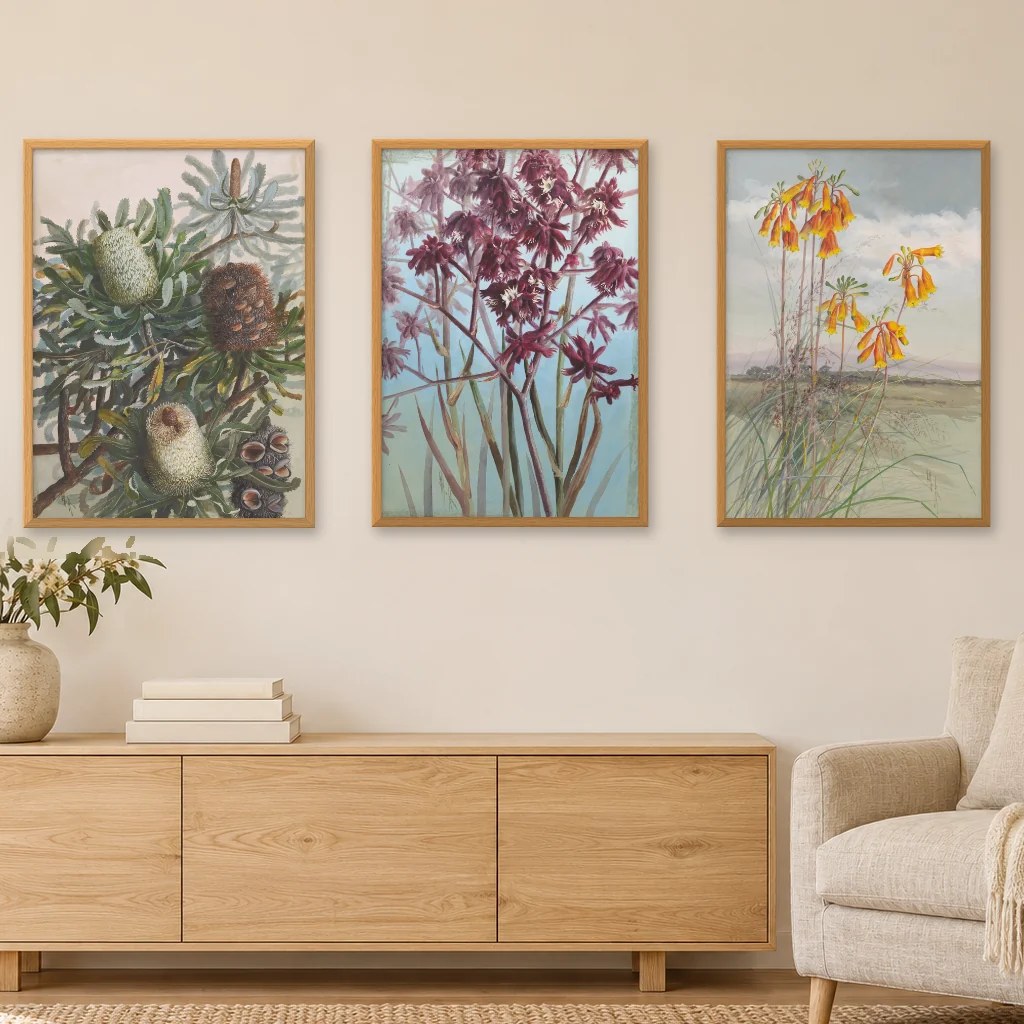
The wildflower sheets named below were painted in the 1880s, one of them about 1885, and each one solves a different problem: contrast, distance, weight, colour. Taken as a set they are a short course in botanical illustration carried out in the open air, and several carry the plant’s common name as their title. Six are worth knowing by name.
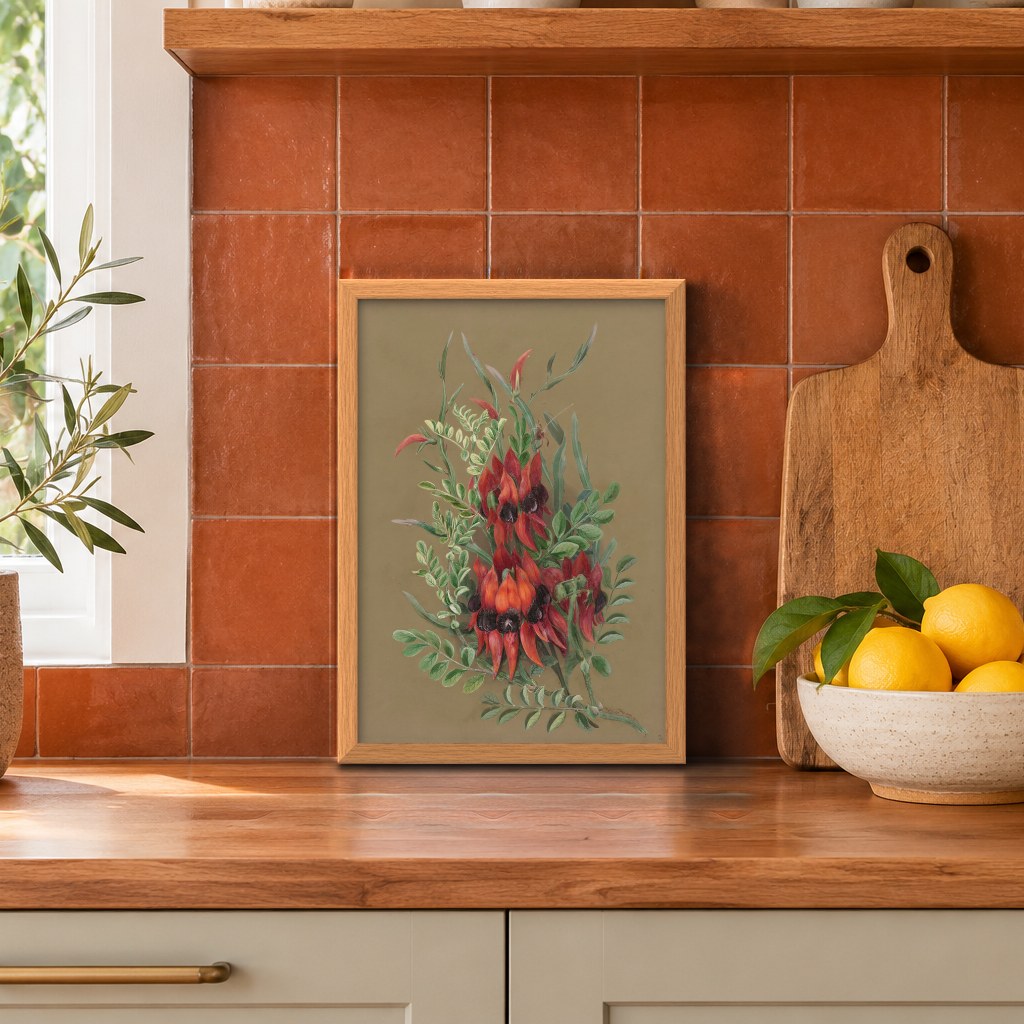
- 1880s: Sturt’s Desert Pea puts scarlet flowers with black centres against an olive-brown ground, and that dark backing is what pushes the red forward.
- 1880s: Golden Wattle lifts clusters of yellow balls over slender grey-green foliage, with distant gums dissolving into a pale blue-grey haze.
- 1880s: Old Man Banksia pairs pale cream flower heads with a dark brown cone and woody pods, and a grey-blue spike tops the branch.
- 1880s: Red Kangaroo Paw hangs dark maroon, tubular flowers from tall stems, and a pale blue background stops the plum tones turning heavy.
- 1885: Christmas Bells carries orange-yellow bell flowers above grass and a flat line of distant trees under a cloudy sky.
- 1880s: Gymea Lily gathers spidery pink and crimson flowers into a broad dome, grey-green strap foliage spreading beneath it.
John Gould put the birds of Australia on stone
John Gould (1804 to 1881) brought out The Birds of Australia across seven volumes, from 1840 to 1848. Across those volumes sit 681 plates, every one a hand-coloured lithograph, and the work ran in two stages. A drawing went onto stone and printed in black. After that, a colourist worked over each impression in watercolour, one sheet at a time.
The drawings came from more than one hand. Elizabeth Gould, John Gould’s wife, drew 84 of the plates before she died in 1841, and Henry Constantine Richter supplied most of the others. Both names belong beside his on any account of the book.
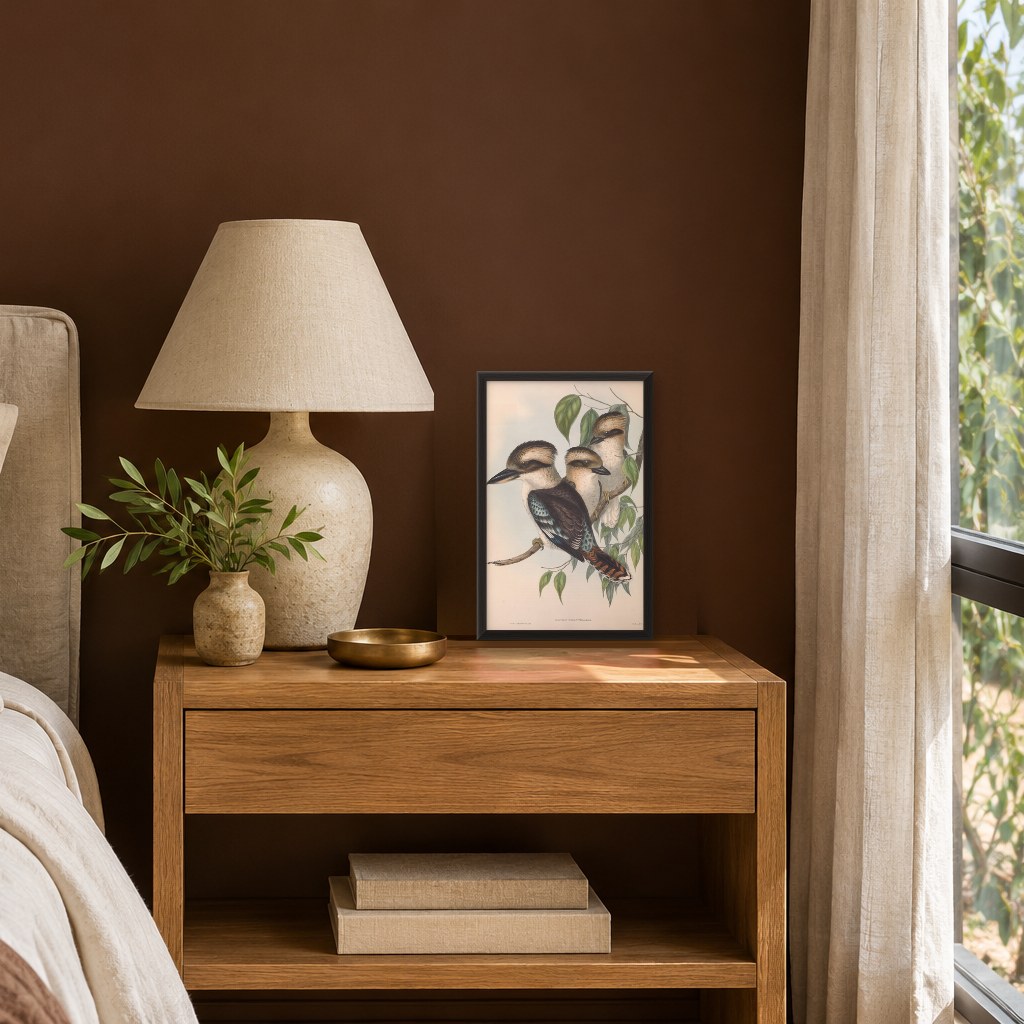
The Gould plates in our range come from this book. The Laughing Kookaburra places three birds on a bare branch, a spray of pale green leaves to one side, lettered DACELO GIGANTEA and published as Great Brown Kingfisher. The Galah shows two birds on a green-leaved branch under a soft blue-grey sky, lettered CACATUA ROSEA. A third, the Superb Fairy-wren, is lettered MALURUS CYANEUS. All three date from 1848, and the scans behind them come from a printed copy held by the Smithsonian Libraries and Archives.
How the mammals of Australia followed the birds
The Mammals of Australia came in three volumes between 1845 and 1863, with 182 hand-coloured plates. Henry Constantine Richter drew the plates and prepared them for stone, using studies and watercolours made by John and Elizabeth Gould. Elizabeth had died in 1841, so her share came from work already on paper, and Richter’s hand carried the project through to print.
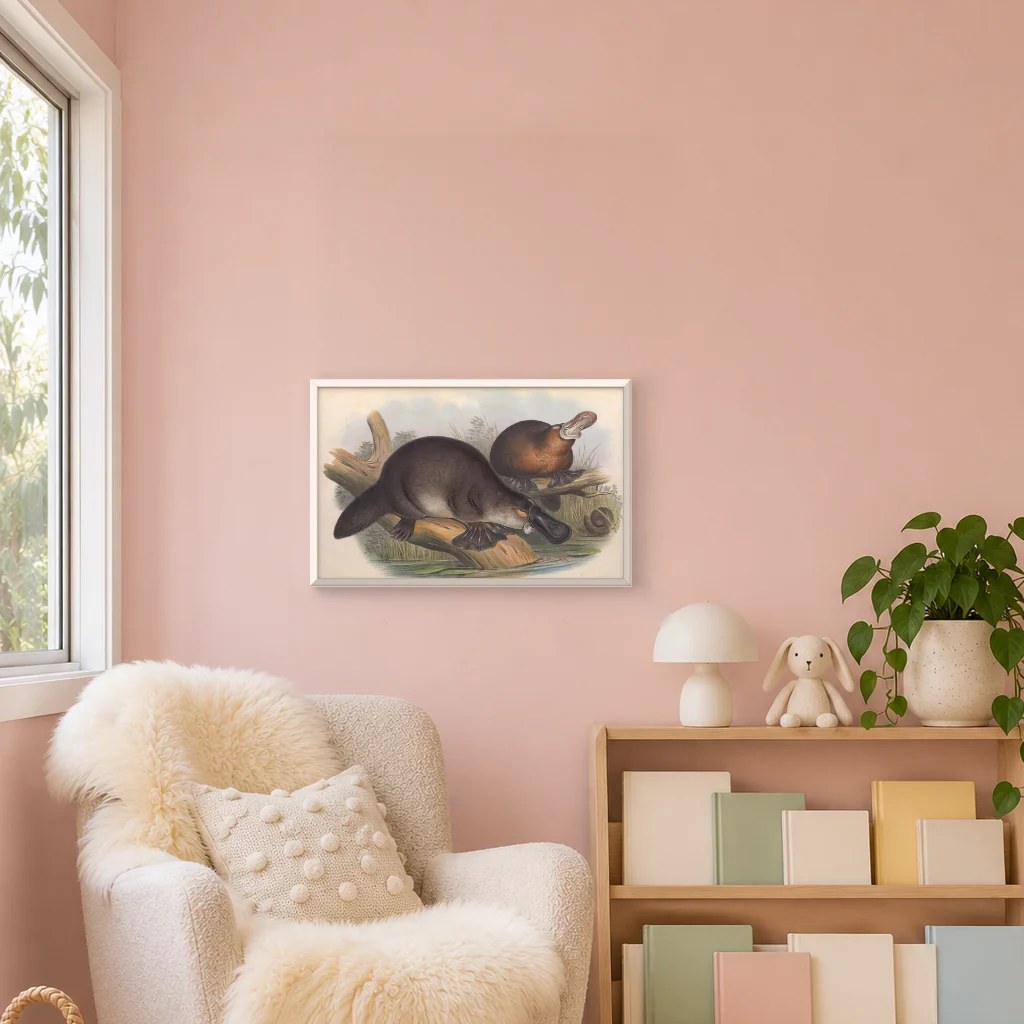
Three mammals from that project are in our range, all dated 1863 and attributed to a pair of makers, John Gould working with H. C. Richter, with the originals held by Smithsonian Libraries: a koala, a platypus and a wombat. Each behaves differently on a wall. The koala, one animal alone on a plain ground, scales down without losing its point, so it suits the narrow strip above a dresser. The platypus reads at almost any size and can carry a wall by itself. The wombat rewards room around it, hung at roughly the height of a seated eye.
Hanging botanical illustration and bird plates in one room
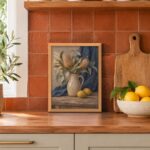
A row of three above a sideboard, or a grid on a longer wall, holds together when each print matches the others in size and frame. Mixed sizes and mixed frames turn a set into a jumble, and the eye spends its time sorting edges instead of pictures. Pairing botanical illustration with a bird plate is a matter of taste rather than rule, and the two kinds of picture hang side by side without one drowning the other. Rowan worked on sheets that are mostly upright and close to A-series proportions, so A3, A2 and a 50 x 70 cm framed print are the natural fits. The kitchen takes wattle and kookaburra, where a bright yellow and a strong brown have to hold their own against jars, tiles and a kettle.
A watercolour is the one case where a frame can get in the way. Left out of a frame, an art print lets a Rowan sheet speak for itself: the brush marks carry the picture, and a frame line would cut across them. Grouping suits vintage botanical prints just as well, and one size across the set reads as a decision rather than an accident. The vintage bird and botanical prints in our range gather Gould plates beside work by Audubon, Redoute, Haeckel and Merian, and each page names the source institution or reads public domain.
How our prints are made, from file to sheet
Every piece in the range starts with a file from a museum, a library or a public image archive, and the works are old enough that copyright has expired in Australia. We clean each file for dust, marks and colour cast, then correct the balance. No part of the picture is retouched or redrawn; the work stops at cleaning. Where the old paper is warm and a little uneven, it stays that way, because that tone is part of what you are looking at.
The collections holding the originals have no hand in these prints, and each artwork page carries a credit line that names the institution where our records do and otherwise reads public domain. Three formats carry the range. An art print uses 200gsm archival matte paper, printed as an archival giclée, with a textured etching paper upgrade on some sizes. A framed print is that same sheet behind perspex, inside a slim 20 mm frame in oak look, black or white, and it comes without a mount unless you add a white one. Canvas is a 400gsm stock on a 38 mm stretcher with mirrored edges and an optional float frame, and it arrives without hanging hardware. Our botanical prints and bird plates come in all three.
Frequently asked questions
Who was Ellis Rowan?
Ellis Rowan was born Marian Ellis Ryan in Melbourne in 1848 and died in 1922. She painted Australian wildflowers, mostly in watercolour, and travelled widely to paint them where they grew. In her later years she turned to birds as well, and painted them on her journeys to New Guinea. Her husband, Frederic Rowan, whom she wed in 1873, was a British army officer, and Melbourne’s 1888 Centennial International Exhibition gave her its highest honours.
How did the National Library come to hold Ellis Rowan’s paintings?
In 1923 the Commonwealth government bought 947 of her paintings from her sister. Ten years later they passed to the body that is today the National Library of Australia, which holds 919 of them, since some disappeared after being lent out. Our prints come from scans of those sheets, and every artwork page names the collection in its credit line.
How many plates are in The Birds of Australia?
There are 681, spread over seven volumes that appeared from 1840 to 1848. The lettering and the picture came off the stone in a single black ink, and a colourist then went over each impression with watercolour. John Gould’s name carries the book, though many of the drawings were made by others.
What did Elizabeth Gould draw for The Birds of Australia?
Elizabeth Gould, John Gould’s wife, drew 84 of the plates before she died in 1841. Henry Constantine Richter did most of the rest. On the mammal volumes Richter both drew and lithographed from studies by the two Goulds, and the koala, platypus and wombat plates in our range attribute the work to John Gould and Henry Constantine Richter.
What is a hand-coloured lithograph?
A hand-coloured lithograph came together in two stages. First the image was drawn on stone and printed in black ink. Then a colourist worked over each impression in watercolour, copy by copy, so the colour was added by hand rather than printed. That is what the term describes: a printed outline with colour applied on top of it.
Should a botanical print be framed?
It depends on the picture. Where the brushwork does the work, a paper print on its own puts nothing between you and the paint. If you would rather hang it without further work, a framed print uses the same 200gsm archival matte sheet and arrives with perspex at the front, inside a slim 20 mm frame in oak look, black or white. The standard pack has no mount; a white one is optional.