
Retail posters do two jobs at once: they catch a passing stranger’s eye before they have decided to come in, and they guide a browsing customer towards the thing you most want to sell right now. Getting that right means choosing the right size for the space, the right material for the conditions, and a refresh schedule tight enough that your window never looks like last month’s news.
Whether you are running a mid-season clearance, a new-range launch, or a simple “open for business” window display, this guide covers everything an Australian retailer needs to know about sizing, materials, mounting, and keeping your promotional poster rotation fresh.
Quick reference
At a glance
- Window posters: A0 (841 x 1189 mm) for maximum footpath visibility; A1 (594 x 841 mm) for large street-facing windows; A2 (420 x 594 mm) for tighter windows or paired displays.
- Material: 200 gsm Synthetic is tear-resistant and moisture-resistant, suited to windows, humid venues and covered outdoor-adjacent display.
- Mounting options: snap frames (permanent install), suction cup holders, removable double-sided tape, or window cling film for residue-free removal.
- Sun fade: north-facing windows receive the most UV in Australia; rotate or laminate posters accordingly.
- Refresh cadence: weekly for active sale campaigns; fortnightly for seasonal or range-led promotions.
- Production time: 2 to 3 working days after proof approval, plus flat-rate shipping anywhere in Australia.
Choosing the Right Size for Your Window or Wall
The single most common mistake retailers make with posters is sizing down when they should size up. A poster that looks large on your screen is often underwhelming in a window. The rule of thumb is simple: match the size to the distance at which customers will first see it.
A3 (297x420mm): close-range and door panels
A3 is ideal for door inserts, till-area displays, or any location where customers are already inside the store and within arm’s reach. At this size, fine detail and promotional pricing are perfectly readable. For shop windows, A3 works on smaller windows or in clustered multi-panel arrangements, but it is not the right choice as a standalone window poster intended to attract foot traffic from the footpath.
A2 (420x594mm): versatile mid-range
A2 is a strong all-rounder for retail. It reads clearly from roughly 1 to 2 metres, which makes it the right size for internal walls, café menu displays, boutique window corners, and smaller shopfronts with less than 2 metres of window glass. A pair of A2 posters side-by-side in a double window display delivers strong visual impact without the production cost of A1. When the window itself needs to stay see-through from inside, our one-way window film carries the same retail promotion on the outside without blocking the view.
A1 (594x841mm): footpath visibility
A1 is the standard for high-street windows and anywhere your goal is to stop foot traffic from the footpath. At nearly 60cm wide and 84cm tall, an A1 poster reads clearly from 2 to 4 metres, which is the typical distance between a passing pedestrian and a shopfront window. For sale events, new arrivals, and any campaign where first impressions drive walk-in traffic, A1 is the right call.
A0 is part of the standard A4, A3, A2, A1 and A0 range, so it does not require a custom quote. Custom sizes are not offered. For help selecting a size, contact Paperlust.

Material: Why Synthetic Stock Matters for Window Display
Not all poster paper performs the same in a retail window. Standard coated paper is fine for interior wall posters in a dry, climate-controlled environment. The moment you move a poster to a window, you introduce a different set of conditions: condensation from temperature fluctuations, direct sunlight, and surface contact that causes scuffing during install and removal.
Paperlust Print Shop posters are available on 200 gsm Satin Paper, 200 gsm Synthetic, 170 gsm Gloss Paper and 350 gsm Artboard. 200 gsm Satin Paper and 200 gsm Synthetic come in all five sizes, from A4 to A0; 170 gsm Gloss Paper and 350 gsm Artboard come in A3 and A2 only. The 200 gsm Synthetic is a plastic-based sheet that is tear-resistant and moisture-resistant, suited to windows, humid venues and covered outdoor-adjacent display. Satin, gloss and artboard are paper stocks for indoor display, and artboard is the heaviest, stiffest stock. Fully exposed outdoor display needs a vinyl banner or a rigid sign instead.
What synthetic does not do is change the colour characteristics of your artwork. Full-colour CMYK prints on 200gsm synthetic are vivid and accurate. Contrast ratios hold up well even under light from behind the print, which is important when interior store lighting backlights a window poster.
A note on sun fade in north-facing windows
In Australia, north-facing windows receive the highest UV load year-round. Posters installed in permanent north-facing window positions will fade faster than those in south, east, or west-facing windows. Synthetic stock handles moisture better than coated paper, but neither provides UV protection on its own. If your north-facing window is a high-rotation promotional spot, factor a shorter refresh cycle into your campaign calendar. For permanent signage that needs to last months, a laminated substrate or vinyl window cling will serve you better.
Mounting Options for Shop Window Posters
How you mount your poster is just as important as what you print. The right mounting method depends on how often you need to change posters, whether you want any residue on the glass, and how much structural framing you are prepared to install.
Snap frames
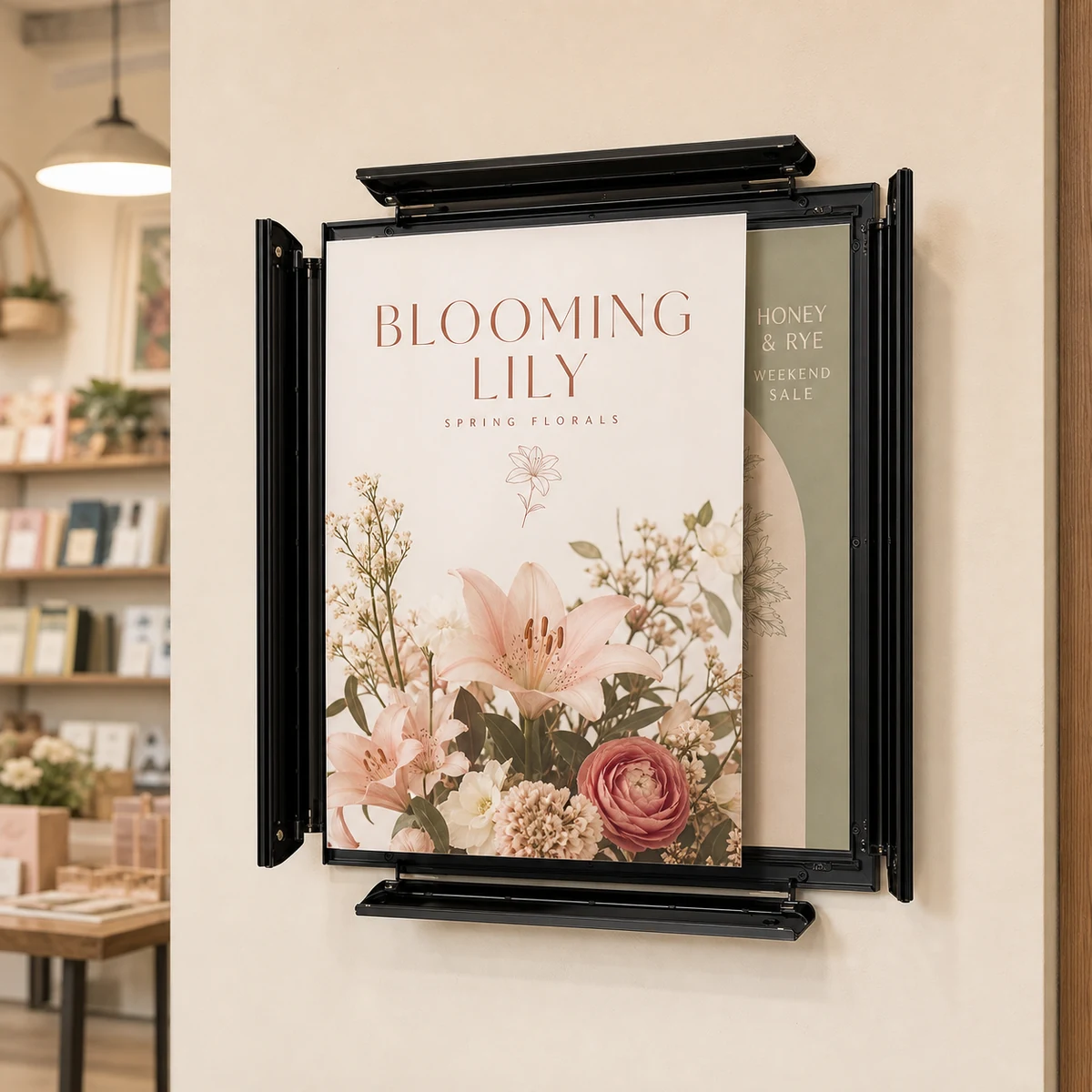
Snap frames are the most professional solution for retailers who update posters regularly. The aluminium frame sits on the wall or window ledge, and the front panel clips open so you can slide a new poster in without removing the frame. Available for A1, A2, and A3 sizes from most display hardware suppliers in Australia. The upfront cost is recovered quickly once you factor in the time saved on recurring poster changes.
Suction cup holders
Suction cup poster holders attach directly to glass with no tools and no adhesive. They are available in A4, A3, A2, and A1 configurations. The main limitation is load capacity: larger suction cup assemblies hold A1 well in moderate conditions, but in high-vibration environments (near heavy foot traffic, a door that closes firmly) they can drop over time. Moisten the cup before applying for best adhesion, and check the cups monthly.
Removable double-sided tape
For a low-cost, flexible option, removable double-sided tape (foam-mounted or flat strip) allows you to fix a poster directly to glass without leaving a residue on removal. This is the most commonly used method for short-run campaigns and works well for weekly swap-outs. Test on a small area of your specific glass first, as some coatings (anti-glare film, treated glass) can react differently to adhesives.
Window cling film
If you want a completely hardware-free install with zero risk of glass residue, a window cling version is the alternative. Note that Paperlust Print Shop posters are printed on 200 gsm Satin Paper, 200 gsm Synthetic, 170 gsm Gloss Paper or 350 gsm Artboard rather than cling film, so cling-specific applications require a different substrate. For short-lived promotions, removable tape is the closer match.
Double-Sided Posters: Seen from Inside and Outside
A standard single-sided poster in a window is designed to be read from the outside. If your window allows light through from both sides (common in smaller shopfronts with minimal visual barriers between the window and the shop floor), a second poster facing inward lets you deliver a different message to customers already in the store.
The more practical alternative is a double-sided print: one design on the front, a second design on the back, so a single mounted poster communicates outward to the footpath and inward to browsers simultaneously. On 200gsm synthetic stock, some light bleed-through between the two sides is possible when held up to a bright window. For campaigns where bleed-through would be disruptive to either design, mount two single-sided posters back-to-back in a double-sided snap frame insert, or add an opaque backing board between them.
Planning Your Promotional Refresh Cycle
One of the most common things that makes a retail window look neglected is an out-of-date promotion. A sun-faded “20% off” poster from last season trains passing customers to ignore your window. A well-managed refresh cycle keeps your window credible and current.
Suggested cadence by campaign type
| Campaign type | Suggested refresh interval |
|---|---|
| Flash sale or single-day event | Remove on the day the promotion ends |
| Weekly specials (cafe, grocery, fashion) | Weekly |
| Fortnightly or monthly promotion | With each promotion change |
| Seasonal campaign (e.g. summer range, EOFY) | At the start and end of season |
| Evergreen brand/range signage | Every 3-4 months or when fading is visible |
For retailers running a high-volume campaign calendar (fashion boutiques, cafes, specialty food, gift stores), ordering posters in batches and keeping a small stock of the next promotion in-store means you are never scrambling for a same-week turnaround. Paperlust Print Shop has a 3-4 working day production time after proof approval, with a 1-2 business day proof delivered before printing begins.
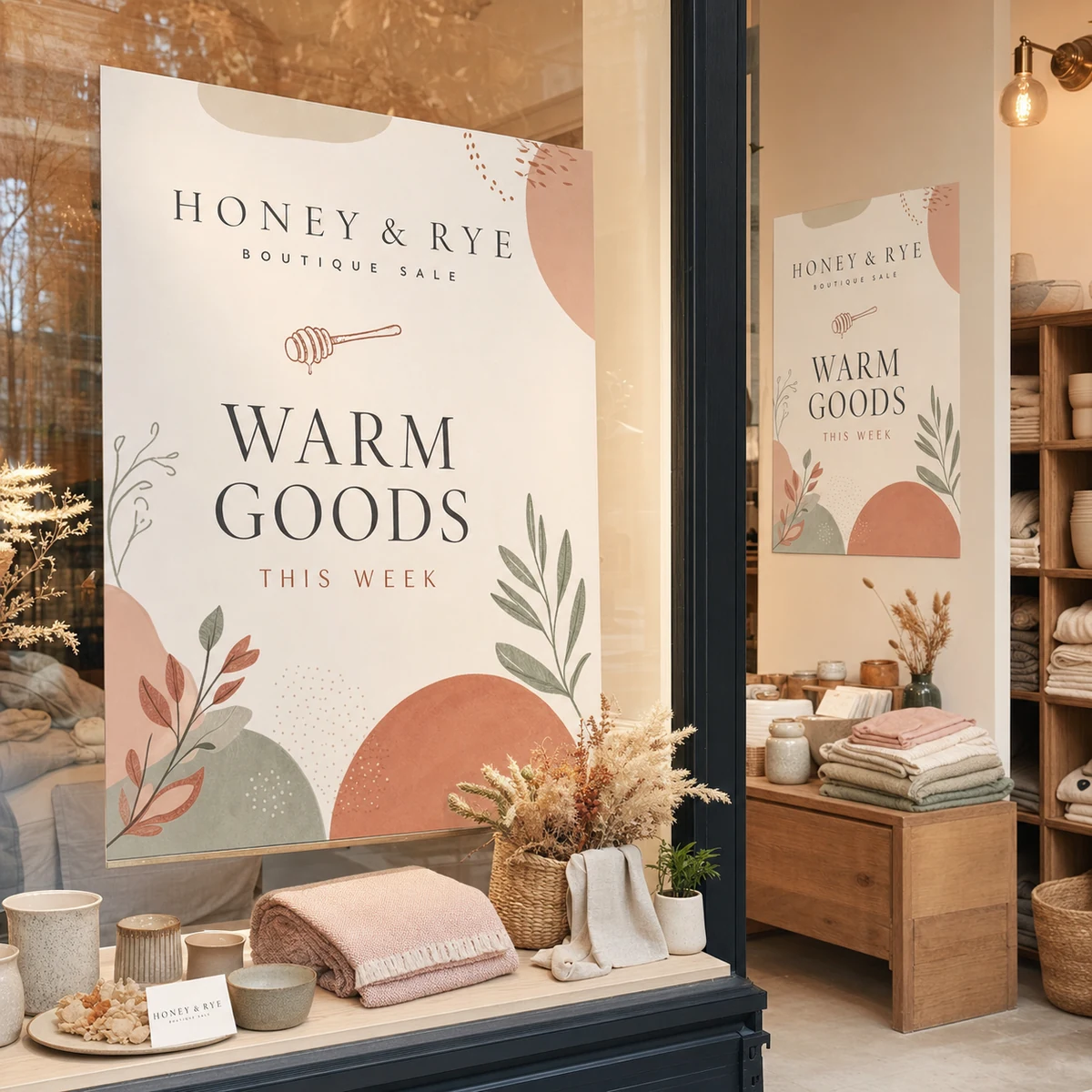
Ordering Retail Posters: What to Prepare
Artwork setup
- Supply artwork as a PDF (preferred), AI, EPS, or PNG file
- Set document size to the exact finished poster size: 297x420mm (A3), 420x594mm (A2), or 594x841mm (A1)
- Add 3mm bleed on all four sides (so your background and edge elements extend to 303x426mm, 426x600mm, or 600x847mm respectively)
- Keep all critical text and logos at least 5mm from the trim line
- Minimum resolution: 300dpi at final print size
Colour mode
Set artwork to CMYK before exporting. Synthetic stock prints in full-colour CMYK, and converting from RGB at the print stage can shift your colours, particularly reds, oranges, and any brand-specific colour. If your file was built in a web-native tool (Canva, Figma, Google Slides), export to PDF and verify that colours look correct in Adobe Acrobat or a PDF reader before ordering.
Minimum resolution reminder by size
| Poster size | Minimum recommended resolution |
|---|---|
| A3 (297x420mm) | 300 dpi at final size |
| A2 (420x594mm) | 300 dpi at final size |
| A1 (594x841mm) | 300 dpi at final size |
Getting Your Posters Printed
You can order retail posters directly from Paperlust Print Shop in A4, A3, A2, A1 or A0. 200 gsm Satin Paper and 200 gsm Synthetic come in all five sizes, while 170 gsm Gloss Paper and 350 gsm Artboard come in A3 and A2 only. Pricing for a single poster starts from $68.13 AUD inc. GST for an A3 poster on 350 gsm Artboard. Bulk pricing starts from $1.53 AUD per poster inc. GST for 100 A3 posters on 170 gsm Gloss Paper. Delivery is $15 standard or $60 express per order, Australia-wide. Every order includes a design proof that you approve before printing begins. Production runs 2 to 3 working days after proof sign-off.
For campaigns that need custom sizes, specialty formats, or a larger print run with volume pricing, contact the Print Shop team for a custom quote.
Frequently Asked Questions
What size poster is best for a shop window in Australia?
A1 (594x841mm) is the standard for street-facing window posters intended to attract foot traffic from the footpath. It reads clearly from 2 to 4 metres. A2 (420x594mm) works well in smaller windows, paired displays, or any window where viewing distance is under 2 metres. A3 (297x420mm) is better suited to door inserts, till-area displays, and close-range reading.
Can I use Paperlust posters directly on a glass window?
Yes. The 200gsm synthetic stock is moisture-resistant and more durable than standard coated paper, making it suitable for window placement. For the easiest installation and removal without leaving residue on the glass, use removable double-sided tape or a suction cup holder. Snap frames are the best option for regular poster swaps.
Will posters fade in a north-facing window?
All printed materials are subject to UV fade over time, and north-facing windows in Australia receive the highest UV load. The 200gsm synthetic stock is not UV-rated for extended sun exposure. For permanent or long-lived installations in north-facing windows, plan for a shorter refresh cycle or ask about laminated options. For rotating promotional posters changed weekly or fortnightly, fading is unlikely to be a visible issue.
What is the difference between synthetic and standard poster paper?
Standard coated poster paper is a wood-pulp-based stock that can warp, sag, and discolour when exposed to moisture or humidity changes, which are common near windows. Synthetic stock is polypropylene-based: it does not absorb moisture, holds its shape, and is more scuff-resistant during handling. For retail window posters that are handled regularly and exposed to temperature fluctuations, synthetic is the more reliable material.
How quickly can I get retail posters printed?
Paperlust Print Shop has a 3-4 working day production time after proof approval. Every order includes a design proof delivered within 1-2 business days before printing begins. Flat-rate shipping is available Australia-wide, so for a weekly promotional cycle, placing your order early in the week for the following week’s promotion gives a comfortable lead time.
Can I print double-sided posters for window display?
Paperlust Print Shop posters are printed single-sided on 200 gsm Satin Paper, 200 gsm Synthetic, 170 gsm Gloss Paper or 350 gsm Artboard. For a window display that communicates to both the footpath and the shop interior, mount two single-sided posters back-to-back in a double-sided snap frame, or use a snap frame with an opaque backing board to prevent light bleed-through between the designs.