Ordering custom packaging for the first time always comes back to the same question: how many do I actually need? It is a question that sounds simple and turns out to be surprisingly consequential. The right number depends on your dispatch volume, your budget, how long you expect to hold stock, and how settled you are in your current design.
Too few and you are reordering within weeks, often paying a higher per-box price because you have not reached a better quantity rung. Too many and you are tying up cash in boxes that may sit for months, particularly if your brand or packaging design shifts in the meantime.
This article walks through the quantity tiers for both full-colour and kraft mailer boxes, explains why the per-box price moves the way it does at each rung, and gives you a practical method for arriving at a number you will not regret. It applies whether this is your first packaging order or you are scaling an existing line.
The short version
- Full-colour mailer boxes are available from 10 units on the digital small-batch tier, with breaks at 10, 25, 50, 100 and 250. Offset volume printing begins at 500 and 1,000.
- Kraft mailer boxes start at 500 units (flexographic press), with per-box price breaks at 1,000, 2,500 and 5,000.
- The per-box price falls at every quantity rung because a fixed setup cost is divided across more boxes with each step.
- The sharpest price drop in the full-colour range is between 250 and 500 units, where the press changes from digital to offset.
- Order for the horizon you are confident about, not the one you are hoping for.
- Small-batch and volume runs use different presses; a small-batch box is an accurate preview of a small-batch run, not a perfect preview of a volume offset run.
Why minimum order quantities exist
Every print job carries a fixed setup cost regardless of how many units the run produces. On a digital press that cost is relatively low. On an offset or flexographic press it is higher, because physical plates or press makereadies are involved. Either way, the setup cost is the same whether the run is 10 boxes or 10,000.
Dividing that fixed cost across more boxes is what drives the per-box price down at each quantity rung. At 10 boxes, the setup cost is divided by 10. At 500 boxes, the same setup cost is divided by 500. This is not a discount the supplier chooses to offer; it is the arithmetic of how print runs work.
It also explains why the per-box price can fall sharply between adjacent tiers, particularly when the quantity crosses from one press type to another. The jump from 250 to 500 full-colour boxes is not just a quantity increase; it is a change from digital to offset printing. Offset carries a higher setup cost, but a significantly lower per-unit press cost. The net result is a meaningful drop in per-box price at that rung, driven by the press change rather than simply by the extra volume.
Understanding this mechanic makes the quantity decision clearer. You are choosing the tier that fits your order volume and cash position, and the price follows from that.
Full-colour mailer boxes: the quantity tiers
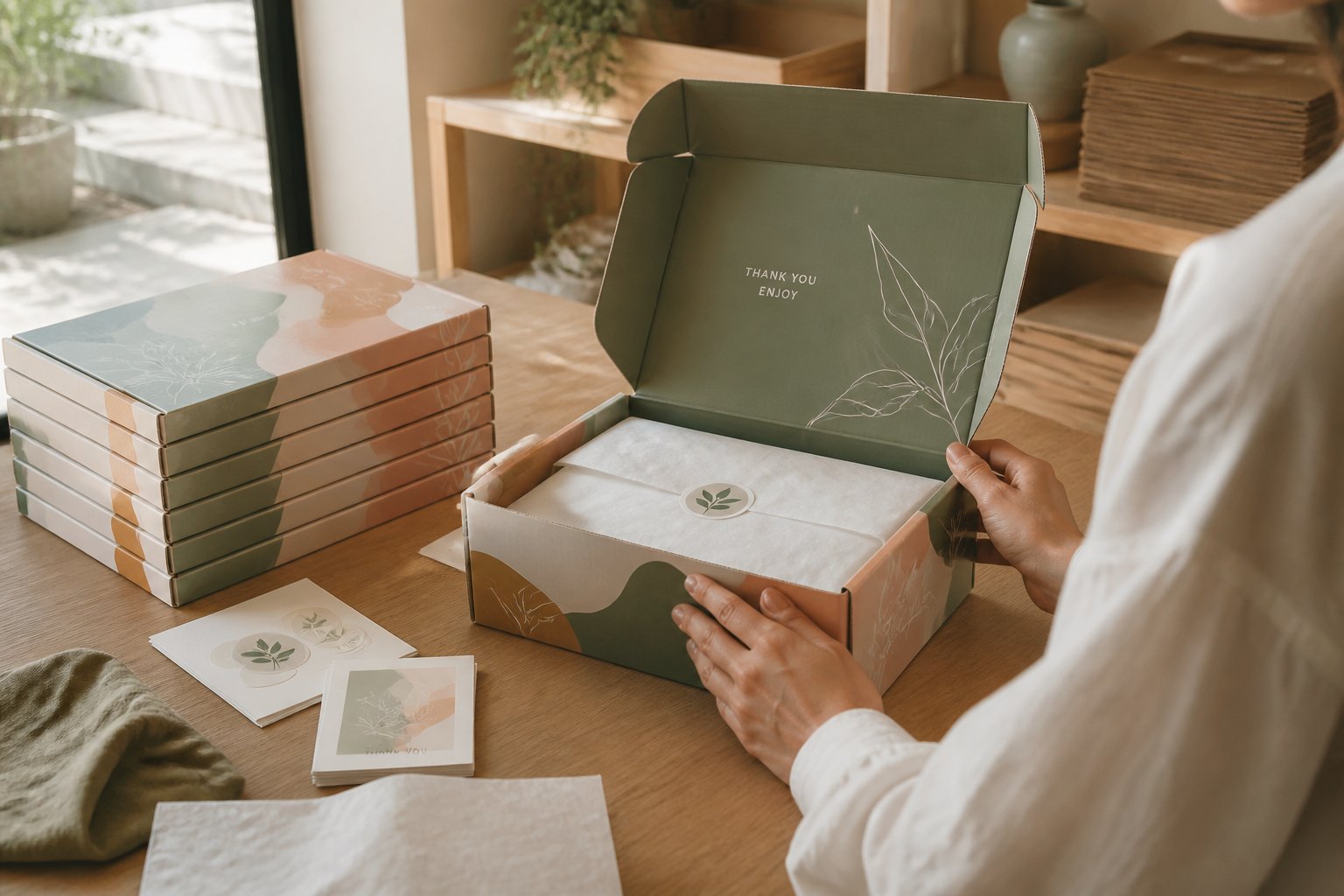
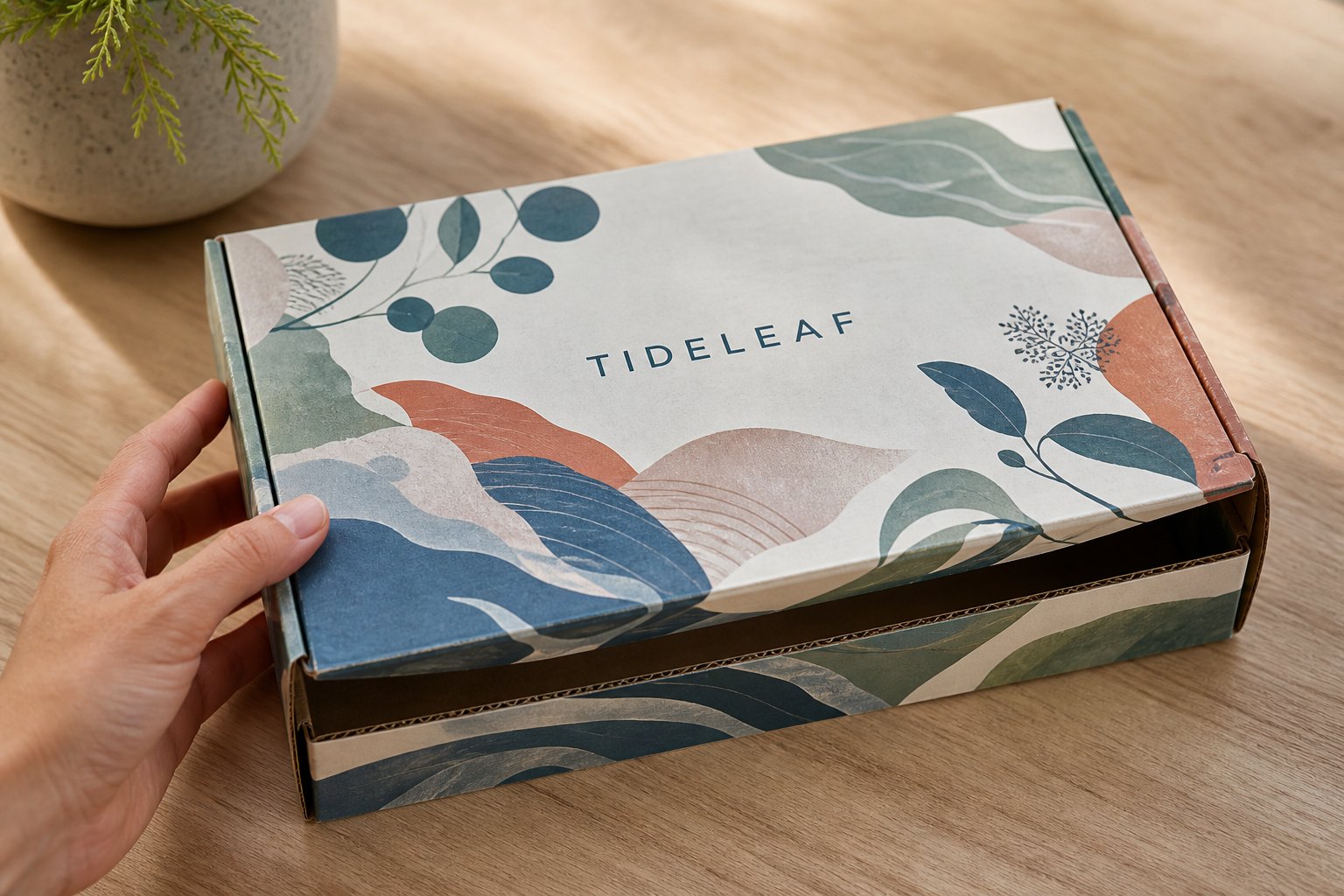
Full-colour mailer boxes are printed edge to edge in CMYK on all exterior panels, on a smooth white liner that reproduces logos, gradients and brand colours with sharp, vivid results. The range runs on two distinct presses depending on the quantity.
The small-batch digital tier covers 10, 25, 50, 100 and 250 boxes. Digital printing has low setup, which is what makes it economically viable at 10 units. Lead time on the digital tier is 3 to 7 working days from proof approval. This tier suits brands that are launching a design for the first time, running a limited or seasonal drop, or operating at a dispatch volume that does not yet warrant a larger commitment.
You can order full-colour mailer boxes from just 10, and the live price calculator on that page shows you exactly what the per-box cost is at each quantity rung as you step through them.
The volume offset tier covers 500 and 1,000 boxes. Offset printing delivers the crispest full-colour result and the lowest per-box price at these quantities. Lead time is 2 to 3 weeks from proof approval. This tier suits brands with a consistent dispatch rate and a settled design they expect to use for a sustained period.
Above 1,000 boxes, or if your product needs a size that falls outside the three standard internal dimensions, the job shifts to a quote.
Kraft mailer boxes: the quantity tiers
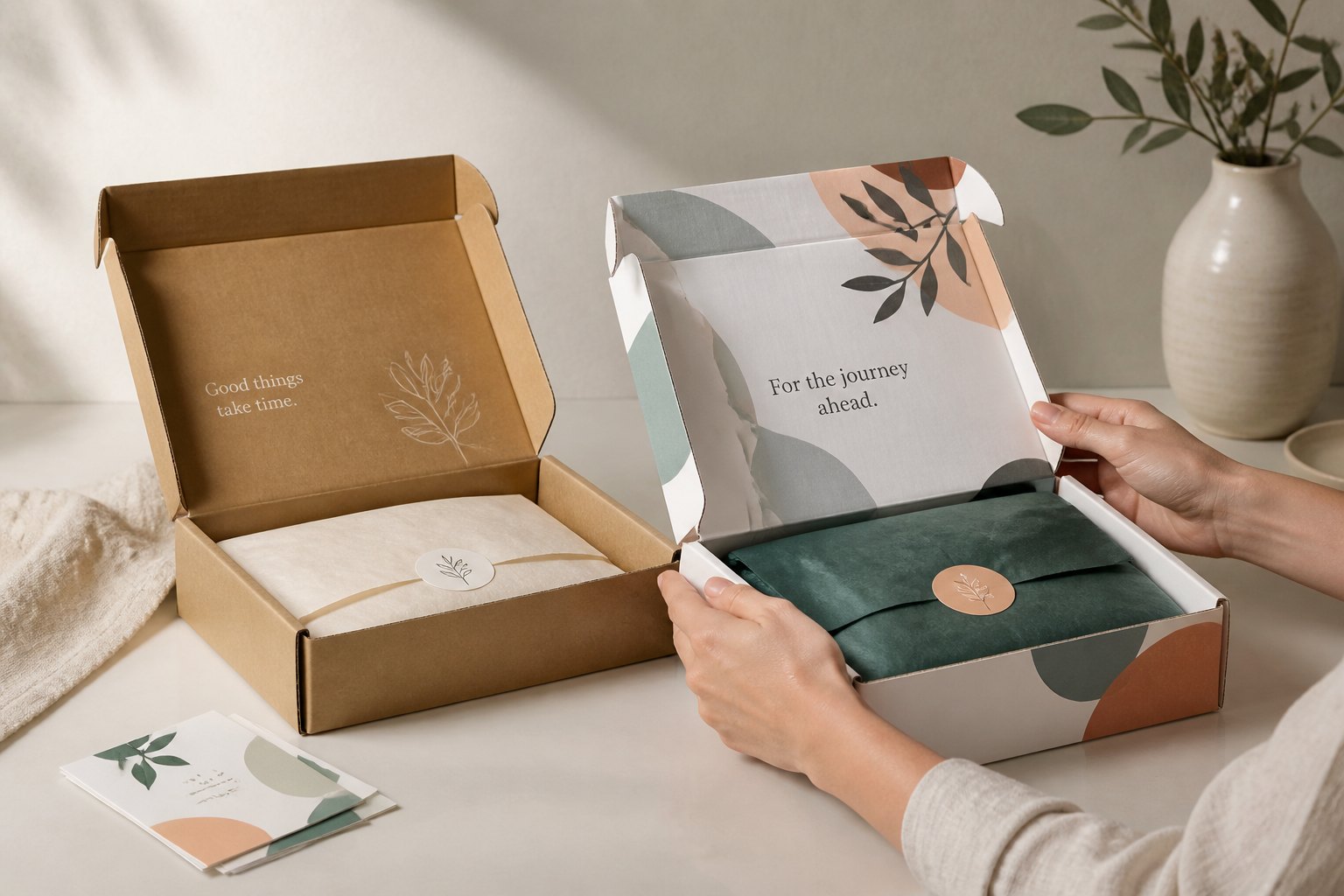
Kraft mailer boxes use flexographic printing in one or two spot colours on natural unbleached brown corrugated board. The board is not coated white, so ink colours sit over the natural kraft tone rather than on a neutral base. That is a design characteristic as much as it is a production constraint: it suits logos, wordmarks, line art and simple repeating patterns, and gives the finished box a strong material feel that suits brands where the kraft look is intentional.
Flexographic printing involves physical plates cut per colour, which sets a higher floor on viable run sizes than digital printing. The minimum order for kraft is 500 boxes, with per-box price breaks at 1,000, 2,500 and 5,000 units. Above 5,000, or for a custom size, the job moves to a quote. Lead time is 2 to 3 weeks from proof approval.
Kraft has a higher minimum order than the full-colour digital tier, but the per-box cost at equivalent large quantities is typically lower than full-colour offset, because you are using one or two colours on uncoated board rather than full CMYK on a white-liner substrate. That is the trade: a higher entry point in exchange for a lower running cost once you are past it.
Quantity tiers at a glance
Both ranges across a single table.
| Mailer box type | Available quantities | Press method | Lead time from proof approval |
|---|---|---|---|
| Full-colour | 10, 25, 50, 100, 250 | Digital | 3 to 7 working days |
| Full-colour | 500, 1,000 | Offset | 2 to 3 weeks |
| Full-colour | Above 1,000 or custom size | Quote required | Quoted at time of order |
| Kraft | 500, 1,000, 2,500, 5,000 | Flexographic | 2 to 3 weeks |
| Kraft | Above 5,000 or custom size | Quote required | Quoted at time of order |
How to work out how many boxes to order
There is a practical method for arriving at a sensible quantity, and it has four inputs. None of them involve guessing.
Your monthly dispatch volume. Start here. How many orders do you ship in a typical month? If you send out 60 parcels and each one goes in a single box, you are consuming 60 boxes a month. That rate of consumption is the baseline for everything that follows.
How long you want to hold stock. Packaging stock is not free. It ties up working capital and requires storage space. A common approach for small to medium ecommerce brands is to order for two to three months of expected volume, which gives you a buffer to reorder before you run out without holding an excessive float. For a brand consuming 60 boxes a month, that suggests a run of 120 to 180 boxes, which sits in the 100 or 250 digital tiers for full-colour.
The per-box saving versus the cash tied up. Stepping up to the next quantity rung lowers the cost per box but increases the total outlay. The question is whether the saving per unit is worth the additional capital committed for the extra weeks it takes to burn through the larger stock. For some businesses, reaching a lower per-box cost matters more than keeping cash free. For others, working capital is tighter and holding two months of stock rather than three makes more practical sense right now. Neither answer is wrong; the right one depends on your situation.
Your confidence in the current design and size. A box printed with your current logo and colour cannot be amended once it is manufactured. If you are launching a new brand, or if you know a rebrand is coming in the next few months, the risk of stranding a large stock increases. Ordering a quantity you can use within a defined window you are confident about limits that exposure. If you have been shipping the same packaging for two years with no plans to change it, you can be more aggressive about quantity.
Combine those four inputs and you have a number. The rule that ties them together: order for the horizon you are confident about, not the one you are hoping for.
For a broader look at keeping packaging costs in line across different product types and order volumes, the guide to packaging on a budget covers the trade-offs between print method, quantity and design complexity.
The small-batch-first play
Ordering a small batch before committing to a volume run is a sound strategy, and the 10-unit digital minimum for full-colour boxes exists precisely to make it viable. You can receive a real physical run, check the sizing against your product with its actual packing materials, review the print quality in hand, and confirm the design is right before placing a larger order.
There is one thing to understand clearly about this approach. Small-batch digital runs and volume offset runs are produced on different presses. A small-batch box is an accurate preview of what your small-batch run will look like. It is not a guaranteed preview of how colours will reproduce on an offset press, because digital and offset printing handle colour reproduction differently. Most of the time the result will be very close, but “very close” is not identical, particularly for brand colours where consistency matters.
The practical implication: if you are ordering a small batch specifically as a rehearsal before committing to a large offset run, tell us that when you place the order. Our team can advise on how your artwork is likely to translate across press types and flag anything worth adjusting before you approve an offset proof. A small artwork adjustment at the design stage costs nothing; the same change after the offset proof is approved costs more time and potentially delays the run.
If you run monthly or subscription fulfilment cycles, the decisions around batch sizing become recurring rather than one-off. The article on subscription box packaging covers how to approach quantity planning across repeating order cycles, including how to manage the transition from small-batch to volume as a subscription grows.
How flat-packed storage changes the calculation
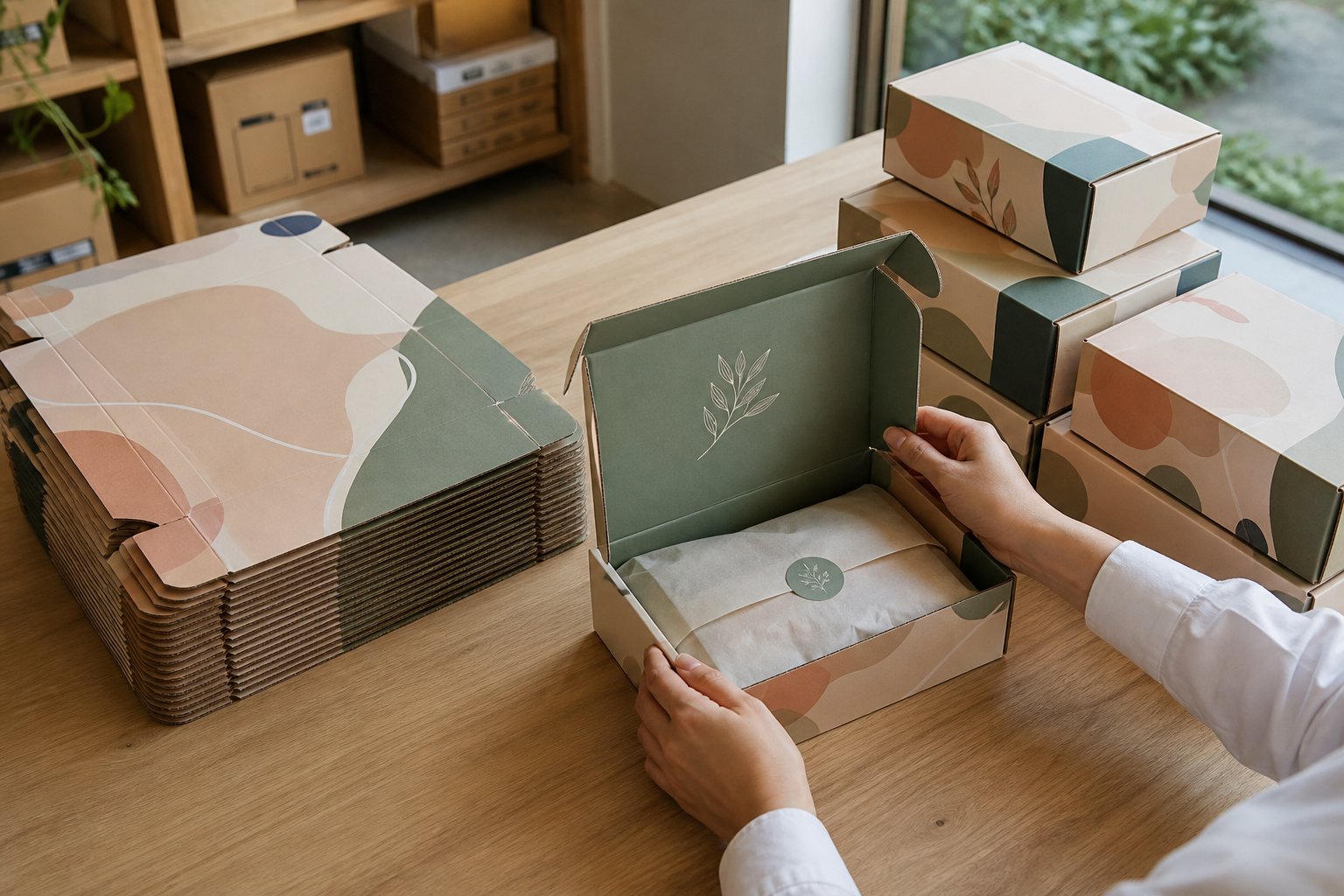
Mailer boxes from Paperlust Print Shop ship and store completely flat. The self-locking design means you fold them up as you need them and the rest of your stock stays flat. No tape or glue is needed to hold the assembled box closed; the roll end tuck front locks itself.
Flat-packed corrugated boxes are far more storage-efficient than assembled packaging. A pallet of flat mailer boxes takes a fraction of the floor space that the same number of assembled boxes would occupy. A run of 250 boxes flat-packed fits in a space that would surprise most first-time buyers: roughly the footprint of a couple of packing shelves.
If storage has been a reason to hesitate about a larger quantity, measure your available space and account for the flat format before ruling it out. You may find the practical limit is further than you assumed, which opens up the next quantity rung at a more favourable per-box cost.
When to hold back and when to step up
There are situations where a smaller run is clearly the right call, and situations where stepping up to the next tier makes straightforward sense.
Hold to a smaller quantity when: you are launching a new product and do not yet have a reliable dispatch rate; you know a rebrand or design revision is coming within the next few months; you are producing a limited-edition or seasonal packaging variant that has a defined end point; or cash flow is tight and the benefit of a lower per-box cost does not outweigh the benefit of keeping that capital working elsewhere.
Step up to a larger quantity when: you have a consistent dispatch rate and a design you expect to use for at least six months; the per-box saving from the next rung is meaningful relative to your product margin; you are approaching a high-volume season such as Black Friday or Christmas gifting and want to hold enough stock to cover a surge without reordering during peak production periods; or your storage situation comfortably accommodates the additional flat-packed stock.
The economics of branded packaging versus the alternatives are worth considering separately. If you are still deciding whether custom printed boxes are the right move over plain boxes combined with branded stickers, the comparison article looking at a printed box against a plain box and a sticker works through the cost and presentation differences in a way that makes the decision clearer.
Frequently asked questions
What is the minimum order quantity for custom mailer boxes in Australia?
It depends on the print method and whether you want full-colour or kraft. Full-colour mailer boxes start at 10 units on the digital small-batch tier, with breaks at 25, 50, 100 and 250. Kraft mailer boxes start at 500 units. Above 1,000 full-colour boxes, or 5,000 kraft boxes, or any custom size, the job moves to a quote.
Can I order fewer than 500 kraft mailer boxes?
No. Kraft mailer boxes use flexographic printing, which requires physical plates per ink colour. That setup cost sets a floor of 500 units for the minimum viable run. If you need a lower quantity or a full-colour result, the full-colour digital range starts at 10 units and is better suited to smaller runs.
Why does the per-box price drop so sharply at 500 full-colour boxes?
At 500 boxes, the full-colour range moves from digital printing to offset printing. Offset has a higher setup cost, but a significantly lower per-unit press cost. The net result is a meaningful fall in per-box price at that rung, even though the total outlay is larger. It is the press change, not just the quantity increase, that drives the drop.
Is a small-batch order a reliable preview of a volume offset run?
It is an accurate preview of a small-batch digital run. It is not a perfect preview of an offset run, because the two presses reproduce colour differently. If you are ordering a small batch as a test before committing to 500 or 1,000 boxes at offset, let our team know at the small-batch stage. They can advise on how your artwork will translate across press types before you commit.
How much storage space do flat-packed mailer boxes need?
Far less than most people expect. Flat-packed corrugated boxes stack compactly and efficiently. A run of 250 boxes in flat format occupies roughly the space of two to three packing shelves. Storage is rarely the constraint it appears to be when buyers first consider ordering a larger quantity.
Should I order for peak season in advance?
Yes, if you have predictable high-volume periods such as Black Friday or Christmas gifting. Volume offset runs carry a 2 to 3 week lead time, and production periods fill up in the lead-up to peak season. Ordering your packaging stock four to six weeks before your expected peak gives you room to receive, check and have boxes on hand when dispatch volumes climb.
What happens if my design changes after I have ordered?
Boxes already manufactured cannot be amended. Design changes after an order is placed and approved affect only the next run. This is one reason to avoid ordering more than you can comfortably use within the period you are confident your design will remain unchanged, particularly when a brand refresh or artwork update is on the horizon.
What to do next
The quantity decision comes down to the horizon you are planning to. Work from your actual dispatch rate and the storage space you have, then choose the rung that gets you through a period you are confident about.
Both the full-colour and kraft ranges carry live price calculators on their product pages, so the per-box cost at any quantity is a click away. You can compare sizes and quantities across the full range of custom mailer boxes to see where your order lands.
A digital proof is included with every order, and our team reviews your artwork before the job goes to press. If you have questions about quantity or whether full-colour or kraft suits your brand, contact us before you place the order.