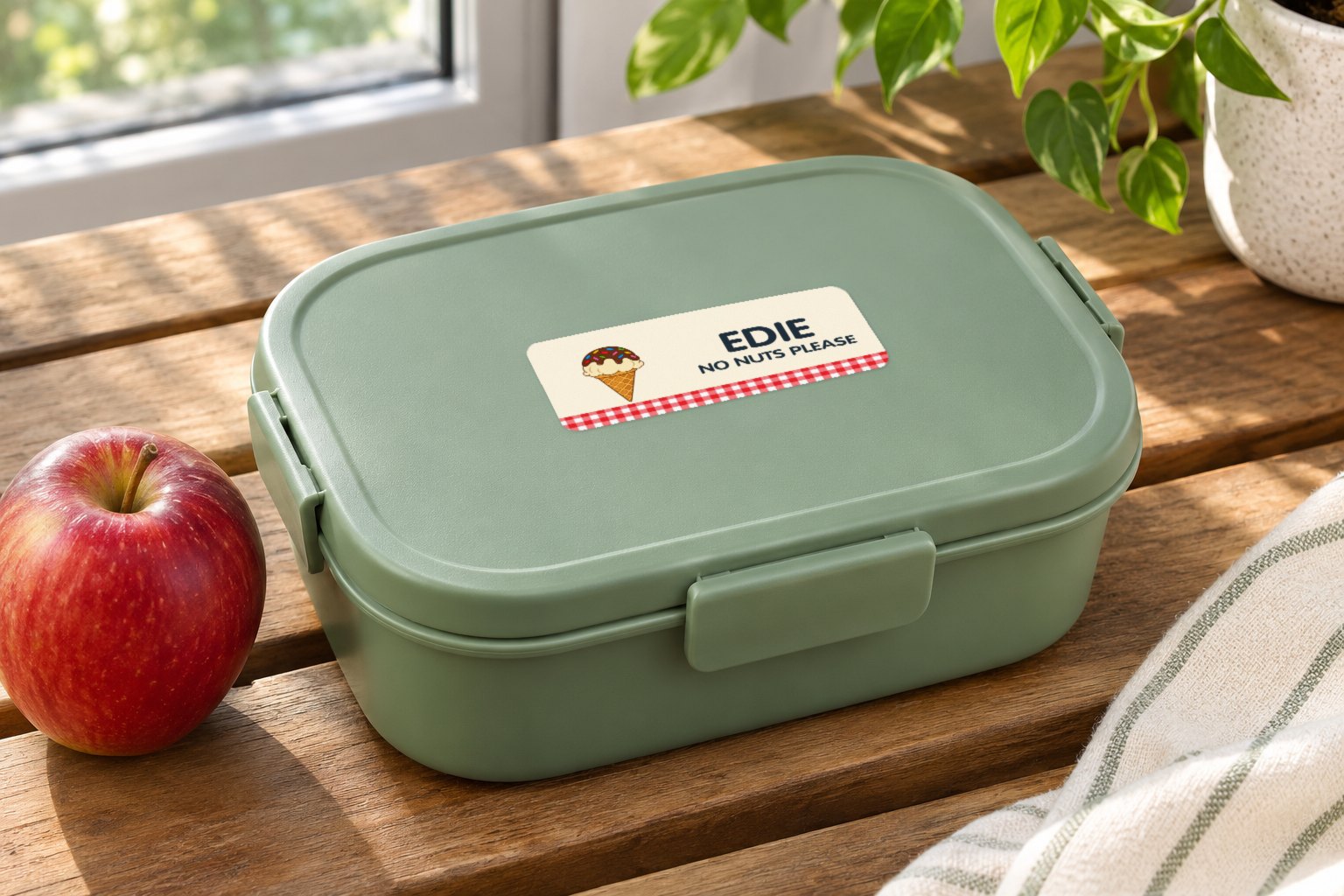
The first morning of school, and you are at the kitchen bench with a permanent marker, writing a name on a lunch box lid in letters that will not survive the first wash. Then the harder part: the box belongs to a child with a food allergy, and the adults who handle it during the day have never met them. Working out what to include on an allergy label comes down to two short lines a stranger can act on.
Below are those two lines, the places a sticker has to sit, what a school will still want from you, and how ordering works when two children need labelling at once. It also covers the limit that matters most: a label supports staff and never replaces them.
The short version
- Put the child’s name on the first line and the allergen in plain words on the second, and nothing else.
- The allergy line holds up to 30 characters, so “No nuts please” or “Dairy free” fits with room to spare.
- Label the lunch box lid and its base separately, plus every container and the drink bottle.
- Tell the school or daycare about the allergy and follow its allergy policy; the label only backs that up.
- Add each child as a separate cart line and read the spelling check before you order.
- The vinyl labels are water resistant, so a wipe over at the end of the day is fine.
What to include on an allergy label, and what to leave off
A lunch box label gets a glance, not a read. The name answers whose box it is. The allergy line answers what must not go near it. Every extra word competes with those two answers.
- The child’s name. The version they answer to, spelt the way their enrolment paperwork spells it. The name line takes up to 40 characters, which covers most full names.
- The allergen in plain words. “No nuts please”. “Dairy free”. “Egg free”. Write what a person would say out loud, not what a form would ask for.
- Nothing else. No mobile number, no room name, no diagnosis, no list of every food involved. Those belong on other labels or in the enrolment file.
The second line on Allergy Labels holds up to 30 characters, and the order will not go through without it. Thirty characters is roughly five short words, which is why a phrase beats a list. Two allergens can sit together on that line if you keep the wording tight, as in “Nut and egg free”.
How to make an allergy label read at a glance
Picture the relief teacher at lunchtime, a bench of lunch boxes in front of her and no time to open them all. She is not reading for pleasure. She is scanning for one box and one warning.
Design against that. The name goes first and large, the allergy line sits directly underneath as a single clear phrase rather than a cluster of initials. Plain words travel faster than an abbreviation: “Egg free” lands, “EF” does not.
The people most likely to look at your label have the least background: a relief teacher covering a sick day, canteen staff at the window, an after school carer. None of them memorised the allergy list at enrolment, and none of them should have to.
You can see the finished thing before anything is printed. Enter the name a single time on the product page and the pack preview redraws with every keystroke, built from the same settings the print file uses, so what you see on screen is what comes off the press. The personalised allergy labels are the ones with the allergy line built into the second line, which is precisely where that short phrase belongs.
Where the labels need to go on a lunch box
Lids and bases part company before morning tea and rarely find each other again. One ends up in the staffroom sink, the other stays under a hat at the bottom of a bag. Label only the lid and half the box is anonymous by lunch.
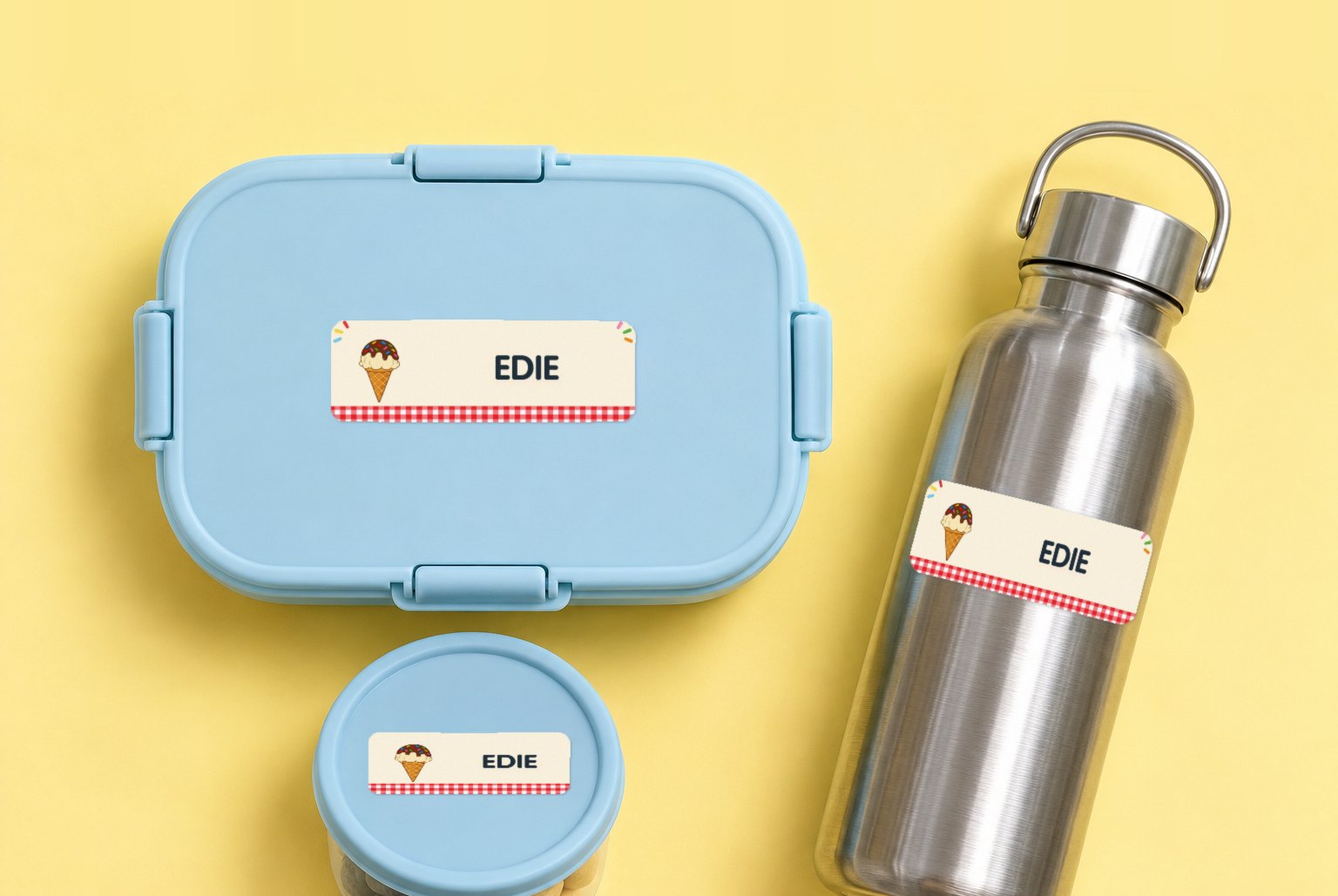
So the rule is repetitive on purpose: the lid, the base, every container that leaves the house, and the drink bottle. A bottle deserves as much attention as the box. It is handled most, put down in the most places, and picked up by the wrong child more often than anyone admits.
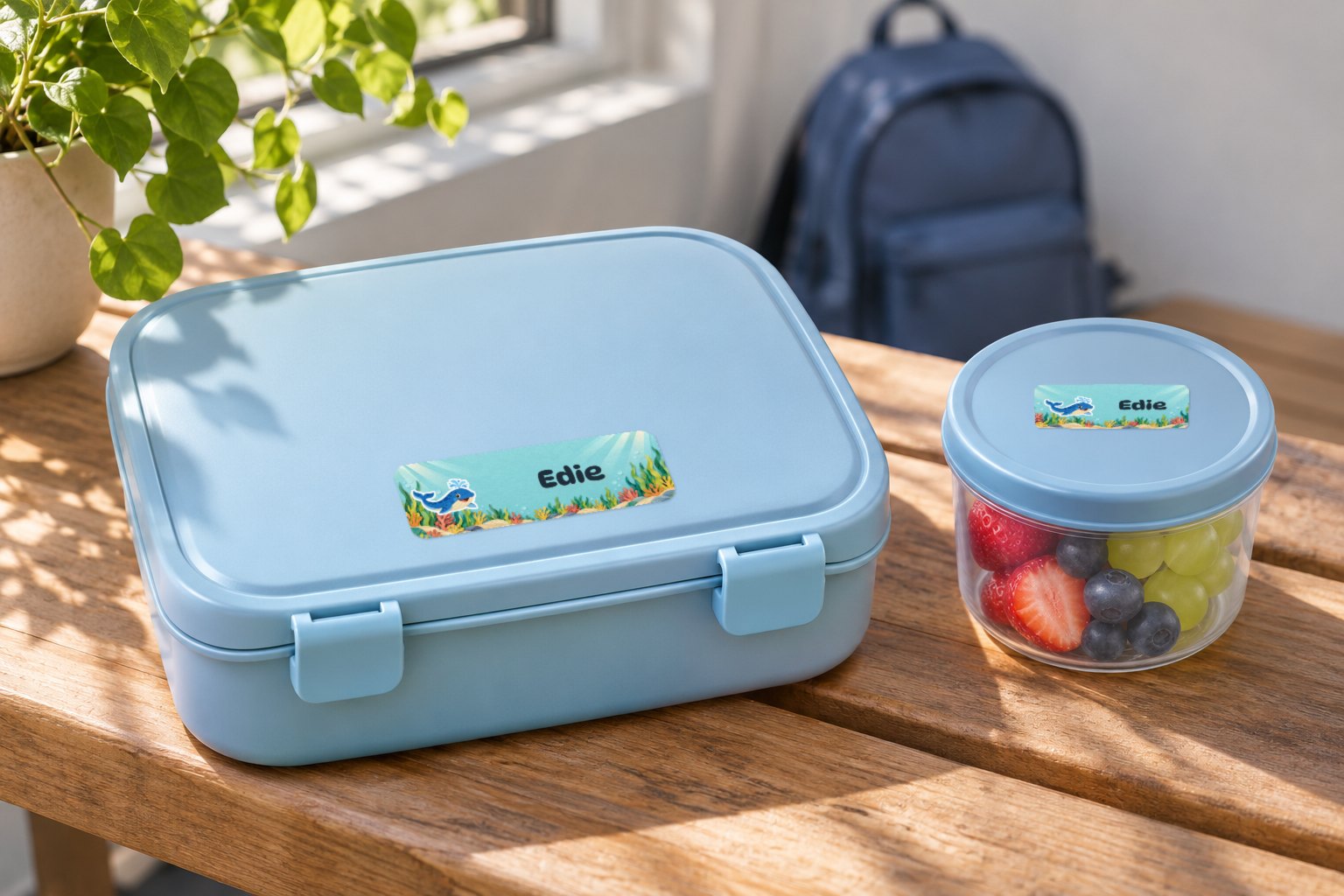
At the standard size of 50 x 25 mm, a label fits a lid, a container or a bottle without curling around a curve. The 3M cast vinyl underneath is gloss laminated and water resistant, so it takes the rest in its stride: a wipe with a cloth and a dash through the rain are both fine.
For the rest of the set, the lunch box and drink bottle labels carry a class name on their second line instead of an allergen, which sorts a box to the right hook in one sticker.
At school, the label backs up the conversation
No sticker has ever told a school something the school did not need to hear from you first. Before term starts, tell them about the allergy directly, in writing and in person, and read the allergy policy so you know how food, sharing and celebrations are handled.
The label’s job is narrower. It is a reminder for staff, and it is not a medical device. It does not diagnose anything, it does not treat anything, and it does not stand in for the action plan your doctor wrote.
What it does well is catch the adult who never saw the enrolment file: the casual teacher covering a sick day, the canteen volunteer at the window, the after school carer collecting a row of boxes. That is where a name and a short line earn their place.
At daycare, the bottle changes hands all day
Daycare runs on movement. Bottles and containers get washed, refilled and carried between rooms, and the person handing your child a sippy cup in the afternoon may have come on shift while that cup was already sitting in the room. Carers who do not know your child handle those things every day.
Tell the centre about the allergy and work within its allergy policy, exactly as you would at school. Then let the stickers do the object work: the bottle, the containers, the shoes that come off in the sandpit.
The printed daycare labels give their second line to a room name or a phone number rather than an allergen, which keeps a bottle traceable when it wanders. Long labels, 70 x 25 mm, go on bottles; standard labels, 50 x 25 mm, on containers; circles, 30 mm across, on shoes.
Ordering: packs, spelling checks and timing
Allergy Labels come in two packs. The Starter pack fills one A5 sheet with 12 labels, the Value pack fills one A4 sheet with 27. The allergy line is compulsory on this product, and the name line takes up to 40 characters.
With more than one child, add another child rather than squeezing two names onto one pack. Each one gets their own name, design, colourway, font and small picture, and arrives in the cart on its own line, defaulting to the same pack size. A pack is filled with a single child’s name all the way through, so two siblings cannot end up sharing a sheet.
One step before the cart, a spelling check lists each name in the form it will be printed in. Accents and macrons, hyphens, apostrophes and full stops all come through to the label, though a straight apostrophe may be set as a curly one, and capitals can change depending on the font. Read that list properly. A name too long for a size is flagged on the page, and the cart button stays locked until every size fits.
At checkout you choose how it runs. The default is print it as shown; the alternative is to ask for a PDF proof to be emailed to you before anything goes ahead. If a centre is fussy about wording, that step is worth it.
Timing deserves more thought than it usually gets. State education department calendars put the start of term 1 in 2027 in late January for Victoria and Queensland, and in early February for New South Wales, Western Australia and Tasmania, so an order in December or the first days of January gives you the widest margin. Each product page carries a delivery estimate for an order put through today.
Frequently asked questions
What should an allergy label say?
A name and one plain allergy line, nothing more. The first line carries the child’s name as the school spells it, and the second carries the allergen in words a stranger would say out loud, such as “No nuts please”. Leave off phone numbers, room names and medical detail. On Paperlust Allergy Labels the allergy line is compulsory and holds up to 30 characters, which is roughly five short words.
Is an allergy label a medical device?
No. It is a reminder for the adults around your child, not a medical device, and it neither treats nor diagnoses anything. The real protection comes from elsewhere: telling your school or daycare about the allergy, working within its allergy policy, and keeping the action plan your doctor wrote up to date. The sticker catches the adults who were not in that conversation; it does not stand in for them.
Can I list more than one allergy on a label?
Usually, yes. There is room for 30 characters on the allergy line, which leaves space for a pair of allergens in one compact phrase, as in “Nut and egg free”. If the combination runs past that limit, tighten the wording rather than adding a second line. Where several allergies need more room, label the box more than once and make sure your centre holds the same information in writing.
Are allergy labels waterproof?
The vinyl labels are water resistant. A wipe with a cloth is fine, and so is a dash through the rain at the gate. 3M rates the film’s water resistance as excellent, but that rating does not cover a soak. A labelled lunch box or drink bottle goes on the top rack, because 3M rates the film from -40 to 107 °C and a home dishwasher washes at about 45 to 65 °C, or 70 to 75 °C on an intensive or hygiene cycle. Leave it 24 hours from sticking before the first wash. These are stickers for flat, firm surfaces such as lunch boxes, containers and drink bottles, not for fabric.
Where should allergy labels go?
On the lunch box lid and on the base, since the two spend most of the day apart, plus every container that leaves the house and the drink bottle. A bottle is handled more than anything else in the bag, so it needs the allergy line as much as the box does.
Do I still need to tell the school or daycare about the allergy?
Yes. Nothing stuck to a lunch box replaces that conversation. Say it in writing and in person before term starts, follow the allergy policy, and keep the action plan from your child’s doctor current. The label then does the narrower job of catching the adults who missed all of that: the relief teacher, the canteen volunteer, the carer from another room.