
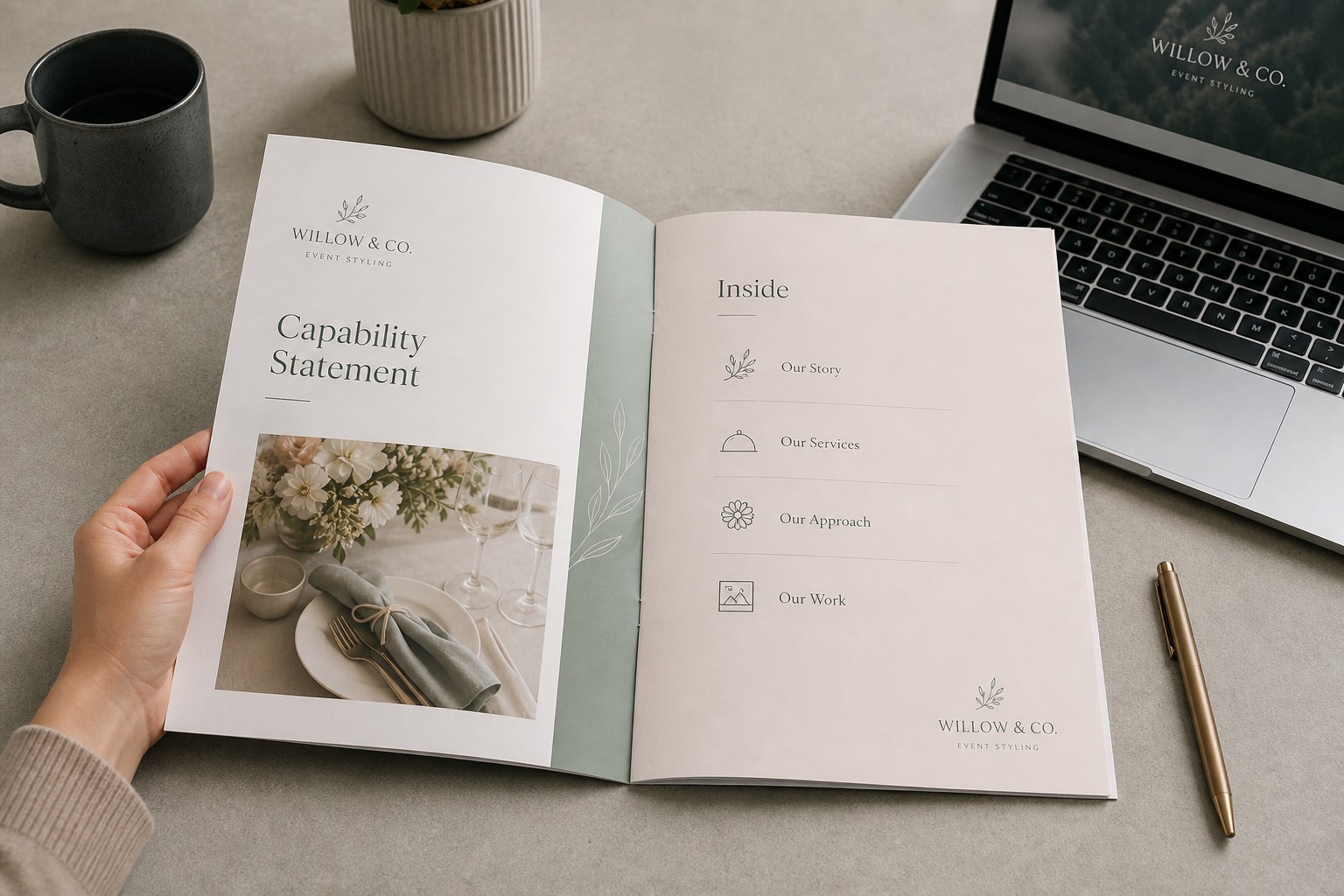
If you are bidding on a government contract, applying to a supplier panel, or responding to a corporate request for proposal, a professionally printed capability statement can be the difference between being taken seriously and being passed over. Here is a practical guide to what goes in it, which format works, and when printing matters.
- A capability statement is a 2-6 page document used for government tenders, supplier panel applications, and corporate EOIs in Australia
- Five sections to include: company overview, core competencies, past performance, compliance/certifications, contact details
- Standard format: A4 (210 x 297mm) booklet, saddle-stitched, 8-page minimum, 250gsm cover with matte lamination
- Most government portals accept PDF; printed copies are standard for in-person presentations and shortlist evaluations
- Proof turnaround: 1-2 business days; production: 3-7 working days after approval
- Flat-rate shipping Australia-wide
What is a capability statement and when do you need one?
A capability statement is a concise, structured document that tells a procurement officer or tender panel who you are, what you deliver, and why your business can be trusted to perform. Think of it as a targeted credentials brief – built for buyer review, not brand storytelling.
In Australia, capability statements are most commonly requested in three contexts:
- Government tender responses: Federal and state agencies often require a capability statement alongside a formal submission on portals such as AusTender or state-level procurement systems
- Supplier panel applications: Many government and corporate panels require a capability statement before assessing your eligibility to quote
- Expressions of interest (EOI): A brief capability statement is frequently the only document submitted in the EOI phase, before a formal shortlist is drawn
Unlike a company profile (which covers your brand story and may run to 16-20 pages), a capability statement is scoped tightly to what a buyer needs to assess suitability. Keep it factual, structured, and under six pages.
The five sections your capability statement needs
1. Company overview
Your opening section should tell the reviewer who you are, where you operate, and what you do – in three to four sentences. Include your ABN or ACN, business structure, years of operation, and primary service area. Skip the marketing language. Procurement panels want facts.
2. Core competencies
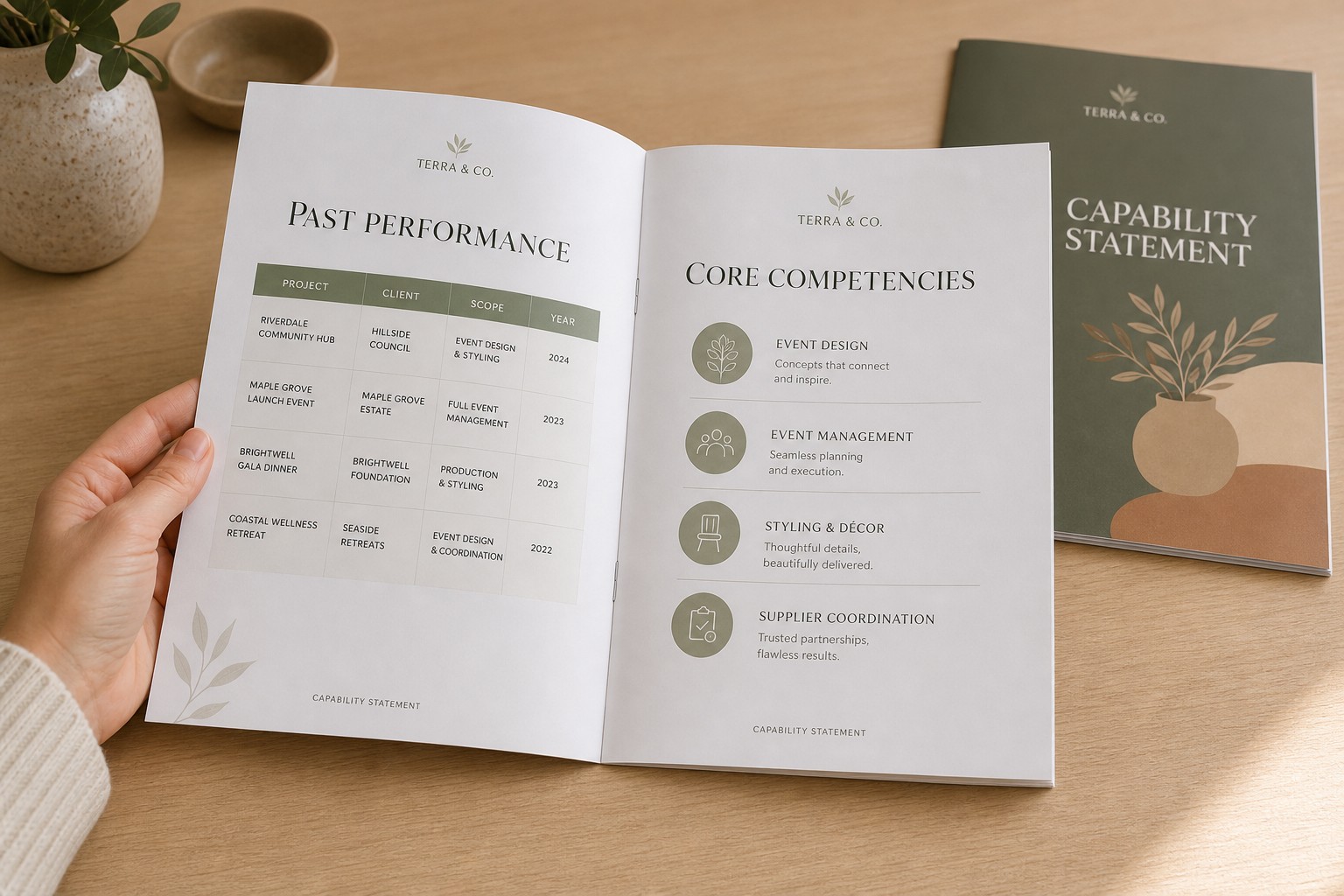
List the specific services or products your business delivers that are directly relevant to the tender category. Be concrete: “Commercial electrical contracting for government facilities” outperforms “electrical services.” Limit yourself to four to six tightly defined competencies – trying to cover every capability dilutes the ones that matter.
3. Past performance and project experience
Include five to eight recent engagements (within the last three to five years). For each, note the client name, scope of work, contract value range where permitted, and outcome. Government experience carries particular weight with public sector buyers. If you have completed work for a federal or state agency, name it and describe what you delivered.
4. Compliance, certifications, and insurances
Include any sector-specific certifications your buyers expect: ISO accreditation, industry licences, WHS management systems, public liability insurance, and any registration schemes relevant to your sector (NDIS, ASIC, builder registration). In construction, healthcare, and defence tendering, this section can be decisive.
5. Contact details and identifiers
Your final section lists your primary contact name, title, phone, email, business address, website, and ABN. Some government panels also request UNSPSC commodity codes or Supply Nation certification if applicable.
Format, size, and print specifications
Page count
A capability statement typically runs two to six pages of content. When printing as a booklet, page counts must be multiples of four (because sheets fold in half through the press). An eight-page booklet (two folded A4 sheets, saddle-stitched at the spine) gives you six content pages plus a cover and back – the right fit for most capability statements.
The table below compares the most common formats used in Australian tender contexts:
| Format | Best use case | Page count | Binding |
|---|---|---|---|
| A4 booklet (210 x 297mm) | Full tender submissions, panel applications | 8-64 pages | Saddle-stitch |
| A5 booklet (148 x 210mm) | Compact version for smaller tenders or distributor panels | 8-32 pages | Saddle-stitch |
| DL trifold brochure | EOI leave-behind, trade show handout | 6 panels (folded) | Folded, no staple |
| A4 single sheet (folded) | One-page EOI or high-volume networking event handout | 2 sides | None |
Cover stock and lamination
For a capability statement intended to be handled by multiple reviewers, a 250gsm cover with matte lamination is the most practical choice. Matte lamination reduces glare under office lighting (useful when a panel is reading across several submissions at once), holds up to repeated handling, and photographs cleanly if any reviewer needs to scan the document. Gloss lamination is a valid alternative if your brand uses bold, saturated colour or high-contrast photography.
Our A4 booklets are printed from $17.71 inc. GST with saddle-stitch binding and a 250gsm laminated cover. If a compact version suits your brief, A5 booklets (148 x 210mm) are available in the same specification.

File setup
Submit files as print-ready PDFs. Requirements for booklet printing:
- 3mm bleed on all edges beyond the trim line
- Text and design elements at least 3mm inside the trim line
- Colours in CMYK (not RGB)
- Images at 300dpi minimum
- All fonts embedded
If your capability statement was built in Microsoft Word or PowerPoint, export to PDF at maximum quality settings before uploading.
When does a tender require a printed capability statement?
Most Australian procurement portals – including AusTender, NSW eTendering, and ProcurePoint – accept and often prefer PDF submissions. In that context, printed capability statements serve as leave-behind documents: handed to each panel member at a shortlist presentation, brought to site visits, or distributed at industry briefings.
Printed copies become a requirement when:
- The request for tender or request for proposal documentation explicitly states physical copies are required alongside the digital submission
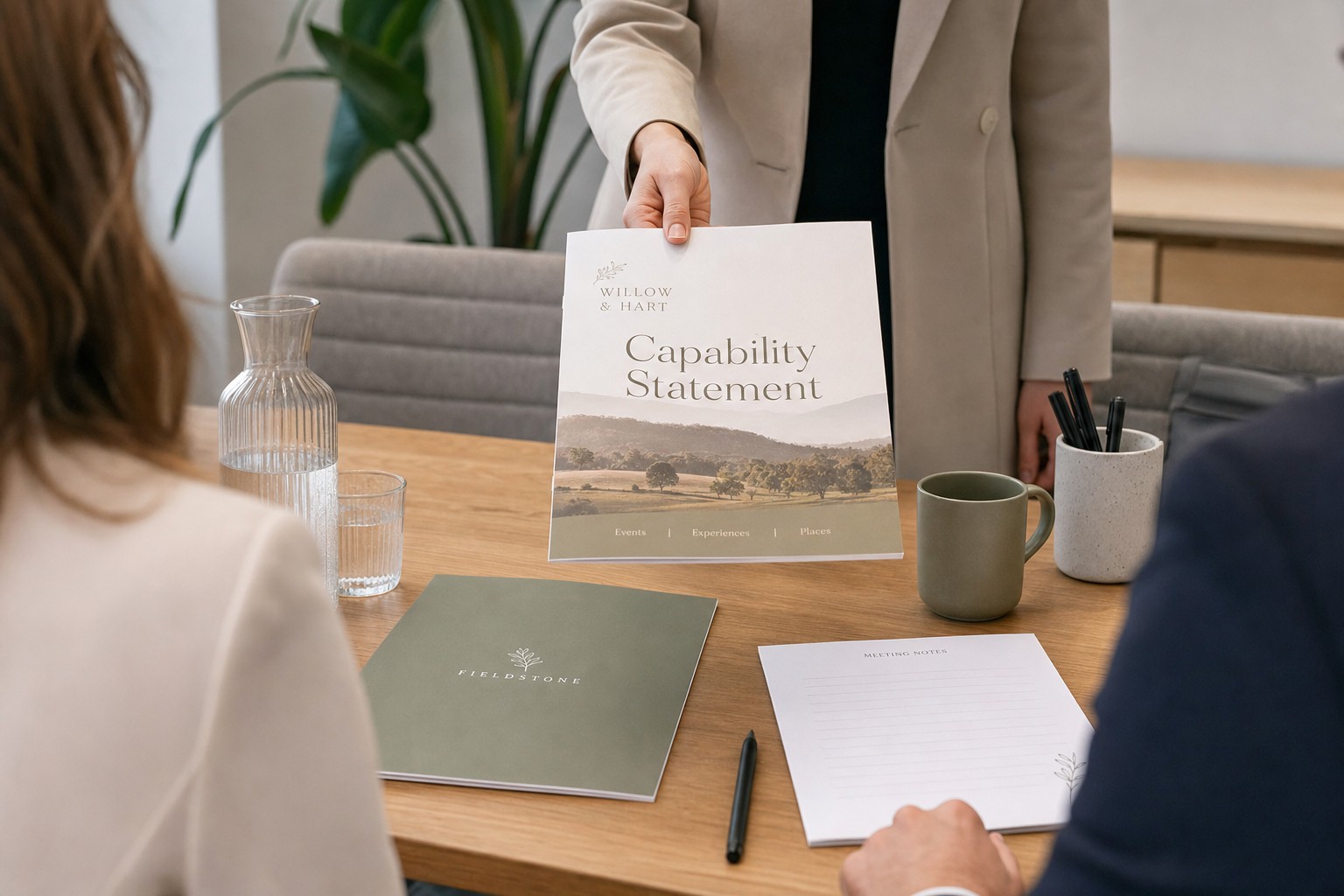
- You are presenting as part of a shortlisted evaluation and want a professional document for each person on the panel
- Your industry involves regular site-based engagement where printed credentials are standard practice (construction, mining, defence, healthcare)
A practical approach: maintain a current PDF for portal submissions and print a short run of 10-20 booklets for in-person use. With flat-rate shipping Australia-wide and print minimums starting from low quantities, a short print run is cost-effective and easy to reorder whenever your content changes.
For a DL format leave-behind that is more pocketable than an A4 booklet, see our brochures product page. For a broader view of print formats suited to B2B marketing and business development, browse our marketing materials range.
Related reading
If you need a longer corporate document – a full company profile, annual report, or credentials booklet running to 20 pages or more – our guide to company profile and annual report printing covers binding choices, paper weight recommendations, and when saddle-stitch gives way to perfect binding.
Frequently asked questions
How many pages should a capability statement be?
Most Australian government and corporate tenders expect a capability statement of two to six pages. When printing as a booklet, page counts must be multiples of four. An eight-page booklet is the most common choice: it gives you six pages of content with a front cover and back page. If your statement runs longer, higher page count options are available while keeping the same saddle-stitch binding method.
What size should I print a capability statement?
A4 (210 x 297mm) is the standard size for Australian government and corporate tenders. It matches the document format used in procurement portals and fits neatly into tender folders and evaluation packs. A5 (148 x 210mm) is an option for a compact version or a leave-behind handout.
Does a capability statement need to be printed, or is a PDF sufficient?
Most Australian procurement portals accept PDF submissions, and many prefer them. Printed copies are most valuable for shortlisted tender presentations, site visits, and in-person meetings. Some requests for tender explicitly require physical copies alongside a digital submission. Always check the RFT or RFP documentation for the specific submission requirements.
What is the difference between a capability statement and a company profile?
A company profile covers brand story, history, values, and general services and may run to 16-20 pages or more. A capability statement is scoped specifically for procurement: it covers only what a buyer needs to assess suitability (core competencies, past performance, compliance, and contact details) and typically runs two to six pages. Some businesses maintain both documents and adapt content between them.
What cover stock and finish should I use for a capability statement?
A 250gsm cover with matte lamination is the most practical choice for a capability statement that will be handled by multiple reviewers. Matte lamination reduces glare under office lighting, making dense text and tables easier to read, and it is more fingerprint-resistant than uncoated stock. Gloss lamination works well if your document features bold colour or photography.
How quickly can I get capability statements printed in Australia?
After you upload your files, a design proof is sent within 1-2 business days. Once you approve the proof, production takes 3-7 working days. With express delivery to metro areas, you can receive your printed booklets in 1-2 business days after dispatch. Flat-rate shipping applies Australia-wide.