Australian law makes care labelling mandatory for clothing and household textiles under the Consumer Goods (Care Labelling) Information Standard 2023, enforced by the ACCC. Fibre composition disclosure is not required by the same mandatory standard, though it is commercially standard practice.
- Care labelling: mandatory under the Consumer Goods (Care Labelling) Information Standard 2023
- Instructions must be permanently attached to clothing, in English or using ISO 3758:2012 care symbols, or both
- Fibre content (e.g. “100% cotton”): not mandated by the ACCC care labelling standard
- Country of origin for imported goods: mandatory trade description required at the border under the Commerce (Trade Descriptions) Act 1905
- Country of origin for domestically supplied goods: voluntary, but any claim made must not be false or misleading under the Australian Consumer Law
- Second-hand goods and most footwear are exempt from mandatory care labelling
The mandatory care labelling standard
The Consumer Goods (Care Labelling) Information Standard 2023 is the current ACCC mandatory standard for care labelling. It replaced Consumer Protection Notice No. 25 of 2010 as of 5 September 2023, with a transition period that ended on 5 March 2024.
The standard applies to new:
- clothing and apparel
- household textiles and furnishings
- upholstered furniture
- bedding, mattresses and bed bases
- piece goods and yarns made from textiles
- plastic and plastic-coated fabrics
- suede, skins, hides, leathers and furs
Specific categories are exempt, including most second-hand goods and footwear. If you are uncertain whether your product falls within scope, the ACCC publishes guidance on its website at accc.gov.au.
What the standard requires
For any product within scope, the supplier must provide care instructions that are:
- permanently attached to clothing (for certain made-up goods listed in the standard where permanent attachment is not practical, removable tickets, hanger tags, pamphlets or other documentation supplied with the product are permitted)
- written in English, using ISO 3758:2012 care symbols, or both
- legible and adequate so that the article is not damaged if the instructions are followed
- inclusive of all applicable cleaning methods, and if the article cannot be washed or dry-cleaned, the label must say so and describe the recommended care method
The standard draws on AS/NZS 1957:1998 (the Australian and New Zealand text-based care labelling standard) and ISO 3758:2012 (the internationally recognised GINETEX symbol system). Since 5 March 2024, suppliers may choose English text only, ISO symbols only, or both.
Care symbols: the five families under ISO 3758:2012
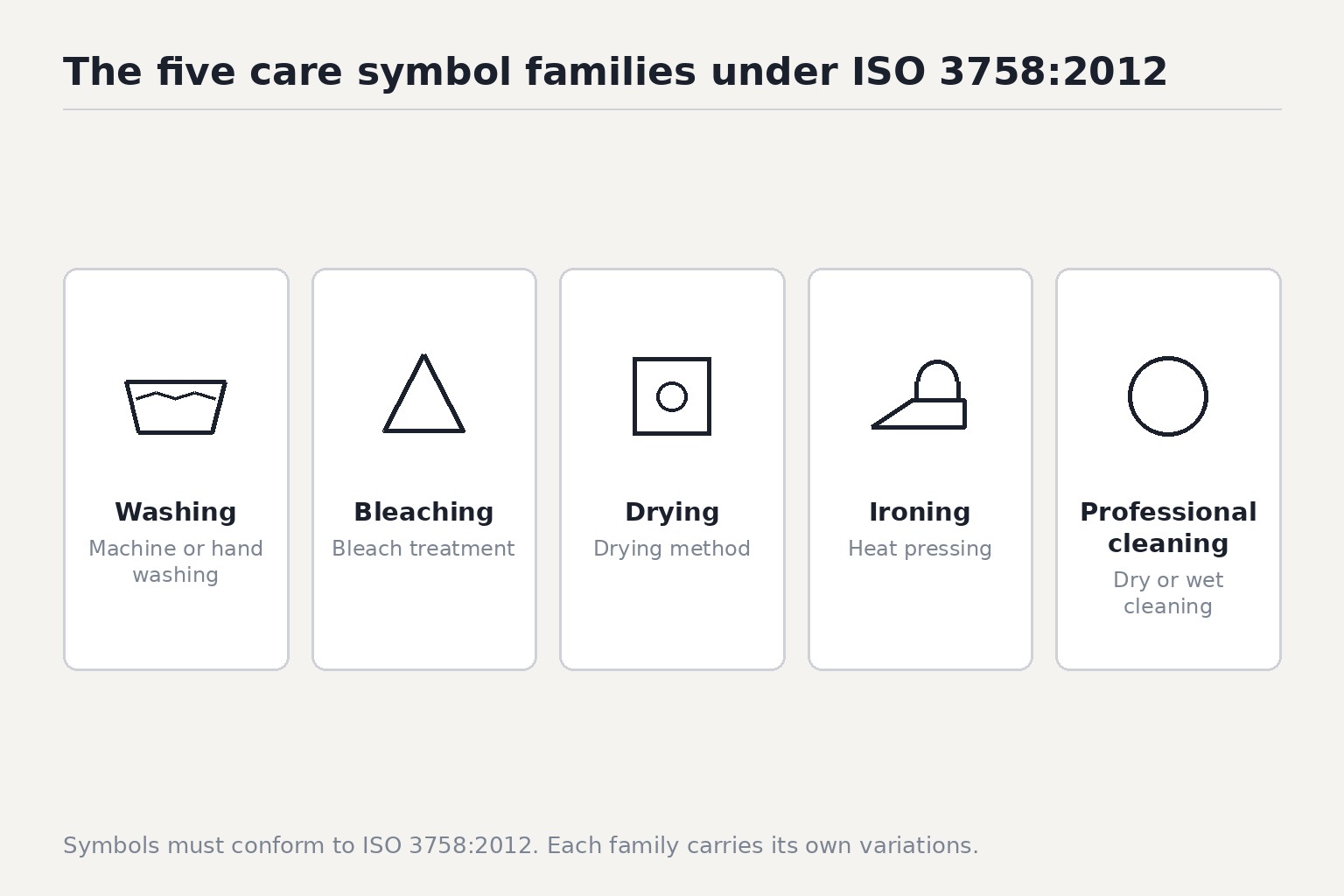
If you choose to use symbols, they must conform to ISO 3758:2012. The standard defines five symbol families.
| Symbol family | Represents | Common variations |
|---|---|---|
| Washing (tub) | Machine or hand washing | Temperature (30, 40, 60, 95 C), hand wash only, do not wash |
| Bleaching (triangle) | Bleach treatment | Bleaching permitted, non-chlorine only, do not bleach |
| Drying (square) | Drying method | Tumble dry (heat settings), line dry, drip dry, flat dry, dry in shade |
| Ironing (iron) | Heat pressing | Low, medium or high heat; do not iron |
| Professional cleaning (circle) | Dry or wet cleaning | Specific solvents, wet cleaning, do not dry clean |
The detailed artwork for these symbols is in ISO 3758:2012, published by Standards Australia and ISO. Suppliers who need precise vector artwork for label production will need to purchase or licence the standard.
Fibre composition: industry standard, not legal mandate
Stating fibre content (for example, “100% merino wool” or “80% polyester, 20% cotton”) is widely expected by consumers and retailers, but it is not required by the ACCC care labelling information standard.
The Australian Fashion Council’s labelling guide confirms: “There is no national mandatory information standard presently in place for fibre content labelling.” The Consumer Goods (Care Labelling) Information Standard 2023 does not reference fibre composition.
That said, there are strong commercial reasons to include it:
- Buyers for department stores and wholesale accounts frequently require fibre content as a condition of ranging.
- Consumers with allergies or material preferences (wool-free, vegan) rely on it.
- If you make a fibre claim (for example, “pure wool”) that is false or misleading, the ACCC can take action under the Australian Consumer Law regardless of whether composition labelling is formally mandated.
Include fibre content on your labels as a matter of sound practice, even though it is not compelled by the mandatory care labelling standard.
Country of origin labelling
Country of origin sits in two separate legal regimes.
Imported clothing and textiles: mandatory at the border
For many imported textile, clothing and footwear products, the Commerce (Trade Descriptions) Act 1905 and the Commerce (Trade Descriptions) Regulations 2016 require that a true trade description accompany the goods at importation. That description must state what the goods are and where they were made or produced. Australian Border Force may seize imports that are not correctly labelled.
Claims made in the domestic market: must not mislead
Once goods are in the Australian market, the Australian Consumer Law (ACL) (Schedule 2 of the Competition and Consumer Act 2010) applies. There is no information standard that universally mandates origin labelling for clothing in the domestic market, but any claim you make must be accurate.
The ACL provides safe harbour tests for specific phrases:
- “Made in Australia”: the goods must have been substantially transformed in Australia, and at least 50% of the cost of production must have occurred here. Cutting and sewing imported fabric into a finished garment meets the substantial transformation test. Adding a print to an imported T-shirt does not.
- “Product of Australia”: a stricter test requiring that each significant component originates in Australia and that all, or virtually all, manufacturing processes occurred here.
The ACCC publishes guidance specifically on country of origin claims for textiles, clothing and footwear on its website.
What this means for a small apparel brand
If you sell new garments in Australia, the practical minimum is:
- Attach a permanent care label giving adequate cleaning instructions in English, in ISO care symbols, or both.
- Ensure the instructions account for all trims, finishes, dyes and construction details, not just a generic “machine wash” instruction.
- If you import the garments, include country of manufacture on the trade description at the border.
- Include fibre composition as commercial good practice, even though it is not legally compelled by the care labelling standard.
- If you make any origin claim, verify it against the ACL safe harbour tests before printing labels.
The ACCC publishes a free product safety guide for clothing and textiles at accc.gov.au, and the full text of the 2023 information standard is available on the Federal Register of Legislation at legislation.gov.au.
Adhesive labels for apparel: where Paperlust fits
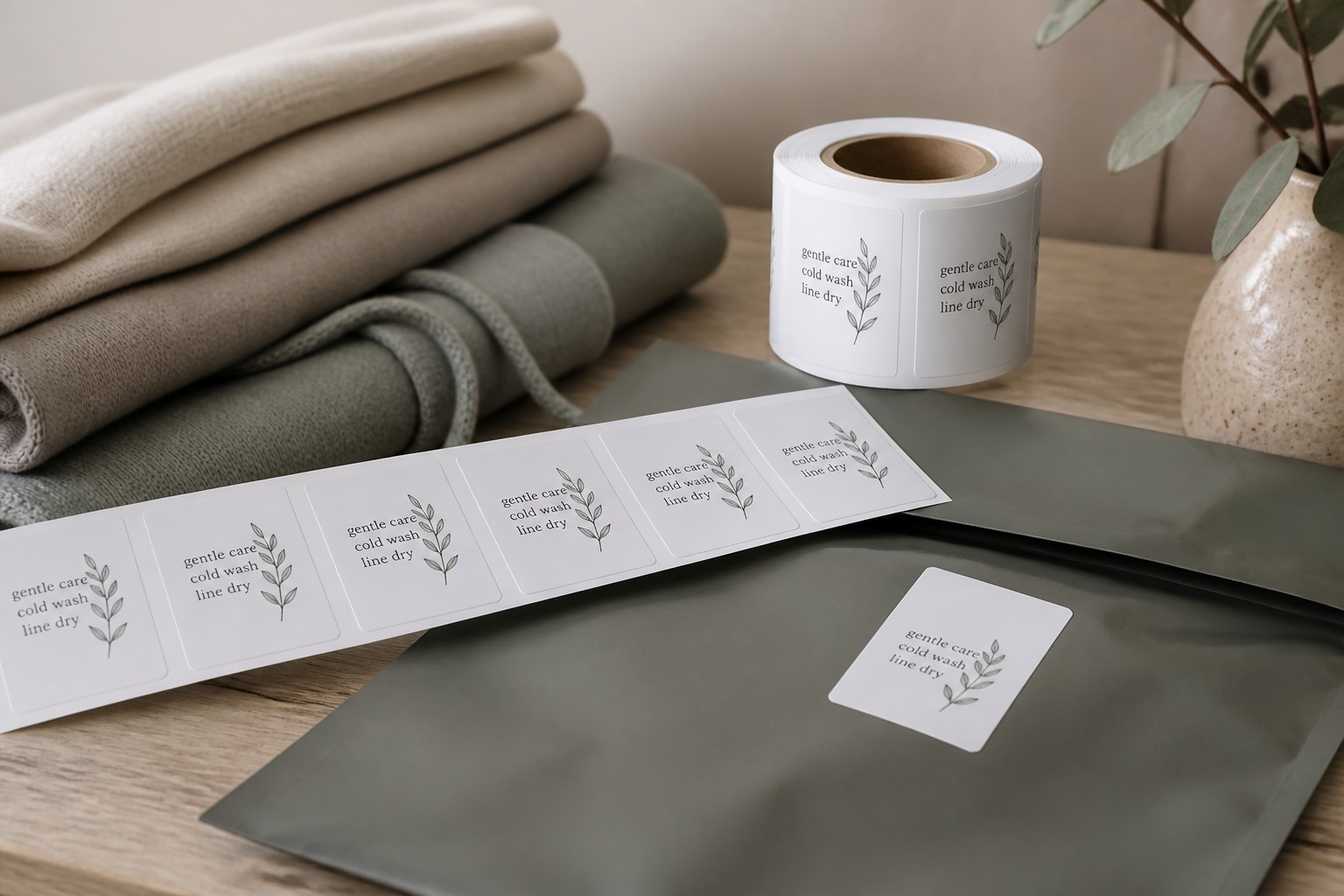
Paperlust prints adhesive labels, not sewn-in woven care labels. The two serve different purposes.
Adhesive care and composition labels are commonly used on:
- outer packaging and mailer inserts, where care information sits alongside the garment rather than sewn into it
- swing-free retail presentation on folded garments or accessories displayed flat in-store
- poly mailers, where care and composition details appear on an adhesive strip or an insert card
If you need adhesive labels for garment packaging, retail presentation, or poly mailers, the custom label range at Paperlust covers rectangle, circle, custom cut and clear formats printed on white cast paper with matte laminate. Minimum order is 500 labels, with 48-hour production.
For care information that must be permanently sewn into the garment, you will need a specialist woven label or printed satin ribbon supplier.
Frequently Asked Questions
Is care labelling mandatory for all clothing sold in Australia?
Yes. The Consumer Goods (Care Labelling) Information Standard 2023, enforced by the ACCC, makes care labelling mandatory for new clothing, household textiles and a range of other textile products. The standard sets out what instructions must be provided, how they must be attached, and what format they must take.
Do I have to state fibre composition on my garment labels?
No. Fibre composition (for example, “100% cotton” or “70% polyester, 30% elastane”) is not required by the ACCC care labelling mandatory standard. The Australian Fashion Council confirms there is no national mandatory information standard for fibre content labelling. Including it is commercially standard practice and strongly advisable, but it is not legally compelled.
Can I use only care symbols on my garment labels, or do I need English text?
Since 5 March 2024, you may choose English text only, ISO 3758:2012 care symbols only, or both. Either approach satisfies the Consumer Goods (Care Labelling) Information Standard 2023. The full symbol set is defined in ISO 3758:2012, available from Standards Australia.
What changed between the 2023 standard and the old 2010 notice?
The 2023 standard replaced Consumer Protection Notice No. 25 of 2010 and explicitly permitted ISO 3758:2012 care symbols as a standalone compliance option. The 2010 notice required English text. A transition period ran from 5 September 2023 to 4 March 2024.
Is country of origin labelling mandatory for clothing?
It depends on where the goods are in the supply chain. For imported clothing and textiles, the Commerce (Trade Descriptions) Act 1905 requires a trade description including country of manufacture at importation. In the domestic market, origin labelling is not universally mandated for clothing, but any claim made must not be false or misleading under the Australian Consumer Law.
What does “Made in Australia” actually require?
Under the ACL safe harbour, “Made in Australia” requires that the goods were substantially transformed in Australia and that at least 50% of the cost of production was carried out here. Cutting and sewing imported fabric into a finished garment meets the substantial transformation test. Adding a decorative print to an imported garment does not.
Can I use adhesive labels instead of sewn-in labels for garment care information?
The Consumer Goods (Care Labelling) Information Standard 2023 requires care instructions to be permanently attached to clothing for most garments, which in practice means a sewn-in label. The standard does allow non-permanent labelling (tickets, tags, documentation supplied with the product) for certain specified categories of made-up goods. Read the standard for your specific product type before relying on an adhesive label as the primary care label.
Where can I find the official text of the care labelling standard?
The Consumer Goods (Care Labelling) Information Standard 2023 is available on the Federal Register of Legislation at legislation.gov.au. The ACCC also publishes free product safety guidance for clothing and textiles at accc.gov.au.