Ordering custom business cards in Australia used to mean two options: a mass-market online printer with templated designs, or an expensive local printshop with a slow turnaround and a phone call to get a quote. Neither gave independent professionals and small businesses what they actually needed – proper print-quality standards, a range of premium finishes, a fast proof, and cards at their door the next day. That gap has closed. This guide covers everything you need to know to order confidently in 2026: what finishes are available, which paper stocks suit which professions, realistic pricing and lead times by state, and how to set up print-ready artwork that clears pre-press without revisions.
Quick reference
Custom Business Cards Australia at a Glance
Key facts before you order.
- Standard AU size: 90 x 55mm – also available as rounded corners, circle (60x60mm), and oval (90x50mm)
- Fastest turnaround: Standard, Flat Foil and Coloured Paper business cards are produced in Melbourne with 24-hour production
- Specialty finishes (Spot UV, Scodix, Raised Foil, Duplex): Specialty finishes are produced in Melbourne with 7-10 working days production
- Per-card “from” pricing (inc. GST): Standard from $0.08, Spot UV from $0.14, Scodix from $0.20, Raised Foil from $0.24, Flat Foil from $0.18, Duplex from $0.45
- Minimum orders: 50 cards for Standard range; 250 cards for specialty finishes
- File setup: 3mm bleed, 4mm safe zone, CMYK, 300 dpi, fonts outlined – AI, PDF, or SVG preferred
- Quality guarantee: free digital proof before production, 100% happiness guarantee on every order
Why Order Custom Business Cards in Australia (vs Generic Templates)
The case for ordering from an Australian printer is not just about patriotism or supporting local business. It comes down to three practical realities that affect the quality of what lands in your hands.
Lead time. An order placed with an Australian print studio on Monday can be in your hands on Tuesday or Wednesday – 24-hour production plus overnight Startrack covers most metropolitan Australia. International printers, regardless of how slick their websites look, are adding 7-21 days of ocean or air freight before production time even enters the calculation. That matters when you have a pitch on Thursday, a trade show next week, or a new employee starting on Monday who needs cards.
Colour accuracy. Colour management is a technical process that degrades across long supply chains. Australian printers who operate their own press equipment – not offshore print brokers – calibrate for local inks, local paper stocks, and local environmental conditions. What you proof is what you get. This is particularly important for brand-colour-critical work: a law firm with a specific navy, a real estate agency with a branded burgundy, a photographer with skin tones across their card back. The farther your files travel, the more variable the result.
Accountability. When something goes wrong with an offshore order – a batch with a colour shift, a mis-cut, cards that arrived damaged – the resolution process is slow, expensive, and involves international time zones. An Australian printer with a genuine reprint guarantee resolves the same problem in days, not weeks.
What custom actually means. Generic template services offer customisation in the loosest sense – you can change the name and email on a pre-set layout. True custom business card printing means choosing your paper stock, your finish, your shape, your print method, and your artwork – then having a pre-press file check confirm your files will print as intended. The two categories are not comparable products.
For Australians ordering in volume – 250, 500, 1,000 or more cards – the per-card economics also tilt toward local printers at a certain quantity threshold. You are not paying for international freight or import handling, and bulk rates on Australian print runs are competitive with what major global services offer once logistics costs are factored in.
Explore custom business cards made in Melbourne with delivery charged per order at $10 for standard delivery or $15 for express delivery anywhere in Australia.
Print Shop Options Available: From Digital to Premium Finishes
Not all custom business cards are built the same. The finish you choose determines the production method, the paper stock it can be paired with, the minimum order quantity, and the lead time. Understanding the range up front helps you match the product to the impression you want to make.
Standard Digital Business Cards are the workhorse of the range. Full-colour CMYK printing on a choice of linen, cotton, metallic, or matte stock. These carry the lowest per-card cost at scale, and matte stock is the fastest and the only one with 24-hour production, while linen, cotton and metallic run 3 to 5 business days. They are appropriate for most professional contexts: corporate cards, networking events, hospitality staff, retail teams, real estate agents. If you need 500 cards by tomorrow, this is the product. See the full standard business card range.
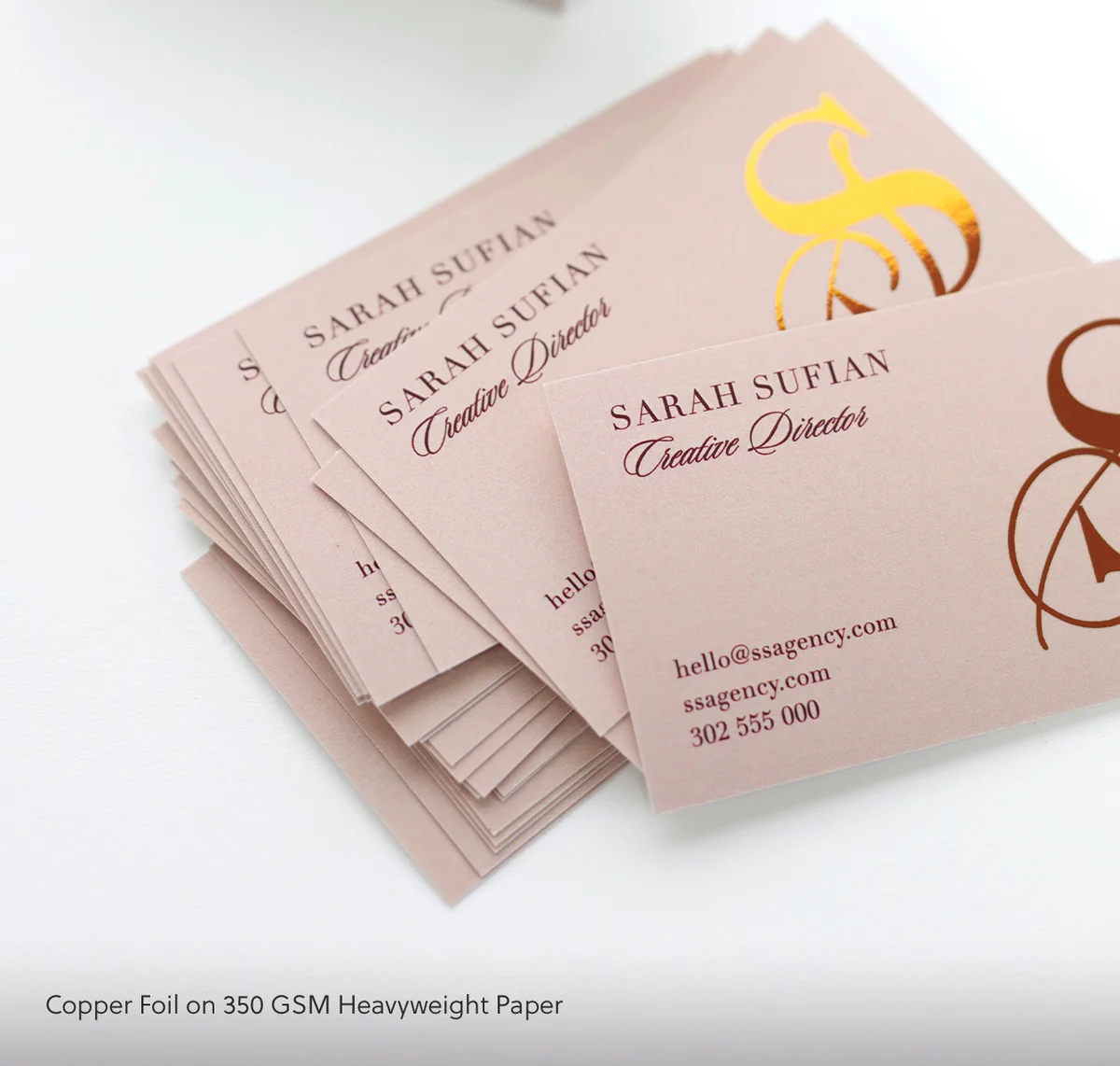
Flat Foil Business Cards add a metallic foil element – gold, silver, rose gold, copper, or holographic – to a digital print base. Production is 48 hours, making this one of the fastest premium upgrades available. The foil sits flat (no deboss) and delivers a mirror-bright finish on selected design elements. From $0.18 per card.
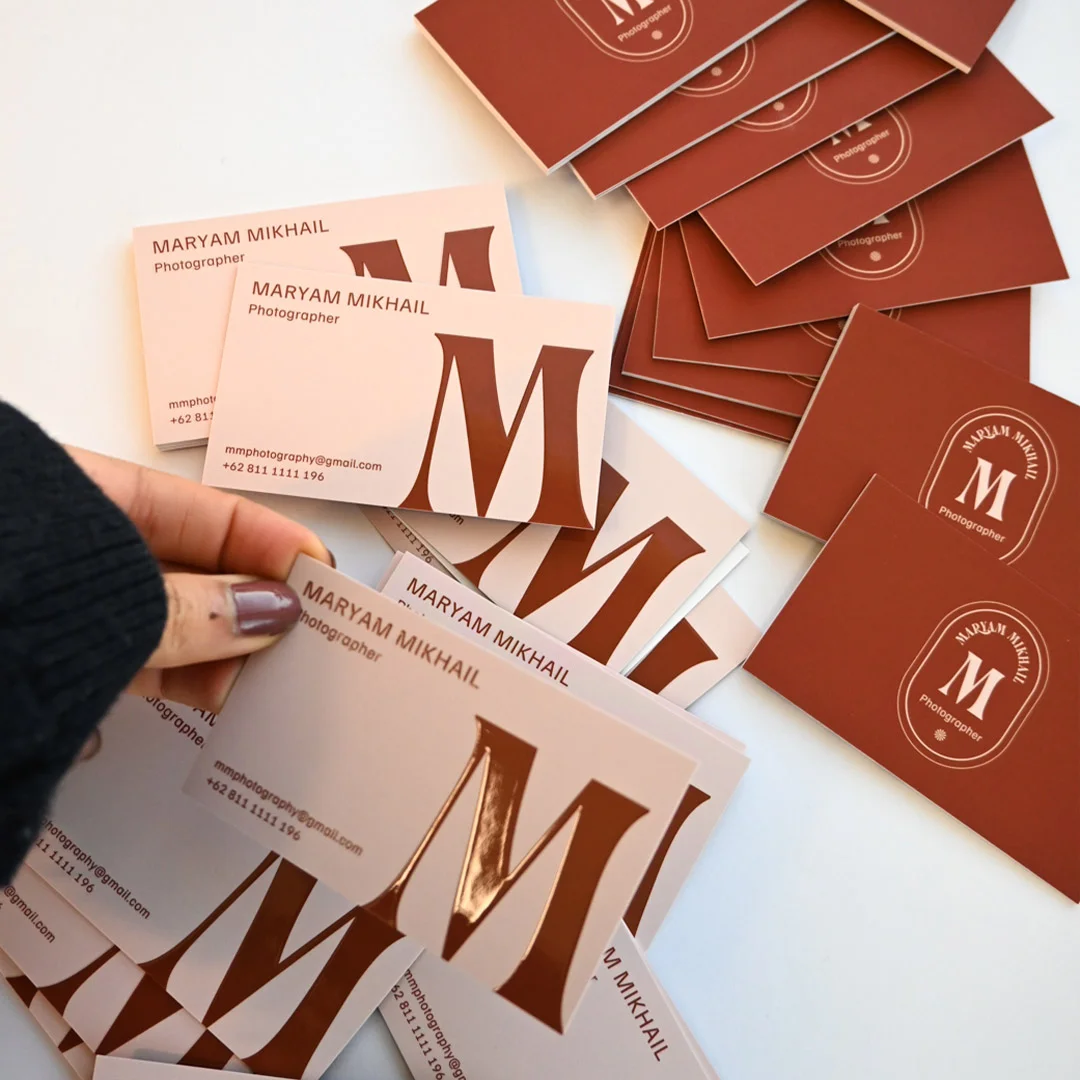
Coloured Paper Business Cards are printed on through-dyed card stock – the colour runs through the entire thickness of the paper, so cut edges show the same colour as the surface. This creates a distinctive look that standard white card with a colour-printed back cannot replicate. Also 24-hour production from $0.43 per card.
Spot UV Business Cards combine a matte-laminated artboard base with a clear UV-cured gloss coating applied selectively to nominated areas – your logo, your name, a background texture. The result is a high-contrast matte/gloss interplay that changes as the card moves in light. From $0.14 per card at volume. Minimum 250 cards, 7-10 working day production. Learn more about Spot UV Business Cards.
Scodix Business Cards go a step further. Scodix is a digital embellishment process that deposits clear polymer in precise layers, creating a physically raised, 3D texture you can feel with your fingertip. Where Spot UV is purely visual, Scodix is tactile – it changes how the card feels, not just how it looks. From $0.20 per card. Minimum 250 cards, 7-10 working days. See Scodix Business Cards.
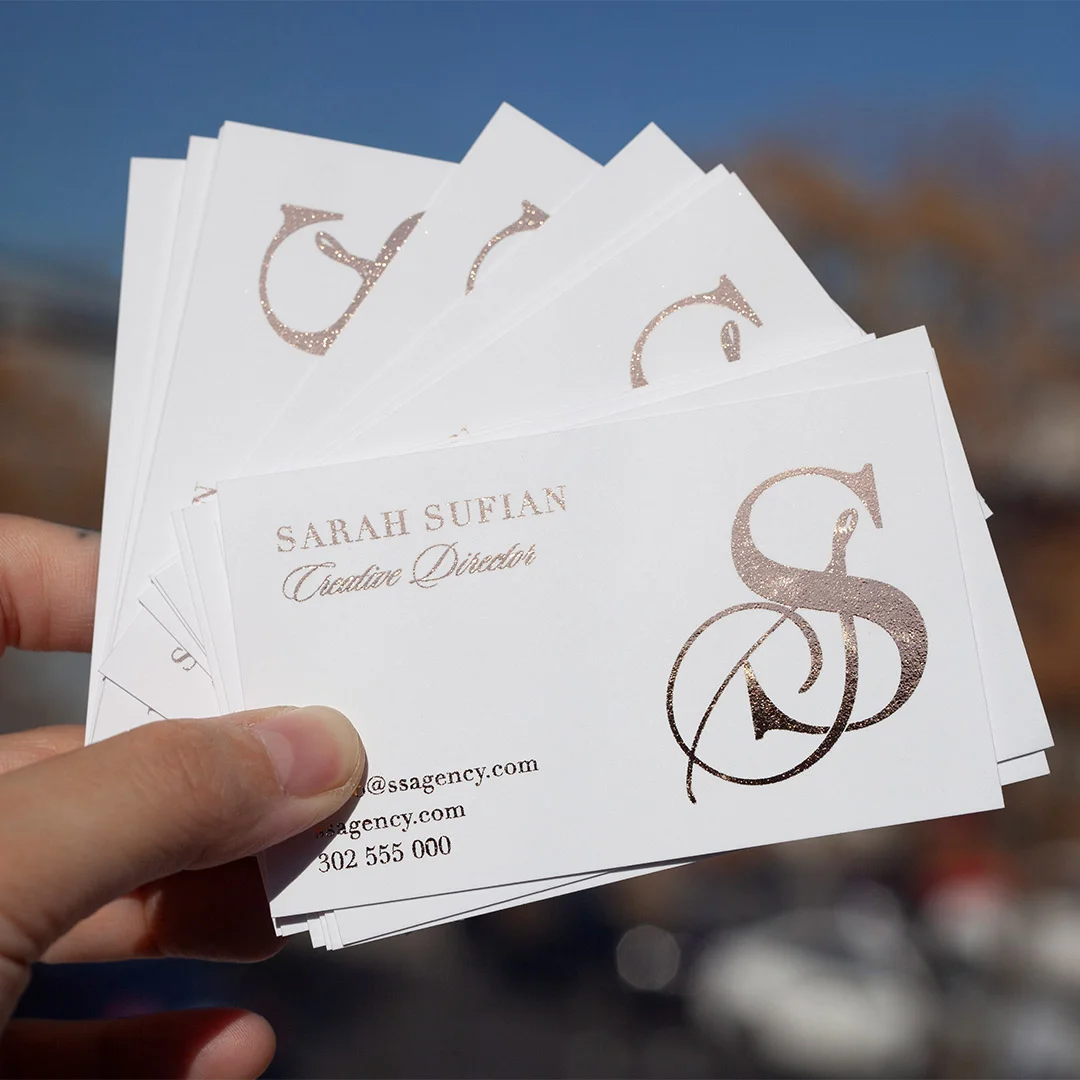
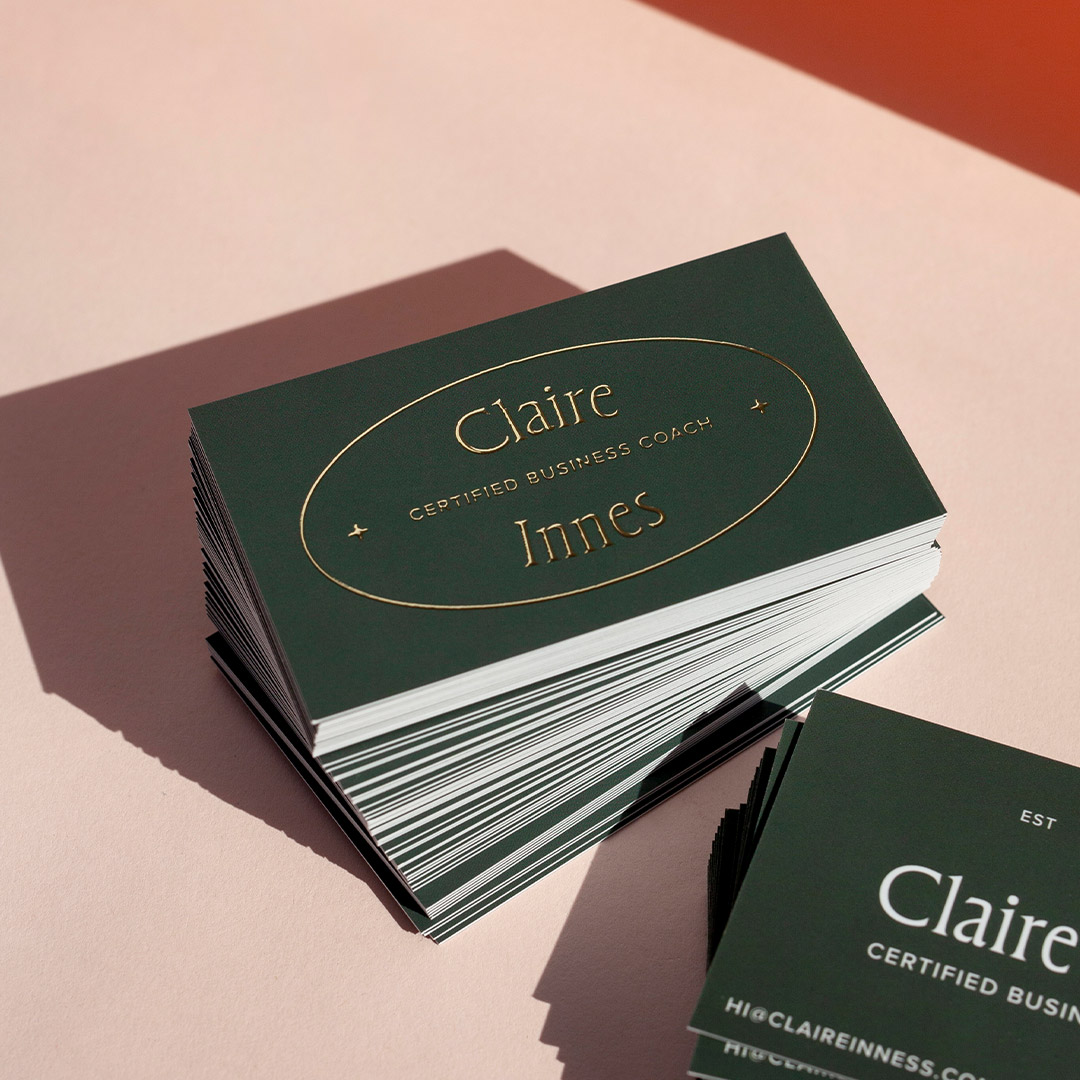
Raised Foil Business Cards apply real metallic foil (gold, silver, or rose gold) in a raised, textured layer – combining the mirror-bright colour of foil with the 3D physical presence of Scodix. This is the most tactile and visually striking option in the range. From $0.24 per card. Minimum 250 cards, 7-10 working days. Browse Raised Foil Business Cards.
Duplex Business Cards are constructed by bonding two sheets of card together, creating a thick, substantial card that communicates quality through weight alone. At $2.27 per card from, these are the highest-end option in the range – chosen by architects, interior designers, senior partners, and anyone for whom the physical heft of the card is part of the brief.
Paper Stock Choices: Linen, Metallic, Cotton, and Standard Coated
The paper stock you choose affects how a card feels in the hand, how well it accepts ink, and which print finishes are compatible with it. Standard digital business cards have the widest stock selection; specialty finishes are paired with specific stocks optimised for their production process.
| Stock | Weight | Surface | Best For | Finish Compatibility |
|---|---|---|---|---|
| Artboard + Velvet Laminate | 350-450gsm | Soft-touch matte | Dark designs, high-contrast finishes, luxury feel | Spot UV, Scodix, Raised Foil |
| Linen | ~350gsm | Fine cross-hatch texture | Creative professionals, design studios, consultants | Standard digital |
| Cotton | ~350gsm | Soft, slightly absorbent | Luxury cards, natural-brand identities, artisan businesses | Standard digital |
| Metallic | ~350gsm | Shimmering pearl sheen | Photographers, jewellers, luxury retail, beauty brands | Standard digital |
| Matte | 300-350gsm | Flat, light-absorbing | Minimalist design, corporate, text-heavy cards | Standard digital |
Matte 300 GSM Matte is the standard choice for most professional cards. The stock has a smooth non-reflective coated surface that holds full-colour print crisply, stays neutral so the design leads, and is rigid enough not to flex when picked up. It is the lowest cost tier, from 100 cards at $44 ($0.44 a card) and 1,000 cards at $139 down to a $0.08 a card floor at 5,000.
Linen stock adds a subtle cross-hatch texture that you can see and feel without looking dramatic. It suits professionals who want a card that feels distinctive without using a specialty finish. Interior designers, architects, and consultants use it often.
Cotton stock has a softer, slightly absorbent surface that reads as genuinely luxurious – not in a flashy way, but in the way a quality business envelope feels compared to a standard white envelope. It is well-suited to brands built around natural credentials, sustainability, or artisan craft.
Metallic stock has a built-in shimmer – think of it as a pearl-finish paper. This creates an effect without needing a foil finish, making it a cost-effective way to add visual interest. Photographers who use it for their card backs often find that the metallic base enhances the colour rendition of portfolio images printed on the reverse.
Artboard with Velvet Laminate is the base for all specialty finishes (Spot UV, Scodix, Raised Foil). The soft-touch matte laminate creates the contrast surface that makes Spot UV and Scodix effects visible – without it, the UV gloss or raised polymer would not stand out from the card surface. Choosing a dark design colour (navy, black, forest green, charcoal) maximises the contrast further.
Seven finish options, six paper stocks, 24-hour production on standard range. Melbourne studio, 100% happiness guarantee.
What to Expect: From Upload to Delivery (Process Walkthrough)
Understanding the production process removes the anxiety from ordering. Here is how a standard order moves through the press.
Step 1: Upload your artwork
Submit your file through the product page. Accepted formats: AI, EPS, PDF, SVG, PNG, or TIFF. PDF and SVG are the preferred formats – they preserve vector paths and font outlines without any ambiguity. If you are submitting a raster file (PNG or TIFF), it must be 300 dpi at the final print size. Anything lower will print noticeably soft.
Step 2: Pre-press file check
Before your file enters the production queue, it goes through a pre-press check. The team reviews bleed, safe zone margins, colour mode, font outlining, and image resolution. If there are issues, you receive specific, actionable revision notes – not a generic “your file has a problem” message. This step catches most artwork problems before they reach the press, which is what prevents reprints.
Step 3: Digital proof approval
You receive a digital proof showing exactly how your card will print. Review it carefully: check that colours render as expected, that no text is clipped by the safe zone, and that the design reads correctly on both sides if you have ordered a double-sided card. Approve the proof, and your order enters the production queue.
Step 4: Production
Standard, Flat Foil, and Coloured Paper cards: 24-hour production. Spot UV, Scodix, Raised Foil, and Duplex: 7-10 working days. Production time begins after proof approval, not after the initial order placement – factor this into your lead time planning if you have a fixed deadline.
Step 5: Quality inspection and dispatch
Cards are inspected after cutting and before packaging. Paperlust Print Shop operates a 100% happiness guarantee – if your cards do not meet expectations, the team arranges a free reprint or a refund. Packing and dispatch happen in Melbourne. Delivery is charged per order: $10 for standard delivery or $15 for express delivery anywhere in Australia.
Step 6: Delivery
Startrack Express delivers to most Australian metropolitan addresses on the next business day after dispatch. Regional and rural addresses typically add 1-3 business days depending on location. You receive a tracking number at dispatch.
Turnaround Times by Location: Sydney, Melbourne, Brisbane, Perth, Adelaide, Hobart, Darwin
Total lead time for your order equals production time plus transit time. The table below shows estimated transit times after dispatch via Startrack Express. Production times are noted separately – always plan for proof approval time as well, which typically adds 1 business day before production begins.
| Location | Metro Transit | Regional Transit | Total (Standard/24hr) | Total (Specialty Finishes) |
|---|---|---|---|---|
| Melbourne (VIC) | Same/next BD | 1-3 BD | 2-3 BD from order | 9-12 BD from order |
| Sydney (NSW) | Next BD | 1-3 BD | 2-3 BD from order | 9-13 BD from order |
| Brisbane (QLD) | Next BD | 2-4 BD | 2-3 BD from order | 9-13 BD from order |
| Adelaide (SA) | Next BD | 2-3 BD | 2-3 BD from order | 9-12 BD from order |
| Perth (WA) | 2-3 BD | 3-5 BD | 3-5 BD from order | 10-14 BD from order |
| Hobart (TAS) | 1-2 BD | 2-4 BD | 2-4 BD from order | 9-13 BD from order |
| Darwin (NT) | 2-3 BD | 3-5 BD | 3-5 BD from order | 10-14 BD from order |
BD = business days. All totals assume: same-day proof approval, no artwork revision required, and order placed before 12pm. Specialty finishes = Spot UV, Scodix, Raised Foil, Duplex. Standard/24hr = Standard Digital, Flat Foil, Coloured Paper.
Melbourne
Paperlust Print Shop operates its press studio in Melbourne, which means VIC metropolitan orders have the shortest possible end-to-end lead time. Same-day or next-business-day Startrack delivery covers most Melbourne metropolitan addresses after dispatch. For businesses in Melbourne’s CBD, inner suburbs, or industrial zones, 24-hour production plus next-day delivery means cards ordered Monday morning can realistically arrive Tuesday.
Sydney
Sydney is one of Startrack’s primary overnight metro corridors from Melbourne. Next-business-day delivery to most Sydney metropolitan postcodes after dispatch is standard. For businesses in the CBD, Surry Hills, Pyrmont, North Sydney, and other inner-metro areas, the total lead time for standard business cards (24hr production + next-day transit) is 2-3 business days from order placement including proof approval.
Brisbane
Brisbane metropolitan delivery via Startrack Express runs overnight from Melbourne in most cases. Next-business-day transit applies to inner Brisbane, the CBD, Fortitude Valley, South Bank, and inner suburbs. Outer Brisbane metropolitan areas and the Sunshine or Gold Coasts may add 1 business day. Total lead time for standard cards: 2-3 business days from order.
Perth
Perth is the longest haul from Melbourne in the Startrack network. Metro Perth transit is typically 2-3 business days after dispatch – factor this into your planning. For a standard business card order placed Monday, Perth metropolitan delivery is realistically Thursday or Friday. If you have a fixed deadline in Perth, order a day or two earlier than you would for east coast delivery. Specialty finishes add 7-10 working days of production before transit begins.
Adelaide
Adelaide metropolitan delivery from Melbourne is typically next business day via Startrack Express. SA regional areas – Victor Harbor, Mount Gambier, the Barossa, and outback SA – add 2-3 business days to transit time. Adelaide is well-served by the Melbourne-to-Adelaide overnight corridor.
Hobart
Tasmania is serviced overnight from Melbourne via Startrack’s air and road network. Hobart metropolitan addresses typically receive next-day or second-business-day delivery. Remote TAS locations – the West Coast, the far south, and smaller island communities – may take 2-4 business days beyond dispatch. Plan for 2-4 business days total for standard card orders.
Darwin
Darwin and the Northern Territory generally see 2-3 business day transit from Melbourne. Remote NT communities and outback locations can extend to 3-5 business days or more depending on access. For time-sensitive Darwin orders, standard 24-hour production cards are the right choice – specialty finishes would push total lead time to two or more weeks for most locations.
Pricing Tiers: What Australians Actually Pay for Custom Cards
Business card pricing in Australia is quoted per-card, with significant volume breaks. The “from” price always reflects the best rate at high volume – do not plan your budget around it for a run of 100 cards. Below is a realistic guide to what different finish tiers cost at different quantities.
| Finish | From (inc. GST) | Min Order | Production | Price Tier |
|---|---|---|---|---|
| Standard Digital | $0.08/card | 50 cards | 24 hours | Entry |
| Coloured Paper | $0.43/card | 50 cards | 24 hours | Entry-Mid |
| Spot UV | $0.14/card | 250 cards | 7-10 working days | Mid (volume) |
| Scodix | $0.20/card | 250 cards | 7-10 working days | Mid-Premium |
| Raised Foil | $0.24/card | 250 cards | 7-10 working days | Premium |
| Flat Foil | $0.18/card | 50 cards | 24 hours | Premium |
| Duplex | $2.27/card | 50 cards | Check at order | Ultra-Premium |
A few notes on reading this table correctly:
Spot UV per-card pricing looks low because of volume economics. At the 250-card minimum, the per-card rate is higher than the “from” figure, which reflects runs of 500 or 1,000 cards. Specialty finish setups carry a fixed cost – more cards spread that cost further. If you are ordering exactly 250 Spot UV cards, expect to pay more than $0.14 per card.
Flat foil and spot UV are two different effects, not two price points of one finish: flat foil runs from $1.59 a card at 100 to $0.18, while spot UV starts at $0.64 a card for 250 with a $0.14 floor. Flat Foil is a separate foil application process that involves real metallic foil media and a different press setup. Spot UV uses a UV-cured clear varnish. The two finishes look completely different: Spot UV is clear and adds no colour; Flat Foil adds a gold, silver, or coloured metallic sheen. They are not substitutes for each other.
Duplex at $2.27 is a different product category. You are paying for two sheets bonded together – the weight and thickness of the card is part of the product value. Architects and senior professionals who carry Duplex cards use them precisely because the card communicates something before it is even read.
All pricing includes GST. Delivery is the only extra: $10 for standard delivery or $15 for express delivery per order, shown separately in the cart.
View the full Paperlust Print Shop business card range with live pricing across all finishes.
Standard, Spot UV, Scodix, Raised Foil, Flat Foil, Coloured Paper and Duplex are all made in Melbourne. Delivery is charged per order at $10 for standard delivery or $15 for express delivery.
File Setup: How to Prepare Print-Ready Artwork
Most print delays and reprint requests trace back to artwork files that were not set up correctly for production. Getting this right before submission means your order clears pre-press without revision and enters the production queue on time.
Document size and bleed
Set your document up at the exact card size: 90 x 55mm for a standard rectangle. Add 3mm bleed on all four sides – this means your document canvas is 96 x 61mm. Bleed is the area of your design that extends beyond the trim line; it ensures that background colours and edge-to-edge graphics continue to the card edge after cutting, preventing white sliver margins.
Safe zone
Keep all critical content – text, logos, QR codes, contact information – at least 4mm inside the trim line (not the bleed edge; the trim edge). This is the safe zone. The cutting process involves mechanical tolerances that can shift the cut by 1-2mm in any direction. Content sitting in the safe zone is guaranteed to appear on the finished card. Content sitting between the safe zone and the trim line may be partially cut off.
Colour mode
Set your document to CMYK colour mode before you place any images or set any colours. CMYK is the colour space used by offset and digital presses. If you submit an RGB file, the pre-press team will flag it – the automatic conversion from RGB to CMYK can shift certain colours noticeably, particularly vibrant blues, greens, and oranges. Convert deliberately in your design software rather than letting the printer’s RIP do it automatically.
Image resolution
All raster images embedded in your file must be at least 300 dpi at the final print size. A photo that is 300 dpi at A4 size is not 300 dpi if you scale it up to fill a full-bleed card back – it is much lower. Check the effective resolution of scaled images in your layout software before export. For a standard 90 x 55mm business card at 300 dpi, that means your raster images need to be at least 1063 x 650 pixels.
Fonts
Outline all fonts before saving your final print file. “Outlining” converts font letterforms into vector paths, so the printer’s system does not need the original typeface installed to render your text correctly. In Adobe Illustrator: Select All, then Type > Create Outlines. In InDesign: export a PDF with “Embed All Fonts” checked (or flatten to outlines before export). Failure to outline fonts is one of the most common pre-press issues – it takes 30 seconds to fix in your software, and causes a file rejection and delay if overlooked.
File formats
Preferred: AI, EPS, PDF, SVG. Accepted raster formats: PNG or TIFF at 300 dpi minimum. PDF/X-1a or PDF/X-4 are the gold-standard export settings for print-ready PDFs – they embed all fonts, use CMYK colour, and include bleed and crop marks. If your design software offers a “Print-Ready PDF” or “Press-Quality PDF” export preset, use it.
Double-sided cards
Submit front and back as separate files, clearly labelled (e.g., card_front.pdf, card_back.pdf). Do not supply front and back on the same artboard unless your software allows you to designate pages to sides. For double-sided cards, check that both sides are orientated consistently and that the back is not inadvertently mirrored.
Premium Finishes: Spot UV, Foil, Scodix – When to Upgrade
The decision to upgrade from standard digital to a premium finish is not purely aesthetic – it is a brief question about what you need the card to do. Three scenarios where an upgrade makes objective business sense:
You are in a high-volume networking environment. Tradeshows, industry conferences, and professional events involve dozens of card exchanges. A standard card competes on content. A Spot UV or Raised Foil card competes on feel before anyone has read a word on it. The person sorting through 30 cards from the day’s networking will notice the one that feels different. If business development is your primary card use case, the upgrade has a direct ROI argument.
Your brand is built on luxury or craft. A jeweller, a bespoke tailor, a boutique architect, a luxury real estate agent – these professionals need their card to embody the same quality signals as the services they sell. A thin, flat, digital card creates a dissonance. Duplex thickness, Raised Foil, or Scodix texture closes that gap.
You want to be remembered, not just filed. Most business cards are filed or photographed and discarded. Cards with a physical quality marker – raised texture, metallic foil, a tactile soft-touch laminate – have a measurably longer desk life because people handle them more and put them down less readily.
When Spot UV is the right choice: you want visual contrast (matte vs gloss interplay) without tactile raise; you have a strong design with a clear focal element (logo, icon, name) that benefits from selective highlighting; you are ordering 250+ cards and want a premium effect at a mid-tier per-card cost. Explore Spot UV Business Cards.
When Scodix is the right choice: you want the Spot UV visual effect plus a physically raised, tactile surface; your brand identity has a strong mark or texture element that benefits from 3D treatment; you are comfortable with 7-10 working days production. See Scodix Business Cards.
When Flat Foil is the right choice: you need a metallic element – gold, silver, rose gold, copper, or holographic – but with 48-hour production rather than the 7-10 day specialist finish window; your design has a clean element that benefits from metallic treatment and you do not need tactile raise.
When Raised Foil is the right choice: you want metallic colour and tactile texture together – the premium version of both Spot UV and Flat Foil combined; you are willing to wait for 7-10 working days production in exchange for the most striking finish in the range. Browse Raised Foil Business Cards.
When Duplex is the right choice: weight and thickness are as important as surface finish; you want a card that communicates quality through physical substance before any finish is even noticed; budget per card is less of a concern than impact per interaction.
Minimums and Bulk Orders: Australian Print-Run Expectations
Minimum order quantities exist because of print setup costs – certain press configurations and specialty finishing processes have a fixed overhead that only becomes economical above a certain print run. Understanding the minimums helps you plan realistically.
Standard, Flat Foil, and Coloured Paper business cards: 50-card minimum. Standard business cards at 50 cards are the right starting point for an individual professional, a small team, or a new business testing a design before committing to a large run. At 50 cards, per-card costs are at their highest, and the economics of scale start at 250 and improve significantly at 500 and 1,000.
Spot UV, Scodix, Raised Foil, and Duplex business cards: 250-card minimum. Specialty finishing equipment requires press setups and material preparations that are not cost-effective below this quantity. If you want Spot UV but only need 100 cards, the honest answer is that you either order 250 (and have stock on hand for the next 6-12 months of networking) or choose Flat Foil at the 50-card minimum instead.
Bulk orders and volume pricing. Per-card rates decrease at 250, 500, 1,000, and 2,500 cards. For businesses that use cards in volume – agencies with multiple team members, hospitality groups with seasonal front-of-house staff, real estate offices onboarding new agents – ordering at 1,000+ cards is significantly more economical per card than placing several smaller orders. The cards store well if kept flat, dry, and away from humidity.
Team and multi-person orders. If you have multiple people in your organisation who need cards with different names and contact details but the same design, the most efficient approach is to order each person’s cards as a separate job sharing the same template. The pre-press file check runs once per template; subsequent name/contact variations are straightforward updates. Coordinate quantities to hit volume thresholds where possible – five people ordering 200 cards each at the same time, for example, may be more cost-effective handled as a 1,000-card run with variable data printing.
The full range of custom business card printing options at Paperlust Print Shop includes live quantity pricing so you can calculate your order total before submitting.
Quality Checks: How to Spot a Reputable Australian Printer
The Australian print industry includes a wide range of operators – from large-format commercial printers taking on business card work as a side product, to offshore-brokered print services operating through local-looking Australian websites, to genuine local print studios with their own press equipment. Here is how to distinguish between them before you commit your brand to a print run.
They have a documented quality guarantee. Any reputable Australian business card printer should have an explicit guarantee – free reprint or refund if the finished product does not meet the approved proof. If this guarantee is absent from the website, or buried in vague language, treat it as a red flag.
They provide a digital proof before production. A pre-production digital proof is standard practice in professional print. If a service proceeds to production without a proof step – or charges extra for proofing – they are either cutting corners or they do not have a workflow that catches pre-press errors. Either outcome puts your order at risk.
They are transparent about turnaround times. Reputable printers distinguish between production time and transit time, and they are honest about when each phase begins. Watch for services that advertise “3-day delivery” without clarifying that production adds 7-10 days first. Transparent lead time communication is a signal of operational maturity.
They have verifiable customer reviews. Check Google Reviews and Trustpilot, not just testimonials on the printer’s own website. Look for a minimum of 4 out of 5 stars across 50+ reviews. A small number of glowing testimonials hand-picked for the homepage is not the same as a verified review record across independent platforms.
They publish their file requirements clearly. A printer that does not tell you what file formats, colour modes, bleed dimensions, and resolution requirements they need is going to generate revision requests and delays. Good printers publish clear technical specifications because they want files that do not need rejection and rework.
They are actually in Australia. Some print services operating under Australian-sounding names or .com.au domains are print brokers using offshore production. The giveaway is usually in the transit times (3-4 weeks is not an Australian print lead time), the customer service timezone (replies at 3am AEST), or the absence of any studio address or production facility information. Genuine local printers operate presses they own and can tell you where they are.
Frequently Asked Questions
What is the standard business card size in Australia?
90 x 55mm is the standard Australian business card size, matching the ISO CR80 format used in most of the world. Paperlust Print Shop also offers rounded corners at the same 90 x 55mm dimension, circle cards at 60 x 60mm, oval cards at 90 x 50mm, and custom die-cut shapes. Note that shape availability varies by finish – Spot UV, Scodix, and Raised Foil are currently available in rectangle format only.
How quickly can I get custom business cards printed in Australia?
Standard Digital, Flat Foil, and Coloured Paper business cards are available with 24-hour production. Delivery is charged per order at $10 for standard delivery or $15 for express delivery anywhere in Australia. Specialty finishes – Spot UV, Scodix, Raised Foil, and Duplex – have a 7-10 working day production window before dispatch.
What is the minimum order quantity for custom business cards?
Standard, Flat Foil, Coloured Paper, and Duplex business cards have a minimum of 50 cards. Spot UV, Scodix, and Raised Foil business cards require a minimum of 250 cards due to the additional setup required for specialty finishing processes. Per-card rates decrease significantly at 500, 1,000, and 2,500 cards.
What files do I need to submit for print-ready business card artwork?
Accepted formats are AI, EPS, PDF, SVG, PNG, or TIFF. PDF and SVG are preferred. All raster images must be 300 dpi at final print size. Set your document to 90 x 55mm with 3mm bleed on all sides and keep all critical content within a 4mm safe zone from the trim edge. Use CMYK colour mode and outline all fonts before export. A free pre-press file check is included with every order.
How does Spot UV differ from Scodix?
Spot UV applies a flat, clear UV-cured gloss coating selectively over a matte-laminated card surface – it is visually striking (matte vs gloss contrast) but physically flat. Scodix creates a physically raised, 3D digital embellishment that you can feel with your fingertip. Spot UV is the choice when visual contrast is the goal; Scodix is the upgrade when tactile texture is part of the brief. Both use 450gsm Artboard with Velvet Laminate as their base stock.
What paper stocks are available for custom business cards?
Standard digital business cards are available on Artboard (smooth coated), Artboard with Velvet Laminate (soft-touch matte), Linen, Cotton, Metallic (pearl sheen), and Matte stocks. Specialty finishes – Spot UV, Scodix, and Raised Foil – are paired with Artboard with Velvet Laminate specifically, as this stock provides the contrast surface the finishing process requires.
Can I get a proof before my cards go to print?
Yes. Every order includes a digital proof before production begins. Paperlust Print Shop also provides a free pre-press file check with specific revision notes, so any artwork issues are identified and communicated before the proof stage. If changes are needed, you receive clear instructions rather than a vague file rejection.
How much do custom business cards cost in Australia?
Per-card pricing (inc. GST) starts from: Standard $0.08, Coloured Paper $0.43, Spot UV $0.14, Scodix $0.20, Raised Foil $0.24, Flat Foil $0.18, Duplex $2.27. These are “from” prices at high volume – the per-card rate at the minimum order quantity will be higher. Delivery is charged per order at $10 for standard delivery or $15 for express delivery, and both figures include GST.
What does delivery cost for business cards in Australia?
Delivery on a business card order is charged per order: $10 for standard delivery or $15 for express delivery, anywhere in Australia. Both figures include GST. The card price and the delivery fee are shown separately in the cart, and the delivery fee is the only extra on top of the card price.
What business card shapes are available beyond standard rectangular?
Available shapes include: standard rectangle (90 x 55mm), rounded corners (90 x 55mm), circle (60 x 60mm), oval (90 x 50mm), and custom die-cut shapes. Shape availability varies by finish – specialty finishes (Spot UV, Scodix, Raised Foil) are currently available in rectangle format. Standard digital, Coloured Paper, and Flat Foil cards have the widest shape selection.
How do I know if a business card printer in Australia is reputable?
Key indicators: a documented quality guarantee (free reprint or refund policy), verified customer reviews on Google and Trustpilot rather than only website testimonials, transparent turnaround times that separate production from transit, clear published file requirements, and an Australian studio address with actual press equipment. Be cautious of services with 3-4 week lead times advertised as “fast,” no proof step, or no published quality guarantee.
Paperlust Print Shop prints every business card order in Melbourne, backs each order with a 100% happiness guarantee, offers finish options from standard digital to Raised Foil and Duplex, and charges delivery per order at $10 for standard delivery or $15 for express delivery. 24-hour production available on the standard range.