A drink bottle comes home with a label reading Maximilian and nothing after it. The rest of the name never made the cut, the letters are small enough to need squinting at, and the accent on the last vowel has vanished. If you have bought name labels for long names before and got back a trimmed version of what you typed, the printer is rarely the culprit. The fitting rule behind the label is.
What follows covers what happens when a long, hyphenated or accented name meets a small piece of vinyl: where type shrinks, where it breaks across two lines, when a short name is the honest answer, and how to vet a whole pack before it goes to print.
The short version
- A name with space to spare keeps its full size; a longer one shrinks to the smallest readable height, or takes two lines if the label is deep enough.
- Hyphenated and double-barrelled names break at the space or the hyphen, never in the middle of a word.
- Macrons (ā, ē, ī, ō, ū), accents, apostrophes and hyphens all print, and a name can run to 40 characters.
- If one size cannot hold the name, you give that size a shorter version; the rest of the pack keeps the full one.
- The live preview follows the same fitting logic as the print file, and a spelling check lists every name before you add to cart.
- The largest labels give a long name the most room, at 60 x 22 mm on School Labels and Name Stickers, and 70 x 25 mm on Daycare Labels.
Why long names get cut on small labels
Every label is a fixed box. Nothing you type makes it wider, and the name has to sit inside it with a margin so the last letter does not run off the edge. That leaves three levers: how tall the letters are, how many lines the name can use, and how much of the name you are willing to lose.
Most of the trouble comes from that third lever being pulled quietly. The type gets scaled down until a child cannot read it across the table. The tail end is chopped, so the lunch box belongs to someone called Maximilian-Alex. Or a mark drops off: an accent or macron disappears, occasionally replaced by a small empty rectangle, and a correct name turns into a wrong one.
No single one of those is dramatic. Stacked together, they add up to a child wearing someone else’s name for the whole year.
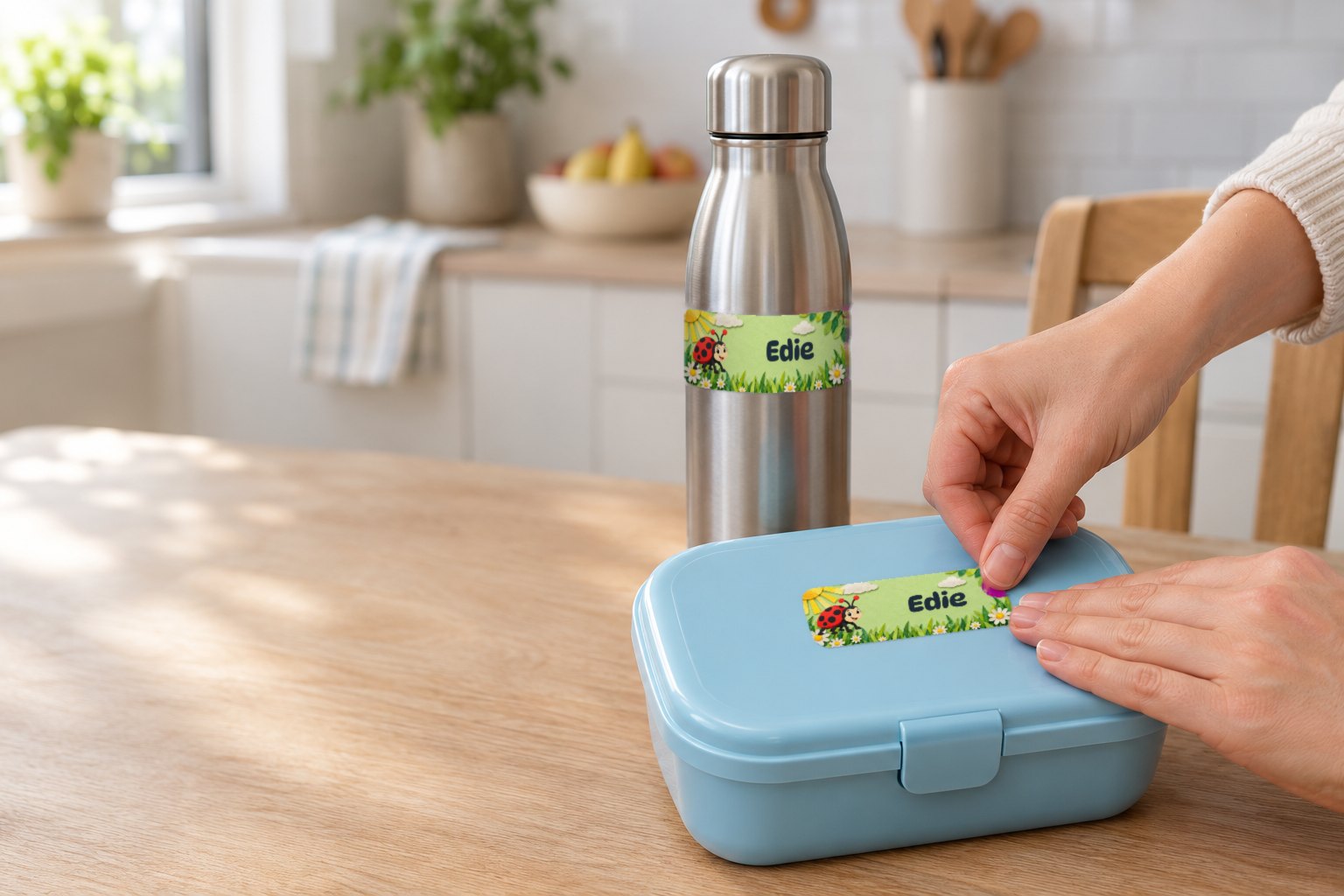
How hyphenated and double-barrelled names fit a label
A hyphenated name is two names joined, and the join is the natural place to pause. A double-barrelled name with a space behaves the same way. On a label deep enough for a second line, the break lands at the space or the hyphen, which leaves both halves whole.
Maximilian-Alexander Worthington is the test case. Squeezed onto one line at a size thin enough for a pencil strip, it turns into a grey smudge. Split over two lines, it reads as Maximilian-Alexander above and Worthington below, and the child can pick out their own lunch box without asking.
A break in the wrong spot is worse than a slightly smaller font. Worthing on one line and ton on the next is not a name, it is a puzzle to solve. Only spaces and hyphens are used as break points, nowhere else in the word.
Accents, macrons and apostrophes: how they reach the label
In te reo Māori the macron (ā, ē, ī, ō, ū) signals that a vowel is held long, and length can shift what a word means. A Māori name printed without its macrons is not a relaxed spelling. It is a different name, and a wrong one. Accents behave identically: the mark over the é, ñ or ü belongs to the name rather than decorating it.
Which leaves the labels one clear job: keep the spelling you entered. A name can run to 40 characters, and every one of them prints. Mārama O’Connor-Hughes arrives with its macron, its apostrophe and its hyphen intact. Zoë Núñez keeps the dots over the e and the marks over the two letters that follow.
The apostrophe needs a note of its own. Type the straight version or the curly one and both are accepted, but the character that reaches the vinyl is always the curly typeset apostrophe, so O’Connor is printed as O’Connor. Worth knowing in advance if the straight mark matters to you.
Fonts are the other half. Not every typeface carries every letter, and a font that cannot print a character in your child’s name will say so: the page names the missing character and points you to one that covers it. It does not leave a blank rectangle where a letter should be. Do check the preview for capital letters too, because some fonts keep the capitals you typed while others set every name in upper case so that a capital I and a lower case l never look alike. The preview tells you which one you are looking at before you order.
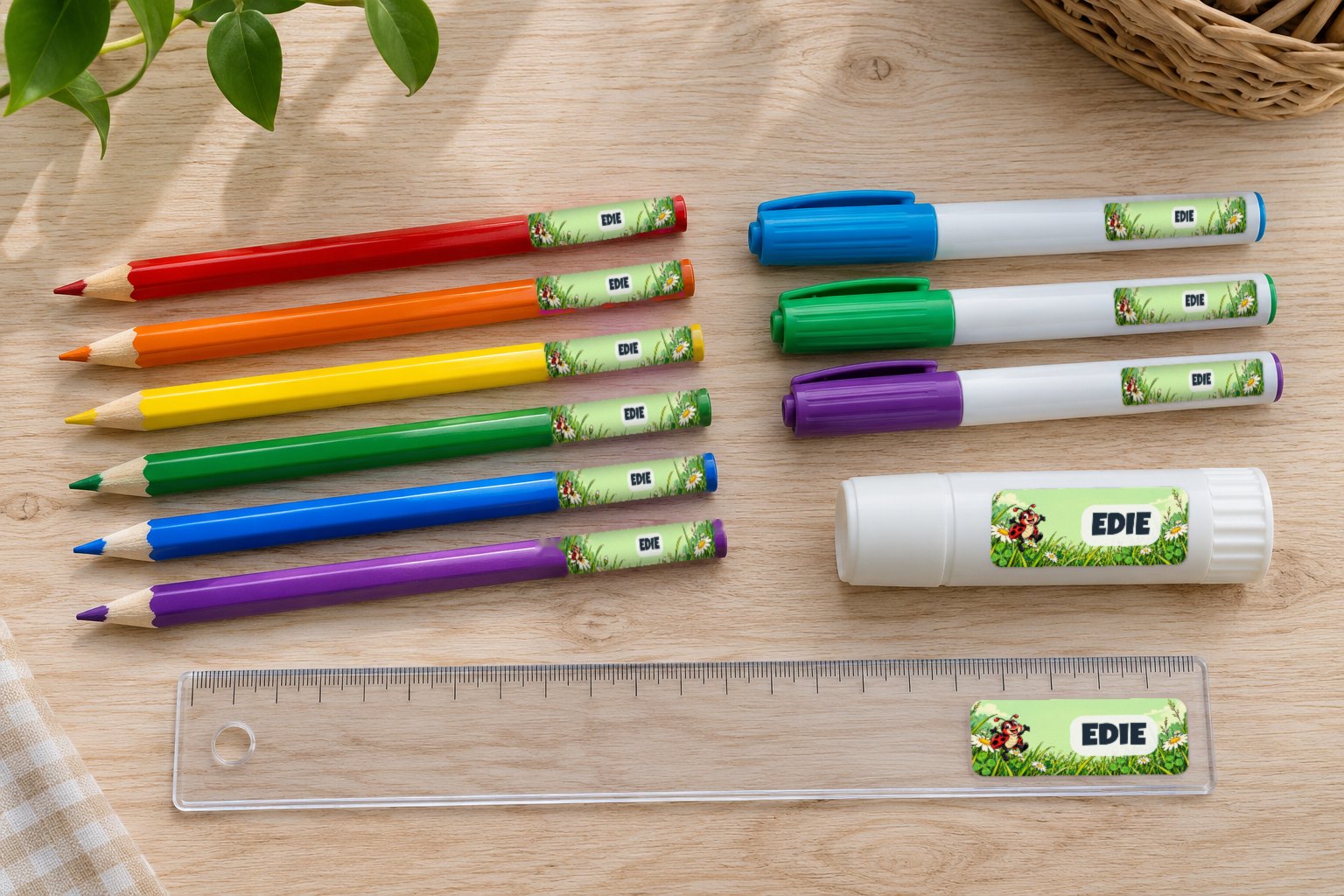
When a size truly needs a short name
The pencil label measures 38 x 9 mm and holds one line. Sold as their own product, pencil labels are a longer 50 x 8 mm strip that still holds one line. There is a floor below which type stops being legible, and pushing a four-part name into that strip does not solve anything. It buries the problem in lettering nobody can decipher.
When a name would need to go under that floor, the page flags the size and offers a smaller field for a nickname or the first name, used on that size alone. The rest of the pack keeps the full name, so the lunch box and book covers stay labelled properly.
What you should not do is surrender the whole name because one thin strip cannot hold it. Give the small size a short name and let the bigger sizes carry the rest.
Check the whole pack before you print
Type the name once and the whole sheet redraws as you go. What you see on screen comes from the same fitting logic and the same design that feed the printer, so the pack in front of you is the pack you will receive. An awkward line break or a nickname that reads oddly will show up there, not on a drink bottle in week two of term.
Before Add to cart, a spelling check lists each name the way it will come off the press. Read it slowly. That is the last moment at which a stray apostrophe costs nothing to fix.
If you would like a second pair of eyes, ask for a PDF proof and we will email one before printing starts. Preview and proof work the same way across our school labels for lunch boxes and book covers as they do on every other product in the range.
Which labels suit long names
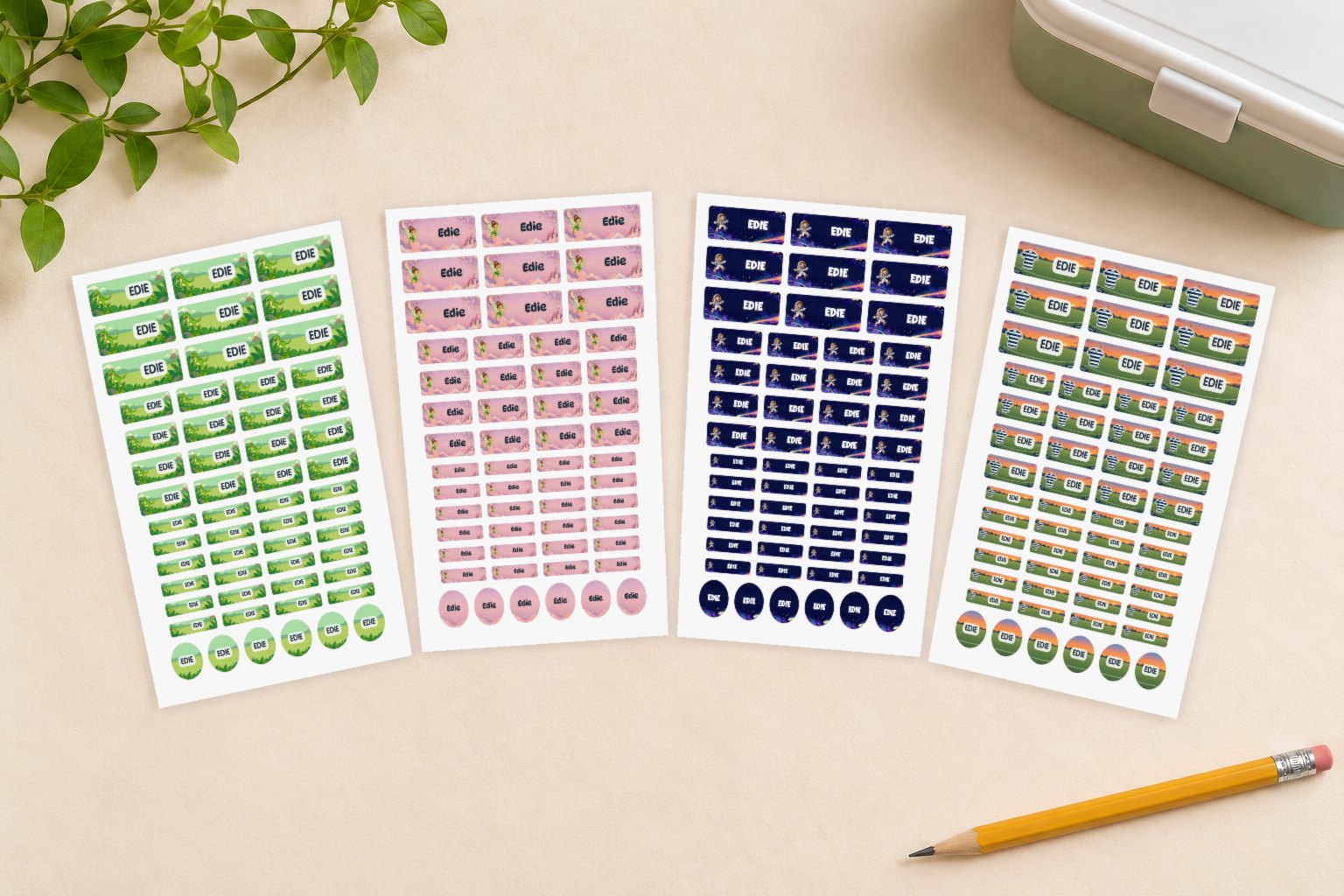
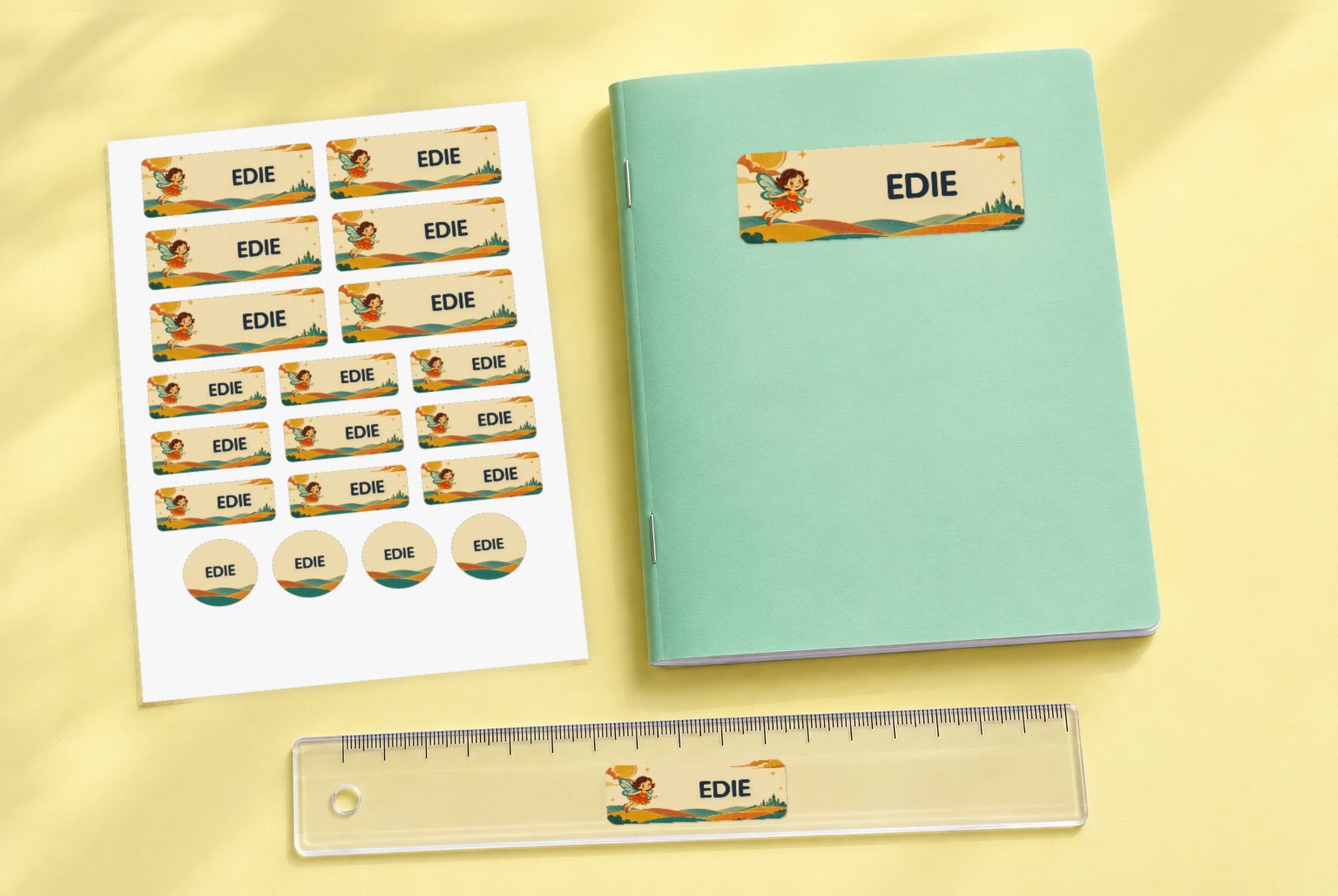
Start with the roomiest size a product offers and work down. On School Labels the large option measures 60 x 22 mm, enough for a full long name across a lunch box lid or a book cover. Among our daycare labels for bottles, the long size runs to 70 x 25 mm, made for the drink bottles and lunch boxes that travel to and from childcare. Inside a book cover, book labels place a long name in a 48 x 48 mm square under the words This book belongs to.
Toys, tablets, chargers and sports gear are covered by name stickers for everyday gear, which also come in a large at 60 x 22 mm. Sizes and pack counts sit side by side on the kids name labels range, so you can hold a long name up against the space each product gives it. On photo name labels the photo sits above the name, with no second line, so the large 30 x 39 mm size gives a long name the most room.
Where one size in a pack genuinely cannot hold the name, the nickname step covers it and the bigger sizes keep the full version. Choose the label by the name it has to carry, not by how many come on the sheet.
Frequently asked questions
Will a long name fit on a name label?
Usually, yes. A name with room to spare keeps its full size, and a longer one is shrunk only as far as the smallest height a child can read without straining, or placed on two lines. A name can be up to 40 characters. If a particular size still cannot take it, that size is flagged and you can use a nickname for it.
Can I print a hyphenated name?
Yes. Hyphens print as typed, and a name can run to 40 characters. On a label with space for two lines, a hyphenated or double-barrelled name breaks at the space or at the hyphen rather than inside a word, so each half stays whole. If one size cannot hold the full name at a readable height, you can shorten it for that size only.
Can name labels print Māori macrons?
Yes. In te reo Māori a macron marks a vowel held long (ā, ē, ī, ō, ū), and a name without them is spelt wrong, so the marks print exactly as you typed them. If your chosen font lacks one of those characters, the product page names the letter and suggests a font that includes it. No empty rectangle is ever printed in place of a letter.
Do accents print correctly?
Accents come out correctly, including é, ñ and ü, along with hyphens and full stops. Apostrophes print too, though a straight mark is set as the curly typeset apostrophe. The preview you see on the product page uses the same logic that drives the printer, so the marks on screen match the marks on the vinyl. Should a font be missing a character, the page names it and offers an alternative that carries it.
Can a name have an apostrophe, like O’Connor?
Yes. A straight or a curly apostrophe can be typed and both are accepted, but the label always prints the curly typeset apostrophe, so O’Connor comes out as O’Connor. The spelling check before Add to cart lists every name as it will print, which is the moment to confirm the rest of it.
What happens if the name is too long for the smallest label?
That size is flagged as too long for the name, and you can enter a nickname or the first name for that size alone. Every other size in the pack keeps the full name, so lunch boxes and book covers stay labelled in full. Add to cart waits until each size has something that fits.