A business card that turns soft and illegible after two days in a tradie’s back pocket is not doing its job. Australian tradies hand out more cards per week than most professionals, in conditions that would destroy the average office card – oil-stained hands, damp toolboxes, glove boxes baked by afternoon sun, dusty work vans, and open outdoor worksites. The card that survives that environment and still looks professional when a homeowner pulls it out three months later is the one that wins the callback. This guide covers everything Australian tradies need to know about choosing the right card stock, finish, and information layout to get maximum return from every card they hand out.
Quick reference
Tradie Business Cards: What You Need to Know
Key facts before you order for your trade.
- Most durable option: Duplex cards – two paper stocks bonded together for extra-thick rigidity; from $2.27/card inc. GST
- Best value bulk: Standard business cards from $0.08/card inc. GST on 350-400gsm coated stock with 24-hour production available
- Protected surface: Spot UV adds a full matte laminate base plus selective UV gloss coating over key elements; from $0.14/card
- Premium + fast: Flat Foil – mirror metallic finish with 24-hour production available; from $0.18/card
- Must-have info: trade licence number, ABN, mobile number, services list (3-5 items), service area
- Standard AU card size: 90mm x 55mm
- Delivery: standard $10 per order, express $15 per order, Australia-wide
Ready to order tradie cards that last?
Standard, Duplex, Flat Foil, and Spot UV – all printed in Melbourne and delivered Australia-wide.
Why Standard Business Cards Don’t Survive Worksites (and What Does)
The business cards sold at office supply stores are built for office environments – air-conditioned rooms, clean hands, dry pockets. They are typically printed on thin 260-300gsm uncoated stock with no surface protection. In those conditions they perform adequately. Put the same card into a tradie’s week and the failure modes appear quickly.
Water is the first problem. A card that gets caught in a morning shower before being handed to a customer, or picked up off a damp worksite surface, will soften at the edges within minutes on uncoated stock. The ink bleeds, the card curls, and by the time it reaches the customer’s hands it communicates low quality before they have read a single word.
Oil and grease are the second problem. Even a residual smear from working with tools transfers to an uncoated surface and creates blotchy dark staining that makes the card look neglected. A card that arrives at the customer with a grease thumbprint over the phone number is not going to generate a callback.
Physical wear is the third problem. Business cards live in back pockets, toolboxes, glove compartments, and shirt pockets on hot days. Thin stock cracks at corners within hours, develops soft dog-eared edges, and after a week of being shuffled around with tools it can be mistaken for scrap paper. Tradies handing out 20-30 cards a week cannot afford to have half of them destroyed before they reach a decision-maker.
What survives instead
Worksite-capable cards share three characteristics: thick cardstock (350gsm minimum), a sealed or coated surface, and a print method that resists abrasion and UV exposure over time. At Paperlust Print Shop, this means choosing from four main options, each suited to a different combination of budget, volume, and durability requirement.
- Thick coated stock (350-400gsm): baseline standard; resists casual moisture and routine wear without bending
- Duplex bonded stock: two layers permanently fused together for maximum rigidity and thickness
- Spot UV surface: full matte laminate seals the card against moisture and oil; UV gloss protects featured elements
- Foil elements: metallic foil areas resist surface wear; 24-hour production available for urgent orders
The good news is that worksite-tough does not mean expensive. Standard business cards from Paperlust Print Shop are printed on 350-400gsm coated stock – already a significant step up from cheap uncoated alternatives – and the upgrade path to Spot UV or Duplex adds meaningful durability without requiring a large per-card budget.
Paper Stock for Tradies: Thickness, Coating, and Lamination
Thickness and surface coating are the two variables that matter most for durability. A heavy card with no coating will still absorb moisture and oil at the surface. A thin card with a full laminate will survive surface contact but bend and crease easily. Worksite-ready cards need both – and the options at Paperlust Print Shop are designed around that requirement.
| Card Type | Stock Weight | Surface | Worksite Durability | Best For | From (inc. GST) |
|---|---|---|---|---|---|
| Standard | ~350-400gsm | Coated cardstock | Good | Bulk orders, budget-conscious trades | $0.08/card |
| Spot UV | ~350gsm + full matte laminate | Matte laminate + selective UV gloss | Very Good | Surface protection + professional finish | from $0.14/card |
| Flat Foil | ~350-400gsm | Coated + metallic foil on selected elements | Good | Premium branding with 24-hour production | $0.18/card |
| Duplex | Double-bonded (thickest) | Depends on stock selection | Excellent | Maximum thickness, rigidity, and premium feel | $2.27/card |
The lamination question
When tradies ask about “laminated” or “waterproof” business cards, they are describing the kind of protection that comes from a fully sealed surface: one that wipes clean, does not absorb moisture, and does not peel or scuff under handling.
Spot UV cards have a full matte laminate applied across the entire surface before the selective gloss elements are added. This gives the entire card a sealed, wipeable surface – the closest thing to what tradespeople typically mean when they ask for a laminated card. Spot UV business cards start from $0.14/card inc. GST (at volume), making them an excellent cost-effective upgrade for tradies who need a protected surface.
Duplex business cards take a different approach to durability: two paper stocks are permanently bonded together to create an extra-thick card with exceptional rigidity. Duplex cards do not bend easily, do not crease in pockets, and have a substantial weight that communicates quality before the reader looks at the design. They are the most structurally durable option in the range and the right choice for tradies who want their card to survive years in a customer’s wallet.
Best Business Card Finishes for Worksite Durability
Beyond paper stock, the finish determines how the card holds up to surface contact, UV exposure, and the everyday dirt of tradie work. Here is how each finish performs in worksite conditions.
Standard coated – the reliable baseline
The entry point and the right choice for tradies who need volume. Standard business cards at Paperlust Print Shop are printed on 350-400gsm coated stock with 24-hour production available. They handle casual moisture and routine handling well. For tradies who hand out 200+ cards a month across multiple job sites and need to keep per-unit cost low, standard is the right call – order in bulk, as the per-card price improves significantly with quantity.
Spot UV – best surface protection
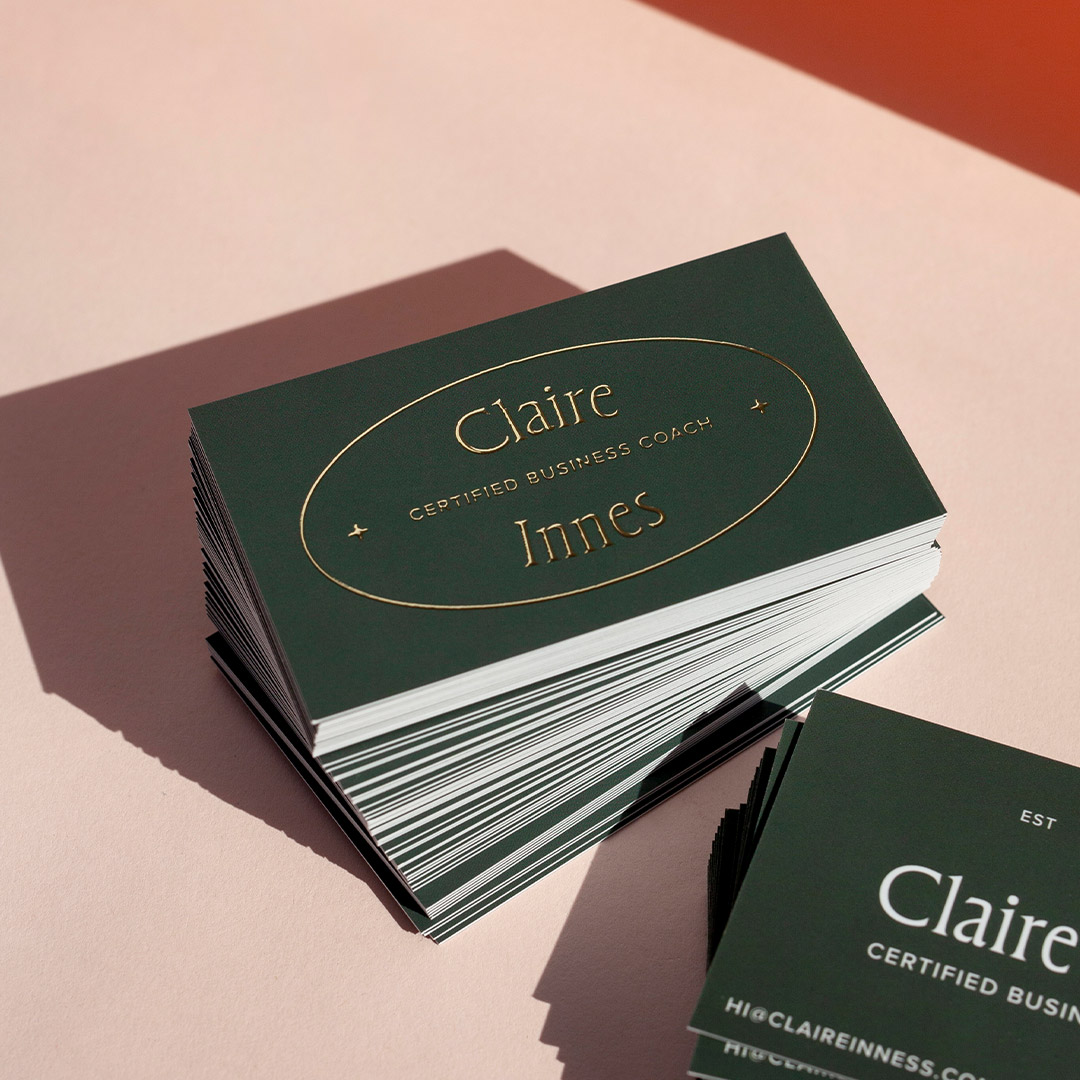
Spot UV is the durability upgrade most tradies should consider first. The process applies a full matte laminate across the entire card surface, then adds a clear UV-cured gloss coating to selected elements – your logo, your name, a design accent. The matte laminate seals the card against moisture and oil across the entire surface. The selective gloss elements make the card visually striking: your logo catches the light while the rest of the card stays in soft matte. Spot UV business cards from $0.14/card represent strong value for the level of protection and professional finish they deliver. Note that Spot UV has a longer production time than standard – it is not available on the 24-hour rush option, so allow additional lead time when ordering.
Flat Foil – premium trade identity
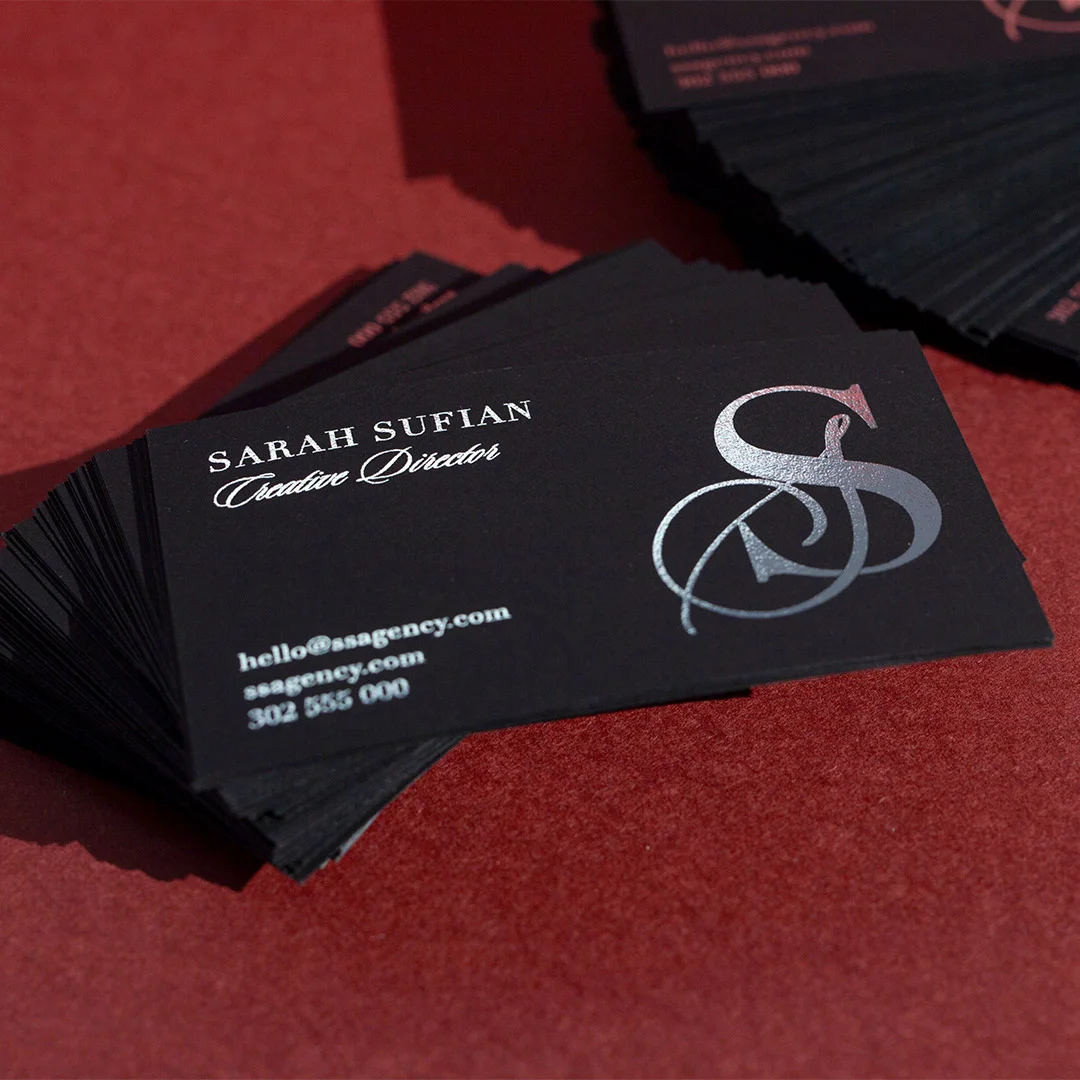
Flat Foil applies a mirror-bright metallic film to selected design elements – logos, business names, trade icons. When you hand a flat foil business card to a client at a consultation or tender presentation, it signals that you take your business seriously. Available foil colours include gold, silver, rose gold, copper, and specialty options. Flat Foil has 24-hour production available – a strong advantage when you need premium cards with a tight turnaround. From $0.18/card.
Duplex – maximum thickness
Duplex cards bond two paper stocks together to create an ultra-thick card that is noticeably heavier and more rigid than any single-stock option. They can be produced with different coloured cores – the layer visible at the edge where the two stocks meet – which creates a subtle design detail that signals craftsmanship to anyone who looks closely. Duplex business cards from $2.27/card are the premium tier in the range: the right investment for tradies who want maximum structural durability and a card that makes a statement at high-value client meetings.
Not sure which finish suits your trade?
Standard from $0.08. Spot UV from $0.14. Duplex from $2.27. Delivery is not included in the card price: standard delivery is $10 per order and express delivery is $15 per order, Australia-wide.
Recommendations by Trade: Plumbers, Electricians, Carpenters, Builders, Landscapers
Different trades have different priorities. A plumber’s card needs to survive contact with water. An electrician’s card needs to project technical credibility. A builder’s card needs to reflect the scale of the work they do. Here are specific recommendations for the most common Australian trades, matched to finish, colour palette, and essential information.
| Trade | Recommended Finish | Why | Colour Direction | From (inc. GST) |
|---|---|---|---|---|
| Plumber | Spot UV or Duplex | Moisture exposure makes a sealed surface essential; duplex adds rigidity for toolbox storage | Navy, white, royal blue | from $0.14/card |
| Electrician | Flat Foil or Spot UV | Foil gold/yellow mirrors trade colour conventions; Spot UV adds a precise, technical aesthetic | Black + gold; navy + silver; charcoal + white | from $0.14/card |
| Carpenter | Standard or Duplex | Natural earthy tones with thick stock reflect craft; duplex coloured core echoes layered timber | Kraft brown, forest green, deep charcoal | from $0.08/card |
| Builder | Duplex or Flat Foil | Substantial card weight matches the scale of the work; foil logo elevates premium residential projects | Charcoal, slate grey, navy | from $0.18/card |
| Landscaper | Standard or Spot UV | Outdoor use means sealed surface preferred; budget matters for high-volume suburb distribution | Olive green, terracotta, natural tones | from $0.08/card |
| Painter | Flat Foil or Spot UV | A painter’s card should demonstrate colour confidence; foil shows you understand premium finishes | White with single accent; or bold contrast pair | from $0.14/card |
Plumbers
Plumbing cards live in wet environments. Whether passed to a homeowner with damp hands during a job or stashed near the sink after a service call, a plumber’s card needs a sealed surface. Spot UV is the smart choice: the full matte laminate base creates a water-resistant surface across the entire card, and the selective gloss on your logo adds a professional finish that holds up against the casual presentation many competitors default to. Include your plumbing licence number prominently – it is a legal requirement in most Australian states for licensed plumbers and signals legitimacy to homeowners who have had bad experiences with unlicensed operators.
Electricians
Electricians work in environments that mix physical wear with professional expectation. Homeowners making decisions about rewiring, solar installation, or switchboard upgrades are spending significant money and want to feel confident in the person they are hiring. A flat foil business card with a gold or silver logo against a dark background (navy, charcoal, or black) projects that confidence immediately. Your A-grade electrician licence number belongs front and centre. A clear services list – rewiring, switchboards, EV charger installation, smoke alarms, solar connections – helps the card pre-qualify enquiries from the moment it is handed over.
Carpenters and joiners
Carpentry cards can lean into craft aesthetics in a way that feels authentic. A duplex card with a kraft or matte natural-tone stock and an earthy coloured core communicates the same attention to material and detail that defines good carpentry work. Keep the typography clean – a single strong font, no decorative clutter. The craft speaks through the card’s physicality rather than ornate design. Standard cards on a natural or kraft-effect stock also work well for carpenters who need volume at a lower price point.
Builders
Builders typically manage larger projects and higher-value client relationships than individual contractors. The card needs to match that positioning. A duplex or flat foil business card communicates scale and professionalism at first touch. Builder licence number, ABN, and a brief line describing project scale (“Residential and commercial builds”) all belong on the card. If you work with architects, project managers, and real estate developers alongside homeowners, a premium duplex card at those meetings and a standard card for site distribution is the most cost-efficient two-tier approach.
Landscapers
Landscaping cards are handed out at a high rate – on site, at nurseries, at neighbour interactions – which means volume and per-card cost matter. Standard business cards are the right backbone for most landscapers, with Spot UV as the sensible upgrade for a sealed surface that handles outdoor storage better. Olive green, terracotta, and natural-tone palettes work well and differentiate from the generic blue-and-white that many local service providers default to.
Mechanics
A mechanic’s card needs to be the hardiest in the range. Oil, grease, and the workshop environment mean uncoated stock will not last a week. Duplex is the recommended choice: the card’s rigidity means it does not bend when oil-stained fingers handle it, and the substantial weight feels professional when handed to a customer picking up their vehicle. Include a call-back promise and any specialisations – European, diesel, 4WD, EV charging – to help the card pre-qualify enquiries from the first touchpoint.
Durability Tests: What “Worksite-Tough” Actually Means
The term is used loosely in the printing industry. Here is a practical breakdown of what different card types can and cannot handle, tested against the three most common failure scenarios tradies encounter.
The moisture test
Uncoated standard-weight cards (under 300gsm): fail within minutes of water contact – edges soften, ink bleeds, card warps as it dries. Coated 350-400gsm standard stock: handles a brief splash without immediate failure; extended saturation will eventually cause edge softening. Spot UV cards: the full matte laminate base is water-resistant across the entire surface; brief immersion does not affect legibility; edges remain stable. Duplex cards: two bonded stocks create excellent structural resistance; the card will not delaminate or warp under normal moisture exposure.
The oil and grease test
Uncoated stock: grease penetrates immediately, creating permanent staining. Coated standard stock: a light grease smear can be wiped off a coated surface without permanent staining if addressed quickly. Spot UV: the matte laminate surface wipes clean in most cases; the UV-coated logo elements are impervious to oil penetration. Duplex: depends on the top stock selected; matte and coated options wipe clean; uncoated options are more susceptible.
The pocket and toolbox test
Thin uncoated stock (under 300gsm): corners fold and crack within a day of pocket life. Coated standard 350-400gsm: holds shape through normal pocket storage; corners may soften after weeks but the card remains functional and legible. Duplex: resists bending and corner damage significantly better than single stock; the double-bonded structure means the card springs back from light pressure rather than creasing permanently. Flat Foil: foil elements protect the surface but structural rigidity is comparable to standard; relies on stock weight rather than bonded construction for resistance to bending.
Information Hierarchy for Tradies: Licence, ABN, Trade Specialty, Call-Back Promise
A business card for a tradie is not a branding exercise – it is a conversion tool. Every element on the card should work towards a single outcome: a customer calling the number on the front within 24-48 hours of receiving it. That means information hierarchy matters more for tradies than for most business card users.
Front of card: priority tiers
Primary tier (must be immediately readable at arm’s length):
- Mobile number – the most important element on the card. Make it large, prominent, and impossible to miss. Do not bury it under your logo.
- Business or trading name – if different from your personal name
- Trade specialty – “Licensed Plumber”, “A-Grade Electrician”, “Licensed Builder”
Secondary tier (important, but secondary to the phone number):
- Your name – many tradies put name smaller than business name; both belong on the front
- Email address
- Website URL or QR code linking to your website or Google Reviews page
- Service area: “Servicing [Suburb] and surrounds” or “Greater Melbourne”
Compliance tier (required by law for most licensed trades):
- Trade licence number – legally required on business materials in most Australian states for licensed tradespeople. Plumbers, electricians, gasfitters, and builders all have licensing obligations. Check with Service NSW, the Victorian Building Authority, the Queensland Building and Construction Commission, or your relevant state licensing body for exact requirements.
- ABN – not legally required on business cards but strongly recommended. It signals legitimacy, helps business customers claim GST, and differentiates you from unlicensed or unregistered operators at a glance.
The call-back promise
One of the highest-converting elements a tradie can add to a business card is a simple call-back commitment. “We return all calls within 2 hours” or “Same-day quotes” sets a clear expectation and differentiates immediately from competitors who do not make that commitment visible. It works because the homeowner’s main anxiety when calling a tradie is not whether they will do the job – it is whether they will respond at all. Addressing that anxiety directly on the card removes a barrier before the customer has even picked up the phone.
Services list: the 3-5 rule
Listing three to five specific services on the card helps it pre-qualify enquiries. A plumber who lists “Blocked drains, hot water systems, emergency call-outs, gas fitting” will receive more targeted calls than one who just says “Plumbing Services.” Specific service terms also help if the card is photographed and stored digitally – which an increasing number of homeowners do with cards they want to keep on file.
QR codes for tradies
A QR code linking to your Google Business profile takes up minimal back-of-card space and adds meaningful value. Customers who want to check reviews before calling can do so instantly. A well-maintained Google profile with 20+ five-star reviews is a powerful conversion asset – the QR code makes it effortless to access. Link directly to your Google Reviews listing rather than your homepage for maximum effect. Minimum QR code size on print: 15mm x 15mm for reliable scanning.
Tear-Off Coupons and Service Reminders on the Back
The back of a tradie’s business card is valuable real estate that most tradies leave blank. A blank back is a missed opportunity – not for more contact details, but for information that keeps the card in a customer’s possession for longer than a standard card would be kept.
Annual service reminders
For trades with predictable service cycles – plumbing inspections, electrical safety checks, HVAC maintenance, gutter cleaning – a preprinted reminder on the back of the card extends its shelf life significantly. An example for a plumber:
Annual service recommended every 12 months
Call [number] to book your next inspection
A homeowner who would normally discard a business card after a job is done will keep a card with a relevant reminder on the back. Every month that card sits on the fridge or in the kitchen drawer is another month your phone number is accessible.
Seasonal offer panels
A back panel that reads “Show this card for 10% off your first call-out” or “Free safety inspection with any switchboard replacement” gives the customer an explicit reason to hold onto the card. It functions as a lightweight loyalty mechanism without requiring any technology – just the card itself. Keep the offer simple and make sure it is one you can honour consistently across volume.
Maintenance checklists
For builders, carpenters, and general trades who work on properties, a brief maintenance checklist on the back positions you as a helpful resource rather than a salesperson. When the homeowner eventually needs one of those jobs done, your card is already in their hand – and your number is on the front.
Logo Treatment for Visibility in Toolboxes and Glove Boxes
A business card that lives in a toolbox or glove compartment is stored in a low-light, high-contact environment. It may be pulled out in a dark ute, held under fluorescent workshop lighting, or grabbed alongside tools and loose change. Logo and design choices that look sharp on a computer screen do not always translate to that environment.
High contrast above all else
Contrast between background and text is the single most important design decision for a tradie’s card. A dark background with white type, or a white background with dark type, reads clearly under any light condition. Avoid mid-tone combinations – grey text on off-white, dark blue on dark grey – that look fine on screen but become illegible in low light or when the card has any surface dirt.
Foil catches light in dark spaces
This is the specific advantage of flat foil business cards in toolbox environments: a foil-stamped logo catches light and reflects at an angle even in conditions where the rest of the card is hard to read. When a customer is rifling through a dark glove box looking for the card from three months ago, the card that catches their eye is the one they pick up. A foil logo functions as a passive visual signal in precisely these conditions – one that continues to work long after the job is finished.
Logo simplicity for small formats
Business card logos need to read cleanly at approximately 25-30mm wide. Logos with fine detail, thin stroke lines, or intricate supporting text become illegible at that size, especially on a card that has seen any wear. If your logo is complex, create a simplified version specifically for small-format print. The business card is not the place for a detailed icon – it is the place for the clearest possible version of your brand mark.
Minimum text size and font weight
For phone numbers and other critical contact information, use a minimum 9pt font size – 10pt or above is better for anything that needs to be read at arm’s length. Opt for medium or semi-bold weights over light or thin variants. A 300-weight font that looks elegant on a poster becomes unreadable on a card held under fluorescent light by someone who has been working with their hands all day. Your mobile number should be readable at arm’s length without squinting.
Bulk Print Runs: Australian Cost Breakdown for Tradies
Tradies who network actively – attending trade shows, visiting supplier accounts, leaving cards at hardware stores and real estate offices – typically go through 300-500 cards per quarter. A sole trader who relies primarily on word-of-mouth referrals may need 100-200 per quarter. Here is an indicative cost breakdown based on published “from” per-card rates at Paperlust Print Shop, all prices inc. GST.
| Quantity | Standard (from $0.08/card) | Spot UV (from $0.14/card) | Flat Foil (from $0.18/card) | Duplex (from $2.27/card) |
|---|---|---|---|---|
| 100 cards | $44 | from ~$14 | $159 | from ~$227 |
| 250 cards | $84 | from ~$35 | $199 | from ~$568 |
| 500 cards | $105 | from ~$70 | $250 | from ~$1,135 |
| 1,000 cards | $139 | from ~$140 | $329 | from ~$2,270 |
Note: figures are calculated from published “from” per-card rates and are indicative only. Actual pricing depends on stock selection, design complexity, and quantity tier. Visit the standard business cards page or duplex business cards page for exact pricing at your required quantity.
The two-tier tradie card strategy
The most cost-effective approach for most tradies is a two-tier card system: a high-volume standard business card order (500-1,000 cards) for general distribution at worksites, hardware stores, letterbox drops, and casual networking, combined with a smaller premium run of Flat Foil or Duplex cards for higher-value client interactions: building consultations, architect meetings, real estate agent relationships, and formal tender presentations.
The standard cards keep cost-per-interaction low. The premium cards make the right impression at the right moment. Order both in the same session and you cover every use case without overspending on premium cards at casual interactions, or underselling at premium meetings.
What does delivery cost?
Delivery is not included in the card price: standard delivery is $10 per order and express delivery is $15 per order, Australia-wide. For tradies who have run out of cards mid-week, Paperlust’s 24-hour production on standard and flat foil cards combined with express delivery means fresh cards in hand within 2-3 business days of ordering.
Reorder Strategy: How Often Tradies Actually Need New Cards
Most tradies reorder less often than they should and more urgently than they planned. Running out of cards mid-job is a genuine business problem – a customer asking for your details and getting a hand-scrawled number on a piece of paper is a conversion rate loss that compounds across every job. Here is a practical reorder cadence for different trade volumes.
Volume-based reorder triggers
- High-volume trades (electricians, plumbers, builders): reorder at the 6-month mark or when stock falls below 100 cards – whichever comes first. The 24-hour production plus express delivery window means there is no reason to risk running out completely.
- Mid-volume trades (carpenters, landscapers, painters): annual reorder typically sufficient for sole traders distributing 50-100 cards per month. Set a calendar reminder for the same month each year.
- Low-volume trades (specialist trades, custom work, referral-based businesses): reorder when stock falls below 50 cards. These tradies often keep cards longer, so premium finishes are a better investment – the per-card impression value is higher when fewer cards are distributed.
Detail-change triggers
Reorder immediately when any of the following change – do not run out the old stock first:
- Mobile number (most common detail change for tradies who switch or upgrade plans)
- Trade licence renewal with a new licence number
- ABN changes following a business structure change
- Website URL or email domain
- Business name change
- New specialisation or expanded service area
A card with the wrong phone number distributed to 50 customers is a net negative for your business. Order correctly updated cards immediately and retire the old run.
Design refresh cycle
Beyond detail changes, a design refresh every 3-4 years keeps the card looking current. Trade identity has shifted meaningfully over the past decade – from the legacy yellow-pages look to cleaner, more brand-conscious design – and a card produced seven years ago may be communicating something different about your business than you intend today. Use each major reorder as an opportunity to evaluate whether the design still reflects where the business is now.
Frequently Asked Questions
Are waterproof business cards available for tradies in Australia?
No business card is completely waterproof, but Spot UV and Duplex cards from Paperlust Print Shop are significantly more water-resistant than standard uncoated options. Spot UV cards have a full matte laminate applied across the entire surface, creating a sealed moisture-resistant barrier. The card handles brief water contact without damage to legibility. For tradies in high-moisture environments – plumbers, irrigation specialists, pool maintenance – Spot UV is the recommended choice for maximum water resistance in a paper-based card.
What is the most durable business card finish for worksites?
Duplex is the most structurally durable option – two paper stocks bonded together create a card that resists bending, corner damage, and physical wear better than any single-stock option. For surface durability against oil, grease, and moisture, Spot UV is the best choice because the full matte laminate seals the entire card surface. For the best of both worlds on a worksite, Duplex cards paired with a coated or matte top stock deliver maximum performance in both dimensions.
Should I include my ABN on my tradie business card?
Yes – strongly recommended. ABN inclusion signals to homeowners and business customers that you are a registered, legitimate operator. Business customers who claim GST credits need your ABN on invoices, and seeing it on the card signals that your paperwork will be in order. It also differentiates you from unlicensed or cash-only operators at a glance, which matters in trades where customers have been burned by unregistered work.
Should I put a photo on my tradie business card?
A photo can be effective for tradies who rely on personal relationship selling – especially in home renovation trades where the homeowner is inviting someone into their house. A professional headshot (not a selfie) on the front of the card can increase recall and build trust before the first call. It works best on a dark background with the photo taking up roughly one-third of the card width. If you do not have a professional headshot available, skip it and focus on clean design and clear contact information – a poorly executed photo looks worse than none.
Are QR codes on business cards worth it for tradies?
Yes, if the destination link is valuable. A QR code linking to your Google Business profile with a strong review count is one of the most useful additions you can make to the back of a tradie’s card. Customers who want to verify your reputation before calling can do so immediately, removing a barrier in the decision process. Link directly to your Google Reviews listing rather than your homepage – social proof converts better at this stage than brand content. Minimum QR code size on print is 15mm x 15mm for reliable scanning.
What size should tradie business cards be?
The standard Australian business card size is 90mm x 55mm, and this is the default size at Paperlust Print Shop. It fits standard card holders, wallets, and the clear sleeves in most customer files and folders. If you want more content space, use both sides rather than increasing the card dimensions – an oversized card is awkward to store and can signal poor planning rather than professionalism.
How many business cards should I order as a tradie?
A minimum first order of 250-500 cards is sensible for most tradies. Under 250 cards typically results in a higher per-card cost and means reordering sooner than expected. High-networking tradies – plumbers, electricians, and builders who work with real estate agents and property managers – should consider 1,000-card print runs to maximise value and avoid urgent reorders. Delivery is not included in the card price: standard delivery is $10 per order and express delivery is $15 per order, Australia-wide.
What is the difference between duplex and standard business card stock?
Standard business cards are printed on a single sheet of cardstock, typically 350-400gsm at Paperlust Print Shop. Duplex cards bond two separate paper stocks together to create a single card with exceptional thickness and weight – noticeably heavier and more rigid than any single-stock card. The bonded edge is visible from the side and can be produced with a contrasting coloured core for a subtle premium detail. Duplex cards start from $2.27/card versus $0.08/card for standard – a significant price difference justified by the premium feel and structural durability.
How quickly can I get tradie business cards printed in Australia?
Standard and Flat Foil business cards at Paperlust Print Shop have 24-hour production available. Delivery is not included in the card price: standard delivery is $10 per order and express delivery is $15 per order, Australia-wide. With express shipping, an order placed by end of business can reach metro addresses within 2-3 business days. Spot UV and Duplex cards have longer production times and are not available on the 24-hour rush option – allow additional lead time when ordering these finishes. For urgent orders, standard or flat foil on the 24-hour run is the fastest path to cards in hand.
Do I need to include my trade licence number on my business card?
For licensed trades, yes – and in most Australian states it is a legal requirement. Licensed plumbers, electricians, gasfitters, and builders are required to display their licence number on advertising and marketing materials, which includes business cards under most state interpretations. Requirements vary: check with Service NSW, the Victorian Building Authority, the Queensland Building and Construction Commission, or your relevant state body. Beyond legal compliance, displaying your licence number proactively signals credibility to homeowners who check credentials after encountering unlicensed operators.
Can I order business cards as a sole trader without a registered business name?
Yes. Many Australian tradies operate as sole traders under their personal name rather than a registered business name. A card with your personal name, trade specialty (“Licensed Carpenter”), mobile number, email, and service area works well. You can include your ABN without a separate business name on the card. If you plan to register a business name in future, consider ordering a smaller initial run until the name is confirmed – you will likely reorder once the branding is finalised anyway.
Order tradie business cards
Standard, Spot UV, Flat Foil, and Duplex – all printed in Melbourne and delivered Australia-wide.