Custom tissue paper is the quiet workhorse of ecommerce packaging. Customers see it the moment they open a box, before they touch the product, before they read any copy. That fraction of a second shapes how they feel about your brand. For small and growing Australian ecommerce businesses, custom printed tissue paper is one of the highest-ROI packaging decisions you can make. It costs less than most founders assume.
This guide covers everything: sizes, GSM weights, print colour limits, sustainability credentials, how to pair tissue with stickers and mailer boxes for a cohesive unboxing moment, and design tips that actually work on thin stock.
At a glance
Custom printed tissue paper for ecommerce: what you need to know
28gsm recyclable tissue, printed in 1 or 2 spot colours across four sheet sizes. On the 220 x 300 mm size in 1 colour, a 2,500-sheet order works out to $0.17 per sheet inc. GST.
- 4 sizes available: 220x300mm (small), 380x380mm (square mid), 380x500mm (rectangular mid), 500x750mm (large)
- Print method: spot colour only, up to 2 colours; no full CMYK photographic printing
- Material: 28gsm recyclable, not acid-free by default, and the team can confirm current acid-free options before you order.
- Minimum order: 250 sheets (across any single size and print option)
- Production lead time: 16-18 working days from artwork approval; order 4+ weeks ahead
- Shipping: flat-rate Australia-wide express freight
- Best combined with: custom stickers, die-cut labels, mailer boxes for a complete unboxing kit
Why tissue paper is the first thing customers notice
Ecommerce packaging has one job before the product does: create an emotional response. Research from packaging industry bodies consistently shows that consumers make brand-quality judgements within the first three seconds of opening a parcel. Tissue paper is the layer that creates that moment. It signals care, it slows the reveal, and it gives your logo a tactile presence that poly bags and plain newsprint simply cannot.
For subscription box businesses, fashion brands, beauty sellers, and specialty food retailers, branded tissue paper turns a routine delivery into a shareable experience. Customers who photograph their unboxing for Instagram or TikTok are, in effect, producing free brand content. That photograph almost always starts with the tissue.
The per-sheet cost drops sharply with volume. On the 220 x 300 mm size in 1 colour, 250 sheets cost $1.04 each including GST, while 2,500 sheets cost $0.17 each including GST. That branded wrap travels with the product all the way to the person opening the box.
Sizes: which one suits your products
Choosing the wrong size is the most common tissue paper mistake. Too small and the paper bundles awkwardly; too large and you end up with messy folds that obscure the pattern.
220 x 300mm: small products
Ideal for jewellery, cosmetics, gift cards, and folded accessories. At roughly A4-minus, this sheet wraps a standard jewellery box cleanly with two layers. The smaller surface area means your logo or pattern fills the sheet at a higher relative density, which tends to read more clearly.
380 x 380mm: mid-size square
A square format that suits clothing accessories, candles, and mid-size lifestyle products. The symmetry works well with centralised logo placement and repeating geometric patterns.
380 x 500mm: mid-size rectangular
The most versatile option for most ecommerce categories. At roughly A3+, this sheet wraps folded garments, footwear, and homeware pieces with room to spare. It also lines the inside of a standard A4 mailer box flat, which creates a neat branded base layer before the product goes in.
500 x 750mm: large format
For bulkier items, framed art, multiple-garment orders, or premium gift hampers. A single sheet at this size can wrap a full folded outfit. This is also the size to reach for if you are lining the interior walls of a rigid gift box rather than wrapping the product itself.
| Size | Best for | Common use |
|---|---|---|
| 220 x 300mm | Small / delicate items | Jewellery, cosmetics, accessories |
| 380 x 380mm | Mid-size square wrap | Candles, gifts, homeware |
| 380 x 500mm | Most ecommerce categories | Apparel, folded garments, A4 mailer liner |
| 500 x 750mm | Bulky / premium orders | Hampers, multi-item orders, rigid box lining |
Understanding GSM and why 28gsm is the sweet spot for tissue paper
GSM (grams per square metre) is the standard measure of paper weight. Standard office printer paper runs at 80gsm. Cardboard starts around 250gsm. Tissue paper lives at the featherweight end of the spectrum, typically between 17gsm and 35gsm.
Paperlust tissue paper is produced at 28gsm. Here is what that means in practice:
- Translucency and colour bleed-through: At 28gsm, the paper is semi-translucent. A dark product sitting beneath a single layer will be slightly visible through the wrap. This is normal and expected for tissue paper. If you are wrapping dark garments or heavily pigmented products, two layers of tissue eliminate the bleed-through.
- Print opacity on thin stock: Because the substrate is thin, very dense ink coverage (over 50% of the sheet surface) can cause the paper to feel slightly damp immediately after printing and may increase translucency in the printed area. This is why Paperlust tissue paper is offered in 1-colour (under 50% ink coverage) and 1-colour full background (over 50% coverage) print options. For 2-colour prints, keep each colour at moderate coverage to maintain paper integrity.
- 17gsm alternatives: Some suppliers offer 17gsm tissue for an ultra-lightweight feel, but the translucency is significant: ink colours appear washed out, and branding legibility drops on patterned designs. For branded packaging where logo clarity matters, 28gsm produces a noticeably more professional result.
- 30gsm alternatives: A small step up from 28gsm, 30gsm tissue is slightly more opaque and handles full-coverage print runs with a little more consistency. The difference in weight is negligible in shipping calculations.
Print options: 1 colour, 2 colours, and what you cannot do
Tissue printing uses one or two spot colour inks, a different method from the CMYK full-colour printing used for cards and brochures. Knowing these limits before you design saves a few rounds of revision.
What spot-colour printing means
Spot colour printing lays down one or two premixed ink colours directly onto the stock. There are no cyan, magenta, yellow, and black channels blending to simulate thousands of colours. What you specify is what prints: a single Pantone-matched tone, or two distinct solid colours.
This makes spot-colour printing ideal for:
– Logo marks with one or two brand colours
– Geometric repeat patterns
– Single large text or wordmarks
– Botanical line-art illustrations
What it cannot do
Full photographic imagery, gradients, and watercolour washes do not translate to spot-colour tissue printing. If your brand identity relies on a gradient or a photograph, adapt your design to a solid-fill version before submitting artwork.
Colour bleed-through on thin stock
Even with correct artwork, very dark inks (navy, black, deep burgundy) printed on 28gsm tissue will show through to the reverse side of the sheet. This is a characteristic of the stock, not a printing error. For packaging applications where customers see both sides of a sheet (for instance, if you fold tissue into a square at the base of a box), use a lighter ink colour or a lower-coverage pattern on one of the two colours.
A practical workaround: position your primary brand colour as a light or mid-tone, and use the second ink colour for fine-line detail or a secondary mark. The combination reads well from both sides.
Sustainability: recyclable, not acid-free by default
Consumer expectations around sustainable packaging have shifted sharply in Australia over the past three years. For ecommerce brands, the question is no longer whether to offer eco-friendly packaging but how to communicate it credibly.
Paperlust tissue paper is:
- Recyclable: This is a recyclable stock, so after the box is opened the tissue belongs in the recycling bin rather than general waste.
- Not acid-free by default: Acid-free tissue suits products that stay wrapped, delicate items, and packaging your customer may keep. This stock is not acid-free by default, so brands that need acid-free sheets should ask the team what is available now.
A short disposal cue printed on the tissue, such as “Please recycle this sheet”, can be set in a corner or inside the pattern. It gives the person receiving the parcel a simple instruction. Keep the wording brief and make sure it fits within your 1 or 2 spot colours.
Pairing tissue paper with stickers and mailer boxes for a cohesive unboxing moment
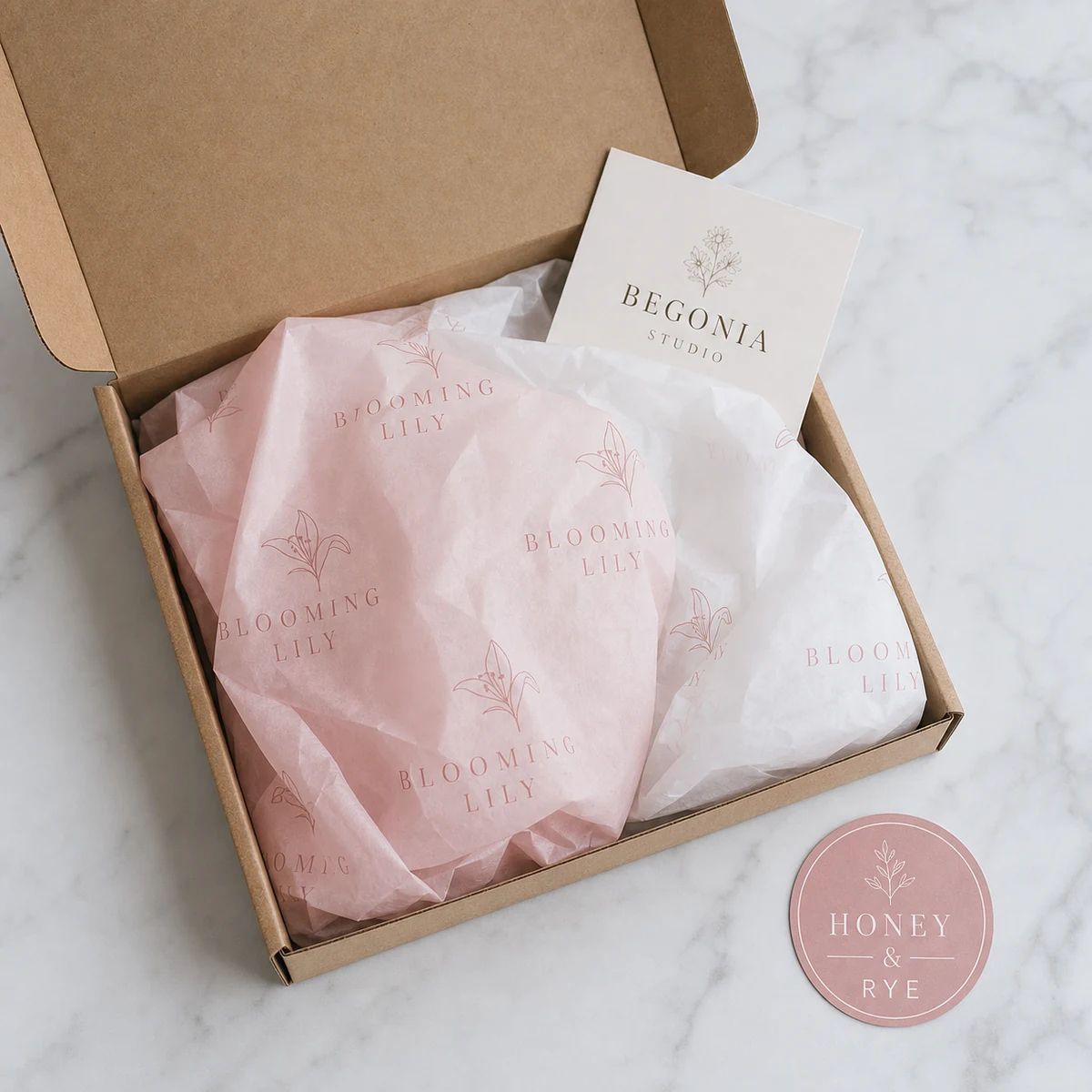
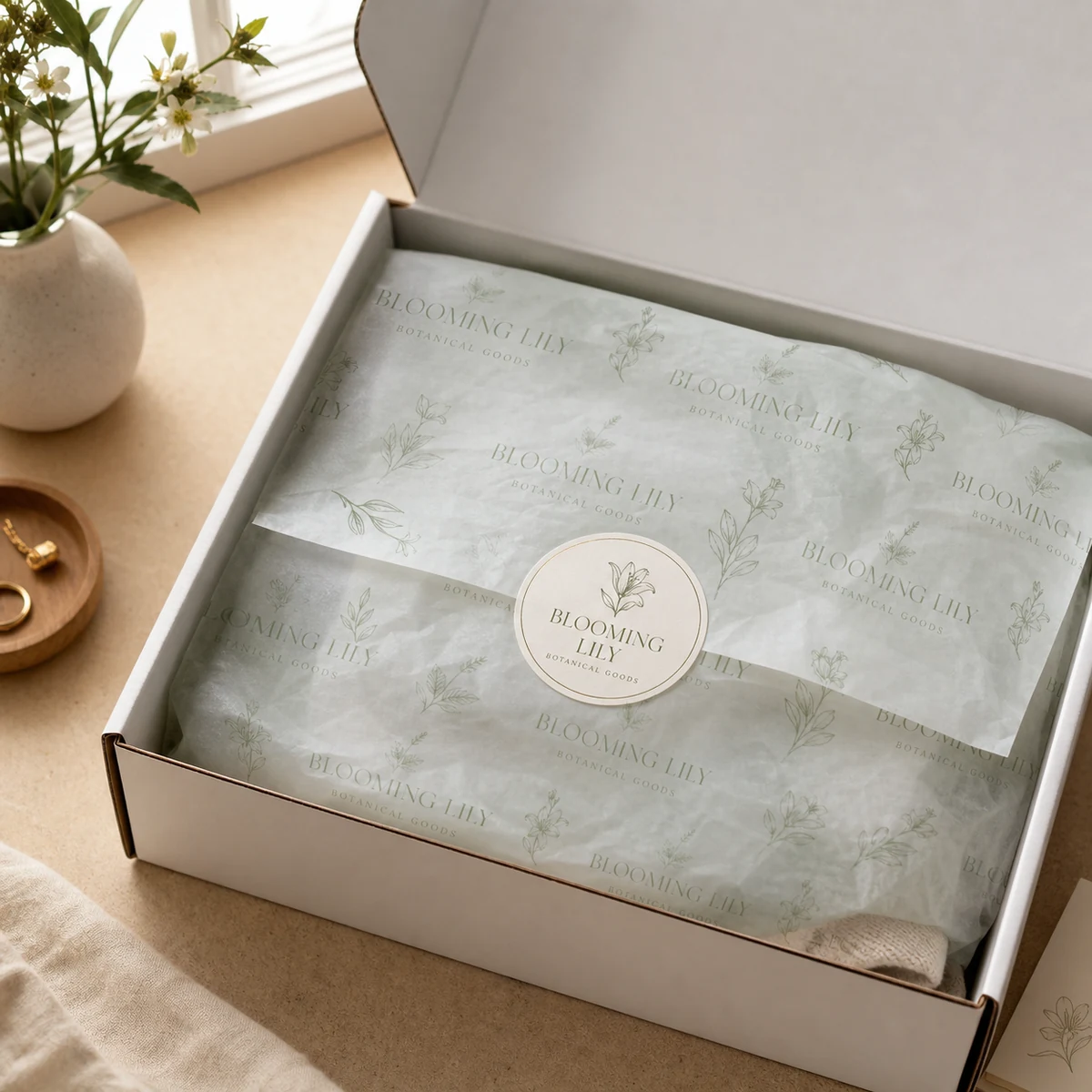
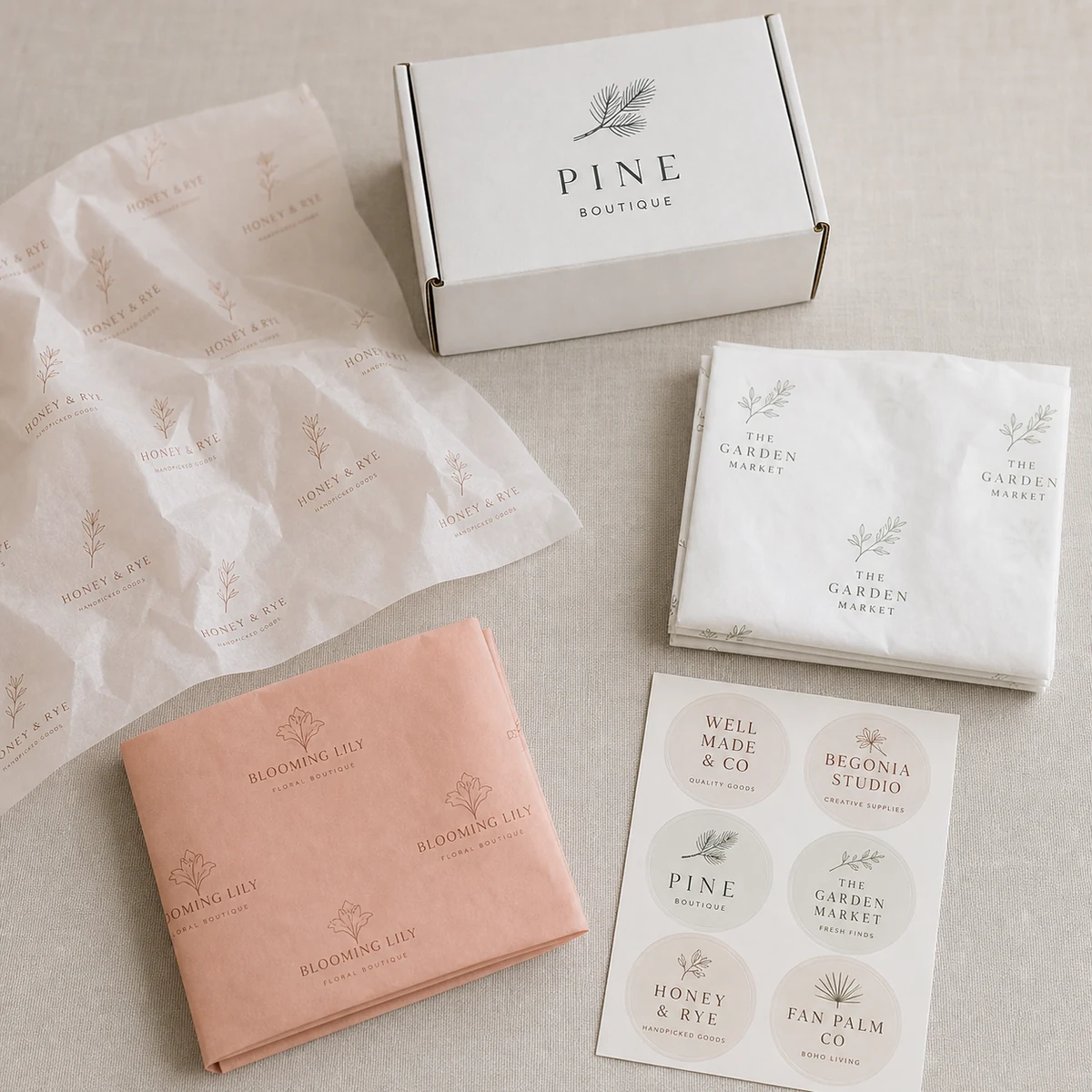
The most effective branded unboxing experiences are built from three components: the outer packaging, the tissue wrap, and a closure element. Tissue paper alone does not close. Pairing it with a custom sticker seal or label turns a loose wrap into a finished, gift-ready presentation.
The three-layer unboxing kit
Layer 1 – the outer box or mailer: A custom mailer box or branded kraft mailer sets the first impression at the letterbox. It does not need to be heavily printed; a single-colour logo or even a plain box with a branded sticker label on the outside achieves the look at lower cost.
Layer 2 – the tissue wrap: Use one sheet for small products, two for medium or dark products where bleed-through is a concern. Fold the tissue so the pattern or logo faces outward when the box is opened. For the 380x500mm sheet inside an A4 mailer box, a simple packet fold (four sides folded in, product placed on top, excess folded over) takes under ten seconds per order.
Layer 3 – the closure sticker: A round or square custom sticker seal closes the tissue fold and becomes the focal point of the unboxing moment. This is where a wax-seal-style or logo-mark sticker earns its keep. A 50mm round sticker in a matching brand colour ties the tissue wrap together without adding any packing time.
For the full specifications on sizes, pricing, and artwork requirements, visit the custom printed tissue paper product page and pair it with a matching sticker seal for a complete unboxing kit.
Colour coordination across packaging components
When ordering tissue, stickers, and mailer boxes as a set, align colours across all three components by specifying the same Pantone reference for each supplier. Brand consistency across packaging components is what elevates a small brand to a premium-feeling one, and it requires nothing more than a documented brand colour standard.
If you are working with a new brand or refreshing packaging on a budget, start with one anchor colour: a single brand tone that runs across your tissue print, your sticker, and any printed element on the mailer. One well-chosen colour executed consistently reads better than three colours applied inconsistently.
Design tips for tissue paper: repeat pattern vs single logo placement
The two most common design approaches for custom tissue paper are the all-over repeat pattern and the single centralised placement. Both work, but they suit different brand identities and packaging styles.
Repeat patterns
A repeat pattern tiles a motif or logo across the entire sheet surface. It works well for:
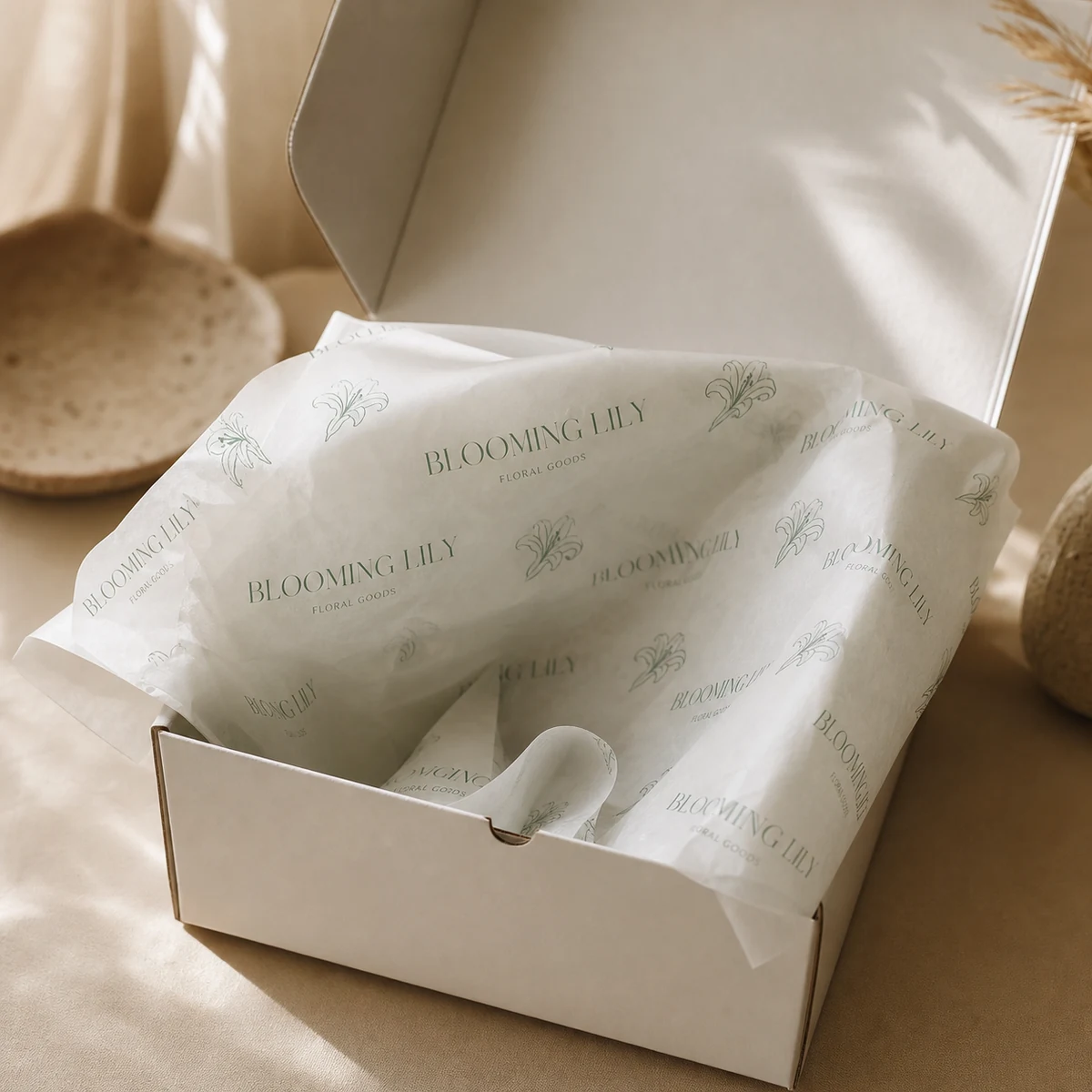
– Fashion, homewares, and lifestyle brands with a strong visual identity
– Seasonal or limited-edition runs (a botanical print for spring, a geometric for winter)
– Cases where the product will be partially visible through the tissue, because the pattern frames rather than obscures
Design tip for repeats: Set up your file with 3mm bleed on every side and add crop marks. Let the repeat artwork extend into the bleed, and keep any logo or small text away from the final trimmed edge. Check the emailed proof to see how the pattern sits on the sheet before you approve production.
Colour bleed consideration: Dense repeats with high ink coverage will bleed through to the back of the sheet more noticeably than lighter repeats. If you are using a repeat pattern with over 50% coverage, choose the 1-colour full background pricing tier and keep the second colour (if any) to fine-line detail only.
Single logo or central placement
A single logo or wordmark centred on the sheet creates a more restrained look. It suits:
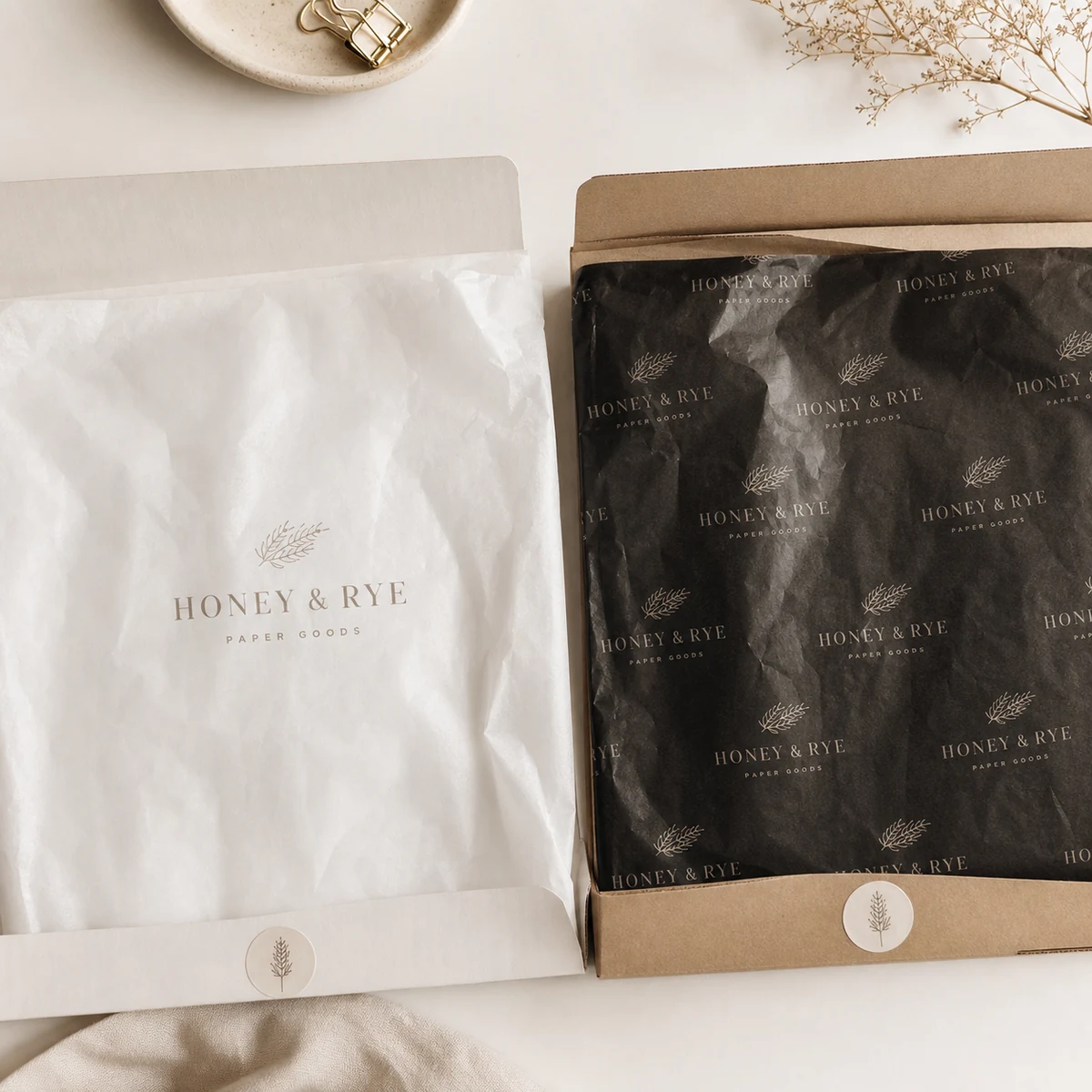
– Luxury and minimalist brands
– Brands where the product category (jewellery, fragrance, premium food) implies quiet sophistication
– Orders where tissue is folded into the box base rather than wrapped around the product
Design tip for single placement: Scale the logo to roughly 30-40% of the sheet width. Too small and it reads as an afterthought; too large and it loses its elegance. Position it slightly above centre on the sheet so when the tissue is folded, the logo sits in the upper-visible portion of the fold.
A note on colour choice on 28gsm stock
Very pale colours (10-20% tint of a brand colour) can lose definition on 28gsm tissue during printing. The thinness of the stock means light inks may appear even lighter than on a heavier paper. If your brand colour is a deep navy, printing it at full saturation on tissue paper reads beautifully. Do not dilute it to a sky blue to “keep it subtle” because you will lose legibility. Trust the primary colour.
Warm neutrals (terracotta, sand, blush, sage) and deep naturals (forest green, navy, charcoal) consistently perform well on tissue stock. Bright primary colours (pure yellow, fire-engine red) can appear slightly different from screen to print on tissue stock, so request a printed proof if a colour match is critical to your brand.
Production timeline and ordering for ecommerce businesses
Production runs 16-18 working days from artwork approval. Add weekends to that and the order is usually ready to dispatch in around three and a half to four weeks, with public holidays able to extend the wait.
For ecommerce businesses with seasonal peaks (Christmas, Mother’s Day, Valentine’s Day, EOFY sales), this lead time has two practical implications:
- Order well before your sales period begins. For Christmas, submit artwork in late October. For Mother’s Day, submit by early April. For Valentine’s Day, submit in the first week of January.
- Hold a small buffer stock. Tissue paper stacks flat and stores easily. A buffer of 200-300 sheets above your current sales rate protects you against a sudden order spike without requiring an emergency reorder at premium rates.
The minimum order is 250 sheets. For the 220 x 300 mm size in 1 colour, 250 sheets cost $262.30 including GST and 2,500 sheets cost $425.10 including GST. You can check the other sizes and colour options on the product page. Standard delivery is $10 per order and express is $15 per order, while pickup from Oakleigh South, Victoria costs nothing.
For full specifications and to order, visit our custom printed tissue paper page.
Frequently asked questions
What is the minimum order quantity for custom printed tissue paper in Australia?
The minimum order quantity for custom printed tissue paper at Paperlust is 250 sheets. This applies across all four sheet sizes and both print options. Ordering in larger volumes reduces the per-sheet cost, so if you expect steady demand it is worth ordering above the minimum to lock in a lower unit rate.
Can I print a full-colour photograph or gradient on tissue paper?
No. Tissue paper is a spot colour product, which means only 1 or 2 solid inks can be laid down. Photographs, gradients and full-colour CMYK work are not supported on this stock. Convert any artwork like that into flat solid colours before you send the file in.
Is custom printed tissue paper recyclable?
Yes. The 28gsm tissue stock is recyclable, so after unpacking the sheet can be dropped in the recycling bin rather than put in general waste. This paper is not acid-free as standard. If your packaging needs acid-free tissue, contact the team to confirm what is in stock.
How do I prevent colour bleed-through on thin tissue paper?
At 28gsm, semi-translucency is normal. To minimise bleed-through: use two layers of tissue when wrapping dark products, avoid very dense ink coverage over more than 50% of the sheet surface, and choose lighter or mid-tone brand colours for the primary print. The full-background print option (over 50% coverage) is available but will show more bleed-through than the standard under-50% option.
How far in advance should I order tissue paper for Christmas or peak sale periods?
Allow at least 5-6 weeks before your packaging needs to arrive. Production runs 16-18 working days from artwork approval, and artwork revision cycles can add 3-5 working days on top of that. For Christmas, submit artwork by late October. For other Australian retail peaks (Mother’s Day, Valentine’s Day), submit 6 weeks before the event date.
What is the difference between a repeat pattern and a single logo placement for tissue paper?
A repeat pattern tiles your logo or motif across the entire sheet and suits lifestyle, fashion, and homewares brands. A single centralised placement puts the logo once in the middle of the sheet and suits luxury, minimalist, or jewellery brands. Both are available at the same price point. The choice depends on your brand identity and how the tissue will be folded inside the box.