You Googled “sticker printing cost” and found nothing but “get a quote.” Every supplier is hiding their pricing behind a contact form, hoping you will just call.
Here is what sticker printing actually costs in Australia in 2026, what drives the price up or down, and how to get the most out of your printing budget.
At a Glance
Sticker printing starts at $0.07 per sticker on paper stock and $0.09 per sticker on vinyl for 5,000 stickers in the 30 x 30 mm size, and quantity drives price most.
Plan for what changes the run price, namely size, a laminate and the number of designs, and note that a custom die cut shape carries no tooling fee. Spend on substrate first, finish second, quantity third.
- Baseline pricing: At 5,000 stickers in the 30 x 30 mm size, prices start at $0.07 per sticker on paper stock, $0.09 per sticker on vinyl or clear stickers, and $0.20 per sticker for foil.
- Quantity drives price more than design — the price per sticker falls from $0.52 each at 100 to $0.19 each at 500 and $0.14 each at 1,000.
- Hidden costs to plan for: a laminate, extra designs in a run and a larger size add cost, while a custom die cut shape carries no tooling fee.
- Budget rule: spend on substrate first, finish second, quantity third — order extras while the price break holds.
The Baseline: From $0.07 Per Sticker
Our stickers start from $0.07 per sticker at volume. That is the floor – for a standard shape, standard size, standard material, at a reasonable quantity.
What does that look like in practice?
Indicative pricing tiers:
| Quantity | Price per sticker |
|---|---|
| 10-50 | $0.64 |
| 100 | $0.52 |
| 500 | $0.19 |
| 1,000 | $0.14 |
| 5,000 | $0.07 |
This table gives live prices per sticker for 30 x 30 mm die cut, circle or square stickers on White Gloss Sticker or White Matte Sticker, one design, no laminate, GST included. Orders of 10 to 50 are charged as 50 stickers, while larger sizes, laminates or extra designs raise the price. The product page calculator gives the exact figure.
As a quick budget guide, 500 round stickers in the 30 x 30 mm size cost $97, while 1,000 die-cut stickers in a custom shape at that same size come to $142. These are the numbers that small businesses and independent brands actually pay.
What Drives the Price Up (and Down)
Five variables control sticker printing cost. Change one, change the price significantly.
Get a sticker quote in 60 seconds
Configure quantity, size, finish, and material — pricing updates instantly.
1. Quantity – the Biggest Lever
Because this is a digital print line, there is no printing plate and the order form adds no setup fee. Even so, quantity is the main cost driver. The sticker unit rate drops as the order gets larger, and the next paragraph lays out the figures.
The price per sticker falls from $0.52 each at 100 stickers to $0.36 each at 200 stickers and $0.24 each at 300 stickers. If your budget is tight, order more. A run of 300 stickers costs $74, which is less than the $104 total of two runs of 100 stickers priced at $52. Stickers do not expire, so buying a six-month supply at once is a sensible approach for most businesses.
2. Material
Material choice has real consequences on cost and durability:
- Standard white vinyl – a vinyl stock that is not the lowest-priced option, since the paper-based White Gloss Sticker or White Matte Sticker is. At 30 x 30 mm, 500 stickers cost $108 on vinyl and $97 on paper.
- Clear stickers – the price sits above the paper stock, with 500 stickers at 30 x 30 mm running to $126 rather than $97. Ideal for product labels and packaging where the “no label” look matters.
- Specialty or foil finishes – a foil finish that starts at $0.20 per sticker at 5,000 in the 30 x 30 mm size, against $0.07 per sticker on the paper-based stock. Reserve for high-value giveaways, flagship product labels, or contexts where the finish is doing specific marketing work.
Ordering cheap paper stickers for outdoor use is not a saving – it is paying twice when you reprint them after they peel within weeks.
3. Size
More material equals higher cost. Simple arithmetic, but it compounds at volume.
A 25mm circle uses about 1/16th the material of a 100mm circle. For large quantities, size has a meaningful impact on price. If you are at a budget ceiling, consider whether your design could work at a slightly smaller size. For packaging seals, 38mm often does the job a 50mm was doing. For product labels, measure your container and choose the size that fits the surface without excessive empty space – oversizing a label adds cost without adding value.
4. Shape
At the same size, circle, square and die-cut stickers cost the same. The cutting is digital, so the shape adds no tooling or setup cost.
Die-cut stickers are trimmed to the edges of your artwork and sell for the same price as circle or square stickers at the same size. A run of 500 in the 30 x 30 mm size costs $97 in any of the three shapes. Choose a custom outline when the shape is part of the brand identity, like a product silhouette, character or logo element, because people notice and keep it.
Rounded corner stickers come as rectangles starting at 40 x 70 mm, and a run of 500 costs $175. A rounded edge looks gentler and more deliberate than a sharp square corner, a good fit for brands that want a polished feel.
5. Finish
Finish affects both the aesthetic and the price:
- Gloss laminate – the price for a run of 500 at the 30 x 30 mm size is $122 with the finish and $97 without it. Vivid colors, fingerprint-visible but cleanable, good durability.
- Matte laminate – the price of this finish equals the gloss finish at every size and quantity. Fingerprint-resistant, contemporary feel, better for designs where a soft or understated look is the goal.
- Foil – hot-stamped metallic finish. Significant cost increase but significant visual impact. Best reserved for hero products or high-value marketing contexts where the finish is doing specific work.
What “Cheap Stickers” Actually Costs You
The cheapest sticker is almost never the cheapest outcome. Here is what the budget end of the market typically involves:
Paper Material Instead of Vinyl
Paper stickers are fine for indoor use on products that stay dry. The moment they go on a water bottle, a bumper, a laptop lid, or a food product that will sit in a fridge or freezer – they degrade. Peeling, yellowing, bubbling. You reprint. You have now paid twice, plus absorbed the cost of damaged product or brand perception. Stickers headed outdoors or into heavy water contact need Vinyl Stickers, waterproof as standard. For pieces that face only an occasional splash, a matte or gloss laminate on paper-based White Gloss Sticker or White Matte Sticker is enough.
No Laminate
Unlaminated stickers scratch, scuff, and lose color quickly. A sticker on a product that gets handled, shipped, and touched constantly needs laminate protection. The laminate is not a luxury – it is what makes the product functional for its intended use.
Small Orders Repeated vs. One Larger Order
A first order of 50 stickers in the 30 x 30 mm size at $32, plus another 100 next month at $52, adds up to $84 for 150 stickers. If you instead print 200 as a single run at $72, you receive 50 more stickers and spend $12 less than the separate smaller orders. For products or brands with consistent sticker needs, calculating your 6-12 month requirement and ordering it in one run almost always produces a better outcome than repeated small orders.
How to Reduce Your Per-Unit Cost
Practical strategies for getting more from your sticker budget:
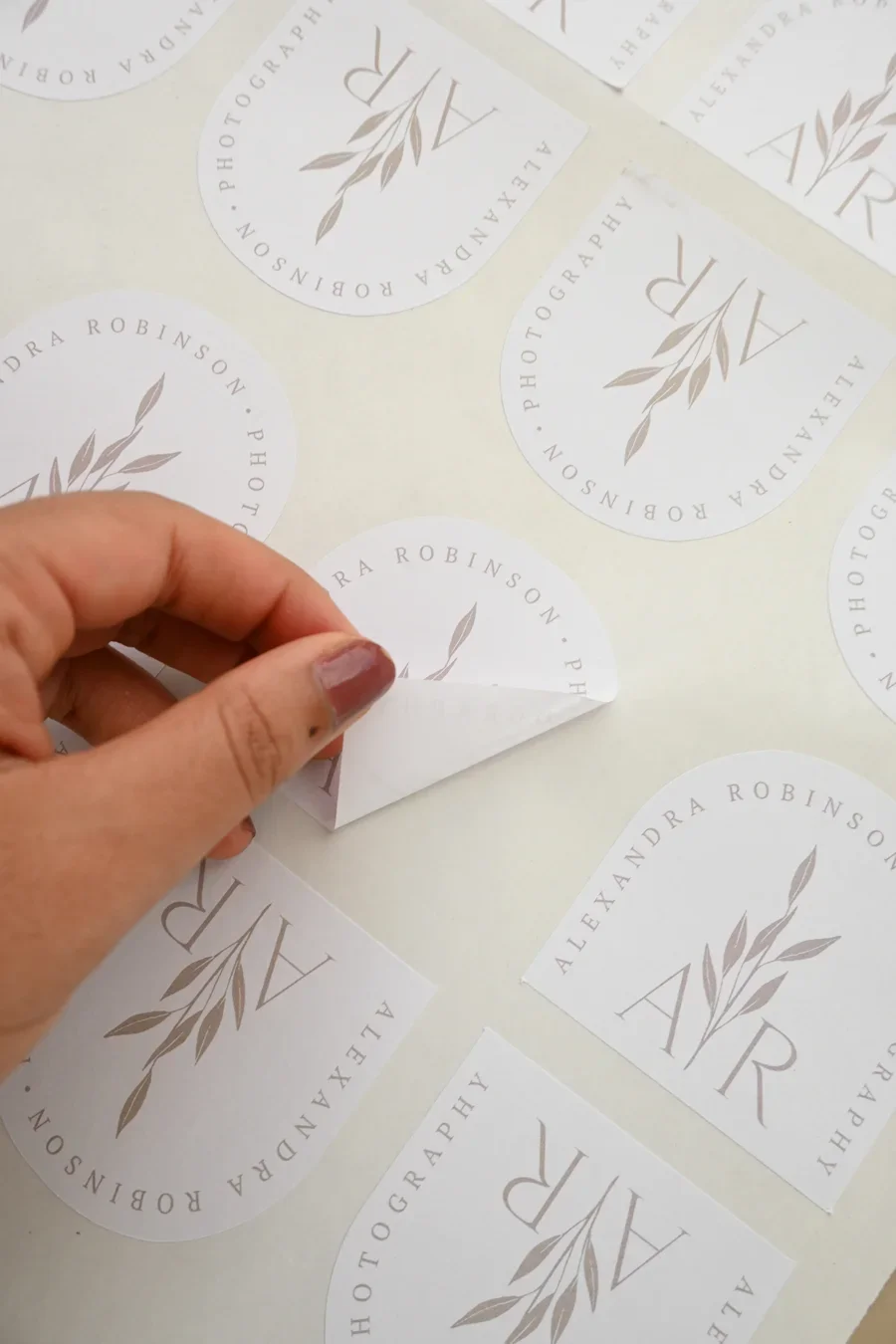
When you order sheets, sticker sheet printing costs are quoted per sheet and the rate falls as the order grows. For an A6 sheet of 105 x 148 mm with one design and no laminate, pay $7.20 per sheet at 10 sheets, $2.48 per sheet at 100 and $1.00 per sheet at 5,000. Each sticker costs the sheet price split across however many fit, so sellers batch larger runs.
Order More in One Run
The most effective lever. Even if you do not need 1,000 stickers immediately, consider whether you will need them in the next 12 months. Stickers do not expire, and the per-unit savings at higher quantities are substantial. Calculate your usage across all events, products, and campaigns planned for the year and place a single order rather than four small ones.
Use Sticker Sheets for Multiple Designs
If you have multiple sticker designs at small quantities, a sticker sheet prints all of them on one sheet. Custom sticker sheets are particularly useful for brands that need variety – a set of product label stickers, promotional designs, and packaging seals can all share a single sheet, reducing total cost while giving you the variety you need.
Choose Finish Strategically
Gloss laminate is right for most uses, but it is an extra option rather than part of the standard price, and matte carries the same charge. Reserve foil for the few stickers where the finish supports the campaign, and skip it everywhere else. Consistent use of a premium finish everywhere dilutes its impact anyway. Use it selectively and it will do more work.
Size Your Stickers to the Surface
A 50mm logo sticker does not need to be 80mm. Measure the actual surface – the container, the package, the badge, the laptop lid – and choose the size that fits the space without wasted empty margin. Oversizing adds material cost without improving legibility or impact. Getting the size right the first time also means not reprinting because the sticker looks awkward on the product it was designed for.
Shipping Costs in Australia
Shipping is a factor that is easy to overlook when comparing sticker prices:
- Flat rate $10 AUD Australia-wide – regardless of how many stickers you order. A single $10 shipping fee on an order of 1,000 stickers is essentially free per unit.
- International shipping via DHL – $35 AUD. Fast, tracked, reliable for customers outside Australia.
For most small business sticker orders, the flat $10 rate is excellent value. A common mistake is to comparison-shop on per-unit price without factoring in shipping, and then finding that the “cheaper” supplier adds $25 in shipping that erases the saving. Factor total landed cost when comparing options.
Planning Your Sticker Budget
A simple approach that works for most small business sticker orders:
- List every use case – product labels, event giveaways, packaging seals, promotional runs. Count how many you need for each over the next 12 months.
- Choose your format – pick shape, then stock, paper-based White Gloss Sticker or White Matte Sticker with no laminate, matte or gloss, or Vinyl Stickers on White Matte Vinyl or Clear Vinyl, no laminate. These decisions affect price and which products on the site apply to you.
- Build your quantity – add up all your use cases and order in one run where possible. The per-unit cost difference between 250 and 500 units is often significant enough to justify a slightly larger order.
- Add shipping – $10 flat rate for Australian delivery.
- Get a quote – the product builder on our site updates pricing live as you select quantity, size, and shape. No contact form needed.
Related reading:
The Bottom Line
Sticker printing in Australia is genuinely affordable when you plan it correctly. The floor is $0.07 per sticker at 5,000 stickers in the 30 x 30 mm size on paper-based stock, so it depends on ordering the right quantity. A trial run of 100 stickers of a new design in the 30 x 30 mm size comes to $52 on paper-based stock or $58 on vinyl, though smaller orders cost more per sticker.
Browse affordable custom sticker printing to configure your size, shape, material, and quantity – live pricing updates as you build your order. No contact form required. Your first sticker run does not have to be expensive. It just has to be right.
How to Choose and Spec a Sticker Order to Optimise Cost
The single biggest lever on per-unit cost is quantity tier — the second-biggest is finish complexity. In the 30 x 30 mm size at 5,000 stickers, expect $0.07 per sticker on paper-based stock, $0.09 per sticker on vinyl, and $0.20 per sticker on foil. Aiming for the highest tier you can credibly distribute beats every other optimisation.
Before you order: cost-optimisation checklist
- Quantity tier — Choose the next published tier because unit price drops from $0.24 each at 300 to $0.19 each at 500 and $0.14 each at 1,000
- Size — price moves with size, 500 stickers cost $97 at 30 x 30 mm and $212 at 60 x 60 mm, no surcharge for a custom size
- Finish — Adding a laminate lifts a run of 500 at 30 x 30 mm from $97 to $122, while foil begins at $0.20 per sticker
- Cut type — Kiss cut and die cut stickers are priced the same at every quantity
- Single design vs multi — Extra designs raise the run price, so 500 at 30 x 30 mm cost $97 for one design and $255 across five designs
- Lead time — no rush fee applies, since digital print stickers already have 24-hour production when the proof is approved by 10am Melbourne time
Frequently Asked Questions
What factors affect the cost of printing stickers in Australia?
The final price depends on the size, the quantity you order, the stock and the finish, and on how the run is divided across designs. Ordering a larger run brings the per-sticker price down. A bigger sticker costs more than a smaller sticker. At the same size, changing from a circle or a square to a custom die-cut outline does not alter the price, because there is no tooling fee. Adding a laminate, foil or holographic stock pushes the price up. By balancing these choices you can get the finish you want at a cost that suits your budget.
How does cost per unit change with quantity?
The price per sticker drops as the order quantity rises. At the 30 x 30 mm size, the price for die-cut stickers is $0.64 each at 50, $0.19 each at 500 and $0.07 each at 5,000. An order of 10 to 50 is charged as a run of 50. Most of the savings appear when you move up from the smallest runs, and the drop becomes gentler once you pass 500. If your design is finalized and your sticker need is predictable, ordering 3-6 months of stock in one run is nearly always cheaper than placing multiple smaller orders.
What is the cheapest sticker format to print in Australia?
At 5,000 stickers in the 30 x 30 mm size, the paper-based White Gloss Sticker or White Matte Sticker reaches $0.07 per sticker, which is the lowest published price per sticker. The same price list covers die-cut, circle, square and kiss-cut stickers, since changing the shape at the same size does not alter the price. Whether you order circle stickers or die-cut custom shapes, the price is the same, so let the look you want guide the format. Browse the sticker range to compare formats, sizes and current pricing.
Is there an extra cost for rush or express sticker orders?
No rush fee applies. Quick production is already standard: digital print stickers get 24-hour production when the proof is approved by 10am Melbourne time. Foil stickers run 3 to 5 working days, Vinyl Stickers run 5 to 7, and bumper stickers run 4 to 5, all counted from proof approval. For quicker transport, the only surcharge is express delivery with StarTrack at $15 per order instead of $10 for standard delivery, and it reaches metro addresses in 1 to 2 business days.
Do sticker prices in Australia include GST?
Yes, prices displayed on the Paperlust Print Shop website include GST for Australian customers. When you view pricing in the product builder, the total you see is the GST-inclusive price. A tax invoice showing the GST component is issued with every order, which is useful for businesses claiming input tax credits. If you are ordering from outside Australia, GST does not apply to your order and pricing adjusts accordingly at checkout. International orders ship via DHL express at a flat rate of $35 AUD.