
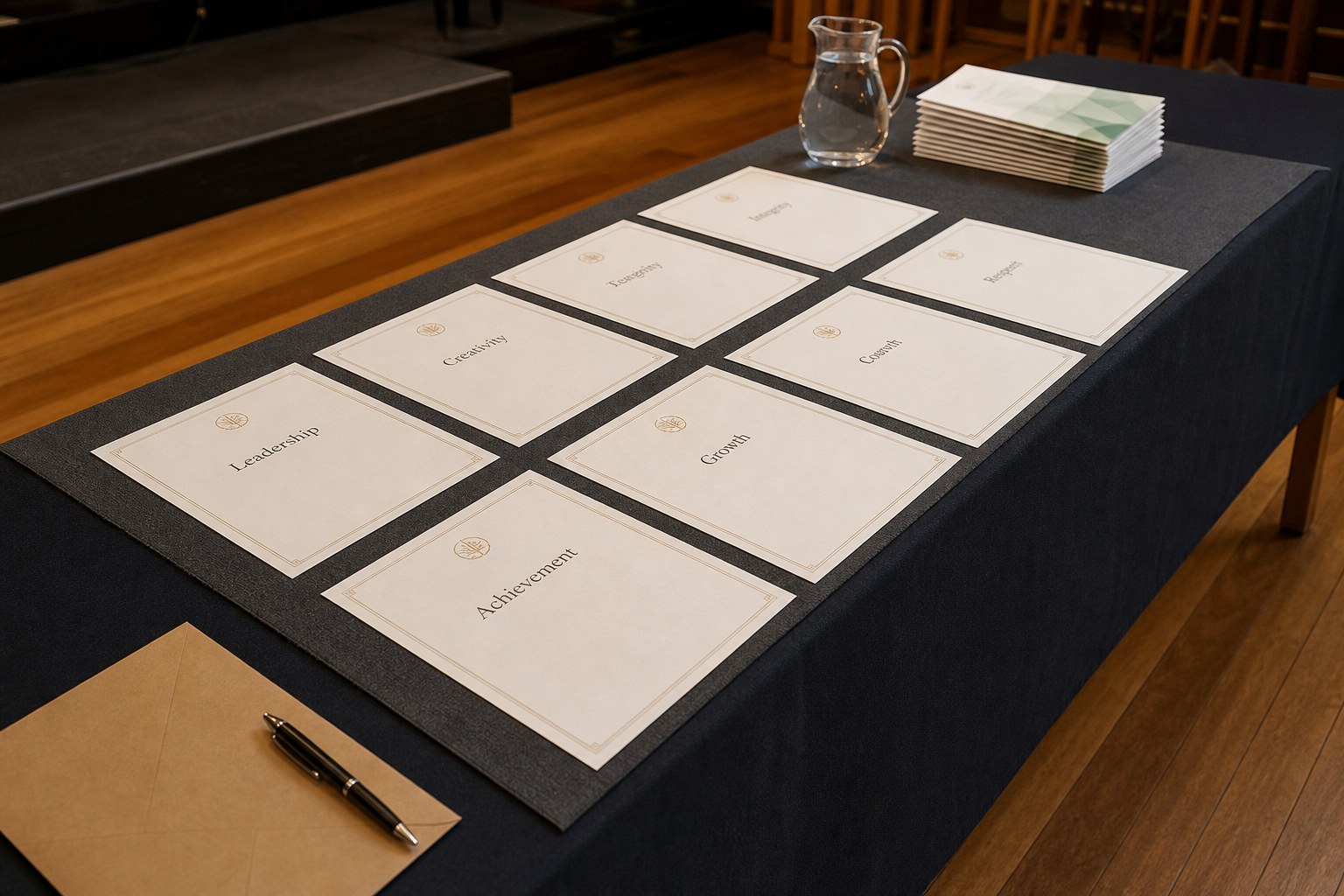
The presentation night date is already in the newsletter and the venue is booked. The award certificates list is still a shared spreadsheet that three people are editing between other jobs.
The printing is not the slow part. The list is. Most presentation night certificates end up in a rush because the design, the quantity and the merge file all wait on a recipient list that will not settle. The date is fixed, so the plan has to be built around the list.
This guide covers how many award certificates to order, which decisions to lock early, how to collect the list so it merges cleanly, and what happens when a name changes late. It is written for the person running a school speech night, an end of season club presentation or a community award evening.
The short version
- Lock the run wide decisions early: size, stock, foil, corner or shape, design and wording, signature block and total quantity.
- Keep the per copy data late: the person named, the award title, the date printed and the certificate number can come from the spreadsheet.
- The minimum order is 25 certificates, with quantity rungs of 25, 50, 100 and 250 and custom quantities by request.
- The printed name, award title, date and certificate number merge from your spreadsheet at $1.00 per certificate including GST.
- Every merged certificate receives an individual quality check, and nothing prints until you approve the proof.
- Order spares in the same run because a later top up is a separate order with its own quantity rung and per order charges.
How many award certificates should you order?
Start with award certificate printing quantity rungs, because the count drives more decisions than the design does. Paperlust prints award certificates in quantity rungs of 25, 50, 100 and 250, with custom quantities available by request. The minimum order is 25 certificates, and published pricing starts from $49 including GST for that first rung.
Begin the count with the award list as it stands. Add the categories that produce more than one recipient, because a relay team, a band section or a shared service award can turn one line into three certificates. Then add the perpetual trophies and encouragement awards that tend to be confirmed later than the main list. These are the certificates nobody counted in the first meeting. Finally, add the spare allowance.
The spare allowance matters because of how the pricing works. The per certificate price falls as quantity rises, and per order charges such as rounded corners or a die cut shape are paid once regardless of quantity. That means a few extra certificates in the same run add very little at the margin. A later top up is a separate order at its own quantity rung with its own per order charges. The cheapest certificate you will ever buy is the spare you ordered the first time.
What to lock early for the presentation night and what can wait
The cleanest way to plan the run is to split the decisions into two columns. One column is fixed across every copy. The other is what changes on each certificate. The design itself can start from a template in the catalogue or from your own artwork.
| Lock this early | This can wait |
|---|---|
| Size, stock, foil, corner or shape, design and wording, signature block, total quantity | The name on each copy, the award title, the printed date, the certificate number |
These two lists are different for a structural reason. The early column is everything that is identical on every copy. The late column is everything that changes on each one. That split is the reason certificate printing in Australia built around a data merge can absorb a late list while older hand set work cannot. For school award certificates, the crest and the signature block sit in the early column. The student name and the award title sit in the late column.
The split matters because everything in the early column is set once and repeated, while everything in the late column is printed from the supplied file. That is the whole reason a merge exists for this job.
Build the recipient spreadsheet so the merge runs clean
Variable Data certificate printing takes the name on each certificate, the award title, the printed date and the certificate number from a spreadsheet you supply, and Paperlust merges them at $1.00 per certificate including GST. The merge runs exactly as clean as the file it is given.
Use one spreadsheet with one row per certificate, not one row per person. A student who wins two awards on the same night needs two rows, because each certificate is a separate printed copy. Type the name the way the recipient spells it, not the way it appears on the roll. Add a column for the award title exactly as it will be read from the stage. Decide once whether dates are written out or numeric, and keep that format the same in every row.
The hard part is that we merge the list as supplied and do not check the printed name, the award title, the date or the number against any other source. The spreadsheet is the last place a spelling error can be caught before it lands on the printed certificate. A name spelled wrong in the file will be printed wrong.
The proof is the real gate for a late name change
A PDF proof is emailed for approval before any order goes to print, and it includes a data merge sample where Variable Data is selected. Nothing prints until you approve the proof. That makes proof approval the gate the whole plan hangs on. Your real internal deadline is the day the list has to be final, which is earlier than the print date and much earlier than the ceremony.

Before the proof is signed off, changing one certificate is a change to a file. Once you have approved the proof, changing that one certificate becomes a new order for that certificate rather than an edit to the existing run. That is why the list has to be locked before the proof, not before the event. For a run of school award certificates, that is the honest version of a last minute change.
Every data merged certificate receives an individual quality check, and any certificate affected by a data error on Paperlust’s side is reprinted free of charge. That is not the same as a free reprint when the supplied list contained the error. If the file says a name incorrectly, the printed certificate will say it incorrectly.
Because this product has no published production or delivery time, the only reliable way to work backwards is to confirm dates with the Paperlust team as soon as the date for the night has been locked in. Do not assume a window. School teams can run the same internal deadline across the wider welcome and event print, and our school, kinder and OSHC print kit covers exactly that.
A4 and A5 award certificate sizes, stock and finish
The two sizes are A4 (210 x 297mm) and A5 (148 x 210mm), both printed flat and single sided. A4 is the standard size for award, completion and graduation certificates, and it is the one most likely to be framed or presented in a sleeve. A5 suits smaller recognition cards and event awards, particularly the participation card handed out in volume.
Paperlust offers two stocks. Matt 300gsm Digital is a smooth professional finish. 360gsm Premium Digital is a heavier board that feels substantial in the hand, which matters for the award that gets framed or kept on a wall.
Foil is available in gold, silver or rose gold on either stock, applied to the certificate title, crest or border. Published foil pricing starts from $129 for 25. Square corners are standard. Rounded corners are from $15 per order on orders of 25, 50 or 100 certificates, and $25 per order on an order of 250 certificates. A simple custom die cut shape is from $49 per order on orders of 25, 50 or 100 certificates, and $89 per order on an order of 250; complex or irregular shapes are quoted separately. These charges are per order, not per certificate.
For end of season awards, the same stock argument applies to sports club award certificates. Our sports club season print kit covers the other pieces the night will need.
The rest of the presentation print around the awards
Most presentation nights need more than certificates. A program for the night gives families a run order and the correct spelling of every recipient name, which quietly supports the certificate table. The oversized cheque for the fundraising or sponsorship presentation usually has to be in the same room on the same night.
Our event program and booklet printing guide covers the format and finishing choices for the program. Our giant novelty cheque printing guide covers what to prepare for the cheque, from artwork to the moment it is carried on stage.
Every piece is printed in Australia and delivered Australia wide, which keeps the conversation simple when the night itself is close.
Frequently asked questions
What is the minimum order for award certificates, and is it 25 certificates?
The minimum order is 25 certificates. Quantity rungs are 25, 50, 100 and 250, and custom quantities are available by request. Published pricing starts from $49 including GST for 25 certificates. The 25 rung suits a small presentation or a run of participation awards, while larger ceremonies usually land at 50 or 100 once extra categories and spares are counted.
How do recipient names get printed with Variable Data?
Variable Data printing personalises each certificate with the printed name, the award title, the date and the certificate number merged from a spreadsheet you supply. The merge reads one row per certificate. Paperlust merges the data as supplied and does not verify it against another source, so the spreadsheet needs to be checked carefully before it is supplied. The merge is charged at $1.00 per certificate including GST.
How far ahead should we order when the date is locked and the proof is the gate?
Start by confirming the sequence with the Paperlust team once that date has been set, because this product has no published production or delivery time. The fixed point in the process is the PDF proof. Printing starts only after the proof has your sign off, and the proof includes a data merge sample where Variable Data is selected. Work backwards from proof approval to your own list deadline, then confirm the rest of the schedule with the team.
What happens if a name needs to change before you approve the proof?
Before the proof is signed off, correcting a name is a change to the file, and the correction can be made before printing starts. After the proof is approved, altering one certificate becomes a new order for that certificate. Every merged certificate gets an individual quality check, and a data error on Paperlust’s side is reprinted free of charge. An error in the supplied list is not covered that way, because we print the data as supplied.
Can we add extra spares after the order has gone through?
It is far better to order spares in the original run. The per certificate price falls as quantity rises, and per order charges such as rounded corners or a custom die cut shape are paid once. A later top up is a separate order at its own quantity rung with its own per order charges. If you know there will be late additions or a few awkward handovers, add the spares before the proof has been signed off.
What size and stock suits a framed award, and is A4 the right choice?
A framed award usually calls for A4 at 210 x 297mm, printed flat and single sided. A4 is the standard size for award, completion and graduation certificates and fits standard frames and presentation sleeves. A5 at 148 x 210mm works for smaller recognition cards and event awards. On stock, 360gsm Premium Digital is the heavier board that feels substantial in the hand. Matt 300gsm Digital is a smooth professional finish and still sits cleanly in a frame.