Somebody has already set the date. The training calendar or presentation night is locked, the recipient list is half collected, and the template that has been emailed around since last year still has the wrong logo on it. That is the normal starting point for certificate printing.
Two decisions shape the job more than any other, and they are rarely the ones people expect. The first is how few certificates you can order without pretending a small presentation is a large run. The second is whether the recipient names are printed during the run or written on later.
This guide covers the certificate printing decisions in the order you will make them: A4 and A5 sizes, the two stocks, foil and corners, how the names get on the page, what a small run actually costs, and where this product does and does not win. By the end you should be able to price a real order before you contact anyone.
The short version
- Two sizes: A4 at 210 x 297mm and A5 at 148 x 210mm, both printed flat and single sided.
- The minimum order is 25 certificates, with published pricing from $49 including GST.
- Two stocks: Matt 300gsm Digital and 360gsm Premium Digital.
- Foil is available in gold, silver or rose gold on either stock, from $129 for 25.
- Square corners are standard. Rounded corners are from $15 per order and a simple custom die cut shape is from $49 per order.
- Variable Data prints recipient names, titles, dates and certificate numbers from your spreadsheet at $1.00 per certificate.
- A PDF proof is emailed before anything prints.
What certificate printing covers here, and what it does not
Certificate printing in this context marks an achievement, not a transaction. The product is built for course completion, training completion, graduation, achievement, employee awards and long service recognition. The people placing the order are usually not designers. A training coordinator finalising 50 completion certificates on a Friday has the same core requirement as a club secretary organising a presentation dinner.
The organisations that order them are just as varied: registered training organisations, schools and universities, employers, sporting clubs and community organisations. What they share is a date, a recipient list and an inherited template that is almost right but not quite finished.
One distinction matters before any stock or foil decision. A gift voucher printing order is a different product. A gift certificate carries monetary value and is redeemable against a purchase. A certificate marks an achievement or a completion and is not redeemable for anything.
That difference shapes every specification below. A certificate is a document somebody keeps, signs or frames, and the paper, size and finish decisions follow from that fact rather than from what is cheapest to ship.
Choosing between A4 and A5 sizes
Both formats in this range are printed flat and single sided, which means there is no fold to confuse the layout and no second side to design. A4 at 210 x 297mm is the standard size used by training providers, RTOs, schools and employers for graduation, completion and award certificates. It is also the most suitable size for framing or presenting in a sleeve.
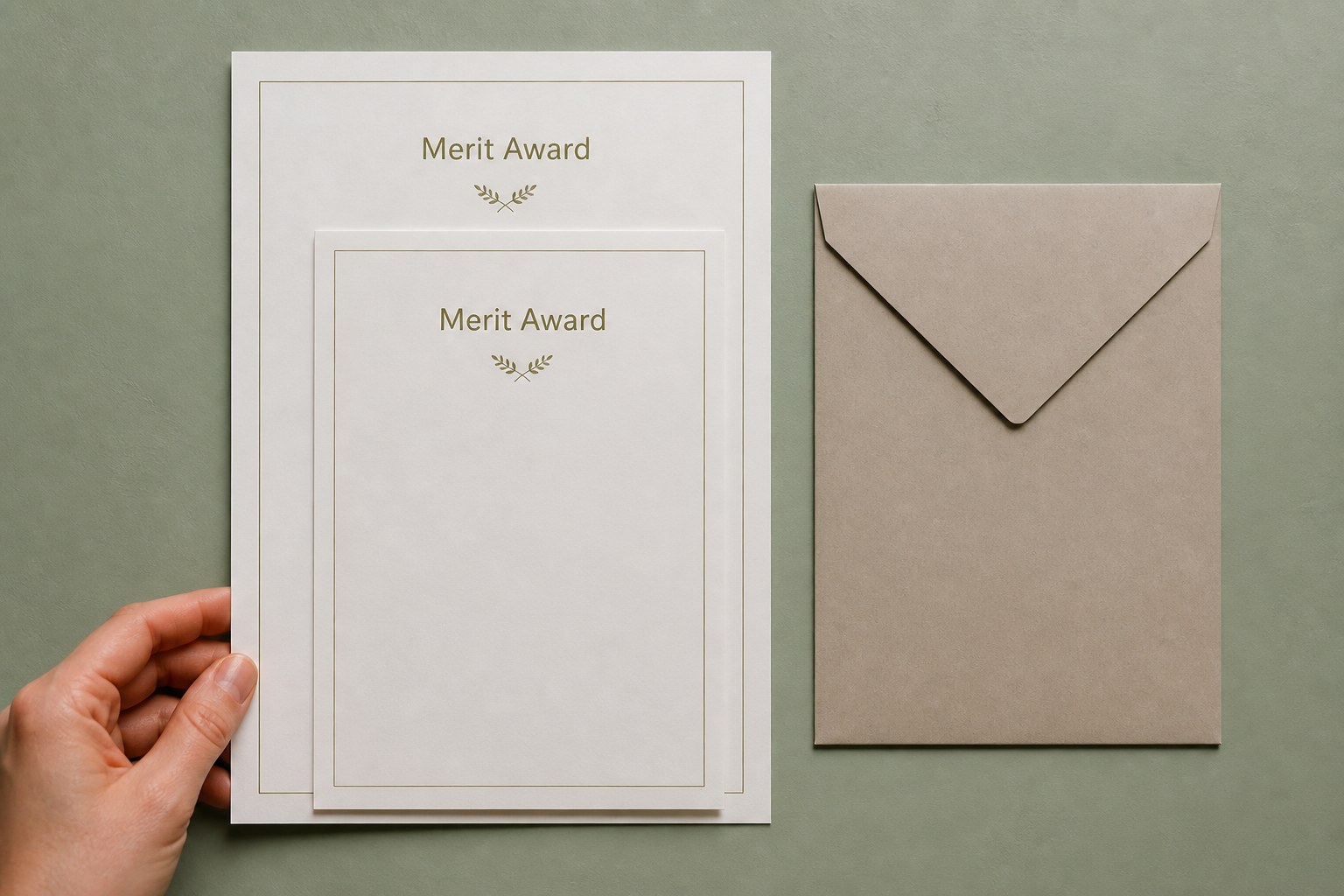
That framing decision is easier when the artwork is built around standard frame sizes for A4 and A3 prints, because the finished certificate can drop into a widely available frame instead of a custom one.
A5 at 148 x 210mm is the right call when the certificate is a smaller recognition card, an event award or a compact format that will be handed across a table rather than mounted on a wall. Most certificate printing in Australia orders cluster around A4 for the simple reason that the document usually has to read as formal, even in a small room. A5 saves space and often suits a more casual awards night, but it rarely carries the same framing presence.
Why 360gsm changes the hand feel of a certificate
The standard stock is Matt 300gsm Digital, a smooth professional finish at an accessible price point. It is the workhorse for training completion, award and recognition certificates, and it handles full colour cleanly without pushing the run into premium territory.

The upgrade is 360gsm Premium Digital. It is a heavier board that feels substantial in the hand, and it is recommended for graduation certificates, employee recognition and any occasion where the weight of the certificate reflects the value of the achievement. On a document that gets kept for years, the move from 300 to 360gsm is the difference between something that sits lightly in a pile and something that feels like it belongs in a frame.
Both stocks are available with or without foil, which keeps the finishing decision separate from the paper choice.
Beyond those two stocks, coloured, textured and other specialty stocks can be sourced. Specialty finishing including embossing and letterpress is offered on request, quoted per job through the customer service team or a quote request. Those options are genuine, but they are not priced on the product page. Treat them as a quote-only service rather than a cart addition.
Foil, corners and shape: the three finishing decisions
Foil is the first of the three finishing decisions. It is available in gold, silver or rose gold, applied to the certificate title, crest or border, on either stock, at a published price from $129 for 25. The finish reads best when it is limited to one or two formal elements rather than spread across the whole layout.
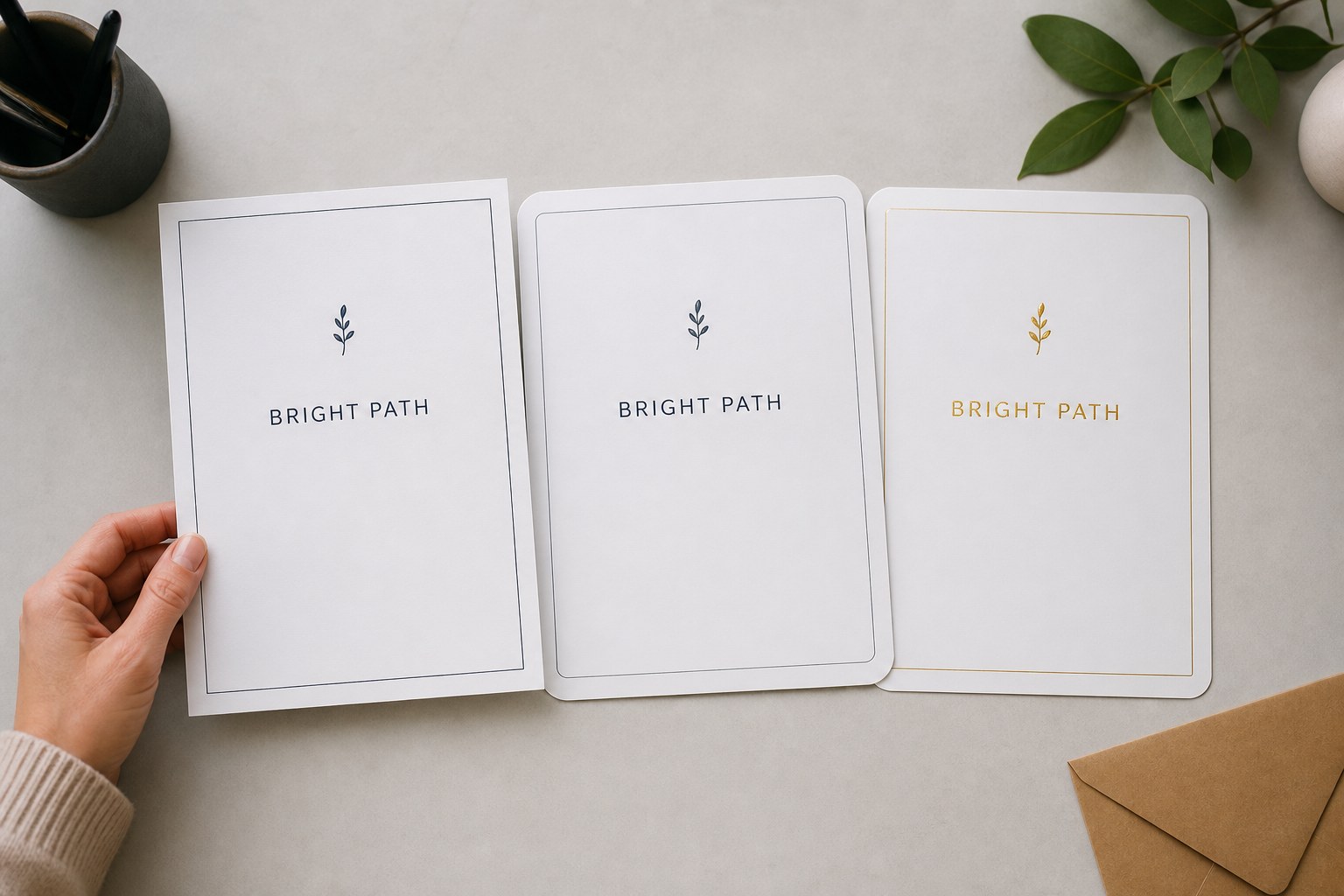
Corners are square as standard. Rounded corners are $15 per order on orders of 25, 50 or 100 certificates and $25 per order on an order of 250 certificates. A simple custom die cut shape is $49 per order on orders of 25, 50 or 100 certificates and $89 per order on an order of 250 certificates. Complex shapes are quoted separately. Both options are available on any stock and foil combination.
The table below summarises what each option costs and when it earns its place.
| Finishing option | What it costs | When it is worth it |
|---|---|---|
| Square corners | Standard, no extra charge | Most certificate runs, especially those going into folders or frames. |
| Rounded corners | From $15 per order for 25, 50 or 100 certificates; $25 per order for 250 certificates | Compact A5 recognition cards or a softer look without committing to a custom shape. |
| Custom die cut | From $49 per order for simple shapes on 25, 50 or 100 certificates; $89 per order for 250 certificates; complex shapes quoted separately | Branded silhouettes or shapes that need to echo a logo or themed event. |
| Foil | Gold, silver or rose gold from $129 for 25 | Graduation, long service and senior awards where the crest or title should catch the light. |
The budgeting point is that corner and shape charges are per order, not per certificate, so they behave like a set-up cost. Rounded corners are $15 per order on an order of 25, 50 or 100 certificates, and $25 per order on an order of 250 certificates; a simple die cut shape is $49 per order up to 100 certificates, and $89 per order on an order of 250 certificates. Spread over 250 certificates it is a small part of the order; on 25 it is a real line item.
How recipient names get on the page with Variable Data
On a certificate run, the design, the wording, the crest, the foil and the signature block are identical on every copy. The recipient name, the award or unit title, the date and the certificate number are the elements that change on each one. For runs above a few dozen, the better choice is to print certificates with the names already in the file, which turns a stack of blanks into custom certificates rather than a bespoke project.
The option that handles that split is Variable Data certificate printing, which merges recipient names, award titles, dates and certificate numbers from a spreadsheet you supply at $1.00 per certificate including GST.
Every data merged certificate receives an individual quality check. Any certificate affected by a data error on our side is reprinted free of charge. The PDF proof contains a data merge sample when Variable Data is selected, so you can see how each name and date sits on the page before the run starts.
Paperlust merges the data as supplied. We do not check the list against any external source. If a name is spelled wrong in the spreadsheet, it prints wrong. The merge removes the handwriting, but it does not proofread the list for you.
What 25 certificates cost, and where the value is
Instant published pricing starts from $49 including GST for 25 certificates. The quantity rungs are 25, 50, 100 and 250, with custom quantities available by request. As quantity rises, the per certificate price falls. A 25 certificate run is the small order you can actually buy without asking for a quote first.
Many certificate printing services in Australia are quoted rather than published, which is why a small run is hard to price and easy to overpay for. Our published ladder is built for that small run, but it is not a claim to be the cheapest order in the market.
At 50 certificates and above, there are cheaper per unit options in the Australian market. We are not the cheapest at volume. The reason to order here at any size is the combination of the merge, the proof and the published price. If you are comparing 250 units on price alone, compare the market. If you are ordering 25 and do not want to handwrite the names, that published price is the more useful starting point.
From file to PDF proof: getting it right
You can start from a design in the catalogue of templates or upload your own artwork. If the artwork is ready, upload it. If it is not, the templates remove most of the layout work without forcing you to build a certificate from a blank page.
Before anything prints, a PDF proof arrives by email for approval. If Variable Data is part of the order, that proof includes a merged field sample so you can confirm the data is sitting where it should. Nothing prints until you approve that proof.
All certificates are printed in Australia and delivered Australia wide. For schools pulling recipient lists together alongside other end of year print such as a school yearbook and magazine printing order, the file preparation habits are the same: one clean set of data, checked early, saves the whole run.
If the job is an RTO testamur or statement of attainment, hold that thought. A regulated document has its own requirements, and this article does not cover compliance rules. The dedicated guide on what has to be printed on a statement of attainment goes through the specifics.
The file you supply and the proof you approve are the two places where accuracy is decided before the stock gets cut.
Frequently asked questions
What is the minimum order for 25 certificates?
The standard quantity rungs are 25, 50, 100 and 250, with custom quantities available by request. Published pricing starts from $49 including GST for 25 certificates. That makes 25 the smallest run you can order at a published price rather than waiting for a quote first. As the quantity rises, the per certificate price falls, so a 50, 100 or 250 certificate order carries a lower unit cost.
What sizes are available for A4 and A5 certificates?
Two sizes are available. A4 at 210 x 297mm is the standard size used by training providers, RTOs, schools and employers for graduation, completion and award certificates. A5 at 148 x 210mm suits smaller recognition cards, event awards or a compact format. Both sizes are printed flat and single sided, so there is no fold and no second side to design.
Is gold foil available on certificates?
Yes. Foil is available in gold, silver or rose gold, applied to the certificate title, crest or border, on either stock. The published foil price starts from $129 for 25. Gold foil tends to work best on graduation, long service and senior award certificates where the crest or title should catch the light. It is a finishing option rather than a separate paper stock.
How are recipient names printed with Variable Data?
Variable Data merges recipient names, award titles, dates and certificate numbers from a spreadsheet you supply at $1.00 per certificate including GST. The design, crest, foil and wording stay identical across the run. Only the recipient specific fields change. Every data merged certificate receives an individual quality check, and any certificate affected by a data error on our side is reprinted free of charge.
Is a certificate the same as a gift certificate?
No. A gift certificate carries monetary value and is redeemable against a purchase. A certificate marks an achievement or a completion and is not redeemable for anything. This guide covers achievement, training completion, graduation, award and recognition certificates, not gift vouchers with a redeemable balance.
Can I upload my own artwork or use a template?
Yes. You can start from a design in the catalogue of templates or upload your own artwork. Either way, a PDF proof is emailed for approval before anything goes to print, and if Variable Data is being used the proof will include a merge sample from your file. Nothing prints until you approve the proof, which catches most file issues before the run starts.
Can specialty stock or embossing be ordered on request?
Yes. Coloured, textured and other specialty stocks can be sourced, and specialty finishing including embossing and letterpress is offered on request. These options are quoted per job through the customer service team or a quote request, and they are not priced on the product page. Ask for a quote rather than trying to add them in the standard order flow.