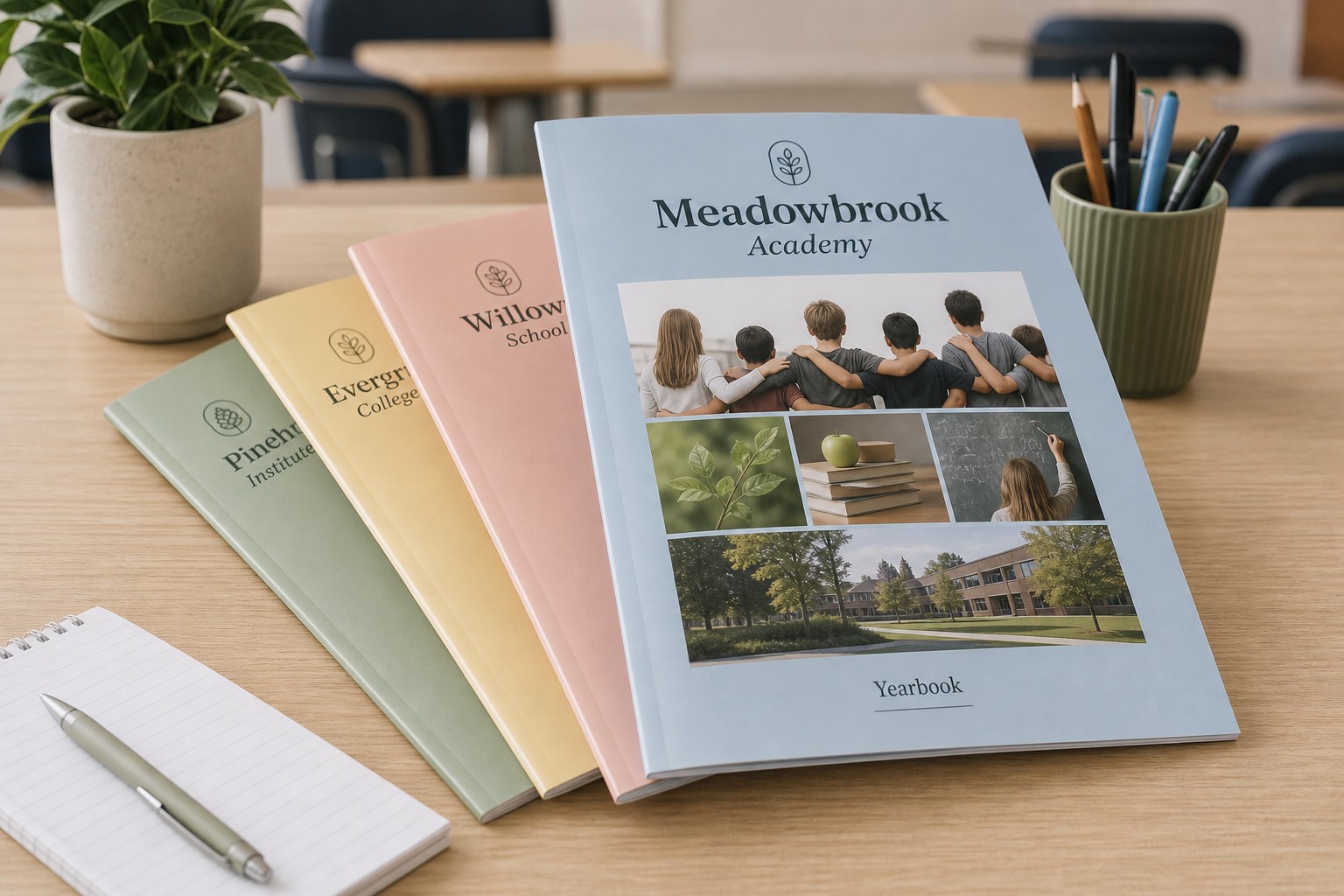
Planning a school yearbook or end-of-year magazine sounds manageable until you are six weeks from graduation with 300 students’ photos still to compile. Getting the print side sorted early (binding type, page count, and lead times) means the finished book arrives on distribution day without drama. This guide gives P&C and P&F committees, student editors, and school administrators across Australia a clear, practical reference for yearbook printing.
- A4 (210 x 297mm) suits most secondary and senior primary yearbooks; A5 (148 x 210mm) suits smaller term magazines and junior leavers’ booklets
- Saddle-stitch binding runs from 8 to 56 pages in multiples of four and opens flat for signing.
- Page count must be a multiple of 4; plan sections first, then round up
- Order quantity = total students plus 15-20% buffer for teachers, admin, library, and spares
- Work backwards from distribution day: allow at least 5-6 weeks from final artwork submission to delivery
- Proofs are ready within 1-2 business days; production runs 3-7 working days after approval
Which format suits your school: A4 or A5?
Format sets the tone before anyone reads a single caption. A4 (210 x 297mm) is the standard choice for secondary schools and senior primary yearbooks. It matches the magazine format students recognise and gives portrait photos, group shots, and full-bleed spreads the room they need.
A5 (148 x 210mm) is a practical choice for junior primary books, Year 6 leavers’ booklets and termly newsletters. It is not a shorter format than A4. Both formats run to the same printed page counts, up to 56 pages, so choosing between them is a size and budget decision, not a page count limit. Above 56 pages, either format moves to perfect binding, which is quoted rather than ordered from the product page.
Both formats are printed as saddle-stitched softcover booklets. For publications beyond the saddle-stitch maximum, perfect binding is available and produces a flat, labellable spine.
Paperlust Print Shop offers both sizes. Explore A4 booklet printing and A5 booklet printing to compare options and get a quote.
Binding and page count
Saddle-stitch: the practical choice for most school yearbooks
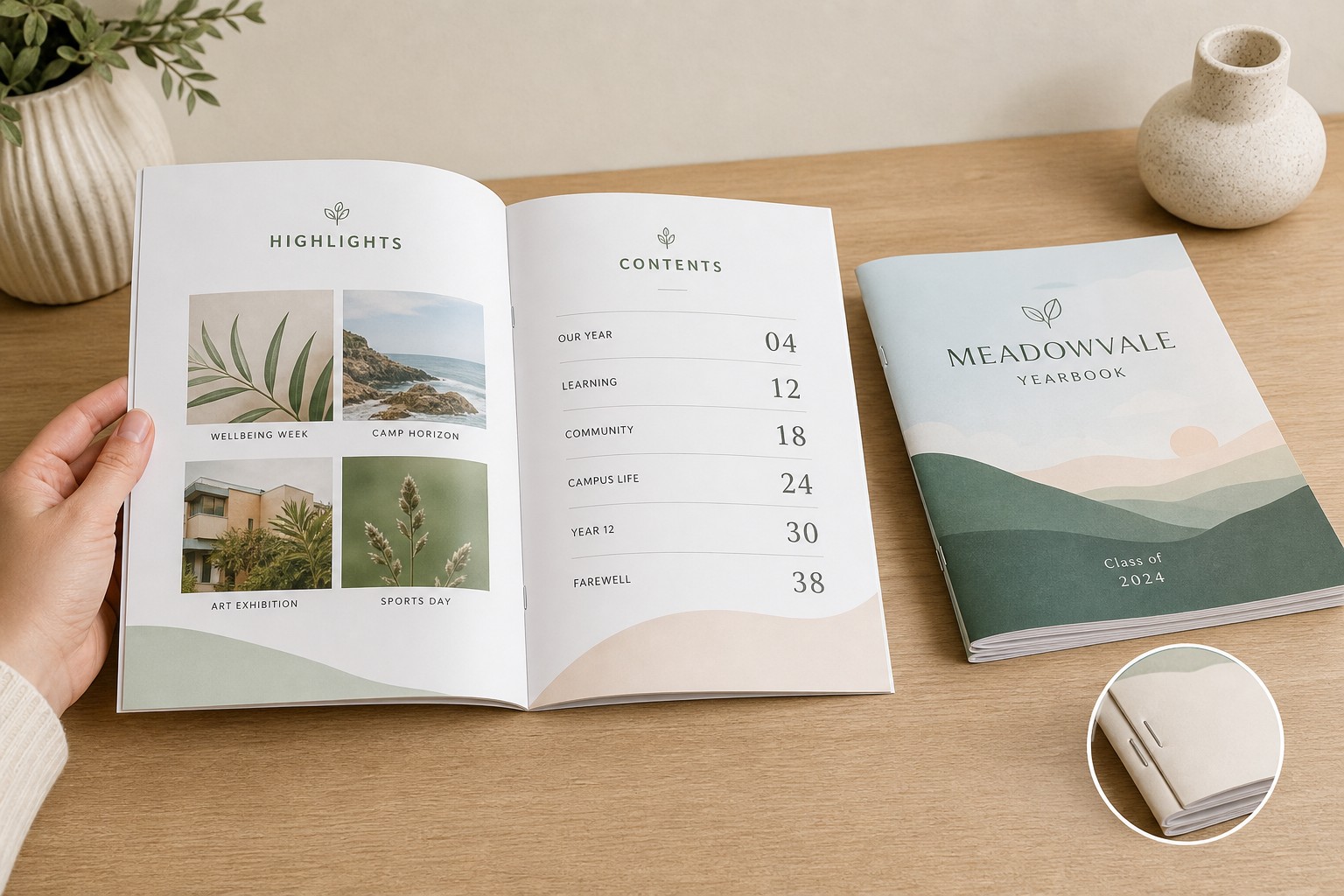
Saddle-stitch uses two staples through the folded spine. The finished booklet opens completely flat, which matters for signing pages, and the unit cost is lower than perfect binding for moderate page counts. It is the right choice for the majority of school yearbooks.
For A4, A5 and DL booklets, the printed page count range is the same: 8, 12, 16, 20, 24, 28, 32, 36, 40, 44, 48, 52 or 56 pages. 56 pages is the top of the standard saddle-stitch range on all three formats, and anything above it moves to a quote. Every saddle-stitch count has to be a multiple of four because each folded sheet creates four pages, so a plan that lands on 46 pages has to shift to 44 or 48. For books beyond the standard range, perfect binding is the step up and is quoted rather than ordered from the page.
Perfect binding: for larger, thicker publications
Perfect binding is for yearbooks that outgrow saddle stitching. Once your page count climbs past 56 pages, the job moves to a glued spine instead of staples. The result is a flat spine you can label on the shelf, and the book opens and reads much like a paperback. At that size we do not run it through the standard booklet product page. We quote it for you instead, so the page extent, stock and quantity can be checked before you commit.
The table below compares saddle-stitch and perfect binding across how each is bound, page count range, whether it opens flat, whether it has a printable spine, and how it is ordered.
| Saddle-stitch | Perfect binding | |
|---|---|---|
| How it is bound | Two staples through the folded spine | Pages glued at the spine |
| Page count range | 8 to 56 pages, in multiples of four | Above the standard saddle-stitch range |
| Opens flat | Yes, completely | No |
| Printable spine | No | Yes, flat and suitable for a label |
| How to order | Direct from the product page | By quote |
Cover and paper stock
The cover does a lot of work on a yearbook. It needs to survive a school bag, look impressive on distribution day, and feel substantial enough to be kept for years.
A4 and A5 booklets share one cover stock range, so the same choices apply to both formats. You can pick 150gsm gloss, 170gsm matte, 250gsm gloss or 250gsm matte. The 150gsm and 170gsm covers give you a lighter finish, while the 250gsm stocks are the heavier choice for a book that will be handled often. For a yearbook that gets passed around, the heavier 250gsm stock is the sensible starting point.
You can skip lamination, choose gloss on both sides, or choose matte on both sides. Gloss lamination lifts colour and suits photo heavy covers, while matte lamination looks softer and handles fingerprints better, which matters on a yearbook passed around for signing. For a book meant to be kept and signed, choose matte lamination on a 250gsm cover. That pairing gives you the sturdiest cover combination on offer.
Planning your page count: the yearbook ladder
The most reliable approach to page planning is to map out content sections before committing to a number. This is sometimes called a “ladder” in yearbook production: a simple section-by-section table with estimated page allocations.
| Section | Typical page range | Notes |
|---|---|---|
| Cover and title spread | 2 pages | Counted in your total |
| Principal or editor message | 1-2 pages | Keep brief |
| Staff and faculty portraits | 2-4 pages | Verify name spellings carefully |
| Student portraits by class | Varies by cohort | ~1 page per 15-20 students at standard portrait scale |
| Sports and activities | 4-8 pages | Collect images early; highest-demand section |
| Events and excursions | 4-8 pages | Camp, carnival, productions, incursions |
| Candid and memory pages | 4-8 pages | Student submissions; allow two weeks lead time |
| Farewell and graduating class | 2-4 pages | Portraits, quotes, superlatives |
| Acknowledgements and sponsors | 1-2 pages | Optional; P&C ads can offset print costs |
Add up your sections, round to the nearest multiple of 4, then add a 4-8 page buffer for late-breaking content and corrections. Carrying a few blank spreads is far easier than discovering you need more pages after artwork is finalised.
Yearbook printing costs in Australia
Yearbook printing costs are the first figures a committee takes to a meeting. The prices below are per book, in Australian dollars, and quoted on a portrait book with 128gsm matte inside pages, a 250gsm matte cover and matte laminate on both cover sides. Two levers move the number most: page count and order quantity. Quantities run from 25 to 500 copies in the tables below.
A4 pricing runs from $13.64 per book for 24 pages at 25 copies to $10.88 for 56 pages at 500 copies.
| Page count | 25 copies | 50 copies | 100 copies | 250 copies | 500 copies |
|---|---|---|---|---|---|
| 24 pages | $13.64 | $9.29 | $7.26 | $5.52 | $5.15 |
| 32 pages | $15.21 | $10.86 | $8.82 | $6.95 | $6.57 |
| 40 pages | $16.82 | $12.46 | $10.42 | $8.40 | $8.03 |
| 48 pages | $18.40 | $14.03 | $11.98 | $9.83 | $9.45 |
| 56 pages | $19.98 | $15.61 | $13.55 | $11.25 | $10.88 |
A5 pricing shows the saving clearly: a 40 page book at 100 copies totals $677.93 all up, against $1,041.97 for the same A4 book.
| Page count | 25 copies | 50 copies | 100 copies | 250 copies | 500 copies |
|---|---|---|---|---|---|
| 24 pages | $12.77 | $7.82 | $5.17 | $3.35 | $2.90 |
| 32 pages | $13.56 | $8.61 | $5.96 | $4.07 | $3.61 |
| 40 pages | $14.39 | $9.44 | $6.78 | $4.82 | $4.36 |
| 48 pages | $15.18 | $10.23 | $7.57 | $5.54 | $5.08 |
| 56 pages | $15.98 | $11.02 | $8.36 | $6.25 | $5.80 |
Read these tables as bands. The steepest per book fall happens between 25 and 100 copies. From 250 copies on, the curve flattens, so going to 500 changes the unit price only slightly. Three specification changes move the number after that: page count, format and cover laminate. Removing the laminate lowers the price. Dropping to a lighter cover stock lowers it as well. Prices cover the book only. Delivery is added at checkout.
Quantities: how many to order
Order for every student in the target year levels, plus 15-20% for teachers, library archive copies, administration, and spares. A Year 12 cohort of 80 students warrants roughly 95-100 booklets; a whole-school run of 300 students sits around 345-360 copies.
Unit cost decreases at higher quantities. If you are close to a volume break, get quotes at both quantities, the higher volume often lowers the per-unit cost enough to justify the extra outlay.
Your production timeline: working backwards from distribution day
Production does not begin until you approve your proof. Proofs take 1-2 business days to prepare; production then runs 3-7 working days. Add flat-rate shipping Australia-wide on top.
Working backwards from your distribution date:
| Milestone | Weeks before distribution |
|---|---|
| Order placed and proof approved | 5-6 weeks |
| Final print-ready artwork submitted | 6 weeks |
| All photos and written content received | 8 weeks |
| Internal layout draft complete | 10 weeks |
| Photo and content collection deadline (students and families) | 12 weeks |
| Committee roles assigned, printer quotes confirmed | 16-20 weeks |
Working back from a late November distribution, the schedule falls into school terms. Assign committee roles and confirm printer quotes in Term 3, 16 to 20 weeks out. Set the photo and content collection deadline later in Term 3, at 12 weeks out. The internal layout draft is due at 10 weeks, and all photos and written content are received at 8 weeks. Submit final print ready artwork in Term 4, at 6 weeks out. Place the order and approve the proof in the first half of Term 4, at 5 to 6 weeks out. Proofs take 1 to 2 business days to prepare, and production runs 3 to 7 working days after proof approval. Delivery is on top of that.
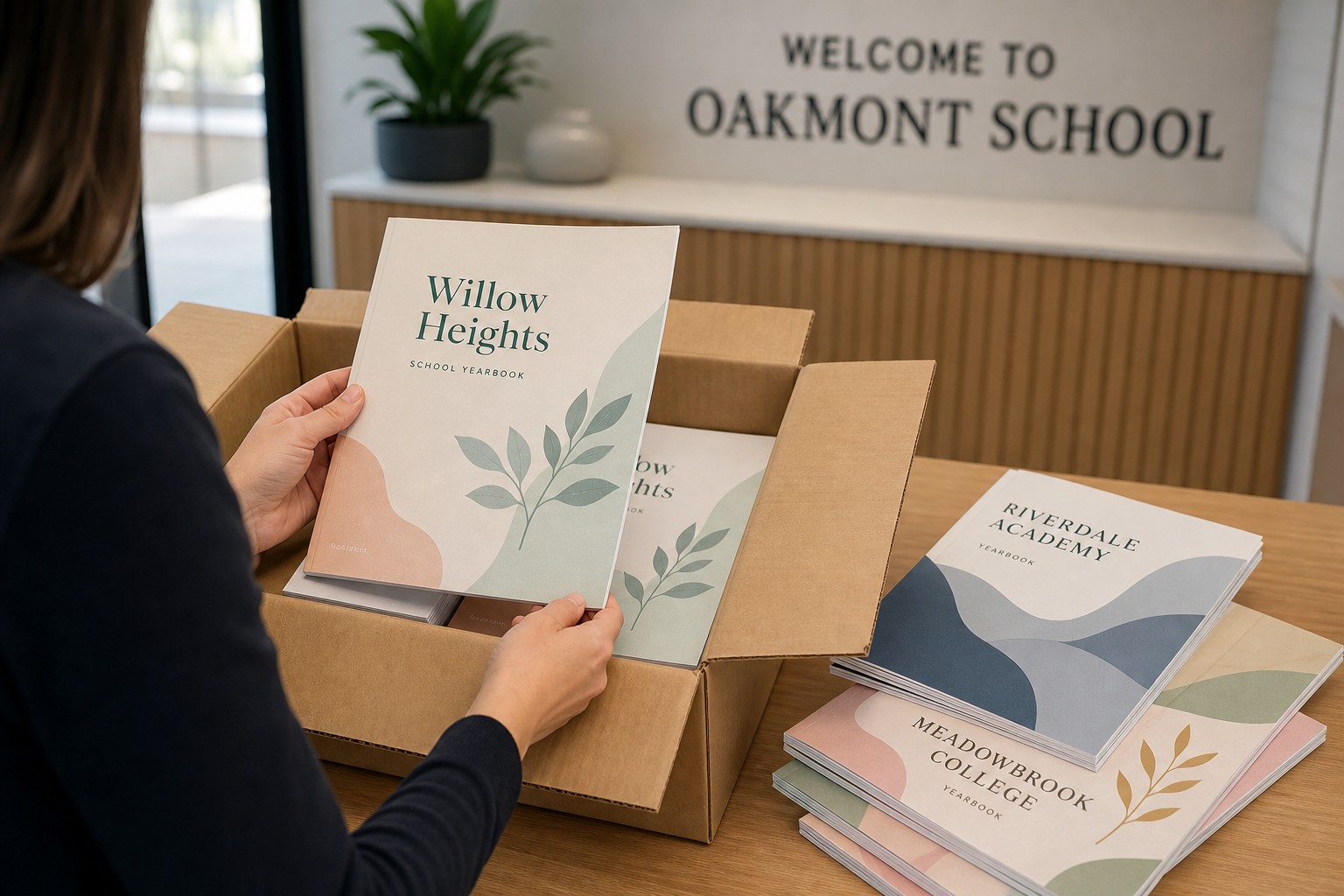
Yearbook printing in Melbourne, Sydney, Brisbane, Perth or Adelaide follows the same online path: upload artwork, approve the proof, then production. There is no counter service and no per city pricing, so a school in Perth or Adelaide pays the same book price as one in Melbourne or Sydney. Production runs 3 to 7 working days after proof approval, and delivery is on top of that depending on the destination. Further from production, the buffer is yours: approving the proof earlier is the only way to protect a fixed distribution date. Books arrive in cartons at one delivery address.
Budget levers: where to adjust without sacrificing quality
If the first quote comes in above budget, there are five adjustments to consider before you start cutting content sections:
1. Trim page count by 4-8 pages. Even a modest reduction has a material effect on unit cost. Identify the sections with the weakest photography and combine or cut them first. 2. Adjust the cover finish. A 250gsm unlaminated cover costs less than a laminated one while still looking polished on distribution day. 3. Choose A5 over A4. Starting from $16.54 inc. GST, A5 booklets offer a meaningful saving per unit on larger runs compared to A4 starting from $17.71 inc. GST. 4. Increase the print quantity. If you are close to a volume break, ordering an extra 20-30 copies often lowers the per-unit cost enough to offset the additional outlay. 5. Build in realistic internal deadlines. Rushing artwork to meet a self-imposed tight deadline incurs unnecessary revision rounds. A realistic schedule reduces back-and-forth costs.
For schools also producing other printed materials such as flyers, prospectuses, or event signage throughout the year, bundling these through a single print supplier can simplify the quoting and approval process. See the marketing materials range for related products.
Artwork and file preparation
Artwork problems are the most common cause of delayed proofs. Set clear standards for anyone contributing layouts or photos to your yearbook project:
- Resolution: 300 dpi minimum for all photos. Images downloaded from Facebook or Instagram are rarely print-ready.
- Colour mode: CMYK, not RGB. RGB images convert unpredictably and colours can shift on press.
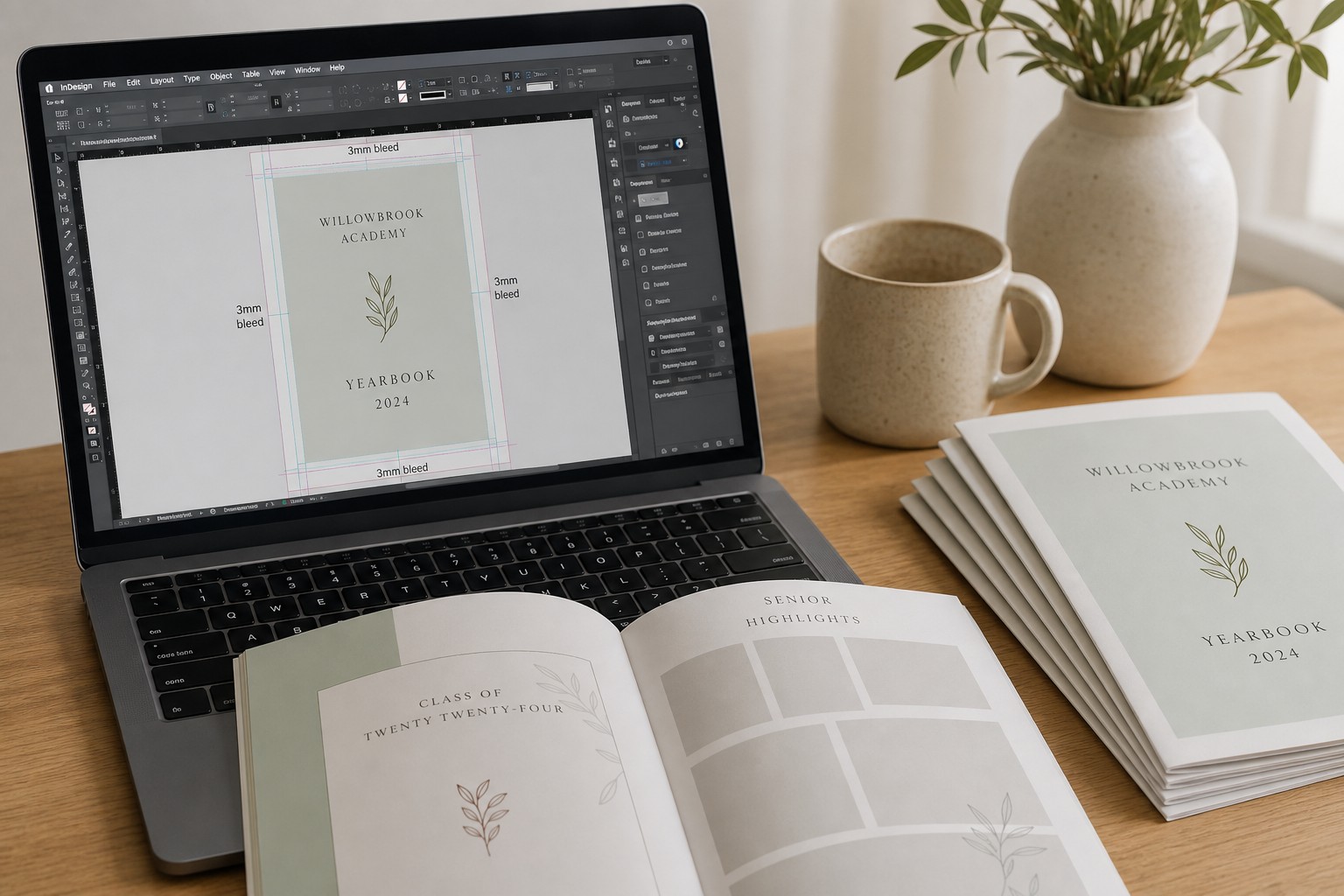
- Bleed: 3mm on all four sides for any element running to the page edge.
- File format: Export as PDF in single pages, not spreads.
- Name checks: Verify every student and staff name against the school enrolment list. A misspelled name is the detail families remember.
Related reading
For broader context on booklet formats and binding, see:
- Booklet Printing in Australia: A Complete Guide
- Event Program Booklet Printing: for schools producing graduation ceremony and order-of-service programs
Frequently asked questions
How many pages does a school yearbook need to be?
The practical range for a school yearbook is the saddle-stitch range of 8 to 56 printed pages. Available page counts are 8, 12, 16, 20, 24, 28, 32, 36, 40, 44, 48, 52 and 56 pages. Every option must be a multiple of four because each folded sheet produces four pages. List your content sections, count the pages, then round up to the next available count and leave a small buffer for signing pages, photo spreads and last-minute additions.
What is the difference between saddle-stitch and perfect binding for a yearbook?
Saddle-stitch binding uses folded sheets stapled through the spine, and it is only available for A4, A5 and DL booklets up to 56 pages. Because the page count must also be a multiple of four, it suits shorter yearbooks and opens flat, which makes signing pages easier. Perfect binding is used above 56 pages and is quoted rather than ordered from the product page. It gives the book a flat, labellable spine but does not open as flat, so it is better for larger yearbooks kept on a shelf.
Should I use A4 or A5 for a school yearbook?
A4 (210 x 297mm) is the standard format for secondary and senior primary yearbooks, offering the space that portrait grids, group photos, and event spreads need. A5 (148 x 210mm) suits junior primary memory books, Year 6 leavers’ booklets, and termly school magazines. A5 also has a lower starting price, from $16.54 inc. GST, making it a cost-effective option for smaller-run or more frequent publications.
How early do I need to place a yearbook printing order?
Allow at least 5-6 weeks between placing your order and distribution day: proof preparation (1-2 business days), production (3-7 working days), plus shipping. For end-of-year distribution in November or December, finalise artwork by mid-October and confirm your supplier by July or August.
What cover options are available for printed school yearbooks?
Printed school yearbooks can be ordered with a 150gsm gloss, 170gsm matte, 250gsm gloss or 250gsm matte cover. You can choose no lamination, gloss lamination on both sides, or matte lamination on both sides. For a yearbook meant to last, 250gsm with lamination is the sturdiest cover combination we offer. Gloss lamination lifts colour on photo heavy covers, while matte lamination is softer and handles fingerprints better on a book passed around for signing.
How do I calculate how many yearbooks to order?
Total students in the target year levels, plus 15-20% for staff, library, admin, and spares. A Year 12 cohort of 80 warrants roughly 95-100 copies; a whole-school run of 300 needs around 345-360. If you are close to a volume break, quote both quantities, the higher number often reduces per-unit cost enough to justify the outlay.