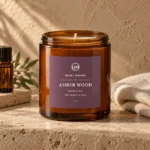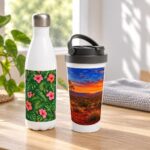
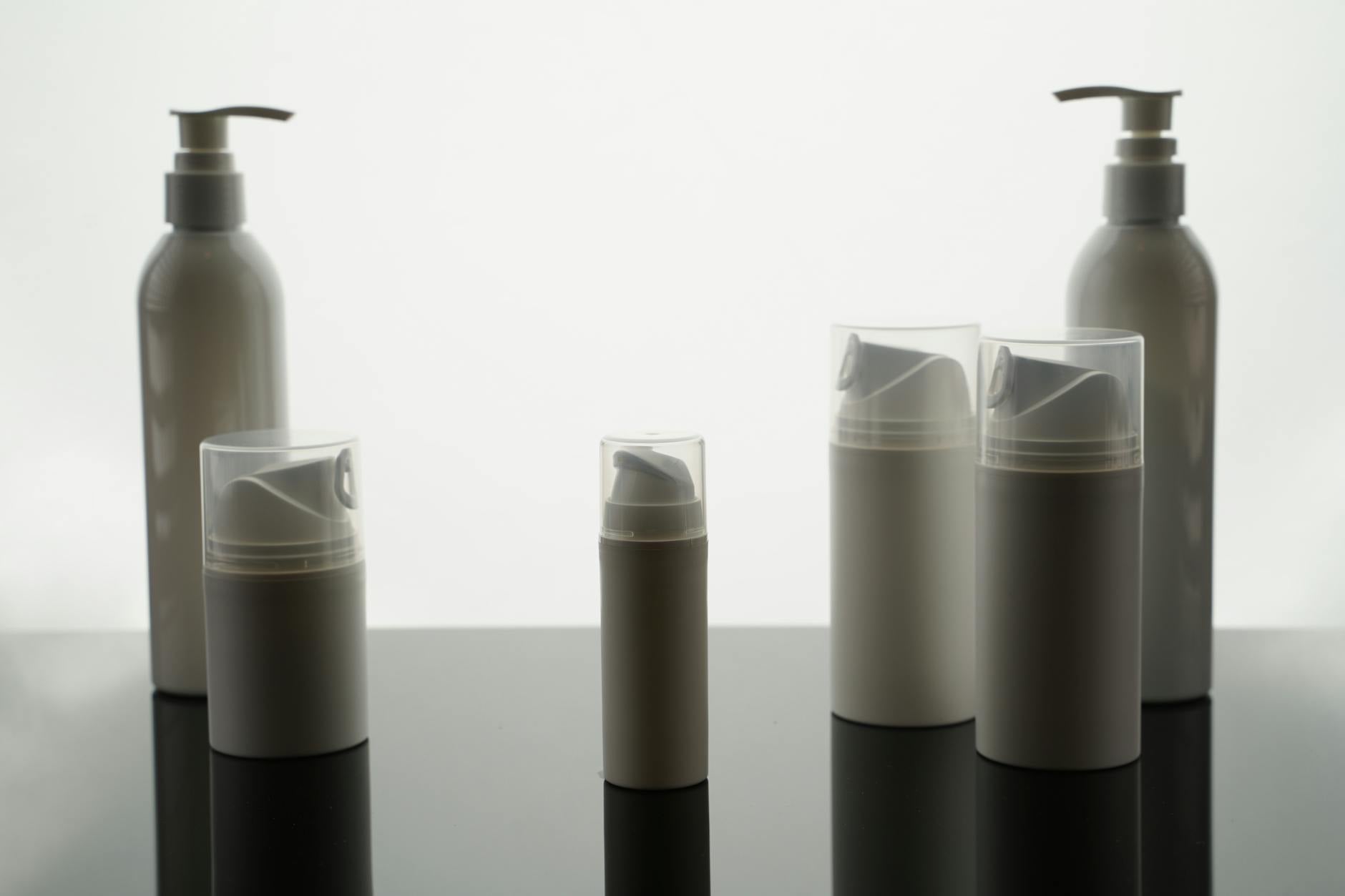
The hard part of a clear label order is not the printing. It is the first label on the filled bottle, when the colours look lighter than the screen and the clear areas show the liquid behind them.
Used well, clear labels for product packaging remove the white paper frame and let the container become part of the design. Used without planning, they make contrast mistakes obvious.
The no-label look is a styling effect, not an invisible label
Clear labels remove the white backing, not the label film itself. The no-label look is a styling effect: your artwork sits against the container colour instead of a bright rectangle. There is still a physical edge where the clear synthetic film ends. On a smooth jar or bottle that edge can be subtle, but it does not disappear.
The standard clear roll label prints on Clear Synthetic film with a gloss varnish. There is no frosted or matte clear roll stock to fall back on. That single finish keeps the decision focused on what clear film does well and where it needs help.
White ink and white underprint are two different jobs
White ink prints as an opaque white layer. If your design has white text or white graphic elements, those areas can be printed in white ink and will read white on the container.
White underprint is a separate layer placed beneath coloured CMYK artwork. It stops the container colour and liquid behind the label from changing how the printed colours appear. A full-colour logo on dark glass usually needs a white underprint beneath it to keep the colours accurate.
Unprinted areas of the clear film stay transparent. That is what creates the no-label look around the printed design. You can choose selective white underprint: put it behind a logo or ingredient panel while leaving the surrounding clear areas open.
The practical artwork walkthrough for this step is the clear sticker versus white ink guide.
When white ink or underprint is worth adding
- White text or white logo marks. Print those areas in white ink so they stay opaque white.
- Dark or coloured containers. Coloured artwork usually needs underprint, especially over dark brown, green, or amber glass.
- Low-contrast layouts. Thin pale type and hairline elements fade further on clear film. Check them on the filled vessel, not a transparent screen mock.
- Filled packaging. An empty jar and a full jar have different backings. Amber oil, dark syrup, or green liquid behind the label can shift the look.
Light containers and clear packaging may not need underprint when the design is already dark and bold. If the container colour is part of the look, leave the surrounding zones clear.
Check contrast on the filled container
A design that works on a white screen or an empty bottle can fail on a shelf. Clear labels let the contents show through wherever the film is unprinted, so the same label will look different on a clear jar of honey and an amber jar of body oil. Look at the actual product, filled and sealed, before finalising the artwork.
Apply labels to a clean, dry surface and follow the supplier’s application instructions, including any recommended dwell time before the packaged product faces moisture or handling. Surface coatings also matter. Smooth rigid containers generally work better than textured or flexible surfaces, but coated glass and some plastics need a real application test on the exact container. Do not assume a cleared proof covers physical colour, gloss, or adhesion.
For wet-use packaging, a white synthetic roll label may be worth comparing. The waterproof vinyl labels range uses white polypropylene film with a permanent acrylic adhesive and is supplied on 500-label rolls. It is a separate product choice, not a clear-label fallback.
Measure the container and plan artwork
Capacity tells you millilitres, not panel dimensions. Measure the actual straight zone where the label will sit. Wrap a paper strip or soft tape around the circumference and mark where it meets. Decide the seam gap you want between label edges. Wrap width equals measured circumference minus that gap. There is no universal seam gap. Paper-test your own gap on the real container before committing to a roll.
The bottle and jar label sizing guide walks through the steps for straight and curved surfaces. If the surface tapers, has ribs, or swells at the shoulder, a custom die-cut or specialist advice may be required.
Ordering clear roll labels from Paperlust
Standard clear labels are supplied on rolls, one-up, with 500 labels per roll. The minimum is one roll of 500 per design and per size. A 1,500-label order across three designs, where each design is on its own 500-label roll, meets each minimum. A 500-label total spread across three designs does not meet any single design’s minimum.
Choose the size from the Clear Labels range, select how many designs you need, and upload your artwork. White ink underprinting is available on the clear stock, and we review every file and may recommend whether underprinting would improve visibility. Nothing prints until you approve the emailed proof. Follow the artwork instructions for the chosen product. Not every product has a downloadable template, so check what the page provides before setting up your file.
Production takes 48 hours after your proof is approved. That is production only. Delivery time is separate, and you choose your delivery option at order.
Planning multiple designs without losing count
Packaging faces and container numbers are not label quantities. If a jar has a front label, a lid label, and a back label, that is three designs. A 500-jar run with all three faces needs 1,500 labels, not 500. Each design still has its own roll and its own 500-label minimum.
| Label face | Finished size (example only) | Stock and finish | Artwork identifier | Roll quantity |
|---|---|---|---|---|
| Front label | 50mm W x 150mm H | Clear Synthetic, Gloss Varnish | Honey_front_v3 | 500 |
| Back label | 30mm W x 100mm H | Clear Synthetic, Gloss Varnish | Honey_back_v2 | 500 |
| Lid label | 40mm W x 40mm H | Clear Synthetic, Gloss Varnish | Honey_lid_v1 | 500 |
These rows are examples only. Your measured panel may need a different size. If the size is outside the current list, ask our team for a custom size enquiry.
Use a matrix to keep every variant straight: identifier, file name, finished width and height, stock, finish, quantity, version, and proof status. Store the approved files and quote reference together. If every label must vary per unit, ask our team before ordering. Standard clear roll printing does not add automatic variable data or serialisation.
Samples, proofs, and print tests are different
A sample pack is a preprinted, fixed assortment. It helps you compare available samples, but it does not carry your own artwork and you cannot pick the contents. If a material identity is unclear, record the product name and confirm with our team.
A digital proof checks layout, text, and declared dimensions. It does not confirm physical colour, gloss, or how the label sits on a filled jar.
If you want your own artwork printed on the clear stock, that is a separate paid print order with its own minimum. It is not an included free custom sample. A small run of clear stickers is a different product and is not a stand-in test for the roll stock. Use the guide to testing sticker samples before a bulk order to make the most of a physical sample.
Clear labels in cosmetic and skincare packaging
Clear labels often sit well on serum bottles, cream jars, and soap packaging, but the product colour behind the label is part of the design. Check the layout on the filled container, not an empty beauty mockup. A milky lotion and a dark green balm create different backings.
The Cosmetic and Skincare Labels page lets you choose clear synthetic among other stocks and shape options such as circle, rounded corner, oval, and custom die-cut. For soap bars and skincare ranges, the cosmetic soap label printing guide covers related stock and artwork decisions.
Clear labels are one packaging route, not the whole range
Clear roll labels are a container labelling product. Clear Stickers are a separate format, not the roll product, and Textured Stickers are a separate sticker range for tactile dry packaging. Do not substitute one for the other when checking stock or finish.
For the separate clear sticker format, see the clear stickers guide and the separate Clear Stickers range. For the wider role of packaging stickers across sealing and branding, read the product packaging stickers guide. If the project is outer packaging rather than a product container, custom kraft mailer boxes are built for that job. Browse the packaging and branding category for the full range.
FAQs: Clear Labels for Product Packaging
Does the no-label look mean the label edge disappears completely?
No. A clear label still has a finished edge. The effect comes from removing the white paper frame, not from making the material invisible. On a smooth jar the seam can be subtle, but it does not disappear.
Will my white text stay white on a clear roll label?
White text must be printed in white ink to stay white. An area that looks white in the design file but is left unprinted will be clear, so the container or liquid shows through. Printed white ink forms an opaque white layer for the text.
When does coloured artwork need a white underprint?
Underprint sits beneath coloured CMYK artwork to block the container colour. It tends to help on dark, amber, green, or black glass, and whenever the filled liquid would otherwise shift the colours. Test on the filled container before finalising.
What is the minimum order for clear labels?
The minimum is one roll of 500 labels for each design and each size. If three designs each have their own 500-label roll, that is 1,500 labels total and meets each minimum. A total of 500 spread across multiple designs does not meet any single design’s minimum.
How long does production take?
Production takes 48 hours after your proof is approved. Delivery time is separate, and you choose your delivery option at order.
Can I get a frosted or matte clear roll label?
No. The standard clear roll label prints on Clear Synthetic film with a gloss varnish. That is the transparent roll-label finish. For a softer or matte look, a different packaging design or separate sticker range may be needed.