
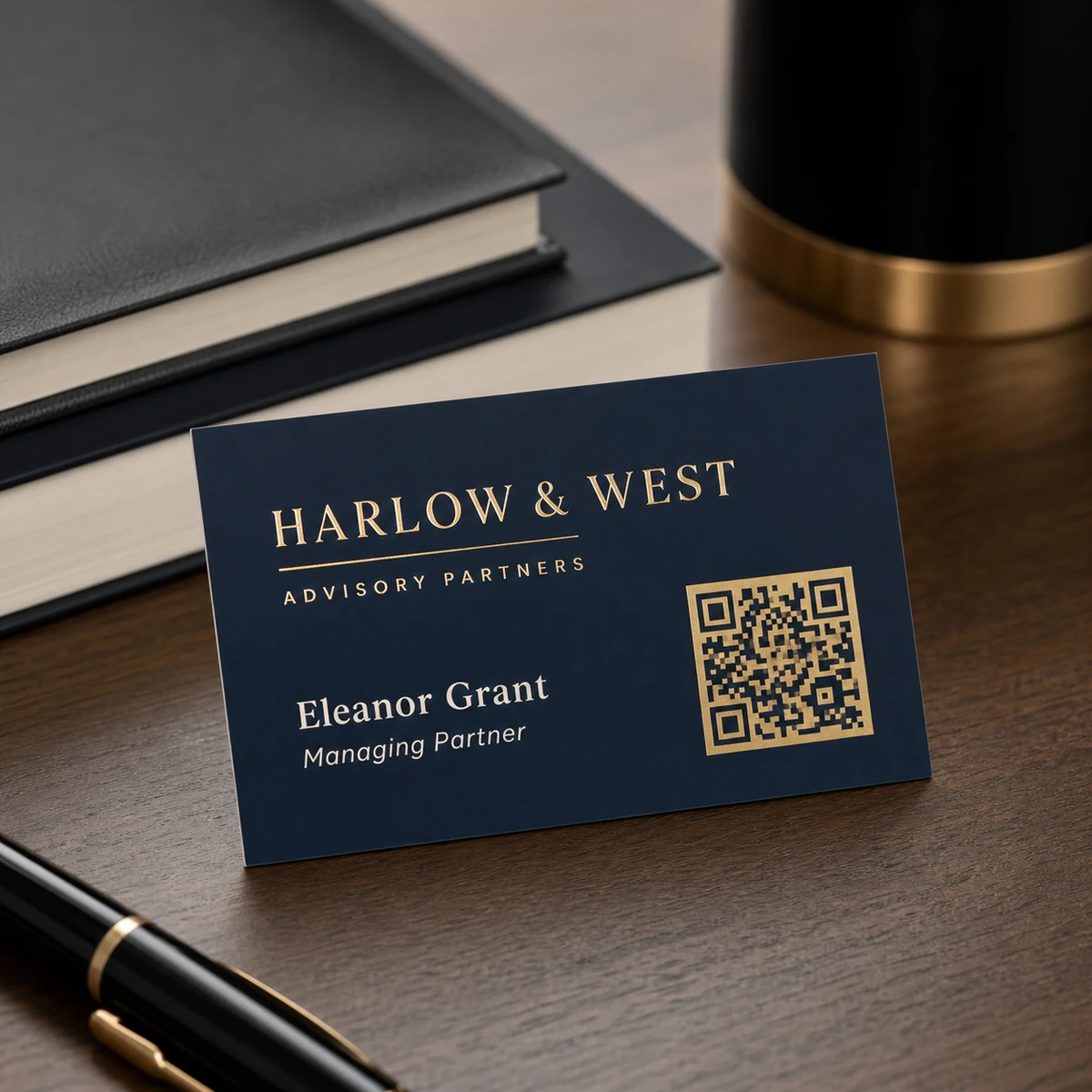
Business cards remain one of the most cost-effective trust signals in the accounting and bookkeeping professions. A well-designed card communicates credentials, reliability, and attention to detail before a word is spoken, whether you hand it to a client at a tax-time debrief, leave a stack at a mortgage broker’s reception, or pass one across a table at a networking breakfast.
Accountant & bookkeeper business cards
Quick reference
Everything you need to know before you order.
- Standard size is 90mm x 55mm – the Australian standard that fits every wallet and card holder
- Restrained palettes (navy, slate, forest green, charcoal) signal trust and precision better than bright colours
- Include your credential abbreviation (CPA, CA, BAS Agent, ICB) on the card – clients recognise the shorthand
- A QR code linking to your booking page or client portal adds immediate utility and reduces friction
- Linen and cotton stocks add tactile quality that reinforces a premium, detail-oriented practice
- Print runs from 50 cards at $27.20 inc. GST ($0.54 per card), or from $0.44 per card inc. GST at 100 cards, with 24-hour production available
Why business cards still matter in accounting and bookkeeping
Accounting and bookkeeping are trust-dependent professions. Clients hand over sensitive financial information, often during stressful periods: end-of-year compliance, business restructure, a first BAS lodgement. Every interaction either builds or erodes that trust.
A business card handed at exactly the right moment does something a LinkedIn connection cannot: it gives the other person something physical to hold, file, and retrieve weeks later. Referral networks in accounting are dense – mortgage brokers, real estate agents, financial planners, and HR consultants all cross paths with accountants. A card left with a broker or a stack placed at a conveyancer’s office can generate long-tail referrals from a single print run.
The difference for accountants specifically is that the card itself must look precise. A typo, a pixelated logo, or a flimsy cardstock sends exactly the wrong message for a profession built on accuracy.
What to put on an accountant or bookkeeper business card
Getting the information hierarchy right is the foundation of effective card design. Not everything deserves equal prominence.
Essential fields
- Your name – set larger than everything else on the card
- Credential or qualification – see the section below on how to handle this
- Job title or specialisation – “Tax Accountant”, “Business Bookkeeper”, “BAS Agent”, “Financial Controller”
- Firm or practice name (or your trading name as a sole trader)
- Mobile number – primary contact; landline optional as secondary
- Email address
- Website URL or a short URL that points to your booking/inquiry page
- QR code – link this to your calendar booking page, client portal, or a contact card URL; see the QR section below
Fields to leave off
- Full street address (unless you operate from a physical consulting space clients actually visit)
- Fax number
- Multiple mobile and landline numbers (choose one primary per channel)
- Long taglines that eat into whitespace
The standard 90mm x 55mm card has limited real estate. Every character of text reduces the whitespace that makes the card feel premium and readable. Aim for clean breathing room, not a comprehensive capabilities statement.
Credentials on the card: CPA, CA, ICB, BAS Agent
The accounting and bookkeeping sector in Australia has a well-established credential hierarchy. Getting this right on your card signals to clients, peers, and referral partners that you are registered and current.
Common accountant credentials
- CPA – Certified Practising Accountant (CPA Australia member); the most widely recognised designation for public-practice accountants in Australia
- CA – Chartered Accountant (CA ANZ member); strong recognition in corporate and advisory contexts
- CPA and CA dual – some practitioners hold both; list only the one most relevant to your target client
- FCPA / FCA – Fellowship designations; worth including as they signal seniority
Common bookkeeper credentials
- ICB – Institute of Certified Bookkeepers member
- BAS Agent – registered with the Tax Practitioners Board; required to legally charge for BAS preparation services; high client recognition
- MYOB Certified Consultant / Xero Certified Advisor – software credentials; relevant for practices leading with cloud accounting as a differentiator
How to display credentials on the card
Place the credential abbreviation directly after your name or on the line below, in a smaller point size. The format that works well:
Tax Accountant
Hartley Partners Pty Ltd
Business Advisory
Mitchell & Co Chartered Accountants
Bookkeeping & Payroll
Nair Bookkeeping Services
A registered agent number is not required on your business card (it belongs on your client engagement letters and invoices). Keep the card clean.
Colour palettes that work for accountants and bookkeepers
Colour carries meaning. In the accounting space, the right palette communicates reliability and numeracy. The wrong one can make a professional practice look like a hair salon.
Palettes that consistently perform well
Navy and white with a gold accent
Authoritative, classic, and widely associated with the financial sector. A navy card with white type and a single gold rule or logo element reads as senior and established. Works especially well on linen or cotton stock.
Charcoal and slate with a green accent
A modern evolution of the navy palette. Charcoal is less cold than pure black and more sophisticated than dark navy. A forest green or sage accent avoids the generic “bank” association while keeping the palette restrained.
White/off-white with a single deep ink colour
Maximises whitespace. Often the most legible option for bilingual cards or cards with a QR code where screen-readable contrast matters.
Mid-blue and silver
Works well for accountants positioning around technology or cloud accounting. Silver on mid-blue reads as precise and digital-forward without being garish.
What to avoid
- High-saturation warm colours (red, orange, bright yellow) clash with the precision association
- Gradients that compress poorly in print and look amateur on close inspection
- Too many type weights and colours (stick to two at most: a headline weight and a body weight)
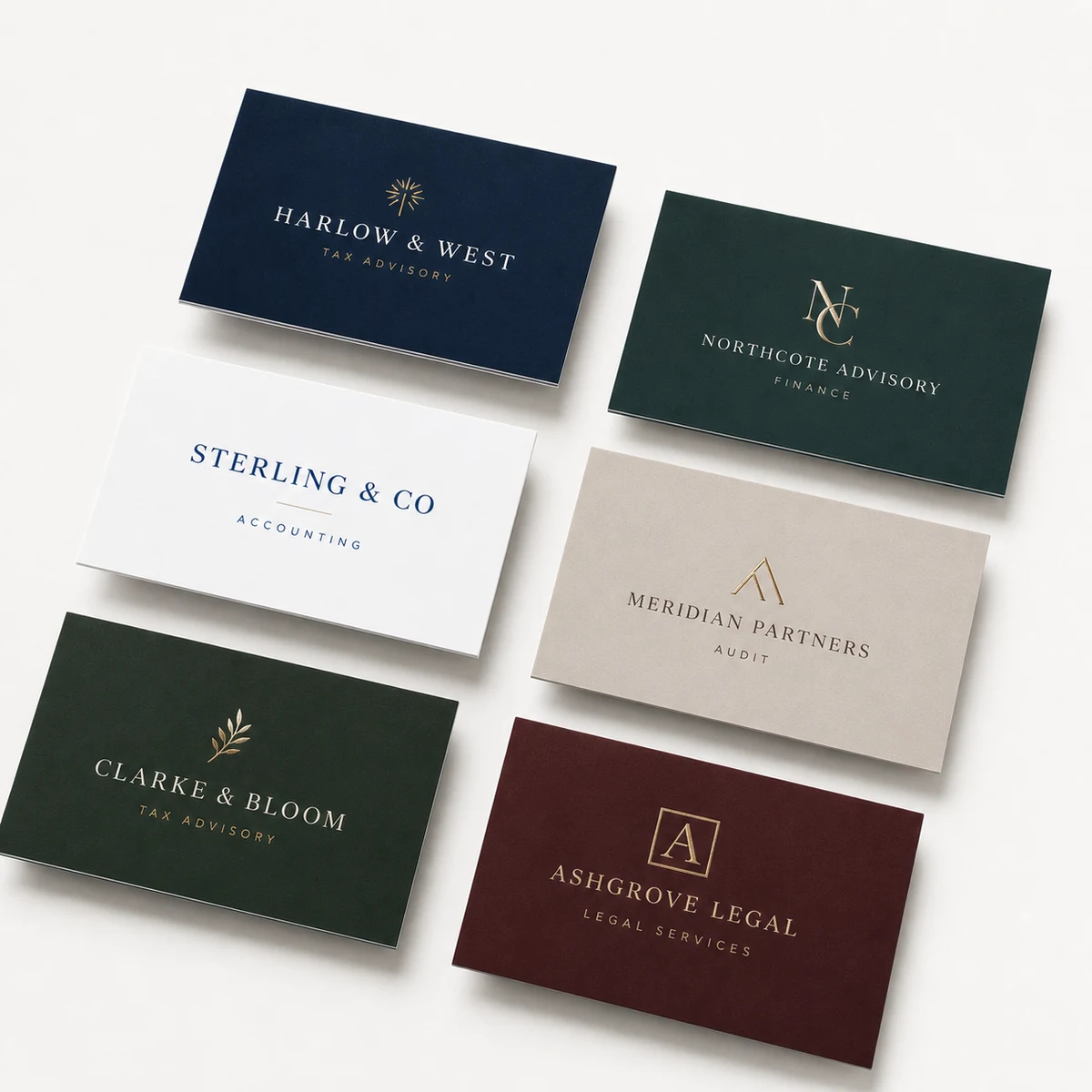
Paper stocks and finishes for accounting professionals
The physical quality of a business card reinforces the standard of your work. A card that bends, fades, or looks like it was printed at home undercuts an otherwise strong first impression.
Our standard business cards are printed on stocks from 350 to 400gsm, which is a substantial, professional weight. Available stock options include:
- Matte – clean, non-reflective, and easy to write on; the default choice for most professional contexts; holds fine serif type well
- Linen – textured surface with a subtle crosshatch weave; communicates handcraft and quality; excellent for traditional or heritage-positioned practices
- Cotton – soft, premium feel; rare in the business card category; immediately signals a level of investment that stands out in a stack
- Artboard with Velvet Laminate – matte laminate with a soft-touch finish; slightly rubberised feel; high perceived value; suits modern practices targeting premium clients
- Metallic – a reflective base stock; suited to minimal designs with high contrast type; creates immediate visual interest without adding a printed foil finish
All stocks are available in the standard 90mm x 55mm rectangle. Rounded corners are also available on the same dimensions.
A note on finish for accountants
The strongest-performing finish for most accounting and bookkeeping practices is a matte or linen card with clean, simple design. High-gloss finishes can work in consumer-facing contexts but can look more sales-focused than trust-focused in a professional advisory role. If you want to add a tactile premium element, the velvet laminate or cotton stock achieve that effect through texture rather than shine.
Sole trader bookkeeper vs accounting firm: what changes
The brief, the volume, and the design approach differ depending on where you sit in the profession.
Sole trader bookkeeper
A sole trader bookkeeper’s card needs to do more work per square centimetre. There is no firm brand behind the name to do the heavy lifting.
Key priorities:
– Your name prominently set (it is the brand)
– Your credential or software certification visible (it is your differentiator)
– A direct mobile number – accessibility and responsiveness are the USP
– A QR code linking to a Calendly or Acuity booking page so a referral can turn into an appointment without friction
– A secondary specialisation note if you target a specific sector: “Specialising in trades & construction” or “Xero-only practice” signals niche expertise to the right clients
Order 200-500 cards at a time. Sole traders hand cards to every referral partner, at every industry event, and to every new client. Running out is a missed opportunity.
Mid-size accounting firm
At firm level, cards are about brand consistency as much as individual identity. The firm’s visual identity (colours, logo, type) should drive the card design, with individual personalisation limited to name, title, and direct contact details.
Key considerations for firms:
– All cards in the practice should share the same design; the only variable is the name, title, and direct contact fields
– A QR code at firm level can link to a centralised contact page or the staff member’s profile on the firm website
– Higher-weight stock or a premium finish (velvet laminate, cotton) signals that the firm invests in the detail of its presentation – a subtle signal about how it will treat client work
For firms printing multiple sets across a team, our standard business cards can be ordered in individual runs from 50 cards per team member with consistent stock and finish across the batch.
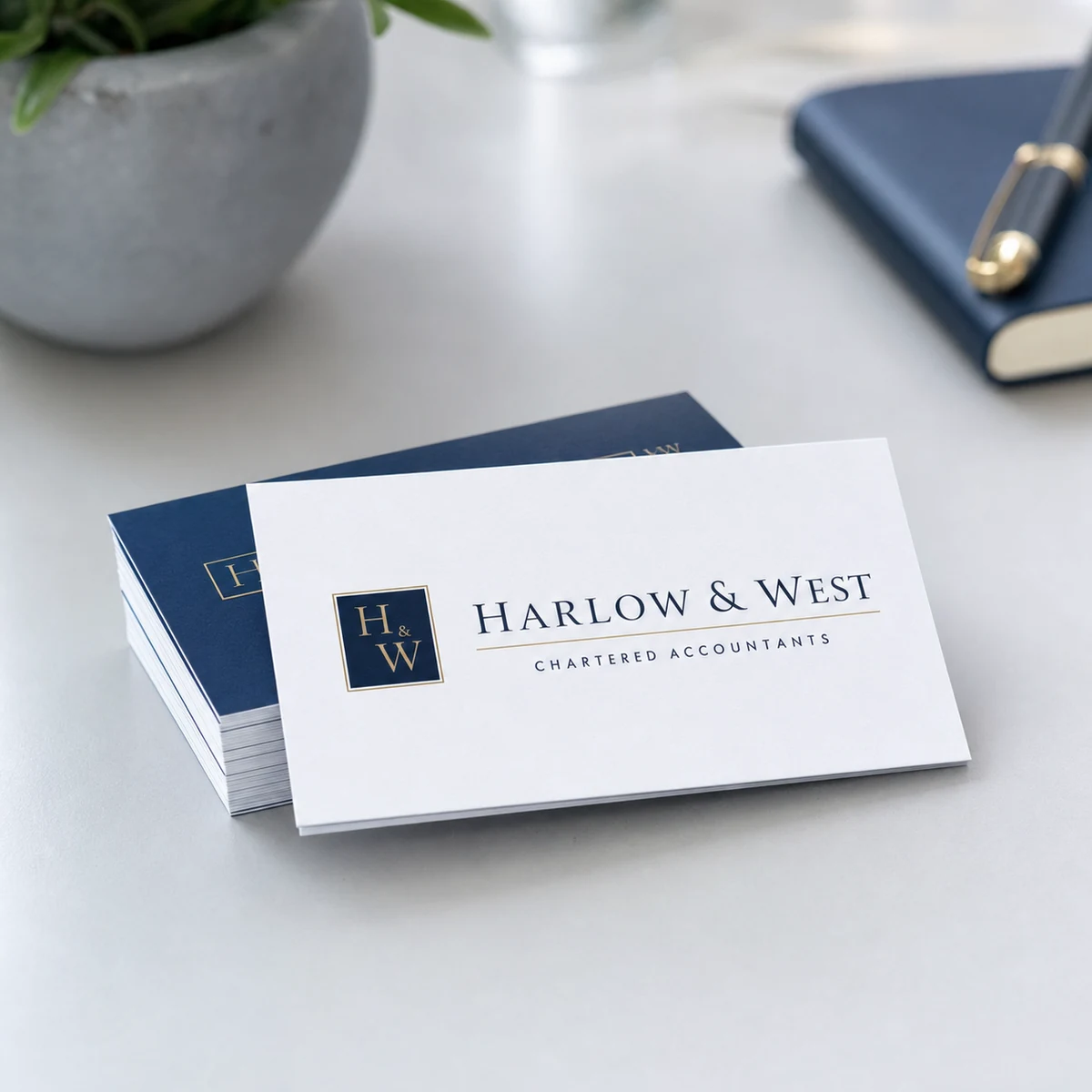
QR codes for accountants and bookkeepers
QR codes have become practical rather than gimmicky since 2020. On an accountant or bookkeeper’s card, a well-placed QR code reduces the friction between first contact and booked appointment.
What to link your QR code to
Booking page (Calendly, Acuity, HubSpot Meetings, or similar): the highest-conversion destination for a sole trader or small practice. A contact who scans on the spot can book a discovery call before the conversation ends.
Client portal login (Xero Practice Manager, MYOB Practice, FYI, or your own branded portal): useful for existing client cards handed at review meetings. Signals a modern, organised practice.
Personalised landing page: a short, mobile-optimised page with your headshot, a two-line bio, credential badge, and a single call to action. More controlled than a LinkedIn profile and more persuasive than a website homepage.
LinkedIn profile: functional and credible, though LinkedIn formatting is outside your control and the feed can distract from the conversion goal.
Design rules for QR codes on business cards
- Minimum 2cm x 2cm for reliable mobile scan
- High contrast: dark code on a light background, or a white version on a dark card background
- Add a short instruction: “Scan to book” or “Scan to access client portal” removes ambiguity
- Test the code on three different phones before going to print
- Do not use a free QR code generator that expires – use a permanent redirect or a paid service with link management
Tax season and referral networking
The Australian tax season creates predictable peaks in networking demand for accounting professionals. End of financial year (June/July) and the October/March BAS lodgement periods are when accountants most often find themselves introduced to new contacts – through client referrals, at firm events, and at professional development sessions.
Having fresh cards at the start of each major lodgement period is practical not symbolic. Handing a client a fresh, professionally printed card alongside their completed return positions you to capture the referral they will almost certainly give when a friend asks for an accountant recommendation in July.
Referral partner channels worth stocking with cards:
– Mortgage brokers and finance professionals (significant client overlap)
– Business advisors and management consultants
– HR professionals and payroll services
– Legal professionals handling business matters
– Financial planners and wealth advisors
Leave a small stack with the reception team at each of these businesses rather than relying on individual card handovers.
Pairing your card with a digital follow-up
A business card opens a channel; a digital touchpoint sustains it. Accounting clients often research multiple providers before committing. A card that directs them to a professional profile or booking page keeps you in consideration during the comparison window.
Effective digital pairings for accountants:
– A brief Google Business Profile with reviews and specialisation listed
– A LinkedIn profile with completed experience and credential sections
– A simple practice website with a clear service list and a contact or booking form
– An email signature that mirrors your card’s visual identity (consistent colour, type weight, and logo treatment)
Consistency between the physical card and the digital presence builds the impression of an organised, detail-oriented practice – which is exactly what accounting clients are selecting for.
FAQ
What size are standard business cards in Australia?
The Australian standard business card size is 90mm x 55mm, matching the ISO standard and fitting standard cardholders and wallets. This is the size used for our standard business cards. Rounded corner cards are available on the same 90mm x 55mm dimensions.
What should an accountant put on their business card?
An accountant’s business card should include: full name, credential abbreviation (CPA, CA, FCPA), job title or specialisation (tax accountant, business advisory, financial controller), firm or practice name, mobile number, email, and website URL or QR code. A QR code linking to a booking page or client portal adds immediate practical value. Leave off the full street address unless clients visit a physical office, and avoid long taglines that crowd the design.
Should a bookkeeper include their BAS Agent number on their business card?
Your registered BAS Agent number belongs on client engagement letters and invoices, not your business card. On the card, include “BAS Agent” as a credential descriptor – this is the client-facing shorthand that signals you are registered with the Tax Practitioners Board. The registration number itself is not required on a card and adds visual clutter without adding client value.
What is the best paper stock for professional accountant business cards?
Matte cardstock is the standard choice: non-reflective, easy to write on, and clean-reading for fine type. For a premium feel without adding a foil finish, linen stock (textured crosshatch weave) or cotton stock (soft, substantial feel) both communicate quality through texture. Artboard with velvet laminate is well-suited to modern practices targeting premium clients. Avoid low-weight stocks under 300gsm, which bend and feel insubstantial.
How many business cards should an accountant order?
A sole trader bookkeeper or sole-practice accountant will typically use 200-500 cards per year when actively networking and maintaining referral partner relationships. Accounting firms ordering for multiple staff members typically order per-team-member in batches of 100-250. Our standard business cards start from a minimum of 50 cards per order.
Can I add a QR code to my accountant business card?
Yes. QR codes are fully supported on our standard business cards and can be included in your artwork at the design stage. Link the code to a booking page (Calendly, Acuity), a client portal, or a landing page. Make the code at least 2cm x 2cm, ensure high contrast, and add a short scan instruction (“Scan to book”) to maximise scan rates. Test on multiple phones before submitting artwork for print.