Bar, Cocktail and Drinks Menu Printing Australia
Drinks menus take more punishment than almost any other printed item in hospitality. Every shift brings spilled cocktails, wet hands, a dripping pint glass set down on the corner of a menu card, and staff wiping tables with a damp cloth. A menu that turns into a soggy pulp by Thursday night is a branding problem as much as a practical one.
This guide covers everything Australian bar, pub, cocktail bar, brewery, and function venue operators need to know about printing drinks menus that survive a busy service: stock and lamination choices for wet environments, the right format for each bar type, how to handle seasonal cocktail rotations without reprinting your entire list, layout principles for low-light legibility, and the finishes that elevate a signature cocktail list from printed paper to a genuine brand asset. For the full rundown of paper weights and lamination across every menu type, see our restaurant menu printing guide
- Laminated 300gsm matte is the workhorse stock for bar menus – wipe-resistant surface handles spills without degrading print quality.
- DL (99 x 210mm) and A5 (148 x 210mm) suit cocktail and drinks cards; A4 works for full wine lists and multi-page beverage menus.
- Split your list: print a durable laminated core list for your permanent range and a lighter-weight insert for seasonal specials you swap out monthly.
- Minimum order from $9.90 inc. GST – short runs make seasonal reprints economical.
- Flat-rate shipping Australia-wide with most orders printed in 24-48 hours after artwork approval.
- Full-colour printing on both sides is included with all standard menu orders.
Why drinks menus need different thinking to food menus
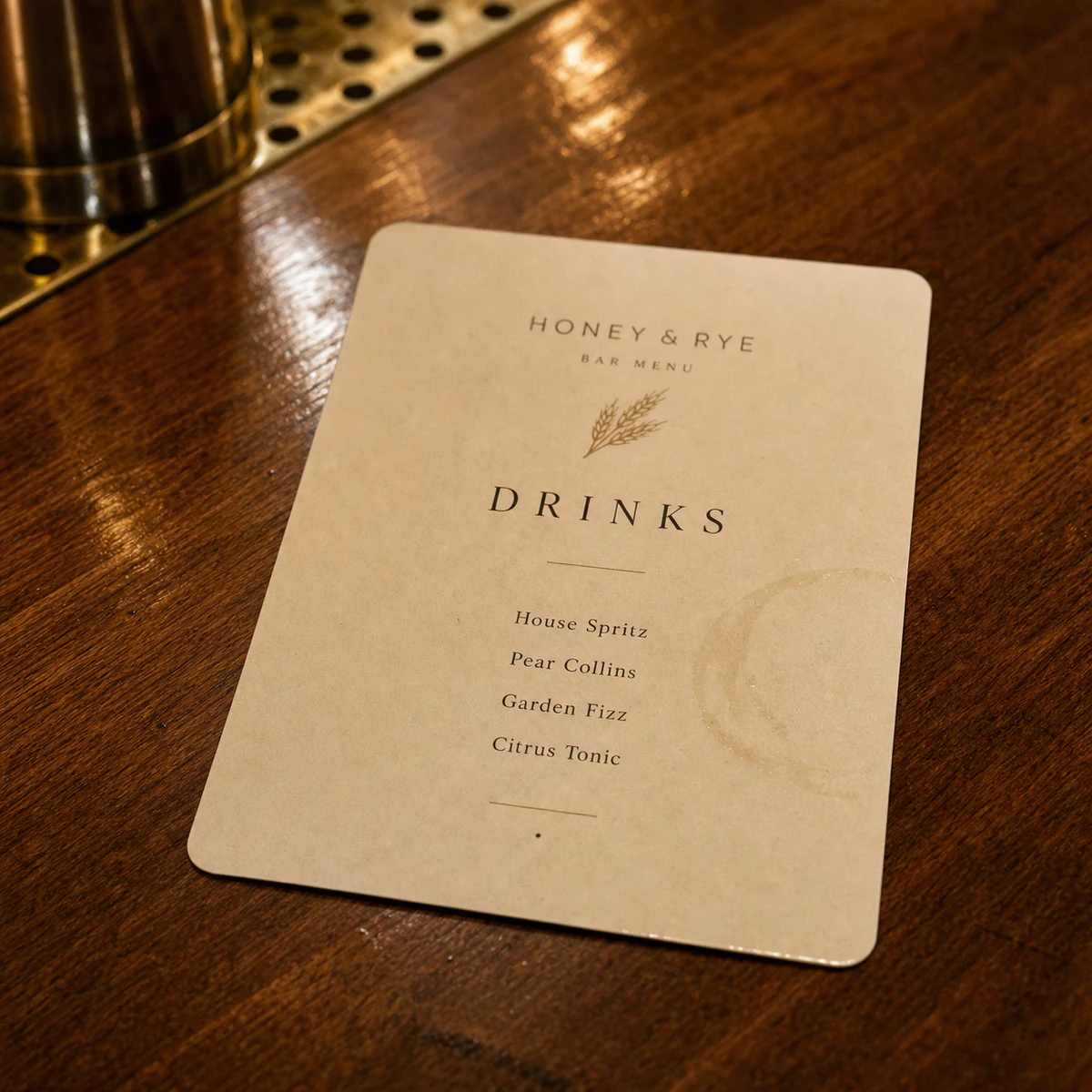
A lunch cafe turns its menus maybe twice a day. A busy cocktail bar touches its menus 40 or 50 times a shift: handed to a customer, set on a wet bar top, picked up again, handed back. By the end of a Saturday night the menu has absorbed condensation from glasses, the occasional splash, and repeated handling by damp fingers.
Stock weight and surface treatment determine how long a printed drinks menu lasts in that environment. The three options used by Australian bars are: standard unlaminated card (fine for low-traffic venues or single-use inserts), laminated card (wipe-resistant, recommended for anything handled regularly), and synthetic/waterproof stock (the most durable, typically used for outdoor bar areas or beach venues).
For the majority of bars and pubs, laminated 300gsm matte is the right call. It gives you a premium flat finish with enough body to hold its shape through a busy service, and the laminate layer means a spill can be wiped off without the ink blooming or the card going soft at the edges.
Lamination: gloss vs matte vs soft touch
The choice of laminate affects both durability and look-and-feel.
- Gloss laminate makes colours more saturated and images pop. Good for food menus where photography is important, but in a dimly lit bar, gloss can create glare and make text harder to read under low pendant lights.
- Matte laminate diffuses light rather than reflecting it, which is a real advantage in bar environments. Darker colour palettes and serif typefaces read more clearly. Wipe-resistant surface is the same as gloss.
- Soft touch/velvet laminate adds a tactile premium feel. Useful for a signature cocktail list or a high-end wine list where the physical experience of holding the menu is part of the brand.
At Paperlust Print Shop, laminate is available on 300gsm matte stock and adds meaningful durability for high-contact use. If you are printing a signature list that sits in a leather menu holder or a premium frame on the table, soft touch finish is worth the upgrade.
Format guide: matching the menu format to your bar type
There is no single right format for a drinks menu. The best choice depends on your venue type, how many drinks you list, and how your service works.
DL single card (99 x 210mm)
DL is the slimline format that fits in the palm of one hand. It works well for:
- Cocktail bars with a curated list of 10-20 signatures
- Beer and cider bars listing taps and bottles
- Happy hour specials menus at casual pubs
- Seasonal specials inserts to sit alongside a core printed list
Because DL is small and light, it is also the most economical format for short runs of seasonal reprints. When your summer cocktail menu wraps up in March, reprinting 200 DL cards is a much smaller commitment than reprinting a full A4 book.
A5 folded (148 x 210mm)
A5 is the compact table format. Folded, it sits neatly next to a candle without overwhelming the table, and opens to four printable panels. Good for:
- Wine and cocktail lists that need two sections (wines by the glass / cocktails) on separate panels
- Pub dining rooms where one card covers food and drinks but you want to separate them visually
- Function venues that need a menu that looks substantial without being the size of a newspaper
A4 flat or folded (210 x 297mm)
A4 is the most common format for full beverage menus covering wine lists, cocktail menus, beers, spirits, and non-alcoholic options all in one place. A4 flat sits on the table on its own or in a menu holder. A4 folded gives you four printable panels.
A3 shared table display (297 x 420mm)
A3 suits large-format shared lists: brewery taprooms where the tap list changes weekly and is placed on the table for the group, beer gardens where the format needs to be readable from a metre away, or sharing-table venues where a single display-format card is passed around.
Core list vs seasonal rotation: a practical split
One of the biggest cost mistakes bars make with menu printing is treating the whole list as one item that needs to be reprinted whenever anything changes. A better approach is to separate your list into two tiers:
Tier 1 – The core list. Your permanent range: the classic cocktails that never leave, the house wines, the beers on tap that rotate rarely. Print this on laminated 300gsm card, high quality, in a run that lasts 6-12 months. This is what you invest in premium finishes for.
Tier 2 – The seasonal specials insert. Your limited cocktails, seasonal spirits, the new experimental tap, the weekly wine feature. Print this on lighter 170gsm silk or a simple unlaminated card in small batches of 50-100 at a time. When the cocktail changes, you reprint the insert, not the whole menu.
This split means your core list keeps its quality and durability over a long service life, while your specials stay current without a costly full-menu reprint each month. Paperlust Print Shop’s standard menu printing supports both approaches, with short print runs available at economical pricing starting from $9.90 inc. GST.
Planning your seasonal rotation
Most bars find a quarterly rotation works well: a summer cocktail list running December-February, an autumn list with warmer flavours for March-May, a winter list for June-August (think hot cocktails, whisky-forward drinks, mulled wine options), and a spring list from September-November. Each seasonal reprint of DL specials cards runs to about 100-200 copies depending on covers.
For venues that rotate specials more frequently, the 24-48 hour print turnaround means you can have fresh menus on the table within a few days of confirming a new recipe.
Stock and finish options for bar menus
Not every venue needs the same solution. Here is a quick reference:
| Stock | Best for | Wet-area durability |
|---|---|---|
| 300gsm matte – laminated | Core bar and cocktail lists, pub drinks menus, all high-contact use | High – wipe-resistant surface, spill tolerant |
| 170gsm silk | Seasonal inserts, single-use or low-rotation specials cards, table tents | Moderate – lighter weight, not for extended wet-area use |
| 300gsm matte – unlaminated | Low-traffic venues, presentation-only lists in covered holders, dry environments | Low – standard card, not wet-area suitable |
All standard menu printing at Paperlust Print Shop comes with full-colour printing on both sides. Sizes available are DL (99 x 210mm), A5 (148 x 210mm), A4 (210 x 297mm), and A3 (297 x 420mm). Flat and folded formats are both available.
Die-cut shapes take the format itself beyond the standard rectangle. A circular cocktail card or a rounded-corner wine list signals quality before a guest reads a word, and works particularly well in premium bars and wine bars where the menu is part of the physical experience. Die cut menus are available on 300gsm stock with matte or gloss lamination from $11.40 inc. GST.
Design principles for low-light legibility
Bar menus have a specific design challenge that food menus and cafe menus do not: they are read in low light. Pendant lights over a dark timber bar, candles in a moody cocktail lounge, or ambient glow from backlit shelving behind the bar are not conditions where small serif text in light grey reads well.
A few principles that work reliably in bar lighting:
Font size and weight. Drink names should be set at 14pt minimum; 16pt is more comfortable. A medium or semi-bold weight on the body copy is easier to read in low light than a regular weight. Very light (thin) font weights look beautiful in a print proof but disappear under a candle at a table.
Contrast. Dark backgrounds with white or cream type read well in bar lighting, which is why so many cocktail menus use this approach. Light backgrounds with dark type also work. The failure case is mid-tone-on-mid-tone: grey type on off-white, for instance.
Section breaks. Drinks menus benefit from clear visual segmentation: Cocktails / Wine / Beer / Non-Alcoholic all separated by a rule, a colour block, or a change in type treatment so guests can navigate quickly.
QR codes. If you are linking to a digital menu via QR code, make sure the code is printed at a minimum of 25mm square and is positioned on a high-contrast background. Small or low-contrast QR codes are a source of table frustration in low light.
Premium finishes for signature cocktail lists
For bars where the cocktail list is part of the brand – where the menu is a conversation piece, not just a functional document – premium finishes make a real difference.
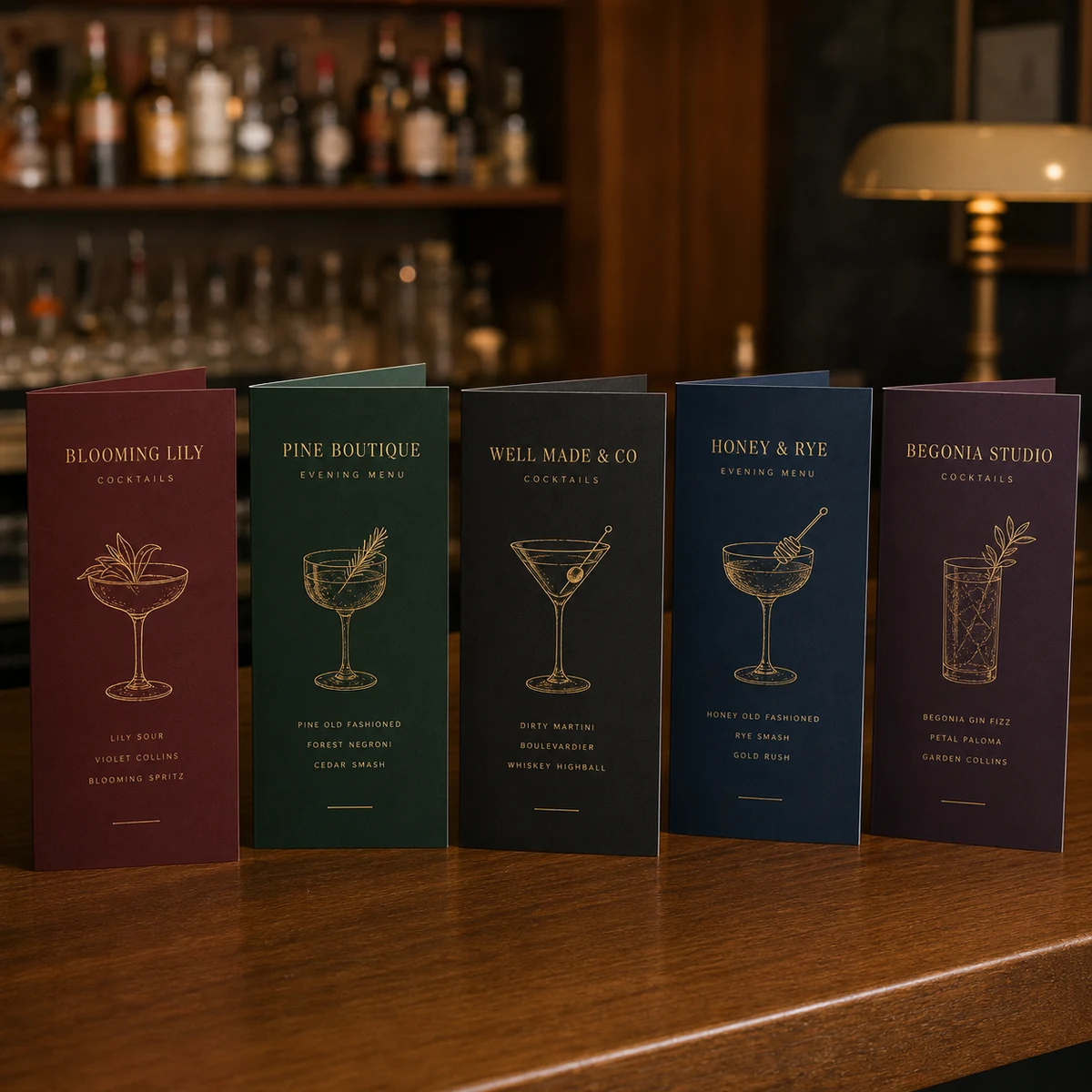
Spot UV on matte laminate adds a selective gloss coating over specific design elements: your logo, a cocktail illustration, the venue name. The rest of the surface stays matte, making the UV-coated areas catch the light when the card is picked up and turned. This finish works particularly well on dark-background designs because the contrast between matte and gloss reads clearly even in dim lighting.
Foil finishes add a metallic layer – gold, rose gold, or silver – over specific design elements. A gold-foiled signature on a dark menu card is a premium touch that signals quality before the guest reads a single word. Both spot UV and foil options are available through Paperlust Print Shop’s standard menu range.
Bars that want this finish can order our foil premium menu printing for signature cocktail and wine lists that need a durable, high-end look.
Thick duplex or mounted stock can also be used for premium card-format cocktail lists. A two-layer duplex card with a coloured core adds physical presence: picking it up feels different to a single-ply card, which is a small but real signal of quality.
Wine list vs cocktail list vs beer list: layout differences
These three list types have different information architectures that affect how you should lay out each format.
Wine list layout
Wine lists typically organise by style (sparkling, white, rose, red, dessert) then by region or grape within each style. A wine list needs more column space because each entry has multiple data points: producer, region, vintage (sometimes), glass price, and bottle price. A4 folded is the standard format for a wine list with more than 20 labels; A5 works for compact by-the-glass lists.
Cocktail list layout
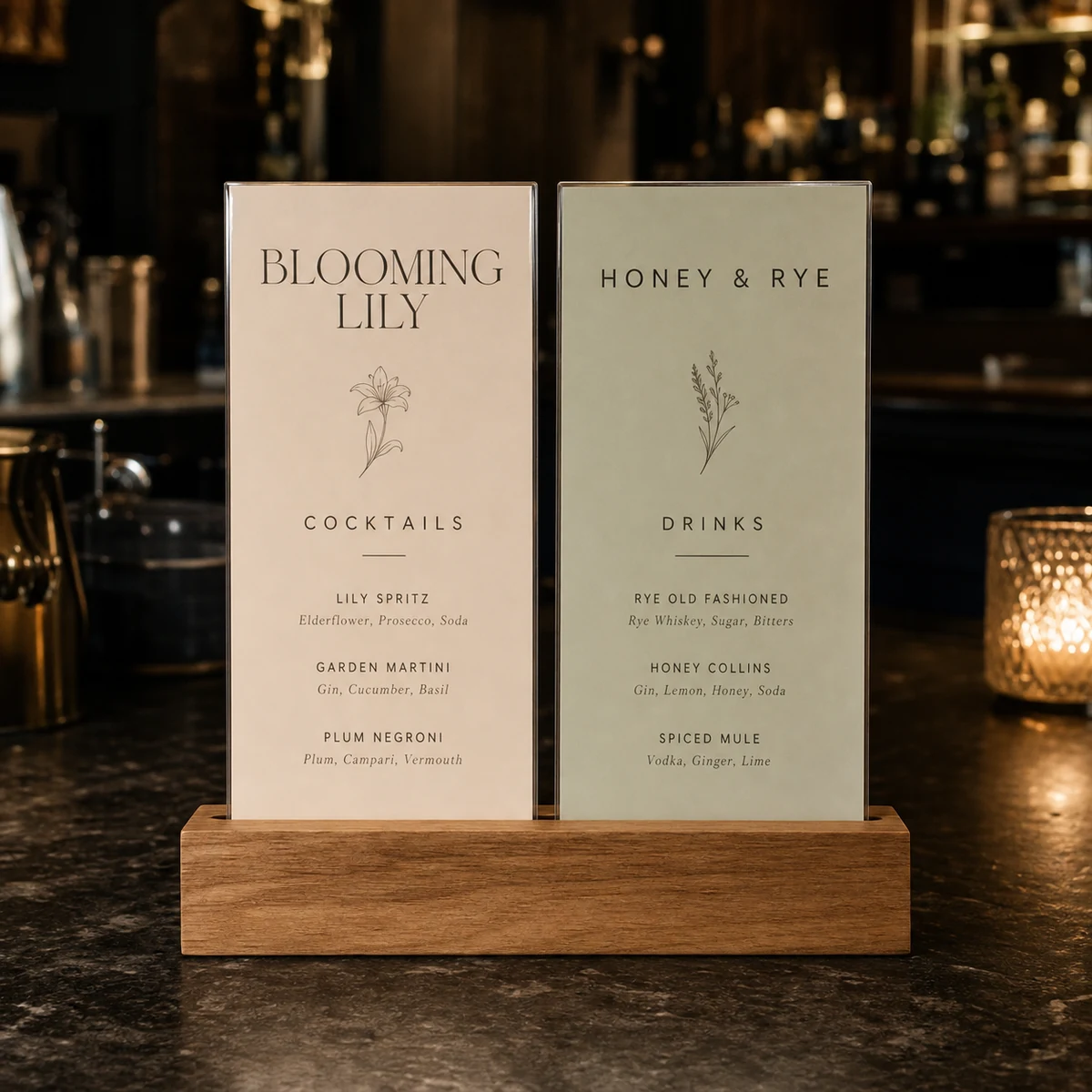
Cocktails are usually listed with a name, a brief flavour description (2-5 words works better than a full sentence in low-light reading conditions), and a price. Grouping by spirit base or flavour profile (floral / citrus / smoky / sweet) helps guests navigate without reading every entry. DL and A5 are the natural formats; A4 if you carry more than 20-25 signatures.
Beer and tap list layout
Tap lists change frequently (especially at craft breweries) and benefit from the seasonal insert approach described above. A clean table at the start of each rotation: brewery name, beer style (e.g. pale ale, IPA, hazy), ABV, and glass size price. A3 shared-table format works for taprooms; DL or A5 single cards work for pubs with a curated selection.
Ordering process: from artwork to bar
Step 1 – Finalise your design
Upload your artwork file in PDF, AI, EPS, or high-resolution PNG format. Ensure your file includes 3mm bleed on all edges and that all fonts are either outlined or embedded. If you are working with a designer, pass them these specs: 3mm bleed, CMYK colour mode, 300dpi minimum resolution.
Step 2 – Proof approval
A designer proof is returned within 1-2 business days of placing your order. Review carefully for: text accuracy (especially prices, which change), colour correctness against your brand palette, and that the bleed and safe zone are set correctly on all panels for folded formats.
Step 3 – Production
Most standard menu orders are printed within 24-48 hours of proof approval. Larger quantities or premium finishes may take additional time – confirm at ordering if you have a specific event or opening deadline.
Step 4 – Delivery
Flat-rate shipping Australia-wide. Metro deliveries typically arrive within 1-2 business days of dispatch; regional areas may take a little longer. If you need menus urgently for an event or a new venue opening, factor in the full timeline: proof turnaround plus production plus transit.
Extending Your Bar’s Printed Presence
A drinks menu is the anchor of your bar’s printed presence, but it works better when it is part of a coordinated set.
Custom coasters are one of the most cost-effective brand touchpoints in hospitality. Printed on 355gsm beermat board, custom coasters carry your logo and can include a QR code linking to your current drinks list. At $3.46 inc. GST from a 50-unit minimum, every table placement reinforces your brand without requiring a customer to pick anything up.
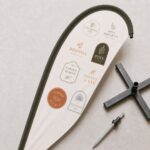
Point-of-sale standees work well for featured bottle promotions, cocktail-of-the-week callouts, or branded displays at the end of a bar run. A rigid 5mm foamboard standee draws the eye from across a room and pairs naturally with a well-designed drinks card. Shop now
FAQ
What is the most durable stock for a bar drinks menu?
Laminated 300gsm matte is the recommended choice for any menu handled regularly in a wet-area bar environment. The laminate layer creates a wipe-resistant surface that resists condensation and accidental spills without damaging the print. For outdoor bars or beach venues where menus may get genuinely soaked, ask about synthetic waterproof stock options.
What sizes are available for drinks menus?
Standard sizes available are DL (99 x 210mm), A5 (148 x 210mm), A4 (210 x 297mm), and A3 (297 x 420mm). DL works well for cocktail cards and specials inserts. A5 suits compact table menus. A4 is standard for full beverage books. A3 suits taproom tap lists and shared-table formats.
Can I print a small run of seasonal cocktail specials cards?
Yes. Short runs are available and economical for seasonal specials inserts. Printing 50-200 DL or A5 specials cards at a time lets you keep your core laminated list in service for 6-12 months while reprinting only the seasonal insert when your cocktail rotation changes. Turnaround is 24-48 hours from proof approval, which means you can have fresh menus on the table within a few days of finalising a new recipe.
Is full-colour printing included on both sides?
Yes. All standard menu orders include full-colour printing on both sides. There is no additional charge for double-sided printing within standard product configurations.
What file format should I provide for my drinks menu artwork?
PDF is the preferred format. AI, EPS, and high-resolution PNG files are also accepted. Your file should be set up in CMYK colour mode (not RGB), at 300dpi minimum resolution, with 3mm bleed on all edges and all fonts either outlined or embedded. Folded menus should have each panel set up as a separate page in the same file.
How long does drinks menu printing take?
Most orders are printed within 24-48 hours of proof approval. The designer proof is returned within 1-2 business days of placing your order. Factor in both timelines when planning against an event or venue opening date. Flat-rate Australia-wide shipping applies; metro delivery is typically 1-2 business days from dispatch.
How many drinks menus should I order for my venue?
A practical starting point is 1.5 times your table or seat count, plus a buffer in reserve. For a bar with 40 seats, 60-80 cards gives you coverage during peak service while allowing for normal wear. For seasonal or event-specific menus, order what you need for the run and plan to reprint rather than stockpile outdated stock.
Can I add a QR code to my drinks menu?
Yes. A static QR code that links to a page you update online works well for menus that change frequently. Customers scan for the current full list while the printed card handles your brand presentation and the permanent range. Your designer or our team can assist with placement and sizing on the artwork.