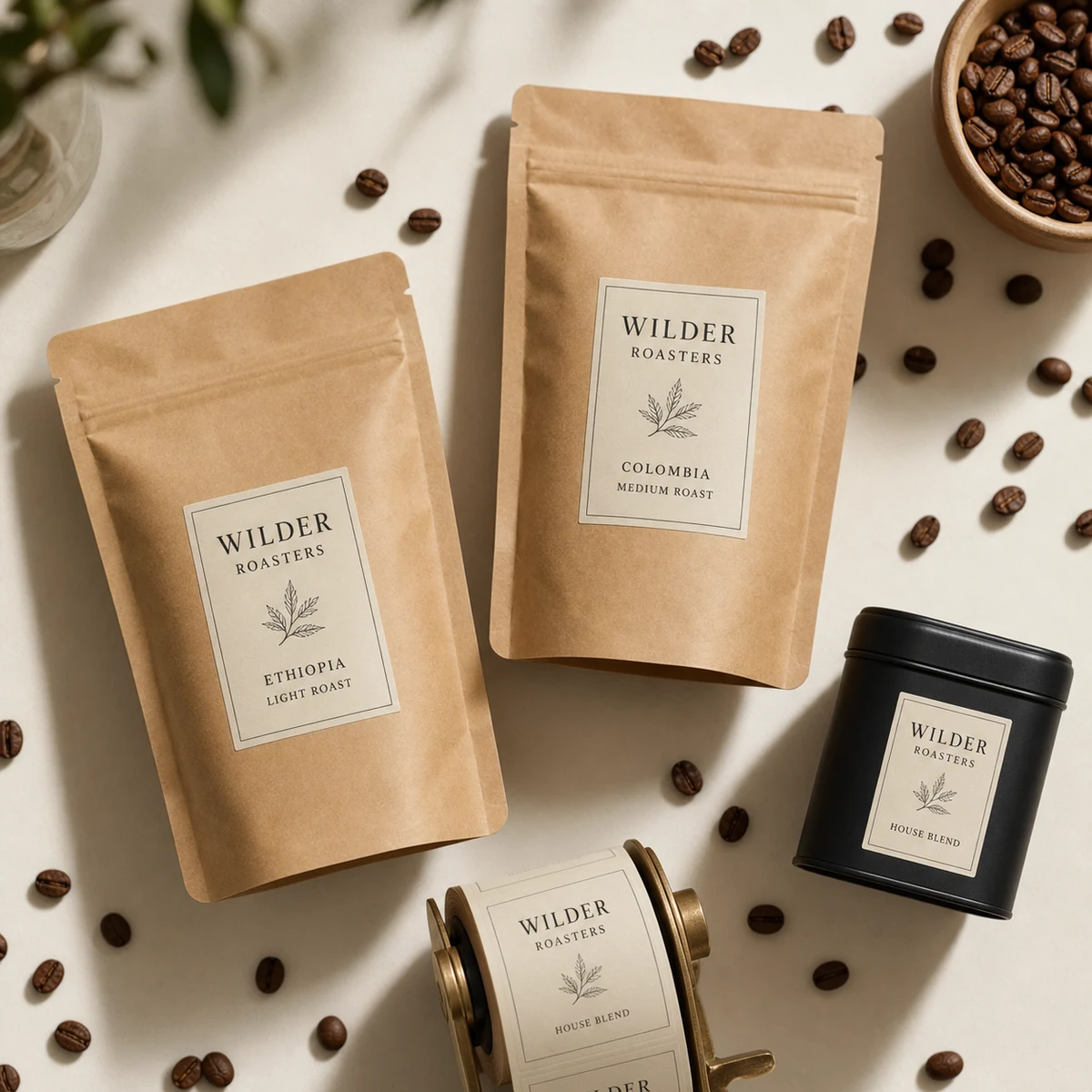
Specialty coffee roasters and loose-leaf tea blenders invest months developing their product. A label is often the first thing a customer sees, and the last thing many brands get right. Whether you are printing labels for valve bags, stand-up pouches, kraft flat-bottoms, or tins and caddies, the label is doing more work than most people realise: it carries your brand, meets regulatory requirements, and has to hold up in conditions that would destroy a standard paper sticker.
This guide covers what coffee bag labels and tea labels need to do, how to size them correctly for different container formats, which materials and finishes suit the specialty beverage category, how small-batch roll labels work for hand application, and what Australian food-labelling law requires at a general level. At the end you will find a direct link to the Paperlust Print Shop rectangle label product page where you can get a quote and upload your artwork.
AT A GLANCE
Coffee bag and tea labels: quick summary
Custom labels for coffee and tea packaging need to balance brand aesthetics with compliance requirements and durability in humid or oily environments.
- Coffee bag labels must withstand oil migration from freshly roasted beans. Choose a laminated or synthetic stock rather than plain uncoated paper.
- Australian food law (FSANZ Food Standards Code) requires country of origin, net weight, ingredient/allergen list, best-before or roasting date, and contact details on commercially sold product.
- Valve bags and stand-up pouches typically need a front panel label + a separate back panel label carrying the compliance copy; size each panel independently.
- Specialty coffee and tea brands favour matte laminate, kraft paper, or recycled board stocks for an artisan aesthetic.
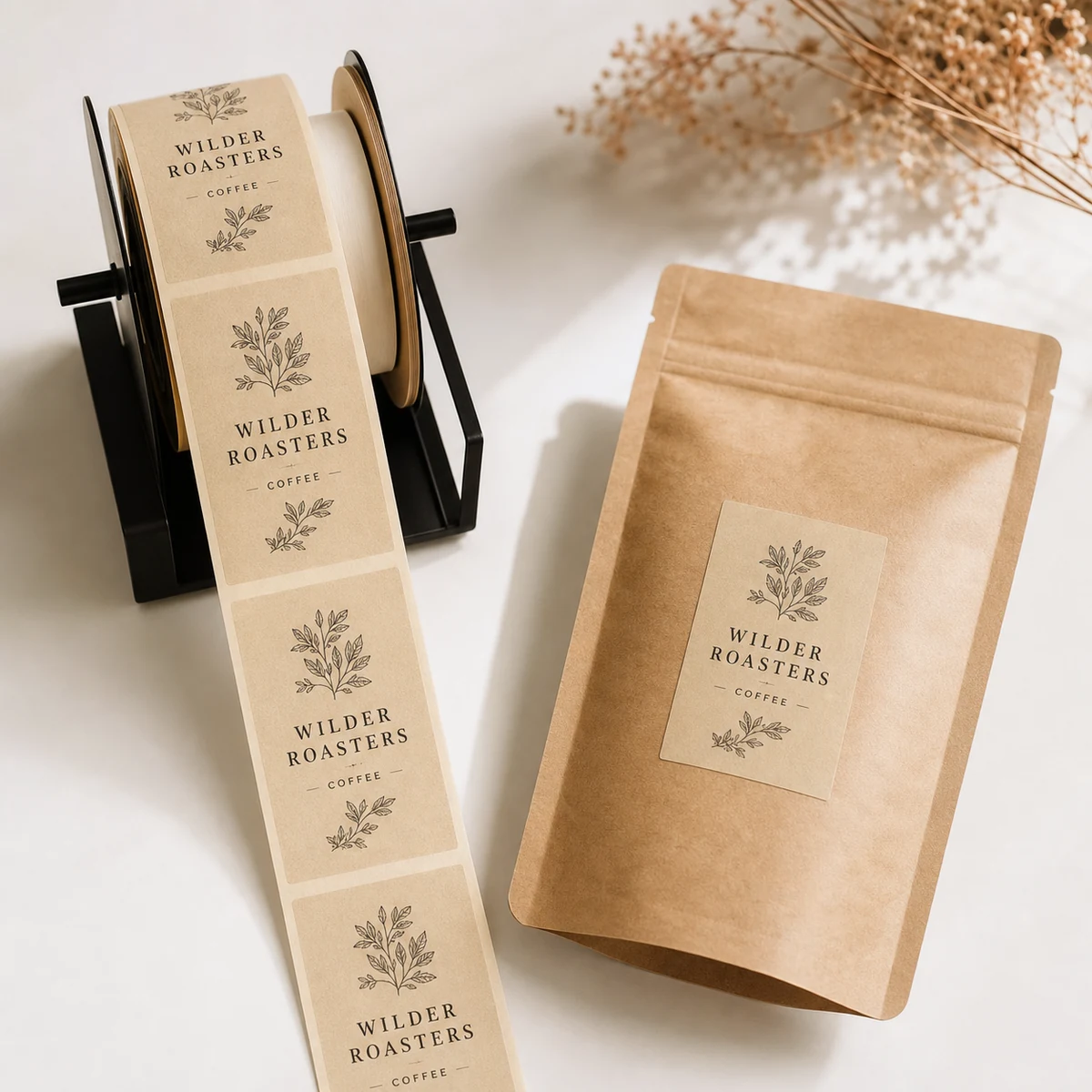
- Small-batch hand application is easiest with roll labels; they feed cleanly from a dispenser or straight off the spool without pre-separation.
- Paperlust Print Shop rectangle labels are available in custom sizes with matte, gloss, and satin laminate finishes. See the rectangle labels product page for current pricing and specs.
What a coffee bag label must carry
Before you design anything, lock down the required information. Australian commercially sold food products (including roasted coffee and packaged tea) must comply with the FSANZ Food Standards Code. This is general regulatory guidance, not legal advice. Always verify requirements with a food labelling consultant or FSANZ directly.
Mandatory elements under Australian food law
The following items are generally required on packaged food products sold in Australia:
- Name or description of the food (e.g. “Single Origin Ethiopia Yirgacheffe, Medium Roast Filter Coffee”)
- Ingredient list (for blends or products with additives; single-ingredient products still need allergen declarations if applicable)
- Net weight or volume (in metric: grams for solid/ground coffee, millilitres for liquid products)
- Country of origin (required under the Country of Origin Food Labelling Information Standard; coffees imported and roasted in Australia must state both origin and where the roasting took place)
- Best-before or use-by date (many roasters use a roasting date plus a recommended consumption window)
- Business name and address of the Australian importer, packer, or manufacturer
- Allergen declarations (if applicable: milk, soy, tree nuts, sesame, and others listed under Standard 1.2.3)
- Lot or batch identifier (strongly recommended even if not always mandated, for traceability)
What roasters often add voluntarily (and what builds trust with specialty coffee buyers): the farm or co-operative name, altitude, processing method (washed, natural, honey), cupping notes, brew recipe or dose guide, and a QR code linking to a digital origin story or brew calendar.
Tea brands have similar requirements, with the addition of brewing instructions for regulatory compliance in some formats.
Sizing labels for different coffee and tea containers
Competitor resources rarely address this clearly. Label sizing depends on the container format, not just the brand’s preference.
Valve bags and stand-up pouches
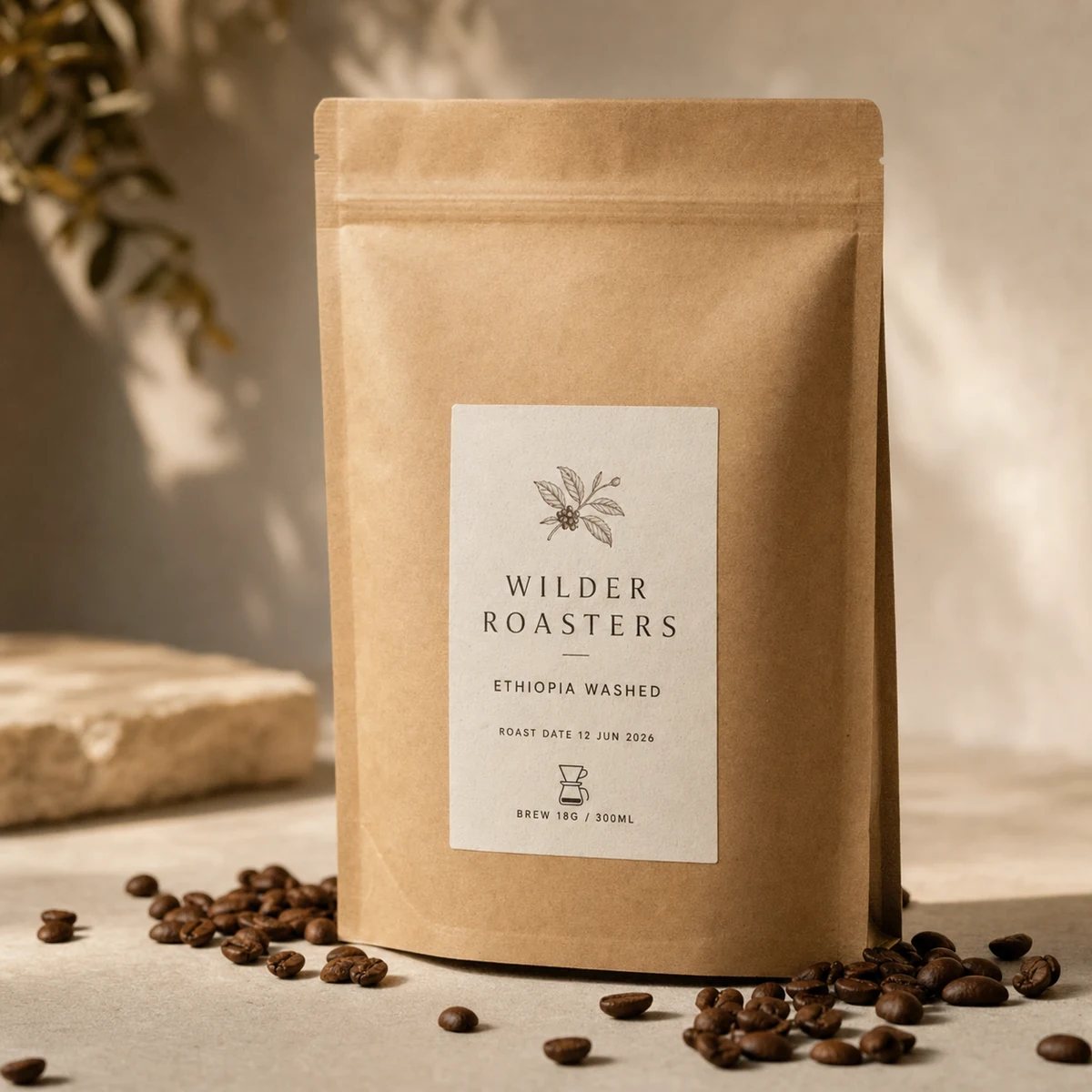
Valve bags (250 g and 1 kg formats are most common in Australian specialty coffee) have a flat front panel, a gusseted back, and either a tin-tie or a zip-lock seal at the top. The usable label area on a standard 250 g kraft flat-bottom pouch front panel is roughly 85 mm wide x 120 mm tall; on a 1 kg format, closer to 120 mm wide x 170 mm tall. These are general starting points. Measure your actual bag with the gusset expanded.
For compliance-heavy copy, most roasters run two labels:
1. A front brand panel carrying the name, origin, roast style, and visual identity
2. A back compliance panel carrying net weight, ingredients, allergens, country of origin, best-before, and contact details
Keeping these separate means you can update the compliance copy for a new batch without reprinting your entire brand stock.
Tins and caddies
Loose-leaf tea is commonly sold in round tins (75 mm diameter, 100 mm tall is a typical 100 g format) or rectangular caddies. For a round tin, a wrap-around label needs to be cut precisely to the circumference (approximately 236 mm for a 75 mm tin) and the height of the can body. Rectangle labels work well here. Print the full label width to match the circumference and set the height to leave a 5-10 mm gap at top and bottom.
Square and rectangular caddies are more straightforward: measure the front panel, leave 3-4 mm clear of any folded edge, and design within that boundary.
Jars
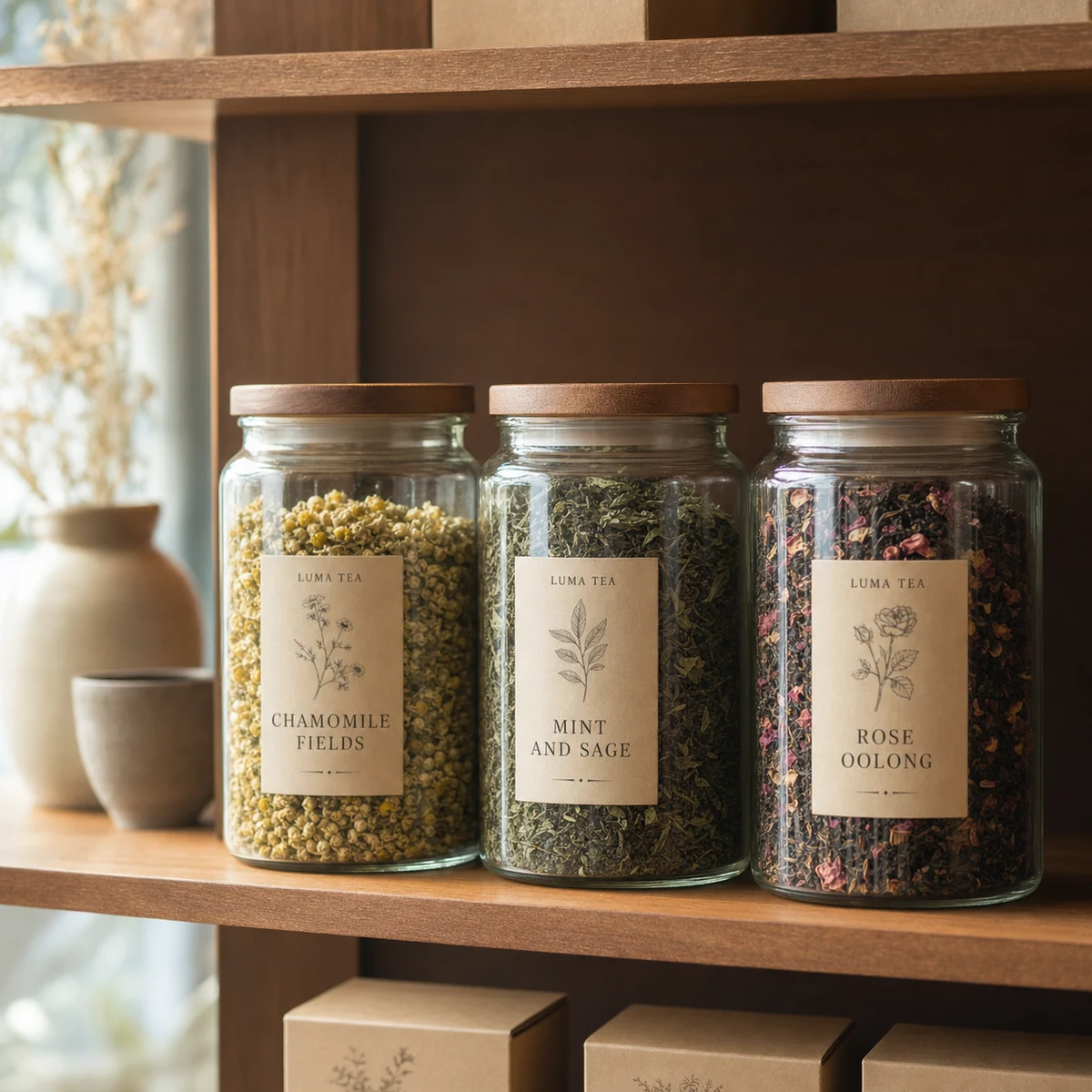
Many loose-leaf tea retailers sell through glass jars (mason jar or clip-top formats). Glass requires a label with a reliable permanent adhesive. The surface is non-porous and condensation can work its way under a weaker adhesive. A waterproof vinyl stock with permanent adhesive is the reliable choice here. Our waterproof vinyl labels use the same synthetic stock and permanent adhesive combination to stay in place on glass jars and similar non-porous surfaces.
Materials and finishes for coffee and tea labels
This is where specialty coffee and tea brands often make the wrong call. The default assumption is that a printed label is just a printed label. In the coffee category, that thinking leads to delaminating labels and oil staining within weeks of production.
Why oil resistance matters for coffee labels
Freshly roasted coffee beans contain volatile oils that migrate through kraft and paper packaging over time. A degassing valve on a coffee bag slows this migration but does not eliminate it. Labels applied to coffee bags, particularly on the exterior of a kraft flat-bottom where oil can wick through the seam area, are exposed to a low-level, ongoing oil environment.
Plain uncoated paper labels will absorb oil and discolour. The print degrades, text becomes illegible, and the label looks grubby within a few months on shelf. For any coffee bag application, specify a laminated stock:
- Matte laminate: the preferred choice for specialty and third-wave coffee. Provides oil resistance while projecting a premium, non-commercial feel. Fingerprints show less than on gloss.
- Gloss laminate: higher visual pop, more commercial look. Better if the design relies on photographic elements or vibrant colour.
- Satin laminate: a midpoint between matte and gloss; slightly less fingerprint-prone than gloss, marginally less premium than matte.
Kraft and recycled stocks
Many specialty coffee and tea brands want an earthy, artisan aesthetic. A kraft paper label with a matte laminate over the print achieves this. The kraft substrate gives the natural paper look, and the laminate protects the print from oil and moisture. Recycled board stocks are used in a similar way by brands with explicit sustainability positioning.
Note: kraft and uncoated recycled stocks are suitable for relatively dry applications (tea tins, dry goods jars). For bags in direct contact with the degassing environment, a fully laminated synthetic label is more durable.
Vinyl for high-moisture applications
Loose-leaf tea sold through refrigerated formats, or coffee cold brew concentrate in bottles, needs a waterproof vinyl label. Vinyl does not absorb moisture, the adhesive holds on wet or condensation-prone surfaces, and the print remains vibrant. For clear or glass packaging where the “no-label look” matters, a clear vinyl stock with white underprint allows the design to appear to float on the container.
Paperlust Print Shop rectangle labels are available in matte, gloss, and satin laminate finishes. Check the product page for current stock options and sizing.
Small-batch roll labels for hand application
This section matters most for roasters and tea blenders in the early growth stage: those typically producing runs of 50-500 units where automated label application is not yet economical.
Why roll labels beat sheet labels for hand application
Sheet labels (kiss-cut on a flat sheet) are practical for very small quantities and one-off runs. For weekly or fortnightly production batches, roll labels are significantly faster to apply by hand:
- You grip the spool or place it on a simple label dispenser
- Labels peel off cleanly in sequence with no peeling-and-separating individual sheets
- The backing paper feeds away as a continuous strip, keeping your workstation clean
- Label orientation is consistent, which matters for speed on a production line
Most commercial roll label printers (including the Paperlust Print Shop) supply labels wound on a standard core, compatible with desktop label dispensers available from packaging suppliers. When you need a particular shape on those rolls, our die-cut labels are cut to custom outlines and supplied ready for dispensers and labelling machines.
Minimum quantities and unit economics
Custom roll labels are typically priced per unit on a volume tier. The per-label cost falls sharply as you increase the quantity. For small-batch roasters, this creates a practical planning question: order conservatively to minimise upfront spend, or order in greater volume to reduce cost-per-label and avoid frequent reprints.
A reasonable approach for a new blend or seasonal offering: order a modest first run to validate the design on your actual bag format before committing to a larger print volume. See the rectangle labels product page for current pricing tiers and minimum order quantities.
Tea label printing: what is different from coffee
Coffee labels attract most of the commercial attention in this category, but loose-leaf tea and herbal infusion brands have their own labelling requirements and aesthetic conventions.
Container variety
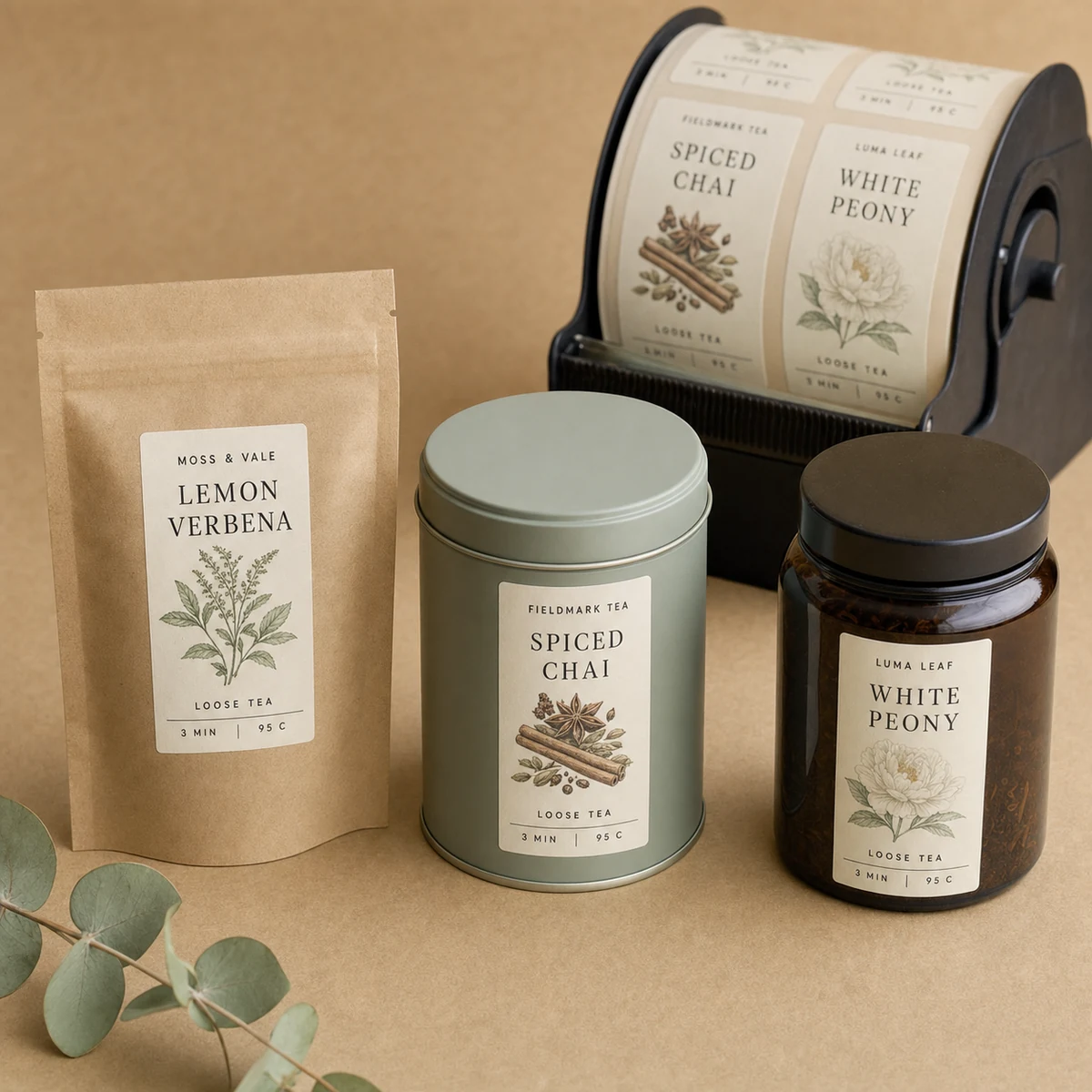
Tea is sold in a wider range of containers than coffee: tins, caddies, kraft pouches, stand-up ziplock bags, glass jars, and increasingly, biodegradable loose-leaf sachets in a secondary box. Each format calls for a different label shape and adhesive specification. The rectangle label format suits flat pouches, tins, and caddies directly; round tins require a wrap-around rectangle precisely cut to the tin’s circumference.
Aesthetic conventions in specialty tea
High-end loose-leaf tea brands in Australia and internationally have converged on a visual language that differs from coffee: botanical illustration, hand-drawn elements, estate or garden names, infusion colour swatches, and fragrance or flavour notes in a typographic grid. Matte laminate or uncoated kraft stocks align with this aesthetic more naturally than high-gloss vinyl.
Moisture considerations
Tea tins and caddies are opened repeatedly, and the interior can develop condensation over time. Labels on the exterior of a tin do not face moisture from inside. If your tea is sold in a refrigerated or high-humidity retail environment, treat the label spec the same way you would a wine or cold-brew label: waterproof stock, permanent adhesive.
Brewing guide inclusion
Many Australian specialty tea brands include a short brew guide on the label: water temperature (80-100°C depending on variety), steep time (1-4 minutes), and quantity per cup. This information is expected by the specialty buyer segment. Build it into your compliance panel or a side panel. It will affect your total label sizing.
The design process for coffee and tea labels
Set up artwork for label printing
Standard label artwork requirements:
– Supply files in PDF, EPS, or high-resolution TIFF (300 dpi minimum at final print size)
– Include a 2-3 mm bleed on all edges
– Keep all live text and critical design elements at least 3 mm inside the trim line (safe zone)
– Specify Pantone colours if brand colour accuracy is critical, or provide CMYK breakdowns
– For transparent vinyl, include a white underprint layer on a separate spot plate
Variable data
If you need batch numbers, roasting dates, or best-before dates to change from run to run without a full reprint, ask about variable data printing at order stage. This allows a static base label design with one or more fields that print differently per label or per group of labels.
Getting your coffee or tea labels printed in Australia
Printing labels locally in Australia means faster turnaround and lower freight risk than offshore suppliers, and you retain the ability to do small reprints without large minimum orders. For small-batch and independent specialty brands, this is a meaningful operational advantage.
The Paperlust Print Shop produces custom rectangle labels in Melbourne. See the rectangle labels product page for available sizes, stock and finish options, current pricing, and how to upload your artwork. If a rectangle is not the right fit for your bag or tin format, the wider custom label printing range covers circle, square, oval, rounded-corner and die-cut shapes.
For roasters and tea blenders labelling bags, pouches and tins, the Food Labels page is the direct fit. These roll labels are made for the outside of a pack, such as the front of a pouch, and come 500 to a roll. Choose laminated paper stock for dry packs, or laminated white synthetic for anything damp or chilled.
For roll-versus-sheet label format decisions, or questions about which adhesive grade suits your specific container, see the Print Shop’s label format guide (linked from the product page).
Frequently asked questions
What is the best label material for coffee bags in Australia?
A laminated stock (matte, gloss, or satin) is the standard recommendation for coffee bag applications. Roasted beans emit oils over time, and a laminate layer protects the printed surface from discolouration. Plain uncoated paper absorbs oil and degrades on shelf. For most specialty roasters, matte laminate is the preferred choice: it provides the necessary protection while giving the label a premium, non-commercial finish.
Do I need to include nutritional information on a coffee bag label in Australia?
Under the FSANZ Food Standards Code, most single-ingredient foods (including pure roasted coffee) are exempt from the full nutrition information panel requirement. However, you are still required to include the product name, net weight, country of origin, best-before or use-by date, and your business name and address. If your coffee contains any additives or is sold as a blend with other ingredients, additional declarations may apply. This is general guidance only. Verify your specific obligations with FSANZ or a food labelling consultant.
How do I size a label for a round tea tin?
Measure the diameter of the tin at the widest point of the can body. Multiply by pi (3.14159) to get the circumference. This is the maximum label width for a full wrap-around. For a 75 mm diameter tin, the circumference is approximately 236 mm. Set the label height to match the can body height minus 5-10 mm clearance at top and bottom. Order your label as a rectangle at those dimensions and it will wrap the tin cleanly.
What is the difference between a front panel label and a back compliance panel for a coffee bag?
A front panel label carries your brand identity: logo, product name, origin, roast style, and any design elements. A back compliance panel carries the legally required information: net weight, ingredients, allergens, country of origin, best-before, and contact details. Running them as separate labels means you can update compliance copy for a new batch without reprinting your entire brand stock, and it keeps your front label design clean and uncluttered.
Can I get roll labels with variable data for roasting dates and batch numbers?
Variable data printing allows specific fields on a label (such as a roasting date, batch number, or best-before date) to change from label to label without a full redesign and reprint. Ask about this option when placing your order. It typically requires that the variable fields be clearly identified in your artwork file with placeholder text in the correct font size and position.
Are small minimum orders available for coffee bag labels?
Minimum order quantities vary by printer and format. For roll labels, quantities are generally measured per roll. For specialty and artisan brands testing a new blend or seasonal offering, starting with a modest run to validate the label design on your actual bag format before committing to a larger print volume is a sensible approach. See the Paperlust Print Shop rectangle labels page for current minimum order information and pricing tiers.