
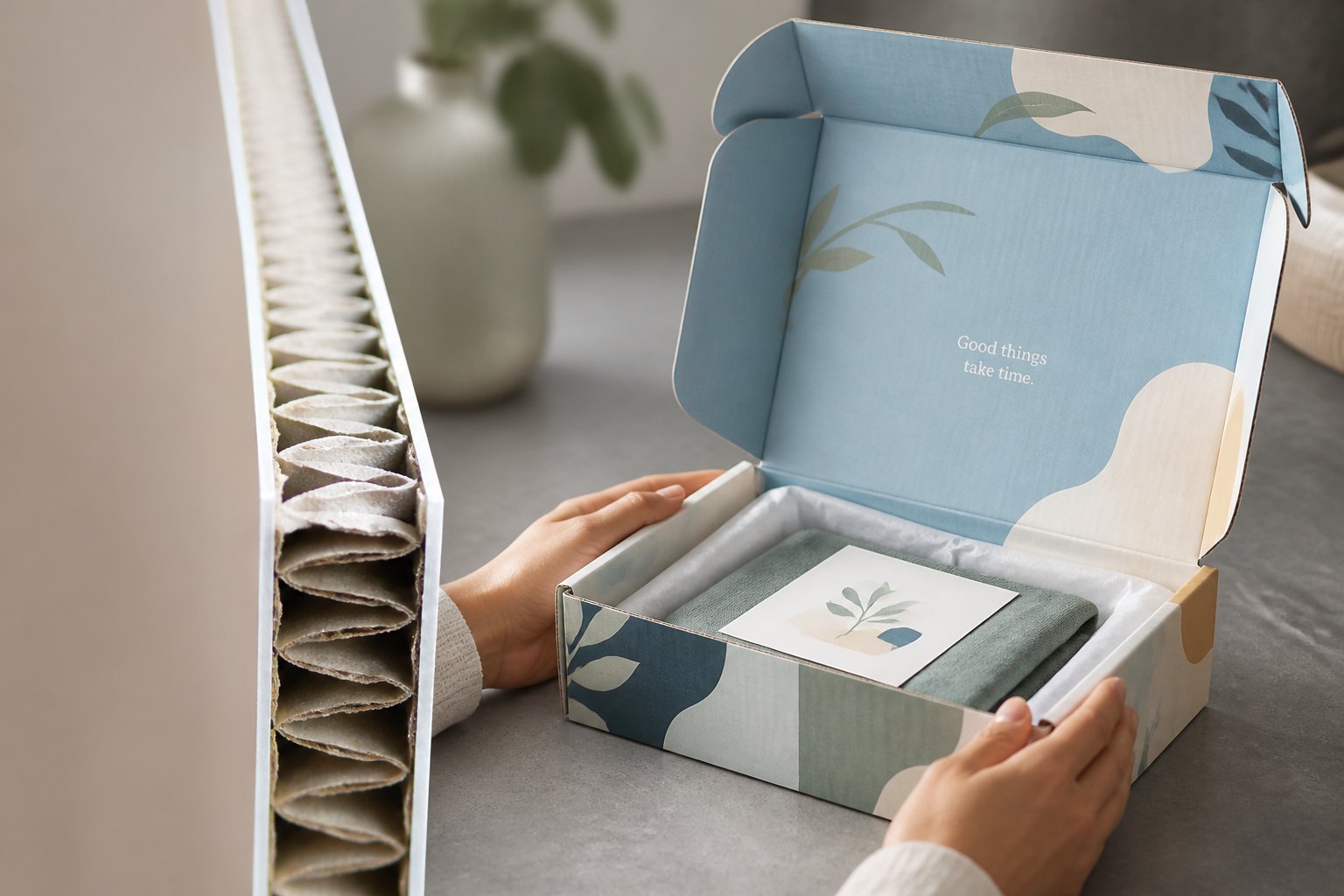
Corrugated board is one of the most engineered materials in everyday packaging, even when it looks like plain brown cardboard. The rigid, arch-based structure inside a mailer box is the reason your product survives three days moving through an Australia Post network, and understanding how those arches vary between flute profiles makes it straightforward to choose the right board for what you are shipping.
This guide covers the flute types you are most likely to encounter when ordering custom boxes in Australia: E, B, C and the double-wall BC combination. For each one, you will find an approximate thickness, a plain-language read on crush strength and puncture resistance, what the print surface is actually like, and which products it suits. There is a comparison table, and the guide lands on a clear answer for why B-flute is the standard choice for a mailer box.
One clarification before we start: in Australian packaging conversations, the word “corrugated” can refer to two completely different materials. This article covers corrugated paper-based board, which is what cardboard boxes are made of. There is also corrugated plastic (polypropylene, also called corflute), which is what signs are made of. Those two are not the same thing. There is a clearly signposted section below that separates them. If it is the signage material you came for, our corrugated plastic signs are printed on 3mm and 5mm fluted polypropylene.
The short version
- E-flute (approximately 1.0 to 1.5 mm thick) has the smoothest print surface of the single-wall profiles, but lower crush resistance and cushioning. Best for lightweight retail and cosmetics packaging.
- B-flute (approximately 2.5 to 3.0 mm thick) is the standard mailer box flute: stronger and tougher than E, more compact than C, with good print quality on a white liner. Both Paperlust mailer box ranges are B-flute.
- C-flute (approximately 3.5 to 4.5 mm thick) is the general-purpose shipping carton flute. Better stacking strength than B or E, but heavier and bulkier.
- BC double-wall (approximately 5 to 6 mm thick) bonds a B and a C layer together for heavy-freight, palletised loads and industrial applications. Not suited to standard consumer parcels.
- Liner weight (the paper grade of the outer and inner flat sheets) affects box performance as much as flute type. Both are part of the full board specification.
- All thickness figures in this guide are approximate industry bands. Actual board thickness varies between mills and liner specifications.
What corrugation actually is
Corrugated board is a three-layer structure. The two flat outer sheets are called liners. The wavy layer between them is the fluted medium. In manufacture, the medium is pressed into a continuous arch profile under heat and steam, then adhesive-bonded to both liners while the arches are held under tension.
The arch geometry is the load-bearing mechanism. A flat sheet of paper buckles under compression almost immediately because there is no efficient internal load path. An arch under the same load converts vertical force into horizontal force that tracks along the curve toward the two base points, where the liners absorb it. The principle is the same as a Roman stone arch or an eggshell: curved geometry transfers load far more efficiently than flat geometry for the same material weight. This is why a lightweight sheet of corrugated board can handle stacking loads that would buckle a solid sheet of equivalent paper weight many times over.
The character of those arches is what the flute letter code describes. A finer flute has more arches per 300 mm of board, each arch smaller and lower in height. A coarser flute has fewer, taller arches. More arches per length means a flatter outer surface (better for printing) but less air volume inside the board. Fewer, taller arches mean more air volume and more cushioning capacity when the board absorbs a corner drop or a lateral impact.
Liner weight and board grade
Flute type and liner weight are two separate variables, both part of the full board specification. A B-flute board made from 125 gsm liner on both faces performs differently from a B-flute board made with 200 gsm outer liner and 150 gsm inner, even though both are nominally B-flute. Heavier liner weight improves compression strength and puncture resistance across any flute profile.
Australian corrugated packaging specifications sometimes write out the full board grade explicitly. The notation “B-flute 150/B/150”, for example, means 150 gsm outer liner, B-flute medium, 150 gsm inner liner. At consumer packaging volumes, the liner combination is typically standardised by the supplier for each flute grade and does not need to be specified separately by the buyer. Liner weight becomes a live variable in high-volume industrial contracts or applications with unusually heavy or fragile products where the buyer is working directly with a corrugated converter on a custom spec.
The common flute profiles
These are the four configurations a seller is most likely to encounter in the Australian custom box market. Thickness ranges are approximate industry bands; actual board thickness varies by mill and liner specification.
| Flute | Approx. thickness | Crush/stacking strength | Puncture resistance | Print surface | Typical uses |
|---|---|---|---|---|---|
| E | 1.0 to 1.5 mm | Low | Low | Excellent | Retail boxes, cosmetics, small lightweight mailers, POS displays |
| B | 2.5 to 3.0 mm | Moderate | Good | Good | Mailer boxes, die-cut cartons, canned goods, POS displays |
| C | 3.5 to 4.5 mm | High | Good | Acceptable | Shipping cartons, outer boxes, palletised freight, glass and fragile goods |
| BC double-wall | 5.0 to 6.0 mm | Very high | Excellent | Acceptable | Heavy freight, furniture, industrial components, palletised loads |
All thickness figures are approximate. Actual board thickness varies by mill and liner specification.
E-flute is the retail and presentation flute. At roughly 1.0 to 1.5 mm, it is barely thicker than a rigid folding carton. The fine arch profile, around 90 arches per 300 mm of board, leaves a very flat outer liner surface that gives crisp reproduction of detailed artwork, photography and fine typography. The trade-off is cushioning: the small arch height means less air volume inside the board and limited ability to absorb corner drops or lateral impacts during parcel transit. E-flute suits cosmetics, skincare, small electronics accessories and lightweight gifts that go into retail environments or are already cushioned internally.
B-flute is the practical standard for mailer boxes. At roughly 2.5 to 3.0 mm, it is compact enough to keep postage dimensions and weight under control, but the wider arch profile, around 47 arches per 300 mm, delivers meaningfully better puncture resistance and cushioning than E-flute. The print surface is good: on a smooth white liner, full-colour CMYK printing reproduces brand colours, logos and photographic artwork well. B-flute also die-cuts cleanly, which matters for the interlocking cut panels of a roll end tuck front mailer box design.
C-flute is the most widely used shipping carton flute in Australia. The taller arch gives higher stacking strength, which matters when boxes are palletised and stacked multiple units high in a warehouse or freight depot. C-flute is heavier per unit area than B-flute, which is acceptable when filling a pallet but adds unnecessary weight and dimension when you are posting individual consumer parcels through standard carrier networks. The outer surface is also slightly coarser than B-flute, giving adequate but not optimal print quality for high-coverage branded artwork.
BC double-wall bonds a B-flute layer to a C-flute layer, producing board roughly 5 to 6 mm thick. Stacking strength and puncture resistance are significantly above any single-wall grade. This profile is used for furniture, glass panels, heavy machinery components and palletised industrial freight. For consumer mailer boxes, the extra weight and bulk would add meaningful freight cost across every parcel you send, with no corresponding benefit for the protection level a standard carrier parcel needs.
Corrugated board and corrugated plastic: an important distinction for readers of this blog
On this blog, the word “corrugated” has historically appeared in the context of corrugated plastic signage, which is the twin-channel polypropylene sheet most Australians know as corflute, used for real estate signs, event hoarding and election placards. This article is about a different material entirely: corrugated paper-based board, the kind used to make cardboard shipping boxes. The two share a descriptive name because both have an internal corrugated or channelled structure, but the materials, recycling pathways and performance characteristics have nothing in common. Corrugated paper board (this article) is kerbside recyclable through the standard yellow-lid bin in almost every Australian council area; corrugated plastic (polypropylene) requires a specialist PP recycling stream and does not go in the yellow bin.
Print quality in practice
The print surface on a corrugated box is the outer liner, not the fluted medium. The quality of that surface depends on two things: how flat it is (determined by flute type) and what it is made of.
A natural unbleached brown kraft liner shows grain and texture. Ink printed on kraft sits over that surface and picks up its colour, so print on a kraft board has a warmer, earthier tone than the same ink on white paper. This is part of the appeal of kraft packaging for brands built around natural or artisan aesthetics. A smooth white liner, typically a clay-coated or bleached sheet, gives a surface close to uncoated white paper. Full-colour CMYK artwork on a smooth white liner produces vivid, bright results, with good fine detail and graduated tints.
B-flute on a smooth white liner is the practical combination for full-colour branded mailer boxes. The arch profile is wide enough to stay below the liner surface after lamination, so the outer face remains relatively flat. The result is a box that carries detailed brand artwork without the wavy surface texture you would expect from a heavier, coarser flute grade. For most artwork intended for a mailer box, the difference between B-flute and E-flute in finished print quality is visible at very close range but not meaningful at normal viewing distance.
Why B-flute is the right choice for a mailer box
A mailer box specification needs to balance four things: structural protection in transit, light enough to post individually without an outsized freight bill, compact enough to store flat-packed before use, and a print surface that does justice to branded artwork.
E-flute achieves a better print surface than B-flute, but the lower crush resistance creates real risk for parcels moving through a standard carrier network. A box that arrives compressed or punctured is a customer service problem and a replacement cost that outweighs any print quality advantage. C-flute provides more stacking strength than a consumer mailer box needs, and the extra thickness adds weight and dimension to every parcel, multiplying freight cost across every shipment.
B-flute sits correctly in the middle. The arch profile gives enough cushioning and puncture resistance for the handling a parcel sees between pick-up and delivery. The board is compact and relatively light, keeping postage weight and cubic dimensions within reasonable bands. The print surface, particularly on a white liner, handles full-colour digital and offset CMYK printing without visible flute show-through on well-prepared artwork.
This is why both ranges of custom mailer boxes at Paperlust Print Shop use B-flute board. It is the specification that performs across the widest range of products and shipping conditions without forcing a compromise on print quality or postage cost. If you are still working through the economics of your packaging programme, the guide to packaging on a budget covers the broader cost picture across size, quantity, print method and print coverage.
Before you order
Once you know B-flute is the right board specification for a mailer box, the remaining decisions are size, print method and artwork setup. Our guide to choosing a box size walks through the three standard internal sizes and the product categories each one suits, based on the rule of thumb of 15 to 25 mm of clearance on each side of your packed product.
For artwork, the standard requirements are a PDF, SVG or Adobe Illustrator file with 3 mm bleed, the dieline on the top layer, all fonts outlined and all images embedded. The guide to setting up your artwork covers each of those requirements in detail, including how to read the dieline and how to handle bleed on corner panels.
If you are ready to look at quantities and pricing, both mailer box pages carry a live price calculator: pick a size and quantity and the per-box price updates as you go. The full-colour mailer boxes page covers the two-tier digital and offset print options, how the per-box price moves across the quantity breaks, and the difference in colour reproduction between a small-batch digital run and a volume offset run.
Frequently asked questions
Is B-flute or E-flute better for a mailer box?
B-flute is the better choice for a mailer box sent through a standard carrier network. E-flute has a smoother print surface, but its lower puncture resistance and cushioning make it vulnerable to the handling a parcel sees in transit. B-flute gives the balance of protection, postage-friendly dimensions and good print quality that most products need when shipping direct to a customer.
What does the flute letter code mean?
Flute letters are a naming convention from the corrugated board manufacturing industry. The most common profiles in Australia are E (finest), B (medium) and C (standard shipping flute). BC refers to a double-wall board that bonds a B-flute layer to a C-flute layer for significantly higher strength. The letters do not indicate a quality hierarchy: each profile is designed for different applications.
Can I print full colour on B-flute corrugated board?
Yes. On a smooth white outer liner, full-colour CMYK printing on B-flute board reproduces logos, photography and brand artwork well. At small-batch quantities (10 to 250 boxes), digital printing is used: good colour accuracy, fast turnaround, low setup. At volume quantities (500 and 1,000 boxes), offset printing produces the crispest full-colour result and the lowest per-box cost.
Is corrugated board kerbside recyclable in Australia?
Yes. Corrugated paper-based board is kerbside recyclable through the standard yellow-lid bin in almost every Australian council area. Break down the box flat before placing it in the bin. Corrugated plastic (polypropylene, also called corflute) is not kerbside recyclable and requires a specialist PP recycling stream.
What is the difference between single-wall and double-wall corrugated board?
Single-wall board has one fluted medium bonded between two liners. Double-wall board has two fluted mediums bonded between three liners. BC double-wall (the most common double-wall configuration) is significantly thicker, heavier and stronger than single-wall B or C flute. Single-wall B-flute is appropriate for most consumer mailer applications. Double-wall is used for heavy-freight, industrial and palletised packaging where the box is the primary structural member.
Does flute type affect the weight of my mailer box?
Yes. Board thickness scales with flute type, and thicker board adds weight. A B-flute box is slightly heavier than an equivalent E-flute box, but lighter than C-flute. For individual consumer parcels, the difference between B and E-flute is a matter of grams per box. When you are shipping at volume, that small difference per parcel accumulates, so it is worth including in your cost modelling alongside freight rates.
Is corrugated plastic the same as a cardboard box?
No. Corrugated plastic (polypropylene) is a rigid, moisture-resistant plastic sheet with parallel internal channels, used in Australia for signs, real estate boards and construction hoarding. Corrugated board is a paper-based product: two paper liners bonded to a paper fluted medium. They share a descriptive name because both have an internal corrugated or channelled structure, but they are different materials with different uses, different recycling pathways and very different performance characteristics.