If you run a trade business, every kilometre your ute or van covers is a potential lead. Car magnets are one of the most cost-effective ways to turn your vehicle into a moving billboard without committing to a permanent wrap. This guide covers everything Australian tradies need to know: the right sizes, how the magnetic material works, what to put on your sign, and how to keep it looking sharp for the long haul.
CHEAT SHEET
- Standard car door magnets measure 300 x 600mm and are sold in pairs for left and right panels.
- Print on heavy-duty magnetic sheet keeps signs flat at highway speeds and removes cleanly without adhesive or paint damage.
- Include your business name, primary trade, phone number and licence number (required in many states for some trades).
- Remove and store flat indoors every few nights to protect both the sign and your paintwork.
Why Car Magnets Work for Tradies
Tradies are on the road constantly, moving through residential streets, industrial estates and job sites where potential customers are watching. A well-designed car magnet delivers your phone number to anyone who sees your vehicle, and unlike a full wrap, it costs a fraction of the price and can come off when you want a clean vehicle on weekends.
Car magnets suit sole traders and small teams particularly well. If you have employees using their own vehicles, they can attach branded magnets while on the job, then remove them when finished. That flexibility is something a painted sign or permanent wrap simply cannot offer.
For tradies who are building brand recognition in a local area, consistent signage across multiple vehicles, combined with a clear, easy-to-read design, reinforces trust at every touchpoint.
Standard Sizes and What Fits Where
Choosing the right size comes down to the surface you are covering and how much information you need to display. The table below outlines the most common formats and their typical applications.
| Size (mm) | Typical use | Best fit |
|---|---|---|
| 300 x 600mm | Car door | Standard sedan, SUV |
| 400 x 600mm | Van or ute door | Side door, larger panel |
| 150 x 950mm | Ute tray, tailgate or boot | Horizontal rear panels |
| Custom (up to approx. 600 x 500mm) | Irregular panels, bonnet strips | Specialist applications |
The Paperlust Print Shop car magnets product page lists a standard dimension of 600 x 300mm and notes that custom sizes are available up to approximately 600 x 500mm. Signs are sold in pairs so your door panels match.
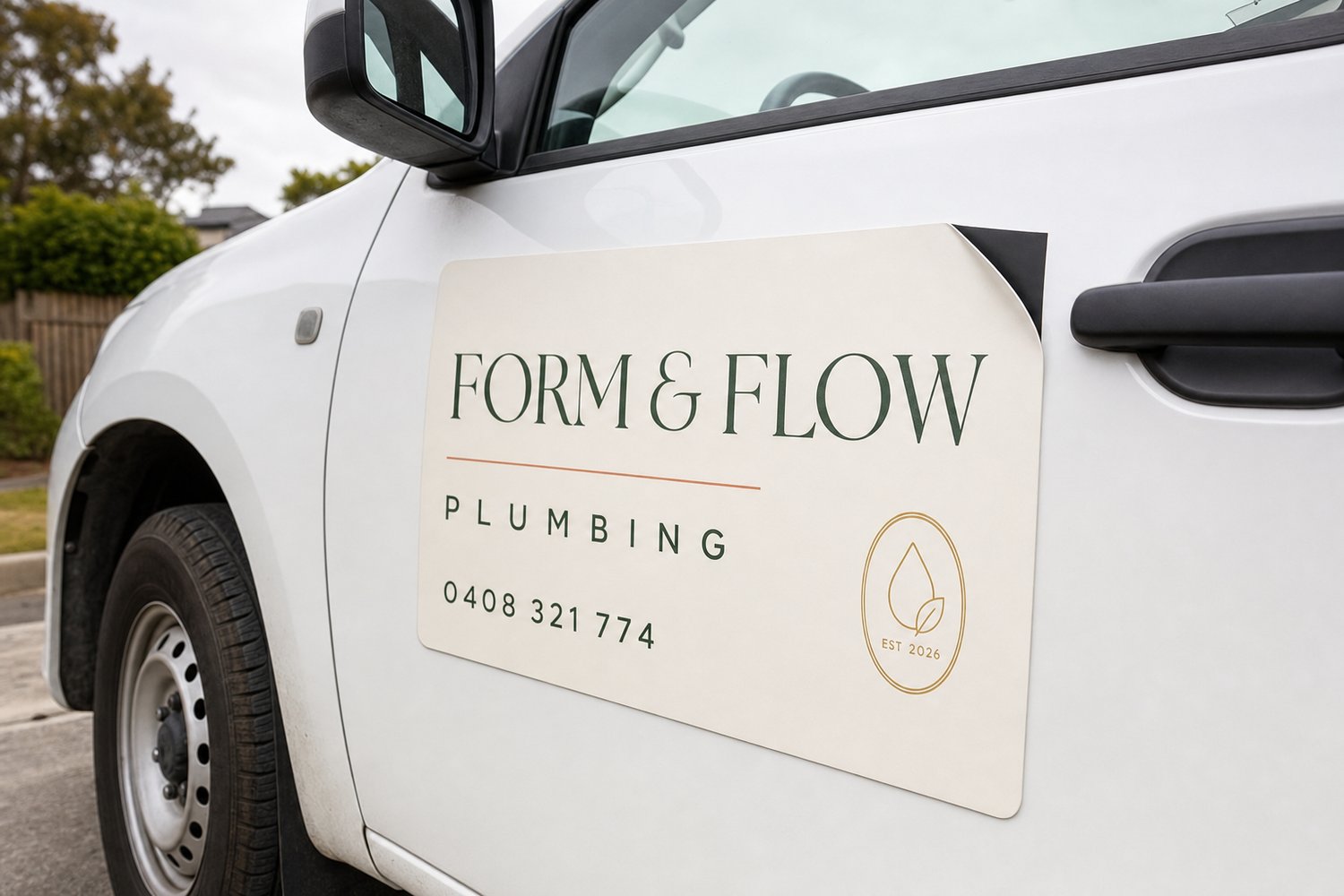
For most trades, a 300 x 600mm pair is the practical starting point. It is large enough to display your business name, trade type and phone number at a readable size, while still fitting comfortably on a standard car or small SUV door.
Magnetic Material: What Makes a Good Vehicle Magnet
Not every magnetic sheet is equal. For vehicle use, the key properties to look for are thickness, print quality and UV resistance.
Thickness and Hold
Industry standard for vehicle magnets is around 30 mil thickness. Thinner magnets can lift at the edges at highway speeds, especially on warm days when steel panels expand slightly. Heavy-duty magnetic sheet is the correct specification for any sign that needs to stay flat and secure during highway driving in Australian conditions.
The magnetic sheet used for vehicle signs grips ferrous steel panels but will not adhere to aluminium, fibreglass, plastic trims or panels that have been repaired with non-metallic filler. Always test a corner of the door before relying on the sign at speed.
Print and Lamination
Full-colour printing on heavy-duty magnetic sheet gives you sharp graphics, legible text and the ability to display your logo at its best. UV-resistant inks protect the print from fading in Australian sun. A properly printed magnet maintained with basic care can hold good colour quality for 12 to 24 months.
What the Paperlust Car Magnets Are Made Of
Based on the live product page, Paperlust car magnets are printed in full colour on a commercial-grade heavy-duty magnetic sheet. They are described as weatherproof and UV-resistant, built for Australian conditions, and designed to stay flat at highway speeds. The product page specifically notes the signs fix securely to steel vehicle panels and remove cleanly without adhesive, residue or paint damage.
What to Put on Your Car Magnet
A car magnet gives passing drivers about four seconds to absorb your message. Every element needs to earn its place. Here is what to include and what to leave out.
Essential information
- Business name in the largest, boldest text on the sign
- Your trade or service (e.g. Licenced Electrician, Plumbing and Gas Fitting, Landscaping) so customers know what you do at a glance
- Phone number in a large, highly legible font, positioned so it can be read from a passing vehicle
- Licence number where required by your state or trade (building, electrical and plumbing trades each have their own requirements; check with your relevant state authority)
- Website or social handle if space allows and it is short enough to read quickly
What to leave out
- Lengthy lists of every service you offer
- Small-print terms, qualifications or award logos that cannot be read at speed
- Multiple phone numbers or multiple calls to action (pick one)
Design principles for readability
Use high contrast between your text and background. Dark text on a light background, or white on a dark or branded-colour field, both work well. Avoid decorative fonts for critical information; a simple bold sans-serif reads fastest at distance and in passing traffic. Match background contrast to your vehicle colour so the sign is distinct from the panel it sits on.

Application Surfaces and Where Magnets Will Not Stick
Magnetic signs only work on ferrous steel. Most older utes and vans have steel door panels, which makes them ideal. Newer vehicles increasingly use aluminium doors or mixed-material body panels where magnets will not hold.
How to check before you order
Hold a standard fridge magnet firmly to the panel you plan to use. If it holds, the surface is steel and your car magnet will work. If it slides or falls off, the panel is aluminium or another non-ferrous material.
Common non-magnetic surfaces to avoid:
- Aluminium van doors (increasingly common on European vans)
- Fibreglass panels or aftermarket body kits
- Plastic trim surrounds
- Heavily curved areas near wheel arches or bumper edges
- Any panel repaired with non-metallic body filler
If door panels are unsuitable, the rear tailgate or cargo doors on a ute or van are often a reliable alternative, with flatter surfaces and steel construction on most Australian working vehicles.
Care, Removal and Storage
Proper care prevents paint damage and extends the life of your sign. A few simple habits make a significant difference.
Routine care
- Remove the magnet every two to three days to let the vehicle surface dry and breathe, especially in humid coastal climates
- Wipe the back of the magnet and the vehicle panel clean before reapplying; grit and moisture trapped underneath can scratch paint over time
- If the vehicle has been in heavy rain, remove the magnet and dry both surfaces before reattaching
Storage
Store magnets flat, not rolled or folded. Rolling or bending a magnet repeatedly weakens the magnetic layer and can cause the sheet to delaminate over time. A flat shelf in your work vehicle or shed is ideal.
When to replace
A magnet showing fading, peeling edges or reduced grip should be replaced. Given the cost relative to a full wrap, periodic replacement is a straightforward maintenance decision.
Getting Your File Ready for Print
Resolution and bleed
Supply artwork at 300 dpi at the final print size. If you are designing at a smaller scale to send to your designer, confirm the scaling factor before sign-off. Vector artwork (AI, EPS, PDF) is ideal for logos and text because it scales without quality loss.
Add a 3mm bleed on all four sides and keep critical text at least 5mm inside the finished edge.
Colour mode
Design in CMYK rather than RGB. Screen colours, particularly vibrant blues and oranges common in tradie branding, shift noticeably in print when converted from RGB at the printer end. Converting to CMYK in your design file gives you control over the final appearance.
If your brand colours are Pantone-specified, ask for the closest CMYK equivalent; exact Pantone matching is not standard for vehicle magnet printing.
You can also pair car magnets with vinyl stickers for smaller on-vehicle branding applications like ute toolboxes, trailers or equipment.
For a full comparison of magnets versus permanent decals, see Magnetic Vehicle Signs vs Vinyl Decals: Pros, Cons and Costs.
Frequently Asked Questions
Do car magnets damage paint?
A properly made car magnet on a clean, well-maintained vehicle surface should not damage paint when applied and removed correctly. The risk comes from grit or moisture trapped between the magnet and the panel, or from leaving a magnet on for extended periods in direct sun on a very hot surface. Removing the magnet every few days, cleaning both surfaces and storing the sign flat indoors significantly reduces any risk.
How long do car magnets last?
With proper care, a UV-resistant car magnet can maintain good print quality for 12 to 24 months. Longevity depends on how frequently the magnet is removed and reapplied, exposure to direct sun and heat, and how well the surfaces are kept clean. Magnets left in place for months without removal, or stored rolled rather than flat, will deteriorate faster.
What is the turnaround time for printed car magnets?
Paperlust Print Shop car magnets have a production time of 3 to 4 working days after design approval. Delivery time depends on your location; express options are available for metro areas.
How much do car magnets cost?
Car magnets from Paperlust Print Shop start from $30.46 inc. GST. Final pricing scales with size and quantity. For an accurate quote on your specific size and run, visit the car magnets product page and use the live quote tool.
Will car magnets stick to my van doors?
Magnets adhere to ferrous steel panels only. Test with a standard fridge magnet before ordering: if it holds, your panel is steel and car magnets will work. Many newer European vans use aluminium doors, which are non-magnetic. In that case, rear cargo doors or tailgate panels on the same vehicle are often still steel.
Do I need to include my licence number on a trade vehicle magnet?
Licence number requirements vary by trade and state. Electrical and plumbing contractors in most Australian states are required to display their licence number on work vehicles. Building contractors may also have display obligations depending on the state. Check the specific requirements with your state licensing authority (e.g. NSW Fair Trading, VBA in Victoria, QBCC in Queensland) before finalising your design.