An A1 poster measures 594mm x 841mm (59.4cm x 84.1cm, or roughly 23.4 x 33.1 inches). It is exactly half an A0 sheet, double the area of A2, and the largest standard poster size we print at Paperlust Print Shop. If you have seen a large retail window poster or a research display at an Australian university conference, there is a good chance it was A1.
| Format | Millimetres | Centimetres | Inches |
|---|---|---|---|
| A1 | 594 x 841 mm | 59.4 x 84.1 cm | 23.4 x 33.1 in |
- Dimensions (portrait): 594mm x 841mm
- Dimensions (landscape): 841mm x 594mm
- In centimetres: 59.4cm x 84.1cm
- In inches: approximately 23.4 x 33.1 in
- Material: 200gsm Synthetic, tear-resistant and moisture-resistant
- Colour mode: CMYK
- Artwork setup: 594 x 841mm at 300 DPI, 3mm bleed on all four sides
- Common uses: retail displays, event wayfinding, gig posters, academic and conference presentations
At 594mm x 841mm, A1 is the largest poster we print. It runs on 200 gsm Synthetic CMYK in quantities from 1 to 20, with one print at $80.77 and twenty prints at $14.24 each. Start your file at A1 and order it through A1 poster printing.
Where A1 fits in the ISO A series
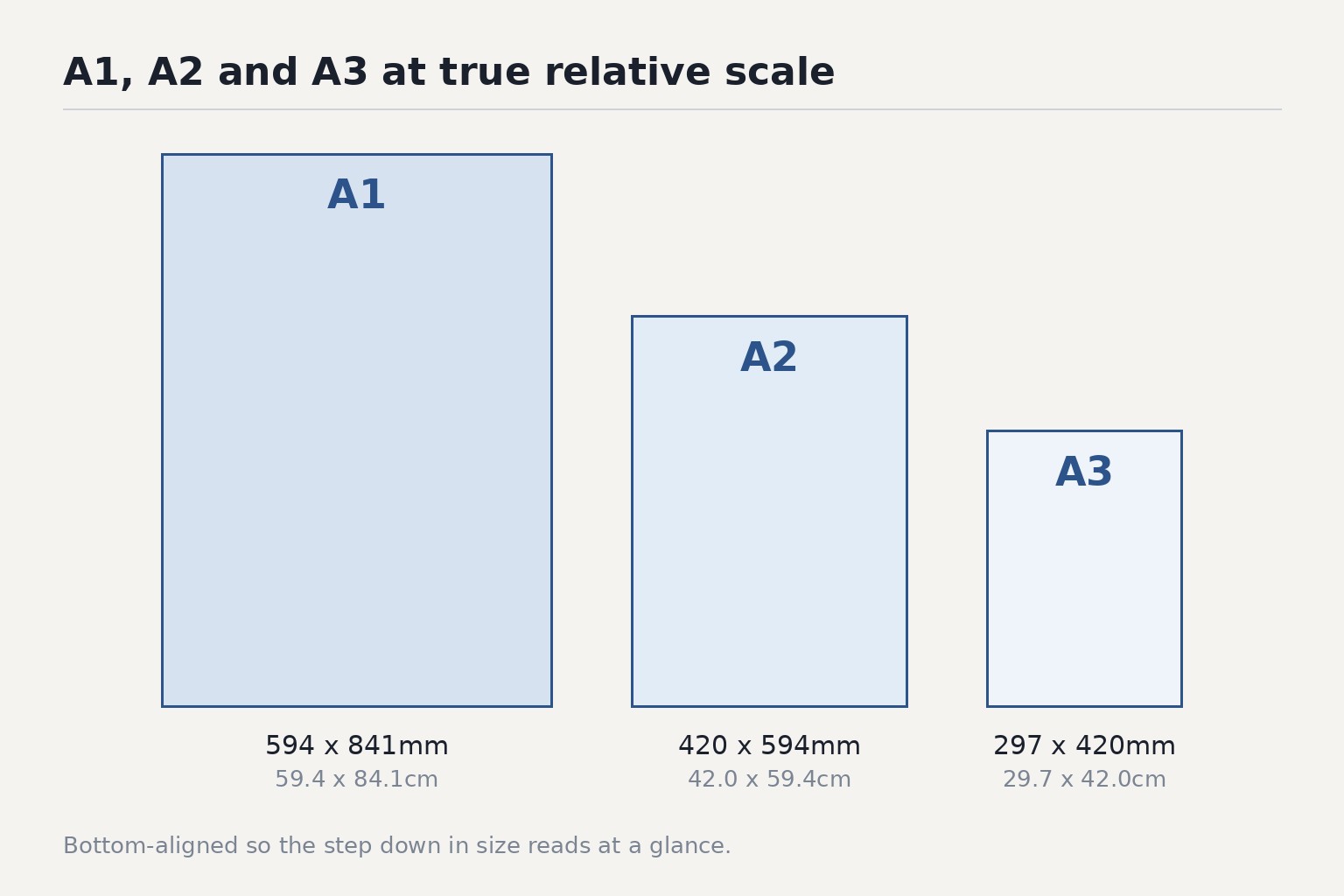
The ISO 216 A-series is built on a simple rule: each size is exactly half the area of the one above it, achieved by halving the longer dimension. A0 is the root at 841mm x 1189mm, roughly one square metre of paper. A1 is half of A0. A2 is half of A1. A3 is half of A2.
The three sizes we print at Paperlust Print Shop are:
| Size | Dimensions (mm) | Dimensions (cm) |
|---|---|---|
| A1 | 594 x 841 | 59.4 x 84.1 |
| A2 | 420 x 594 | 42.0 x 59.4 |
| A3 | 297 x 420 | 29.7 x 42.0 |
A1 has exactly double the surface area of A2 and four times the area of A3. Crucially, all three share the same proportions (the ratio of the short side to the long side is always 1:1.414). This means artwork designed at A3 can be scaled up to A1 without any distortion or reformatting, which is useful when you need the same design at multiple sizes across a campaign.
What A1 posters are used for in Australia
A1 sits in a practical middle ground: large enough to command attention in a busy environment, light enough to transport, reposition and swap over without tools or special equipment.
Retail window and in-store displays
A standard shopfront display frame is typically sized for A1 or A2 portrait. Retailers use A1 for seasonal promotions, sale announcements, new arrivals and directional messaging. At 594mm wide, an A1 sheet fills a standard window panel neatly beside a door frame or in a floor-standing poster stand, and at 841mm tall it sits at natural eye level for a pedestrian approaching from the footpath.
Our synthetic stock is moisture-resistant, which matters in environments near refrigerated displays, outdoor-facing windows with condensation exposure, or busy hospitality venues where standard paper stock would degrade quickly.
Event and venue wayfinding
Conferences, trade shows, markets, festivals and sporting events rely on A1 for room allocations, schedules, floor maps, sponsor acknowledgements and safety notices. Stand-mounted A1 poster frames are standard inventory at Australian venues and event hire companies. A set of A1 prints can be swapped overnight between conference days without reprinting the display infrastructure. For permanent wall display, those prints need to be assessed against room scale and frame proportions, and our guide to poster sizes for walls and frames explains how to choose the right fit.
Gig and entertainment posters
Concert posters have used A1 as their de facto format for decades. The size suits positioning at eye level on a venue wall, in a bar corridor, or at the entrance of a live music room. Our synthetic stock holds colour well under the warm, variable lighting conditions common in entertainment venues.
Lecture theatre and corporate use
Universities, government agencies and corporate offices use A1 for timetables, safety procedure cards, department announcements and information displays. The format fits standard corridor display rails and lecture room notice boards without trimming.
Academic and conference poster presentations
A1 is one of the two standard sizes for academic poster sessions at Australian universities and research conferences, alongside A0. Many conferences with smaller venue footprints or crowded breakout rooms specify A1 portrait as their default. It fits most pop-up display boards, correx panels and cable display systems at Australian universities and conference centres. Where the board must be printed, not borrowed, PVC sign printing prints the 594 x 841mm A1 footprint on 3mm or 5mm rigid PVC board. Corflute sign printing does not offer A1 as a standard size; the nearest orderable board is 900 x 1200mm.
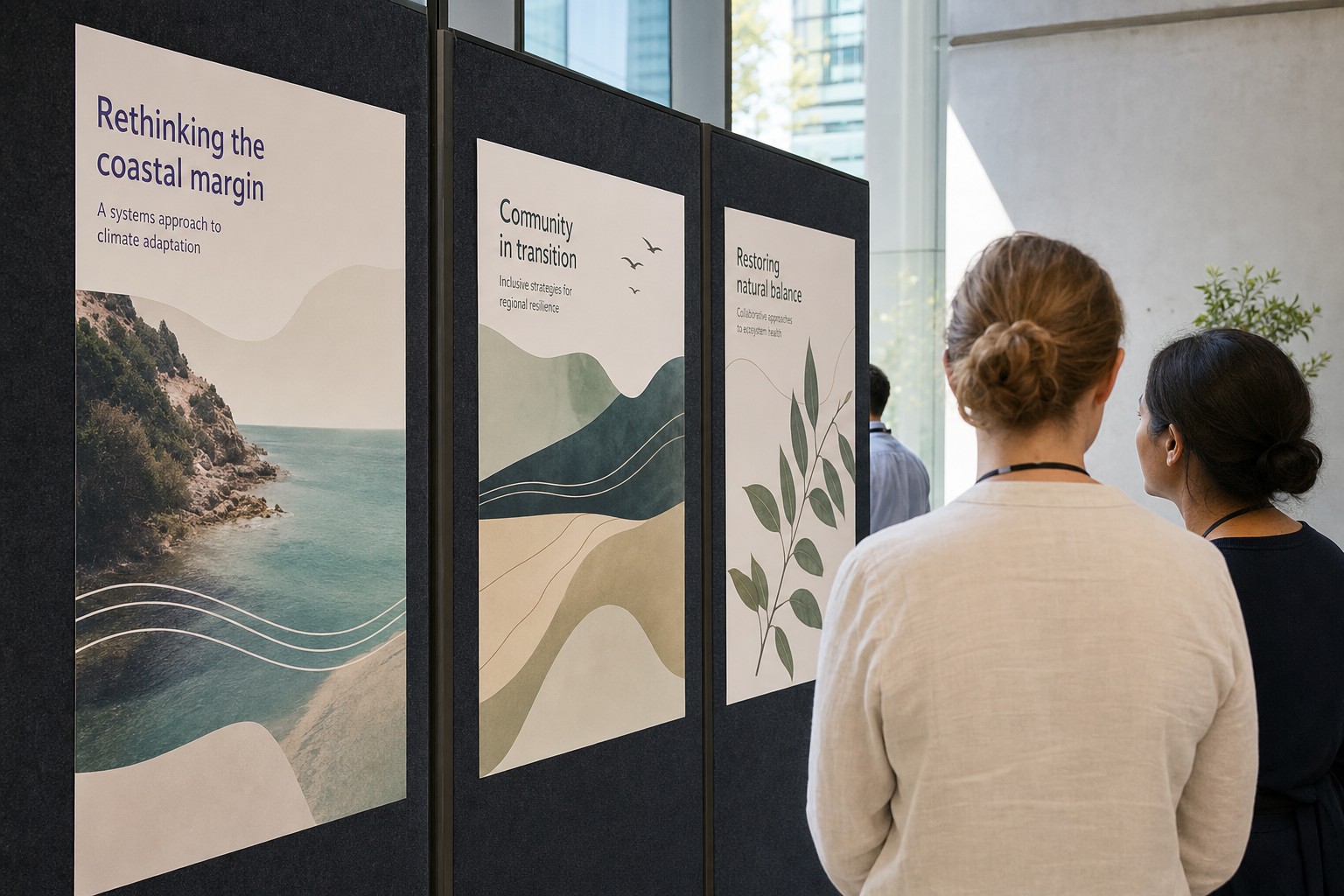
The standard academic poster layout at A1 runs in two or three vertical columns. The title and author block sits at the top, followed by introduction, methods, results and discussion in the columns below, with references and acknowledgements at the foot. For comfortable readability at A1 dimensions, body text sits at 18 to 24pt, section headings at 28 to 36pt, and the title at 60pt or larger.
Our 200gsm synthetic stock suits academic poster use particularly well. It is lightweight for transport in a carry tube, resistant to edge tearing after repeated handling over a conference day, and the matte surface minimises glare under the fluorescent lighting common in conference rooms and university corridors.
If your conference specifies A0 rather than A1, see the note at the end of this article. A0 is larger and we do not print it.
Portrait vs landscape: which orientation suits your design
A1 in portrait (594mm wide x 841mm tall) is the standard orientation for the vast majority of poster frames, display systems and stand hardware in Australia. When someone says “A1 poster,” they almost always mean portrait.
A1 landscape (841mm wide x 594mm tall) works well for specific contexts: a display panel that runs along the top of a service counter, a horizontal frame in a trade-show booth, or a window that is wider than it is tall. Landscape also suits photographic or panoramic artwork that benefits from horizontal space rather than vertical height.
Both orientations use the same 594 x 841mm sheet. Set up your artwork in the orientation that matches your display location and let us know which you intend when uploading your file.
Viewing distance and minimum type sizes
A1 communicates well at a range of one to five metres depending on type size. This covers the majority of retail, conference and event applications where a viewer is walking past or standing at conversational distance.
Recommended minimum type sizes at final print size:
- Headline copy: 48pt and above, readable from 4 to 5 metres
- Subheadings: 28 to 36pt, readable from 2 to 3 metres
- Body copy: 14 to 18pt, readable from 1 to 2 metres
- Fine print and references: 10 to 12pt, readable at arm’s length only
If your poster needs to communicate a single message at a glance from across a room, size your headline well past 48pt. At 594mm wide, a 120pt headline reads clearly from five metres.
Artwork setup for A1
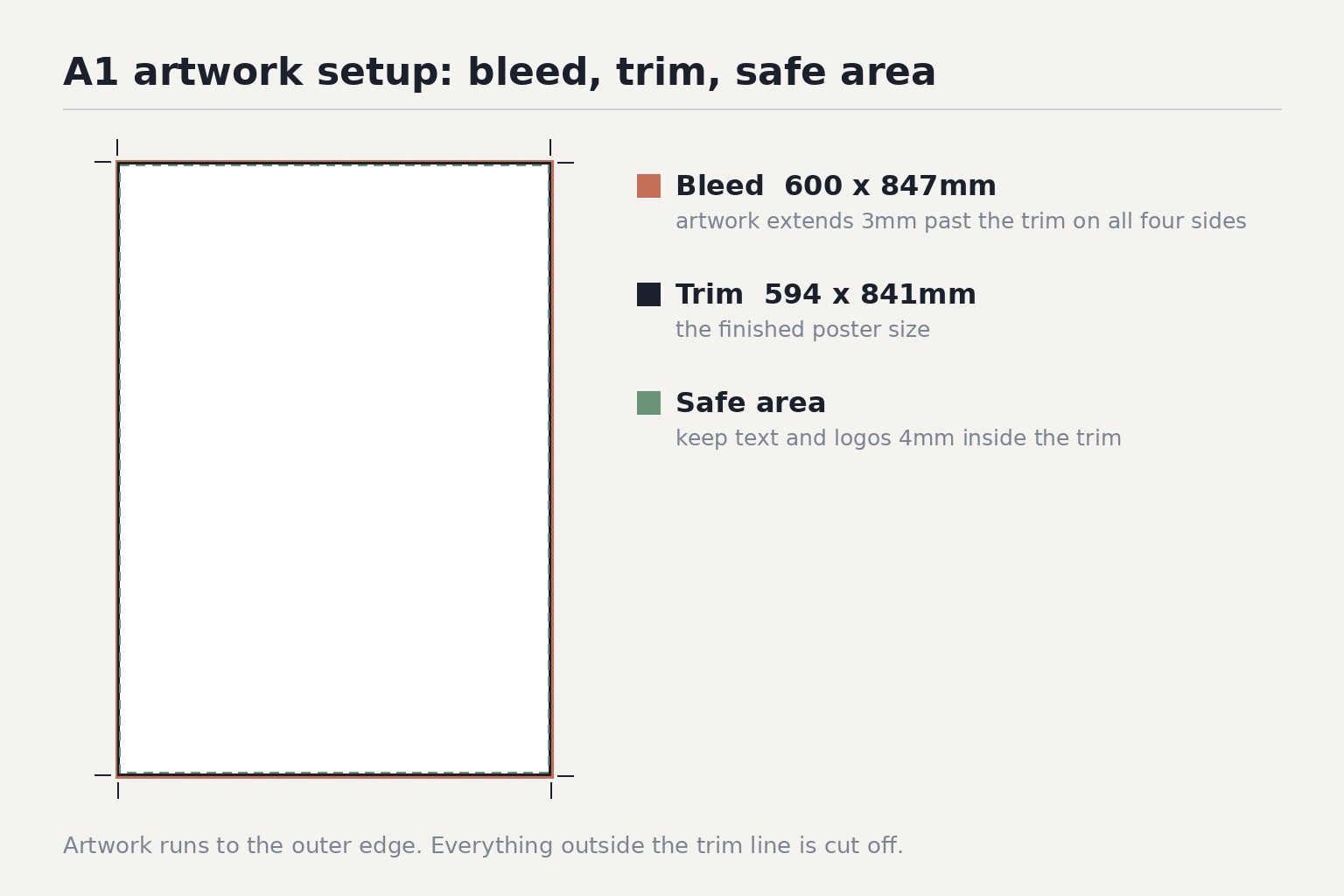
Document size and bleed
Set your document to exactly 594mm x 841mm. Add 3mm bleed on all four sides, which brings the total canvas to 600 x 847mm. Keep all critical content, including text, logos and key imagery, at least 4mm inside the trim edge to allow for minor variation in the cutting process.
Colour mode
Set your document to CMYK throughout. Our posters are printed via CMYK digital production. Artwork supplied in RGB will be converted at our end, and the conversion can shift certain colours, particularly deep blues and vivid oranges. Working in CMYK from the outset gives you the most predictable result between screen and print.
Resolution
Set raster images and effects at 300 DPI at the final output size. For large photographic backgrounds where very fine detail is not the priority, 150 DPI is acceptable given the viewing distance, but text, logos and line art should always be at 300 DPI.
File format
PDF (print-quality, with bleed marks and crop marks included) is the preferred format. High-resolution JPEG, TIFF and PNG files are also accepted.
Proofs, pricing and delivery
Once you upload your artwork, a design proof is emailed to you for approval. Nothing goes to print until you confirm it, so you have a clear checkpoint before committing to a run.
A1 pricing scales with quantity, with per-unit cost falling significantly as the run grows. To give a sense of the curve: a single A3 poster costs $71.59 inc. GST, while a run of 20 A3 posters comes down to $6.45 per unit. A1 is priced separately at a higher per-unit rate. For current A1 pricing, visit our custom poster printing product page and configure your run.
Shipping is flat-rate $15 AUD Australia-wide with tracking. International orders ship at a flat rate of $35 AUD, delivered in 2 to 4 working days via DHL.
A note on A0 and sizes larger than A1
A0 is bigger than A1. A0 measures 841 x 1189mm, and we do not print it on paper. If you genuinely need output larger than 594mm x 841mm, two paths are worth considering. For indoor display, foam board printing reaches A0 and 600 x 900mm in 5mm or 10mm thicknesses. Foam board is a rigid indoor panel, so it suits presentations, events and retail displays that will not face weather. For outdoor or tougher signage use, our custom signage range includes PVC signs, corflute signs and construction signs in large-format sizes suited to display environments where A1 is not large enough. For decorative rather than signage use, canvas printing in Australia may also suit, though our framed prints stop at A2 rather than going larger.
Frequently Asked Questions
What is the size of an A1 poster in millimetres?
A1 is 594mm x 841mm in portrait orientation. In landscape it is 841mm wide x 594mm tall. Both use the same sheet, simply rotated.
What is A1 in centimetres?
An A1 poster is 59.4cm x 84.1cm.
What is A1 in inches?
A1 measures approximately 23.4 x 33.1 inches (more precisely 23.39 x 33.11 in).
How does A1 compare with A2 and A3?
A1 is double the area of A2 (420 x 594mm) and four times the area of A3 (297 x 420mm). Each step down the A-series halves the longer dimension and halves the total area. The proportions remain identical at every size. The next step down in the A series is covered in our guide to A2 poster size, including the situations where it is a practical choice.
Is A1 the standard size for academic conference posters in Australia?
A1 portrait is one of the two standard sizes for academic poster sessions in Australia, alongside A0. Many conferences specify A1 as their default because it fits standard display boards and is easier to transport than A0. Always check your conference or symposium guidelines before printing. Our overview of poster sizes in Australia explains how A1 compares with the other standard options and when each size is most useful.
Can I print an A1 poster in landscape orientation?
Yes. A1 landscape is 841mm wide x 594mm tall. Set your artwork up in landscape orientation and let us know your intended format when uploading.
What material are your A1 posters printed on?
We print A1 posters on 200gsm Synthetic stock. It is tear-resistant and moisture-resistant, making it suitable for retail, event and venue use where standard paper would degrade.
What is the difference between A1 and A0?
A0 is larger than A1. A0 measures 841mm x 1189mm, compared to 594mm x 841mm for A1. We do not print A0 on paper. For a larger-format display, A0 is available as printed foam board for indoor use.