Every December, an Australian small business can reach the season with nothing physical to sell while neighbouring product retailers move stock from shelf to counter. Christmas gift vouchers are the obvious fix, but the week most businesses reach for them is usually the week a well-printed run has already left their control.
The order date is not the date that sets the schedule. The artwork date is. Nothing prints until a PDF proof gets your approval, and that proof is only emailed after the order and artwork are in. That switch changes how a Christmas voucher run should be planned.
This guide walks through why a printed voucher outsells a code at the counter, the decision order, how many to print, what the three year expiry rule means for a December sale, and the finishing choices that make a voucher feel giftable.
The short version
- A printed voucher is a physical product you can sell over the counter and gift on the spot, with more weight than a code in an inbox.
- The proof gate sets the timeline: once the order and artwork are in, the team emails a PDF proof for check, and nothing moves without approval.
- Minimum order is 25 vouchers, with a published quantity ladder from 25 to 500.
- Unit costs fall steeply as quantity rises, so a real run costs far less per card than a token one.
- A voucher sold at Christmas carries the three year expiry rule from the day it is supplied.
- The expiry has to be displayed on the card itself.
- Variable Data gives each voucher numbering or a unique code for a seasonal campaign you can reconcile after the rush.
Why Christmas gift vouchers outsell a code in December
A printed Christmas gift voucher is not just a payment method. It is a physical product your customer can buy and hand over on the spot, with more presence than a digital code. On the counter it reads as an impulse purchase. In an inbox it reads as an errand. The customer who has just finished a meal or a treatment sees the card, feels the stock, and can hand it over before they leave. That is a sale a code sent later rarely makes.
The format suits a broad run of businesses. Salons, spas, cafes, restaurants, retail, trades and service businesses regularly use the product for gift vouchers, client gifting and seasonal promotions. The business keeps the sale without holding stock, boxing freight or clearing a shelf at a discount.
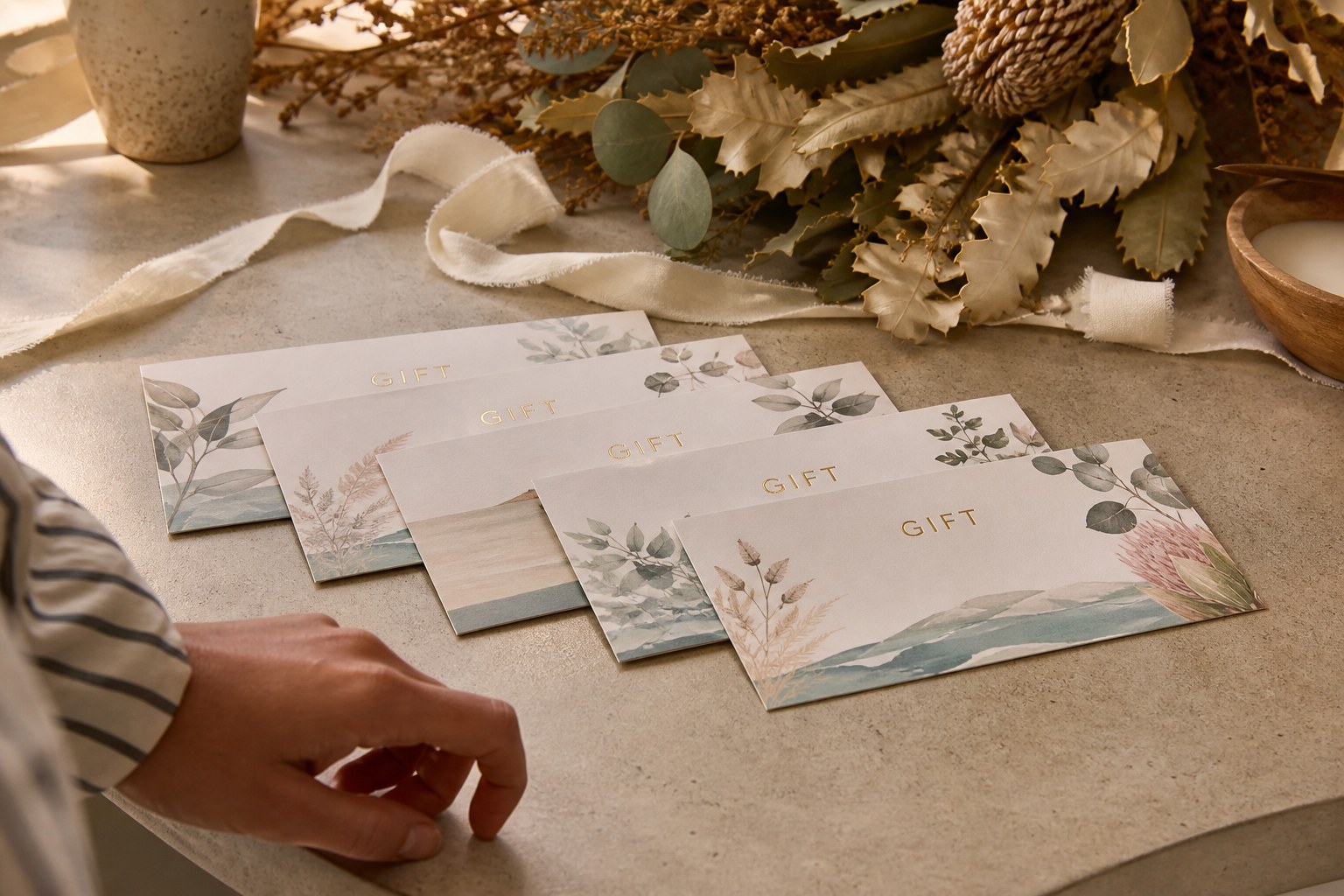
If you are weighing the format, the printed Christmas gift vouchers on the product page show what a small run can carry once the design moves from a screen to a card.
The proof approval date sets the whole timeline
The most useful date on the calendar is not the day you submit an order. It is the day you can approve the proof. After the order and artwork arrive, the team emails a PDF proof for review, and the press stays idle until that proof is approved. That means the clock a business actually controls starts at artwork, not at checkout. If the artwork is not finished, the proof cannot be emailed. If the proof is not approved, the job does not move.
Artwork can start from the catalogue of business-ready templates or from your own file. Every uploaded file is reviewed, and the team makes contact if something needs adjusting for correct printing. That exchange is part of the timeline, and it is worth allowing for when the artwork comes from a busy designer or a file that has been sitting in a folder since last year.
Proof approval starts the clock. Digital gift vouchers print in 3 to 5 working days after you approve the PDF proof. Foil gift vouchers take 7 to 10 working days after approval, so the finish you choose becomes a scheduling decision, not just a look. The artwork date and the approval date remain the two dates your business controls. Delivery is confirmed when you order and is additional to the production window.
Working backwards from the date you want to be selling
Work backwards from the day the vouchers need to be on the counter. The table keeps the decisions in order, but the production row now names the working day window that starts when you approve the proof. The earlier stages depend on your own dates and files, so those are the ones you can compress or remove.
| Stage | What has to be finished | What decides how long it takes |
|---|---|---|
| Deciding format and quantity | The stock, foil, corners and quantity rung are locked in | How quickly you can settle the stock, foil and corner choice so the designer has a clean brief |
| Finalising artwork | The design is ready in the template or your supplied file meets the DL or A6 spec | Your designer’s availability and the number of revision rounds you allow |
| Placing the order | The order is submitted with the final artwork attached | How much checking remains on the file after it leaves the designer |
| Proof approval | You approve the PDF proof, including any Variable Data sample | How soon the proof gets opened, checked and returned to the team |
| Production | The run is printed and finished | Digital 3 to 5 working days, foil 7 to 10 working days |
| Delivery | The vouchers reach your premises | The carrier timetable and any delivery delays outside the team’s control |
The only stage the business does not control is production and delivery. That is exactly why the earlier stages should not be left to compress. Artwork revisions, file checks and proof approval are the avoidable delays, and they sit in the period before the press run rather than inside it.
How many gift vouchers to print for Christmas
Minimum order is 25 vouchers, with published pricing at 25, 50, 100, 250 and 500. All prices below include GST. There is a table for each size because DL and A6 are priced differently, and the figures cover Front only printing with square corners. Front and back printing adds $0.20 per voucher to the order.
DL (99 x 210 mm)
| Quantity | Matt 300gsm Digital | Matt 300gsm Digital with foil | 360gsm Premium Digital | 360gsm Premium Digital with foil |
|---|---|---|---|---|
| 25 | $89 | $259 | $159 | $279 |
| 50 | $109 | $309 | $219 | $349 |
| 100 | $119 | $339 | $329 | $439 |
| 250 | $159 | $439 | $519 | $619 |
| 500 | $179 | $529 | $659 | $749 |
A6 (105 x 148 mm)
| Quantity | Matt 300gsm Digital | Matt 300gsm Digital with foil | 360gsm Premium Digital | 360gsm Premium Digital with foil |
|---|---|---|---|---|
| 25 | $89 | $249 | $119 | $249 |
| 50 | $99 | $279 | $159 | $309 |
| 100 | $109 | $309 | $209 | $369 |
| 250 | $119 | $439 | $349 | $449 |
| 500 | $139 | $539 | $429 | $519 |
Do not let the first quantity set expectations. On DL Matt 300gsm Digital, 25 vouchers work out to $3.56 per voucher. At 500 they fall to $0.36 each. The move from a token run to a real one costs far less per card than most people expect, which is why sizing the first Christmas order matters.
A useful starting point is to look at how many transactions a normal December week brings, then allow vouchers to make up only a small part of that. Round to a published quantity rather than ordering a custom amount and carrying the guess. If the quantity genuinely falls outside the published ones, custom quantities are printed on request. For an estimate, take the per voucher rate of the next published quantity below yours for your chosen stock and foil combination; the team confirms a full quote within 1 business day. The product page example puts 150 vouchers on Matt 300gsm Digital with no foil at the 100 voucher rate: $1.19 per voucher for DL and $1.09 per voucher for A6.

Why the expiry rule matters most on a Christmas voucher
The Australian Consumer Law treats a gift card as a three year obligation, and December is the sharpest case of the rule. The ACCC puts it plainly: gift cards purchased on or after 1 November 2019 must be redeemable for at least 3 years after the day they were supplied or purchased. A voucher bought in the Christmas rush is often redeemed a year or more later. The clock starts from the day it was supplied, not the day it is opened.
That obligation has a printing consequence. The ACCC says the expiry date must be prominently displayed. It may be expressed as a period of time if the card also shows the date it was issued, or the card must state that there is no expiry. A static print run cannot print a different issue date on every card unless the date comes from Variable Data or is written at the point of sale. Decide the wording before the artwork is locked. The rules are a printing brief in themselves, so check the gift voucher terms and conditions guide before you finalise the back panel.
One general-information note: this is general information about what to print on a voucher, it is not legal advice, and a business should confirm its own obligations with the ACCC, its state consumer body or its own adviser.
Making a Christmas voucher feel giftable with foil
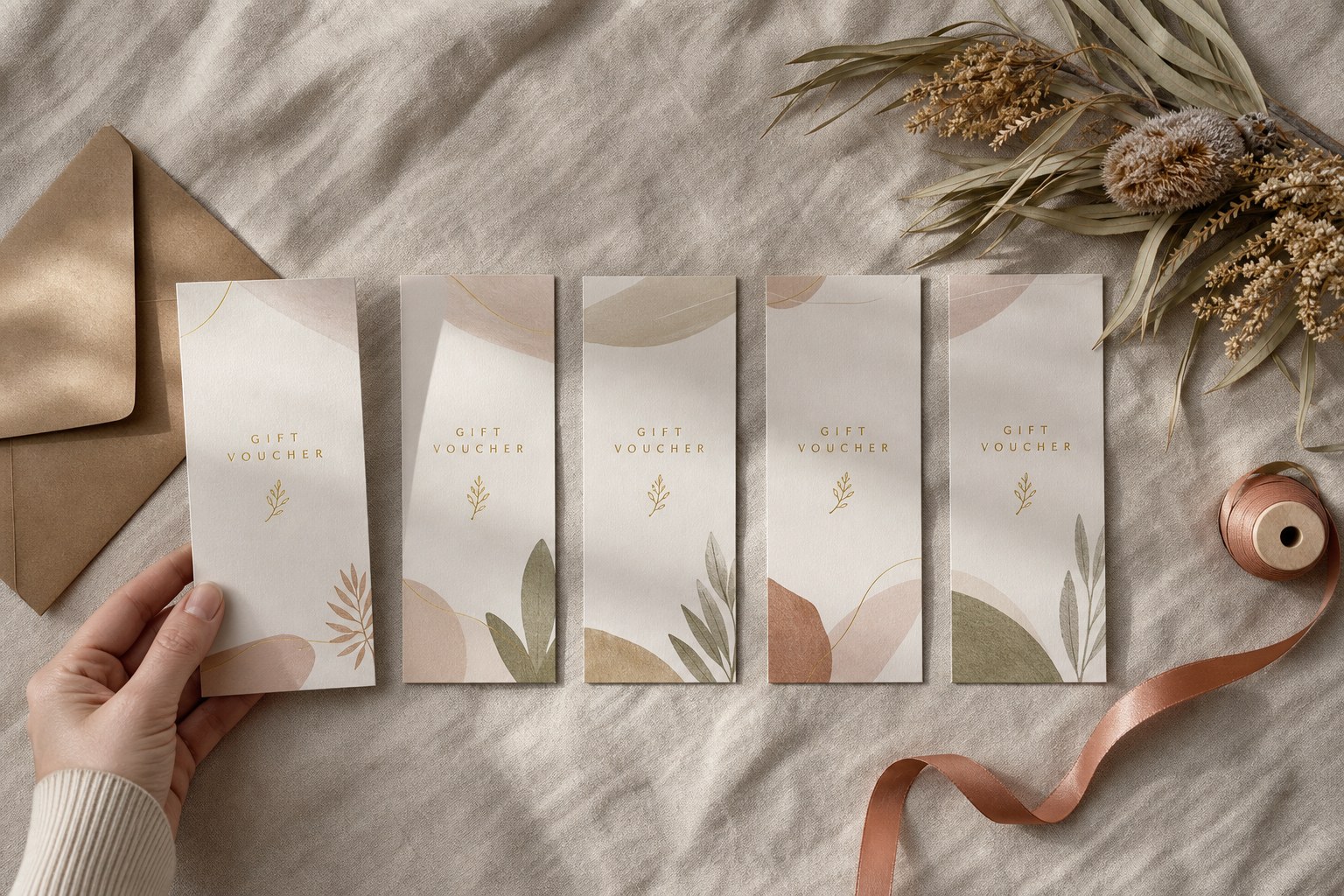
Foil is the fastest way to move a voucher from receipt to gift. Gold, Silver or Rose Gold can be applied to a title, logo or border on the front, on either stock, with no price difference between colours. The distinction is in what your customer feels. The voucher is often the gift itself rather than the proof of one, and the first touch of the card has to carry that moment.
The stock choice supports it. 360gsm Premium Digital is thicker and more rigid than Matt 300gsm Digital, and both are available on any quantity with or without foil. Corners follow the same logic. Square corners are standard at no extra charge. Both rounded corners and simple custom die cut shapes carry a per order extra, set by size and quantity. For A6 at 25 vouchers, rounded corners add $105 and a simple custom die cut adds $115 per order. Complex or irregular shapes are quoted separately.
Be honest about cost. Foil roughly doubles the cost of a small run, and the price ladder in the section above gives the exact numbers to weigh that against. At the 25 voucher rung, the difference between a no-foil and a foil order is the difference between a card that disappears into a wallet and one that gets handed over as a gift.
Variable Data: numbering and codes for a seasonal campaign
Variable Data is where a printed voucher starts working like a sales record. Each voucher can carry sequential numbering, unique voucher codes, recipient names or personalised amounts. You supply the data in a spreadsheet and the data is merged into the design. The price is $0.40 per voucher inclusive of GST, added to the base order total, on any quantity rung and any stock or foil combination.
In December the value is practical. A numbered voucher can be reconciled against the till at the end of the season. A promotional code can be tracked separately from a paid voucher, so a quiet January afternoon can separate what was sold from what was given away. The proof includes a data-merge sample, so the numbering format is checked before the run. Every personalised voucher receives an individual quality check, and any voucher affected by a data error on the team’s side is reprinted at no charge.

The checklist to work through now
Work through the decisions in this order and the December rush becomes a delivery schedule, not a design emergency.
- Decide the format. Settle on DL or A6 before the artwork starts, because the size guide shows how the two proportions change the layout. Vouchers print flat in DL (99 x 210 mm) or A6 (105 x 148 mm), with Front only as standard and front and back printing as an option.
- Set the quantity rung from the ladder after counting a standard December week.
- Decide whether the run needs numbering. Variable Data is the difference between a voucher and a record you can reconcile.
- Write the expiry wording for the back panel now, before the proof stage catches an undecided expiry.
- Check the artwork against the spec. Vouchers are flat, printed in digital CMYK with 3mm bleed; supply artwork for one side on a Front only order or both sides when front and back printing is chosen.
The businesses that sell vouchers well in December are the ones that treated it as a September decision. Whether the voucher run is one part of a storewide push or a standalone order, the Christmas retail print guide rounds out the other items, and the gift voucher printing guide covers the process end to end.
Frequently asked questions
When should a small business order Christmas gift vouchers?
The two dates a business controls are the artwork date and the proof approval date. Work backwards from the day the vouchers need to be on the counter. Artwork has to be finished before the team can email a PDF proof, and no print starts before you approve that proof. Once approved, digital runs take 3 to 5 working days and foil runs take 7 to 10 working days. Delivery is confirmed at order time and comes after production. The order date stays less important than the date the file is ready and the date the proof can be checked.
How many gift vouchers should a business print for Christmas?
Minimum order is 25 vouchers, with published quantities of 25, 50, 100, 250 and 500. On DL Matt 300gsm Digital with Front only printing, 25 vouchers cost $89 and 500 vouchers cost $179, so the per voucher cost moves from $3.56 to $0.36. A sensible first run counts the transactions in a typical December week and takes vouchers as a small share of that, then rounds to a published quantity. Quantities outside the published ones are printed on request, with a full quote confirmed within 1 business day.
Does a Christmas voucher have to show an expiry date?
The ACCC says gift cards purchased on or after 1 November 2019 must be redeemable for at least three years after the day they were supplied or purchased. The expiry date must be prominently displayed, either as a date or as a period of time if the card also shows the date it was issued. A card with no expiry must state “No expiry date” or similar wording. For a Christmas voucher, the three year clock starts on the day it is supplied. This is general information, not legal advice, and a business should confirm its own obligations.
What does a printed voucher cost at 25 vouchers?
At 25 vouchers with Front only printing, Matt 300gsm Digital is $89 in both DL and A6. 360gsm Premium Digital is $159 for DL and $119 for A6. With Gold, Silver or Rose Gold foil on Matt 300gsm Digital, the DL price is $259 and the A6 price is $249. All prices include GST. Front and back printing adds $0.20 per voucher. Square corners are standard at no extra charge. Rounded corners and simple custom die cut shapes each add a per order charge that depends on size and quantity. For A6 at 25 vouchers, rounded corners add $105 and a simple custom die cut adds $115 per order.
Can each voucher carry its own number with Variable Data?
Yes. Variable Data can add sequential numbering, unique voucher codes, recipient names or personalised amounts to each voucher. You supply the data in a spreadsheet and it is merged into the design. The price is $0.40 per voucher inclusive of GST, added to the base order total. Variable Data is available on all quantity rungs and any stock or foil combination. The proof includes a data-merge sample, and any voucher affected by a data error on the team’s side is reprinted at no charge.
Does foil cost more in a particular colour?
No. Gold, Silver and Rose Gold foil go on a title, logo or border on the front, and the colour choice does not change the price. Foil is available on either Matt 300gsm Digital or 360gsm Premium Digital. What changes the price is the size, the quantity, the stock, whether foil is added at all, front and back printing, the corner shape and Variable Data. The colour decision can be made on the finished look rather than the quote.
Where are the vouchers printed and delivered in Australia?
The vouchers are printed and produced in Australia and delivered Australia-wide. Before any run begins, the team sends a PDF proof for your approval, and nothing goes to print until you approve it. That proof step applies wherever the order is sent, so the design is checked before printing starts. The team can confirm the current print and delivery schedule when you order, and the vouchers arrive flat, ready for the counter or a gift envelope.