Twenty famous paintings sit in an odd position. Their originals are held in collections across Europe, the United States and Australia, while the version that reaches your own wall is a reproduction. That second life is usually what sends someone looking for the painter, the year, and what is really going on inside the frame.
What follows are twenty of them in five groups: Vincent van Gogh, the impressionists, the painters of modern life, a run from Japan to Vienna to America, and two Australian pictures that belong in any local conversation. Each entry gives you the painter, the year and one detail worth leaning in for. The last section covers choosing a print of one, from the format to the crop you actually receive.
The short version
- Twenty paintings in five groups, each with its painter, its year and one detail that rewards a closer look.
- Van Gogh, Monet, Hokusai and Klimt all appear, alongside Tom Roberts and Arthur Streeton.
- Museum Collection pictures are out of copyright in Australia, because their makers died more than 70 years ago.
- Any piece can be ordered unframed, in a frame or on canvas, in sizes from A4 to 70 x 100 cm.
- All three formats are offered on each work; the sizes vary, because a shape is listed only where the picture can fill it after a slight trim.
- Judge the preview crop before you order, because the preview shows exactly what will print.
Four Van Gogh paintings you already know by sight
Vincent van Gogh lived from 1853 to 1890, and these four works fall between 1888 and 1890. Between them they carry the yellows, the blues and the branches that come to mind when you hear his name.
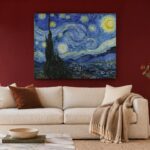
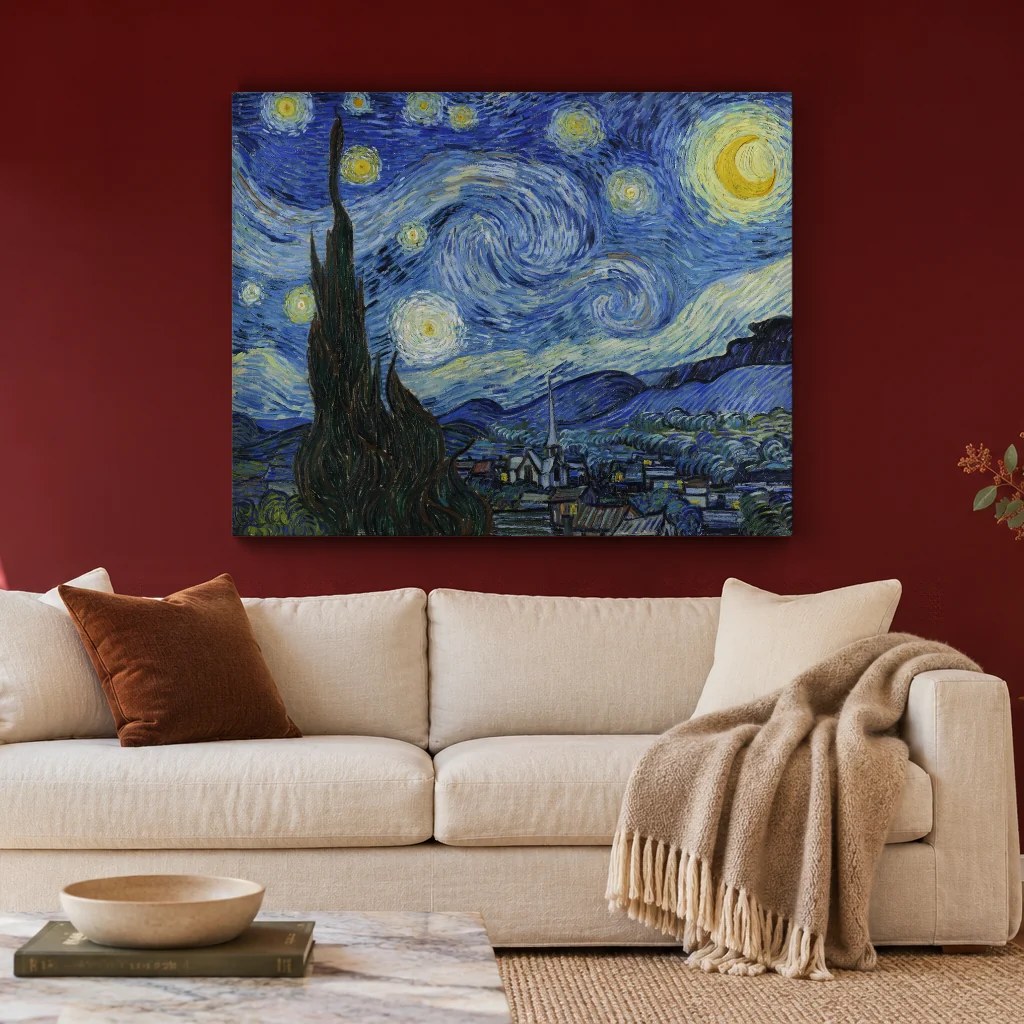
- The Starry Night (1889). A yellow crescent moon and a knot of glowing stars occupy a sky of swirling cobalt and ultramarine. Below that churn, houses and a church spire sit tucked down in the valley, and a dark cypress climbs past the hills towards the top edge. The Museum of Modern Art looks after the original. Greens and deep blues in the landscape hold all that yellow in check, so a Starry Night print settles above a dark timber sideboard or against warm grey paint.
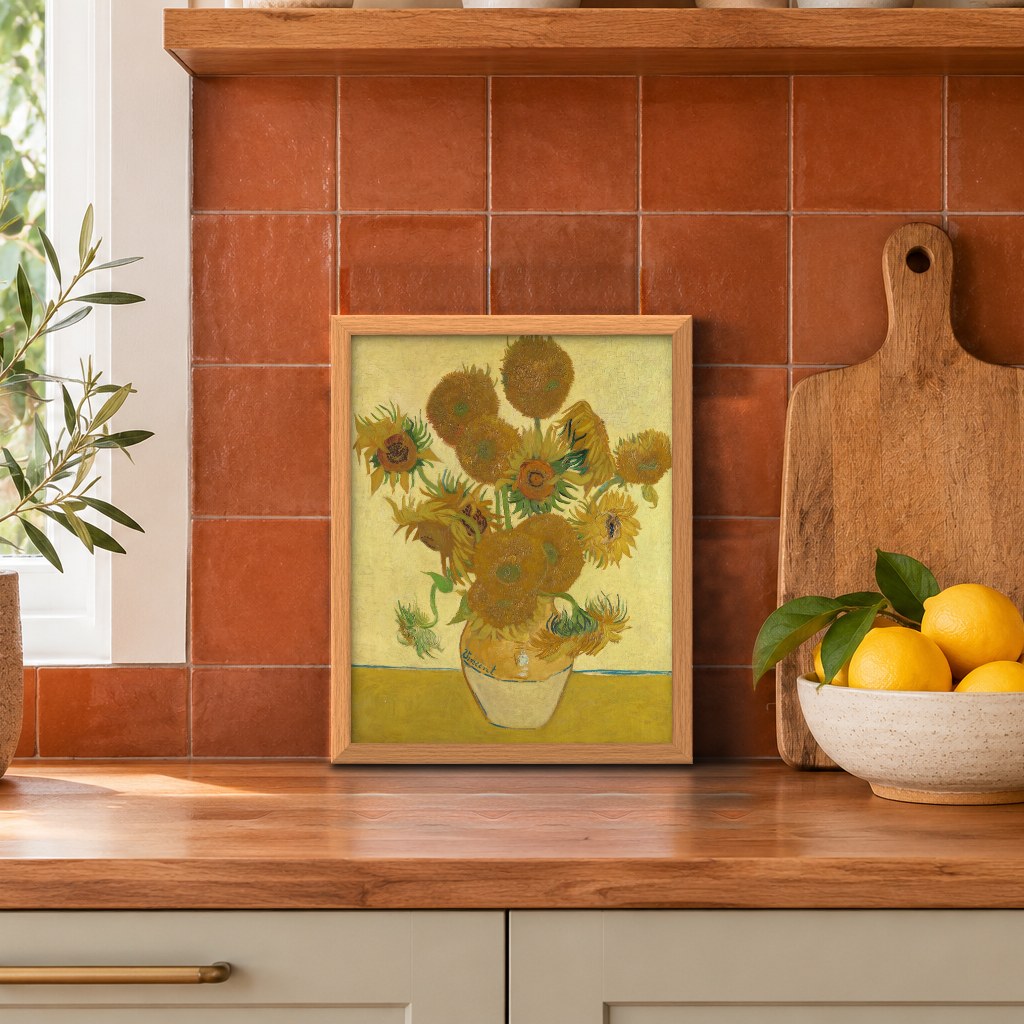
- Sunflowers (1888). Flowers at every stage, from tight bud to wide open face, pack an ochre vase that stands on a golden tabletop, and the pale yellow wall behind carries the warmth right to the edges. The National Gallery in London keeps the painting. In a kitchen or dining room a Sunflowers print lifts the wall, and you can echo the palette with a burnt orange bowl or an olive green chair.
- Café Terrace at Night (1888). A yellow awning covers a terrace of small round tables, seated figures glow under a dark blue sky pricked with stars, and a cobbled street heads off to the right. Van Gogh painted it in 1888 and the Kröller-Müller Museum has the painting. Golden yellow and ochre warm a dining room or a long hallway, and a Café Terrace at Night print will not be lost against navy or cobalt walls.
- Almond Blossom (1890). Grey-green branches twist across a flat turquoise ground, some in open white flower and others still tight buds. It was painted in 1890 and now belongs to the Van Gogh Museum. Because the background is even, the blossom sits forward with almost no shadow, so an Almond Blossom print is an easy fit for a study, bedroom or hallway painted white or lined with light timber.
Five impressionist paintings and the light they chased
These five share a habit: they catch a moment rather than a pose, whether that is a low sun over hazy water or a rehearsal room mid-stretch. Each is also a lesson in where colour sits, which matters once the picture has to work with the room around it.
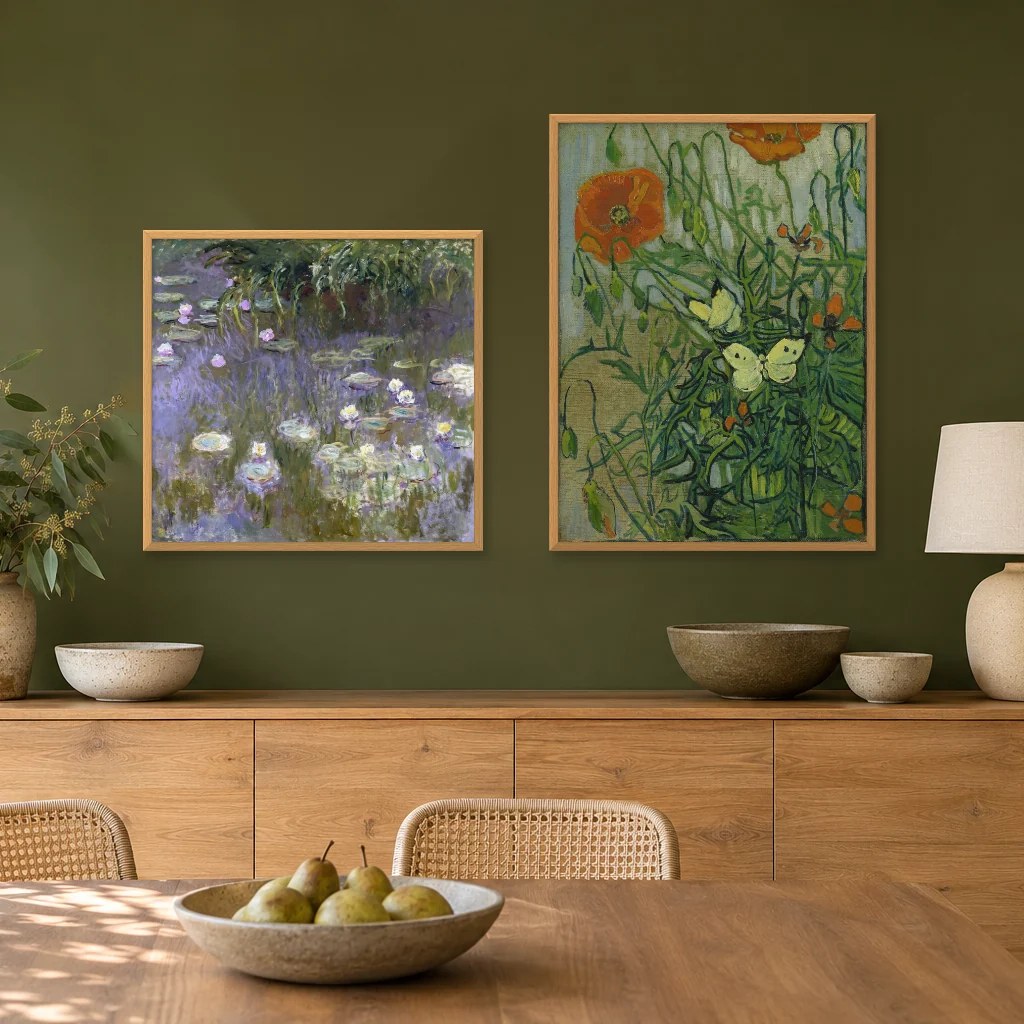
- Water Lilies, Claude Monet (1906). No horizon line interrupts this view: you look down into the pond itself. Lilac and blue water carries the reflection of trees, a dark band of foliage crosses the top, and white and pink flowers float over green pads through the lower part of the picture. The Art Institute of Chicago holds the painting. Hang a Water Lilies print at about the height of your own eyes while sitting, and the paint reads as water instead of decoration.
- Impression, Sunrise, Claude Monet (1872). One figure rows across hazy water while a low red-orange sun sits above the faint shapes of industrial chimneys. Monet dated the work 1872. The Musée Marmottan Monet has the painting. Cool greys, teals and dusky blues settle the scene, so that one warm note pulls the eye, and an Impression, Sunrise print works above a desk or on a narrow strip of wall.
- Woman with a Parasol (1875). Claude Monet painted his wife Camille and their son Jean in 1875. She stands on a hillside in a pale dress holding a green parasol, the boy in his straw hat close by, and blue sky taking up much of the space above the meadow grass. His name is lettered inside the picture itself. Sky blue, grass green, cream and pale grey make a Woman with a Parasol print restful beside a reading chair, particularly where pale wood or linen are already in the room.
- Luncheon of the Boating Party (1881), Pierre-Auguste Renoir. A red-and-white awning runs above a long table laid with bottles, glasses and fruit, men and women seated along it, and a dog down at the near end beside the woman in the red hat. Renoir finished it in 1881 and The Phillips Collection owns the painting. Cherry red, straw yellow, navy, cream and leaf green hold together without shouting, which makes a Luncheon of the Boating Party print a natural for a kitchen or a dining wall you spend time looking at.
- The Dance Class, Edgar Degas (1874). Degas gives you a rehearsal room with sage green walls and bare boards, where pupils in white tulle flex and tug their coloured sashes while the teacher, white haired in a dark suit, leans on a long stick. One girl stands with her back to you near a piano holding open sheet music. The Metropolitan Museum of Art holds the picture. A Dance Class print suits a hallway or study, where sage and warm brown have room to settle.
Four paintings of modern life, four different settings
Each of these puts you in a specific place and lets the detail do the talking. A park on a Sunday, a wet pavement, a bar counter, a garden at dusk: the subject is less the people than the hour they are standing in.
- A Sunday on La Grande Jatte, Georges Seurat (1884 to 1886). Seurat worked on it between 1884 and 1886, and nothing in the picture is blended: grass, water and figures are all made from small separate touches. Sun and shade fall across the lawn in bands. A woman stands in profile under a black parasol with a small monkey on a lead, a girl runs up the bank, and out on the water sit sailboats and a small steamboat. The Art Institute of Chicago holds the painting. A Grande Jatte print wants a wide wall, where those yellow greens and river blues can spread out.
- Paris Street, Rainy Day, Gustave Caillebotte (1877). Two figures under grey umbrellas cross wet cobbles, a green lamp post beside them and a horse-drawn cart standing before tall cream buildings. Caillebotte painted it in 1877, looking across the Place de Dublin, with the rue Clapeyron and the rue de Moscou both inside the view. Slate grey and cream dominate, warmed through with ochre and sage green, so a Paris Street, Rainy Day print suits a dining room or study with even light.
- A Bar at the Folies-Bergère, Edouard Manet (1882). The woman behind the counter meets your eye directly, in a dark dress, bottles and a glass of beer lined up on the marble in front of her with a bowl of oranges beside them, the crowd and its balcony behind. Manet painted it in 1882 and the Courtauld Gallery holds it. Black, champagne cream and marble grey do most of the work, with rose pink and one flash of orange, so the Folies-Bergère picture suits a dining room where cool greys have space.
- Carnation, Lily, Lily, Rose, John Singer Sargent (1886). Two girls in white dresses stand among tall lilies and pink flowers, each holding a paper lantern glowing pink against the darkening garden. Sargent worked in oil on canvas in 1886, and Tate Britain owns the painting. Lantern light against deep green foliage, with white dresses and touches of peach, sets the hour just after sunset, and a Carnation, Lily, Lily, Rose print suits a landing, where you pass it on the way to bed.
From Japan to Vienna to America: five pictures that crossed borders
This group starts with a wave off Kanagawa and ends in front of a white farmhouse, with a Viennese embrace and a railed bridge in between. What holds them together is scale: each one makes a single image do a great deal of work.
- The Great Wave off Kanagawa, Katsushika Hokusai (1831). A wave rears up on the left of the picture, its crest splitting into white fingers that hang over three wooden boats. Mount Fuji, small and capped with snow, waits far off behind the rising water. Hokusai drew it in 1831, and the Library of Congress holds the original. Blues and teals dominate with tan warming the boats, and a single Great Wave print can carry a living room wall by itself.
- Fine Wind, Clear Morning (Red Fuji), 1831, by Katsushika Hokusai. Fuji fills the view in red-brown, a dark band of forest at the foot of the slope and deep blue sky above streaked with thin white cloud. The Tokyo Fuji Art Museum holds the original. That clash of brick red on deep blue does most of the carrying, so a Red Fuji print fits a hallway or study that already has pale wood in it.
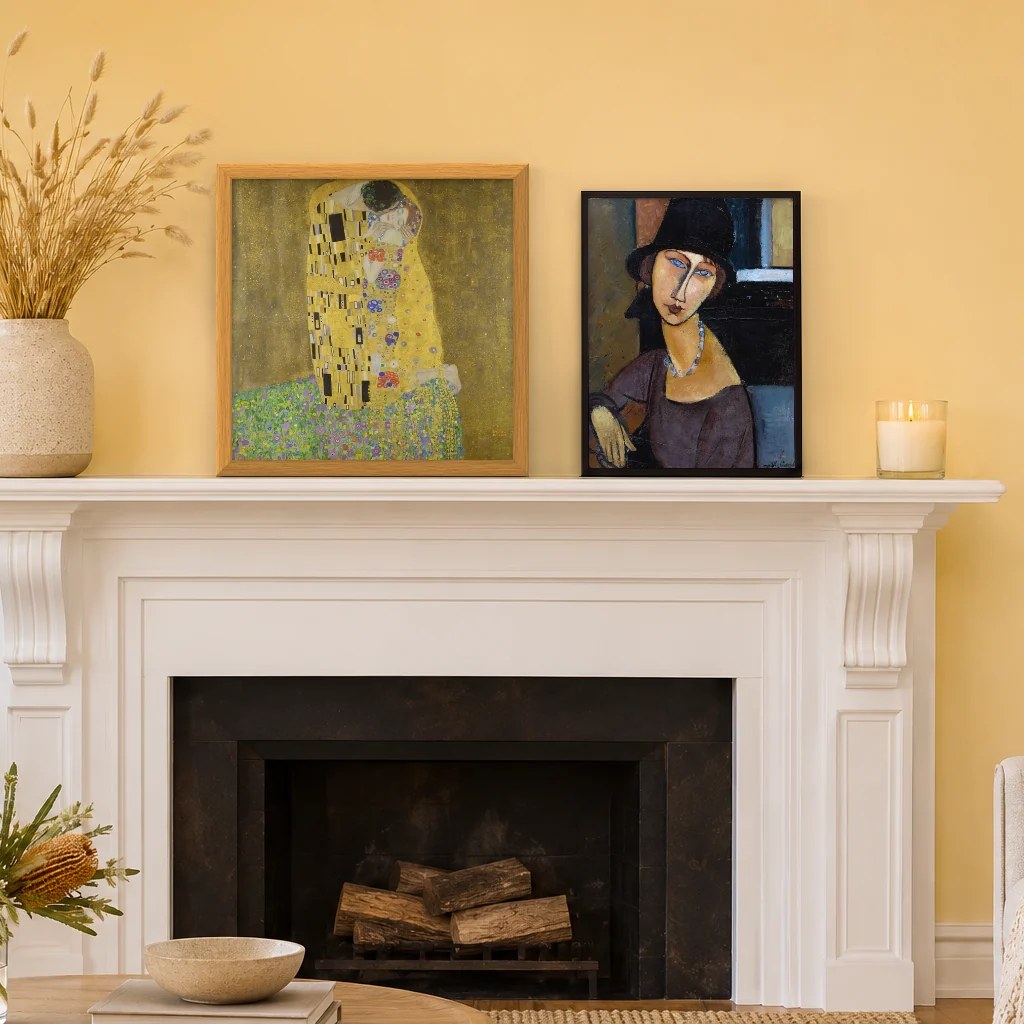
- The Kiss, Gustav Klimt (1908/1909). The pair embrace where a small meadow of flowers begins. She kneels with her face turned away, he bends low above her, and their robes do the rest: rectangles of black, white and gold on him, circles of colour on hers. Klimt finished it in 1908/1909 and the Belvedere in Vienna has it. Gold and olive brown warm a room without making noise, and the violet and green flowers stop it turning stuffy, which makes The Kiss a good fit for a bedroom or a front room you use at night.
- The Scream, Edvard Munch (1893). A pale figure with an open mouth stands on a bridge with a railing, the sky above rolling in bands of red and orange, dark blue water and hills behind. Munch put his signature and the date inside the picture itself: E.Munch 1893. Those reds and oranges take over a room, so give The Scream a hallway or dining room wall near dark timber and let the colours answer back.
- American Gothic, Grant Wood (1930). Overalls, round glasses and a pitchfork: that is the man in front, with a woman in a patterned brown dress beside him, a cameo at her collar, and a white farmhouse and red barn filling the space behind. Wood painted it in oil on Beaver Board in 1930, the lettering in the picture spells GRANT WOOD, and it now sits in the Art Institute of Chicago. Pale blue, cream, brown and red give a wall warm and cool notes at once, which is why an American Gothic print does well in a kitchen or hallway with daylight.
Two Australian paintings that belong on a local wall
Tom Roberts finished Shearing the Rams in 1890, and it drops you into a timber shed mid-shift: one shearer bent over a sheep at the centre, a boy standing to the left, the boards and the fleece running through warm tan, pink, brown and cream. The National Gallery of Victoria looks after the painting. A Shearing the Rams print brings a busy, warm surface, and a hallway or study with timber furniture absorbs it without strain.
Golden Summer, Eaglemont is Arthur Streeton’s, painted in 1889 and held by the National Gallery of Australia. A dry slope fills most of the picture, its grass pale gold in strong sun, with long blue shadows lying over the ground below. A few thin gums stand at the right, a single small figure beside them, and the distance closes in blue hills under a pale streaked sky. A Golden Summer print warms a hallway or living room, and a view that wide earns a wall you see from across the room.
How to choose a print of a famous painting
You can order any of the twenty above as a bare sheet, in a frame or on stretched canvas, with sizes running from A4 to 70 x 100 cm. The art print is archival giclée ink on 200gsm matte paper, made to sit in a frame you already own. A framed print needs no work once it arrives: the frame is 20 mm, in oak look, black or white, and perspex sits at the front rather than glass, with no mount as standard and a white mount if you want one. Canvas is 400gsm over a 38 mm stretcher, with the full picture kept on the face and its edge mirrored down each side. It arrives without hanging hardware. Sizes are not uniform across the range, and that is deliberate: a shape appears only where the picture can fill it after a slight trim and the file still carries detail at that scale. Artwork pages open on 50 x 70 cm, and the preview shows the crop you will actually receive, so study it before you order. If your wall is heading towards Monet, Renoir and Degas, the impressionist art prints collection gathers those painters in one place.
Every painter, printmaker and designer behind these pictures died more than 70 years ago, so copyright has expired in Australia and the images sit in the public domain. Files reach us through a mix of libraries, museum archives and public image archives; we clean dust, marks and uneven colour, and we never repaint the picture. A credit line names the collection that holds the original where our records document it, and reads public domain otherwise. No museum, gallery or library endorses these prints or supplies them. The same pictures also come as an exhibition poster, where the image sits on a sheet alongside the artist’s name, the artwork’s title, its year and the artist’s dates, all set in our own type. The Gallery version sets the picture on a plain paper field; the Colour version takes a shade out of the painting and uses it as the surround. No museum or exhibition is named on the sheet. Beyond these, the full wall art range takes in Australian Masters, Japanese Woodblock and William Morris. A print is a reproduction rather than an original, which is exactly why it can hang in a hallway where a bike leans against the wall.
Frequently asked questions
Where is The Starry Night held today?
The Museum of Modern Art holds the original of The Starry Night, painted by Vincent van Gogh in 1889. Anything you hang at home is a print made from a public image file rather than the painting itself, and our credit line names that collection where our records document it. It is a reproduction, not an original.
Can famous paintings be printed in Australia?
For the pictures in this range, yes. Everyone who made them died more than 70 years ago, so copyright has expired in Australia. The image files are sourced from museums, libraries and public image archives, and we clear dust, marks and uneven colour without repainting anything. Where our records name the holding collection, the credit line says so; otherwise it reads public domain.
What size print suits a famous painting?
Start with the wall rather than the picture. Our room photos put two 50 x 70 cm canvases above a sofa, one 70 x 100 cm canvas above a bed, and a white framed A3 in a bathroom that stays dry. Sizes run from A4 to 70 x 100 cm, though each work lists only the shapes its picture can fill after a slight trim, so check the artwork you have chosen.
What is the exhibition poster layout?
An exhibition poster carries the image on paper with the artist’s name, the title, the year and the artist’s dates, all set in our own type. There are two looks: the Gallery version on an unprinted paper ground, and the Colour version, whose surround takes its cue from a colour in the picture. No museum or exhibition is named on the sheet, and none endorses it.
Is The Great Wave a painting or a print?
The Great Wave off Kanagawa is a woodblock print rather than a painting. Katsushika Hokusai drew it in 1831, and the Library of Congress holds the original. The picture shows a crest breaking into white fingers above three wooden boats, with Mount Fuji small and snow-capped in the distance.
What does the credit line on a museum print mean?
The credit line records the collection that holds the original painting, and only where our records document it; otherwise it reads public domain. It is a note about where the picture came from, nothing more. No institution endorses these prints or supplies them, and every one is a reproduction, printed in Australia from a file cleaned of dust, marks and uneven colour, with nothing repainted.