The week after a death is filled with decisions, and choosing funeral hymns and readings often comes down to a few evenings at the kitchen table with a list from the celebrant or minister. You want words that sound like the person you loved, but you also need them to sit cleanly in the printed booklet.
This guide steps through the hymns, readings, poems and funeral songs families often choose, shows how the words sit across the booklet, and explains which words you can print in plain terms.
The short version
- Old hymns such as Amazing Grace and Abide with Me are usually out of copyright, so you can print the words.
- How Great Thou Art and Morning Has Broken are two familiar hymns still in copyright in Australia.
- Religious services often use a Bible reading, while non-religious services often use Death Is Nothing at All.
- Poems families often choose include Remember, Crossing the Bar and Clancy of the Overflow, but treat Do Not Stand at My Grave and Weep as in copyright.
- Printed song lyrics usually need permission; the song title and artist on the service page are enough.
- Our designs give one page to a poem or reading and one to the hymn or song words.
Traditional funeral hymns and what each one suits
Many Australian services open with a hymn the family knows from childhood, with the words usually printed on one page so people can sing with confidence.
| Hymn | Words by | Written | Words in copyright? |
|---|---|---|---|
| Amazing Grace | John Newton (died 1807) | 1779 | No, out of copyright |
| Abide with Me | Henry Francis Lyte (died 1847) | 1847 | No, out of copyright |
| The Lord’s My Shepherd | The Scottish Psalter | 1650 | No, out of copyright |
| Be Still, My Soul | Katharina von Schlegel in German, English words by Jane Borthwick (died 1897) | 1752, English 1855 | No, out of copyright |
| How Great Thou Art | English words by Stuart K. Hine (died 1989), from a Swedish poem by Carl Boberg | English 1949, Swedish 1885 | Yes, the English words are in copyright |
| Morning Has Broken | Eleanor Farjeon (died 1965) | 1931 | Yes, in copyright |
Amazing Grace carries the mood of grace and homecoming, and it is sung by people of many backgrounds. Abide with Me suits evening and the sense of a steadfast presence. The Lord’s My Shepherd is about comfort and being led with care, while Be Still, My Soul suits calm and trust.
How Great Thou Art suits wonder at creation; the English words are still in copyright, so permission is needed before you print them. Morning Has Broken suits morning light and gratitude, and those words are also protected, so the same permission applies. Both titles can appear in the list of the service even when the full words cannot be printed.
Funeral readings for religious and non-religious services
Religious services often draw on one of four Bible readings. Psalm 23 is about the Lord as shepherd and comfort. Ecclesiastes 3:1 to 8 is about a time for everything. John 14:1 to 3 describes many rooms and a place prepared. Romans 8:38 to 39 is about love that cannot be broken.
Bible translations differ, and each translation carries its own copyright notice, so ask the minister or celebrant which translation the service uses before you print the passage. For a service without religious wording, Death Is Nothing at All comes from a sermon by Henry Scott Holland given in 1910 and is out of copyright. It fits well when the service has no religious language.
One reading is usually enough for a short service; choose two if the service is longer and the celebrant or minister has room for both. The reader can be a family member, a friend or a grandchild. If the person reading is nervous, it helps to hold the booklet low, pause after the title, and read the piece once aloud at home before the day. Keep the reading to a length that suits the service so the moment lands without the printed page becoming a burden. Whoever reads it should be named on the order of service page so they know when to rise.
Funeral poems families often choose
| Poem | Poet | Written | In copyright? |
|---|---|---|---|
| Remember | Christina Rossetti (died 1894) | 1862 | No |
| Crossing the Bar | Alfred, Lord Tennyson (died 1892) | 1889 | No |
| Death Is Nothing at All | Henry Scott Holland (died 1918) | 1910 | No |
| Ode of Remembrance (from For the Fallen) | Laurence Binyon (died 1943) | 1914 | No |
| Clancy of the Overflow | Banjo Paterson (died 1941) | 1889 | No |
| Do Not Stand at My Grave and Weep | Usually credited to Mary Elizabeth Frye (died 2004), authorship disputed | Often dated 1932 | Treat as in copyright |
Remember is about being remembered with a smile rather than sadness. Crossing the Bar suits a calm last voyage and often fits a life by the sea. Death Is Nothing at All speaks of nearness rather than final parting and fits a service with no religious content. Ode of Remembrance, from For the Fallen, is often chosen for a returned service person. Clancy of the Overflow suits a life in the bush and droving country.
Do Not Stand at My Grave and Weep offers the person present in nature, but the authorship is disputed. The safe course is to treat it as in copyright and ask permission before printing the full poem.
Placing the words in the order of service
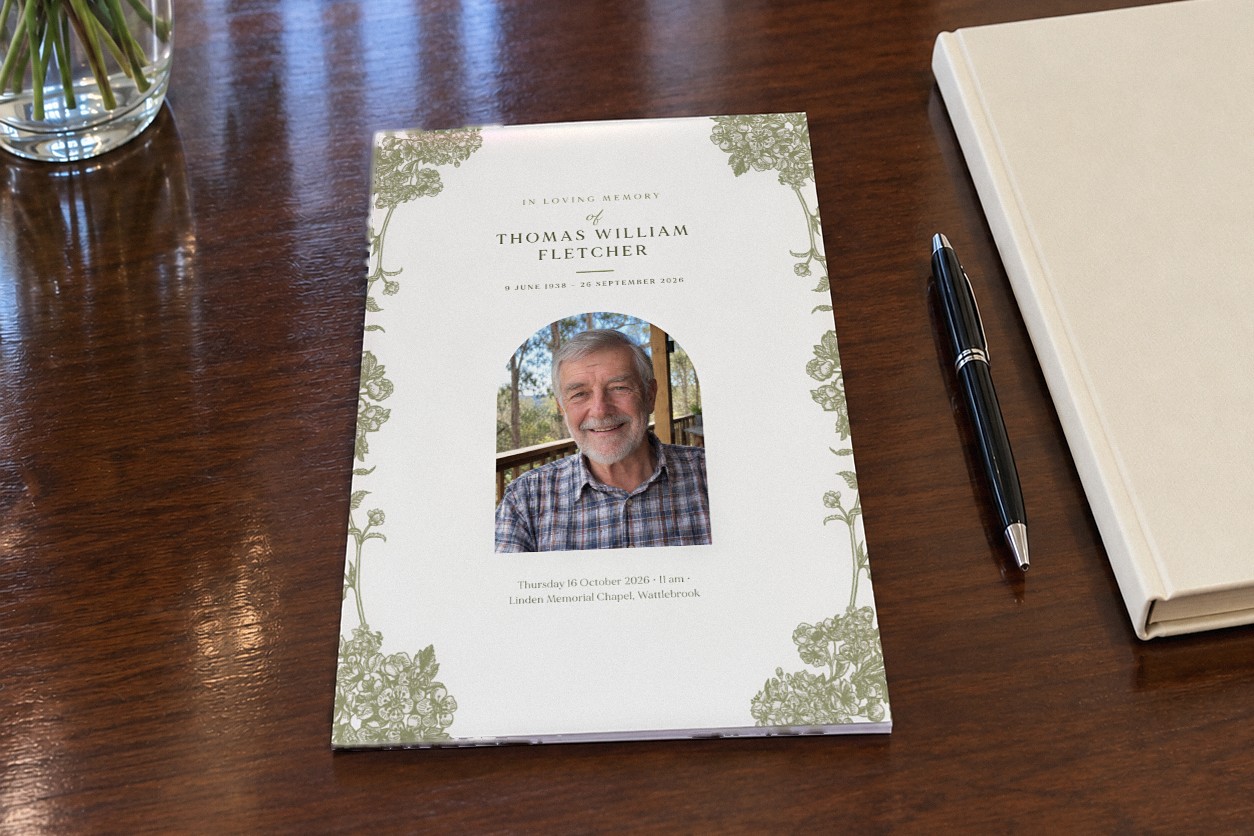
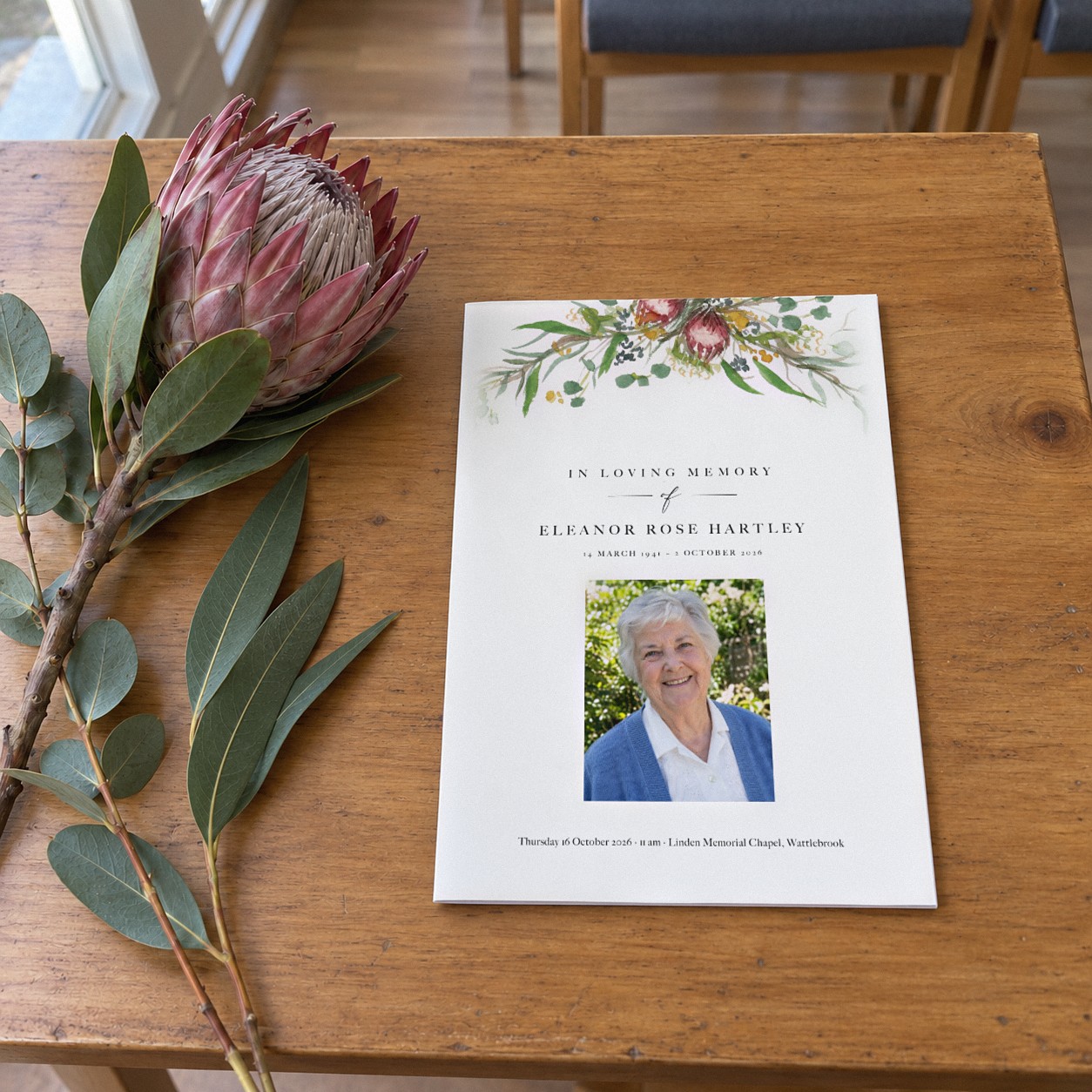
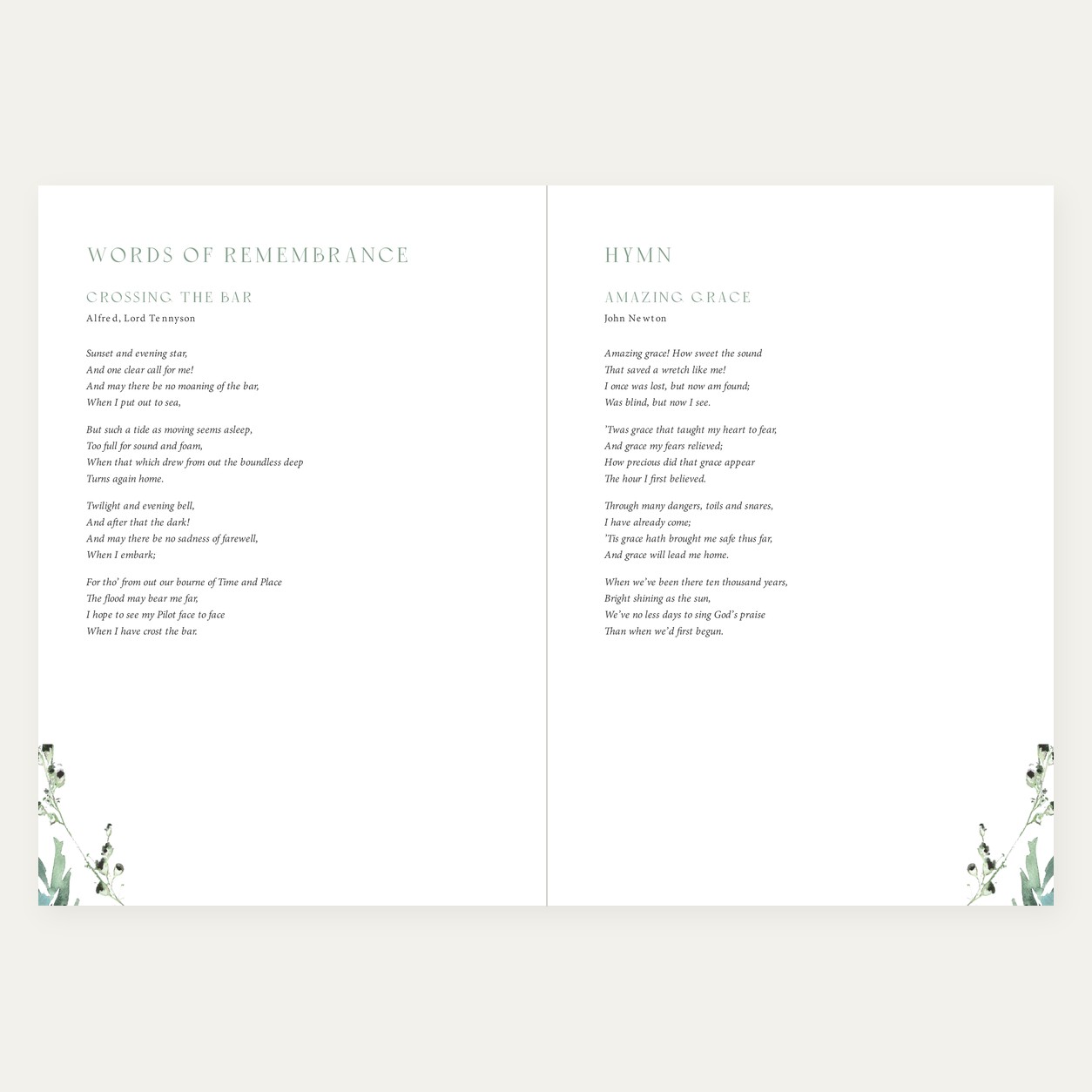
Once the words are chosen, they need a clean page. Our designs follow an eight page plan. Page 6 is the Words of Remembrance page for a poem or reading, and page 7 is for hymn or song words. Put the title on the page and the author beneath it, keep each piece to one page, and leave space between the verses so the page does not feel tight. Choose a type size older guests can read without glasses, and list the reader by name in the service sequence.
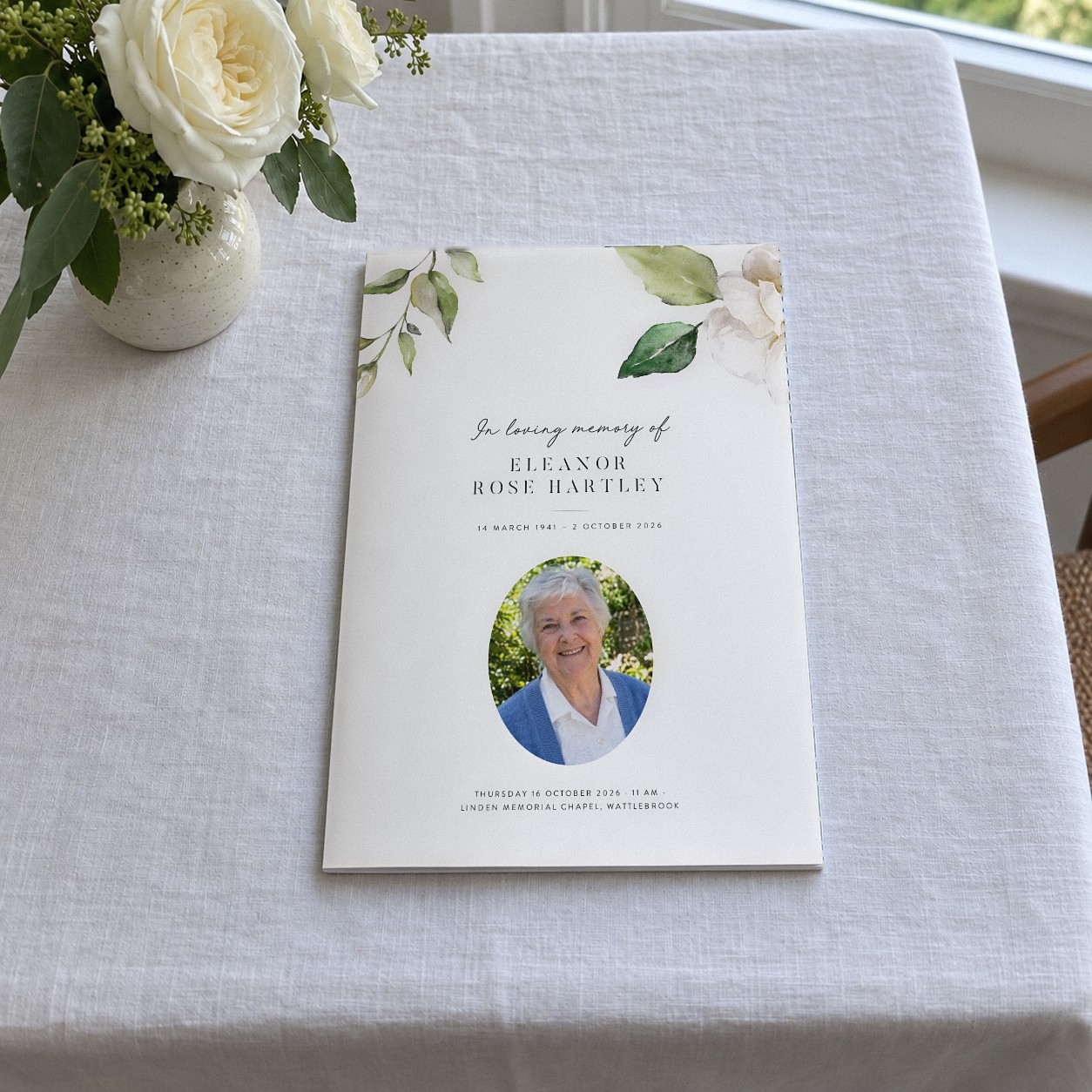
In the 8 page sample booklets, the Eucalyptus, White Garden and Sarulean designs print Remember by Christina Rossetti on the Words of Remembrance page, while the Love and Leaves, Visco Garden and Byron designs print Crossing the Bar by Alfred, Lord Tennyson. Every sample prints Amazing Grace by John Newton on the hymn page. A 12 page sample keeps both poems in the booklet. These choices are not fixed. They show how a poem and a hymn each sit on their own page in a finished booklet. If a hymn is long, ask the minister or celebrant which verses to include so it stays on one page.
If you need more room, the page plan in our funeral order of service booklets adds extra reading pages when you choose a 12 to 20 page booklet. A longer booklet can hold a reading page, a second poem and additional photo spreads without crowding the words.
Funeral songs and recorded music
Recorded songs are often played as people enter, during a photo tribute, and as the service closes. Printing the lyrics is a different matter from playing the recording. Most families print the song title and the artist in the service list instead of the lyrics, which keeps the booklet clean and avoids copyright trouble.
If you do want the lyrics printed, ask the church, celebrant or funeral director whether their permission extends to printed words, or seek the publisher’s permission. Do not assume that a licence for the service covers the printed page.
Copyright and what you can print
Under Australian law, copyright generally lasts for 70 years following the death of the creator, and published works whose creator died before 1 January 1955 are generally in the public domain. That is why the older hymns and poems in the tables above can normally be printed, while How Great Thou Art, Morning Has Broken and Do Not Stand at My Grave and Weep need more care.
The Copyright Agency’s licence for celebrants covers printing readings for a funeral, but it does not cover song lyrics. Under the Copyright Act 1968, permission is usually required for lyrics and sheet music. Ask the person leading the service whether their own licence covers the words before you print anything still in copyright, or ask the publisher for permission. This is general information, not legal advice.
When you are ready to finalise the words and confirm the print date, the ordering guide steps through timing, proof approval and what to write in the checkout notes.
Frequently asked questions
Which funeral hymns are often chosen for Australian funerals?
Amazing Grace, Abide with Me, The Lord’s My Shepherd and Be Still, My Soul are common choices, and their older wording is out of copyright in Australia. How Great Thou Art has English words still in copyright, and Morning Has Broken is also protected, so permission is needed before printing the full words of either.
Can we print the words of a hymn in the booklet?
You can print the words of an older hymn if the wording is out of copyright. For example, Amazing Grace, Abide with Me, The Lord’s My Shepherd and Be Still, My Soul can be printed. For How Great Thou Art and Morning Has Broken, the words are still protected, so ask the person leading the service or the publisher before printing them.
Can we print song lyrics in the order of service?
Printing song lyrics is different from playing a recorded song at the service. The Copyright Agency’s celebrant licence does not cover song lyrics, and permission is usually required under the Copyright Act 1968. Many families print the song title and artist instead. If you want the full lyrics, ask the church, celebrant or funeral director whether their licence includes printed lyrics, or approach the publisher.
What reading or poem suits a non religious service?
Death Is Nothing at All is a familiar choice for a service held without religious elements, and the words are out of copyright. Henry Scott Holland gave the sermon in 1910. Poems such as Remember and Crossing the Bar can also suit the tone of the day, depending on the person’s character and the life you are remembering.
Is Amazing Grace out of copyright?
Yes. The words were written by John Newton in 1779, and he died in 1807. Under Australian law, copyright generally lasts for 70 years after the death of the creator, and works by creators who died before 1 January 1955 are generally in the public domain. That means the words of Amazing Grace can be printed in an order of service.
Where do the hymn and poem go in the booklet?
In our eight page booklet, page 6 is the page headed Words of Remembrance, and page 7 is for hymn or song words. Longer booklets of 12 to 20 pages add a reading page or a second poem. The order of service on page 2 names each piece in the service list, including the reader.