

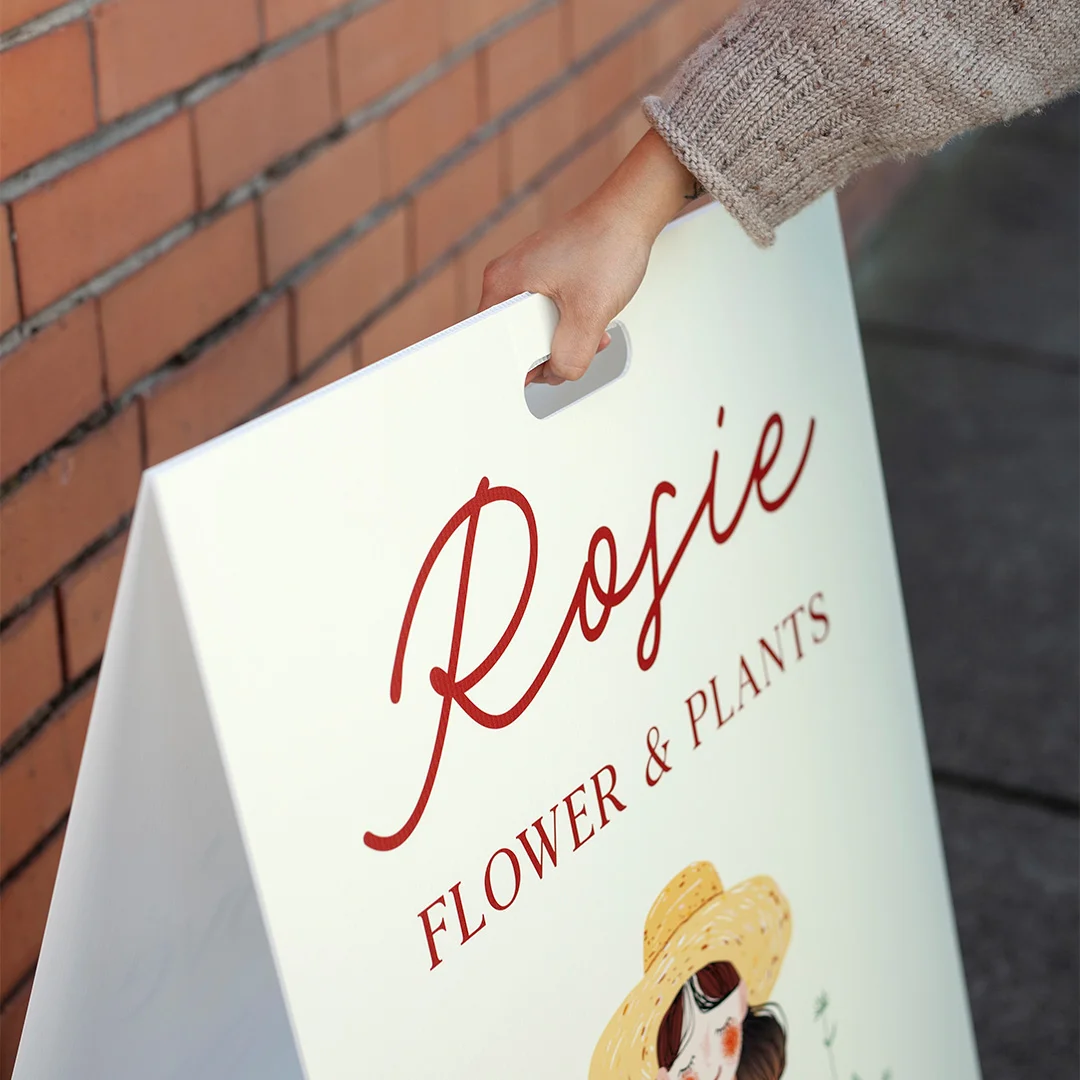
Small businesses spend thousands on digital advertising but often overlook the one marketing tool that works hardest at street level: the humble A-frame sign. Placed well, a corflute A-frame captures attention from pedestrians who are already in your neighbourhood, already in a buying frame of mind, and just one door away. This guide looks at how Australian small businesses use A-frame and sandwich board signs to drive foot traffic, what works, and how to get yours working harder.
- A-frame signs work because they intercept potential customers at the moment of decision, not hours earlier via a social media ad.
- The highest-converting messages are one offer plus one action (no more).
- Businesses that rotate their messaging fortnightly see significantly better engagement than those with a static display.
- Placement at pedestrian decision points (corners, precinct entrances, natural pauses) outperforms placement directly outside the shopfront.
- For full specs, sizes, and material comparisons, see the A-frame signs complete guide.
Why A-Frame Signs Drive Foot Traffic
Most advertising works on a delay. You see a social post or a Google ad, you might act on it later, or you might not. An A-frame sign on the footpath operates on a fundamentally different logic: the person reading it is already standing near your business, and your message can convert that proximity into an immediate visit.
This is the reason A-frames continue to deliver strong results even for businesses with active digital marketing. Digital reaches people who are elsewhere. An A-frame reaches people who are already there.
Research consistently shows that a significant proportion of retail and hospitality purchases are impulse decisions made within 20 metres of the point of sale. A well-positioned A-frame is one of the most reliable triggers for that kind of impulse action. You are not fighting for attention in a crowded feed. You have the person’s physical presence working in your favour.
Which Small Businesses Benefit Most
A-frame signs work for any business with walk-past potential. The category breakdown in Australia looks like this:
Cafes and hospitality
Daily specials, breakfast hours, happy hour offers, and new menu items are all classic A-frame territory. The key is that the offer must be time-sensitive or feel like insider knowledge: “Scrambled eggs and sourdough $14 until 10am” works harder than “Great coffee inside.” The urgency drives action.
Retail boutiques and gift shops
Seasonal promotions, clearance events, and new arrivals announcements suit A-frames well. For retail, the goal is usually to give a reason to browse, not to close a sale on the footpath. A message like “New winter arrivals – just landed” creates curiosity and a reason to step through the door.
Real estate agencies
Open home signage is one of the largest uses of A-frames in Australia. Corflute inserts with property addresses, open home times, and directional arrows are placed at road junctions to guide buyers to the property. Real estate agents typically carry a kit of frames and a batch of pre-printed inserts to deploy quickly on open home mornings.
Medical and allied health practices
Appointment reminders, new service announcements, and flu shot promotions all work well in a medical context. The audience is people walking to and from the practice. Many are existing patients or potential patients in the area.
Hair and beauty salons
Walk-in availability, special offers, and new services. The A-frame functions as a real-time status update for potential clients walking past who had not planned a visit.
Pop-up stalls and markets
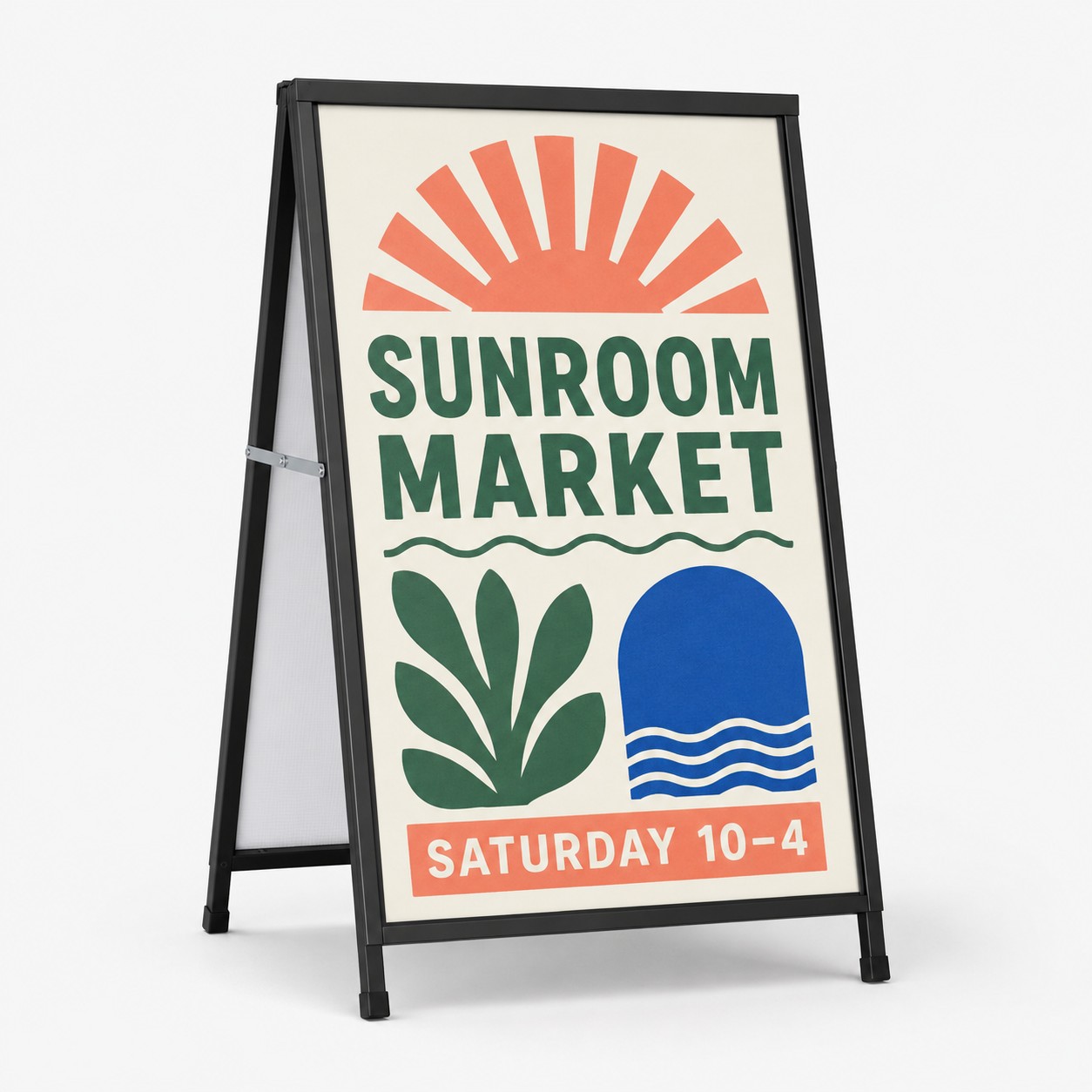
At market events and pop-up activations, an A-frame is one of the fastest ways to claim visual territory. It marks your space from a distance and starts communicating before a customer reaches your table.
What Makes a Compelling A-Frame Message
The constraints of an A-frame sign are actually its strength. You cannot fit a paragraph on a 600 x 900mm panel, so you are forced to distill your offer down to its most essential form.
The best A-frame messages share three characteristics:
Specificity beats generality. “Great coffee” tells a pedestrian nothing they do not already assume. “Single-origin Ethiopia, roasted this week” creates interest. Specific claims are more believable and more memorable.
Create a reason to act now, not later. Time-limited offers, limited quantities, or simply noting that something is new all create a small urgency that shifts a “maybe later” into a “let me just have a quick look.”
One idea per panel. Every element on the sign beyond your core offer dilutes attention. Your business name, a strong headline, and a single action is the full inventory. Resist the temptation to list every product or add social media handles. Nobody transcribes a handle from a footpath sign.
Placement Strategies That Work
Getting the placement right can double or triple the effective reach of an A-frame compared with simply sitting it directly outside your front door.
Corner placement. If your business is on a corner or near a T-junction, a sign at the corner intercepts traffic from two directions rather than one. The same sign, moved 15 metres to the corner, may reach twice as many people.
Funnel placements. Natural pedestrian funnels include the entrance to a laneway, the exit from a train station, the gap between two shops on a busy strip, and the bottom of a set of stairs. Signs placed at these points intercept everyone who passes through.
Dwell points. Pedestrians naturally slow or stop at traffic lights, bus stops, and cafe tables spilling onto the footpath. A sign positioned to be read from a seated or stationary position has longer effective reading time.
Council footpath rules. Before placing your A-frame on public footpath, check with your local council. Most Australian councils permit footpath signs within defined distances from your building and require a minimum unobstructed pedestrian clearance (commonly 1.5 metres). Some councils charge a footpath trading fee or require a permit. This is the business owner’s responsibility to confirm.

Rotating Your Messages for Maximum Impact
A static A-frame becomes invisible to regulars within about two weeks. The human attention system is highly tuned to change and novelty. It filters out objects that have not moved or changed since the last time you walked past.
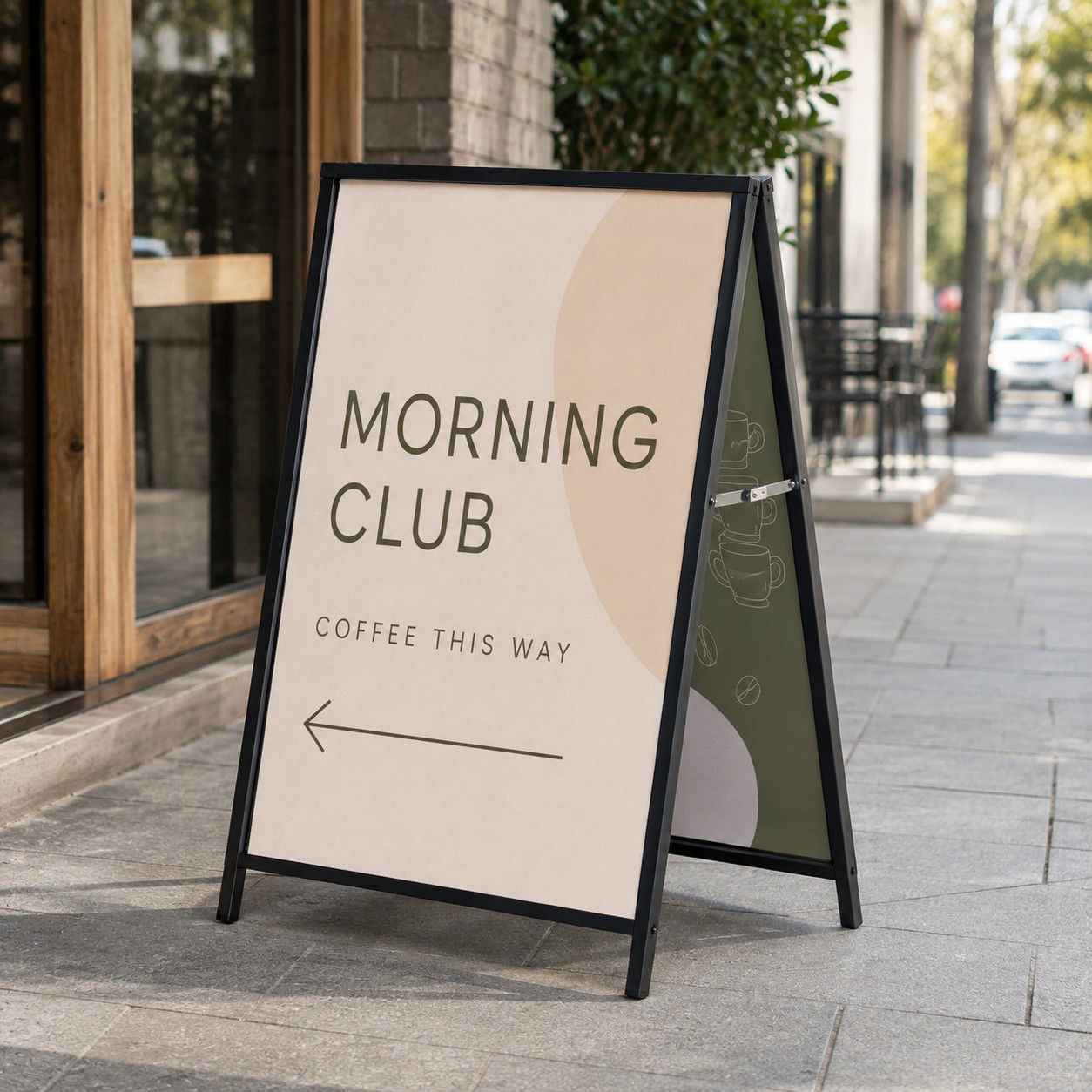
The solution is a batch of inserts rather than a single panel. With five or six different inserts for a 600 x 900mm frame, you can rotate weekly and ensure that regulars are always seeing something fresh. Corflute inserts are inexpensive enough that ordering a batch of six at a time is a practical marketing expense rather than a luxury.
Rotation also gives you the ability to test messages. Two inserts rotated week by week will quickly show you whether “Tuesday curry specials $16” outperforms “Lunch menu from $14” in terms of walk-in conversions. You cannot run this kind of test with a fixed sign.
Integrating A-Frames with Your Broader Marketing
A-frame signs work best as part of a coordinated local marketing approach rather than as a standalone tactic. A few integrations that are worth considering:
Mirror your digital offers. If you are running a social media promotion, put the same offer on the A-frame. Customers who have seen the digital ad and then see the physical confirmation at your door are more likely to convert.
Point to something inside. “Ask about our loyalty card” or “New autumn menu, collect your copy inside” uses the A-frame to start a conversation rather than complete a transaction. This is particularly effective for businesses where the average transaction value is high and building a relationship matters.
Seasonal rotation calendar. Mapping out a 12-month rotation calendar for your A-frame inserts alongside your broader marketing calendar ensures you always have a relevant message rather than scrambling to update it reactively.
Layer with taller formats. A-frames do the work at footpath level, but pairing them with teardrop flag banners pulls attention from 30+ metres down the approach. Cafes, weekend market stalls, and open homes especially benefit from running both formats together.
Getting the Most from Your Corflute A-Frame Signs
For full details on sizes, materials, corflute thickness choices, design file requirements, and ordering, see the A-frame signs complete guide.
To order corflute A-frame signs from Paperlust Print Shop, you can upload your artwork or contact the team for design assistance. Turnaround is 2-3 working days after artwork approval, with Australia-wide delivery. If you need the complete unit (frame plus printed inserts), the insertable A-frame sandwich board is available as a ready-to-display package.
Beyond A-frames, Paperlust Print Shop prints the full range of corflute signs in standard sheet sizes for fences, real estate, and event use, so you can keep your street signage consistent across formats.
Related reading:
Need a quick mock-up first?
Send us your artwork and we will mock the A-frame layout, flag legibility issues, and quote within 1 business day.
Frequently Asked Questions
How much does an A-frame sign cost for a small business?
Corflute insert panels (600 x 900mm, full-colour, double-sided) typically start from around $50-90 AUD per insert for single quantities, with significant discounts for batches of five or more. A complete A-frame unit with metal frame and inserts typically starts from around $120-150 AUD inc. GST. Paperlust Print Shop corflute A-frame signs start from $95.00 inc. GST. Ordering multiple inserts at once is the most cost-effective approach, as the per-unit price drops with quantity.
Do I need council permission to put an A-frame sign on the footpath?
It depends on your local council. Most Australian councils have footpath trading policies that specify where signs can be placed, the minimum unobstructed pedestrian clearance required, and whether a permit or fee is needed. Check with your local council before placing a sign on public footpath, requirements vary significantly between local government areas.
How many A-frame inserts should I order for my business?
A minimum batch of four to six inserts gives you enough variation to rotate weekly without running the same message two weeks in a row. If you run seasonal promotions, order a batch aligned to each season. The low per-unit cost of corflute makes it practical to keep a stock of inserts on hand rather than ordering one at a time.
What is the difference between corflute and other A-frame materials?
Corflute (corrugated polypropylene) is the most common insert material because it is lightweight, waterproof, UV-resistant, and inexpensive. Foam PVC (Foamex) offers a smoother print surface and slightly longer lifespan at a higher cost. Aluminium composite (Dibond) is very durable but heavy and expensive for a frequently-swapped insert. For most small business uses, corflute is the practical and cost-effective choice. For full material comparisons, see the A-frame signs complete guide.
How do I clean and maintain my corflute A-frame inserts?
Wipe down with a damp cloth to remove dust and grime. Avoid abrasive cleaners and sharp objects. Store inserts flat when not in use. Bring them inside during extreme weather. With basic care, 5mm corflute inserts used outdoors typically last 12-18 months in standard Australian conditions.