

If you’ve ever wondered whether a $300 sticker run can actually move the needle for your business, you’re asking exactly the right question. Sticker marketing is one of the most underrated channels in the Australian small-business toolkit: low cost to produce, zero ongoing media spend once distributed, and capable of generating impressions long after your Google Ads budget has burned through. This guide cuts through the noise with real CPM calculations, channel-comparison data, and worked AU case studies so you can make an informed call before you order.
TL;DR: Sticker ROI Scenarios at a Glance
| Application | Investment (AU$) | Typical payback | Best format |
|---|---|---|---|
| Takeaway / packaging seals | $200-400 | 3-6 weeks | Clear stickers |
| Event / market handouts | $150-300 | 4-8 weeks | Die-cut stickers |
| Single vehicle decal | $400-800 | 3-6 months | Vinyl stickers |
| Bumper sticker (guerrilla / community) | $150-350 | 2-5 months | Bumper stickers |
| Product / merch sticker add-on | $300-600 | 4-6 weeks | Die-cut stickers |
| B2B hard-hat / equipment stickers | $300-500 | 6-12 weeks | Vinyl stickers |
| Envelope / direct mail seals | $200-350 | Ongoing open-rate lift | Clear stickers |
| Premium foil bag seals (boutique / gifting) | $350-700 | 4-6 weeks | Foil stickers |
| Loyalty / reward sticker packs | $300-500 | 6-10 weeks | Sticker sheets |
| Fitness / wellness water-bottle stickers | $150-300 | 6-8 weeks | Die-cut stickers |
What ROI Actually Looks Like for Sticker Marketing
For most Australian small businesses, sticker marketing generates a return of 3:1 to 15:1 within the first 60 days, depending on application – well above the 3:1 minimum that AU marketing consultancies typically set as a benchmark for any channel. The nuance is that sticker ROI compounds over time in a way that digital advertising does not: a vehicle decal keeps generating impressions for years after you’ve paid for it, while a Google Ads campaign stops the moment your budget runs dry.
Understanding sticker ROI starts with being clear about what you’re actually measuring. Sticker spend generates value across three distinct layers:
- Direct conversions – a customer who saw your bumper sticker while stuck in traffic and searched your business name, or scanned a QR code on a packaging seal to reorder.
- Assisted conversions – a customer who was already aware of your brand through social or search, but whose decision to buy was accelerated by seeing your sticker at a local market or on a mate’s laptop.
- Compounding brand equity – the growing recognition effect when a potential customer keeps seeing your brand across multiple touchpoints before making a purchase decision. This is the hardest to attribute but frequently the most valuable.
Typical payback windows vary by application. Packaging seals on takeaway orders tend to pay back in three to six weeks because they reach existing customers at a high-attention moment: when they’re opening something they’ve just paid for. Vehicle decals take longer to pay back – often three to six months – but the ongoing cost is zero after the initial print, so the long-term ROI is exceptional. Event handout stickers typically sit in the middle: four to eight weeks if distributed with purpose, longer if handed out indiscriminately.
The key variable isn’t the sticker format – it’s how precisely you’re distributing it. A $250 run of die-cut stickers handed to warm leads at a trade show will outperform a $1,000 run left in a bowl at a reception desk. Distribution strategy matters as much as the sticker itself, and the businesses that see the best sticker ROI are those that treat distribution as deliberately as they treat targeting in a paid campaign.
For a broader look at the full range of sticker use cases before you settle on an application, see our companion piece: 15 creative uses for stickers in small business. This guide focuses exclusively on the ROI and measurement side – the why and how, not the what.
The CPM Maths: Calculating Impressions Per Dollar
Cost Per Mille (CPM) – cost per 1,000 impressions – is the standard metric for comparing awareness-building channels. Sticker formats produce some of the lowest CPMs of any marketing medium available to Australian small businesses, particularly vehicle-mounted formats.
Vehicle decals and bumper stickers
Research on vehicle advertising consistently estimates that a single wrapped or decaled vehicle in an Australian metro area generates 20,000-50,000 daily impressions, depending on routes, dwell time in traffic, and parking visibility. Even using the conservative end (20,000 impressions per day), a vinyl decal that costs $600 and lasts three years produces:
- Year 1 impressions: 20,000 x 365 = 7.3 million
- Three-year total impressions: 21.9 million
- CPM: $600 / (21,900,000 / 1,000) = approximately $0.03 CPM
Bumper stickers operate on a different model: you’re not tracking one sticker on your own vehicle, you’re distributing stickers so customers put them on their vehicles. At a conservative 3,000-5,000 daily impressions per car (suburban AU driving), a single bumper sticker on a customer’s vehicle generates approximately 1.1-1.8 million impressions per year at a production cost of roughly $0.30-0.50 per unit. The CPM is effectively negligible – the cost is in producing and distributing the stickers, not in accessing the audience.
Die-cut sticker handouts
Die-cut stickers handed out at events, included in orders, or placed at partner locations generate impressions over their lifetime on laptops, water bottles, bike helmets, and storage boxes. A conservative estimate: each sticker generates 40-100 impressions before it’s removed or fades. For a run of 1,000 die-cut stickers at $200:
- Total impressions: 1,000 x 70 (midpoint) = 70,000
- CPM: $200 / 70 = $2.86 CPM
That’s still well below Meta Ads AU CPM benchmarks of $10-23, and the impressions occur in higher-attention contexts: on a colleague’s laptop during a meeting, on a gym member’s water bottle at the gym, on a tradie’s work van alongside your number.
Packaging seals
Packaging seals have a smaller impression window (the recipient opens the package once) but the context is extremely high-attention. The CPM looks higher on paper – roughly $25-50 per 1,000 branded moments when you factor in that each seal reaches a single customer. But that customer is actively engaging with your brand at the point of receiving something they’ve paid for, which is worth multiples of a passive scrolling impression. The value case for packaging seals isn’t CPM efficiency – it’s brand recall and repeat purchase rate.
| Sticker format | Typical AU price (1,000 units) | Est. impressions (lifetime) | Approx. CPM | ROI profile |
|---|---|---|---|---|
| Vinyl decal (1 vehicle) | $400-800 (one unit) | 15M-22M (3 yr) | Under $0.05 | Highest long-run CPM efficiency |
| Bumper stickers | $100-300 | 100M+ (if distributed well) | Under $0.10 | Mass-reach, low cost; depends on customer uptake |
| Die-cut stickers | $150-400 | 50K-150K | $1.50-5.00 | High engagement context, mid CPM |
| Clear / packaging seals | $150-350 | 1K-5K (direct) | $30-150 | High attention, repeat purchase driver |
| Foil stickers | $250-600 | 50K-120K | $3-10 | Premium recall lift, shareability |
| Sticker sheets | $100-250 | 30K-80K | $2-8 | Value-tier, loyalty / kit distribution |
Channel Comparison: Stickers vs. Google Ads, Meta, Print Mail and Billboards
Stickers do not replace Google Ads or Meta – but for Australian SMBs already running one or two paid channels, they represent a high-value, zero-ongoing-cost addition that fills the awareness gap those channels leave behind. Here is how the channels compare on the metrics that matter most to a budget-conscious small business:
| Channel | AU CPM (2026 est.) | Attribution clarity | Buyer intent | Shelf life | Min. spend |
|---|---|---|---|---|---|
| Google Ads (search) | $50-120 | High (click-through) | Very high | Zero – stops immediately | $300+/month |
| Meta Ads (AU) | $10-23 | Medium | Low-medium | Zero – stops immediately | $500+/month |
| Radio (metro AU) | $7-15 | Low | Medium | Zero per spot | $1,500+/month |
| Billboards (metro AU) | $5-15 | None | Ambient | Weeks (rental period) | $2,000+/month |
| Print mail / DM | $300-600 | Medium (promo codes) | Medium-high | Days to weeks | $500+/campaign |
| Vinyl / vehicle decal | Under $0.05 | Low (trackable via QR) | Ambient | 3-7 years | $400-800 (once) |
| Bumper stickers | Under $0.15 | Low | Ambient | 1-5 years | $150-300 (once) |
| Die-cut sticker handouts | $1.50-5.00 | Medium (QR + codes) | Contextual | Months to years | $150-300 (once) |
When stickers beat Google Ads
Google Ads is unbeatable for capturing demand that already exists. If someone searches “plumber in Fitzroy” right now, you want to be there. But Google Ads cannot build the initial awareness that makes someone search for your brand by name. Stickers fill that upper-funnel gap at a fraction of the cost. For local service businesses, a van decal or bumper sticker campaign builds ambient awareness in the exact geographic catchment area that Google Local targeting covers – but without a cost-per-click or daily budget cap.
When stickers complement Meta Ads
Meta Ads are highly effective for visual products and new-audience reach, but AU CPMs have risen steadily and the channel stops working the moment your credit card gets paused. Stickers act as a physical-world reinforcement layer: a potential customer who has scrolled past your Meta ad twice and then spots your die-cut sticker on a mate’s laptop is far more likely to convert than one who has only seen you in a feed. The combination of digital and physical touchpoints builds the “I keep seeing this brand everywhere” recognition effect faster than either channel alone.
Stickers vs. print mail
At $300-600 CPM, print mail is one of the most expensive awareness channels per impression. The advantage is targeting specificity – you can mail to a precise postcode or customer list. Stickers are far cheaper per impression but you sacrifice targeting control (with the exception of packaging seals, which reach your existing customer base with perfect targeting). For most AU SMBs spending $1,000-5,000 per year on offline channels, die-cut sticker campaigns deliver more total impressions for the same dollar than any print mail programme.
Sticker Spending Tiers: What $200 to $5,000 Can Actually Do
Your sticker budget doesn’t need to be large to generate a meaningful return – but what you can realistically accomplish scales significantly as investment increases. Here is a practical breakdown of what each spending tier makes possible for an Australian small business in 2026.

| Budget | What you can print | Recommended use | Expected outcome |
|---|---|---|---|
| $200 | 500-1,000 die-cut or 1,000 packaging seals | Packaging seals or event handouts | Brand awareness lift + 3-8 direct conversions from QR/code |
| $500 | 1,500-2,500 die-cut stickers + 250 bumper stickers | Mixed: seals, handouts, community placement | Multi-channel local brand build, 10-25 attributed conversions |
| $1,000 | Vehicle vinyl decal + 1,000 die-cut handouts + 500 bumper stickers | Vehicle + event + community trifecta | Sustained local presence, 4-8 inbound leads/month from vehicle alone |
| $2,500 | Full vehicle wrap + 2 runs of 2,000 die-cut + foil packaging upgrade | Brand refresh: vehicle + product packaging + merch | Cohesive brand visibility across all touchpoints, compound recall effect |
| $5,000 | Multiple vehicles + 5,000+ handouts + seasonal runs | Full sticker marketing programme: vehicle fleet + packaging + events + loyalty | Systematic local dominance across all physical touchpoints, measurable organic search uplift |
Most AU small businesses spending $3,000-5,000 per month on Google Ads or Meta could achieve comparable local awareness from a $1,000-2,500 annual sticker investment. Stickers aren’t a replacement – they’re a force multiplier that makes every dollar in your paid channels work harder by building the ambient recognition layer that converts awareness into intent.
For detailed cost benchmarks before you budget your first run, see our guide to sticker printing costs in Australia.
Highest-ROI Sticker Applications for Australian Small Businesses
Not all sticker applications generate equal returns. These four formats consistently deliver the strongest payback for AU SMBs, based on a combination of cost efficiency, impression volume, and conversion proximity.
1. Packaging seals
Packaging seals are the highest-conversion-per-impression sticker format available. Every sealed takeaway bag, courier box, or handmade product parcel creates a branded moment at the precise point where a customer is most engaged with your business: when they’re opening something they’ve just paid for. A run of 1,000 clear stickers for packaging typically costs $150-350, and the repeat-purchase uplift alone can pay back that investment within the first fortnight. The practical enhancement: add a QR code to the seal linking to a reorder page or loyalty offer, turning a passive brand moment into a trackable attribution event.
2. Vehicle decals and bumper stickers
Vinyl vehicle decals are the single highest-impression-per-dollar format in this guide. A Brisbane tradie who spends $600 on a van decal is effectively buying a three-year billboard that drives through his exact service area every day. At 20,000-40,000 daily impressions, that’s 20-40 million branded impressions over the decal’s life – a CPM that no other channel in the AU market can approach. Bumper stickers extend this logic to your customer community: if even 10-20% of customers who receive your bumper sticker put it on their car, each sticker on the road becomes a multi-year impression engine. The key is brand fit – bumper stickers work best for businesses with a community identity (fitness studios, surf shops, local food brands, trade businesses with loyal contractor networks).
For a deeper dive on vehicle branding, our guide on bumper stickers and modern business branding covers format selection and design principles.
3. B2B hard-hat and equipment stickers
For trade businesses, construction suppliers, and B2B service providers, hard-hat stickers and equipment decals represent an underutilised referral channel. A site with 20 tradies wearing branded hard-hats is a moving billboard in front of every homeowner, project manager, and passing pedestrian on that site. The trust signal is also unusually strong: branded safety equipment implies established business credibility in a way that a Facebook ad cannot replicate. At $300-500 for 250 quality vinyl stickers, the cost-per-impression in high-visibility trade environments is extremely low, and the conversion quality (B2B referrals from site-to-site word of mouth) is high.
4. Envelope and direct mail seals
For businesses that still send physical mail – invoices, quotes, seasonal campaigns, welcome packs – a branded seal on the envelope lifts open rates. Research on physical mail consistently shows that branded packaging increases the perceived value of the contents before the recipient has even opened it. A distinctive seal also makes your mail identifiable in a stack of generic envelopes, which has a measurable impact on open rates in direct mail programmes. At $150-250 for 500 seals, this is one of the cheapest brand-lift investments available for businesses that already have an outbound mail flow.
Start with the Highest-Converting Format
Die-cut stickers are the most versatile ROI workhorse in the Paperlust Print Shop range – custom shapes for packaging, events, merch, and handouts, with full-colour print from $150 for 500 units. Order with a QR code to make every sticker a trackable conversion point.
How to Track Sticker ROI Without Digital Tracking
The most common objection to sticker marketing is attribution: unlike a Google Ads click or a Meta conversion event, there’s no pixel on a bumper sticker. But attribution-free doesn’t mean measurement-free. These four methods allow AU small businesses to track sticker ROI with reasonable precision, even without digital tracking infrastructure.
QR codes on every sticker
QR codes on stickers create a direct link between a physical impression and a digital event. The QR destination should be a landing page or campaign URL that isn’t accessible from your main navigation – so any visit to that URL can be attributed to the sticker. Use a UTM-tagged URL and track visits in Google Analytics. A Melbourne cafe that put a QR code on their takeaway seal linking to a reorder offer recorded 47 scans in the first month – each scan representing a customer who had engaged with the physical sticker in a trackable way.
Discount codes per sticker variant
If you’re running multiple sticker campaigns simultaneously (packaging seals, event handouts, and bumper stickers, for example), assign a unique discount code to each variant. When customers redeem the code at checkout, you can attribute the sale to the specific sticker run. This is standard practice in direct mail attribution and works equally well for physical sticker campaigns. The uplift data then tells you which distribution channel is performing – letting you double down on the highest-converting application at your next print run.
Branded short URLs
For stickers where a QR code isn’t appropriate (bumper stickers are too small; hard-hat stickers are in environments where scanning isn’t practical), a memorable branded URL printed on the sticker achieves similar attribution. Something like “yourbrand.com.au/vans” or “yourbrand.com.au/hardhat” routes traffic through a specific URL that only appears on that sticker type – giving you a proxy for impression-to-visit conversion rates without needing a QR code.
Customer source surveys
The simplest tracking method is asking new customers “how did you hear about us?” at point of sale or in your post-purchase email sequence. In local markets, a meaningful percentage of new customers will reference seeing a vehicle, a sticker on a mate’s laptop, or your packaging seal at a friend’s house. This data won’t be perfectly precise, but a spike in “word of mouth” and “saw your van/sticker” responses after a sticker campaign launch is a reliable signal that the campaign is generating real awareness.
Compound Brand Value: The “I Keep Seeing Them” Recognition Effect
One of the most powerful but hardest-to-attribute benefits of sticker marketing is frequency-driven brand recognition: the psychological effect where a consumer who has seen your brand multiple times in different contexts develops a sense of familiarity that makes them more likely to choose you when the purchase decision arrives.
Marketing research consistently shows that brand recall – the ability to retrieve a brand name without prompting – is significantly harder to achieve than brand recognition (the ability to recognise a brand when shown it). Physical sticker exposure builds both: a customer who sees your die-cut sticker on a colleague’s laptop three times in a week is developing unprompted recall of your brand in a way that a single Meta impression rarely achieves.
This compounds meaningfully with your paid digital channels. A consumer who has seen your Google display ad twice and your vehicle decal four times is not experiencing the same brand exposure as one who has seen your Google ad six times. Research on multi-channel attribution suggests that the combination of physical and digital touchpoints produces higher conversion lift than either channel at double the frequency. For AU small businesses with limited budgets, stickers are the most cost-effective way to add a physical touchpoint layer to an existing digital campaign mix.
The compounding effect is particularly strong for local businesses. A suburb-focused tradie, cafe, or gym that covers the local area with branded stickers, vehicle decals, and packaging seals builds an ambient presence that pure digital spend can’t replicate at any budget level. Local organic search rankings also benefit: brand name searches increase brand authority signals in Google’s local ranking algorithm, and a sticker campaign that drives name searches indirectly supports your local SEO performance.
For a broader look at how sticker branding fits into an integrated small-business marketing strategy, see our business stickers branding guide.
The Highest-Impression Sticker Format in the Market
Bumper stickers generate more impressions per dollar than almost any other marketing format available to Australian small businesses – and those impressions compound year after year with zero additional media spend. Order from $100 for 100 units.
AU Small Business Case Studies: Real ROI Scenarios
The following worked examples use realistic assumptions based on AU market benchmarks for business type, order frequency, and average transaction values. They illustrate what sticker marketing ROI looks like when execution is deliberate rather than ad hoc.
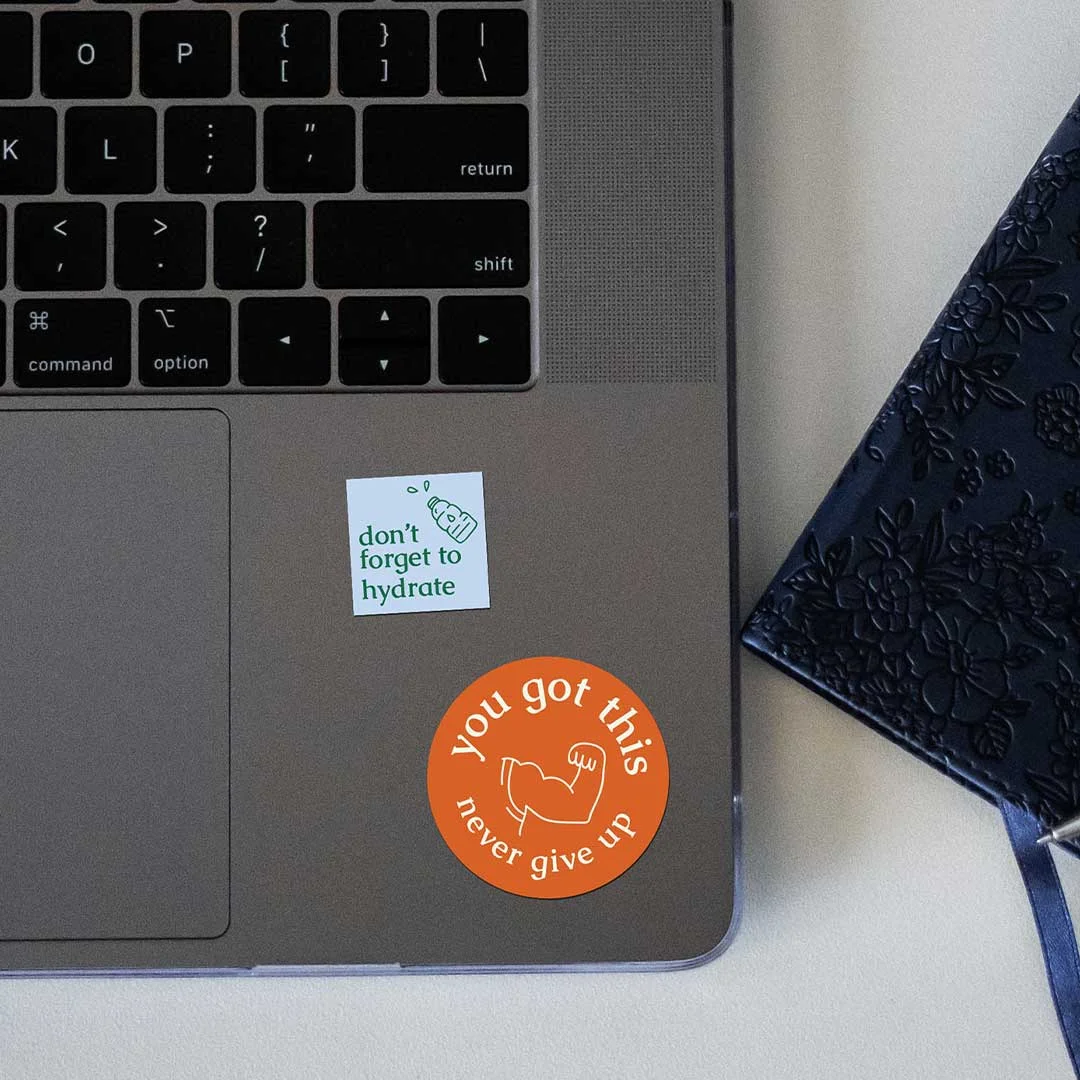
Case study 1: Melbourne cafe – packaging seal programme
A Brunswick café introduced circular branded seals on all takeaway bags after a $350 print run of 2,000 clear stickers. Before the campaign, the café had no branded packaging – orders left in generic brown bags. The new seals featured the café’s logo, Instagram handle, and a QR code linking to a loyalty programme sign-up page.
- Investment: $350 for 2,000 seals (approx. $0.18 per seal)
- QR scan rate: 4.2% of seals scanned (84 sign-ups in 6 weeks)
- Loyalty programme average spend uplift: $22 extra per member per month
- Revenue from 84 new loyalty members: $1,848 in month 1 post sign-up
- Payback period: approximately 4 weeks
- ROI at week 6: approximately 5.3:1
The ongoing value extended well beyond the initial print run: the café reordered twice, and the loyalty programme generated compounding retention value over the following quarter.
Case study 2: Brisbane electrical contractor – van decal
A solo electrician in Paddington invested $580 in a vinyl vehicle decal covering the rear and side of his work van, featuring his business name, phone number, and licence number. Prior to the decal, 100% of inbound calls came from word of mouth and a Google Business Profile listing.
- Investment: $580 (one-off)
- New inbound calls attributed to van (customer source survey): 3-5 per month
- Conversion rate on cold van leads: approximately 40%
- New jobs per month from van leads: 1.5-2
- Average job value: $650
- Monthly revenue from van: approximately $975-1,300
- Payback period: approximately 18 days
- Annual ROI: approximately 20:1 (and the decal continues to generate leads in year 2 and 3)
Case study 3: Sydney boutique – foil bag seal upgrade
A Surry Hills gift boutique replaced their plain tissue paper wrapping with a programme including gold foil stickers on all shopping bags. The change was made primarily for aesthetic reasons, but the brand impact exceeded expectations.
- Investment: $420 for 500 foil bag seals
- Instagram-tagged unboxing posts (before): 2-3 per month
- Instagram-tagged posts (after, 3-month average): 8-10 per month
- Estimated organic social reach lift: 3,000-6,000 additional impressions per month
- New customers acquired via social discovery (estimated): 3-4 per month
- Average order value: $95
- Monthly revenue from social lift: approximately $285-380
- Payback period: approximately 6 weeks
The foil sticker upgrade also lifted the perceived value of the boutique’s packaging, which contributed to a lower return rate and higher rating in Google reviews that mentioned “beautiful packaging”.
Case study 4: Adelaide dog groomer – die-cut stickers with QR
A home-based dog grooming business in Norwood ordered 1,000 custom die-cut stickers shaped like a paw print, featuring the business name and a QR code linking to an online booking form. Stickers were given to every client at pickup, placed on water bowls in the grooming area, and handed out at a local dog park market stall.
- Investment: $220 for 1,000 die-cut stickers
- QR scans in first 30 days: 61
- Bookings from QR scans: 9 new clients
- Average booking value: $90
- Revenue from QR-attributed bookings: $810
- Payback period: under 10 days
- ROI at day 30: approximately 3.7:1 (before factoring in repeat bookings)
Lowest-ROI Traps to Avoid
Sticker marketing delivers strong returns when applied correctly – but several common mistakes reliably kill the ROI, particularly for businesses new to the channel.
Premium finishes on ephemeral applications
Foil stickers and premium die-cut formats are worth the additional spend when they’re on items that persist: retail bags, packaging, vehicle signage, or merch that customers keep. They are a poor investment on items that will be binned within hours, such as single-serve food packaging, paper cups, or one-time event items. Match finish to shelf life: use clear or standard die-cut for high-volume, short-life applications, and reserve premium foil for low-volume, high-visibility touchpoints.
No call to action on the sticker
A sticker that only shows your logo generates awareness but creates no conversion pathway. Every sticker should include at least one of: a phone number, a URL, a QR code, a social handle, or a discount code. The call to action doesn’t need to be prominent – it just needs to be there. A customer who has seen your brand three times on bumper stickers and wants to book your service should be able to do so in under 30 seconds from the moment they see the sticker. If your sticker doesn’t make that possible, you’re leaving conversions on the table.
Distributing to the wrong audience
Handing out 1,000 stickers at a general community event in a suburb outside your service area generates impressions with zero conversion potential. Sticker distribution should be as targeted as a Meta ad audience. For local service businesses: distribute within your exact service radius. For product businesses: include stickers in every outgoing order so recipients are already customers. For B2B businesses: target distribution to trade shows, industry events, and supplier visits where your exact buyer profile is present.
One-run thinking
Sticker marketing compounds over time – but only if you maintain supply. A single run of 500 stickers that generates strong early results and then runs out breaks the distribution flywheel. Businesses that see the strongest long-term sticker ROI treat it as a line item in their annual marketing budget (typically $500-2,000 per year for SMBs) rather than a one-off experiment. The 2026 sticker trends also suggest rotating designs quarterly to keep the format fresh – a new die-cut shape or seasonal variant gives existing customers a reason to pick up a new sticker rather than ignoring a design they’ve already seen.
Browse the Full Range of Custom Sticker Formats
From die-cut to foil, vinyl to clear, the Paperlust Print Shop custom sticker range covers every AU small-business application. All formats are available with QR codes and full-colour print, with fast turnaround from our Melbourne studio.
Frequently Asked Questions
Is sticker marketing worth it for a $1,000 marketing budget?
Yes – for most AU small businesses with a $1,000 total marketing budget, sticker marketing delivers a stronger return than any digital channel at that spend level. A $200-300 investment in die-cut stickers or packaging seals leaves budget available for a small Google Ads or Meta test, while the stickers build the ambient awareness layer that makes paid clicks convert better. The key is deliberate distribution: don’t hand stickers out indiscriminately, place them where your target customer will actually see them.
How do I measure sticker ROI without digital tracking?
The most reliable methods are: QR codes on every sticker linking to a unique landing page with UTM tracking; unique discount codes per sticker variant redeemed at checkout; a dedicated short URL (e.g. yourbrand.com.au/vans) that only appears on a specific sticker type; and a standard “how did you hear about us?” question at point of sale. Combining two of these methods gives you reliable attribution data without requiring any additional technology investment.
Are bumper stickers actually effective in 2026?
Yes, particularly for local and community-focused businesses. The vehicle advertising channel produces some of the lowest CPMs in the Australian market, and the impressions occur in a context where the viewer is stationary (in traffic) and has time to register the brand, phone number, and message. The best-performing bumper sticker campaigns in 2026 feature a clear brand name, a single call to action, and a QR code or short URL. Businesses in trade, food and beverage, fitness, and local retail consistently report meaningful inbound lead attribution from bumper sticker programmes.
How does sticker ROI compare to Google Ads?
Google Ads captures existing demand with high intent and precise attribution. Sticker marketing builds ambient awareness that has no ongoing media cost after the print run. For a business spending $500-1,000 per month on Google Ads, adding a $200-400 sticker campaign doesn’t replace the search channel – it creates the brand recognition that makes search clicks convert at a higher rate. The channels are complementary, not competitive.
What’s a realistic payback window for a $500 sticker campaign?
For packaging seals and event handout stickers: four to eight weeks. For vehicle decals: three to six months for the initial investment to pay back, followed by years of zero-cost impressions. For bumper sticker community distribution: two to five months depending on placement uptake. The businesses that see the fastest payback are those that combine a QR code or discount code with deliberate distribution to warm or semi-warm audiences (existing customers, event attendees in their service area, partner business locations).
Should I bother with stickers if I’m already spending on Meta Ads?
Yes, and specifically because you’re already spending on Meta. Stickers create the physical-world touchpoints that reinforce your Meta impressions in a different context and channel. A potential customer who has seen your Meta ad twice and then spots your sticker at a local cafe is experiencing multi-channel brand exposure – and multi-channel exposure consistently drives higher conversion rates than single-channel repetition. The compound effect is the argument for stickers as a complement to digital spend, not a replacement for it.
How long do car decal impressions actually last?
Quality vinyl vehicle decals applied to a clean surface typically last five to seven years before significant fading or peeling. At 20,000-40,000 daily impressions in metro AU driving conditions, a single van decal costing $600 can generate 35-75 million branded impressions over its lifetime – making the ongoing CPM effectively negligible. For businesses in regional AU where daily driving distances are longer but population density is lower, impression volume will be lower but audience targeting is often more precise (the same people see your van repeatedly in a smaller catchment area).
What’s the minimum viable sticker campaign for a brand-new business?
A 500-unit run of die-cut stickers ($120-200) distributed across three channels simultaneously: in every customer order, at any market or pop-up appearance, and left at two to three partner business locations. This combination builds multi-touchpoint brand presence with a single print run and provides a baseline for testing which distribution channel generates the most QR scans or code redemptions. From that data, you can scale the highest-performing channel with your next print run.
Do foil stickers actually improve perceived brand value?
Yes, measurably so. AU boutique and gifting businesses that upgrade from standard to foil packaging stickers consistently report increases in social media tagging, product gifting rates, and Google review mentions of packaging quality. The perception lift is highest in contexts where packaging is part of the purchase experience: retail bags, gift wrapping, subscription boxes, and premium food products. For high-volume, functional packaging (takeaway food, courier boxes), standard clear or die-cut seals deliver better ROI because the premium finish is lost in the functional context.
How much of my marketing budget should I allocate to sticker marketing?
Most Australian small-business marketing consultancies recommend allocating 3-10% of revenue to total marketing spend, with a balanced mix of paid digital, SEO, and offline channels. For sticker marketing specifically, a starting allocation of 5-10% of your offline marketing budget – or approximately $300-1,500 per year for a business with a $5,000-15,000 annual marketing budget – gives you enough volume to test distribution channels and measure ROI before scaling. The businesses that see the strongest long-term returns treat sticker spend as a fixed quarterly line item, not a one-off experiment.
What sticker format is best for a service business with no physical product?
Vehicle decals and bumper stickers are the most effective formats for service businesses without a physical product to seal or package. A well-designed van decal covers the awareness gap that digital channels struggle to fill for local service businesses: it builds recognition in your exact service area with every drive, without requiring a customer to be actively searching at that moment. For service businesses that do have customer-facing premises (salons, gyms, studios, clinics), window vinyl and branded sticker packs for reception areas create a professional brand presence that supports word-of-mouth referral.
Can sticker marketing support my organic search rankings?
Indirectly, yes. Sticker campaigns that drive brand name searches create a positive signal for Google’s local ranking algorithm: a business that generates consistent branded search volume is treated as more authoritative in local results. Vehicle decals and bumper sticker programmes that generate regular “I’ve heard of them” recognition in a local area often correlate with organic traffic uplift from branded queries over a 3-6 month period. This is a secondary benefit rather than a primary ROI driver, but it adds to the compound value case for sustained sticker investment.