
Choosing the right brochure fold is not about personal preference. It is about which structure guides your reader through your content in the order you intend. Get the fold wrong and a beautifully designed piece becomes confusing to open, awkward to read, and quick to be discarded. Get it right and the fold itself does half the persuasive work before anyone reads a word.
This guide covers the five main brochure fold types used in Australian printing: the tri-fold (letter/roll-fold mechanics), the z-fold (accordion), the gate-fold, the roll-fold, and the half-fold. For each, you will find how it physically opens, which panel the reader sees first, the reading sequence, design implications, and the use cases it suits best. If you need a side-by-side comparison of finished sizes and flat sheet dimensions for each format, the Brochure Printing Sizes guide covers that ground in full.
Brochure folds at a glance
Five folds. Five different reading journeys. Match the mechanics to your message.
- Tri-fold (letter fold): 6 panels, reader sees cover first then 1 inner flap, then full spread – the safest structure for general marketing and menus.
- Z-fold (accordion): 6 panels in a zigzag – unfolds in a continuous strip, ideal for maps, sequential steps, or event programmes.
- Gate-fold: 2 outer panels open like doors to reveal a wide centre spread – maximum visual drama for product launches or premium invitations.
- Roll-fold: 4+ panels roll inward around each other – sequential storytelling format used in product guides and annual reports.
- Half-fold (bi-fold): 4 panels, one centre crease – clean and spacious, suits catalogues, menus, and programmes where each panel needs room to breathe.
- The inner tuck-in panel on tri-fold and roll-fold is narrower by 2-3 mm – this is not a design error; it must be that way so the brochure closes flat.
The Tri-Fold: Australia’s Most-Used Brochure Format
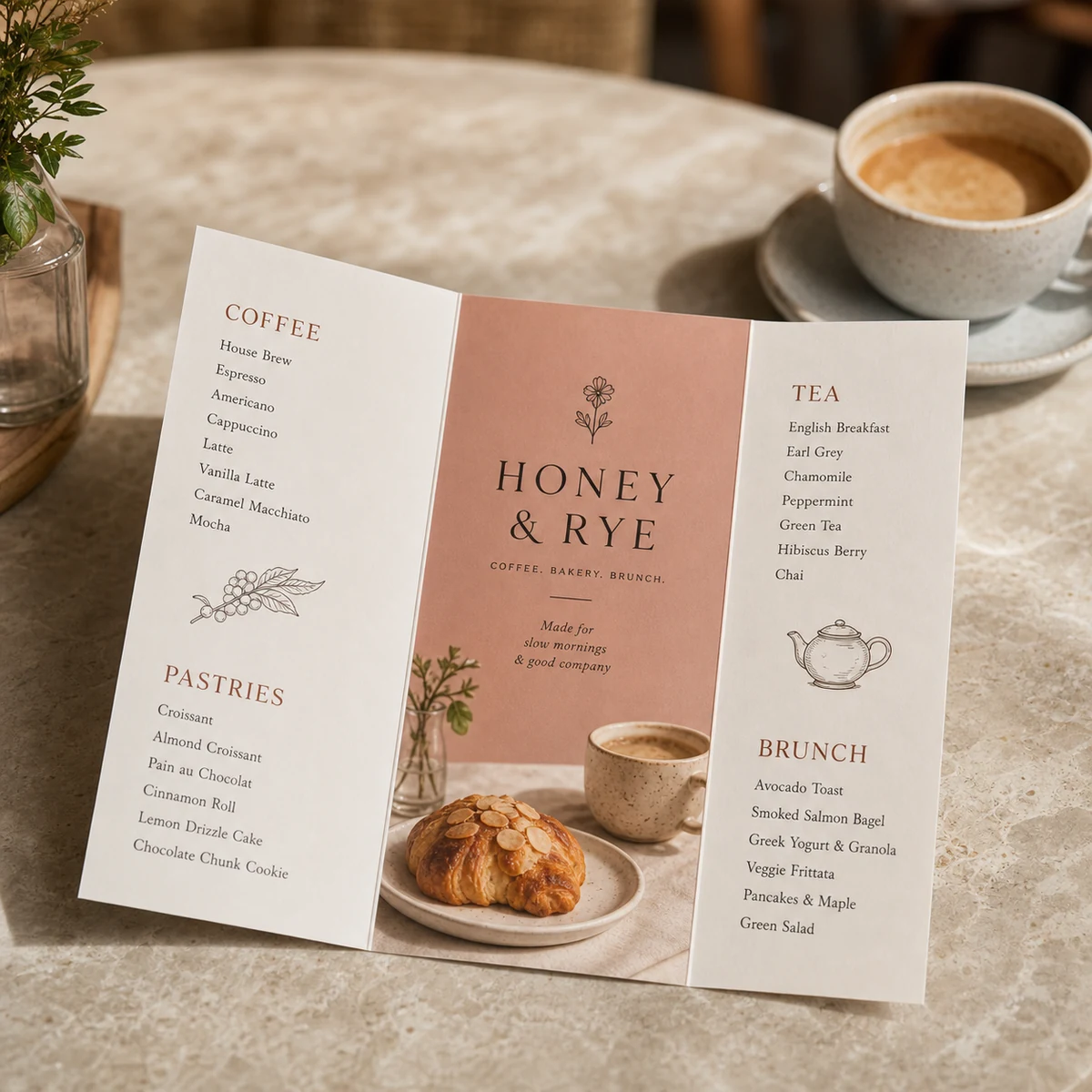
The tri-fold (also called a letter fold) takes a single sheet and creates three panels by folding both outer sections inward so they overlap the centre. The result is six panels total – three on the outside and three on the inside – in a compact format that fits a standard DL envelope and sits neatly in a counter rack.
How the tri-fold opens and the reading sequence
The reader picks up the brochure and sees the front cover panel on the right. The back cover panel sits in the middle position when closed, with contact details and any secondary call to action. The inner left flap is the tuck-in panel – this is the first thing the reader sees when they open the front cover.
Reading sequence in full:
- Front cover (right panel outside) – the invitation to open
- Inner tuck-in flap (left panel inside, first thing revealed when cover opens) – typically used for a brief summary, key offer, or a strong secondary image
- Full inside spread (all three inside panels visible once the flap opens) – the main content area
- Back panels (viewed when the brochure is turned over) – return address, contact details, QR code
This means your most valuable real estate is the front cover and the inner tuck-in panel. Do not bury your headline offer on the full inside spread – by the time the reader gets there, you have already either won or lost them.
The narrower tuck-in panel – a critical design note
The tuck-in panel (left outer panel that folds inside) must be 2-3 mm narrower than the other two panels. This is not optional. If all three panels are the same width, the inner panel will not sit flat when the brochure is closed – the edges will bow and splay. Your designer or print file template should account for this automatically; if you are building artwork from scratch, this is the most common beginner mistake.
When to choose a tri-fold
The tri-fold suits any situation where a confident sequential reveal matters and the content volume fits into six reasonably sized panels. Strong use cases in Australia include:
- Retail and service menus: cafes, salons, spas, healthcare practices
- Real estate one-sheets: property features, floor plans, agent contact
- Tradeshow and event handouts: compact enough to pocket, enough space for key messaging
- DL letter-box drops: folds to DL envelope size, low postage cost for direct mail
The Z-Fold: Continuous Flow in a Zigzag
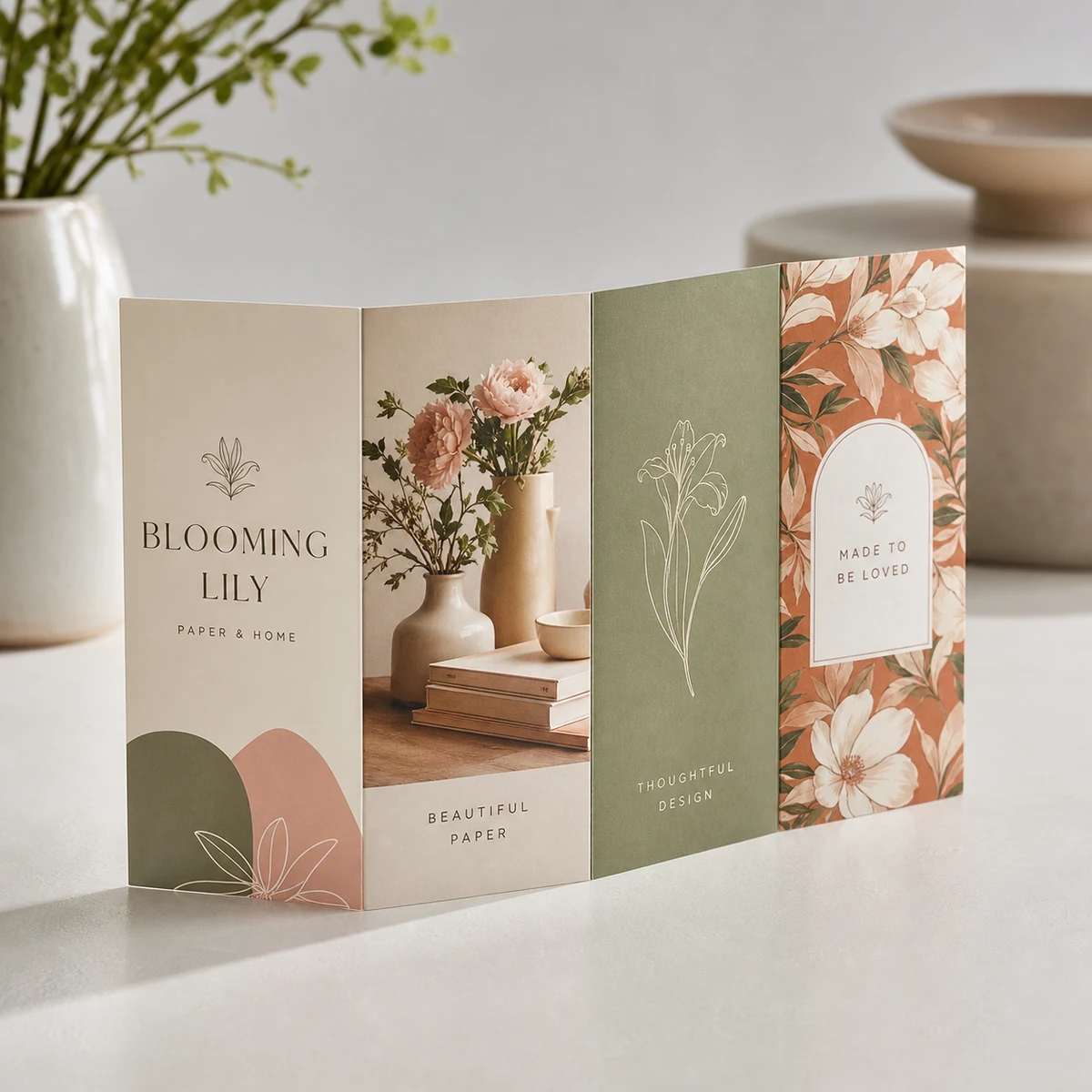
The z-fold (also called accordion fold for a 3-panel version) creates six panels by folding the sheet in alternating directions – forward, then backward, so the folds form a Z-shape when viewed from the side. Unlike the tri-fold where panels overlap, z-fold panels sit parallel and adjacent with no overlap. The brochure extends into one long horizontal strip when fully opened.
How the z-fold opens and the reading sequence
Because the z-fold does not have a tuck-in panel, it opens in a completely different way:
- Front cover (first panel on the right as the brochure is held closed)
- The brochure pulls open from left to right in one continuous motion, revealing all six panels in a strip
- Each panel flows directly into the next without the visual interruption of a tucked flap
This is why z-folds work well for timelines, step sequences, maps, and any content where the information needs to be seen in strict left-to-right order. The reader cannot accidentally jump to panel 4 before panel 2, because the panels must physically unfold in order.
Key design difference from the tri-fold
All three panels in a z-fold can be the same width. There is no tuck-in panel, so there is no need for a narrower insert. The trade-off is that when the piece is standing upright in a counter rack, only the front cover panel is visible – unlike the tri-fold, where the two-panel front face allows for a wider cover visual. If display-rack presence matters, factor that in.
When to choose a z-fold
- Event programmes and concert guides: the accordion structure means the reader can partially unfold the brochure to reveal the running order without needing to fully open it
- Tourist maps and walking guides: partial-unfold navigation is a genuine usability advantage
- Step-by-step how-to guides: assembly instructions, recipe cards, or onboarding sequences where order is critical
- Trade show maps: venue floor plans that benefit from visible segmentation by zone
The Gate-Fold: Dramatic Reveal for High-Impact Pieces
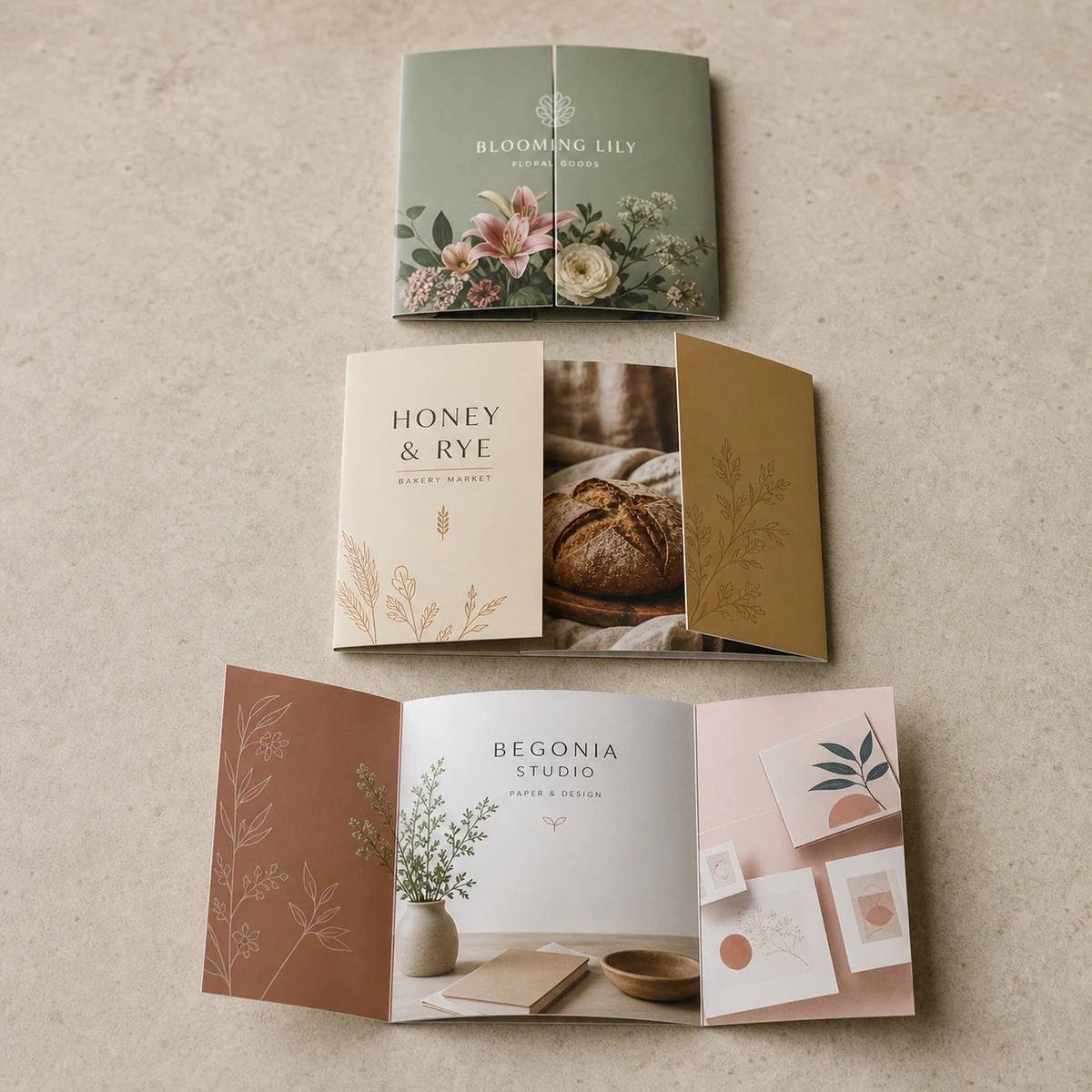
A gate-fold has four panels. Two shorter outer panels fold inward toward the centre, meeting in the middle like a pair of gates or double doors. When both gates open simultaneously, they reveal a wide, uninterrupted centre spread.
How the gate-fold opens and the reading sequence
The gate-fold is explicitly designed around the moment of reveal:
- The reader picks up the piece and sees the two closed gates as the cover – typically carrying a teaser headline, a single strong image, or a luxury brand mark
- Both gates open outward together to reveal the full centre spread in one moment
- The inside of each gate panel (left and right inner panels) carries supporting content alongside the large centre
- The back of each gate panel forms two additional outside panels for contact details, pricing, or secondary messaging
The gate-fold is the only standard brochure format built explicitly around anticipation. Every other fold reveals content progressively; the gate-fold saves everything for a single, simultaneous reveal. That makes it disproportionately powerful for:
- Product launches where the visual needs full width to land
- Luxury brand catalogues where the moment of opening needs to feel premium
- High-end wedding or event invitations (the dramatic opening mirrors the occasion’s significance)
- Annual reports where the CEO message or key data visualisation benefits from a full-width canvas
Design considerations specific to gate-fold
The centre spread is the hero. Resist the temptation to split it into columns that replicate what a standard brochure would do. A gate-fold centre should carry one large image, a single powerful data point, or an immersive visual. Treat the two gate panels as the supporting cast.
Print costs for gate-fold are higher than for tri-fold or z-fold because the fold requires greater precision and usually additional production time. For orders where per-unit cost is a primary concern, the gate-fold is not the right call. But for a piece where impression quality is the entire point – a property development, a jewellery launch, an awards night programme – the cost difference is justified.
The Roll-Fold: Sequential Storytelling for Complex Content
A roll-fold (also called a barrel fold or multi-panel fold) takes a sheet with four or more panels and folds each section inward around the previous one, like a scroll rolling up. Each panel wraps around the next, with the innermost panel being the narrowest (similar in principle to the tri-fold tuck-in, but applied across every fold, not just one).
How the roll-fold opens and the reading sequence
Opening a roll-fold is an experience in itself. The reader unfolds one panel at a time, left to right, with each reveal building on the last. There is no way to skip ahead or accidentally read out of order – the physical structure enforces the narrative sequence.
This makes the roll-fold the format of choice for stories with a clear beginning, middle, and end. Each panel should be designed to earn the reader’s curiosity before the next unfolds. Think of each panel as a chapter heading, not a standalone document.
When a roll-fold is worth the extra production complexity
Roll-folds require more care in artwork setup because each successive inner panel must be fractionally narrower to sit flat inside the previous one. This is an execution overhead that does not apply to bi-folds or z-folds, and it means roll-fold artwork should always be built from a printer-supplied template rather than hand-measured.
Strong Australian use cases for roll-fold:
- Annual reports and sustainability reports: complex data with a narrative arc benefits from forced sequential reading
- Property development prospectuses: site overview, floor plans, lifestyle imagery, and price guide unfolding across 6-8 panels
- Product launch guides: new product categories where the reader needs to understand the problem before the solution
The Half-Fold: The Clean, Spacious Classic
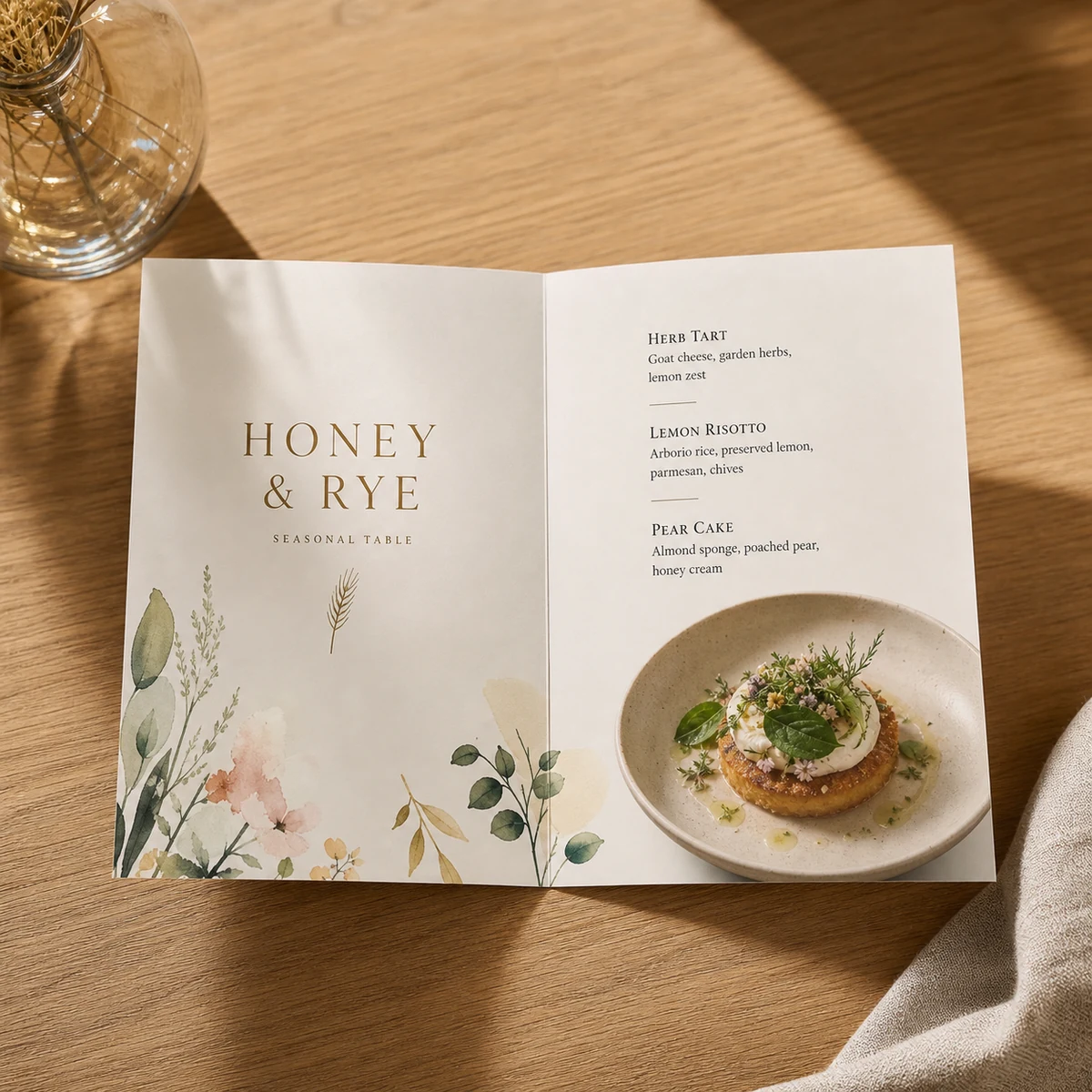
The half-fold (also called bi-fold) is the simplest structure: one fold down the centre of a sheet, creating four panels. Two panels on the outside (front cover and back cover) and two on the inside (left spread and right spread). That is it.
How the half-fold opens and the reading sequence
The half-fold reads exactly like the cover of a small brochure or book:
- Front cover
- Left inside panel (first visible when opened)
- Right inside panel (completes the inside spread)
- Back cover
Because there are only four panels and each panel is large, the half-fold is the format that gives designers the most uninterrupted space per panel. An A5 bi-fold (folded from an A4 sheet) gives two large inside panels at roughly 148 x 210 mm each – significantly more workable space than a tri-fold’s narrower six-panel layout.
When a half-fold is the right call
- A4 restaurant menus: the two large inside panels naturally carry a food and drinks split
- Conference and event programmes: running order on one inside panel, speaker bios on the other
- Product specification sheets: technical tables and imagery that would be cramped in a tri-fold panel benefit from a full bi-fold panel
- Brand introductions and company profiles: clean, uncluttered, with space for photography that does not get chopped by additional fold lines
The half-fold is also the lowest-cost fold format to produce, making it a sound choice for high-volume runs where per-unit economy matters.
Choosing the Right Fold for Your Project: A Decision Framework
With five formats covered, the practical question is which one fits your specific piece. Work through these four factors:
How much content do you have?
Half-fold gives 4 large panels. Tri-fold and z-fold give 6 smaller panels. Gate-fold gives 4 panels plus a large centre spread. Roll-fold gives 6-8 panels in a sequential stack. Content volume is the first filter. Cramming a full product catalogue into a tri-fold produces a piece that nobody will read; giving a two-sentence offer six panels produces one that looks empty.
Does reading order matter?
If your reader needs to understand A before they can appreciate B, choose a structure that enforces sequence: z-fold (linear unfold) or roll-fold (each panel wraps the next). If reading order is flexible, tri-fold and half-fold are fine. Gate-fold suits content where the entire message lands in the moment of reveal.
What is the distribution method?
Postal mail: tri-fold to DL is the most economical format for Australian letter-box drops and business mail, fitting standard DL envelopes without extra trimming. Hand-distributed at events: all formats work, though the gate-fold’s larger flat size makes it slightly bulkier in quantity. Counter display: tri-fold and z-fold sit well in DL counter racks; half-fold and gate-fold require wider display pockets.
What is the impression you need to make?
General information delivery: tri-fold or half-fold. A tactile, interactive experience: z-fold or roll-fold. A premium, high-drama reveal: gate-fold. The fold type itself signals something about the brand. A luxury property development does not hand out tri-folds in DL racks. A community health centre does not commission gate-folds.
| Fold type | Panels | First thing reader sees when opening | Best use case |
|---|---|---|---|
| Tri-fold (letter fold) | 6 | Inner tuck-in flap | Menus, service brochures, direct mail |
| Z-fold (accordion) | 6 | Linear unfold in sequence | Maps, event guides, step sequences |
| Gate-fold | 4 + wide centre | Full centre spread revealed simultaneously | Product launches, luxury invitations |
| Roll-fold | 6-8 | One panel at a time, sequential | Annual reports, prospectuses |
| Half-fold (bi-fold) | 4 | Left inside panel | Menus, programmes, product sheets |
Ordering Brochures in Australia
Paperlust Print Shop produces brochures across four formats: DL Roll Trifold, DL Z Trifold, A5 Bifold, and A4 Bifold. Stock options are 150gsm Gloss, 170gsm Matte and 250gsm Gloss, with 250gsm Gloss on the A5 Bifold and A4 Bifold only. For most general marketing brochures, 150gsm gloss is the most popular choice; step up to 170gsm Matte or 250gsm Gloss if the piece needs to feel premium in the reader’s hand.
Production is 2-5 working days after proof approval, with flat-rate shipping Australia-wide. Every order includes a proof check before printing, so there is a point at which you can verify panel widths, fold lines, and colour before the run goes to press.
If your project calls for gate-fold or roll-fold, contact the Paperlust Print Shop team directly to discuss the format – these are handled as custom fold requests.
Frequently Asked Questions
What is the difference between a tri-fold and a roll-fold?
A tri-fold has one tuck-in panel that folds inward so the brochure closes flat, creating six panels total. The two outer panels overlap the middle panel, and the tuck-in panel is 2-3 mm narrower to prevent buckling. A roll-fold has multiple panels that each roll sequentially inward around the one inside it, with each successive panel being fractionally narrower. Roll-folds typically have 6-8 panels and enforce a strict left-to-right reading order as each panel wraps the next.
Why is one panel on a tri-fold brochure narrower than the others?
The inner panel (the one that tucks inside when the brochure is closed) needs to be 2-3 mm shorter in width than the two outer panels. If all three panels are the same width, the inner panel cannot sit flat inside the closed brochure – the outer edges will bow outward and the piece will not lie flat. A printer-supplied template will account for this automatically; if you are setting up artwork from scratch, build the tuck-in panel 2-3 mm narrower.
What is the reading order of a tri-fold brochure?
Closed: front cover panel (right) and back cover panel (centre, with inner tuck-in behind it). On opening the front cover: the inner tuck-in flap is the first thing the reader sees. Opening fully: all three inside panels are revealed as a continuous spread. The tuck-in flap is prime real estate – use it for your strongest secondary message or a compelling image that draws the reader into the full inside spread.
When should I choose a gate-fold over a tri-fold?
Choose a gate-fold when the moment of opening is part of the message. Gate-folds work best when you have a single, wide, high-impact visual or data point that needs the full centre-spread width to land – think product launches, luxury invitations, or annual report covers. Choose a tri-fold when you have moderately dense information to convey, distribution costs matter (tri-folds fit DL envelopes), or budget per unit is a primary constraint. Gate-folds cost more to produce and require more care in design and finishing.
Can a z-fold brochure stand upright in a display rack?
Yes, though a tri-fold sits more naturally in a standard DL counter rack because its overlapping structure holds its shape better when standing. A z-fold can be displayed in a DL rack but may need a backing card to keep it from splaying. If counter-rack display is a primary consideration, the tri-fold is the more reliable format.
What fold types are available for Australian brochure printing?
The most commonly available fold types from Australian printers include the DL roll tri-fold, DL z-fold, A5 bi-fold, and A4 bi-fold as standard options. Gate-fold and roll-fold are available from specialist printers and are typically handled as custom fold requests with longer lead times. Paperlust Print Shop offers DL Roll Trifold, DL Z Trifold, A5 Bifold, and A4 Bifold as standard format options at printshop.paperlust.co/products/brochures.