Choosing the wrong size for your business cards costs more than a reprint fee – it signals to the person holding your card that something is slightly off. The right size is the one that fits your brand, your industry, and the practical reality of how your cards will be used and carried. This guide covers every standard Australian business card format with exact dimensions, bleed and safe area specs, international size comparisons, and honest guidance on when each format earns its extra cost.
Quick reference
Australian Business Card Sizes at a Glance
The key dimensions before you set up artwork.
- Standard AU size: 90mm x 55mm (3.54″ x 2.17″) – the universal format
- Square: 60mm x 60mm (2.36″ x 2.36″), priced the same as the standard card.
- Mini: 75mm x 35mm is a size some printers sell, while Paperlust’s slimline cards run 90mm x 45mm or 86mm x 54mm.
- Folded (tent): 90mm x 55mm closed, 90mm x 110mm open
- Folded (side): 90mm x 55mm closed, 180mm x 55mm open
- Bleed: add 3mm to every edge; safe area 3mm in from every trim edge
- Australian standard vs US standard: AU is 90 x 55mm; US is 88.9 x 50.8mm – different enough to matter for card holders
- Pricing from: Standard cards from $0.08/card (inc. GST), standard delivery $10 per order and express delivery $15 per order.
Standard Business Card Size Australia: The 90mm x 55mm Rule
The standard business card size in Australia is 90mm x 55mm (approximately 3.54 inches x 2.17 inches). This is not an arbitrary convention – it is the dimension that fits every standard business card holder, wallet slot, and desk organiser sold in Australia. Deviate from it without a good reason and you create a practical problem for the person you are trying to impress.
The 90 x 55mm format is also sometimes quoted as the “Australian standard” because it aligns with the dimensions used across most of the Asia-Pacific region, distinguishing it from the slightly narrower US format (88.9mm x 50.8mm / 3.5″ x 2.0″) and the slightly shorter European format (85mm x 55mm). It is worth noting that some older Australian style guides and online resources incorrectly state 85mm x 55mm as the Australian standard – that is the European dimension. The correct Australian standard is 90mm x 55mm.
Shape variants at the standard size
Standard business cards from Paperlust Print Shop are available in several shape variants, all at the 90mm x 55mm base footprint:
- Rectangle (straight corners): 90mm x 55mm – the clean, professional default
- Rounded corners: You can order rounded corner business cards in the 90mm x 55mm size, keeping the standard footprint with a softer feel.
- Circle: 60mm x 60mm – departs from the rectangle format entirely; suits bold, single-icon brands
- Oval: 90mm x 50mm – fits standard holders while providing a distinctive silhouette
Paper and print options at standard size
The advantage of the standard size is access to the widest range of paper and print options. Standard 90 x 55mm business cards at Paperlust Print Shop are available on Linen, Cotton, Metallic, Matte, and Artboard with Velvet Laminate stocks. Print options include digital colour printing (front only or front and back), flat foil, Spot UV, Scodix raised UV, Raised Foil, Coloured Paper, and Duplex lamination. Most specialty finishes are only available at the standard rectangle or rounded-corner size – another practical argument for defaulting to 90 x 55mm.
When to choose the standard format
The standard format is the right choice when your cards will be given out in volume, carried in wallets, filed in card holders, or exchanged in any professional context where fitting in is part of the goal. It is also the format with the fastest production time – regular business cards are available on 24-hour production for standard digital print, flat foil, and coloured paper finishes. If you need cards urgently or in large volume, standard size is the lowest-friction path.
Square Business Cards: 60mm x 60mm – When to Choose Square
Square formats across the market generally run from about 55 to 65 mm. The square business card Paperlust prints is 60mm x 60mm, a true square rather than a trimmed rectangle. A 90 x 55 mm rectangle tends to signal a conventional professional role, while a square feels more deliberate and creative. The shape creates a pause in the hand because it sits differently among the usual rectangles.
Why the square format works
The equal dimensions of a square business card demand a different approach to layout. There is no landscape orientation, no natural reading direction, no obvious hierarchy of top-to-bottom vs left-to-right. This constraint pushes designers toward centred compositions, bold single images, and typographic layouts that work equally well when the card is held at any angle. For brands whose visual identity is built around a strong logo mark, a circular emblem, or a radially symmetrical pattern, the square is the format those designs were waiting for.
A 60 x 60 mm square offers less total area than a 90 x 55 mm rectangle, so the advantage is not extra room. What changes is balance. A logo that feels squeezed against the long edge of a wide rectangle often holds its centre on a square because the space is even in both directions.
Trade-offs to consider
Square cards do not fit most standard business card holders, wallet card slots, or contact management systems. If the person you give your card to uses a card wallet or filing system designed for the 90 x 55mm format – which most are – your square card will either stick out or need to be stored separately. This is not always a problem; it can make the card more memorable. But if your recipients include people who file and index contacts systematically, the non-standard size creates a friction point.
Some printers charge more for square formats, but Paperlust prices its square card at the same rate as a standard card on the same paper and quantity. The real trade-off is the cardholder fit, because most holders and filing systems are built for the 90 x 55 mm rectangle. A square card either sticks out or needs to be stored separately.
Industries where square works well
- Creative agencies, graphic designers, illustrators
- Photographers with a strong single-image back design
- Premium beauty and skincare brands
- Architects and interior designers with geometric brand identities
- Boutique hospitality venues wanting a distinctive leave-behind
Order square business cards in a 60 x 60 mm size on four 300 GSM paper stocks, with runs from 50 cards. The square card costs the same as a standard rectangle on the same paper and quantity. Standard delivery is $10 per order and express delivery is $15 per order, anywhere in Australia.
Mini Business Cards: 75mm x 35mm – Compact and Premium Feel
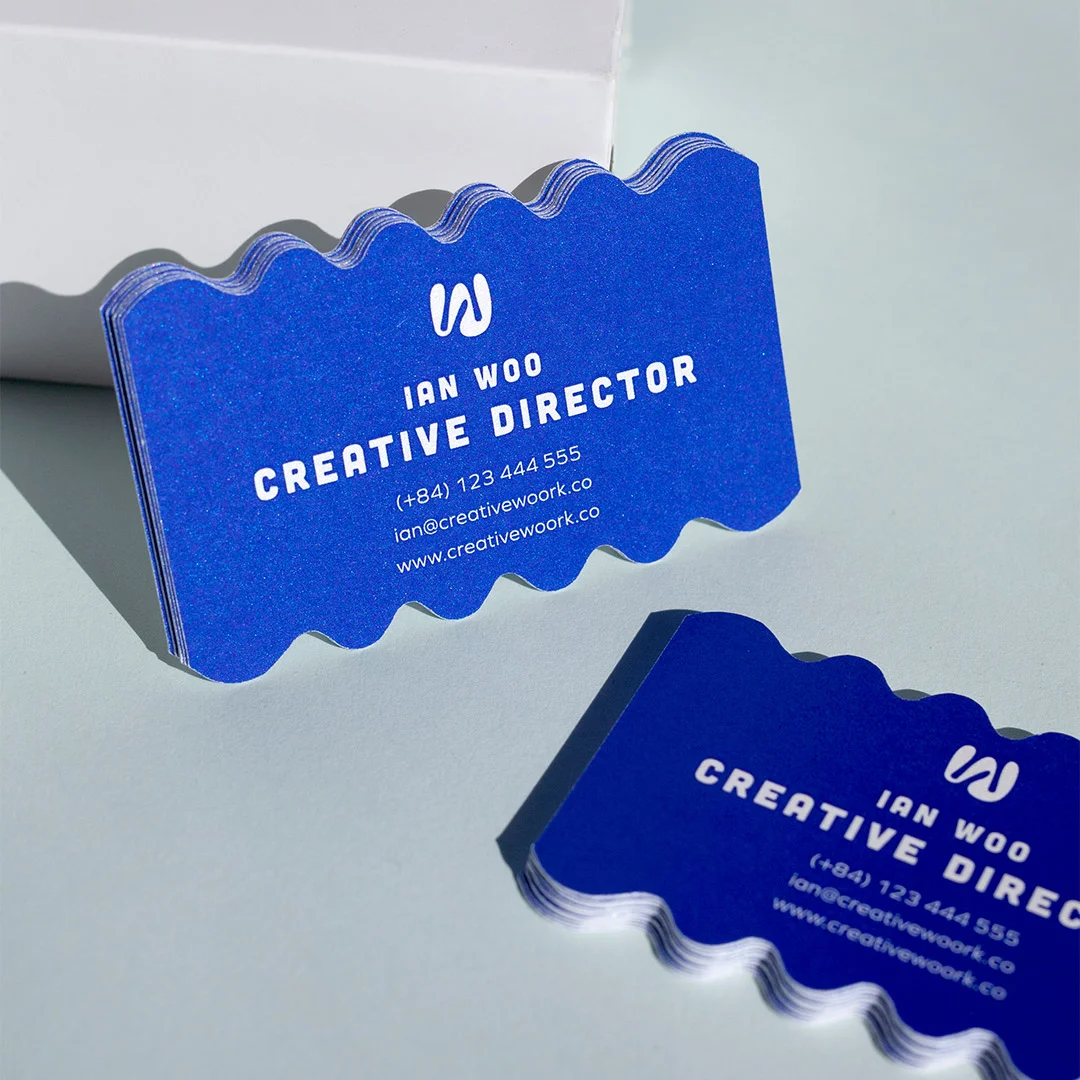
Mini business cards measure 75mm x 35mm (2.95″ x 1.38″) – roughly the size of a credit card cut in half horizontally. The format works precisely because it is unexpected: a small card handed over with confidence reads as intentional rather than budget-constrained, particularly when printed on a premium stock with a considered finish.
75 x 35 mm is a size some printers sell, but the narrow card Paperlust prints is the slimline business cards range, available in 90mm x 45mm and 86mm x 54mm. Both sizes are priced the same as a standard card on the same stock, sides and quantity. 90mm x 45mm keeps the standard length and suits a name, title and one or two contact lines. 86mm x 54mm is close to a bank card, so it slides into a wallet and suits people who want their card carried rather than filed.
What mini cards are actually used for
Mini business cards are most effective in specific use-case contexts rather than as a general networking card. Their most common applications in the Australian market:
- Loyalty cards: the mini format slots neatly into most wallets and is large enough to hold a 10-stamp punch grid or QR code
- Product tags: attached to handmade goods, candles, jewellery, and boutique packaging as a branded card-in-envelope tag
- Appointment reminder cards: clinic, salon, and treatment room cards that fit the breast pocket of a shirt or the card slot in a handbag without folding
- Tasting notes and wine cards: hospitality venues that include a mini card in each experience or at each place setting
- Event guest cards: paired with a gift or a favour, where a full-size card would feel disproportionate
Design constraints at mini size
The 75 x 35mm format is unforgiving. There is room for a name, a title, one contact detail, and a logo – and that is close to the limit. Any design that tries to include the full contact suite (phone, email, website, social handles, address) will be illegible. Mini cards force editorial decisions that most business card briefs defer: what is the single most important piece of information for the recipient? Lead with that, and leave the rest for your full-size card or a QR code. Mini business cards work best when they are extensions of a suite that includes a standard card, not a standalone replacement for one.
Folded Business Cards: Tent-Fold and Side-Fold Dimensions
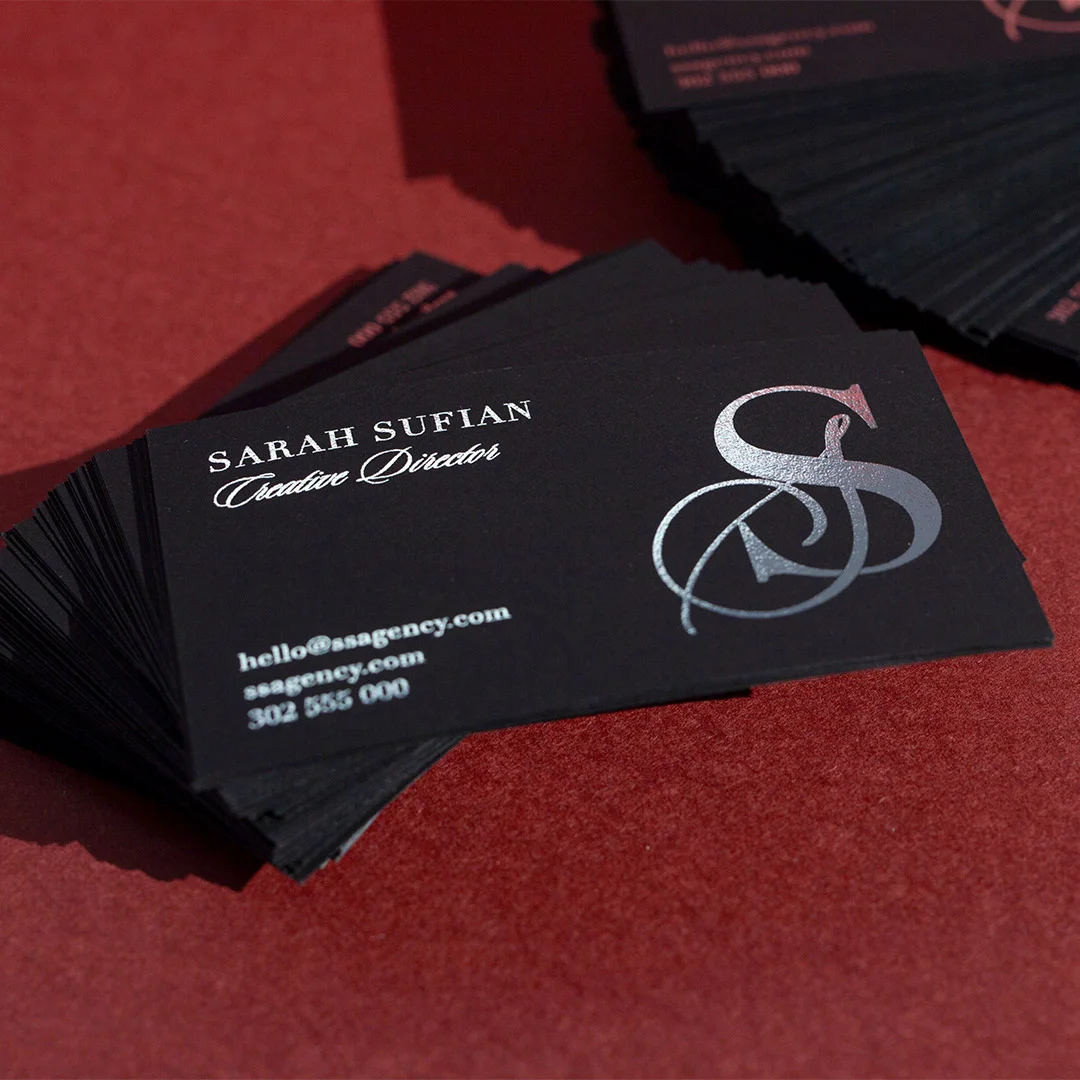
Folded business cards are the format that resolves the tension between card size and information density. Printed on a substrate twice the size of a standard card and folded to 90mm x 55mm, they provide twice the usable print surface while remaining the same size as a standard card in someone’s hand or card holder.
Two fold orientations are available, each creating a different physical behaviour and use pattern:
| Fold type | Closed size | Open size | Panel layout | Best suited for |
|---|---|---|---|---|
| Tent fold (portrait) | 90mm x 55mm | 90mm x 110mm | Two 90mm x 55mm panels, top and bottom | Table cards, appointment reminders, cards that stand upright |
| Side fold (landscape) | 90mm x 55mm | 180mm x 55mm | Two 90mm x 55mm panels, left and right | Service menus, pricing lists, QR code + contact split |
Tent fold: the standing card
The tent fold creates a card that, when opened, can stand upright like a small table tent – the spine is at the top, and the two panels fold down and away from each other. This is the format most commonly used for appointment reminder cards in clinics and salons, table reservation cards in restaurants, and cards that are meant to be displayed rather than stored. The outer face (the front panel when closed) carries the brand; the inner faces, revealed when the card is opened, carry the detail: address, hours, services, or a QR code linking to a booking page.
Side fold: the information expander
The side fold opens like a small brochure: the left and right panels unfold to reveal 180mm of horizontal canvas at 55mm height. This format suits businesses that need to communicate a service list, a product range, a menu section, or a pricing table without resorting to print-on-both-sides density. The outside faces carry the brand and primary contact information; the inside spread carries the structured content.
Both tent and side folded business cards require artwork set up as a two-panel spread with clear identification of which panel is front-outer, back-outer, and inner. Allow for the fold line when placing critical content – text or logos that straddle the fold crease will distort slightly at the point of folding. Keep all important elements at least 5mm from the fold line. Folded card artwork should be submitted as a single flat file with the full unfolded dimensions (96mm x 121mm for tent fold with bleed, or 186mm x 61mm for side fold with bleed) with crop marks and the fold line indicated in a separate non-printing layer.
Not sure which format fits your brand?
Paperlust Print Shop prints standard, square, slimline, rounded corner, round and die cut business cards, with Spot UV, Scodix, Raised Foil, Flat Foil and Duplex among the finish options. You can choose $10 standard delivery per order or $15 express delivery per order, anywhere in Australia.
Custom Sizes: When to Deviate from Standard (and the Trade-Offs)
Beyond the four formats above, custom dimensions are available for specific applications – die-cut shapes, oversized cards, or non-standard rectangles such as 90mm x 50mm or 100mm x 60mm. The decision to go custom should be driven by a clear functional or brand reason, not novelty. The trade-offs are real:
- Fit: custom sizes will not fit standard card holders, wallets, or Rolodex-style filing systems
- Cost: non-standard substrates typically require custom cutting or die-cutting, which adds to per-unit cost and minimum order quantities
- Turnaround: custom shapes require longer production than standard formats – not suitable for urgent orders
- Recipient experience: a card that does not fit anywhere can be memorable or frustrating, depending on the context
The most common legitimate case for a fully custom size is a card that doubles as a functional object: a ruler-shaped card for a design studio, a bookmark-shaped card for a bookshop, or a key-tag-shaped card for a hotel. In each case, the non-standard dimension serves the function, not just the aesthetic. If the only reason for a custom size is that it looks more interesting, reconsider – a standard-size card with an exceptional finish will outperform a custom-size card with average execution at a lower total cost.
For businesses exploring non-standard options, the full range of print formats is available from our Australian business card printers, with a custom quote available for unusual specifications.
Bleed, Safe Area, and Crop Marks: Print-Ready Dimensions
Getting your artwork dimensions right before sending to print avoids the most common and avoidable production problem: critical content – a logo, a name, a phone number – trimmed off during cutting. The solution is straightforward: understand bleed, safe area, and crop marks before you open your design software.
Bleed
Bleed is the extra margin of artwork that extends beyond the intended trim edge of the finished card. When a card is cut, the cutter does not land in exactly the same spot on every run – there is a small mechanical tolerance. Bleed ensures that if the cut falls slightly outside the trim line, your background colour or edge design still runs to the edge of the card rather than showing a white stripe. The standard bleed for Australian business cards is 3mm on every edge. Add 3mm to each side of your finished card dimensions when setting up your artwork file.
Safe area
The safe area is the inverse of bleed: it is the zone inside the trim edge within which all critical content must stay. If your logo or contact details are too close to the trim edge, cutting tolerance can clip them. The standard safe area for Australian business cards is 3mm in from every trim edge – the same 3mm dimension as bleed, but on the inside. Keep all text, logos, and critical graphic elements within this boundary.
Crop marks
Crop marks (also called trim marks) are the small lines at the corners of your artwork file that indicate where the card should be cut. Most professional design applications (Adobe Illustrator, InDesign, Affinity Publisher) generate crop marks automatically when you export to PDF with bleed. If you are using a template-based approach or a consumer design tool, check whether crop marks are included in the export – if not, your print supplier will apply them based on the document dimensions you specify.
| Card format | Finished trim size | Artwork size (with 3mm bleed) | Safe area (content boundary) |
|---|---|---|---|
| Standard rectangle | 90mm x 55mm | 96mm x 61mm | 84mm x 49mm |
| Rounded corners | 90mm x 55mm | 96mm x 61mm | 84mm x 49mm (avoid corners) |
| Square | 60mm x 60mm | 66mm x 66mm | 54mm x 54mm |
| Mini | 75mm x 35mm | 81mm x 41mm | 69mm x 29mm |
| Slimline | 90mm x 45mm | 96mm x 51mm | 84mm x 39mm |
| Slimline | 86mm x 54mm | 92mm x 60mm | 80mm x 48mm |
| Folded (tent, per panel) | 90mm x 55mm closed / 90mm x 110mm open | 96mm x 121mm (full open + bleed) | 3mm in from all trim edges; 5mm from fold line |
| Folded (side, per panel) | 90mm x 55mm closed / 180mm x 55mm open | 186mm x 61mm (full open + bleed) | 3mm in from all trim edges; 5mm from fold line |
File format requirements
Submit artwork as a PDF with bleed and crop marks included. All fonts should be outlined (converted to curves or paths) to avoid font substitution at the printer. All embedded images should be at a minimum of 300 DPI at the intended print size. Colour mode should be CMYK for standard printing – RGB files are automatically converted, but the conversion can shift colours, particularly rich blacks and saturated blues. If colour accuracy is critical, convert to CMYK yourself and proof on screen before submission.
International Sizes Comparison: US, EU, UK, Japan vs Australian Standard
If you exchange business cards internationally, or if you are designing cards for a brand that operates across multiple markets, the dimensional differences between country standards matter more than most people expect. A card designed and printed to Australian standard (90 x 55mm) will not fit neatly into a US card holder (designed for 3.5″ x 2.0″ / 88.9 x 50.8mm) or a European card holder (designed for 85 x 55mm). The width difference between AU and US standards is only 1.1mm, but it is enough to create visible overhang in tight card cases.
| Country / Region | Standard size (mm) | Standard size (inches) | Notes |
|---|---|---|---|
| Australia | 90mm x 55mm | 3.54″ x 2.17″ | Widest of the major English-speaking markets |
| United States | 88.9mm x 50.8mm | 3.5″ x 2.0″ | Narrower and shorter than AU; very common confusion source |
| Europe (general) | 85mm x 55mm | 3.35″ x 2.17″ | Same height as AU; narrower by 5mm |
| United Kingdom | 85mm x 55mm | 3.35″ x 2.17″ | Follows EU standard; also sometimes cited as 90 x 55mm |
| Japan | 91mm x 55mm | 3.58″ x 2.17″ | Meishi; 1mm wider than AU, same height |
| China | 90mm x 54mm | 3.54″ x 2.13″ | Near-identical to AU; 1mm shorter |
| Credit card (ISO 7810) | 85.6mm x 53.98mm | 3.37″ x 2.13″ | Not a card standard but often used as reference; smaller than AU |
Practical implications for multi-market brands
The most common cross-market sizing issue is between Australia and the United States. If your brand exchanges cards in both markets, you have two options: order to Australian standard (90 x 55mm) and accept that cards will overhang US card cases by about 1mm, or order to US standard (88.9 x 50.8mm) and accept that cards will look slightly undersized in Australian wallet slots. Most multi-market Australian businesses default to AU standard and treat the minor overhang as an acceptable trade-off. The alternative – maintaining two separate card stocks – adds inventory complexity and per-run cost that rarely justifies the dimensional precision.
For brands with significant Japanese business relationships, the near-identical dimensions of the Japanese Meishi (91 x 55mm) mean Australian cards will fit Japanese card cases with only a 1mm width discrepancy. This is rarely a practical issue.
Choosing the Right Size for Your Industry
Format choice and industry norms are not identical – there is no rule that says a law firm must use standard rectangular cards or that a photographer must use square. But there are strong conventions, and departing from them requires a clear reason. The table below maps common Australian industries to their most effective card formats and explains the logic behind each recommendation.
| Industry | Recommended format | Why it works | Consider upgrading to |
|---|---|---|---|
| Professional services (law, finance, accounting) | Standard 90 x 55mm | Conservative context; format that fits every card holder reads as organised and reliable | Spot UV or Scodix on logo for tactile quality signal |
| Real estate | Standard 90 x 55mm | Cards are given out in volume at inspections and auctions; standard size ensures no friction | Double-sided with property photo on reverse |
| Creative agencies and studios | Square 60 x 60mm or Standard with Spot UV | Format signals creative thinking; square forces a distinctive layout decision | Scodix raised UV for tactile luxury |
| Health and allied health clinics | Folded (tent fold) or Standard | Tent fold allows appointment details and booking QR code without crowding the front face | Soft-touch laminate for clinical-clean feel |
| Beauty and wellness | Standard rounded corners or Mini | Rounded corners soften the format to match brand aesthetic; mini works as loyalty or product tag | Velvet laminate or Spot UV |
| Hospitality (restaurants, bars, venues) | Folded (side fold) or Standard | Side fold accommodates menu highlights, hours, and booking info without going to a separate flyer | Dark card stock with flat foil logo |
| Photography and creative arts | Square or Standard with full-bleed photo back | Square format rewards portfolio-style layout; photo back converts the card into a gallery sample | Satin or matte laminate with Spot UV on name |
| Trades and construction | Standard 90 x 55mm | Durability matters; standard size on artboard or laminated stock withstands being carried in tool belts and ute compartments | Gloss laminate for wipe-clean surface |
| Retail and e-commerce | Mini or Standard | Mini cards insert into packaging and product bags without bulk; standard works for counter display | Loyalty card format with QR code |
Find the right format for your brand
Paperlust Print Shop prints standard, square, slimline, rounded corner, round and die cut business cards, with premium finishes including Spot UV, Scodix, Raised Foil, Flat Foil and Duplex. Minimums stay low, 24-hour production is available on matte stock, and you can choose $10 standard delivery per order or $15 express delivery per order, anywhere in Australia.
Cost Difference by Size: What Australians Actually Pay
Size affects business card pricing in two ways: the substrate cost (larger or non-standard cut sheet dimensions) and the run efficiency (standard sizes run more efficiently on press than custom dimensions). Here is how the major formats compare in realistic Australian pricing terms.
Standard 90 x 55mm: the most cost-efficient format
Standard business cards at Paperlust Print Shop start from $0.08 per card (inc. GST) for digital colour printing. This is the baseline against which all other formats should be measured. At volume – 500 cards or more – the per-card cost drops substantially. The 24-hour production option is available at this format for digital print, flat foil, and coloured paper finishes, which eliminates any rush-job premium for standard work.
Premium finish pricing at standard size, all including GST:
- Standard digital print: from $0.08/card
- Coloured Paper: from $0.43/card
- Spot UV: from $0.14/card (applied over a base print job)
- Scodix raised UV: from $0.20/card
- Raised Foil: from $0.24/card
- Flat Foil: from $0.18/card
- Duplex: from $2.27/card
Square, slimline and shaped card pricing
Elsewhere, odd sizes can cost more because they change the number of cards cut from a sheet or need separate tooling. At Paperlust, a 60 x 60 mm square card and both slimline formats match the standard card price when the paper, side count and quantity are the same. Round and die cut cards are the ones that add one flat shape charge per order, so the price difference sits with the cutting process, not with a square or slim shape.
The calculator comparison stays simple because the square and slimline cards share the standard card price on matching paper, sides and quantity. For a shaped or die cut format, check the calculator on that product page before comparing, since the cutting pass can change the total. In every case, the per-card cost falls as the quantity rises, so a larger run often narrows any remaining gap.
The value calculation
When a square card costs the same as a standard card on the same paper, with the same number of sides and quantity, the value question shifts. It is no longer about recovering an extra cost per card, because there is no price gap to close. The real test is whether the shape suits the people who will receive it and the places they keep cards. Targeted distribution still matters: a short run of square cards handed to the right prospects can perform better than a larger rectangular run, but the argument now rests on fit and relevance, not on paying back a premium.
Common Sizing Mistakes (and How to Avoid Them)
Most business card print errors trace back to artwork setup rather than press error. The following mistakes recur consistently across Australian print orders and are all straightforward to prevent.
Mistake 1: using 85mm x 55mm as the Australian standard
Multiple online resources, templates, and even some design software defaults list 85mm x 55mm as the Australian standard business card size. This is incorrect. The 85 x 55mm dimension is the European standard (ISO 216 region). The correct Australian standard is 90mm x 55mm. If your design software or template defaults to 85mm, adjust the document size before starting. Cards printed at 85 x 55mm will be visibly narrower than standard Australian cards and will rattle slightly in most card holders designed for the 90mm width.
Mistake 2: no bleed, or insufficient bleed
Submitting artwork at exactly the trim size (90 x 55mm) with no bleed is the most common cause of white-edged cards and cut-off backgrounds. If your design has any colour, pattern, or image that extends to the edge of the card, your artwork file must include 3mm bleed on every edge. Set your document to 96 x 61mm, extend all background elements to the edge of the document, and confirm your PDF export includes bleed and crop marks before submission.
Mistake 3: text and logos too close to the trim edge
Placing a phone number, website, or logo within 2mm of the trim edge invites it being partially cut off. Keep all critical content at least 3mm inside the trim line – this is the safe area boundary. The practical consequence of violating the safe area is a card that reads as unprofessional regardless of how good the design is: a clipped “W” in a web address, or a logo that has lost its bottom edge, undermines the entire card.
Mistake 4: RGB colour mode
Artwork designed in RGB (the colour mode used by screens) will be automatically converted to CMYK (the colour mode used by printing presses) when submitted. This conversion can shift colours significantly – particularly rich blacks, saturated blues, and certain greens. A navy blue that looks correct on screen may print closer to purple or grey. Convert your artwork to CMYK in your design application and proof it before submission. Most professional design tools (Illustrator, InDesign, Affinity Publisher) make this a single-step document setting change.
Mistake 5: forgetting that mini cards have very little safe area
At 75 x 35mm, the mini business card has a safe area of just 69 x 29mm. Many designers work at standard card size and then attempt to scale down, which compresses text below legible sizes. Mini cards need to be designed at actual size from the start, with type no smaller than 7pt (and ideally 8-9pt for secondary information). Design for a mini card, not a standard card made smaller.
Mistake 6: ordering the wrong size for a folded card
A common source of rework on folded card orders is submitting artwork sized to the closed dimensions (90 x 55mm) rather than the open dimensions (90 x 110mm for tent fold, 180 x 55mm for side fold). Folded card artwork must be supplied at the full open size with the fold line clearly indicated. Check the dieline template provided by your supplier before setting up artwork – this template will show the correct open dimensions with fold indication and bleed requirements marked.
FAQs
What is the standard business card size in Australia?
The standard business card size in Australia is 90mm x 55mm (3.54 inches x 2.17 inches). This is the size that fits standard card holders, wallet slots, and filing systems available in Australia. Note: 85mm x 55mm is the European standard, not the Australian one – this is a common source of confusion in online templates and design guides.
What bleed do I need for Australian business cards?
Add 3mm of bleed to every edge of your artwork. For a standard 90 x 55mm card, your artwork document should be 96mm x 61mm. Keep all critical content (text, logos, contact details) at least 3mm inside the trim edge in the safe area. Export as PDF with bleed and crop marks included.
Is 85mm x 55mm the correct size for Australian business cards?
No. 85mm x 55mm is the European standard. The Australian standard is 90mm x 55mm. Cards printed at 85 x 55mm will be 5mm narrower than standard Australian cards and will not fit snugly in most Australian card holders. If a template or design tool defaults to 85 x 55mm, adjust it to 90 x 55mm before starting.
What size is a square business card in Australia?
Square business cards in Australia vary by printer, with common sizes from about 55mm to 65mm. The square card Paperlust Print Shop prints is 60mm x 60mm, a true square priced the same as a standard card. It suits creative, photography and premium lifestyle brands well, but it will not fit most standard card holders made for the 90 x 55mm rectangular format.
How big are mini business cards in Australia?
Mini business cards are commonly 75mm x 35mm elsewhere, about the size of a standard credit card cut in half horizontally. That small format works best as loyalty cards, product tags and appointment reminder cards rather than general networking cards. Paperlust’s narrow card is the slimline in 90mm x 45mm or 86mm x 54mm, which keeps a taller profile for name, title and contact details.
What are the dimensions of a folded business card?
Folded business cards close to the standard business card size (90mm x 55mm) and open to double the surface area. A tent fold opens to 90mm x 110mm; a side fold opens to 180mm x 55mm. Both formats provide two 90 x 55mm panels of usable print space, making them ideal for information-heavy cards, appointment reminder formats, and cards that need to include both branding and a service list.
How does Australia’s business card size compare to the US?
The US standard business card is 3.5″ x 2.0″ (88.9mm x 50.8mm) – slightly narrower and shorter than the Australian standard of 90mm x 55mm. An Australian card is approximately 1.1mm wider and 4.2mm taller than a US card. This difference means Australian cards will overhang US card cases slightly. For businesses that exchange cards in both markets, most opt for Australian standard and accept the minor fit discrepancy.
Can I order a custom size business card in Australia?
Yes. Custom dimensions and die-cut shapes are available for specific applications. Custom sizes cost more per card than standard formats due to substrate handling and cutting requirements, and typically carry longer production times. If you are considering a custom size, ensure there is a clear functional or brand reason – a standard-size card with an exceptional finish will usually outperform a custom-size card with average execution at lower total cost. Contact Paperlust Print Shop for a custom quote.
What file format should I use for business card artwork?
Submit artwork as a PDF file with bleed (3mm each edge) and crop marks included. All fonts should be outlined (converted to paths or curves). All embedded images should be 300 DPI at print size. Use CMYK colour mode – RGB files are converted automatically but colour shifts (especially in navy blues and rich blacks) are common. Adobe Illustrator, InDesign, and Affinity Publisher all export correctly formatted PDFs. File types accepted by most Australian printers include PDF and AI (Illustrator); SVG and high-resolution PNG are accepted by some suppliers for less complex artwork.
How thick are standard business cards in Australia?
Standard business cards at Paperlust Print Shop are printed on 300 GSM Matte, Linen, Cotton or Metallic, or on 450 GSM Artboard with Velvet Laminate. That is substantial enough to feel solid in the hand without being stiff or difficult to carry in a standard card slot. Specialty formats such as Duplex (two sheets bonded together) can reach 600gsm+, creating a noticeably heavier and more luxurious card. Letterpress and Scodix cards use heavier stocks (300 to 600gsm) to handle the print process requirements.
Are there minimum order quantities for non-standard business card sizes?
Minimum order quantities vary by format and print method. Standard 90 x 55mm cards typically have the lowest minimums – often as few as 25-50 cards for digital print. Square, mini, and folded formats may carry slightly higher minimums due to setup requirements, though Paperlust Print Shop is designed for low-minimum orders across all formats. Premium finishes such as Scodix and Raised Foil may carry their own minimum quantities independent of card size. Check the product page for each format for current minimums.
Order business cards in any format, printed in Melbourne
Paperlust Print Shop prints standard 90 x 55mm, square 60 x 60mm, slimline 90mm x 45mm or 86mm x 54mm, rounded corner, round and die cut cards, with premium finishes including Spot UV, Scodix, Raised Foil, Flat Foil, Duplex and Coloured Paper. You can choose $10 standard delivery per order or $15 express delivery per order, anywhere in Australia.