
You have narrowed down your business card design, your paper weight feels right, and now you are staring at two finish options: matte or gloss. It sounds like a minor detail, but your choice here shapes how every person who handles your card experiences your brand. This guide breaks down the real differences between matte and gloss business cards in Australia, covers every relevant finish alternative, and gives you a clear decision framework so you can order with confidence.
Matte vs Gloss Business Cards: Quick Verdict by Use Case
| Use Case | Recommended Finish | Reason |
|---|---|---|
| Professional services (legal, finance, consulting) | Matte | Understated authority; no glare in meeting rooms |
| Photography / creative agencies | Gloss or Spot UV | Colour fidelity matters; spot UV adds premium contrast on a matte base |
| Real estate | Gloss or Matte + Spot UV | Property photos need full colour fidelity; spot UV elevates logo on matte base |
| Hospitality / restaurants | Matte | Tactile premium feel; handles repeated passing more cleanly than gloss |
| Medical / healthcare | Matte | Clinical professionalism; fingerprint-resistant surface |
| Trades / construction | Matte or Coloured Paper | Durability and legibility matter more than finish aesthetics |
| Luxury retail / fashion | Matte or Satin | Perceived premium value; satin bridges gloss vibrancy and matte elegance |
| Tech / startups | Matte or Uncoated | Minimalist, modern aesthetic; uncoated suits eco-positioning |
| Full-bleed photo cards | Gloss | Maximum colour saturation and image depth |
| Type-only minimalist cards | Matte | Clean non-reflective reading surface; no distraction from typography |
Not sure which finish is right for you? Try both in your hands first.
The Paperlust Print Shop sample pack includes cards printed across multiple finishes so you can feel the real difference before you commit to a full order. Matte, gloss, spot UV, coloured paper – all in one pack, delivered free overnight Australia-wide.
What “Matte” and “Gloss” Actually Mean in Business Card Printing
Both matte and gloss business cards start with the same foundation: a coated paper stock. This matters because it means they are fundamentally different from uncoated cards, even though matte and uncoated both have a non-shiny appearance. Understanding what happens at the coating stage explains everything else about how these finishes behave in your hands and under light.
How gloss finish works
A gloss coating is applied over the printed coated stock. The coating is formulated to cure flat and smooth, creating a continuous reflective surface that bounces light in a consistent direction. This is the same physics behind a mirror: a perfectly flat surface reflects light at a predictable angle, which is why gloss cards look shiny and colours appear vivid and saturated. The smoothness also means skin oils from fingertips show up clearly against the reflective background, because the print contrast stands out against the uniform sheen.
How matte finish works
A matte coating uses the same base coated stock, but the coating chemistry is engineered to dry with a microscopically irregular surface. This irregular surface scatters incoming light in many directions rather than reflecting it at a single angle, which produces the flat, non-reflective look. The scattered light also means fingerprints are less obvious on matte cards – the irregular surface breaks up the contrast between an oily print and the surrounding coating. Colours appear slightly softer or more “dusty” on matte because the specular highlights that gloss creates are being scattered away instead.
Why matte coated is not the same as uncoated
This is the most common misconception in finish selection. Both matte coated and uncoated cards look non-shiny, but they behave completely differently:
- Matte coated: has a clear coating layer; smooth to the touch; ink sits on the coating surface; NOT writeable with ballpoint pen; more resistant to moisture and handling damage than uncoated
- Uncoated: no coating at all; paper fibres are exposed; ink is absorbed into the stock during printing; IS writeable with ballpoint or rollerball pen; slightly textured or toothy feel; colours are slightly less saturated because ink spreads into the paper rather than sitting on the surface
If a client or colleague needs to write on the card – appointment notes, a personal mobile number, a referral code – uncoated is the only standard finish option that supports this. A matte coated card will cause ballpoint ink to smear or bead off the coating surface. Both matte and gloss coated cards equally fail this writeability test.
Matte vs Gloss: Head-to-Head Comparison
Here is how the two finishes compare across every dimension that matters from print table to handshake:
| Factor | Matte | Gloss | Winner |
|---|---|---|---|
| Fingerprint visibility | Low – diffuse surface hides prints | High – prints contrast against reflective surface | Matte |
| Glare in bright light | None – diffuse reflection | Significant under fluorescent or direct sunlight | Matte |
| Colour saturation | Softer, more muted tones | Vivid, high-contrast colours | Gloss |
| Photo fidelity | Adequate – fine detail preserved but shadows soften | Excellent – deep blacks, brilliant highlights | Gloss |
| Writeable with ballpoint | No – coating repels ink | No – coating repels ink | Tie (neither) |
| Perceived premium feel | High in most professional contexts | Context-dependent; thin gloss can read as budget | Matte (context-dependent) |
| QR code scannability | Excellent – no glare interference | Good – specular glare at certain angles can cause scan failure | Matte (slight edge) |
| Scratch resistance | Good – scuffs blend into diffuse surface | Lower – scratches disrupt reflective surface visibly | Matte |
| Water resistance | Good – coating repels moisture | Good – coating repels moisture | Tie |
| Cost at standard tier | Same as gloss | Same as matte | Tie |
Finish Recommendation by Industry
Your industry carries built-in expectations about what a card should feel like. Getting the finish right means your card lands in the right register before you have said a word.
Legal, accounting and finance
Matte is the default across this sector. A matte card in sober navy or charcoal reads as authoritative and considered – the qualities a client expects from their adviser. Gloss in this context can feel promotional rather than professional. If you want a subtle premium signal, a spot UV card with a matte base and a gloss-highlighted logo hits the right note without crossing into territory that feels flashy or consumer-facing.
Creative agencies and photographers
This is where gloss earns its keep. A photographer with a full-bleed portfolio shot on their card needs gloss to honour the image – colour depth and tonal range do not translate the same way on matte. Creative agencies with vivid, brand-forward identities also benefit from gloss vibrancy. That said, a growing number of Melbourne and Sydney design studios are choosing matte or spot UV as a deliberate contrast signal – “we could do shiny, we chose not to.”
Hospitality and restaurants
Matte is strongly preferred in hospitality. Venues trade on tactile experience and a soft matte card reinforces that sensory brand. Gloss in hospitality can feel like a franchise card rather than a destination. Thick matte stock – such as the duplex business card format bonded to 650gsm – is particularly popular with restaurant groups and boutique accommodation operators.
Real estate
Real estate agents are among the largest gloss card users in Australia. Property photography is central to most agent card designs and gloss delivers the deepest, most vivid photo reproduction. The trade-off is fingerprints – a card handled by fifty open-home visitors starts to show wear. Agents who do high-volume personal networking and want a card that holds up visually are increasingly moving to matte or spot UV finishes, with the property photo rendered in a contained image window rather than as a full bleed.
Medical and healthcare
Matte is the sector standard across medical, dental, physiotherapy, and allied health. The clean non-reflective surface signals clinical precision. Gloss in this context can feel cheap or overly consumer-facing, which undermines the trust register that healthcare professionals work to establish.
Trades and construction
For tradies – builders, electricians, plumbers, landscapers – finish matters less than legibility and durability. Matte on standard thick stock is the functional default. Some trade businesses use coloured paper business cards in trade-associated tones – yellow for electricians, green for landscapers – which serves both brand recognition and quick visual identification on a work site. Explore the full business card range for every available option.
Retail and luxury
Luxury retail almost universally prefers matte, often paired with a heavy stock and spot UV or foil element. A gloss card in the luxury segment risks reading as “promotional” rather than “premium” – the mass-market associations of gloss work against high-end positioning. Satin (silk) is a strong alternative for this sector: it retains matte’s elegance while offering slightly richer colour reproduction, particularly for warm brand palettes.
Tech and startups
The Melbourne and Sydney tech scenes have largely standardised on matte with minimalist, type-heavy designs that lean on negative space and single-colour palettes. Matte serves this aesthetic well. Uncoated stock is increasingly popular among B-Corp and sustainability-focused startups as it communicates an environmental position without stating it explicitly.
Finish by Card Design Type
Your design determines your finish as much as your industry does. Each common design format interacts differently with matte and gloss:
| Design Type | Best Finish | Why |
|---|---|---|
| Full-bleed photo card | Gloss | Matte softens shadows and highlights; gloss preserves full image depth and tonal range |
| Type-only minimalist | Matte | Clean non-reflective reading surface; no glare competing with fine typography |
| Foil logo + body text | Matte base | Matte body makes foil elements pop with contrast; foil on gloss loses its drama |
| QR code back card | Matte | QR codes scan more reliably without specular glare; zero scan-angle friction |
| Double-sided info-dense | Matte | Dense type is easier to read on a non-reflective surface; gloss glare impedes quick scanning |
| Dark background / white text | Either | Gloss makes the dark feel deeper and richer; matte gives a velvety quality – personal preference call |
| Vivid coloured background + logo | Gloss or Spot UV | Gloss maximises colour vibrancy; spot UV adds tactile logo contrast on matte base |
Standard Business Cards – Matte or Gloss, Your Choice at Checkout
Paperlust Print Shop standard business cards are available in both matte and gloss finishes at the same price – select your finish at checkout. From $0.28 per card (inc GST) with free overnight Startrack delivery anywhere in Australia. 24-hour production available.
The Third Option: Spot UV Business Cards
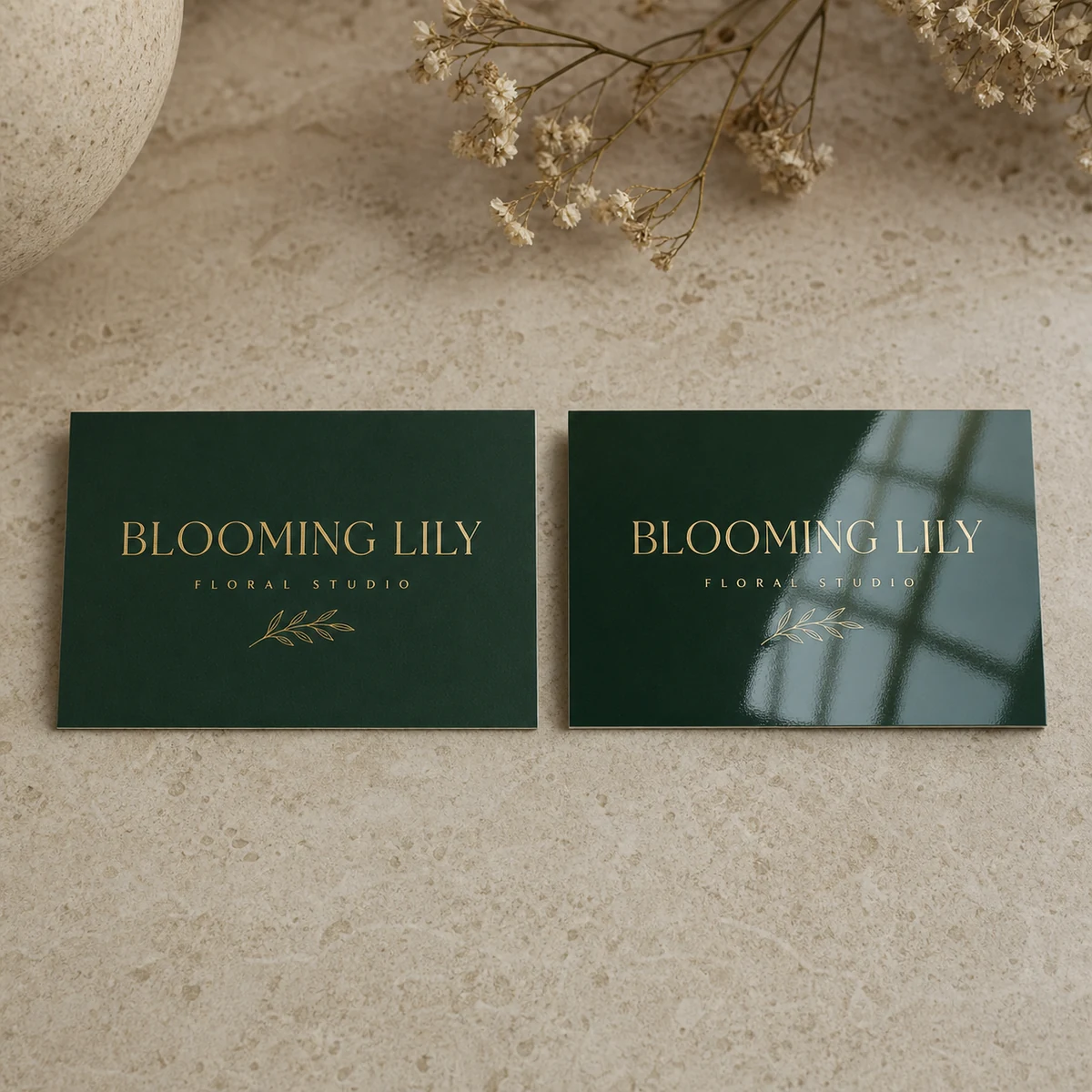
Spot UV solves the central matte-vs-gloss dilemma for a specific type of buyer: someone who wants the elegance of matte but needs selected elements – a logo, a monogram, a decorative pattern – to catch the light. The technique applies a UV-cured gloss varnish to precisely chosen areas of a matte-coated card, creating a tactile contrast between the flat base and the raised, reflective highlights.
What makes spot UV particularly effective is the contrast mechanism. On a fully gloss card, a shiny logo disappears into the surrounding gloss field – both surfaces reflect at the same intensity. On a matte base with spot UV applied only to the logo, the logo literally emerges from the surface. The eye and the finger are drawn to it simultaneously. This contrast effect is why spot UV has become the preferred premium finish across legal, finance, luxury retail, and design sectors in Australia.
Spot UV business cards from Paperlust Print Shop start from $0.14 per card (inc GST). Note that spot UV requires extended production time compared to standard matte or gloss cards – plan accordingly if you are ordering ahead of a specific event or meeting. For a broader overview of all the finish options available, the how to choose the right business cards guide covers each finish in depth alongside paper weight considerations.
Spot UV is the right answer when:
- You want a premium tactile result but full gloss feels too casual or promotional for your sector
- Your logo or monogram deserves physical emphasis beyond colour alone
- Your industry defaults to matte and you want a differentiating texture without breaking the professional register
- Your design has both photography and text elements – spot UV over the image panel, matte on the contact side
Spot UV pairs particularly well with flat foil elements. The combination of a matte base, foil logo in metallic gold or silver, and spot UV over a secondary design element produces one of the most tactilely layered cards available in the market.
The Fourth Option: Silk and Satin Finish
Silk (also called satin) sits between matte and gloss on the sheen spectrum. It uses the same coated stock foundation but with a coating formulated to produce a low-to-medium sheen – softer than gloss, richer than pure matte. The feel is often described as velvety, with a warmth that neither full gloss nor matte quite achieves on its own.
From a print quality standpoint, silk retains most of gloss’s colour vibrancy – typically around 85 to 90 per cent of the saturation advantage – while avoiding the mirror-like reflectivity that creates fingerprint problems and glare. This makes silk the practical choice for buyers who want their colours to read vividly but are concerned about how a full gloss card will look after a day of networking.
Satin is worth considering when:
- Your brand palette uses warm, rich, or jewel tones – deep burgundy, forest green, navy – where satin does the colours full justice without gloss glare
- You distribute cards frequently and want something that holds up visually to repeated handling
- Your design sits between photo-heavy and type-heavy – satin serves both better than either pure finish in most cases
- You want a slightly differentiated tactile impression from the majority of cards in your sector, which default to standard matte
Not all print suppliers draw a hard distinction between “satin” and “silk” – some use the terms interchangeably, others offer distinct coating variants at different sheen levels. When ordering, request a sample pack to feel the exact sheen level before committing to a full production run.
The Uncoated Alternative
Uncoated business cards occupy a different finish category entirely. There is no coating layer – the paper fibres are exposed and ink is absorbed directly into the stock during printing. The result looks and feels nothing like either matte or gloss coated cards:
- Texture: slightly rough or toothy, like quality writing paper rather than a smooth print surface
- Writeable: ballpoint, rollerball and gel pens write on uncoated stock without smearing – the only standard finish option that allows this
- Colour depth: ink absorbs into the fibres, producing softer edges and slightly less saturated output than coated equivalents
- Environmental positioning: uncoated stock suits FSC-certified or recycled paper – no chemical coating layer to factor into the environmental profile of the product
- Moisture sensitivity: exposed fibres absorb humidity more readily than coated stock – relevant in coastal Queensland and tropical Far North where wallet-stored cards can soften, curl or warp over time
Uncoated suits specific use cases well. A boutique architecture studio that wants cards to feel like their sketchbook paper uses uncoated. A sustainability consultant handing cards to government procurement officers uses uncoated on recycled stock. A GP who wants a patient to write down the after-hours number uses uncoated because the card can be written on.
Uncoated is not a budget choice. Premium uncoated stocks on heavy cotton-fibre or linen-textured papers can feel more expensive than a standard gloss coated card because the paper quality itself carries the premium signal rather than a coating finish. The coloured paper business cards range provides access to uncoated European colour stocks in a range of tones – an elegant positioning alternative to both matte and gloss for the right brand. For broader design context across all finish types, the business card design guide is worth reading alongside this comparison.
Durability and Handling
Both matte and gloss coated cards are significantly more durable than uncoated cards because the coating layer protects the printed surface from moisture, oils, and physical abrasion. Within the coated category, here is how the two finishes compare on durability dimensions that matter in real use.
Scratch resistance
Matte coated cards hold up better aesthetically to scratching in day-to-day handling. When a gloss card is scratched, the scratch disrupts the reflective surface and catches light from every angle – it is immediately visible. On a matte card, a light scratch blends into the diffuse surface texture more easily and is less noticeable under normal conditions. Neither finish is immune to a sharp key or a rough surface; matte simply forgives minor abrasion more gracefully.
Fingerprint resistance
Matte wins decisively here. Oils from skin are inevitable on any card that is handed over and handled repeatedly. Gloss surfaces make those oils visible because the print contrast stands out against the reflective base. Matte surfaces scatter the light around the oily area, significantly reducing the contrast and making prints far less obvious. This is especially relevant in warm-weather states like Queensland and the Northern Territory, where handling in high humidity intensifies oil transfer to card surfaces.
Cardholder versus pocket storage
Cards stored in a hard-sided cardholder fare well regardless of finish – both surfaces are protected from direct abrasion in that environment. Cards stored loose in a wallet pocket or jeans pocket accumulate micro-scratches from fabric, other cards, and incidental objects. Matte is more forgiving in this scenario. Cards distributed in environments where they often end up in pockets or toolboxes – trades, events, hospitality – benefit from matte for this practical reason.
Climate considerations in Australia
Both matte and gloss coated stocks resist moisture considerably better than uncoated. In high-humidity environments along the Queensland coast and in tropical Far North Australia, the coating layer is meaningful protection for the paper substrate beneath. Uncoated cards in these environments can soften, curl, or warp over weeks of wallet storage. For business card buyers in Melbourne, Sydney, Adelaide, Canberra, and Perth, both coated finishes perform well for moisture resistance – the finish choice in those markets is primarily an aesthetic decision rather than a durability one.
Age yellowing
High-quality coated stocks are UV-stabilised and will not yellow noticeably over the typical one-to-two year lifespan of a business card batch. Both matte and gloss coated cards hold their appearance well when stored away from direct sunlight. Cards displayed on a window ledge or left in a car dashboard will show colour shift on any stock eventually, but this is a storage issue rather than a finish issue.
Cost Guide: Matte vs Gloss in the Australian Market
One of the most persistent myths about business card finishes is that gloss is cheaper and matte is premium. In practice, the pricing relationship is more nuanced and the assumptions often wrong.
Standard cards: same price for matte and gloss
At the standard business card tier, matte and gloss are the same price. The finish is a selection made at checkout with no price differential between the two options. Standard business cards from Paperlust Print Shop start from $0.28 per card (inc GST), with free overnight Startrack delivery anywhere in Australia and 24-hour production available. The finish you choose does not change the price.
Premium finishes and what the upcharge buys you
Once you move beyond standard matte or gloss, pricing reflects the additional process steps and materials involved in each premium finish:
| Finish | From (inc GST) | Production Time | Best For |
|---|---|---|---|
| Standard (matte or gloss) | $0.28/card | 24-hour production available | Most professional use cases; fast turnaround |
| Coloured Paper (uncoated) | $0.49/card | 24-hour production available | Distinctive uncoated colour stock; writeable surface |
| Spot UV | $0.14/card | Extended production | Matte base + selective gloss highlights on logo or design elements |
| Scodix (raised texture) | $0.20/card | Extended production | Raised gloss tactile highlights; ultra-premium feel |
| Raised Foil | $0.24/card | Extended production | Tactile raised metallic highlights; high contrast on matte base |
| Flat Foil | $1.52/card | Extended production | Mirror-bright metallic foil on logos, text, or design elements |
| Duplex | $2.27/card | Extended production | Two stocks bonded together; maximum weight and prestige in the hand |
When is the premium finish upcharge worth it? The jump from standard matte or gloss to spot UV, foil, or duplex is justified when the card itself is part of the brand experience – not just a contact detail delivery mechanism. For a premium law firm, a financial planner working with high-net-worth clients, a luxury wedding photographer, or a designer whose card IS their portfolio in miniature, the premium finish upcharge is a marketing investment that pays back at every handshake. For a tradie handing out cards on a worksite, standard matte gets the information where it needs to go just as effectively.
Decision Flowchart: Which Finish to Choose – and Four Myths Debunked
Before the decision framework, here are four persistent myths that trip up buyers and lead to orders they later regret:
Myth: “Gloss is always cheaper”
At the standard card tier, matte and gloss are the same price. The myth likely comes from the era of budget photo-paper card printing, where glossy paper stock was sometimes genuinely cheaper than premium uncoated alternatives. In modern commercial printing, the coating chemistry differs but the cost to the buyer at the standard tier is identical. When gloss IS cheaper it is usually because the product is thinner, lighter stock – not because gloss inherently costs less to produce.
Myth: “Matte always looks more premium”
It depends entirely on context. In legal, finance, luxury retail, and hospitality, matte signals premium precisely because it is restrained and associated with high-quality paper feel. In photography, real estate, and event businesses, gloss with rich photo reproduction can be the premium choice. A thick gloss card with stunning full-bleed photography often reads as more premium than a thin matte card with a clip-art logo. Paper weight and design quality influence perceived premium value as much as – often more than – the finish alone.
Myth: “QR codes do not scan on gloss”
They do scan on gloss – reliably. The issue is specular glare: hold a gloss card at the wrong angle under strong overhead lighting and the reflective surface can overwhelm the phone camera’s QR decoding. In practice, most users tilt the card slightly to eliminate the glare and the code reads immediately. Matte cards eliminate this variable entirely since there is no specular glare to manage. If your card’s primary function is QR scanning – a digital portfolio, a link card, an NFC alternative – matte removes the only friction point gloss introduces.
Myth: “Fingerprints are unavoidable on gloss”
Largely true, not universally true. The visibility of fingerprints on gloss depends on individual skin chemistry (oilier skin = more visible prints), ambient temperature (warm hands transfer more oil), and the card’s background colour (dark or black gloss shows prints far more dramatically than light or white gloss). Matte cards do accumulate fingerprints; the difference is that the diffuse matte surface makes prints far less visible. Planning to distribute cards at a trade show, networking event, or industry conference? Matte will look cleaner at card 200 than gloss will.
The decision flowchart
Work through this sequence to land on your finish:
- Do you or your clients need to write on the card? Yes – specify uncoated stock. No – continue.
- Does your card feature a full-bleed or prominent photograph? Yes – lean gloss (or spot UV if you want a premium version). No – continue.
- Is your industry legal, finance, healthcare, hospitality, or luxury retail? Yes – matte is the sector default; consider spot UV if you want a tactile premium element. No – continue.
- Is your logo or brand mark a significant differentiating asset that should stand out physically? Yes – spot UV on a matte base delivers this most effectively. No – continue.
- Is vivid colour reproduction your primary brand signal? Yes – gloss or satin. No – matte.
- Will you be distributing cards in high-touch, high-volume environments? Yes – matte handles repeated handling better aesthetically. No – either finish serves you well; choose on preference.
If you are still undecided after this exercise, the single most useful step is ordering a sample pack and comparing the finishes in your hands. No amount of description replaces the tactile experience of holding a matte, gloss, spot UV, and coloured paper card side by side. For additional context on how finish interacts with card design, the business card design trends 2026 guide and the business card mistakes to avoid are both worth reading before you finalise your order.
Want Matte Elegance with a Gloss Highlight? Spot UV Is the Answer.
Spot UV business cards give you a matte base with strategic gloss applied to your logo or key design elements. The contrast is tactile and immediate – and the card is unforgettable to receive. From $0.14 per card with free overnight Startrack delivery anywhere in Australia.
Frequently Asked Questions
Which lasts longer in a cardholder – matte or gloss?
Matte holds up better aesthetically in a cardholder or wallet over time. Both finishes are coated and resist moisture and oil similarly, but matte’s diffuse surface makes minor scratches and handling marks far less visible than on a gloss surface where the same marks catch the light. For heavy daily use in a wallet or card case, matte is the more practical choice.
Do gloss business cards show fingerprints?
Yes – this is one of gloss’s most consistent trade-offs. The reflective surface makes oil from fingertips visually obvious, particularly on dark-background cards. Matte cards also accumulate fingerprints but the diffuse surface scatters light around the oily area, making prints far less noticeable. If you are distributing cards frequently in warm environments or at high-volume events, matte is significantly cleaner-looking after repeated handling.
Can you write on gloss business cards?
No. Gloss coating repels ballpoint and most pen ink, causing smearing or beading on the surface. The same applies to matte coated cards – despite the non-shiny surface, the coating layer still prevents pen adhesion. If you need a writeable business card, specify uncoated stock when ordering. Neither matte nor gloss coated cards support reliable handwriting.
Will my logo colours look more vibrant on gloss or matte?
Gloss produces more vivid, saturated colour reproduction. The smooth reflective surface allows ink to maintain full saturation without any of the scattering effects that cause matte colours to appear softer. For logos with vivid brand colours, photography, or complex colour gradients, gloss will give you richer output. If your brand uses earthy, neutral, or muted tones, the saturation difference is less pronounced and matte’s softer rendering may actually be preferable to your aesthetic.
Is matte more expensive than gloss?
No – at the standard business card tier, matte and gloss are the same price. The finish is selected at checkout with no price differential. Premium finishes such as spot UV, raised foil, flat foil, and Scodix carry higher per-card costs because of additional production process steps, but those pricing differences exist regardless of whether the base card is matte or gloss.
What are silk-finish business cards?
Silk (also called satin) is a coating finish that sits between matte and gloss on the sheen spectrum, producing a low-to-medium sheen that is softer than gloss but richer than matte. Often described as velvety, silk retains most of gloss’s colour vibrancy while reducing the fingerprint visibility and glare of a full gloss surface. It is a popular choice in luxury retail, fashion, and premium hospitality sectors where the in-between finish aligns well with brand positioning.
Does spot UV count as gloss?
Spot UV is technically a selective gloss element applied to a matte base. The UV-cured varnish used in spot UV is a gloss material, but it covers only specific design areas – a logo, a name, a pattern – rather than the full card surface. The result is a matte card with localised gloss highlights. If someone asks for a “gloss card” they mean a full-surface gloss; spot UV is a distinct and more premium product that uses gloss strategically for contrast effect.
Can I get a card that is matte on one side and gloss on the other?
This is possible depending on the specific product and production arrangement. The duplex business card format bonds two different stocks together, which allows different surface treatments on each face as part of the design specification. Contact the Paperlust Print Shop team directly to discuss your specific requirements for mixed-finish production.
Will a QR code work on a gloss card?
Yes – QR codes work reliably on gloss cards under most conditions. The risk is specular glare: under strong overhead lighting, the reflective surface can create a bright spot that interferes with the phone camera’s QR decoding. In practice, simply tilting the card slightly eliminates the glare and the code scans immediately. If your card’s primary function is QR scanning, matte removes this variable entirely and is the more friction-free choice.
Which is more eco-friendly, matte or gloss?
Neither has a clear eco advantage over the other at the coating level – both matte and gloss coated stocks involve a chemical coating process applied to the paper base. The more meaningful eco lever is the choice of base stock: FSC-certified paper, recycled content fibre, and vegetable-based printing inks apply regardless of finish. If eco-positioning is central to your brand, uncoated stock on certified paper is the most credible option – there is no coating layer to account for in the environmental profile of the card.
What is the best business card finish for a real estate agent?
Most real estate agents use gloss for its superior photo reproduction – property photography and professional headshots look best on a high-sheen surface with deep blacks and vivid tones. However, agents who distribute large numbers of cards at open homes, where fingerprint accumulation becomes increasingly obvious, are shifting to matte or spot UV to maintain a cleaner appearance. If your card design is photo-heavy, gloss is the standard choice. If it is brand-forward with a strong logo as the centrepiece, matte with spot UV on the logo is the premium alternative that holds up better to heavy distribution.
How do I choose a business card finish as a photographer?
Photographers have the most design-driven reason to choose gloss: your card is your portfolio in miniature, and gloss does full justice to colour depth, tonal range, and fine detail in photographic reproduction. A matte photographer’s card can read as a deliberate creative statement (editorial, moody, restrained) but risks making your strongest image look flat. If you use a full-bleed photo, gloss is the functional default. If your card is primarily type and logo with a contained image panel, spot UV on matte is an elevated alternative. The foil business cards guide covers additional premium finish options suited to creative professionals.
What finish works best for business cards with foil printing?
Matte is almost always the right base for foil printing. The visual contrast between the flat matte surface and the mirror-bright foil element creates the drama that makes foil cards striking. On a gloss base, foil loses much of its contrast impact – both surfaces are shiny and the foil blends into the surrounding reflective field rather than standing out from it. For flat foil or raised foil business cards, the design logic consistently starts with a matte base for maximum foil impact.