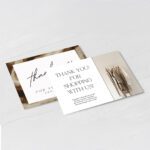
Real estate agents in Australia spend thousands each month on digital ads competing for the same eyeballs on the same screens. Meanwhile, a well-timed 360gsm postcard lands on a kitchen bench, gets pinned to the fridge, and sits there for weeks. Letterbox campaigns have quietly outperformed most digital tactics in AU residential real estate for years, and the numbers back it up: direct mail in Australia routinely achieves response rates of 1 to 3%, compared to well under 0.5% for display and social. This guide breaks down every postcard campaign type agents use, the copy frameworks that drive enquiry, and the compliance requirements that keep your agency on the right side of the regulators.
At a glance
Real estate postcards in Australia
- Response rates of 1 to 3% are typical for well-targeted AU letterbox campaigns.
- Just Listed and Just Sold are the two highest-converting campaign types for residential agents.
- AusPost Unaddressed Mail is the low-cost distribution channel; addressed mail requires compliance with the Spam Act 2003 for electronic data but is unregulated for physical post.
- 360gsm cardstock projects authority and survives the letterbox; lighter paper flyers rarely make it past the recycling bin.
- DL format is the most cost-effective for envelope-compatible addressed mail; A5 wins for impact when dropping unaddressed via AusPost.
- Dedicated QR codes and landing pages are the cleanest way to track ROI per campaign drop.
Why Postcards Outperform Flyers and Digital for AU Real Estate

The average Australian household receives 36 pieces of direct mail per year. That number has fallen steadily as budgets shifted online. That scarcity is an advantage. When you letterbox a suburb with a thick, glossy or matte 360gsm postcard, it stands out physically from the coupon mailers and pizza flyers. Recipients pick it up. They read the front before deciding whether to keep it.
Flyers printed on 80gsm or 100gsm paper communicate cheapness before anyone reads the copy. They bend in the letterbox, arrive creased, and go straight to the recycling bin. A properly printed postcard on 360gsm matte stock communicates the same professionalism as a quality business card. It signals that the agent takes their brand seriously. In a category where trust is the primary purchase criterion, that perception transfer matters.
Digital ads disappear the moment the browser tab closes. A postcard that ends up on the fridge stays in the home for days or weeks, functioning as a passive reminder every time a household member walks past. Sellers thinking about listing often take weeks to act. The agent whose card is still visible when they decide to call has a significant advantage.
AusPost’s own research found that 60% of consumers visit a website after receiving a letterbox piece. For real estate, that visit typically means a check on the agent’s sold results page: exactly where you want them to land.
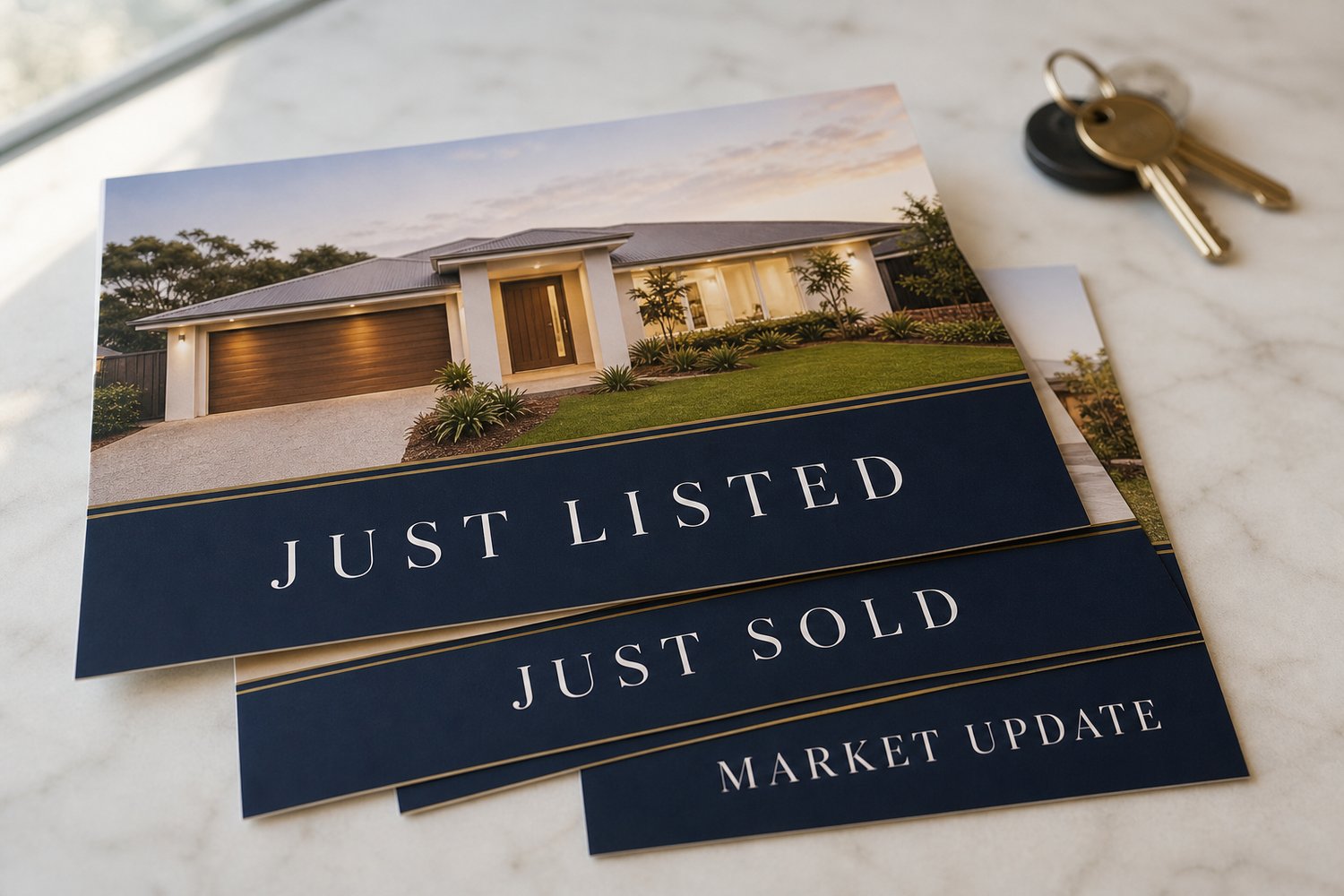
Just Listed Postcard Campaigns
Just Listed campaigns are the highest-urgency category in residential real estate marketing. They serve two simultaneous purposes: alerting potential buyers in the local area, and sending a visible signal to nearby homeowners that this agent is active in their street.
Timing and distribution
Speed is the defining factor. A Just Listed card should be in letterboxes within 48 hours of the listing going live on the portals. Any longer and you lose the “hot off the press” credibility. The card arrives after the buyer has already seen the listing online and the signal value collapses.
Work with your printer to have artwork camera-ready before the photography session is complete. The final hero shot drops in at the last minute. Paperlust’s same-day artwork review means you can submit final files and have production start immediately. This reduces the gap between photography and delivery.
Target radius: aim for 200 to 500 homes within a 300 to 500 metre walk of the listing, covering the most likely “I’d love to live near here” buyers as well as the neighbours who will casually mention the card to friends and family.
Copy framework
Just Listed cards work best with a tight structure:
- Front: Large hero shot of the property (exterior preferred for houses, a lifestyle interior for apartments). Price range or guide price in bold type. Agent name and headshot in the lower corner. Nothing else.
- Back: Suburb name prominent at the top (e.g. “Paddington | 4 Bed | 2 Bath”). Three or four property highlights as one-line bullets. Open home times if confirmed. Two CTAs: a phone number for the agent and a QR code linking to the portal listing page.
Agent headshot on the front builds name recognition in the farm area over time. Every drop reinforces personal branding even when the particular home isn’t relevant to the recipient.
Format recommendation
A5 (148 x 210mm) printed on 360gsm matte is the standard for Just Listed campaigns. It is large enough to display the property photo at genuine impact, and thick enough to feel premium in hand. If postage cost is a constraint, DL (99 x 210mm) is envelope-compatible and keeps addressed mail postage to the standard large letter rate.
Just Sold Campaigns
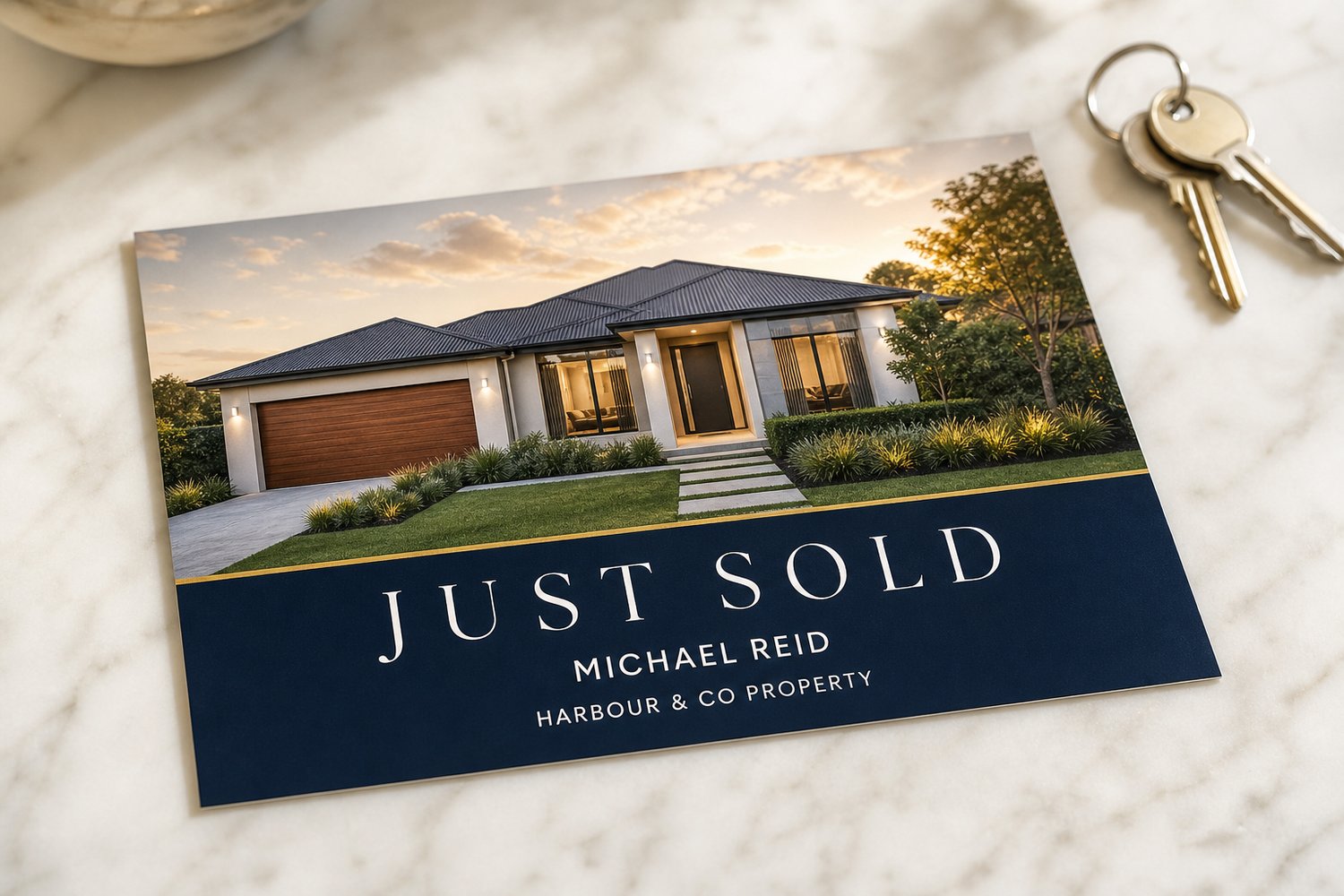
Just Sold campaigns are arguably more powerful than Just Listed for long-term brand building because they carry a proof point: the agent delivered a result. The message is not “I have something for sale” but “I just achieved a great outcome for someone on your street.”
The social-proof play
Neighbours notice when a property sells. They also notice which agent’s name is associated with the result, and they remember it. A well-timed Just Sold postcard reinforces that association with a tangible piece of branded communication in the home.
The primary CTA on a Just Sold card is always directed at potential sellers, not buyers: “Thinking of selling? Find out what your home is worth.” This is the invitation to start a conversation without any pressure.
Neighbour-targeting strategy
Target the immediate 50 to 100 neighbours first (the “ring” approach), then a broader suburb drop within 5 to 7 days. The immediate neighbours are most likely to have seen the sold sticker and to be curious about the price. This audience has the highest engagement with the card.
Sale price disclosure
Sale price disclosure rules vary by state. In Victoria, the REIV has advocated for mandatory disclosure once a contract becomes unconditional, and legislation in this area continues to evolve. In Queensland, the seller disclosure regime introduced in August 2025 focuses on pre-contract disclosure rather than post-sale advertising. As a general rule: confirm with your principal or legal team before featuring an exact sale price on any marketing material. Using “sold above reserve” or “sold prior to auction” is a safer framing if the price is uncertain or sensitive.
Market Update and Neighbourhood Expert Campaigns
Not every postcard needs to be transaction-triggered. Agents who maintain consistent presence in a farm area through non-sales content, market updates, auction clearance rates, suburb median shifts, build long-term authority that makes the listing conversation easier when a homeowner is finally ready to sell.
What to include in a market update postcard
A quarterly or monthly market update postcard should be data-driven and genuinely useful. Include:
- Suburb median sale price (quarter-on-quarter or year-on-year)
- Auction clearance rate for the suburb or postcode
- Average days on market (DOM) for the period
- Number of properties sold in the period
- One-line agent commentary tying the data to what it means for homeowners
The goal is for the recipient to think “this is actually useful” rather than “this is an ad.” Agents who achieve that shift in perception see meaningfully higher recall when the recipient decides to sell.
Cadence and positioning
Monthly is aggressive but works for high-turnover suburbs where there is enough data to report. Quarterly is more sustainable for most agents and avoids the risk of looking like you are padding thin data. The positioning angle, “your neighbourhood expert”, builds over time. The fifth postcard a household receives from the same agent carries significantly more weight than the first.
Variable data printing allows you to personalise each postcard with the recipient’s street name or local data relevant to their specific block. For details on how suburb-level personalisation works in print runs, see the variable data postcard printing guide.
Coming Soon and Off-Market Campaigns
Coming Soon campaigns create urgency before a listing goes live. Off-market campaigns target a specific list, typically an agent’s buyer database, with an exclusive, non-portal opportunity. Both campaign types rely on the perception of scarcity and privileged access.
Coming Soon framing
The postcard copy should lean into exclusivity: “Register your interest before this hits the market.” Include a QR code or a dedicated URL that captures the buyer’s contact details in exchange for first-access notification. This gives the agent a warm lead list before the portal listing is live.
VIP buyer-list framing for off-market
Off-market campaigns are typically addressed mail to a curated list rather than unaddressed AusPost drops. The framing is “as a registered buyer in Paddington, you’re receiving this before it goes public.” This works particularly well in low-supply markets where buyers are actively watching for stock.
For help choosing between A6, A5, and DL formats for these targeted campaigns, the postcard size guide covers the trade-offs in detail.
Australian Compliance for Real Estate Postcards
Real estate marketing in Australia is subject to several overlapping compliance layers. Understanding each prevents costly reprints and potential regulatory exposure.
Agency licence number visibility
In most states and territories, any real estate marketing material, including printed postcards, must display the agency’s licence number. Check the specific requirements for your state: Real Estate Institute of Queensland (REIQ), Real Estate Institute of Victoria (REIV), and their counterparts in NSW, SA, WA, and the ACT each publish current guidance. When in doubt, include it.
Misleading sale price claims
Consumer law applies to real estate marketing. Quoting a sale price on a postcard that is materially different from the contract price, using misleading language around “sold” status before contracts are exchanged, or implying results that were not achieved are all potential breaches of Australian Consumer Law. Run any sale price or result claim past your principal before printing.
AusPost Unaddressed Mail requirements
Australia Post’s Unaddressed Mail service (sometimes referred to as “letterbox drop”) has specific physical requirements for cards and envelopes delivered through the network. These include minimum and maximum dimensions, minimum weight thresholds, and no-junk-mail sticker compliance rules (carriers must honour these stickers). Cards must also not impersonate official government or AusPost communications.
For print specifications: A5 and DL format postcards printed on 360gsm stock comfortably meet AusPost weight and rigidity requirements. A6 format at 360gsm may fall below the minimum weight threshold for some AusPost zones, confirm with Australia Post’s Unaddressed Mail team before booking a run.
Addressed mail and the Spam Act
The Spam Act 2003 governs electronic communications only (email, SMS, MMS), it does not apply to physical addressed mail. Physical addressed mail to residential addresses is legal without prior consent, provided the material is not defamatory or misleading. The only restriction is that recipients who ask to be removed from a physical mail list must be honoured.
Response Rate Benchmarks and ROI Tracking
Knowing whether a campaign worked requires measurement. The most common mistake agents make is running a drop and measuring success by the number of calls received in the following week. This misses the long-tail nature of postcard response.
Realistic response rate benchmarks
Direct mail response rates in Australian real estate typically fall in the 1 to 3% range for well-targeted campaigns. This means 25 to 75 responses per 2,500-card drop. In real estate, a single listing commission at $15,000 to $25,000 means a campaign only needs to convert one response into a client to return 30x to 50x the printing cost.
Transaction-triggered campaigns (Just Listed, Just Sold) tend to outperform brand-building campaigns (market updates, neighbourhood expert) in immediate response rate, but the long-term brand value of consistent market update drops is harder to measure and consistently undervalued.
Tracking methods
Use one or more of these attribution tools per campaign:
- Dedicated QR code: Generate a unique QR code per drop that links to a UTM-tagged landing URL. Google Analytics shows exactly how many people scanned and what they did next.
- Unique landing page URL: A subdomain or path specific to the campaign (e.g. `yoursuburb-report.youragency.com.au`) lets you see traffic without QR scan dependency.
- Dedicated phone number: Services like Twilio AU allow you to provision a local number per campaign. All calls route to your mobile, but you can see call volume and duration per campaign in the dashboard.
- Response code: Include a short reference code on the card (“quote BONDI24 when calling”) for teams that prefer manual tracking.
ROI calculation example
A 2,500-card A5 drop at $0.25 per card (print) plus approximately $350 to $500 for AusPost Unaddressed Mail distribution totals roughly $975 to $1,125. If the campaign generates one listing at a $15,000 gross commission, the ROI is approximately 13x to 15x on the print and distribution investment. Even at a 1% response rate (25 responses), a conversion rate of 4% on enquiries returns that commission.
For a comprehensive overview of campaign planning, targeting, and tracking beyond postcards, the direct mail starter guide for small business covers the full campaign lifecycle. And if you are printing personalised cards with suburb-level or street-level data, the variable data printing guide explains how to structure your data file for variable print runs.
Ready to run your next letterbox campaign? Paperlust Print Shop postcards are available in A6, A5, DL, and square formats on 360gsm matte stock with same-day artwork review.
Queensland agents can order custom postcards Brisbane online with the same Australia-wide dispatch and proof approval.
Frequently Asked Questions
How often should I letterbox the same farm area?
Most agents find a four to six week cadence sustainable for transaction-triggered content (Just Listed, Just Sold) when stock turnover in the area supports it. For market update campaigns, monthly is possible in active suburbs but quarterly is more common and avoids over-saturation. The key principle: every drop should have something of genuine value to the recipient, not just your headshot again.
What is a realistic response rate for real estate postcards in Australia?
Well-targeted campaigns in residential real estate typically generate 1 to 3% response rates. Transaction-triggered campaigns (Just Listed, Just Sold) at the top end of that range; brand-building market update drops closer to the bottom. Response rate is less important than ROI: in real estate, a single listing commission more than covers the cost of a 2,500-card campaign many times over.
What is the difference between AusPost Unaddressed Mail and addressed letterbox drops?
AusPost Unaddressed Mail (previously called Household Distribution) delivers to every active letterbox on a selected postcode or route, including those with “no advertising mail” stickers if your material is not classified as advertising (specific classification rules apply, check with AusPost). Addressed mail requires a list of specific recipient names and addresses and is processed through standard postal channels. Unaddressed Mail is significantly cheaper per piece for volume drops; addressed mail allows precise targeting of specific households or demographics and is typically used for off-market and buyer-database campaigns.
What does an AusPost Unaddressed Mail campaign cost?
AusPost Unaddressed Mail pricing is volume and postcode-dependent, but broadly falls in the $0.12 to $0.25 per piece range for catalogue and card delivery as of 2026. This is in addition to your print cost. Contact your local AusPost Business Centre or approved mail house for a quote based on your target postcode and volume.
Can I include a sale price on a Just Sold postcard?
You can, but check your state’s requirements and your agency’s policy first. In Victoria, the REIV supports sale price transparency and legislation is evolving to mandate disclosure in some circumstances. In Queensland, the seller disclosure regime introduced in August 2025 governs pre-contract disclosure rather than post-sale marketing, but consumer law applies to all marketing claims. When in doubt, “sold above reserve” or “sold prior to auction” is a safer frame than a specific price.
Do Paperlust Print Shop postcards include a design template for real estate campaigns?
Paperlust Print Shop is a print-to-order service, you supply print-ready artwork (PDF preferred, with 3mm bleed and crop marks). If you need a design produced from scratch, the team can provide a quote for a custom design alongside your print order. Contact the team via the postcard product page to discuss design and print together.
What is the minimum order quantity for real estate postcards?
Minimum order quantities are low and vary by format and finish. Standard digital print postcards in A6, A5, DL, and square are available from small runs, suitable for targeted off-market drops, through to high-volume unaddressed mail campaigns of 5,000 or more cards. Pricing is on a sliding scale with lower per-unit cost at higher quantities. See the postcard product page for current pricing or contact the team for a volume quote.
Ready to print your postcards?
360gsm premium card. From $0.15 inc. GST. Ships AU-wide from Melbourne.