
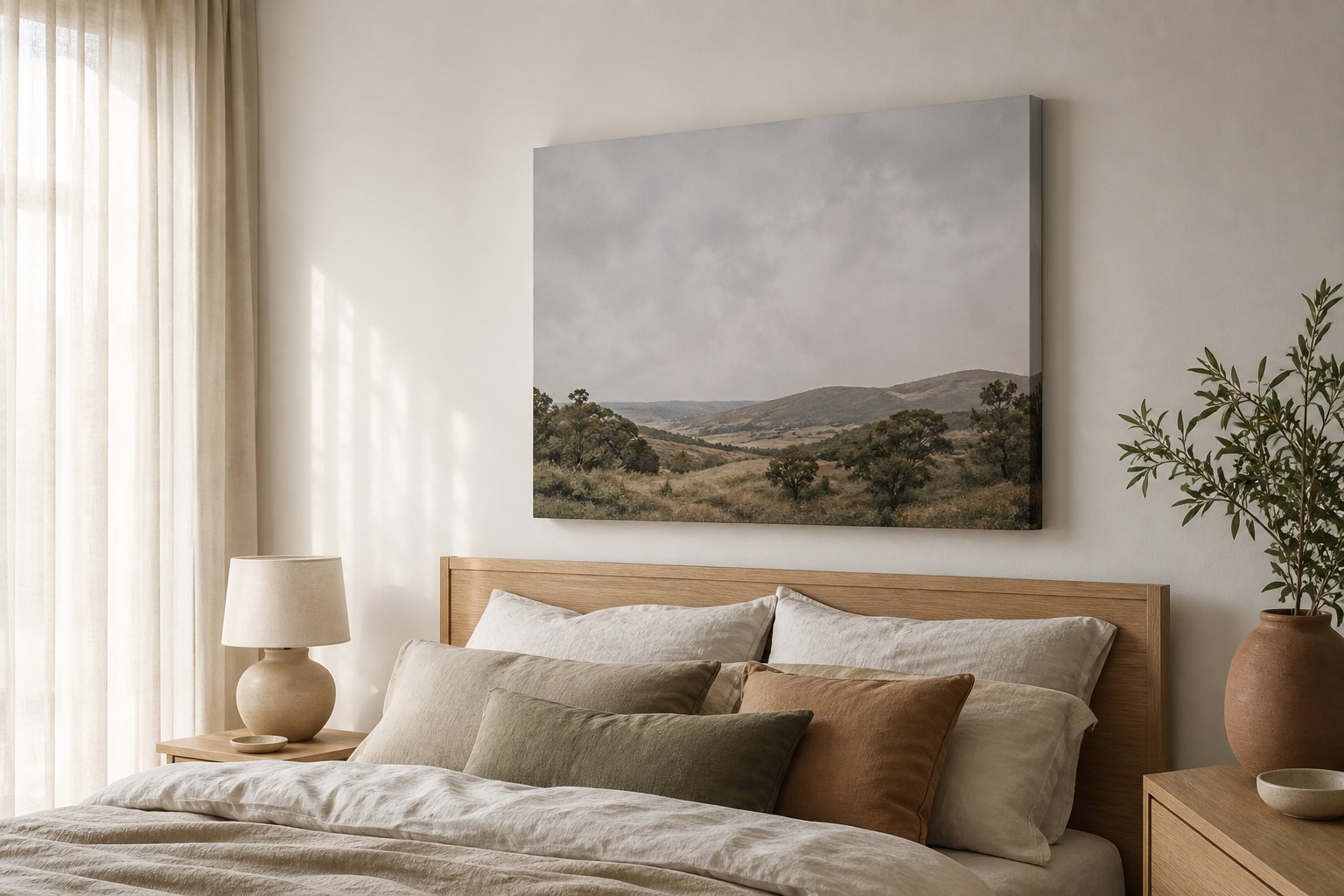
The bedroom is the one room in the house where the art does not need to impress anyone but you. There is no audience, no guests to consider, and no brief beyond how the room makes you feel when you walk in and when you lie down at night. That changes the rules.
Most living-room art earns its place by making a statement. Bedroom art earns its place by belonging. The pieces that work best in a bedroom tend to be quieter, more personal, and chosen for feeling rather than effect. That does not mean forgettable. It means genuinely meaningful.
This guide covers what to put on a bedroom wall, where to put it, and the practical questions that come up once you have decided. For sizing calculations, the two-thirds rule and the tape test, the companion guide How to Size a Canvas Print has the full method.
At a Glance
- Art above a bed reads best at roughly two-thirds the width of the bed head
- The wall you look at when lying down matters as much as the wall above the bed head
- Calm subject matter, soft tones and personal photographs suit bedrooms better than high-contrast graphic work
- A pair above bedside tables needs to match in size and finish or it reads as unintentional
- Canvas prints have no glass or glazing on any finish, so no glare from a bedside lamp and nothing to shatter above a sleeping space
- Framed prints ship with a fold-out stand and hanging hardware already fitted, making them the practical choice for renters and bedroom shelves
What Actually Suits a Bedroom
The subject matter that works best in a bedroom has a common quality: it does not demand your attention. You are asking art to share a room where you sleep, and pieces that are visually loud tend to be the first thing you notice every morning and the last thing you see before you close your eyes.
What works well:
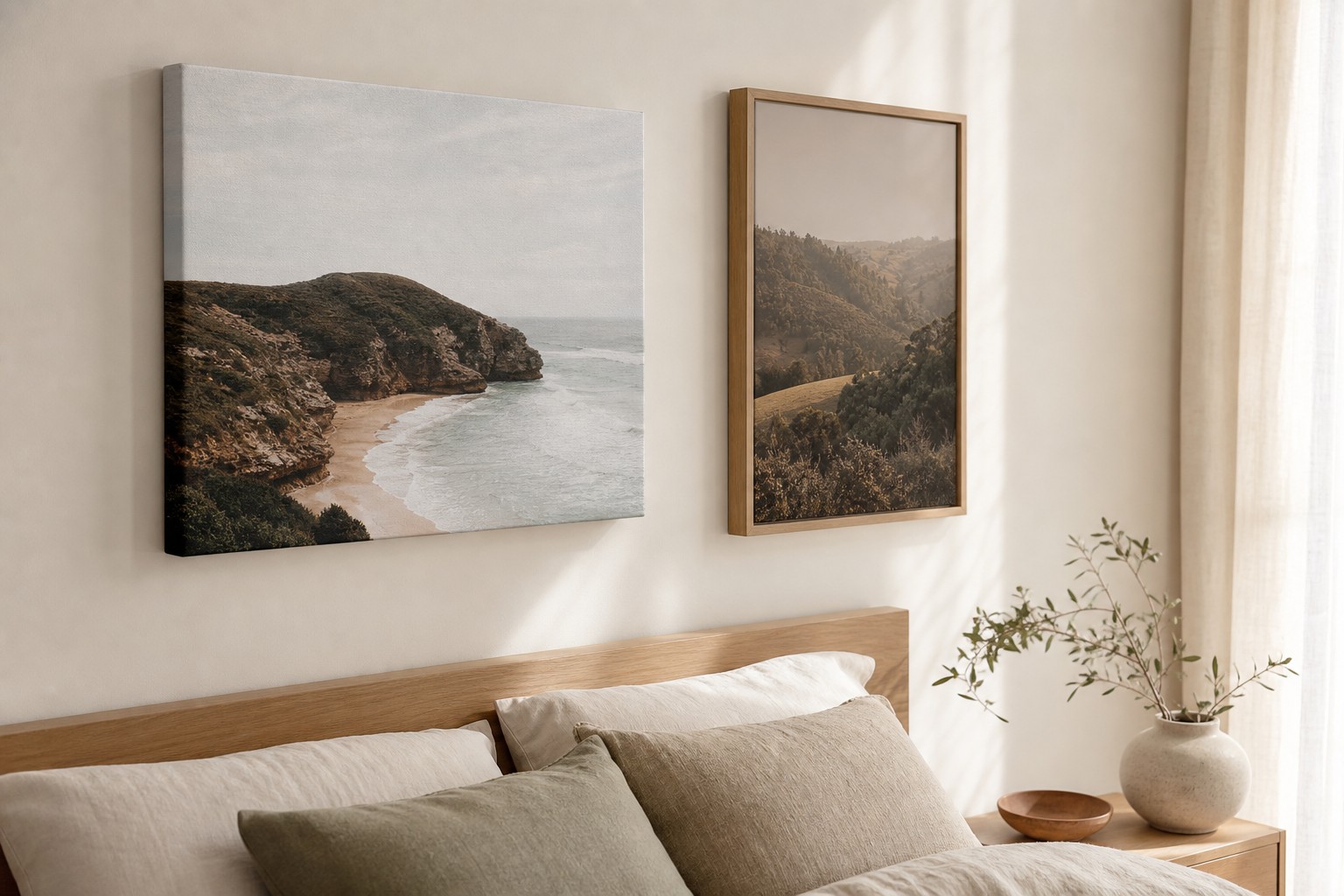
- Soft landscapes, particularly coastal views, rolling countryside or quiet natural details
- Abstract pieces with texture and movement, especially in muted or earthy tones
- Black-and-white photography, which reads as calm regardless of subject
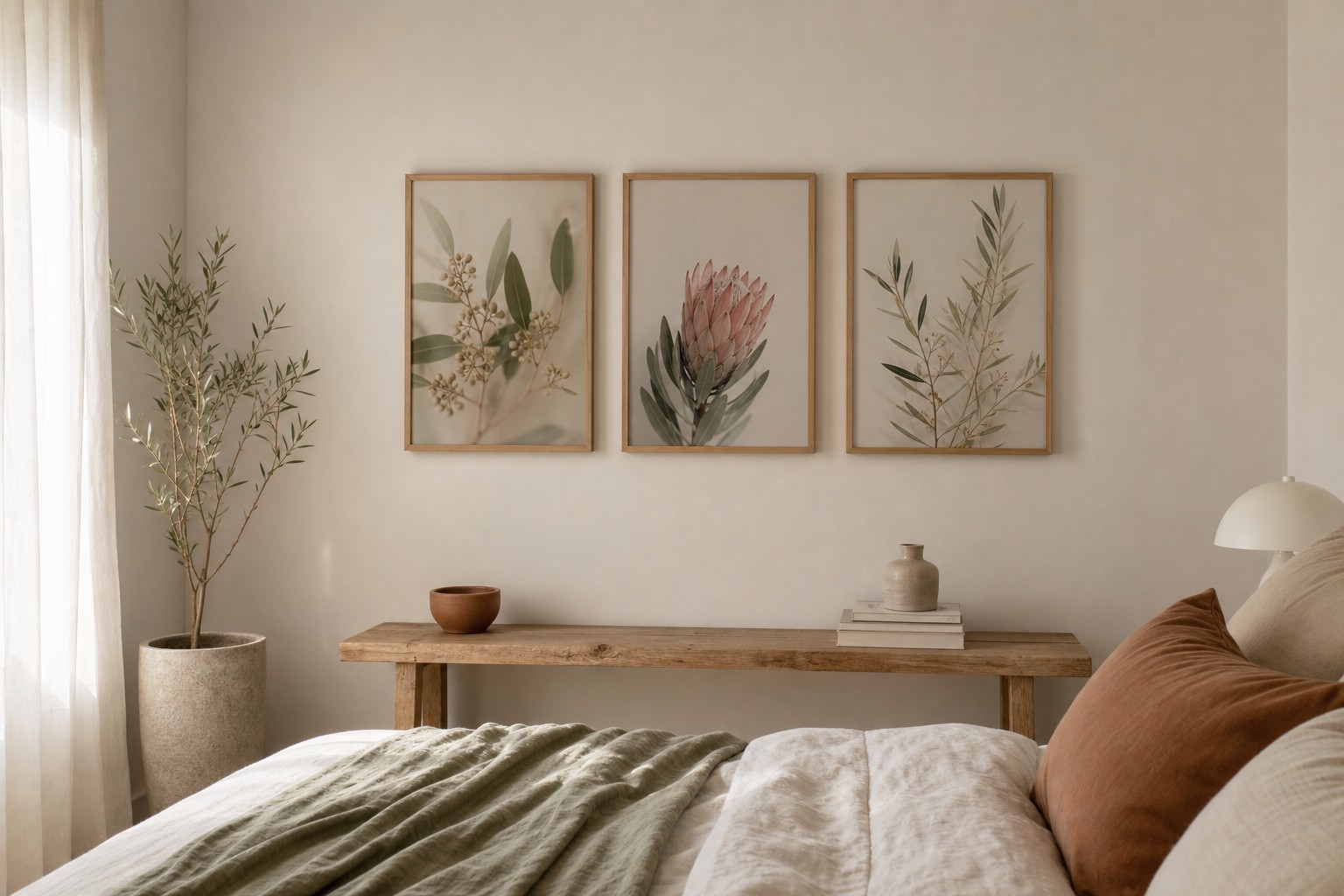
- Botanical prints and pressed-plant studies
- Personal photographs, printed large enough to be meaningful
What tends to fail:
- High-contrast graphic pieces or bold typography directly facing the bed
- Busy gallery-wall arrangements hung immediately above the pillow, which read as visual noise from lying down
- Loud colour palettes that compete with how you have styled the rest of the room
Where to Hang It
Above the bed head
The obvious position, and for good reason. A piece above the bed head anchors the whole room and gives the space a visual centre. The bottom of the piece should sit roughly 20 to 30 centimetres above the top of the headboard, or above the pillows if there is no headboard. That clearance keeps the art visible from across the room and out of range when someone sits up in bed.
For anything above a bed, proper fixings matter more than elsewhere. Canvas prints do not come with hanging hardware, so you choose your own fittings to suit your wall type, whether plasterboard, brick or render. Use fixings rated to the weight of the piece.
The wall you actually look at
The wall opposite the bed is the one you see when you are lying down and awake, which makes it the most viewed surface in the room. A single well-chosen piece on that wall can make a bedroom feel considered in a way that nothing on the bed-head wall achieves. This position suits one statement piece more than a gallery arrangement.
Other positions worth considering
A piece above a chest of drawers creates a natural focal point in rooms without a strong centre. A narrow vertical print beside a doorway fills dead space without crowding the room. A pair of prints flanking the bed, hung level with the top of the bedside lamps, brings balance to rooms where a single large piece above the bed head would be either too dominant or too small.
One Piece, a Pair, or a Small Gallery
A single piece is the right call above the bed head in most bedrooms. It is easier to hang well, easier to centre, and gives the room a clear focal point rather than a cluster to read from across the room.
A pair works best flanking the bed, typically above the bedside tables. Both pieces need to be identical in size and finish. Two A3 framed prints in natural oak reads as a considered choice. An A3 beside an A4, or a white frame next to a black one, reads as two pieces that arrived separately. If you want variety in a pair, keep it in the artwork itself, not the framing.
A small gallery works well on the wall opposite the bed. Keep it to three or four pieces arranged tightly with a common thread, whether that is a colour palette, a subject or a frame finish. For guidance on mixing A-series sizes in a gallery arrangement, the framed print sizes guide covers which combinations work.
Canvas or Framed in the Bedroom
Canvas prints have no glass or glazing on any finish. In a bedroom, this matters in two ways. There is no glare from a bedside lamp or a window opposite the bed, and there is nothing to shatter if a piece ever came off the wall above a sleeping space. Canvas prints start from $79 for a 30x30cm gallery wrap, with a flat $30 shipping fee. Canvas prints do not come with hanging hardware, so you supply your own fittings.
Framed prints are glazed with shatterproof plexiglass rather than standard glass, which addresses the safety concern while keeping the look of a traditionally framed piece. Every framed print ships with a fold-out stand and hanging hardware already fitted. An A4 framed print ($79) can sit on a bedside table without touching the wall. A3 is $129 and A2 is $179, with a flat $15 shipping fee on all orders.
For how the dimensions map to specific bed widths and wall proportions, the full method is in the canvas sizing guide. The broader canvas versus framed decision is covered in the canvas vs framed prints guide.
Decorating a Bedroom When You Are Renting
Renting does not mean bare walls. An A4 framed print ships with a fold-out stand, so it sits on a bedside table, a shelf or a windowsill without touching the wall. A larger framed print or a canvas can lean against the wall on a shelf or chest of drawers rather than hanging. Check with your landlord or property manager before fixing anything to the walls; many leases permit small picture hooks with restrictions on hole size.

Kids’ and Guest Bedrooms
In a child’s bedroom, the most durable choice is a piece the child has some input into. A personal photograph, a favourite animal, or something that reflects a genuine interest will outlast a nursery theme. A framed print in a neutral colour can follow a child through a room refresh more easily than a canvas tied to a specific age.
In a guest bedroom, the goal is a room that feels settled rather than styled for a particular person. A single calm piece above the bed, or a pair flanking it, is enough. Black-and-white photography or a simple botanical print tends to work regardless of the rest of the furnishings.
FAQ
What size artwork should I hang above a bed?
Art above a bed generally reads best at roughly two-thirds the width of the bed head. The exact dimensions depend on the width of the bed, the wall height, and the space between the headboard and the ceiling. The canvas sizing guide has the full method, including a tape test you can run before ordering.
How high should artwork be hung above a bed?
The bottom of the piece should sit approximately 20 to 30 centimetres above the top of the headboard, or above the pillows if there is no headboard. This keeps the art visible from across the room and clears someone sitting up in bed. If hanging a pair of pieces side by side, use a spirit level to make sure both sit at the same height before marking the wall.
Is canvas or a framed print better for above a bed?
Canvas has no glass or glazing, which means no glare from a bedside lamp and nothing that can shatter above a sleeping space. Framed prints use shatterproof plexiglass rather than standard glass, which is safer than a traditionally glazed frame and considerably lighter for larger sizes. Both are practical choices. The canvas vs framed prints guide covers the full comparison.
Can I hang art in a rented bedroom?
Yes, with some planning. An A4 framed print ($79) ships with a fold-out stand, so it sits on a bedside table or shelf without any wall fixing. A larger piece can lean on a shelf or chest of drawers. If your lease permits small picture hooks, most mid-size framed prints and canvas prints can be hung with a single hook. Check with your property manager first.
What art style works best in a bedroom?
Soft landscapes, coastal or natural scenes, black-and-white photography, abstract texture pieces, botanical prints and personal photographs all work well. High-contrast graphic work, loud typographic pieces and busy gallery clusters directly above the pillow tend to make a bedroom feel restless rather than calm.
Do canvas prints come with hanging hardware?
No. A canvas print is dispatched stretched, assembled and finished, but hanging hardware is not included, so you supply your own hook, D-rings or wall plugs matched to your wall type. For plasterboard walls, a picture hook or toggle bolt rated to the weight of the canvas is the standard approach. On brick or rendered walls, a masonry plug and hook is appropriate.