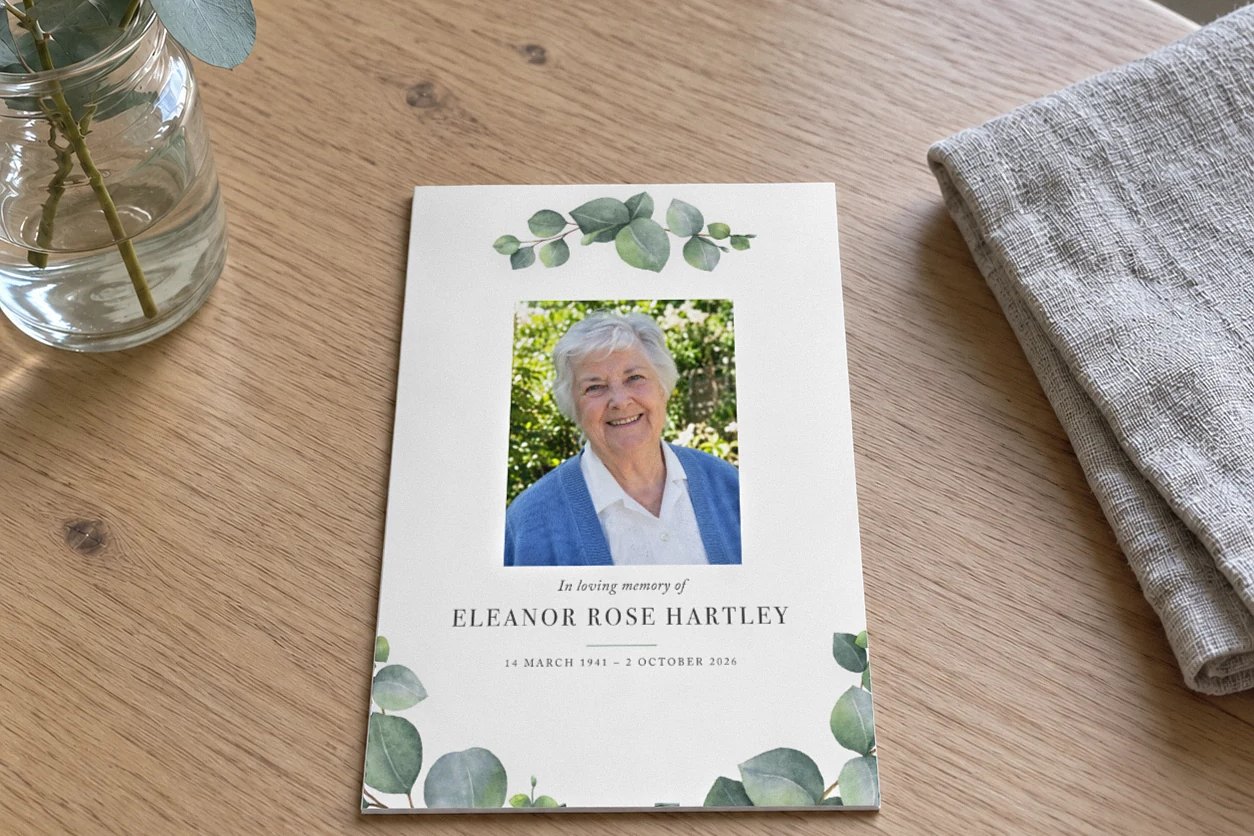
The service is arranged, the flowers are chosen, and someone in the family now has to settle the memorial card wording for a small printed card people will keep long after the day. That task often lands with the person already holding the list of names and dates.
This guide works through memorial card wording for the front and the back. It covers memorial verses and prayers that fit a small card, how to write your own lines, and how to word funeral thank you cards afterwards. It does not cover hymns, readings or the running order of the service.
The short version
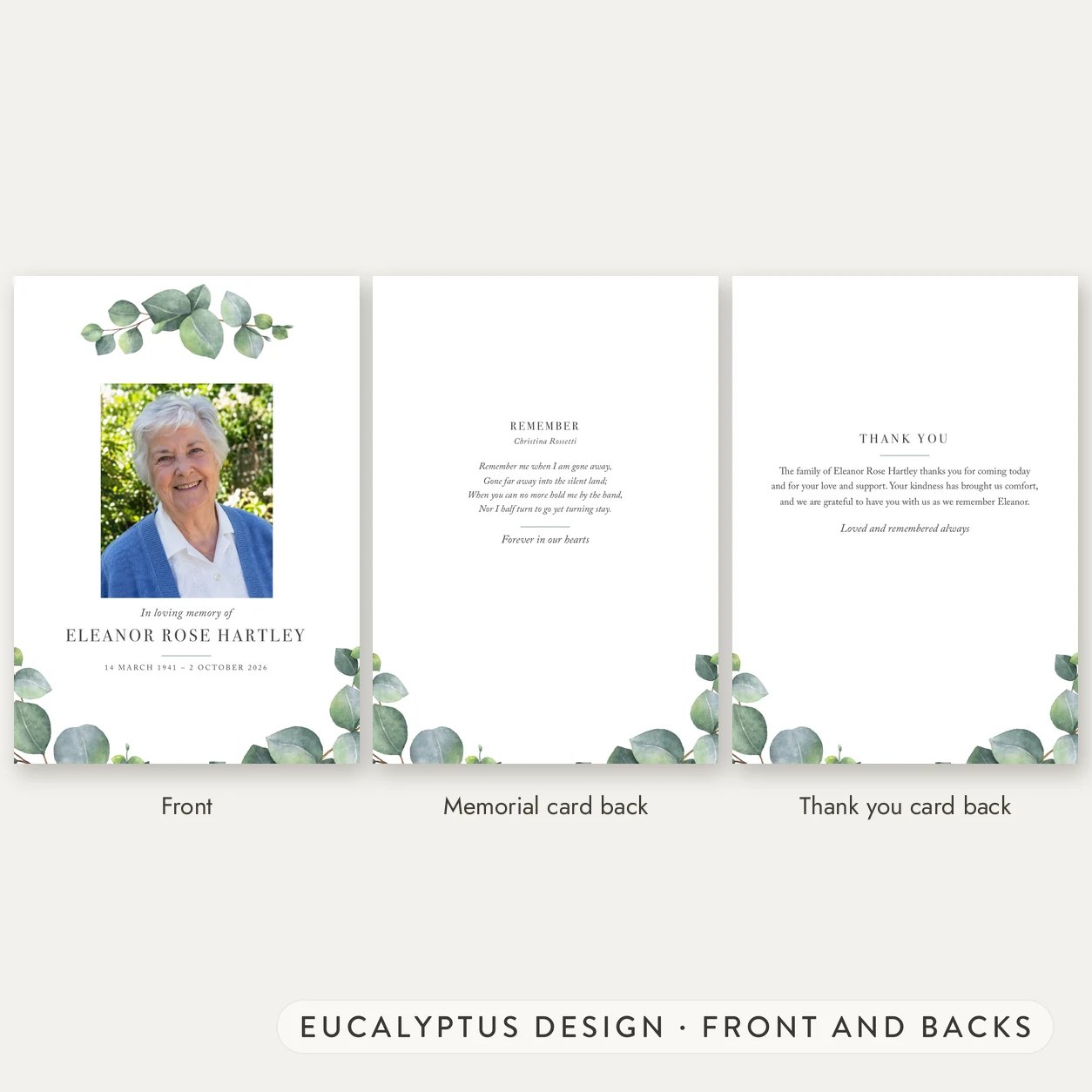
- The front carries the photo, an opening line such as In loving memory of, the full name and the dates of birth and passing.
- The back carries a verse, prayer or poem, or the family’s own words, and a short sign off.
- Pick a piece that fits the card. The DL card has room for a longer verse.
- Words by writers who died before 1 January 1955 are generally out of copyright.
- A thank you card keeps the same front, with Thank You and a message on the back.
- Two people check the names and dates on the PDF proof before approval.
Memorial card wording for the front of the card
The front of the card does a quiet job. It names the person, holds the photograph and gives people a first line to read. This table sets out the usual order.
| Part of the card | What usually goes on it | Tip |
|---|---|---|
| Front opening line | In loving memory of, Celebrating the life of, or In remembrance of | Say it aloud with the full name before you choose. |
| Name | The full name, with the dates of birth and passing | Confirm the spelling exactly as the family writes it. |
| Dates | The dates of birth and passing, written consistently | Use the same date format on the card and the service booklet. |
| Photo | A clear photo where the face is well lit | Choose the clearest photo you have rather than the most symbolic one. |
| Back | The verse, prayer or poem, or the family’s own words, with a short sign off | Keep the back to one piece so the card stays readable. |
| Sign off line | Forever in our hearts or Loved and remembered always | Match the sign off to the tone of the verse above it. |
Start with the opening line. Our designs print In loving memory of, Celebrating the life of or In remembrance of. Say the line aloud with the person’s full name and listen to how it lands before you decide.
Next, confirm the full name. Decide whether to add a preferred name in the family’s own way. The main line should carry the full name, but the surrounding text can hold the shorter name people used day to day if that feels right.
Dates need one rule: be consistent. Choose the same order of day, month and year on the card and on any printed pieces prepared for the day. A small slip in a date is the kind of error a tired eye can miss.
For the photo, use a clear photograph where the face is well lit. At the proof stage our team checks the photo and tells you if it is likely to print soft.
Memorial verses and poems for the back of the card
Many families ask which memorial card verses will fit a small space. The length matters more than the visual design, so check the number of lines before you commit.
| Verse, prayer or poem | Written by | Length | Suits | Copyright |
|---|---|---|---|---|
| Ode of Remembrance, the fourth stanza of For the Fallen | Laurence Binyon (died 1943) | four lines | a returned service person | out of copyright |
| Crossing the Bar | Alfred, Lord Tennyson (died 1892) | sixteen lines in four verses | a calm last voyage, a life by the sea | out of copyright |
| Remember | Christina Rossetti (died 1894) | fourteen lines | being remembered with a smile rather than sadness | out of copyright |
| Psalm 23 | a Bible passage | six verses | faith and comfort | depends on the translation |
| Death Is Nothing at All | Henry Scott Holland (died 1918) | a short prose passage | a non religious service | out of copyright |
| Do Not Stand at My Grave and Weep | usually credited to Mary Elizabeth Frye (died 2004), authorship disputed | often dated 1932 | the person present in nature | treat as in copyright |
When you compare the pieces, start with the mood the family wants and who will read the card. A shorter piece reads easily on an A6 or wallet card, while the DL card gives a longer poem room to breathe. Death Is Nothing at All suits a non religious service. Do Not Stand at My Grave and Weep speaks to people who want the person present in nature, but because its authorship is disputed, it should be treated as in copyright and checked before printing it.
The National Library of Australia explains that copyright in Australia generally lasts for 70 years after the death of the creator. Published works whose creator died before 1 January 1955 are generally in the public domain. Laurence Binyon died in 1943, Tennyson in 1892, Christina Rossetti in 1894 and Henry Scott Holland in 1918, so their pieces are generally out of copyright under the rule above. For Psalm 23, ask the minister or priest which Bible translation the service uses, because each version carries its own copyright notice. The authorship of Do Not Stand at My Grave and Weep is disputed, so the safe course is to treat it as in copyright.
Prayer cards: the same front, the prayer on the back
Memorial cards and funeral prayer cards carry the same front layout. On a prayer card, the back carries the prayer rather than a verse or poem, and the cards are handed out at the service.
For a church service, families often choose the prayer with the person leading the service. Ask which version of the Bible the service reads from, because each translation has its own copyright notice. That detail is easy to forget, but it matters when the text is going to be printed.
Keep the prayer short enough to fit the back of the card comfortably, with room for the sign off line. The card is a quiet keepsake, not the full service sheet.
Writing your own words for the back
You do not need to write a poem. A short personal message, a described line the person often said, or a single sentence about what they loved can hold more than a longer formal reading. Keep it close to the way they spoke.
If the family wants an original sign off, any of these can work as a starting point.
- We will keep your laugh close.
- You left the garden fuller than you found it.
- Rest now, after a life well lived.
- We will carry you with us.
- Gone from the table, never from the story.
Our designs also print two sign off lines: Forever in our hearts and Loved and remembered always.
Keep the message short enough to read in one breath. The card is small, and the white space around the words is part of the design.
Funeral thank you cards and what to say afterwards
A funeral thank you card usually goes to the people who helped, sent flowers or came to the service. The front stays the same as the memorial card, and the back holds the heading Thank You and the family’s message.
Write one or two sentences. The person reading the card knows the context, so a short message is enough.
- Thank you for your kindness and for being there with us.
- Your flowers and your note meant a great deal to our family.
- Thank you for helping us through that week.
Envelopes are not included, so plan for the envelopes you need separately. The card itself should not carry the weight of a long letter.
Choosing the card size and checking the proof
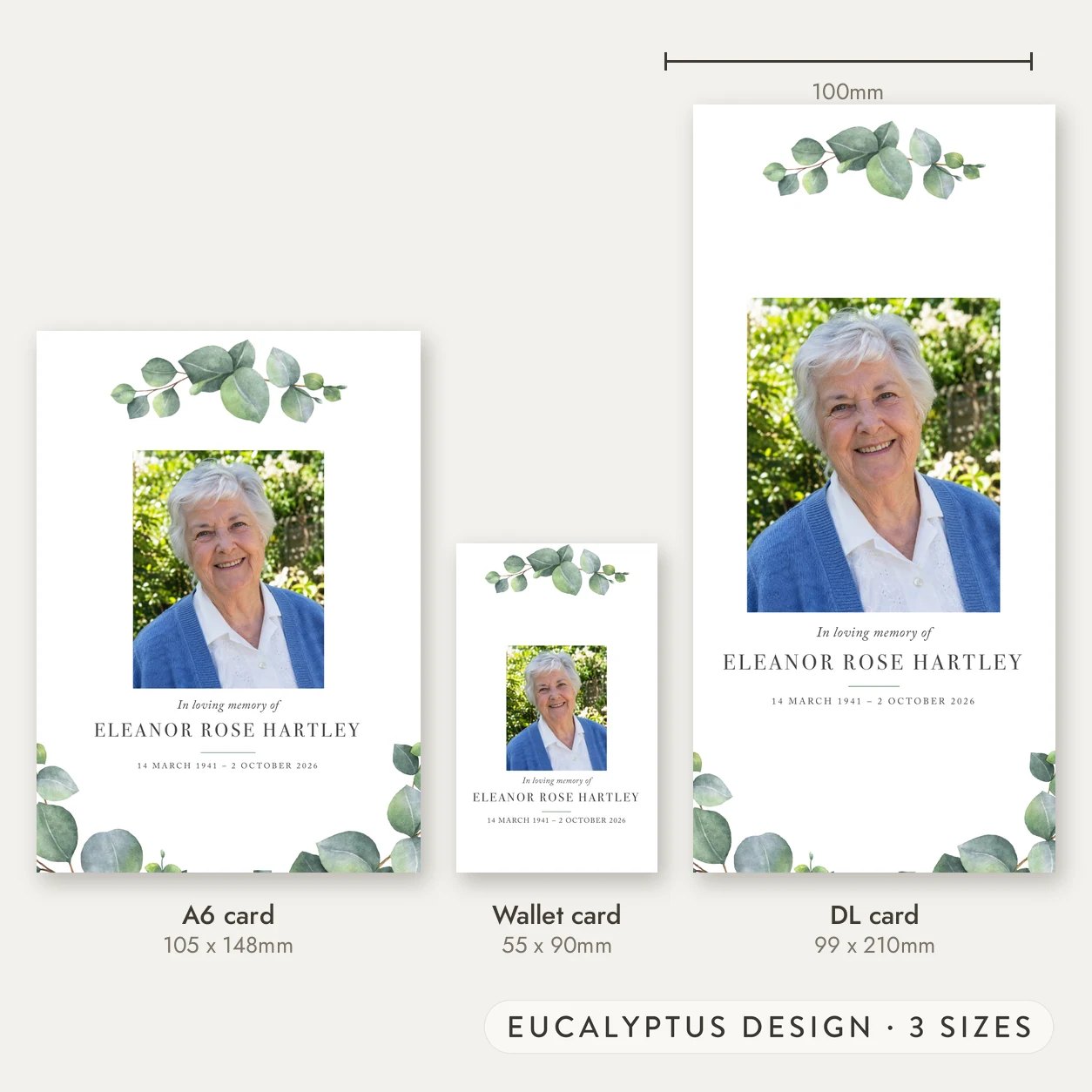
Start with the size that matches how the card will be used. The A6 card at 105 x 148mm is the usual size to hand out at a service and to post with a thank you. The wallet card at 55 x 90mm is the size of a business card and easy to keep in a wallet or purse. The DL card at 99 x 210mm is tall and narrow, with room for a larger photo and a longer verse. Every card is a flat single card printed in full colour on both sides in portrait.
On the memorial cards product page, you choose the design, size, paper and card type, then type the full name, the dates and the verse, prayer, poem or thank you message in one text box of up to 1000 characters and upload one photo. As you choose each option, the price shows on the page.
Our team sets the card in the design and emails a PDF proof. Changes are made on the proof, and nothing prints until you approve it. Before you approve, have a second person check the spelling of every name, the dates and the verse once more.
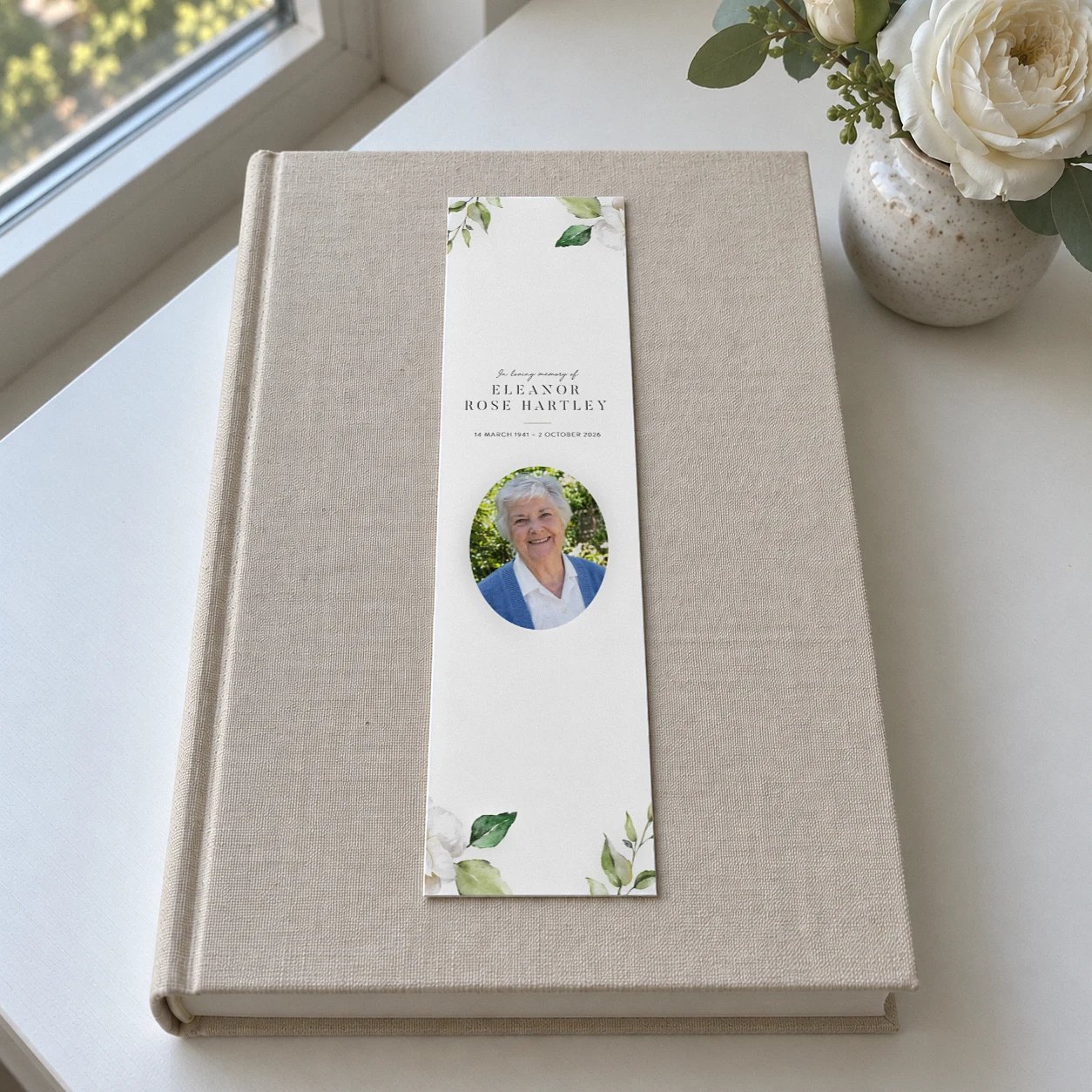
The same six designs carry through to the order of service booklets, and we print memorial bookmarks in three of those designs. Using one design across the card, the service booklet and a bookmark keeps the printed pieces together without extra work.
Frequently asked questions
What do you write on a memorial card?
On the front, the card carries the photo, the line In loving memory of, the full name and the birth and passing dates. The back carries the verse, prayer or poem the family chooses, with a short sign off line. The front opening line can also be Celebrating the life of or In remembrance of, and the sign off can be Forever in our hearts or Loved and remembered always.
What is a short verse for a memorial card?
The Ode of Remembrance, the fourth stanza of For the Fallen by Laurence Binyon, is four lines and is one of the shortest pieces often chosen for a card. It suits a returned service person. Laurence Binyon died in 1943, so the stanza is out of copyright in Australia.
What is the difference between a prayer card and a memorial card?
Memorial cards and funeral prayer cards carry the same front layout. The difference is the back. A prayer card carries the prayer on the back, while a memorial card carries a verse, prayer or poem the family chooses. Both are handed out at the service. For a church service, choose the prayer with the person leading the service and ask which version of the Bible is used.
What do you write in a funeral thank you card?
The front stays the same as the memorial card. The back holds the heading Thank You and a short message from the family. One or two sentences are usually enough. A simple line such as thank you for your kindness and your support is fine. Send them to people who helped, sent flowers or came to the service.
Can we print any poem on a memorial card and how does copyright work?
Not without checking. In Australia, copyright generally lasts for 70 years after the creator dies, so published works by writers who died before 1 January 1955 are generally in the public domain. Bible translations each carry their own copyright notice. The authorship of Do Not Stand at My Grave and Weep is disputed, so treat it as in copyright.
Which size suits a longer verse or a larger photo?
The DL card at 99 x 210mm is tall and narrow, with room for a larger photo and a longer verse. The A6 card at 105 x 148mm is the usual size to hand out at a service and to post with a thank you. The wallet card at 55 x 90mm is the size of a business card and easy to keep in a wallet or purse.