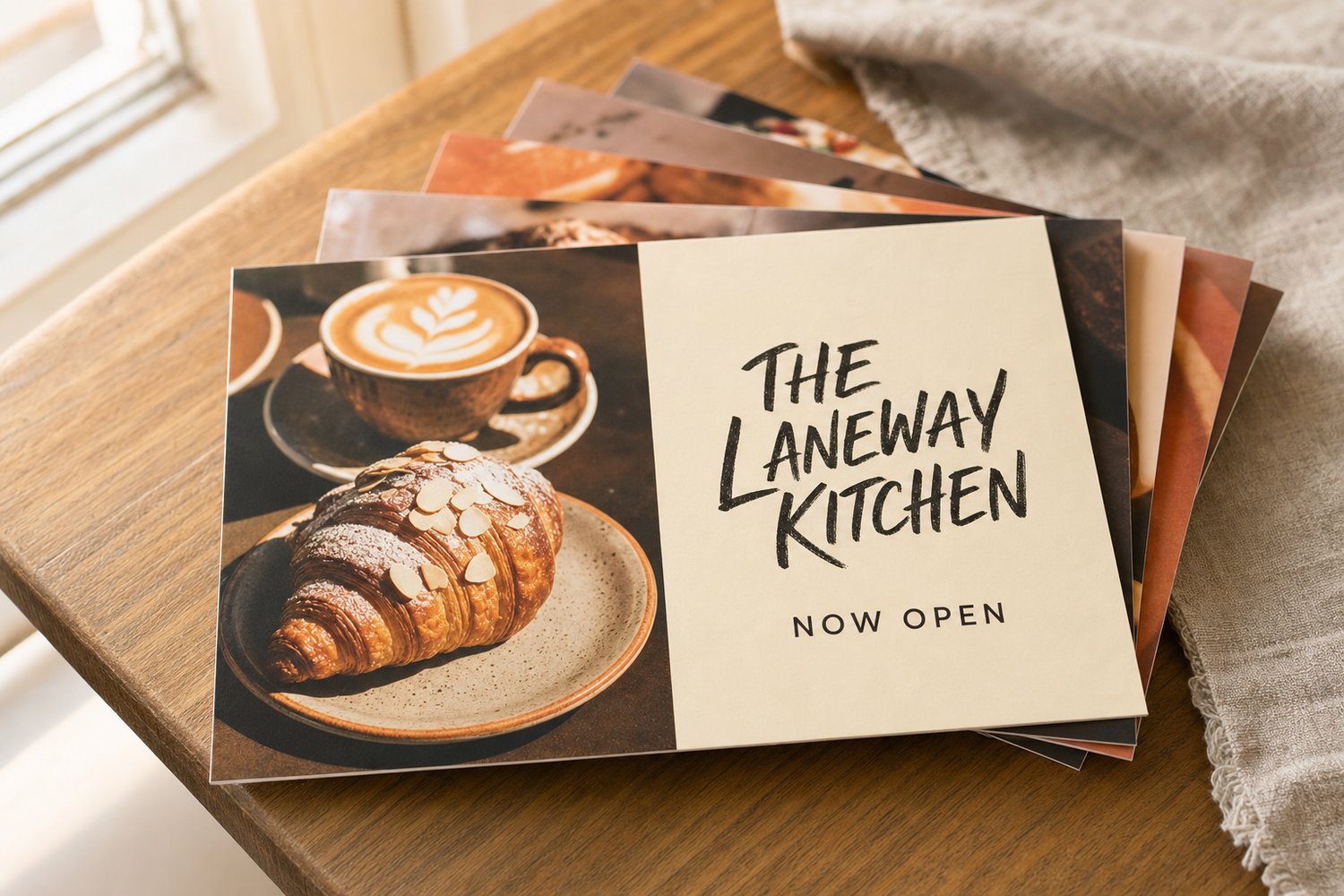
Restaurant letterbox mail has a quiet superpower: it sticks to the fridge. While your paid social disappears from the feed in 30 seconds, a well-designed postcard sits on the kitchen bench for weeks, right where the question “where should we eat tonight?” gets answered. For AU cafes, bistros and neighbourhood restaurants, a targeted postcard campaign within a 3-5 km radius remains one of the most cost-effective ways to drive first-time covers and repeat visits.
This guide covers the full campaign lifecycle: grand openings, weekly specials, loyalty programmes, catering pitches, Australia Post EDM geo-targeting, food photography tips, and AU compliance requirements. Print specs and sizing for each format are drawn from Paperlust Print Shop’s postcard range, which covers A6, A5 and DL formats.
Restaurant postcard marketing
Key facts at a glance
Everything an AU restaurant owner needs before launching a letterbox campaign.
- Best radius: 3-5 km for cafes and casual dine-in; 5-10 km for destination dining
- Recommended format: A5 (148 x 210 mm) for high-impact grand openings; A6 for regular monthly drops
- Offer type that converts best: Free item with main, percentage off a minimum spend, or QR-linked digital menu
- AusPost Unaddressed Mail: Saturate every household in chosen postcodes without a customer list
- AU compliance: GST-inclusive pricing, allergen visibility, licensee number for alcohol, and “T&Cs apply” on promotional offers
- Turnaround: Artwork proof within 1-2 business days; standard production 2-5 working days
Why Postcards Win for AU Restaurants
Digital ads are fast to launch but fast to fade. A Facebook ad has a lifespan measured in hours; a letterbox postcard has a lifespan measured in weeks.
For restaurants, the local trade radius is almost always 3-5 km for casual dine-in, and postcards are built for exactly that geography. AusPost’s Unaddressed Mail service lets you saturate every household in selected postcodes without needing a customer list – a huge advantage for a new venue or one in a part of town where the owner does not yet know their neighbours.
Three dynamics make postcards particularly effective for food and hospitality businesses:
Fridge-stickability. A postcard with a strong offer and a mouth-watering image often lives on the fridge for 4-6 weeks. Every time a household member opens that door, your restaurant re-enters their consideration set. No social media retargeting pixel does that.
Spontaneous dining decisions. Most weeknight dinner decisions are made the same evening, often while looking in the fridge. A postcard already on that fridge wins. This is why time-limited offers (“valid every Tuesday in June”) outperform generic brand postcards – they create a decision window that maps to how people actually choose where to eat.
Zero algorithm dependency. You choose the area, set the offer, and lodge the mail. Response rates are not subject to platform policy changes, iOS privacy updates, or ad fatigue cycles.
Research across AU and comparable markets puts letterbox response rates for local food businesses in the 5-15% range when the offer is strong, the targeting is right, and the postcard arrives within the trade radius.
Grand Opening Campaigns
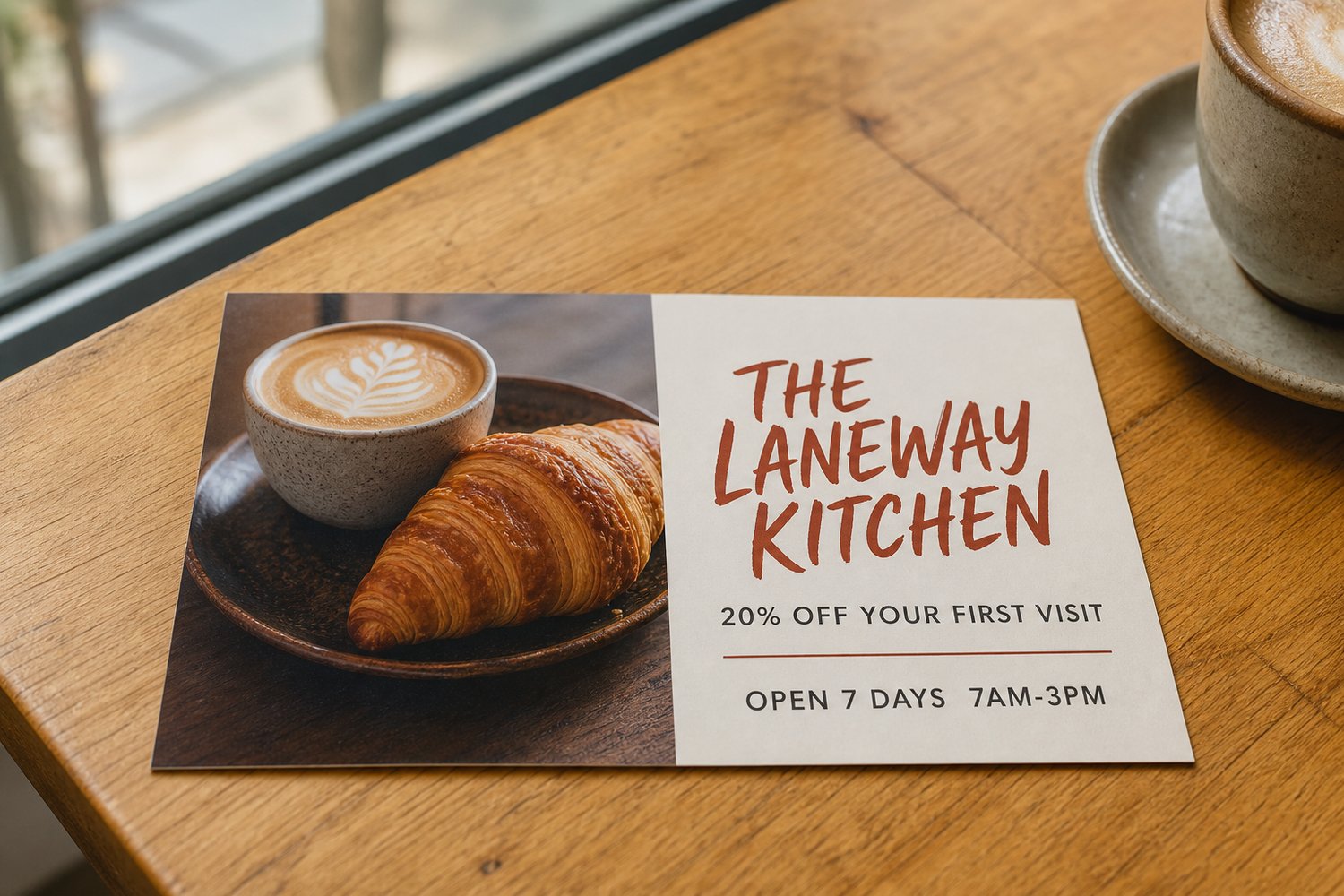
The first 30 days after opening are the highest-leverage window in a restaurant’s life. You will never have as much local curiosity working in your favour again. A postcard blitz during this period compounds that curiosity with a tangible reason to walk in the door.
The first-30-day blitz structure
A well-structured grand opening postcard campaign runs in two waves.
Wave 1 (1-2 weeks before opening): Announce. Focus on building anticipation rather than driving bookings you cannot yet honour. Include: venue name, cuisine, address, opening date, and a “follow us for updates” social QR code. Keep the offer vague (“opening week specials”) so you have flexibility.
Wave 2 (opening week): Convert. Now the offer is specific and urgent. Common high-conversion offers for grand openings:
- Free entree with any main course (capped at X per day)
- 20% off the full bill for the first 30 days (time-bounded redemption)
- “First 200 customers receive a free coffee with any meal” with a postcard barcode for tracking
What to include on a grand opening postcard:
1. Venue name and a one-line descriptor of the cuisine (“Wood-fired Neapolitan pizza, Fitzroy North”)
2. Full address and a simple map reference (“Next to [local landmark]”)
3. Opening hours, including whether you are open for breakfast/lunch/dinner
4. The specific offer with redemption mechanic (postcard coupon, QR code, or unique promo code)
5. QR code linking to your menu (not just your homepage)
6. Contact number and booking link
Size recommendation for grand openings: A5 (148 x 210 mm). The extra surface area lets you include the venue story, a strong food image, and the full offer without the design feeling cramped.
Mini case study: Ground Floor Cafe, Newtown
Ground Floor, a specialty coffee and brunch venue in Newtown, ran a grand opening letterbox blitz to 2,800 households within a 3 km radius in its opening week. The offer was simple: a free coffee with any meal for the first 200 customers, redeemed via a printed QR code on the postcard that logged each scan to a counter. They tracked 156 redemptions in the opening week, a 5.6% response rate from a cold list with no prior relationship. By week 4, the cafe had sold out its weekend brunch service on three consecutive Saturdays – directly attributed to word-of-mouth from that first postcard-driven cohort.
Weekly Specials and Events
Grand openings are a sprint. Recurring postcard campaigns are a marathon – and they compound differently.
A monthly or quarterly postcard drop to a rotating postcode schedule keeps your venue in front of the same households at predictable intervals. The marketing research on repetition is consistent: recipients who see your postcard 3+ times over a 6-month window are significantly more likely to visit than those who see it once.
Postcode-cycle planning for recurring drops
Rather than mailing the same postcodes every month (which leads to diminishing returns), rotate across your full 5 km radius using a postcode grid:
- Month 1: Postcodes immediately surrounding the venue (1 km radius)
- Month 2: Mid-ring postcodes (1-3 km)
- Month 3: Outer-ring postcodes (3-5 km)
- Month 4: Return to Month 1 postcodes with a new offer
By the time Month 1 postcodes receive their second postcard, 3 months have passed – long enough for the offer to feel fresh and for the intervening visits to have built brand familiarity.
Offers that work for recurring monthly drops
- Wednesday burger night: “Double wagyu burger + fries, $22, every Wednesday” – simple, memorable, fills a quiet mid-week slot
- Friday wine night: “Bring a friend, first glass on us” – drives group bookings with a natural social mechanic
- Tuesday taco special: Limited menu items with a recurring night build a habit loop. Regulars plan their week around it.
- Seasonal menus: Drop a postcard when you rotate menus (summer → winter, Easter specials, Melbourne Cup lunch). The menu change itself is newsworthy enough to justify a mail piece.
Keep recurring-special postcards short: one strong image, the offer headline, day/time, and your booking contact. A6 format is usually sufficient and keeps unit costs low for monthly drops.
Loyalty Programme and VIP Card
Most AU restaurant loyalty programmes live in an app or a stamp card given at the counter. The problem with both is they require the customer to already be inside your venue to engage. A postcard can recruit loyalty members before they have ever visited.
The postcard-plus-punch-card combo
A two-piece DL format works well for this: the postcard itself carries the loyalty pitch (“Join our locals club, 10th visit free”), and a detachable punch card at the bottom is the physical redemption mechanic. DL dimensions (99 x 210 mm) are long and slim – ideal for a combined mailer that feels premium but does not bulk out a letterbox.
Loyalty offer structures that convert in AU hospitality:
- Frequency reward: 10th visit = free main course, free coffee, or free dessert. Simple to track, simple to redeem.
- Spend threshold: Every $100 spent earns $10 credit. Works better for higher-ticket venues (hatted restaurants, wine bars) where a frequency model would take too long to accumulate.
- Early access: Loyalty members get 48-hour advance booking for popular sessions (Christmas lunch, Valentine’s Day, special events). Non-monetary but high perceived value.
VIP re-engagement campaigns
If you have a list of past customers (from reservation software, loyalty sign-ups, or takeaway order history), a VIP postcard campaign is among the highest-ROI activities a restaurant can run. The offer is directed at people who already know and like the venue; the conversion rate is typically 3-5x higher than a cold household mailing.
Structure:
1. Segment your list by recency (last visit more than 3 months ago)
2. Send a “We miss you” postcard with a higher-value offer than your public specials (e.g. “20% off your next visit, this month only, for valued regulars”)
3. Include a named contact at the venue (“Ask for Sarah at the front desk”) – personalisation that a digital ad cannot replicate
Catering and Group Bookings
Restaurant postcards are not just for dine-in covers. A well-designed postcard targeting office buildings, local businesses, and community groups within your trade area can open a catering and group-booking revenue stream that has substantially higher average ticket values than table service.
Corporate lunch and boardroom catering
An A5 postcard dropped to a commercial precinct (office towers, co-working hubs, professional services clusters) with a clear catering pitch performs differently from a household residential drop. The offer is not “come in for dinner” – it is “let us bring lunch to you.”
Effective copy focuses on:
- Minimum order size and per-head pricing (if you can commit to a published rate)
- Dietary accommodation (“GF, DF and vegan options available”)
- Lead time needed for orders (“48-hour notice, minimum 10 people”)
- A direct contact line or email address for enquiries (not a generic bookings page)
Event catering and family functions
For life events (birthday parties, anniversary dinners, corporate functions, school celebrations), a postcard arriving in a residential letterbox at the right moment – say, November ahead of the Christmas party season – catches high-intent buyers when the decision has already been made to cater a function.
Key message on a function-catering postcard:
- The venue’s capacity (both seated and cocktail-style)
- A gesture toward the experience (“private dining room, projector and AV on request”)
- A starting price per head or a “packages from $X” anchor to pre-qualify enquiries
- The booking contact, not a generic URL
Holiday-period postcard timing
Run catering postcards 6-8 weeks ahead of the target event period, not 2 weeks. Function bookings take longer to close than walk-in covers. The December Christmas-party postcard should drop in mid-October. The Easter lunch postcard should drop in late February.
Local Geo-Targeting via AusPost EDM
Australia Post’s Everyday Market (EDM) unaddressed mail service is the primary logistics infrastructure for residential letterbox campaigns in Australia. Understanding how to use it changes the effectiveness of your restaurant postcard spend significantly.
Postcode-radius mechanics
AusPost’s Campaign Targeter tool (available via auspost.com.au) allows you to:
- Select delivery by postcode or suburb
- Filter by household type (families with children, owner-occupiers, renting households)
- Filter by demographic proxies (approximate income band, dwelling density)
- Estimate reach and cost before committing to print volumes
Recommended radius by restaurant type:
| Venue type | Primary radius | Secondary (destination dining) |
|---|---|---|
| Neighbourhood cafe | 1-3 km | 3-5 km |
| Casual dine-in restaurant | 2-5 km | 5-7 km |
| Pub or club bistro | 3-5 km | up to 8 km |
| Destination / fine dining | 5-10 km | city-wide for events |
| Takeaway and delivery | 2-4 km (delivery zone) | N/A |
Apartment vs detached home targeting
Urban AU restaurant owners often discover that apartment-heavy postcodes (CBDs, inner suburbs) have different response patterns than detached-home postcodes (middle-ring suburbs, outer areas).
Apartment-dense postcodes: Higher proportion of single-person and couple households with less home cooking and more regular eating out. Respond well to convenience-led offers (“Ready in 20 minutes, deliver to your door”) and premium casual dining. Smaller postcard volumes but higher average response rates.
Detached-home postcodes: More family households with children. Respond to family-deal framing (“Kids eat free Sunday evenings”), bulk catering (“Feeds 4 from $60”), and weekend brunch. Larger households mean larger table sizes when they do visit.
Optimal timing for letterbox drops
AusPost Unaddressed Mail is not same-day. Plan for:
- Print production: 2-5 working days
- Lodgement and delivery: 3-7 business days depending on postcode and lodgement point
For a Friday-night offer, your postcard needs to arrive by Wednesday at the latest – which means lodging on the preceding Thursday and printing the week before that. Build a 3-week total lead time into your campaign calendar.
Food Photography Tips for Postcards
A postcard lives or dies on its hero image. The offer may be compelling, the copy clean, the sizing right – but if the food photo does not make the viewer want to eat immediately, the postcard fails at its primary sensory job.
Natural light over artificial
The most common mistake in restaurant postcard photography is shooting under venue lighting. Warm Edison bulbs that look beautiful in situ render orange and flat in print. For postcard print production, shoot food in natural daylight – either next to a large window or outside during the “golden hour” (1-2 hours after sunrise or before sunset). Diffuse direct sunlight with a white card reflector to avoid harsh shadows.
Shot types that work for print
Overhead (plate-down) shots are the safest bet for postcards. A flat lay of a well-plated dish from directly above conveys the full composition without depth-of-field issues that can muddy postcard reproduction. The clean, graphic quality of an overhead shot also leaves negative space for offer text overlaid on the image.
Three-quarter angle lifestyle shots show the dish in context – a hand reaching in, a glass of wine alongside, linen napkins in frame. These read as warm and social rather than clinical. Use them for the “food memory” you are selling rather than for product specification.
Close-up texture shots work well as design elements on the back of a postcard (textured bread, marbled beef, glossy chocolate). They communicate quality without showing a full dish.
Seasonal imagery
Match the visual temperature of your postcard to the dining emotion you are selling:
- Autumn/winter: Warm tones, steam rising from dishes, comfort foods (pies, soups, roasts, pasta). Dark moody background.
- Spring/summer: Clean whites, fresh greens, seafood, bright citrus. Linen tablecloths and outdoor-table settings.
A summer barbecue postcard arriving in a Melbourne letterbox in June will feel out of step with the diner’s current cravings.
What to avoid
- Generic stock food photography. Diners recognise the same burger image from three different restaurant postcards in their suburb. Use your own food, shot in your own venue.
- Cluttered plate compositions. A postcard is small. Too many elements on the plate read as noise at reduced sizes.
- Low-resolution shots. Print production requires a minimum of 300 DPI at final print size. An A5 postcard at 300 DPI needs an image of at least 1748 x 2480 pixels. Check before sending to print.
For print file specs, bleed requirements, and artwork setup, the Paperlust Print Shop design guide covers accepted formats (PDF, SVG, AI) and bleed specifications.
AU Compliance for Restaurant Postcards
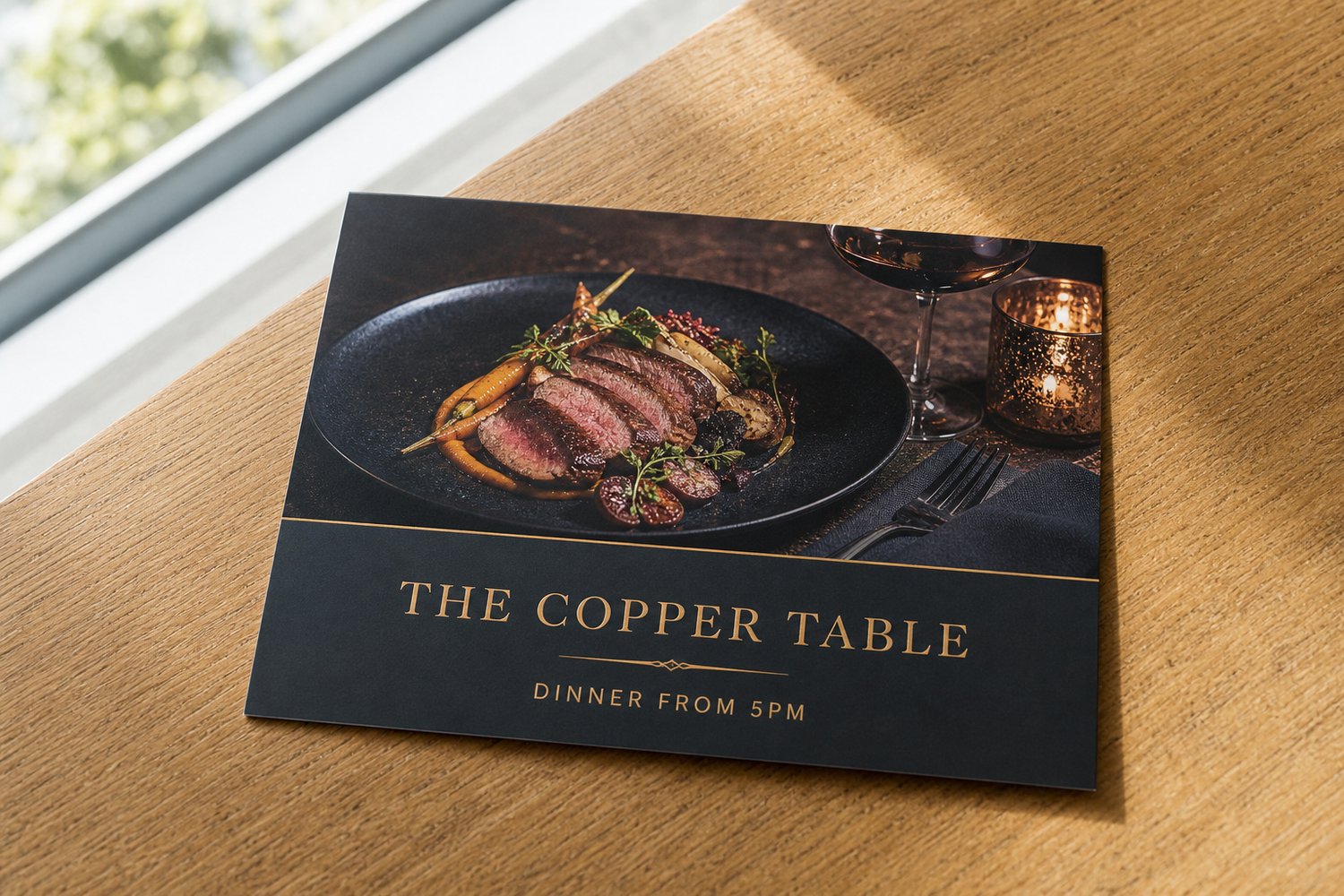
Promotional print material for AU food and beverage businesses carries specific legal obligations that are often missed by operators focused on design and offer mechanics. Getting these right before print – not after – avoids an expensive reprint.
Menu pricing and GST
Under Australian Consumer Law, if you quote prices in promotional material, those prices must include GST. “Burger + fries: $22 inc. GST” is compliant. “$20 + GST” is not acceptable on consumer-facing promotional material.
If your offer references a minimum spend, that figure must also be GST-inclusive: “20% off when you spend $60 or more” means $60 including GST.
Allergen flag visibility
While a postcard cannot list full allergen information for every dish, any promotional claim that includes specific dish descriptions should include an allergen prompt visible on the piece. Standard language: “Some dishes may contain gluten, dairy, nuts or other allergens. Please advise staff of dietary requirements.” This must be legible at the print size used – minimum 8-9pt at 300 DPI for A6, larger for A5.
Liquor licensee information
If your postcard promotes alcohol-related offers (happy hour, BYO nights, wine pairing dinners, “first drink on us” promotions), your venue’s liquor licensee number must be visible on the printed piece. The requirement and format varies by state:
- VIC: Licensee name and licence number
- NSW: Licence number visible on all alcohol advertising
- QLD: Responsible Service of Alcohol (RSA) compliance wording recommended
Check with your state liquor licensing authority for the current requirement in your jurisdiction before print.
Promotional offer terms and conditions
Any time-limited or quantity-limited offer on a postcard must include “Terms and conditions apply” or an abbreviated T&Cs block. For offers with material limitations (“first 100 customers only”, “not valid with any other offer”, “dine-in only”), include those restrictions on the postcard itself rather than directing readers to a URL.
A small-font T&Cs block on the reverse of the postcard is standard and legally defensible. The following is workable for most restaurant promotional offers:
Print Specs for Restaurant Postcards
Paperlust Print Shop produces restaurant postcards across three standard formats, all on 360 gsm premium card stock as the default for mail-handling durability. Other finishes (silk, gloss, recycled) are available on request.
| Format | Dimensions | Best use |
|---|---|---|
| A6 | 105 x 148 mm | Monthly specials, loyalty drops, low-volume VIP mailers |
| A5 | 148 x 210 mm | Grand openings, event catering, high-impact launch campaigns |
| DL | 99 x 210 mm | Loyalty postcard with detachable punch card, envelope-format campaigns |
For campaigns running both an offer and a loyalty mechanic on the same piece, A5 gives the most workable real estate. For pure-offer monthly drops to a large postcode area, A6 is the cost-efficient choice.
More detail on sizing trade-offs for postcard campaigns is covered in the A6 vs A5 vs DL postcard size guide, which includes print-ready dimension tables and resolution requirements.
For a broader introduction to postcard campaign logistics, printing options, and order process, the postcard printing Australia overview covers the full range.
Ready to print your restaurant postcards? Order from Paperlust Print Shop – artwork proof within 1-2 business days, 360 gsm premium card stock, A6/A5/DL formats available.
Frequently Asked Questions
What postcard size is best for a restaurant letterbox campaign?
A5 (148 x 210 mm) is the recommended format for grand opening campaigns and high-impact launches where you need to include a food image, venue details, opening hours, and an offer. A6 (105 x 148 mm) is the cost-efficient choice for recurring monthly specials drops where the offer is the hero and space is less of a constraint. DL (99 x 210 mm) suits loyalty postcard formats with a detachable redemption element.
How do I target specific suburbs with a restaurant postcard?
Australia Post’s Unaddressed Mail service, managed via their Campaign Targeter tool at auspost.com.au, lets you select delivery by postcode, suburb, or demographic filter (household type, approximate income band). For most cafes and casual restaurants, start with a 3-5 km radius from the venue and narrow by household type depending on your offer (family-friendly venues should target family-household postcodes; high-ticket venues can filter by income-band proxies).
How many postcards should I print for a grand opening campaign?
A 3 km radius around a typical inner-suburban AU venue will contain roughly 3,000-6,000 households depending on density. A saturation drop to that catchment (all households, no filtering) is a typical grand opening volume. For a 5 km radius in a mixed urban-suburban area, plan for 8,000-15,000 postcards. Per-unit print costs fall substantially at 5,000+ quantities, so the cost-per-household difference between a small drop and a full-radius drop is usually modest.
What offer type converts best on a restaurant postcard?
Free item with minimum spend consistently outperforms straight percentage-off offers in hospitality direct mail. “Free entree with any main” is a cleaner value proposition than “20% off” because it requires the customer to commit to a meal (protecting your average spend) while delivering a tangible, memorable reward. Time-bounding the offer (“valid Monday to Thursday in July”) fills quiet periods rather than cannibalising your already-busy Friday-Saturday covers.
Do I need to include GST on postcard pricing claims?
Yes. Under Australian Consumer Law, all prices advertised to consumers must be GST-inclusive. If your postcard quotes a dish price, a minimum spend threshold, or a value offer, that figure must include GST. Non-GST pricing in consumer-facing promotional material is a compliance risk.
What image resolution do I need for restaurant postcard printing?
A minimum of 300 DPI at the final print size. For an A5 postcard (148 x 210 mm), that means your hero food image needs to be at least 1748 x 2480 pixels at 300 DPI. For A6 (105 x 148 mm), the minimum is 1240 x 1748 pixels. Files should be submitted as print-ready PDFs with 3 mm bleed on all sides.
How long does postcard printing take for a restaurant campaign?
Paperlust Print Shop delivers an artwork proof within 1-2 business days of receiving your file. Standard production runs 2-5 working days after proof approval. Add 3-7 business days for AusPost Unaddressed Mail delivery depending on your postcode zone. Total lead time from file submission to letterboxes: allow 3 weeks for a planned campaign, or contact the Print Shop to discuss expedited options.
Ready to print your postcards?
360gsm premium card. From $0.15 inc. GST. Ships AU-wide from Melbourne.