The design is final. The recipient list is sitting in a spreadsheet, the date is locked, and the order form has stopped at one line: certificate size.
The measurement answer is one line. A4 is 210 x 297mm and A5 is 148 x 210mm. The choice that follows is less quick. Size decides whether the certificate gets framed or filed, and it decides how much room the merged recipient name gets. The second point is the one most people find during proofing, not before.
The short version
- A4 measures 210 x 297mm and A5 measures 148 x 210mm.
- Both sizes are flat sheets printed on the front only. There is no printed reverse and no fold.
- A4 is the framing size, the one that matches a standard frame or sleeve.
- A5 is the volume and handout size for recognition cards and event awards.
- The same stocks, foil and corner upgrades are available on both sizes.
- A data merged name field needs more room than most spreadsheets suggest. Design for the longest name.
| Size | Dimensions | What it is for |
|---|---|---|
| A4 | 210 x 297mm | The standard award and completion certificate size. Most suitable for framing or presenting in a sleeve. |
| A5 | 148 x 210mm | Compact recognition cards and event awards. Better for volume handouts and filing than for wall display. |
Certificate size: two flat formats measured
There are two certificate size options, and the certificate dimensions are the entire menu. A4 is 210 x 297mm. A5 is 148 x 210mm. Both print as flat, single sided sheets, and that is deliberate. There is no printed reverse and no fold on either format. A certificate should stay flat in the hand during the ceremony and flat against the glass in a frame.
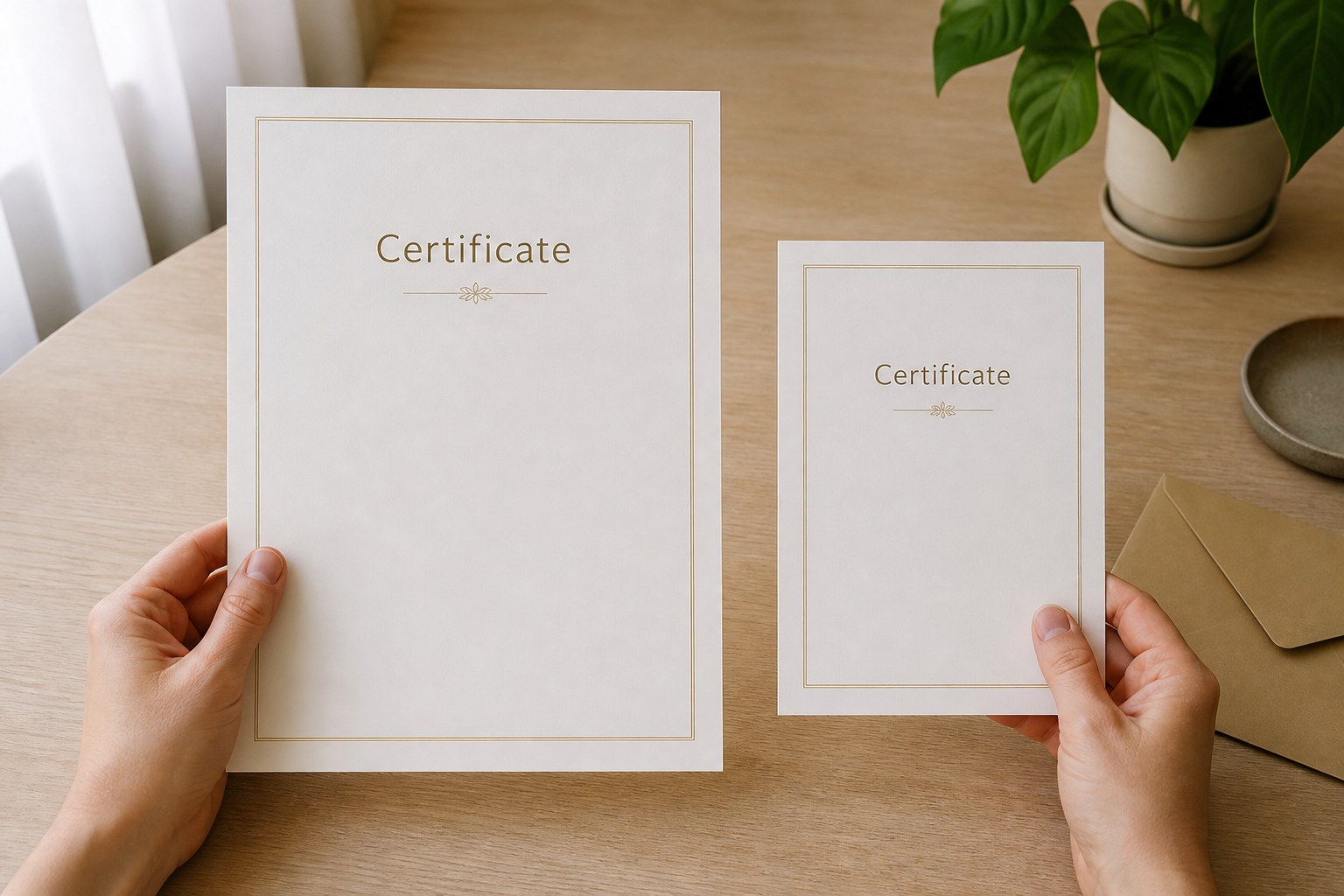
A5 takes up exactly half the area of A4 and keeps the same proportions. That relationship is why a layout tends to scale between the two formats cleanly at a visual level. The crest, the border and the overall balance can look right on both. Text is the exception. A block of copy that sits comfortably on A4 does not automatically fit the smaller sheet, because the type cannot reduce at the same rate and stay readable for a room full of guests. A4 and A5 are part of the A series, the standard paper size family used in Australia, which is why these two formats and not arbitrary sheet sizes make up the default certificate range.
What fits on an A4 page and what gives on an A5 page
A4 vs A5 is easiest to see when the same design is placed on both sheets. The A4 certificate size keeps a formal layout intact. A full A4 design has room for a crest or logo at the top, a heading, and a certifying line without crowding. The recipient name can sit as the visual centre of the piece. Beneath it, the award or qualification title can run in full, followed by the date and a signature block with clear space under the signature. That space is not decoration. It gives the eye a place to rest before the certificate is rolled, sleeved or framed.
Put the same layout on an A5 page and the lower half behaves differently. Something has to give. The signature block tightens first. The award title wraps to a second line where it sat on one. The recipient name loses the surrounding white space that made it the focal point. None of this is a fault in the paper. The page simply runs out of room, and the elements that used to float start to press against each other. If the design file was built at A4 and then resized to A5 without reworking the type area, this is where the proof will show it.
Frame, sleeve and where each size ends up
A4 is the standard size that training providers, RTOs, schools and employers reach for when issuing graduation certificates, completion certificates and award certificates. It is the best format for framing or for presenting in a sleeve. The practical consequence arrives after the applause. A recipient who wants to hang the certificate can buy a frame off a shelf and have it on the wall that afternoon. An organisation that presents certificates in sleeves on the night can match A4 without hunting for a special size. We print the certificate. We do not supply the frame, sleeve or holder. The size decision is where you make that presentation match easy.
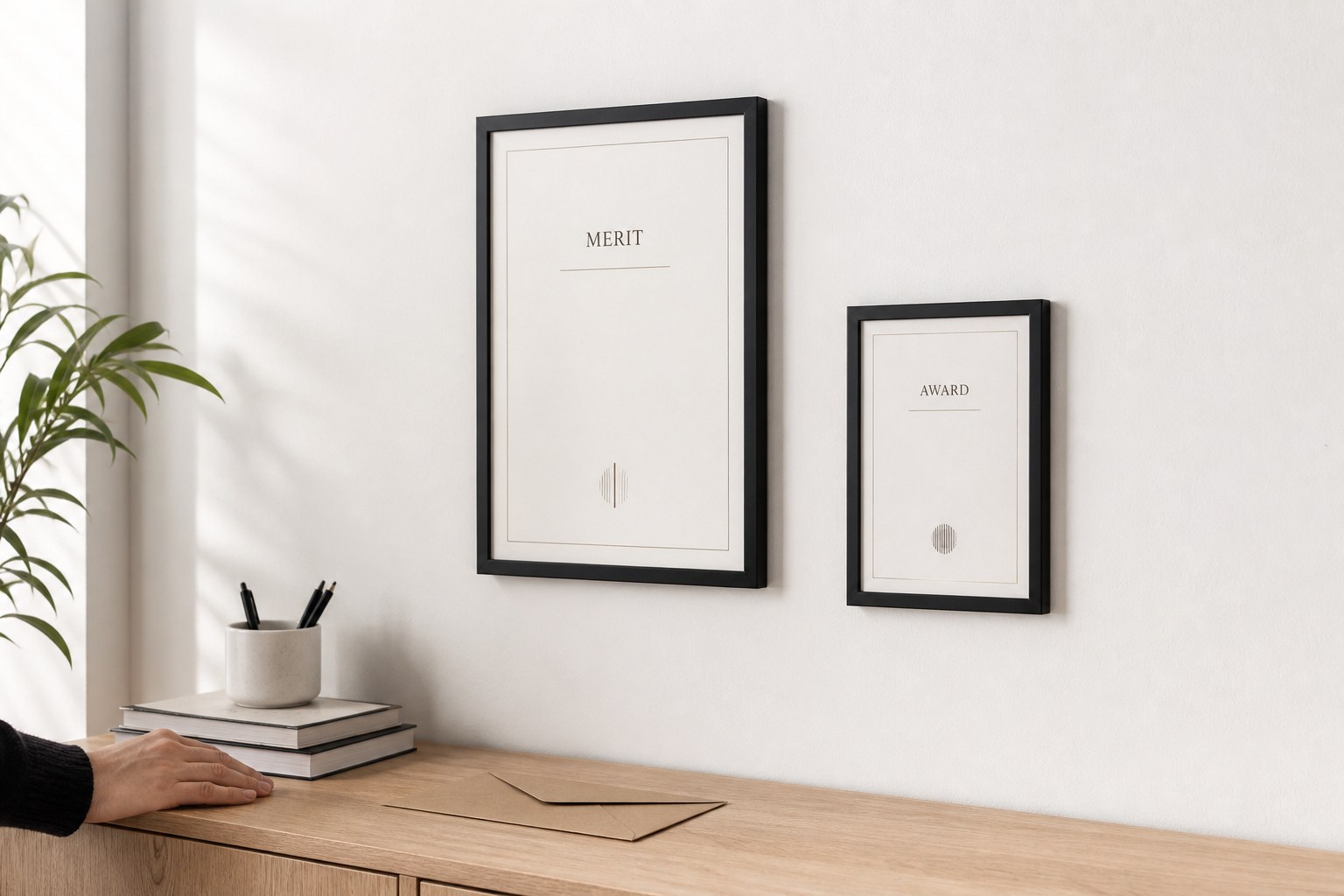
A5 leads to a different after ceremony life. It is the compact recognition card and event award format, the size that is handed out in a stack and more likely to go in a folder or a drawer than on a wall. That is not a downgrade. It is a different kind of recognition, one built for volume and speed rather than a single framed moment on stage.
Before you commit, it is worth checking the two formats against standard frame sizes for A4 and A3 prints, because the easy frame match sits with A4.
Stock weight, foil and why 360gsm matters more at A4
Both certificate sizes are available on the same two stocks. Matt 300gsm Digital is the standard, a smooth professional finish that holds ink cleanly. 360gsm Premium Digital is the heavier board, the one that feels substantial in the hand and reads as a more serious document when it is handled. The size specific point is not complicated. A large unsupported sheet flexes more in the hand, so the case for 360gsm Premium Digital is strongest at A4, and strongest again where an A4 certificate is handed across a stage or read in front of a room. A5 is smaller and simply does not flex the same way.
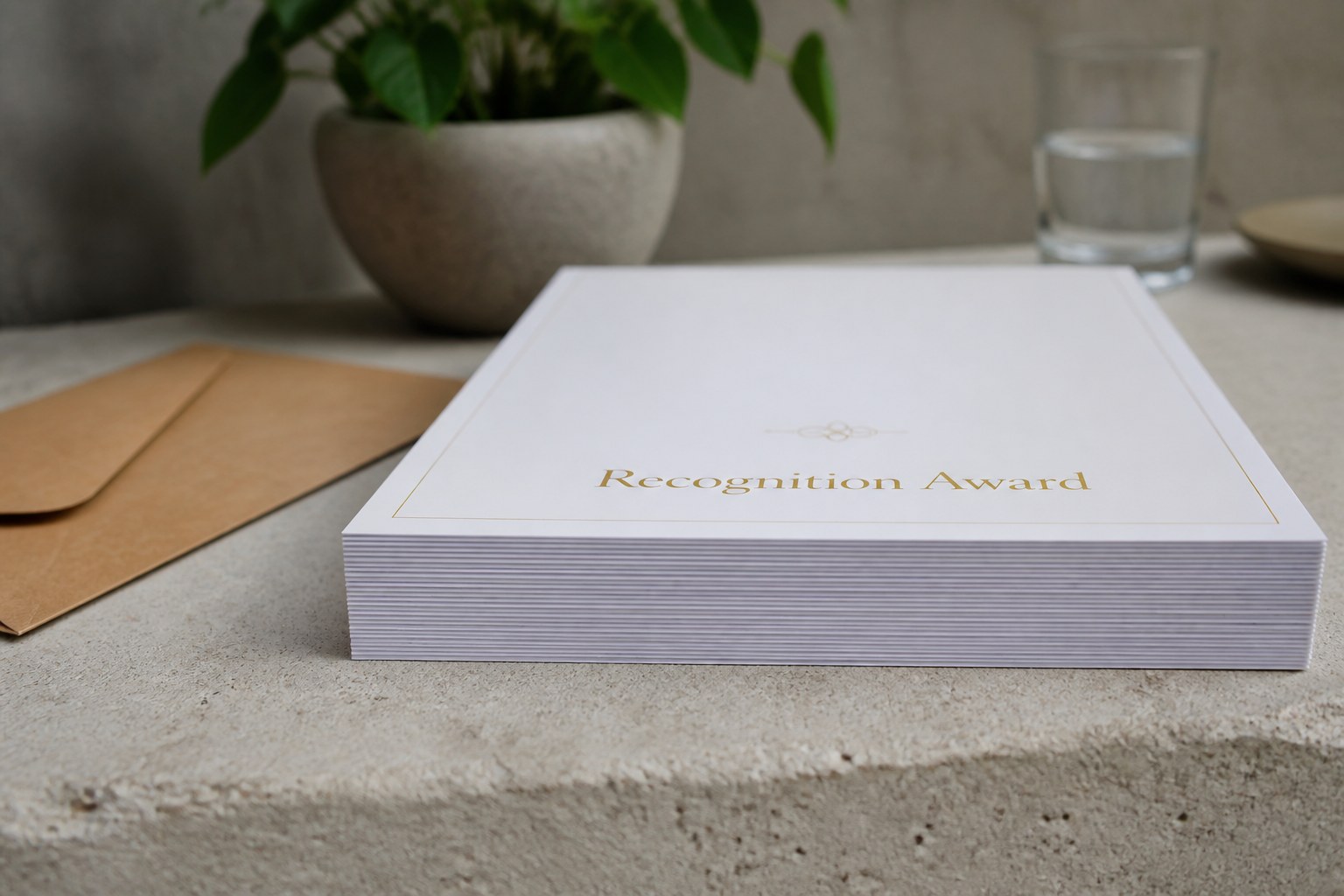
Both stocks are available with or without foil. Foil in gold, silver or rose gold can be applied to the certificate title, crest or border, on either stock and either size, at a published price from $129 for 25. That makes foil an option on the compact handouts as well as the formal wall pieces.
Square corners are standard. Rounded corners are $15 per order on orders of 25, 50 or 100 certificates, and $25 per order on orders of 250 certificates. A simple custom die cut shape is $49 per order on orders of 25, 50 or 100 certificates, and $89 per order on orders of 250 certificates; complex or irregular shapes are quoted separately. These charges are per order, not per certificate, so they work like a setup cost rather than a line item on every sheet. All of these options sit inside the certificate printing in Australia product build, where the stock, foil and corner selections are made before you upload the artwork.
Variable Data and the longest name in the list
The static parts of a certificate are easy to design. The design, wording, crest, foil and signature block stay identical on every certificate in a run. The recipient name, the specific award or unit name, the date and the certificate number are the elements that change on each one. That means the merged field is not built for the average row in the spreadsheet. It has to hold the longest name and the longest award title in the entire list, and A5 gives that field much less room to absorb them. A name that fits on an A4 proof can break at A5 print size, especially near the signature block.
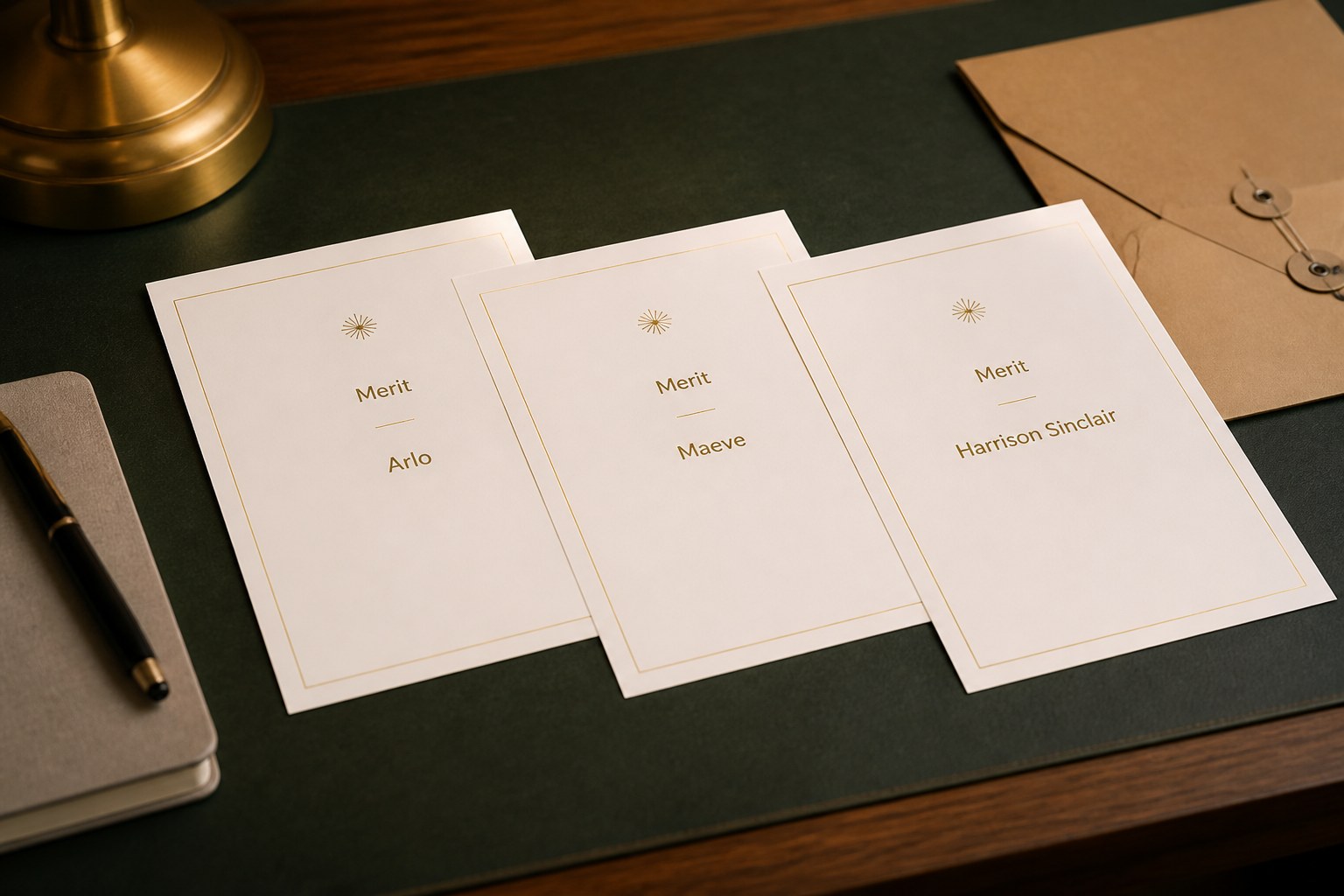
Before you finalise the layout, sort the spreadsheet by string length. Design against the longest recipient name and the longest award title or unit name, not the typical ones. It feels like extra work at the file stage and saves a correction after the proof comes back.
Variable Data certificate printing merges those per recipient elements from the spreadsheet you supply at $1.00 per certificate including GST. A PDF proof is emailed for approval before any order goes to print, including a data merge sample where Variable Data is selected, so you can check the longest records against the live layout. We merge the data exactly as it is supplied, and we do not check the supplied recipient list against anything. That means we do not verify recipient names, award titles, dates or numbers against any other source.
Choosing A5 versus A4 and what entry cost looks like
The decision comes down to what happens after the certificate is handed over. Choose A4 if the certificate will be framed, kept or presented formally to one person at a time. Choose an A5 certificate if it will be handed out in volume, carried home in a bag or filed in a records folder. Both are legitimate. The mistake is choosing by default and discovering the frame problem a week later.
Neither choice changes the entry price. Quantity rungs are 25, 50, 100 and 250, with custom quantities by request. Instant published pricing starts from $49 including GST for 25 certificates, and the rungs and the entry price are the same for A4 and A5. Size is not a price decision at the entry rung. It is a layout and presentation decision.
For award night certificate printing for schools and clubs, the A5 format is often the more practical handout size when there are dozens of names and the proceedings need to keep moving. If you are printing a regulated statement of attainment, the size choice is secondary to the content requirements, so check what has to be printed on a statement of attainment before you lock the layout. Every certificate is printed in Australia and delivered Australia wide.
Frequently asked questions
What is the standard certificate size in Australia?
A4 at 210 x 297mm is the standard certificate size in Australia. It is the page most training providers, schools and employers order for formal presentations, and it is the easiest to frame or present in a sleeve. A5 at 148 x 210mm is the compact alternative for recognition cards and event awards. Both formats belong to the A series, the standard paper size family used in Australia, with A5 taking half the room of A4 and matching its proportions.
What are the dimensions of an A5 certificate at 148 x 210mm?
An A5 certificate measures 148 x 210mm. That is exactly half of an A4 sheet and keeps the same proportions, which is why a design can scale down visually. A5 is the compact format suited to smaller recognition cards, event awards and cases where a compact format is preferred. Both A4 and A5 are printed flat with no fold, and nothing appears on the reverse.
Will an A4 certificate fit a standard frame?
A4 is the easiest certificate size to frame. It matches an off the shelf frame or presentation sleeve without a custom order. Paperlust prints the certificate and does not supply the frame or sleeve, but choosing A4 means the recipient who wants to hang the certificate can find a matching frame easily.
Can both certificate sizes take foil?
Yes. Foil in gold, silver or rose gold can be applied to the certificate title, crest or border on either A4 or A5, and on either stock. Matt 300gsm Digital is the standard, and 360gsm Premium Digital is the heavier board. The published entry price for foil is from $129 for 25. Square corners are standard, with rounded corners available from $15 per order.
Which certificate size suits Variable Data printing?
Both sizes support Variable Data printing, but A4 gives the merged recipient name more room to sit as the focal point. The recipient name, the award title or unit name, date and certificate number change per record, and the layout must hold the longest name and title in the list. A5 has less space to absorb long entries. Variable Data printing merges those fields from a supplied spreadsheet at $1.00 per certificate including GST, and the PDF proof includes a data merge sample so you can check the longest records before printing.
Are certificates printed single sided?
Yes. Both A4 at 210 x 297mm and A5 at 148 x 210mm are printed flat and single sided, with no fold and nothing printed on the reverse. The back of the certificate stays blank, which is what you want if the certificate is going into a frame, a sleeve or a presentation folder, and it also means the two formats stay purely about the printed face.