The owner-builder permit is through and the site is quiet for now, but the sign rules change the moment you cross a state border. Queensland wants the permit number on a weatherproof board, Western Australia wants a phone number and an approval number, and New South Wales gives owner-builders no sign duty at all. That is why owner builder sign requirements deserve a careful state by state read before you order anything.
This guide works through what each state and territory asks for, what the sign must show, how big it should be, where it goes, and what to have ready before you order. It also covers the practical side of owner builder signage: board sizes, corflute thickness, single or double sided printing, and fixing to a temporary fence. It is general information, not legal advice, and a permit or council condition can always add to the basics.
The short version
- Queensland requires the permit number displayed on a weatherproof sign of at least half a square metre with letters at least 50mm high.
- Western Australia requires the owner-builder’s name, a contact telephone number and the approval number, readable from outside the site.
- Regulation 41 sets the permit sign duty for the builder named in the permit, and industry guidance says it covers owner-builders too.
- New South Wales has a consent site sign, but no owner-builder sign duty.
- South Australia, Tasmania and the Northern Territory have no sign duty for owner-builders in the laws read, and the ACT is not confirmed.
- Check the permit, the council conditions and the proof before printing.
Owner builder sign requirements state by state
The table below is the quick reference. It lists the rule as we read it, the details the sign must show, and the source for each state and territory.
| State or territory | Owner-builder sign rule | What the sign shows | Source |
|---|---|---|---|
| Queensland | Yes, before work starts a weatherproof sign must be clearly visible from the street. | The permit number, in letters at least 50mm high. | QBCC |
| Western Australia | Yes, the sign must be attached where the work is carried out and readable from outside the site. | The owner-builder’s name, a contact telephone number and the approval number. | Building Services (Registration) Regulations 2011, regulation 27 |
| Victoria | The permit information sign duty applies to owner-builders too, per industry guidance. | Builder details, the building surveyor’s registration and contact details, and the building permit number with its issue date. | Building Regulations 2018, regulation 41 |
| New South Wales | No sign duty for owner-builders. The consent site sign covers development consent and complying development certificate work. | Principal certifier’s name, address and phone number, principal contractor details if any, and the unauthorised entry statement. | Environmental Planning and Assessment Regulation 2021, sections 70 and 71 |
| South Australia | No sign rule for owner-builders was found. | Not applicable, but check council conditions. | Building Work Contractors Act 1995, section 51 |
| Tasmania | No site sign duty found in the building and occupational licensing laws named in the table. | A permit condition could still require one. | Building Act 2016 and related regulations |
| ACT | Not confirmed whether the licensed builder sign rule applies to an owner-builder licence. | Licensed builder rule: at least 600 x 900mm with the bold heading Notice about building work at least 50mm high. Ask Access Canberra. | Building Act 2004 and Building (General) Regulation 2008 |
| Northern Territory | No site sign duty found. | Check the permit conditions. | Building Act 1993 and Building Regulations 1993 |
The rules above come from the regulator pages and legislation named in the table, read on 6 October 2026 or 19 October 2026. A permit or approval condition can add sign details, so always check the document before you lock in the layout. This is general information, not legal advice.
Queensland owner builder sign rules and sizes
Queensland makes the owner builder sign a condition of starting work, and the rules are specific. Before work starts, you must display a sign that shows you are an owner-builder. The QBCC is the regulator behind this duty, and you may be fined if the sign is not in place.
The sign must be clearly visible from the street, made of weatherproof material, and at least half a square metre in size. It must show the number from your owner builder permit in letters at least 50mm high. It sits in a prominent position on a building site under your control, so face it to the street rather than hiding it behind stored materials.
The board sizes below translate that half a square metre minimum into something you can order.
| Board size | Area | Half a square metre or more? |
|---|---|---|
| 600 x 900mm | 0.54 square metres | Yes |
| 900 x 600mm | 0.54 square metres | Yes |
| 900 x 1200mm | 1.08 square metres | Yes |
The sum is simple. Both the 600 x 900mm and 900 x 600mm boards are 0.54 square metres, just above the 0.5 square metre minimum, while the 900 x 1200mm board is 1.08 square metres for a wide frontage or a busy road.
Western Australia owner builder sign rules under regulation 27
Western Australia does not set a minimum board size in millimetres, but it is very clear about what the sign must do. Under regulation 27, you must make sure a sign is attached to the site where the work is carried out. It has to be in a prominent position, of reasonable dimensions, and written in clearly legible letters and numerals.
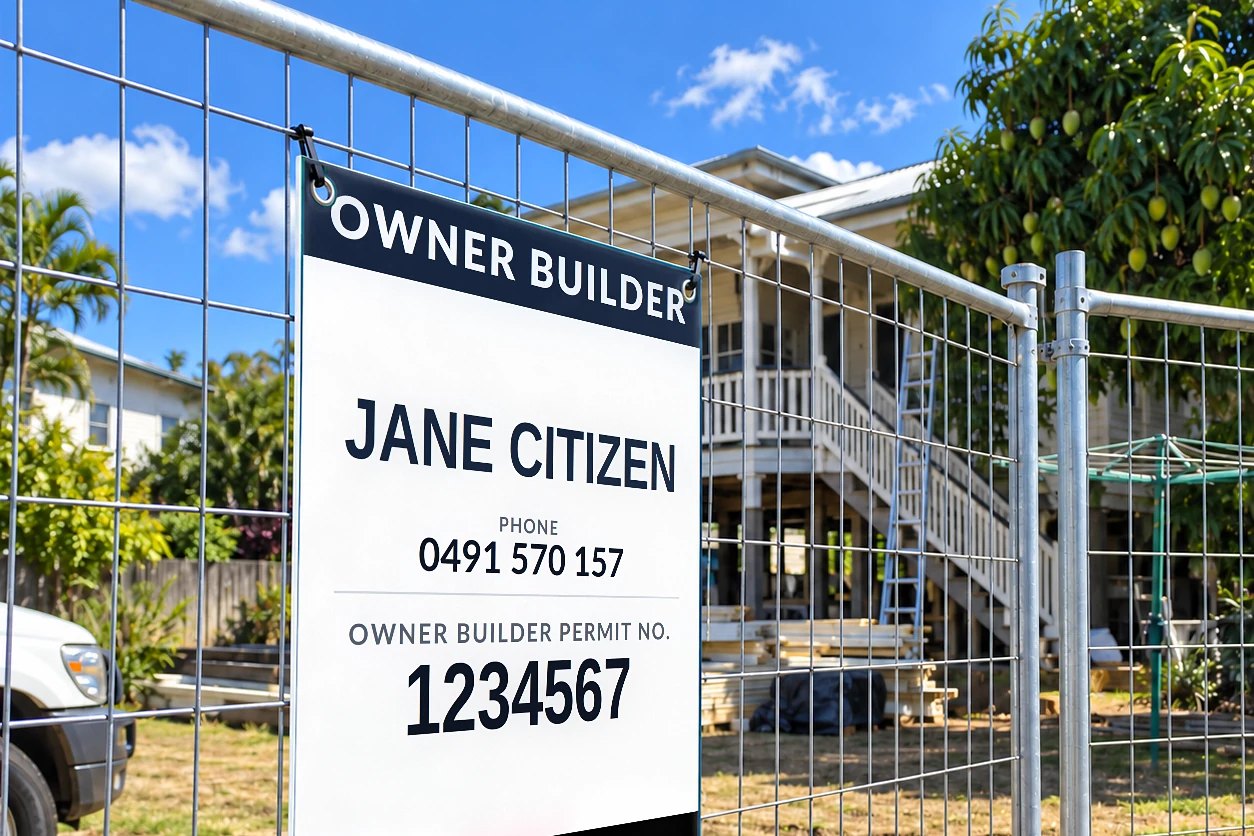
The sign must contain your name, a contact telephone number for you as the owner-builder, and the number assigned to the approval for the work. It also has to be readable by members of the public from outside the site, which means the practical spot is the temporary fence or hoarding facing the street, not a gate post set well back from the boundary.
A penalty of up to $1,000 may apply to owner-builders under regulation 27.
Victoria and New South Wales owner builder sign duties
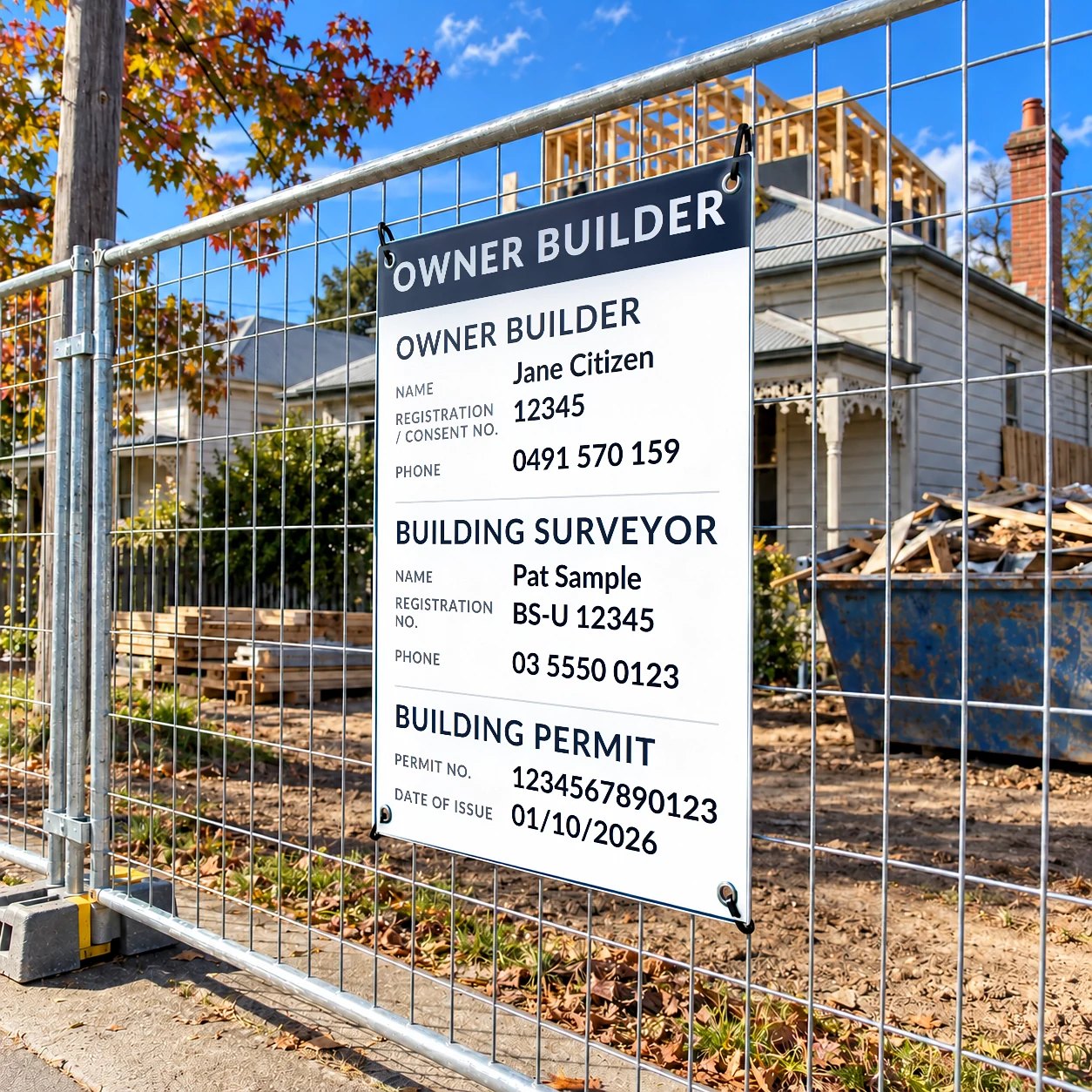
The two states split in opposite directions. In Victoria, regulation 41 sets the permit sign duty for the builder named in the permit, and industry guidance says it covers owner-builders too. New South Wales has a consent site sign, but no owner-builder sign duty.
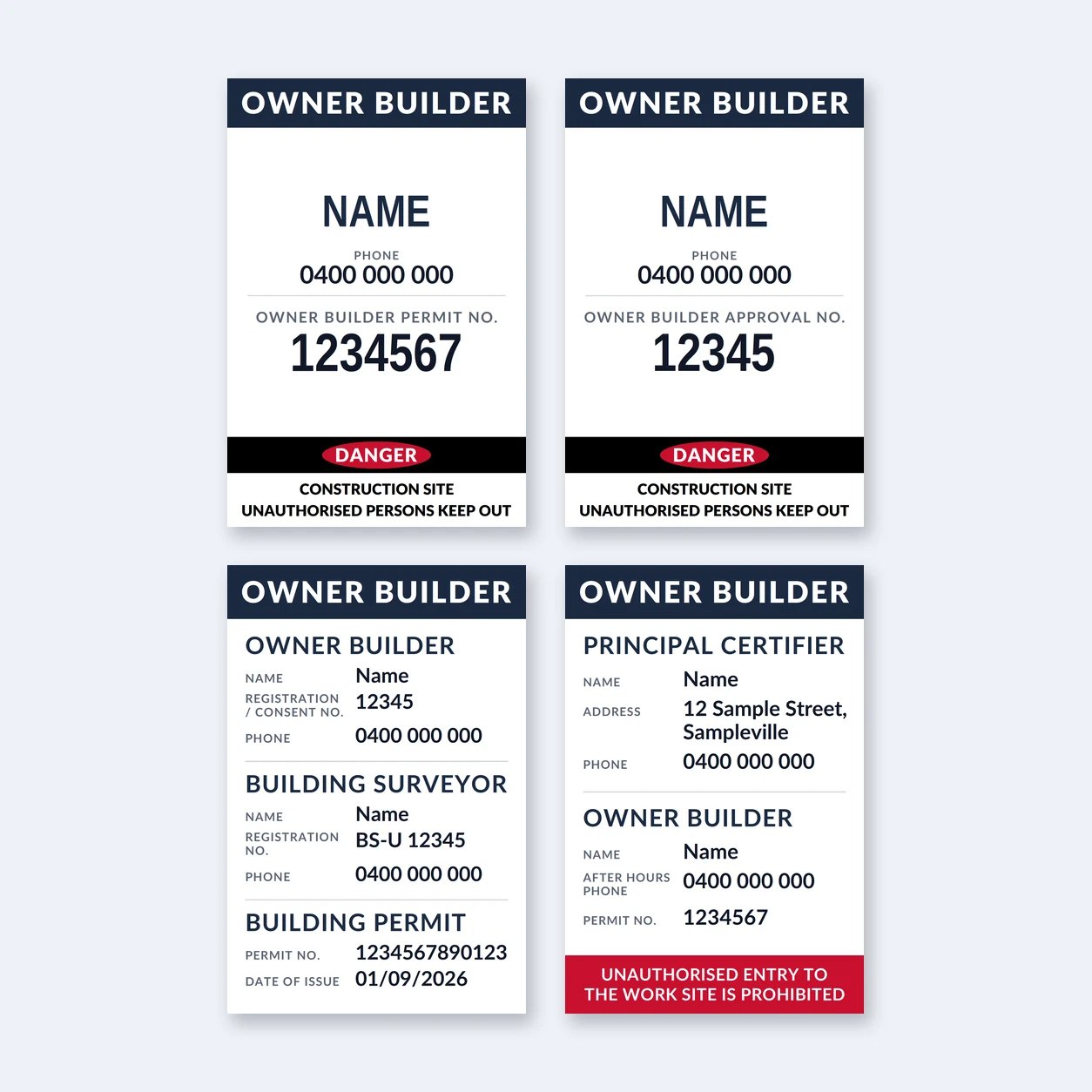
The sign shows the registration numbers and contact details of the builder and the relevant building surveyor, and the building permit number with its date of issue. It must be placed where the public can see it and kept visible and legible while the work goes on. No size is set. How an owner-builder fills the builder’s registration line is not stated in the sources, so ask your building surveyor before you finalise that part of the layout.
New South Wales does not impose a sign duty on the holder of an owner builder permit. The section 70 site sign shows the principal certifier’s name, address and phone number, the principal contractor’s name and an after hours phone number if there is a principal contractor, and the statement “Unauthorised entry to the work site is prohibited”. The clause 32 licensed contractor sign does not apply to work authorised by an owner builder permit. You still send the permit number to the council in writing under section 71, but it stays off the sign.
Owner builder sign rules in the other states and territories
South Australia does not license owner-builders, and its site sign rule binds licensed building work contractors only. No sign duty for owner-builders was found in the source laws, so ask the council about any conditions on the development approval.
Tasmania has owner builder permits, but no site sign duty was found in the building and occupational licensing laws named in the table. A permit condition could still ask for one, so read the permit before you assume nothing is required.
The ACT has a different wrinkle. ACT owner-builders hold a licence in the owner-builder class. The ACT site sign rule for licensed builders sets a sign of at least 600 x 900mm with the bold heading Notice about building work at least 50mm high. Whether that rule applies to an owner-builder licence was not confirmed in the laws read, so ask Access Canberra before work starts.
The Northern Territory has no site sign duty in the two laws read. Check the permit conditions for anything specific to your block.
If a licensed builder comes onto the job, the construction site signs rules for contractor work sit alongside whatever your permit says.
Owner builder signage: sizes, materials and fixing
Before you order, gather the permit or approval number exactly as issued, your full name as the owner-builder, and a phone number you will answer during the job. For Victoria, add the building surveyor’s details and the permit issue date. For New South Wales, add the principal certifier’s details. A permit or council condition can add more, and rules change, so check the regulator’s current page before printing.
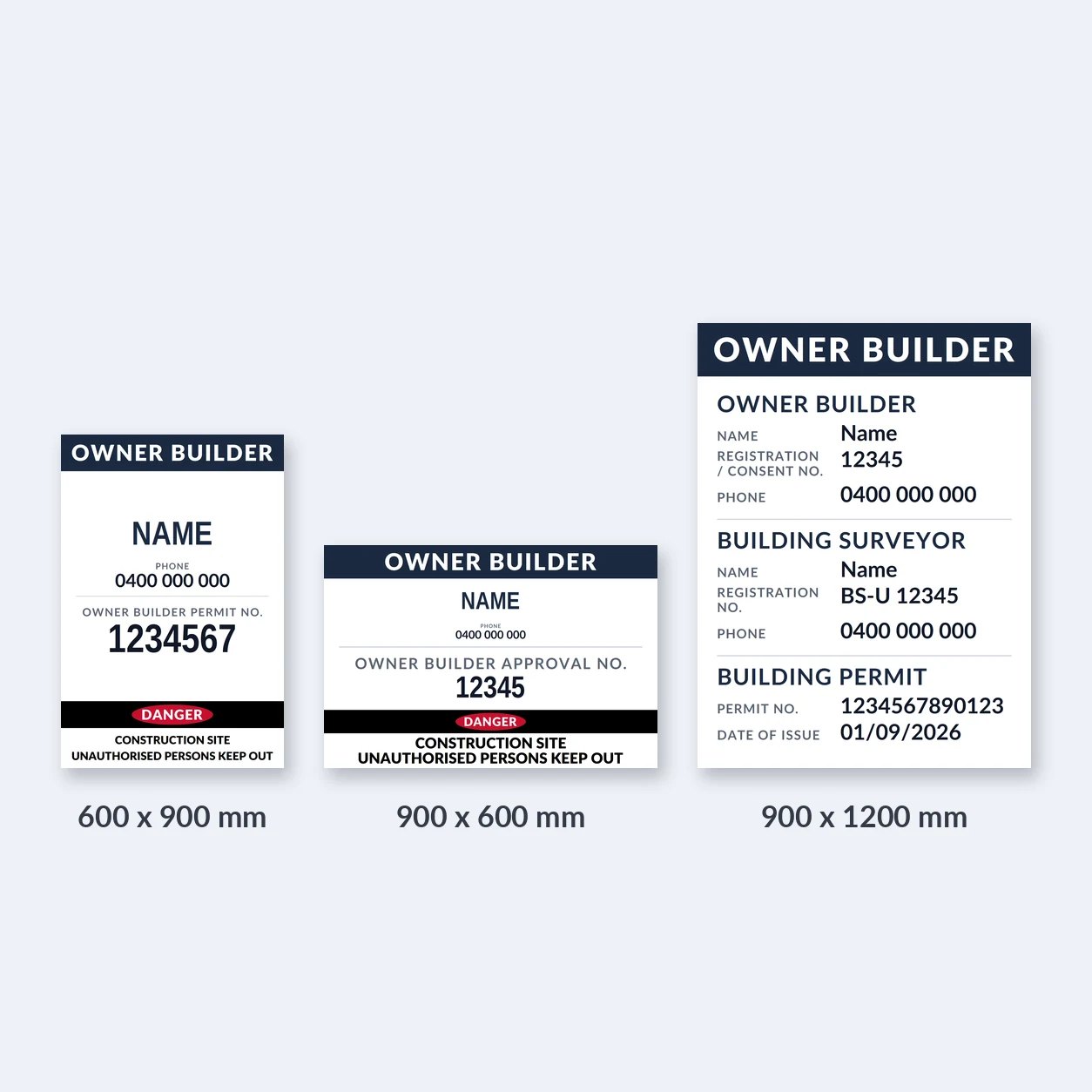
The owner builder signs product page has four state layouts: Queensland, Western Australia, Victoria and New South Wales. Each layout is set up for the details that state lists, but the layout is not legal advice. You check the permit or approval conditions and the proof before approving.
The boards come in 600 x 900mm portrait for fence panels, 900 x 600mm landscape where a long fence panel or hoarding runs across the front, and 900 x 1200mm portrait for a wide frontage or a busy road. Choose 3mm corflute for a lighter board, or 5mm corflute when the site is windy, exposed or running longer. Print one side or both sides in full colour.
The optional Eyelets on All Edges adds a 10mm silver metal eyelet near every corner, so the sign can be cable tied to temporary fencing or hoarding. Only the printed sign is supplied. Cable ties, screws, stakes, frames and other fixings are not included.
Face the sign to the street or the public line, and keep it clear of stored materials. Corflute is weather resistant and keeps its looks for weeks to several months in the open on a typical job, depending on sun exposure and handling.
To order a layout, pick the state and board options, add to cart, then type the sign details into one text field of up to 1000 characters at the Upload Artwork stage. The team sets the details into the layout and emails a PDF proof. Nothing prints until you approve that proof. If the layout does not cover what your permit adds, you can upload your own print ready artwork or ask for a custom design made by a Paperlust designer.
Frequently asked questions
Do I need an owner builder sign for my project?
It depends on the state or territory. Queensland and Western Australia require a sign. Victoria has a permit sign duty that industry guidance says applies to owner-builders. New South Wales has a consent site sign, but no separate owner-builder sign duty. South Australia, Tasmania and the Northern Territory have no sign rule for owner-builders in the laws read. The ACT is not confirmed, so ask Access Canberra before work starts.
How big must the sign be in Queensland?
Queensland requires the sign to be at least half a square metre in size, with letters at least 50mm high. A 600 x 900mm board is 0.54 square metres, just above the minimum. A 900 x 600mm board is the same board laid landscape, and a 900 x 1200mm board is 1.08 square metres if the job faces a busy road.
Does the permit number go on the sign?
In Queensland, yes. The number shown on the owner builder permit must appear on the weatherproof sign before work starts. In Western Australia, the approval number goes on the sign along with your name and phone number. In New South Wales, that number does not go on a sign. Section 71 requires it to be provided in writing to your local council.
What goes on a Western Australian owner builder sign and what is the penalty?
A Western Australian sign must show the owner-builder’s name, a contact telephone number and the approval number for the work. It must be prominent, readable from outside the site, of reasonable dimensions and clearly legible. Under regulation 27, a penalty of up to $1,000 may apply.
Does a New South Wales owner-builder need a sign?
No. The New South Wales rules do not impose a sign duty on an owner builder permit holder. Work under a development consent or a complying development certificate needs the section 70 site sign, which shows the principal certifier’s details and the unauthorised entry statement. The licensed contractor sign does not apply. The permit number is given to the council in writing under section 71 and is not printed on the sign.
What is the sign made of, and how do I fix the corflute to a fence?
The signs are printed on 3mm or 5mm corflute, a fluted polypropylene board. You can choose one side or both sides printed in full colour. The optional Eyelets on All Edges adds a 10mm silver metal eyelet near every corner so the sign can be cable tied to temporary fencing or hoarding. Only the printed sign is supplied, so cable ties and other fixings are separate.