
Custom selfie frames have become one of the most versatile event props in Australia. Whether you are sending guests home with a shareable photo from a school formal, driving hashtag traction at a product launch, or giving wedding guests a laugh between the ceremony and reception, a well-designed frame delivers something most signage cannot: a moment guests choose to participate in.
Getting that moment right comes down to print quality, material choice, and design decisions made before the file goes to print. This guide walks through everything you need to know, from substrate selection and sizing through to hashtag placement, cut-out dimensions, and what to look for when you place an order.
What you need to know before ordering
Custom-printed selfie frames work for weddings, formals, corporate activations, and fundraisers. Here are the key facts.
- Paperlust selfie frames are printed full-colour on 5mm TEKpvc foamboard, lightweight enough to hold comfortably and rigid enough to stand upright.
- Standard size is A1 (594 x 841mm), ideal for one to two people; custom sizing is available to suit group shots.
- Pricing starts from $114.35 AUD inc. GST for a single frame, with significant bulk discounts from 20+ units.
- Production takes 3-4 working days after proof approval; rush options are available on request.
- Flat-rate shipping applies Australia-wide.
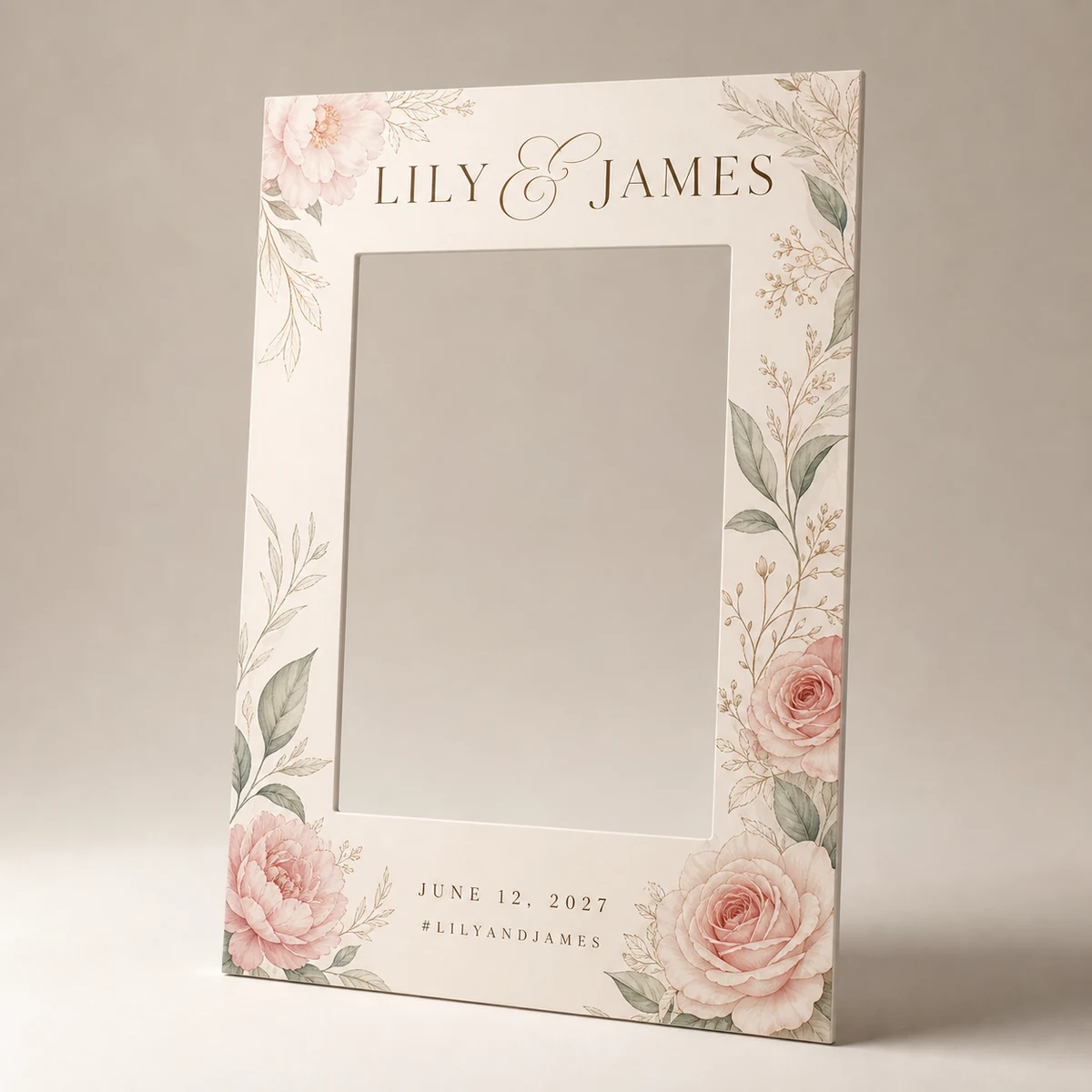
- Frames can be ordered with a custom-cut interior window (router cut to dieline) for the classic hold-up-and-shoot effect.
What makes a great selfie frame prop
A selfie frame is not a standard sign. It is going to be handled repeatedly, held at arm’s length, probably dropped a few times, and photographed in mixed lighting conditions indoors and outdoors. The best ones do three things well: they stay rigid under handling, they photograph cleanly against any background, and the branding is legible in a smartphone photo taken from two metres away.
Material: TEKpvc foamboard vs corflute
The two most common substrates for selfie frame printing in Australia are foamboard (also known as PVC foamboard or foamcore) and corflute (the fluted plastic board used for real estate and event signage). Each has genuine strengths.
Foamboard at 5mm gives a smooth, flat surface that photographs with no texture interference. It is light enough to hold for extended periods without fatigue, it takes a clean router cut for shaped outlines and interior windows, and it presents well in professional brand contexts. Paperlust selfie frames are printed on 5mm TEKpvc foamboard for exactly this reason.
Corflute is more impact-resistant and handles outdoor humidity well, but the internal flute structure can show through photographs under raking light, and the board cannot be router-cut to tight curves or detailed interior shapes without the cut edge looking unfinished. For props that will be rained on repeatedly or handled roughly over a multi-day outdoor festival, corflute is serviceable. For weddings, formals, and brand activations where print quality matters, foamboard is the cleaner choice. Where the brief calls for that trade-off, we print flat corflute signs in 3mm and 5mm TEKflute, one sided or double sided.
Indoor vs outdoor durability
Foamboard selfie frames perform best in sheltered environments: indoor venues, undercover marquees, and shaded outdoor event areas. Direct sun over several hours will warm the board and can cause minor warping if the frame is left flat on a hot surface. For fully outdoor events in harsh sun, keep frames propped upright or leaning against a solid surface rather than lying flat, and store them in the shade between uses.
The UV print on 5mm foamboard is weather-resistant for short-duration outdoor use (a single-day event, a weekend activation). It is not designed for permanent outdoor installation. If you need a frame that lives outside for months, a corflute version printed with UV inks is the more appropriate option.
Reusability
A well-handled foamboard selfie frame lasts across multiple events if stored correctly. Lean it vertically against a flat wall, not flat on a surface where other objects can bend the edges. Use a protective wrap or cardboard sleeve for transport. For a wedding where the frame is used once, this is not a consideration. For a brand activation team rotating the same props across 10 city events, it is worth discussing with your printer whether a heavier or more protective substrate suits your usage pattern.
Sizing for one to two people
The most commonly ordered selfie frame size in the Australian market is around 600 x 900mm to 800 x 1200mm for a hand-held single-person frame. At A1 (594 x 841mm), you have enough height for a standing adult to hold the frame above their head and bring their face into the cut-out, with space for a logo or hashtag below.
For two-person shots, consider scaling up to at least 900 x 700mm in landscape or 700 x 1000mm in portrait. If you want three or more guests to appear in a single frame, you are looking at 1000 x 1200mm minimum, which becomes a two-person carry rather than a one-person hold.
Cut-out window sizing
The interior cut-out is where most first-time buyers underestimate what they need. A common mistake is designing the window too small: the guest has to hold the frame at an awkward angle to get their face centred, the photographer ends up too far back to fill the frame, and the branded elements get cropped.
A reliable rule for the cut-out window:
- Single-person portrait: 350-400mm wide by 450-500mm tall
- Two-person landscape: 550-700mm wide by 400-450mm tall
These dimensions give enough space for a natural, relaxed pose. Leave at least 60-80mm of frame border around the window so the branding has room to breathe and the board stays structurally rigid after the cut. Very thin borders (under 40mm) can flex and crack at the cut edge with repeated handling.
If you are including a lower border for a hashtag or event name, factor that into the frame height. A 100-120mm lower border is comfortable for three to four lines of text at a legible scale.
Design tips for selfie frames
Hashtag and handle placement
The hashtag is the most commercially important element on a brand or wedding selfie frame. It needs to be readable in a phone screenshot, which means at minimum 30-40mm tall at the printed size. All-caps sans-serif typefaces with wide letterforms (Montserrat, Futura, Gotham) read better in photos than light or italic scripts.
Place the hashtag in the lower border, centred, with no less than 20mm of clear space above and below it. Avoid putting the hashtag inside the cut-out area where it will be obscured by the subject’s body.
For Instagram and TikTok handles, the same sizing rules apply. If you are including both a hashtag and an event URL, stack them vertically rather than side by side; horizontal stacking at print scale makes both elements too small to read.
Logo and branding placement
Brand logos belong in the upper or side borders where they appear in every photograph, regardless of how the subject positions themselves. Upper-centre is the most reliable position. Avoid placing logos directly adjacent to the cut-out edge, where the contrast between the logo and the subject’s clothing can create confusion.
For wedding selfie frames, the couple’s names and wedding date in the upper border, hashtag in the lower border, and venue or florals as decorative elements in the side borders is a layout that has proven to work consistently.
Colour and print contrast
The frame will be photographed against a wide range of backgrounds: decorated venue walls, plain white walls, outdoor greenery, and dark evening settings. Colours that read well in all conditions are high-contrast pairings: white on dark, dark on white, or deep brand colours with white text and borders.
Avoid pale pastels as the dominant border colour. They look beautiful in design proofs and can look washed out in phone photos under warm event lighting. If your brand palette is pastel, consider a dark inner border around the cut-out to sharpen the contrast at the edges.
Bleed and safe zone
Your artwork file needs a 3mm bleed on all outer edges. Keep all important design elements (text, logos, the cut-out path) at least 5mm inside the trim edge so nothing is lost to the router cut. If your frame has a shaped exterior outline (rounded corners, arch top, custom shape), supply the cut path as a 100% Magenta spot colour layer on top of your artwork file in PDF, AI, or SVG format.
Events where selfie frames deliver the most value
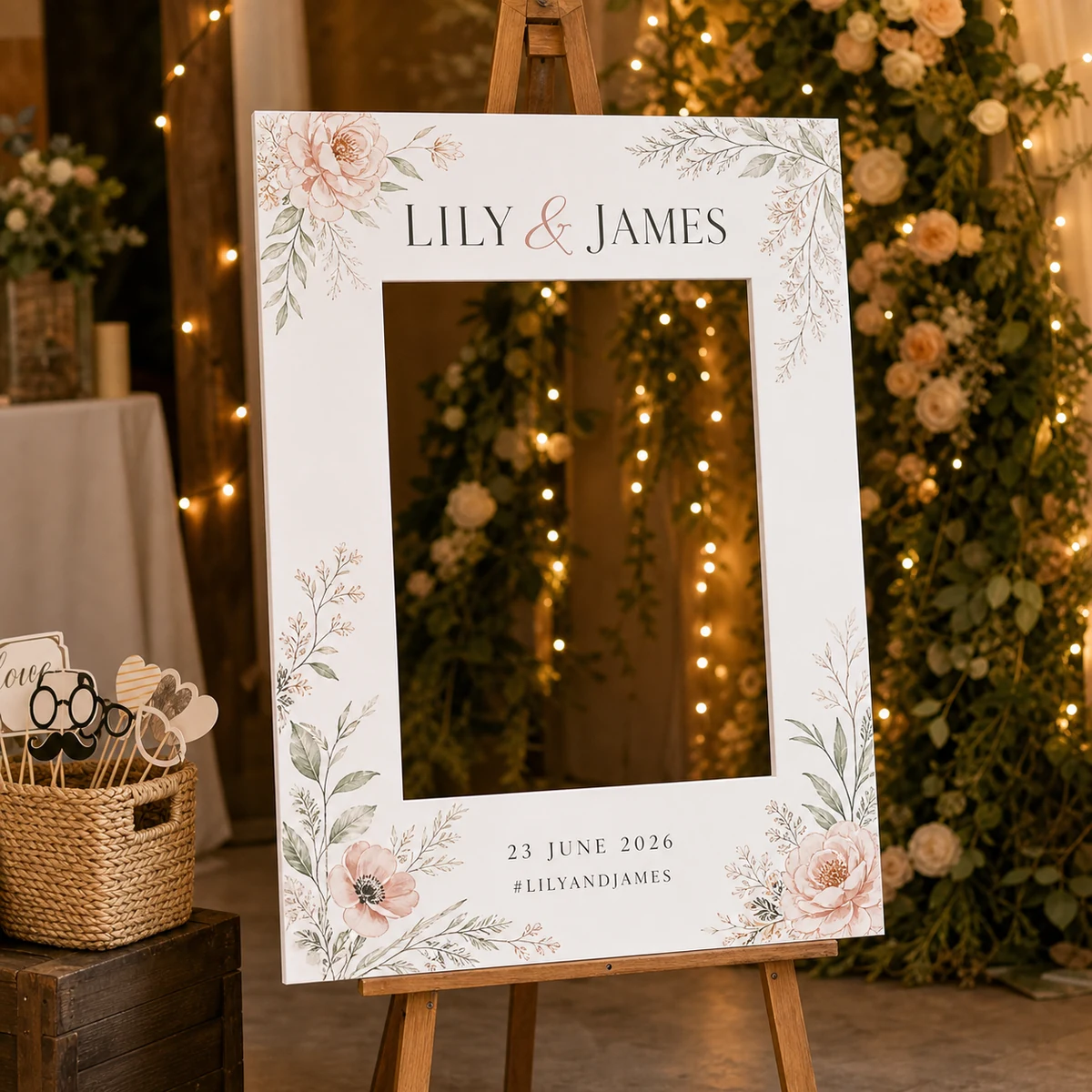
Weddings
A wedding selfie frame gives guests something to do between the ceremony and the reception, keeps people engaged during the cocktail hour, and generates social media posts your guests actually want to share. Most wedding selfie frames include the couple’s names, the wedding date, and the event hashtag. Some couples add the venue name or a short phrase (“Mr and Mrs”). A single A1 frame works well for weddings of up to 80 guests; for larger events, ordering two or three frames prevents queuing at the photo station.
Corporate events, product launches, and brand activations
Brand activations are the highest-ROI application for selfie frames. A guest who holds up your branded frame and posts it to Instagram has effectively done a paid-media impression for free. The key metric is shareable quality: how many posts from your event would a stranger stop to look at? A frame with a plain logo and event name generates moderate engagement. A frame with a clever visual concept (a product cut-out, a location-specific design, a seasonal theme) generates meaningfully more.
For trade shows and conferences, ordering 20+ frames so that multiple booths or event zones each have one is the standard approach for larger activations. Bulk pricing makes this commercially viable.
School formals and graduations
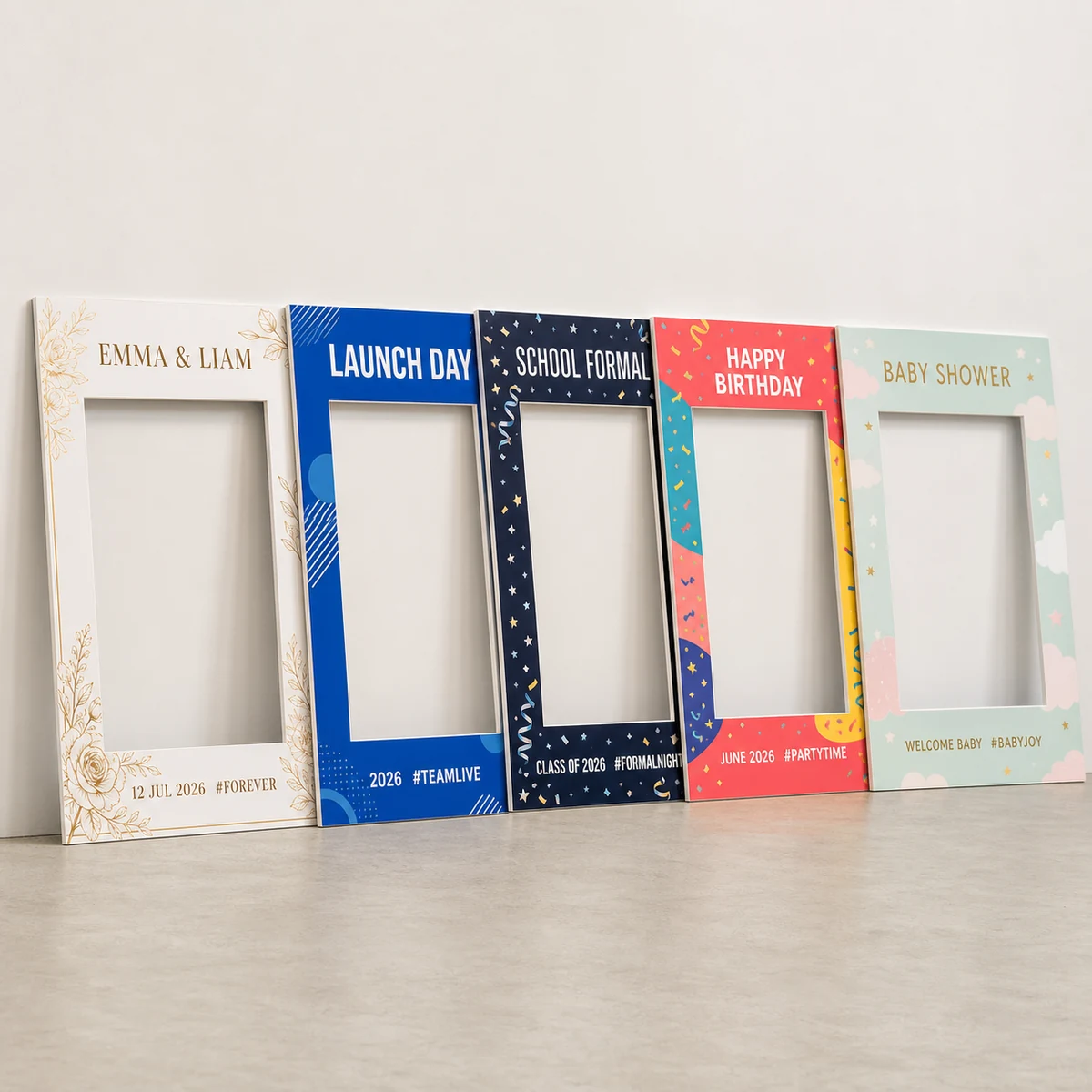
School formals are one of the highest-volume applications for selfie frames in Australia. A frame printed with the school name, year, and a formal-specific design gives students a prop that photographs well against formal venue backdrops. Year 12 graduation frames often feature a countdown (“Class of 2026”) as the central design element.
Formals typically require frames to last one evening of heavy use, so single-event durability is the priority rather than multi-event reusability.
Fundraisers and community events
For charity events and fundraisers, selfie frames double as branding and as a donor engagement tool. Guests photographed with the charity frame generate social content that keeps the cause visible beyond the event itself. Non-profit organisations often find the per-unit cost justifiable against the earned media value.
Ordering custom selfie frames
Paperlust Print Shop produces custom selfie frames on 5mm TEKpvc foamboard with full-colour flatbed UV printing and router cut to dieline for shaped exteriors and interior cut-outs. You can order a single frame for a one-off event or bulk quantities for a brand activation, with pricing that scales favourably from 20+ units.
To place an order via our selfie frames product page:
Step 1: Confirm your size and cut requirements
Decide on overall frame dimensions and whether you need an interior cut-out window, a shaped exterior (rounded corners, arch), or a standard rectangular outline. Custom sizes are available; the standard A1 format suits most single-person and two-person applications.
Step 2: Prepare your artwork file
Supply a print-ready PDF, SVG, or Adobe Illustrator file with 3mm bleed on all edges, fonts outlined, and images embedded at minimum 100 dpi at final print size. If your frame has a custom cut path, include it as a 100% Magenta spot colour on the top layer of your artwork file.
Step 3: Proof and approve
You will receive a designer proof within 1-2 business days of placing your order. Review the proof carefully for text accuracy, logo placement, and cut-out dimensions. Two rounds of edits are included at no extra charge.
Step 4: Production and dispatch
Production takes 3-4 working days after proof approval. Rush production is available on request. Shipping is flat-rate Australia-wide.
If your artwork is not ready, the Print Shop team offers design assistance services to help prepare your file for print.
Frequently asked questions
What size selfie frame should I order for two people?
For comfortable two-person shots, a frame of at least 700 x 1000mm in portrait or 900 x 700mm in landscape works well. The interior cut-out window should be 550-700mm wide to give both subjects room to position themselves naturally. At A1 (594 x 841mm), a two-person portrait is possible but slightly tight; if group shots are a priority, a larger custom size is worth considering.
What is the difference between foamboard and corflute for selfie frames?
Foamboard (PVC foamboard) has a flat, smooth surface that photographs cleanly and accepts detailed router cuts for custom shapes and interior windows. It is the preferred material for weddings, corporate events, and brand activations where print quality matters. Corflute is more impact-resistant and better suited to heavy outdoor use, but its internal flute structure can show in photographs under raking light and it cannot be router-cut to tight curves as cleanly as foamboard.
Can I use a selfie frame outdoors?
Yes, foamboard selfie frames handle short-duration outdoor use well, including a full single-day event. Keep them propped upright rather than lying flat in direct sun, and store them in shade or indoors when not in use to prevent warping. For multi-day outdoor events in harsh sun, discuss corflute as an alternative substrate with the Print Shop team.
How large should the hashtag text be on my selfie frame?
Allow at least 30-40mm of text height at the printed size so the hashtag reads clearly in a phone screenshot. Use a bold, wide-letterform sans-serif typeface and place the hashtag centred in the lower border with at least 20mm of clear space above and below it. Avoid placing hashtags inside or adjacent to the cut-out window where they may be obscured by the subject.
How many selfie frames do I need for my event?
For events up to 80 guests, one frame is usually sufficient with normal queuing. For 80-200 guests where a photo station is a focal activity, two frames help avoid congestion. For large brand activations or conferences where frames will be distributed across multiple zones or booths, ordering 20+ units at a time also activates bulk pricing, which reduces the per-unit cost significantly.
How long does production take for custom selfie frames?
Standard production is 3-4 working days after proof approval. You will receive your designer proof within 1-2 business days of placing your order, and two rounds of edits are included. If your event timeline is tight, contact the Print Shop team to discuss rush production options.