

Variable data postcard printing turns a run of 5,000 postcards into 5,000 individual conversations. Every card carries its recipient’s name, their suburb’s median property price, their last donation amount, or the store nearest to them, pulled live from your data file as the digital press runs. The cost premium over static print is modest. The lift in response rates is not.
The catch is this: VDP only earns its keep when your segmentation data is clean, your offer genuinely varies by segment, and your run is large enough to amortise the set-up. This guide walks through the full picture, from what VDP actually is and how it works, to file prep, compliance, and the honest cases where static print will serve you better.
At Paperlust Print Shop we support VDP on digital postcard runs across A6, A5, and DL formats. Get in touch with the team for a VDP-capable quote on your next campaign.
- What varies: names, addresses, offers, images, QR codes, barcodes, URLs
- Print method: digital press only (offset cannot VDP)
- Data format: CSV or Excel, one row per recipient
- Sizes available: A6 (105x148mm), A5 (148x210mm), DL (99x210mm)
- Stock: 360gsm premium (standard); silk, gloss, and recycled available on request
- Address validation: AusPost DPID recommended for addressed mail
- Minimum run: ~500 records for VDP to be cost-effective
- Quote: Contact the Paperlust Print Shop team for a VDP-specific brief
What Is Variable Data Printing?
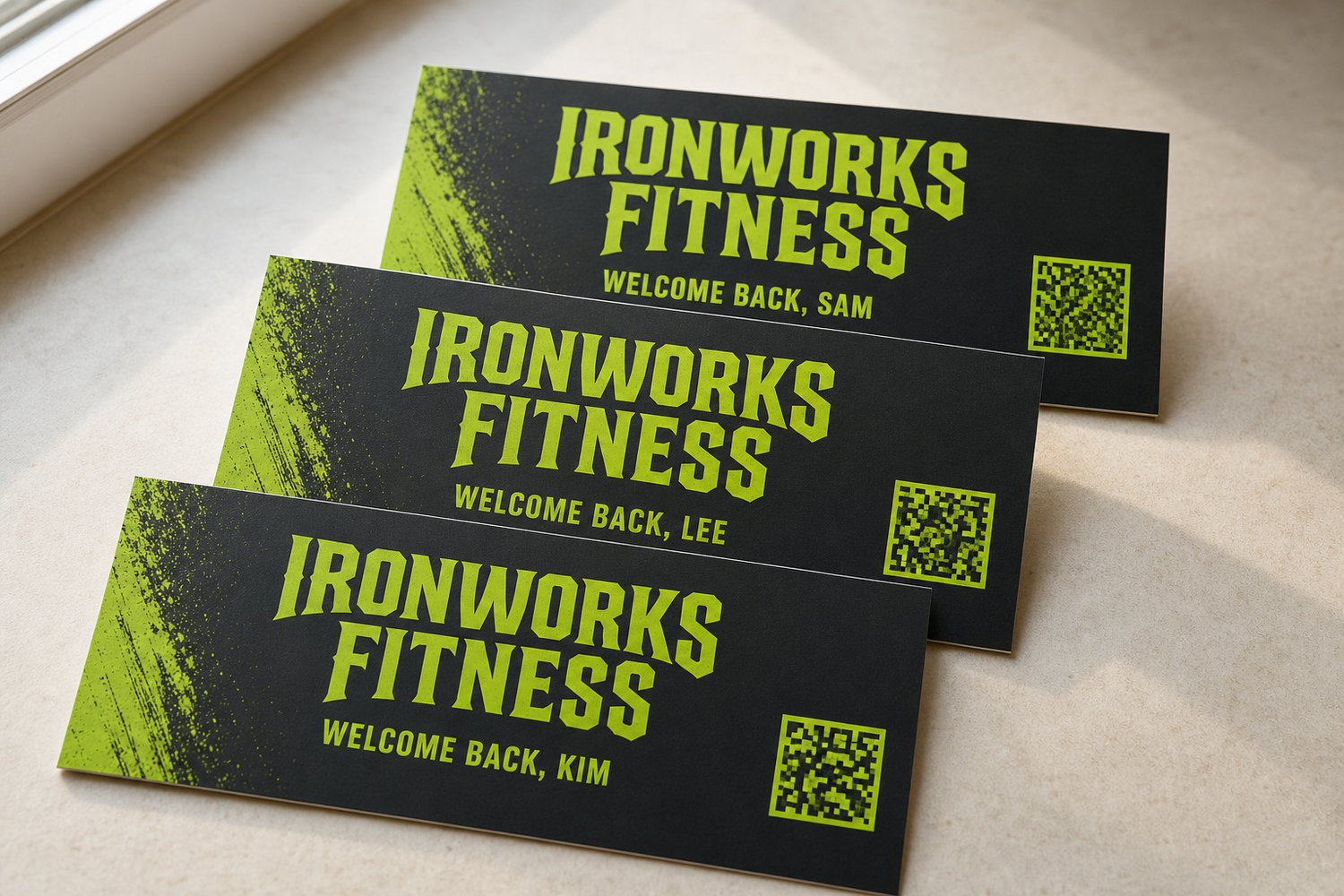

Variable data printing (VDP) is a digital print workflow where each piece in a run can carry different text, images, barcodes, or QR codes, populated from a data file at the moment of printing. The press does not stop between records. It renders each sheet individually and moves on, so a run of 10,000 personalised postcards takes roughly the same time as 10,000 identical ones.
The mechanism sits entirely within digital printing. Offset presses use fixed plates: every sheet is identical. A digital press images directly onto the substrate using a render queue that merges your template with your data row by row. That is why VDP is impossible on offset, and why the cost gap between static digital and VDP digital is smaller than most clients expect.
What can actually vary within a single run:
| Field type | Example | Common use |
|---|---|---|
| Text strings | Recipient first name, company name, suburb | All sectors |
| Numeric values | Loan capacity, median price, last gift amount | Real estate, finance, charity |
| Images | Agent headshot, store photo, product image | Real estate, franchise, retail |
| QR codes | Unique tracking URL per recipient | All sectors (conversion tracking) |
| Barcodes | AusPost DPID barcode for mail processing | Addressed direct mail |
| Promotional codes | Unique redemption codes per household | Retail, hospitality, loyalty |
The lift from this personalisation is material. Personalised direct mail consistently delivers 2-3x the response rate of identical static pieces. Adding the recipient’s name alone to a mail piece has been shown to lift response by up to 135%. For VDP to justify its premium, your campaign needs to do more than print names, it needs to vary an offer or data point that is genuinely relevant to each segment.
VDP Use Cases That Actually Work
Not every campaign justifies variable data. The four use cases below have strong track records because the variable information is high-relevance and the recipient has reason to act.
Real Estate: Suburb-Specific Market Data
A real estate agent mailing to 8,000 households across five suburbs sends one postcard run. Each card carries that household’s suburb name, the current median sale price, the clearance rate for the past quarter, and the agent’s name and headshot. The recipient sees figures about their own street, not a generic pitch.
This is the highest-ROI VDP application in the Australian market. Property owners process suburb-specific price data as personally relevant information, not advertising. The postcard reads as a market update, not a leaflet.
For more on building out a letterbox campaign in this space, see our guide to real estate postcard marketing in Australia.
B2B Account-Based Outreach
Account-based marketing (ABM) at scale is where VDP punches above its weight for B2B teams. A software vendor mailing to 3,000 target accounts can vary the company name, the contact’s role, the industry-specific pain point, and a tailored offer line across a single print run.
The result is a postcard that reads as if it was written for that contact specifically. “We help [Company Name]’s [Role] teams reduce invoice processing time” lands differently to “We help businesses reduce costs.”
This is also where image-swap matters. A postcard sent to a logistics firm shows warehouse imagery. The same card to a professional services firm shows an office environment. Same template, same print run, different visual context per segment.
Multi-Location Franchise Promotions
A franchise chain running a national promotion often needs to include a store address, a local store manager’s name, and a map or directional callout specific to the recipient’s nearest location. Without VDP, this requires separate artwork and separate print runs per location. With VDP, it is one template, one data file, and one print job.
The agency managing a 50-location restaurant group can generate a single brief. The VDP run handles the per-location variation automatically.
Charity Supporter Renewal
Donor renewal campaigns see measurable lift from VDP. When a card reads “Thank you for your $85 gift in March 2026, your support funded 12 meals” instead of a generic ask, lapsed donors respond at higher rates. The variable fields (donor name, last gift date, gift amount, impact metric) come directly from the donor CRM.
This also allows graduated ask amounts per donor, not a flat ask of $50 per piece. A donor who last gave $200 receives a renewal card suggesting $200 or $250. A lapsed donor at $30 receives a re-engagement offer at $30 with a lower barrier to recommit.
The VDP Workflow: From Data File to Printed Card
Understanding the production steps helps you prepare your campaign and avoid delays.
Step 1: Template Design
Your postcard template is designed with fixed (static) zones and variable zones clearly separated. Static zones hold your logo, brand colours, images that are the same across all records, and any body copy that does not change. Variable zones are placeholders that the VDP software will populate from your data file.
Good VDP template design keeps variable text in zones with enough space to handle the longest possible entry in that field. If a company name can be 3 words or 12 words, the layout needs to accommodate both without overflowing or looking broken.
For detailed guidance on postcard artwork, bleed, and file setup, see our postcard design and file format guide.
Step 2: Data File Preparation
The data file is a CSV or Excel spreadsheet, one row per recipient, one column per variable field. Every column header must exactly match the placeholder name in the template. Common required fields:
- Recipient first name and last name (separate columns)
- Full address fields: street number, street name, suburb, state, postcode (separate columns, not combined)
- Variable offer or data field (e.g. suburb median price, company name, donor last gift)
- Image filename (if doing image-swap, the cell value must match the exact filename in your image library)
- QR code URL or unique code (if tracking per recipient)
The single biggest source of VDP production delays is data that arrives in non-standard formats: full addresses in one cell, inconsistent suburb name spelling, special characters in name fields. Clean your data before briefing the print run.
Step 3: AusPost DPID Address Validation
For addressed mail running through the AusPost network, each address should be matched against Australia Post’s Postal Address File (PAF) to obtain a Delivery Point Identifier (DPID). The DPID is an eight-digit number that uniquely identifies a delivery point in AusPost’s system. Printing this as a barcode on the card enables automated sorting and, for high-volume senders, can unlock postage discounts.
DPID validation is handled by AMAS-certified address matching software. You submit your address file, the software validates each record against the PAF, appends the DPID, and flags undeliverable addresses for cleaning before the print run.
If your mailing list has not been DPID-validated, allow time for this step before briefing the print job. Unvalidated lists commonly contain 3-8% undeliverable records.
Step 4: Proof Approval
Before the full run prints, you review a proof set that includes at least three to five records from different segments of your data, checking that variable fields are populating correctly, no fields are overflowing their zones, QR codes resolve to the correct URLs, and the DPID barcode is correctly positioned.
At Paperlust Print Shop, artwork review happens within the same business day of submission. Check your brief against our standard specifications before uploading.
Step 5: Print Run and Dispatch
The validated data file and approved template go to the press. The render queue processes each record and the run completes. Cards are then finished (trimmed, any coating applied) and dispatched. Production time for digital postcard runs is 2-5 working days from artwork approval, depending on run size and finish.
File Preparation for VDP: Technical Requirements
Getting the file structure right before you brief the job saves time and avoids reprints.
| Element | Requirement | Common error |
|---|---|---|
| Data format | CSV or XLSX, UTF-8 encoding | Apostrophes in names corrupt non-UTF-8 files |
| Column headers | Must match template placeholder names exactly | Mismatched case (FirstName vs firstname) |
| Address fields | Split into separate columns (not combined) | Full address in one cell breaks DPID match |
| Special characters | Encode accents (O’Brien, Nguyen, cafe) | Smart quotes corrupt field on import |
| Image swap files | Named library, filename in data column | Filename in data cell doesn’t match actual file |
| QR/unique codes | Full URL or code string per row | Truncated URLs from spreadsheet column width |
| Numeric fields | No currency symbols in data (add in template) | “$” in cell breaks numeric field formatting |
For image-swap VDP, each variable image must be supplied at the same dimensions and resolution as the template zone it will populate. Supply all variable images as a named library alongside your data file, with filenames that match exactly what appears in your data column.
Special characters in name fields are one of the most common causes of encoding errors in VDP. Names with apostrophes (O’Brien, D’Souza), accented characters (Nguyen, Cafe), or special punctuation need to be in UTF-8 encoded files. Review your data file in a plain text editor before submission, not just in Excel, which can silently mask encoding problems.
The B2B Agency Angle: Running Multi-Client and Multi-Location VDP Campaigns
Campaign managers handling multiple clients or franchise networks see the biggest efficiency gains from VDP on postcards.
Multi-Location Restaurant Promo: A Case in Point
Consider a mortgage broker network, Domain Direct, running a postcard acquisition campaign to 12,000 prospects across four states. Each card carries the recipient’s suburb, the current median house price for that suburb, and a borrowing capacity estimate calculated from a simple income-band field in their data. The campaign tracked 380 inbound enquiries, a 3.2% response rate, against a 1.4% response rate on the static control group run in the same period.
The variable fields were three: suburb name, median price (pulled from their data), and the borrowing capacity figure. The template was the same across the full run. The data file took one afternoon to prepare.
This is a representative result, not a guarantee, but it illustrates why the incremental cost of VDP (typically 10-20% above static digital for the same format and quantity) is recoverable on a single campaign when the variable information is high-relevance.
Co-Op Franchise Marketing
Franchisee networks where individual locations contribute to a central media buy often need per-location customisation without per-location artwork. VDP makes this practical. The franchisor supplies a master template. Each franchisee’s record in the data file carries their store address, trading hours, local manager name, and any store-specific promotion. One print run covers the network.
This is also where a single agency account manager can build the brief once and reuse the template structure across multiple campaigns for the same client, varying only the data file each cycle.
Account-Based Marketing at Scale
B2B teams running ABM to named accounts often struggle to justify personalised print because the per-piece economics look unfavourable in small batches. VDP changes this calculation when account lists reach 500 or more. The setup cost is fixed. The incremental cost per record is low. A campaign to 2,000 named accounts across industry verticals, each receiving a card referencing their company name, their industry’s specific pain point, and a tailored CTA, can be designed, proofed, and dispatched in a single production cycle.
Privacy and Compliance for VDP Campaigns
Personalised print campaigns that handle individual recipient data in Australia operate under two primary frameworks.
Spam Act 2003
The Spam Act applies to electronic messages, not physical mail. Addressed physical mail to consumers does not require prior consent under the Spam Act. Unaddressed mail (letterbox drops with no named recipient) is also exempt. The Spam Act is relevant if your campaign has a digital follow-up component (email or SMS) triggered from the same data, where consent requirements do apply.
Privacy Act 1988
If your VDP data file contains personal information (names, addresses, financial data, health data), the Privacy Act applies to how that data is collected, stored, and used. Key obligations for Australian businesses handling VDP campaign data:
- Collect only the data you need for the stated purpose
- Do not repurpose data collected for one campaign for a different campaign without consent
- Store data securely, restrict access to the print supplier to the minimum dataset required
- Provide a clear opt-out or suppression mechanism for future direct mail
When briefing a print supplier on a VDP job, you are sharing personal data. Use a data processing agreement or at minimum confirm with the supplier how the data file is handled, stored, and deleted after the job is complete.
International Recipients on Australian Lists
If your list includes recipients outside Australia (e.g. an AU-headquartered business mailing to international offices), GDPR applies to EU/UK recipients and CCPA applies to California residents. Both impose stricter consent and data minimisation requirements than the Australian Privacy Act. Segment your list and apply the strictest standard applicable to each recipient’s location.
AusPost Addressing Rules
For addressed direct mail to qualify for AusPost’s standard letter rates and automated sorting, addresses must comply with AusPost’s addressing guidelines: correct format, valid postcode, no PO Box substitutions for street addresses, and DPID validation where volume discounts are sought. An unvalidated or incorrectly formatted address file increases undeliverable rates and can affect postage classification.
When Variable Data Printing Does Not Pay
VDP has a meaningful set-up overhead. There are situations where static print is the smarter call.
| Scenario | Why VDP does not pay | Better approach |
|---|---|---|
| Single offer, no segmentation | Nothing meaningful varies by recipient | Static digital print |
| Fewer than ~500 records | Set-up cost is not amortised | Static print or short-run digital |
| No clean segmentation data | VDP without good data produces random variation, not relevant personalisation | Clean the list first, or run static |
| Single-image campaigns | Image-swap not needed; name-only VDP rarely earns premium | Static with strong CTA |
| Very short lead time | Data prep, DPID validation, and proof approval add time | Static if turnaround is under 3 days |
The honest version: VDP earns its premium when you can point to at least two genuinely variable fields that are relevant to each segment and your run is large enough that the set-up overhead is a small fraction of total campaign cost. If the data is thin or the offer is the same for everyone, a static postcard with a strong design and clear CTA will perform comparably at lower cost and production complexity.
For a broader look at postcard vs other direct mail formats, see our guide to direct mail postcards for small business.
Share your data structure, list size, and format with the Paperlust Print Shop team and we will come back with a VDP-capable quote. Postcards printed in Australia on 360gsm premium stock, with same-day artwork review.
Frequently Asked Questions
What is variable data postcard printing?
Variable data postcard printing (VDP) is a digital print process where each card in a run carries different text, images, barcodes, or QR codes pulled from a data file. One print run can produce thousands of unique, personalised cards without stopping the press between records.
What data format do I need for a VDP postcard job?
Supply a CSV or Excel file (UTF-8 encoded), one row per recipient, with separate columns for each variable field. Column headers must match the placeholder names in your template exactly. Address fields should be split into separate columns: street number, street name, suburb, state, and postcode.
What is a DPID and do I need one for my campaign?
A Delivery Point Identifier (DPID) is an eight-digit number that uniquely identifies a postal delivery point in Australia Post’s system. It is printed on addressed mail as a barcode to enable automated sorting. DPID validation is recommended for large addressed mail runs and can unlock AusPost postage discounts. Your data file needs to be processed through AMAS-certified software to obtain DPIDs before printing.
What is the minimum run size for VDP postcards?
VDP has a fixed set-up overhead that is not amortised on very small runs. As a general guide, runs of fewer than 500 records rarely justify the VDP premium over static digital print. For runs above 500, the incremental cost per VDP record is low and the set-up cost becomes a small fraction of total campaign spend.
What sizes are available for variable data postcards?
Paperlust Print Shop supports A6 (105x148mm), A5 (148x210mm), and DL (99x210mm) postcard formats for digital print runs, including VDP jobs. All are printed on 360gsm premium stock as standard; other finishes (silk, gloss, recycled) are available on request.
Can I swap images as well as text in a VDP run?
Yes. Image-swap VDP allows different images per record, populated from a named image library. Each variable image must be supplied at the same dimensions and resolution as the template zone it will fill. The filename in your data file must match exactly the filename in your image library.
Does VDP postcard printing comply with Australian privacy law?
Your data handling obligations sit with you as the campaign controller, not the printer. Under the Privacy Act 1988, you must collect only necessary data, use it for the stated purpose, and store it securely. When briefing a print supplier, share only the minimum dataset needed and confirm how the data file is handled and deleted after the job. Physical addressed mail does not require consent under the Spam Act (which covers electronic messages only).
How does VDP postcard printing differ from standard digital postcard printing?
Standard digital postcard printing produces identical cards across the run. VDP uses a render queue that merges your template with your data file, producing a unique output per record. Both use the same digital press and the same stock. VDP typically costs 10-20% more than static digital print for the same format and quantity, with the main additional time investment being data file preparation and proof sign-off across multiple sample records.
Ready to print your postcards?
360gsm premium card. From $0.15 inc. GST. Ships AU-wide from Melbourne.