
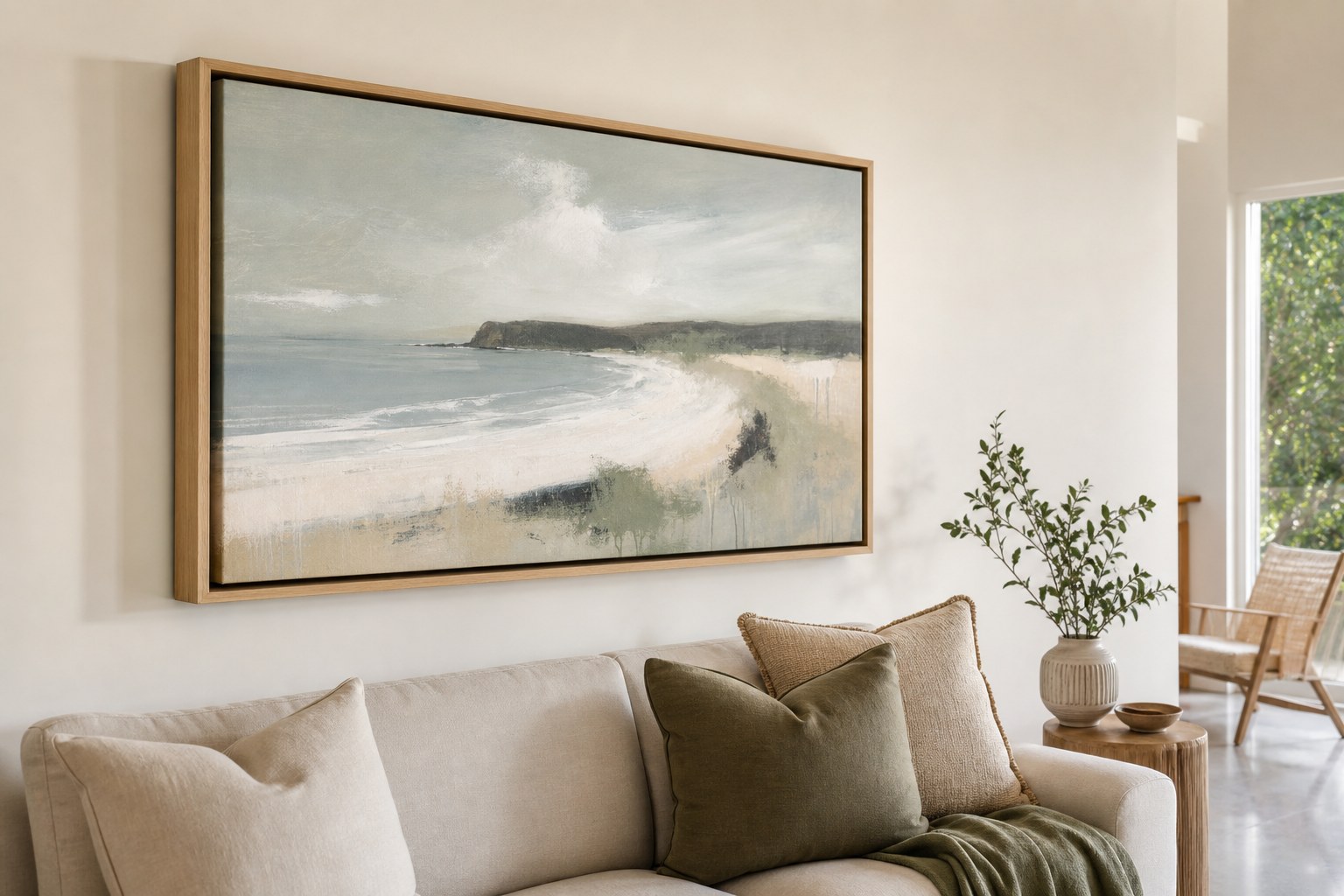
A floating frame is a small addition that makes a significant visual difference. It turns a gallery-wrapped canvas into something that feels like it belongs on the wall of a considered, well-put-together space. If you have seen the option appear when ordering and were not sure whether to add it, this guide explains exactly what it is, how the shadow gap works, and whether it suits your project.
Floating Frame at a Glance
What it is: A solid timber frame that wraps around the canvas edge without overlapping the image, leaving a visible shadow gap so the canvas appears to hover inside the frame.
Frame colours: Black, Natural Oak, White
Add-on pricing by size:
| Size tier | Dimensions | Frame add-on |
|---|---|---|
| Small | 30×30 cm, 30×40 cm | +$40 |
| Medium | 40×50 cm, 50×50 cm | +$50 |
| Large | 50×70 cm, 70×70 cm, 60×90 cm | +$60 |
Display: Designed for wall hanging only. Not suitable for shelf standing.
Arrives: Fully assembled as one finished unit. Hanging hardware is not included.
Not the only framed option: a classic frame overlaps the canvas edge with no shadow gap, on a slim 19mm canvas, and adds $30, $40 or $50 across the same three size bands.
What Is a Floating Frame on a Canvas?
To understand a floating frame, it helps to start with what it sits around: the standard gallery wrap.
Our custom canvas prints are printed on 400 gsm artist-grade canvas, then stretched and gallery-wrapped around a solid 38 mm timber frame. The image wraps around the sides, and when the canvas hangs on the wall, those wrapped edges are visible. The print looks complete and self-contained on its own, no outer border needed.
A floating frame sits around the outside of that canvas. But unlike a traditional picture frame, which overlaps the edge of the artwork, a floating frame is recessed. The canvas sits inside it, and a deliberate gap is left between the canvas edge and the inner face of the frame. This gap is called the shadow gap or reveal.
Because the canvas sits slightly forward from the back of the frame, light falls into that narrow channel and creates a subtle, consistent shadow. The shadow forms a clean border around the canvas, giving the eye a clear visual separation between the artwork and the outer frame. The overall effect is that the canvas appears to hover just in front of the frame behind it: which is where the name “floating frame” comes from.
Our floating frames are solid timber in three finishes: Black, Natural Oak, and White. The canvas and frame are assembled and finished in Australia before dispatch, so you receive a single finished unit. Hanging hardware is not included, so you can choose the hook or wall fitting that suits your wall.
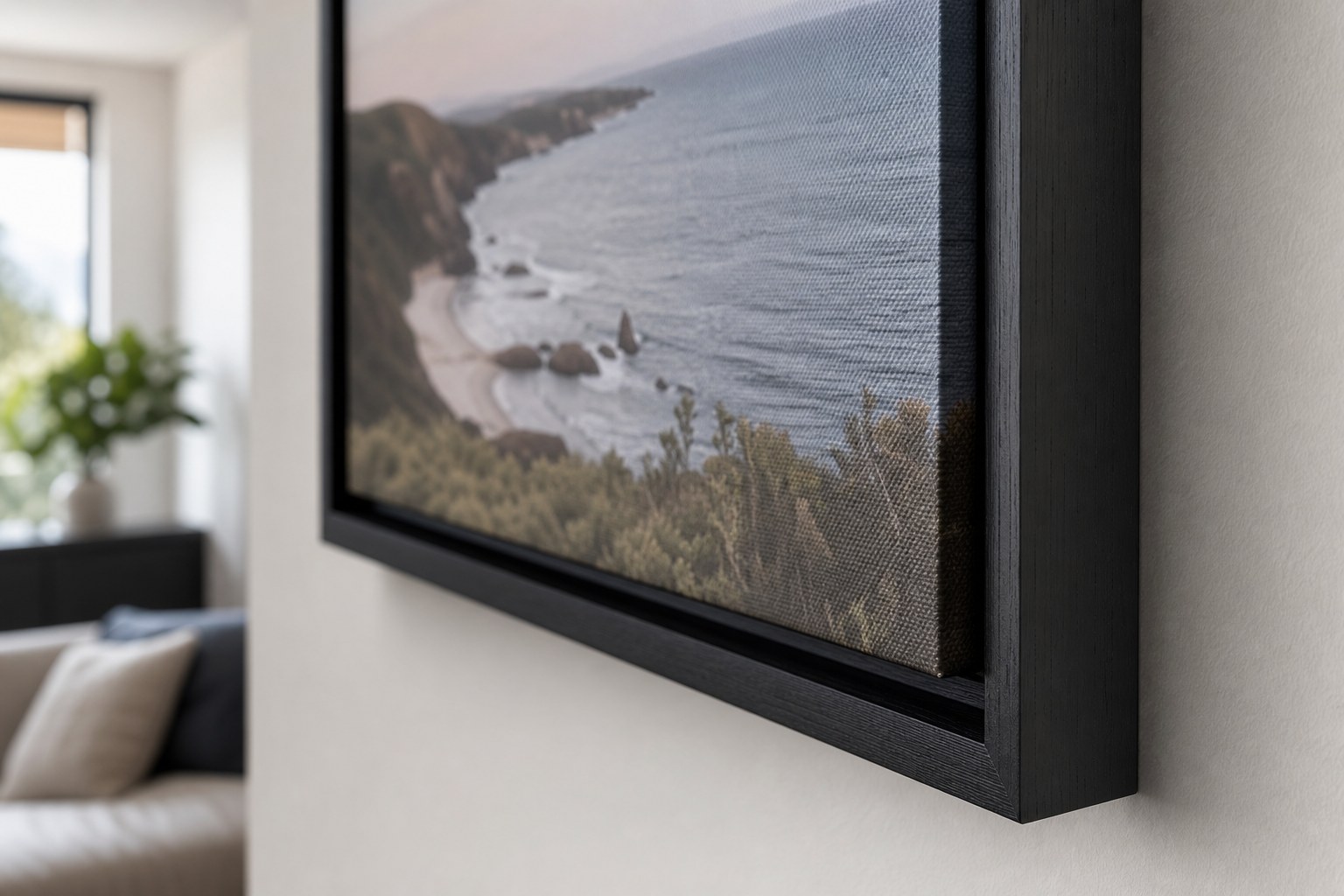
When to Choose a Floating Frame (and When to Skip It)
The floating frame is an upgrade, not a requirement. Both the standard gallery wrap and the framed version look polished and arrive fully finished. The decision comes down to the look you are after and the room it is going into.
Choose a floating frame when:
- You want the finished piece to feel complete and gallery-quality. The outer frame provides a defined visual boundary that makes the canvas look considered rather than casually placed on the wall.
- The wall behind it is textured, patterned, or a strong colour. A canvas without a frame can blend into a busy background. The shadow gap creates a clear edge that lifts the print away from the surface and gives it presence.
- You are buying it as a gift. A fully assembled canvas in a timber frame is a more complete gift than a canvas alone. The recipient does not need to source a frame, source a framer, or make any decisions about finish.
- The image is a statement piece: a large family portrait, a wedding photo, a favourite travel shot, or an art print you want to anchor the room around.
Skip the floating frame when:
- You prefer the gallery wrap look on its own. The edge-to-edge appearance of a canvas without any outer border is a deliberate, widely loved aesthetic, not a compromise.
- You want to keep the cost down. The canvas alone is an excellent product. The frame is purely an aesthetic addition.
- You have your own specific framing plan, such as a gallery wall arrangement where you want full control over frame styles and sourcing.
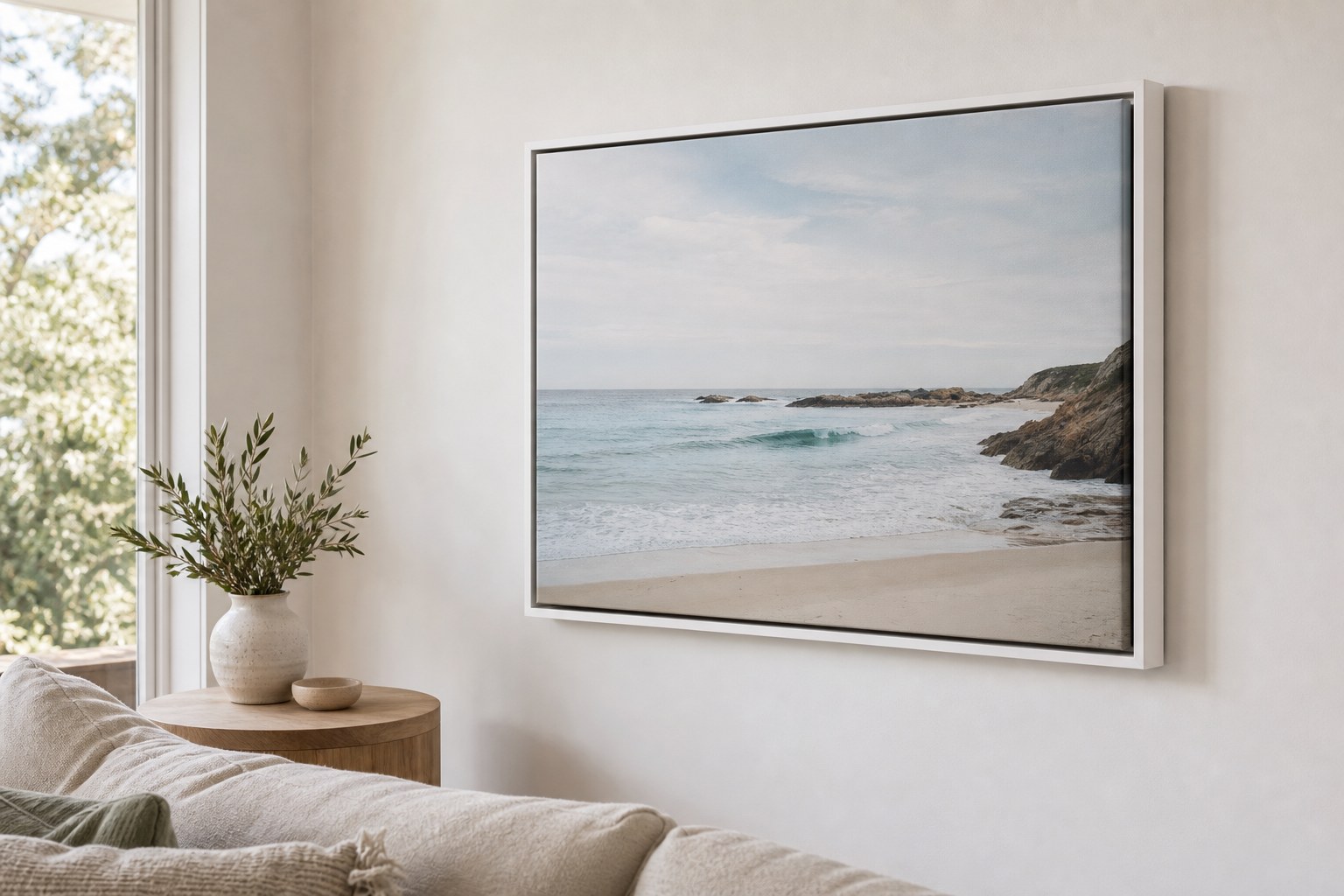
Choosing the Right Frame Colour
The three colour options are designed to sit comfortably within the main interior directions in Australian homes. The best choice usually depends less on the image and more on the room around it.
Black is the highest-contrast option. It draws a firm line around the canvas and works well in modern, minimal, and industrial spaces. It suits dark feature walls and photography with strong contrast of its own: architecture, portraiture, graphic abstract prints. Because a black frame is a design choice rather than a neutral backdrop, it becomes part of the composition.
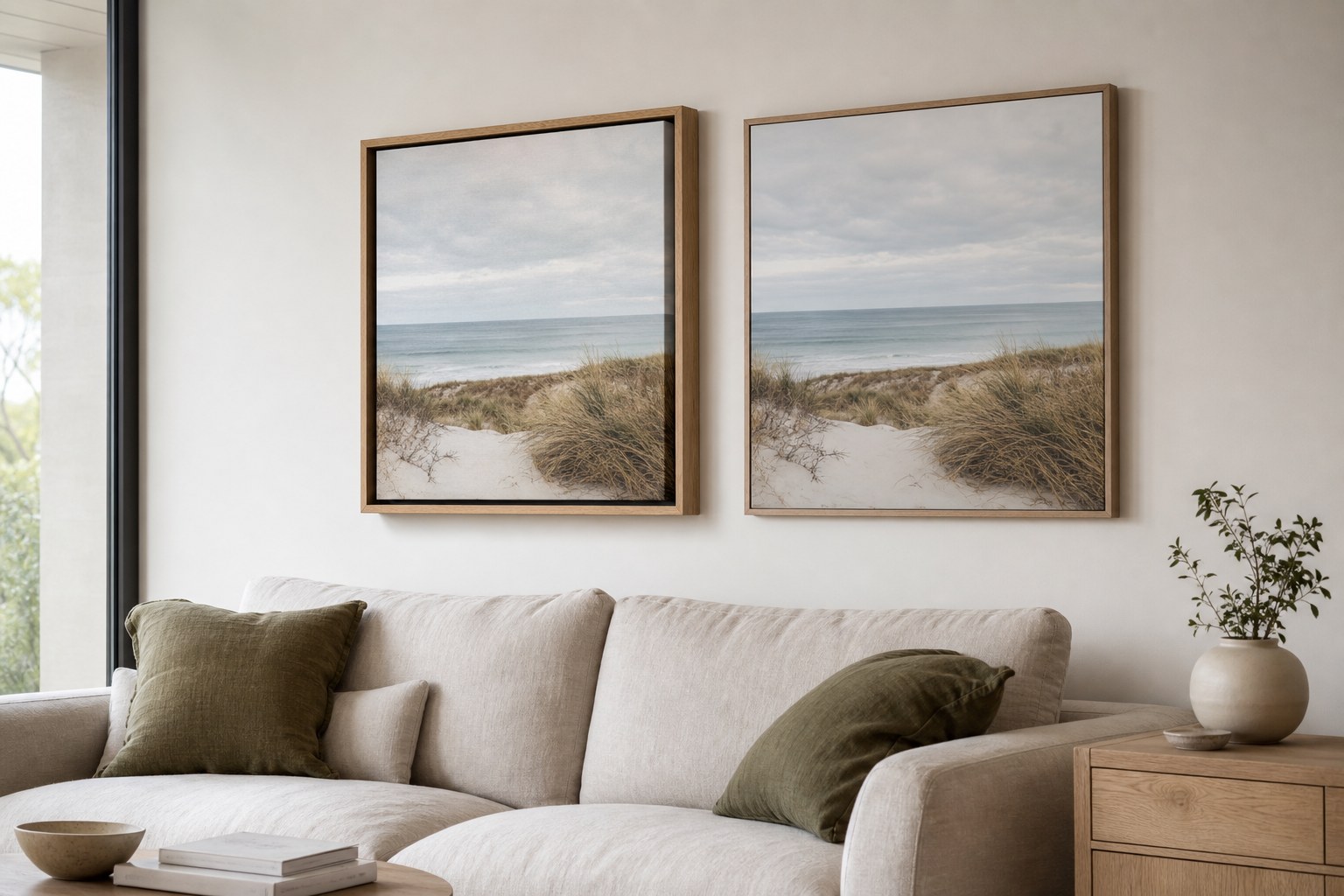
Natural Oak has a warm mid-tone timber finish. It is the most versatile choice for Australian interiors, which often feature timber floors, rattan, and earthy palettes. Natural Oak softens the border of the canvas rather than sharpening it. It reads well with warm-toned photography, botanical prints, family portraits, and lifestyle imagery. If you are unsure which timber finish suits your space, Natural Oak is the easiest starting point.
White is quiet and versatile. It works in coastal, Scandinavian, and light-filled rooms where you want the frame to sit without adding visual weight. A white frame recedes against a white or pale wall, allowing the image to carry the space on its own. It is the most forgiving option if the wall colour or the artwork palette is not yet decided.
A simple rule: if the room already has a dominant frame or furniture colour, match it. If starting fresh, Natural Oak or White are the most adaptable choices across the widest range of interiors.
Floating Frame or Classic Frame?
A floating frame is not the only way to frame a canvas. Our canvas prints come in three finishes: the frameless gallery wrap, the floating frame described above, and a classic frame. Knowing the difference before you order saves choosing the wrong one.
A classic frame is the traditional framed canvas. The inner edge of the frame overlaps the canvas so the two sit flush, with no shadow gap and no glass. It is built on a slim 19mm canvas rather than the 38mm used for a gallery wrap or a floating frame, so it sits closer to the wall and hangs comfortably alongside framed paper prints on a gallery wall. It comes in the same three solid timber colours, and adds $30 on the small sizes (30×30 cm and 30×40 cm), $40 on the medium sizes (40×50 cm and 50×50 cm) and $50 on the large sizes (50×70 cm, 70×70 cm and 60×90 cm).
One thing to know before choosing it: because the frame covers the edge of the canvas, a classic-framed canvas is finished with a plain white edge rather than a wrapped image. Nothing is lost from the front of your picture, but the image does not continue around the sides the way it does on a gallery wrap or inside a floating frame. Choose the floating frame for the shadow-gap look and the wrapped edge; choose the classic frame for a traditional framed finish that sits flat to the wall.
Floating Frame Canvas vs. Framed Print: Which One Is Right for You?
These two products sound similar but they are genuinely different formats, and knowing the distinction before you order saves confusion.
A floating frame canvas (this product) is an image printed onto 400 gsm artist-grade canvas, gallery-wrapped around a solid 38 mm timber stretcher, with an optional outer timber floating frame. There is no glass. The canvas material itself is part of the aesthetic: warm, textured, and suited to large-format wall art.
A framed print is an image printed on paper and mounted behind shatterproof plexiglass in a solid timber frame. It has a sharper, crisper, more photographic character than canvas.
If you want the warmth and texture of canvas, choose a canvas print with or without a floating frame. If you prefer the crispness of a photo print behind shatterproof plexiglass in a traditional frame, a framed print is the right choice. Browse our full wall art prints range to compare both formats side by side before you decide.
FAQ
How much does a floating frame add to a canvas print?
The frame add-on is priced by canvas size: +$40 for small sizes (30×30 cm and 30×40 cm), +$50 for medium sizes (40×50 cm and 50×50 cm), and +$60 for large sizes (50×70 cm, 70×70 cm, and 60×90 cm).
What colours does the floating frame come in?
Three colours: Black, Natural Oak, and White. All are solid timber frames assembled with the canvas and finished in Australia before dispatch.
Can a floating-framed canvas stand on a shelf?
No. A floating-framed canvas is designed for wall hanging only, and it is not made to stand upright on its own. Hanging hardware is not included, so you can choose the hook or wall fitting that suits your wall.
Is a floating frame the same as a framed print?
No. A floating frame is a solid timber outer frame added to a gallery-wrapped canvas, with a visible shadow gap between the canvas and the frame. A framed print is a paper print behind shatterproof plexiglass in a solid timber frame. Browse our wall art prints collection to see both formats.
Does the floating-framed canvas arrive pre-assembled?
Yes. The canvas and frame are assembled and finished before dispatch. You receive a single finished unit, with no additional framing or assembly needed. Hanging hardware is not included, so you can choose the hook or wall fitting that suits your wall.
What is the difference between a floating frame and a classic frame?
A floating frame leaves a fine shadow gap between the canvas and the frame, on our 38mm canvas, so the canvas appears to float and the piece stands proud of the wall. A classic frame overlaps the canvas edge so the two sit flush, with no gap, on a slim 19mm canvas that sits closer to the wall. Neither uses glass. A floating frame adds $40 to $60 by size and a classic frame adds $30 to $50, and both come in Black, Natural Oak and White.