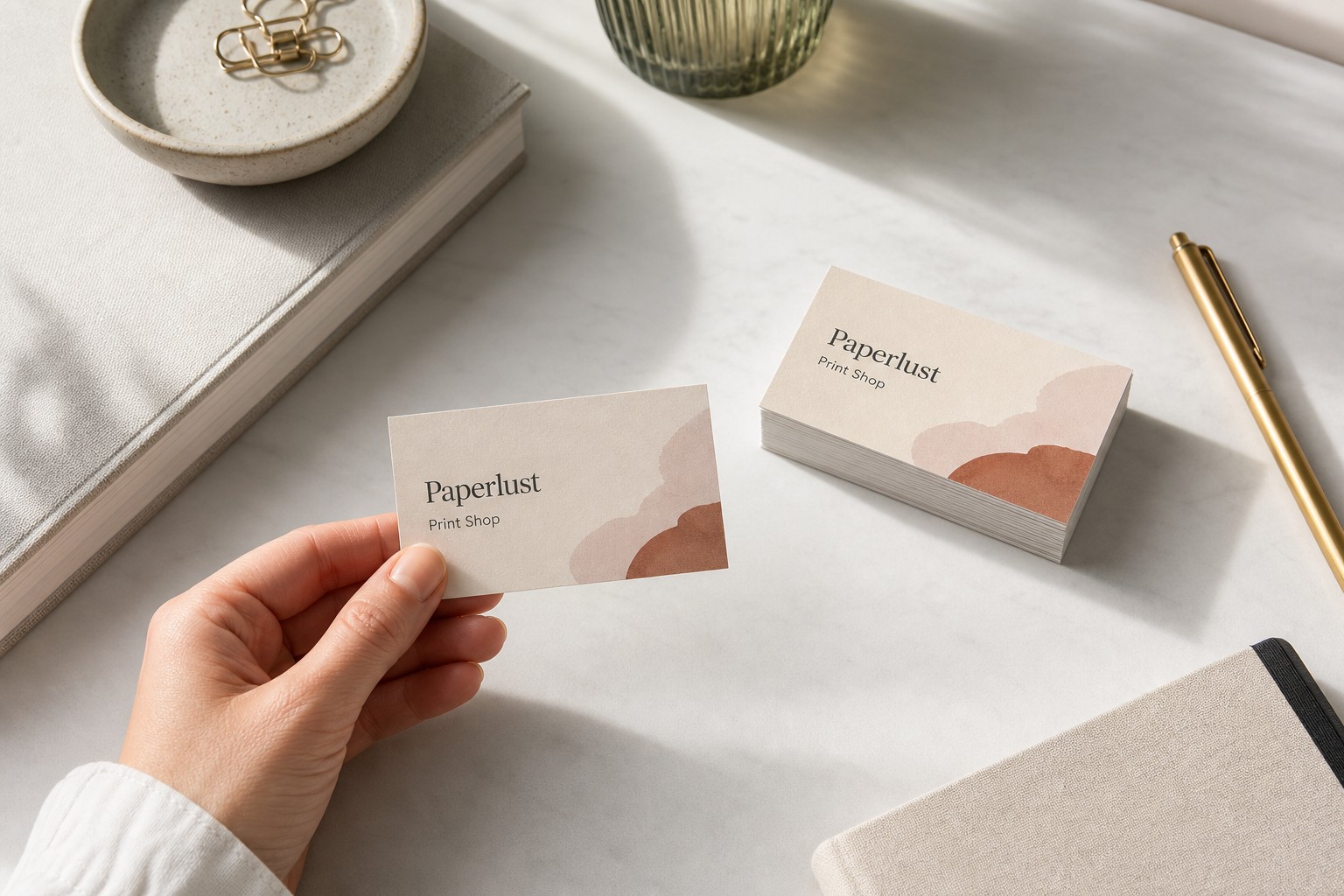
In Australia, the standard business card is 90mm x 55mm, equal to 9cm x 5.5cm and 3.54 x 2.17 inches. It is wider than both the US card, 88.9mm x 50.8mm, and the European card, 85mm x 55mm, while taller only than the US version. It still fits standard cardholders and wallet slots.
| Format | Millimetres | Centimetres | Inches |
|---|---|---|---|
| Australian standard | 90 x 55 mm | 9.0 x 5.5 cm | 3.54 x 2.17 in |
| US standard | 88.9 x 50.8 mm | 8.89 x 5.08 cm | 3.5 x 2.0 in |
| European standard | 85 x 55 mm | 8.5 x 5.5 cm | 3.35 x 2.17 in |
This guide covers every shape available, how the Australian size compares to international standards, how to set up your artwork file correctly, and what each paper option actually feels like.
- Australian standard: 90mm x 55mm (3.54″ x 2.17″)
- Artwork canvas with bleed: 96mm x 61mm (3mm bleed each side)
- Safe area: 84mm x 49mm (keep all text 3mm inside the trim edge)
- Available shapes: Rectangle, Rounded Corners, Circle (60x60mm), Oval (90x50mm), Custom
- Default paper: 300 GSM Matte
- Price: from $0.44 per card at 100, $0.08 per card at 5,000
- Production: 24 Hour Production
Every Shape We Print
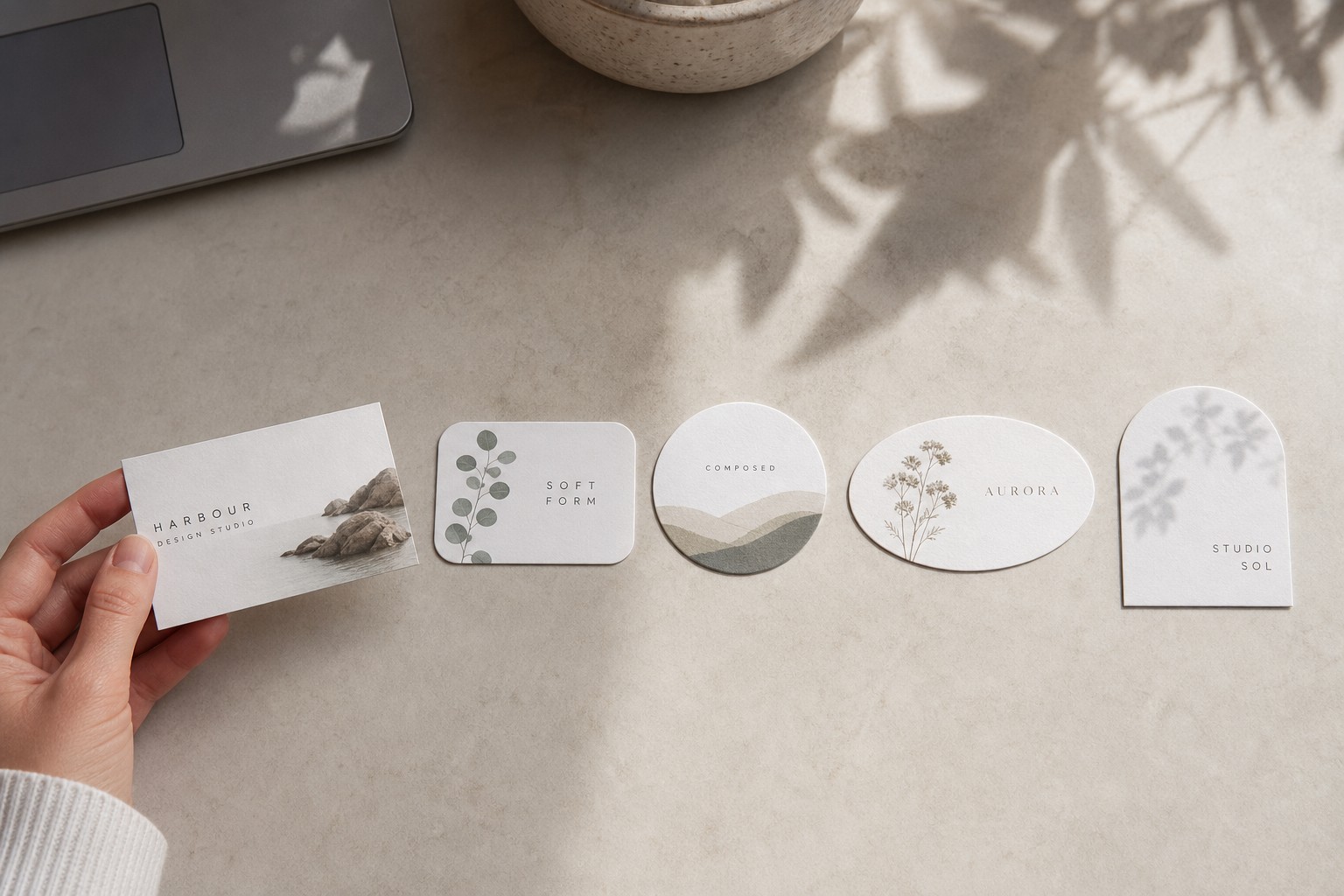
Paperlust prints five business card shapes. Rectangle and Rounded Corners share the same 90 x 55mm footprint; the corner treatment is a finishing choice, not a size change. Circle and Oval are distinct shapes with their own dimensions. Custom shapes use the 90 x 55mm base and are die-cut to your chosen outline.
| Shape | Finished size (mm) | Finished size (inches) |
|---|---|---|
| Rectangle | 90 x 55 | 3.54″ x 2.17″ |
| Rounded corners | 90 x 55 | 3.54″ x 2.17″ |
| Circle | 60 x 60 | 2.36″ x 2.36″ |
| Oval | 90 x 50 | 3.54″ x 1.97″ |
| Custom shapes | 90 x 55 base | 3.54″ x 2.17″ |
Two other formats exist in the wider market that are worth knowing about, even though they are not among the five shapes above. Square cards (typically 65mm x 65mm) are a recognised format used by photographers, designers and creative businesses; they do not fit standard cardholders but stand out precisely because of that. Mini or slimline cards (typically around 85mm x 28mm) are used for loyalty cards, contact strips and industries where a compact profile matters. If you are considering the square format, our square business cards guide covers the format in detail.
Why 90 x 55mm Is the Australian Standard
The 90 x 55mm dimension became the Australian standard because it fits the slot in a standard leather bifold wallet without bending and sits flush in the acrylic card sleeves that are common in Australian reception desks and desk organisers. Most commercially available rigid cardholders sold in Australia are designed around this footprint.
It sits close to, but is not identical with, the European standard. The EU size (85 x 55mm) is 5mm narrower, which means an Australian card fits loosely in a European holder and an EU card looks noticeably short in an Australian one. That 5mm difference is also why European template files downloaded from stock design platforms do not transfer directly to Australian printers without adjustment.
The US standard is 88.9mm x 50.8mm, defined in inches as exactly 3.5″ x 2.0″. Against the Australian 90 x 55mm, that is a difference of 1.1mm in width and 4.2mm in height. The height gap is the real failure mode: a designer who sets up on a US template and prints at an Australian printer ends up with a card that is 4.2mm shorter than every other card in the recipient’s cardholder. That is visible at a glance and impossible to fix after printing.
International Business Card Sizes Compared
| Country / Standard | Size (mm) | Size (inches) |
|---|---|---|
| Australia | 90 x 55 | 3.54″ x 2.17″ |
| United States and Canada | 88.9 x 50.8 | 3.5″ x 2.0″ |
| Europe | 85 x 55 | 3.35″ x 2.17″ |
| Japan (Meishi) | 91 x 55 | 3.58″ x 2.17″ |
If your designer or creative platform is based overseas, confirm which size they are quoting before your artwork is finalised. The AU and EU heights are identical at 55mm, so the width is the variable to watch for EU templates. For US templates, both dimensions differ: 1.1mm narrower and 4.2mm shorter than the Australian standard.
Setting Up Your Artwork: Bleed, Trim and Safe Area
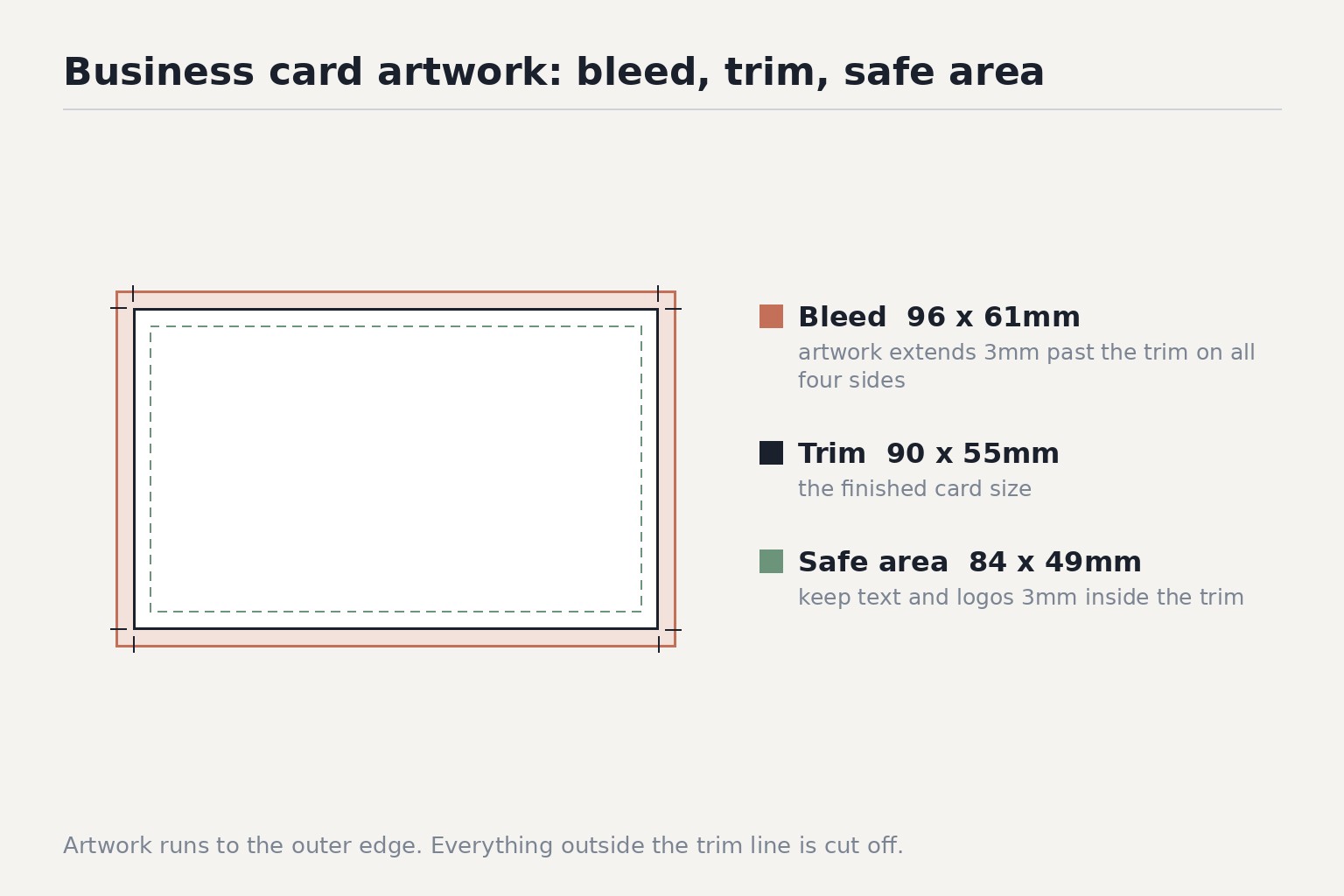
Printers require bleed because cutting is not perfectly precise at scale. Adding 3mm of bleed to every edge means your background colour and images extend beyond the trim line, so a slight shift in the cut does not produce a white or unprinted edge on the finished card.
| Zone | Dimensions for Rectangle / Rounded Corners | What to put here |
|---|---|---|
| Bleed canvas | 96mm x 61mm | Background colour, full-bleed images. Your total artwork document size. |
| Trim line | 90mm x 55mm | Where the card is cut. The finished size your recipient holds. |
| Safe area | 84mm x 49mm | Keep all text, logos and critical design elements inside this boundary. |
For the Circle shape (60mm x 60mm finished): bleed canvas 66mm x 66mm, safe area 54mm x 54mm.
For the Oval shape (90mm x 50mm finished): bleed canvas 96mm x 56mm, safe area 84mm x 44mm.
Set your file to 300 DPI and export in CMYK colour mode. RGB files convert to CMYK at the printer and the colour shift is unpredictable, particularly for brand colours.
Portrait vs Landscape: Same Dimensions, Different Impact
A 90 x 55mm business card can be printed in either landscape (horizontal) or portrait (vertical) orientation. The physical card is the same size regardless: 90mm wide and 55mm tall. What changes is which edge you lead with when you hand the card over.
Landscape is the default for most professional contexts. Reading left to right across a name, title and contact details is what recipients expect, so the layout feels immediately legible. Portrait cards feel more considered: the taller format makes vertical name stacking natural and suits businesses where the card is meant to be distinctive. A full-bleed portrait photo of a property on a real estate card or a vertical typographic arrangement on a design studio card read very differently from a standard horizontal layout, even though both cards are exactly 90 x 55mm.
The bleed and safe area dimensions are the same either way. If you are designing in portrait, simply set your canvas to 61mm wide and 96mm tall (bleed) with a safe area of 49mm x 84mm.
Paper and Thickness
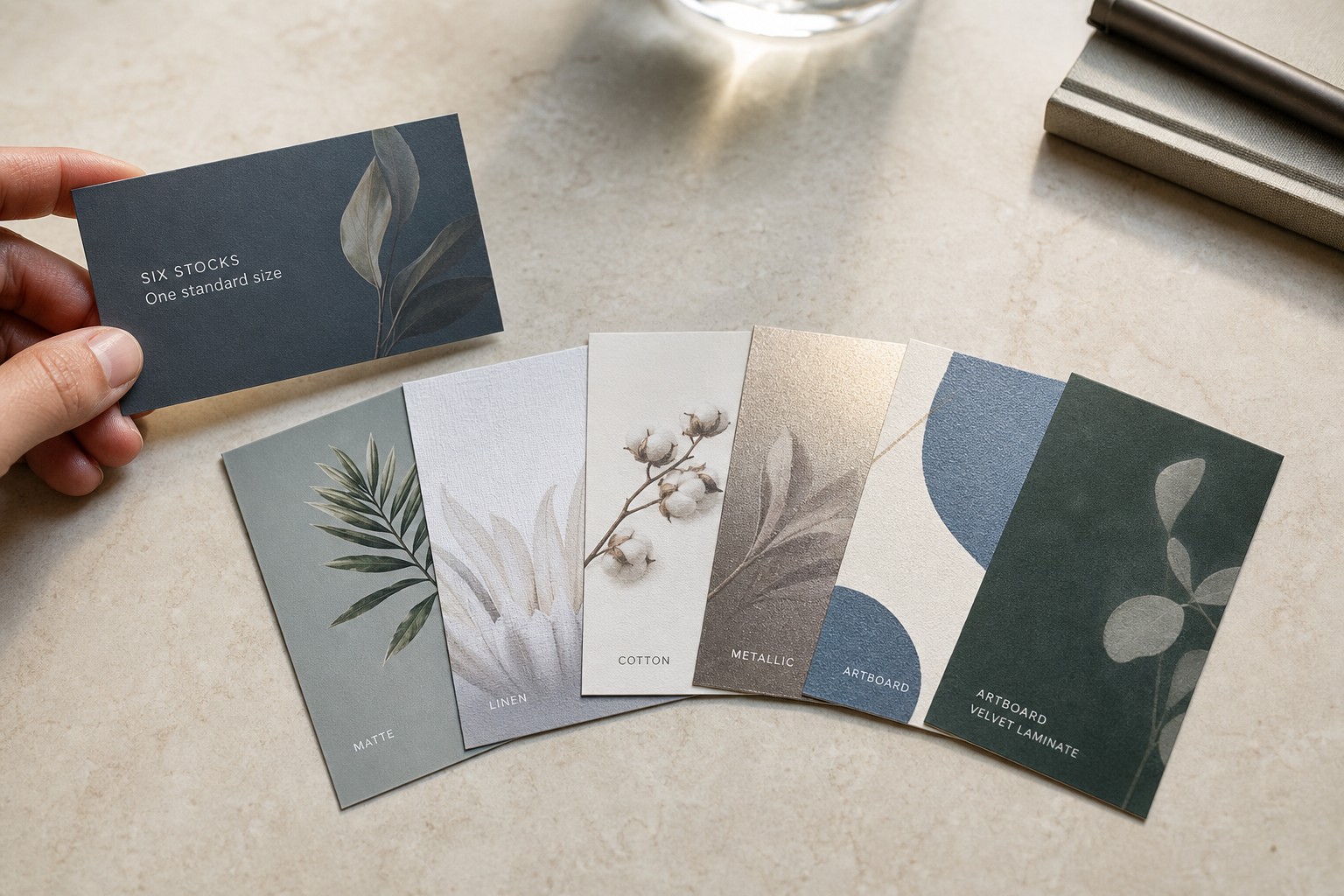
The size of a business card and the weight and texture of the paper are two parts of the same first impression. A 90 x 55mm card on 300 GSM Matte communicates something different from the same card on a soft Cotton stock or a thick velvet-laminated Artboard, even before anyone reads a single word.
| Paper | Character | Works well for |
|---|---|---|
| 300 GSM Matte | Clean, flat finish. No glare. Default choice. | Most industries. Keeps colour accurate without shine. |
| Linen | Subtle woven texture. Premium tactile feel. | Creative, hospitality and consulting professions. |
| Cotton | Soft, organic texture. Very premium. | Luxury brands, architects, bespoke service businesses. |
| Metallic | Shimmering base stock. Makes colour and detail pop. | Nightlife, fashion, beauty, entertainment. |
| Artboard with Velvet Laminate | Soft-touch coating over Artboard. Velvety surface. | Any industry where a tactile first impression matters. |
The front-only or front-and-back printing option applies across all paper types. Front-only is the standard choice for simpler designs. Front-and-back works well when you want a secondary design element, a QR code, or contact details in a second language on the reverse.
Cost and Turnaround
| Quantity | Price per card (inc. GST) |
|---|---|
| 100 cards | $0.44 |
| 5,000 cards | $0.08 |
Standard business cards at Paperlust Print Shop run on 24 Hour Production, making them one of the fastest-turnaround print products available. Flat-rate shipping is available Australia-wide.
For premium finish cards including Scodix, Raised Foil, Spot UV and Duplex, production takes longer. If you need cards quickly, only 300 GSM Matte qualifies for the 24-hour turnaround. Linen, Cotton and Metallic run 3 to 5 business days.
Browse all available shapes, papers and finishes at Paperlust custom business cards, or go directly to the standard business cards product page to check current pricing and place your order.
Frequently Asked Questions
What is the standard business card size in Australia?
The standard business card size in Australia is 90mm x 55mm (3.54″ x 2.17″). This size fits standard wallets, card sleeves and desk cardholders across Australia, and has been the accepted standard for decades.
Is the Australian business card size the same as the US size?
No. The US standard is 88.9mm x 50.8mm (exactly 3.5″ x 2.0″, defined in inches). Against the Australian 90 x 55mm, that is 1.1mm narrower and 4.2mm shorter. The height gap is the practical problem: a card built on a US template and printed in Australia will be 4.2mm shorter than every other card in the recipient’s cardholder.
What is the difference between the Australian and European business card size?
The European standard is 85mm x 55mm, which is 5mm narrower than the Australian 90mm x 55mm. The heights are identical at 55mm. An EU-formatted card will sit short in an Australian cardholder because of the narrower width.
What bleed do I need for a 90 x 55mm business card?
Add 3mm of bleed to every edge. Your artwork canvas should be 96mm x 61mm. The trim line sits at 90mm x 55mm. Keep all text and logos at least 3mm inside the trim edge. The safe area is 84mm x 49mm.
Can I print a business card in portrait orientation at 90 x 55mm?
Yes. The physical card is the same dimensions whether you design it landscape or portrait. In portrait orientation your canvas is 55mm wide and 90mm tall (or 61mm x 96mm with bleed). The safe area becomes 49mm x 84mm.
What paper is used for standard business cards?
Paperlust prints standard business cards on five paper options: 300 GSM Matte (default), Linen, Cotton, Metallic, and Artboard with Velvet Laminate. Each is available in front-only or front-and-back printing.
What shapes are available for business cards in Australia?
At Paperlust, available shapes are Rectangle (90 x 55mm), Rounded Corners (90 x 55mm), Circle (60 x 60mm), Oval (90 x 50mm) and Custom die-cut shapes using the 90 x 55mm base.
How fast are business cards produced?
Standard business cards at Paperlust Print Shop are produced on 24 Hour Production. Premium finish options including Scodix, Raised Foil, Spot UV and Duplex have longer production times.