There is a question every small brand reaches eventually, usually right before placing a packaging order for the first time. Do you pay for a custom printed box, or do you buy plain boxes and brand them yourself with a sticker?
Most guides take a side from the outset, usually in favour of whichever product they happen to sell. This article will not do that, because we are in an unusual position: we make custom printed mailer boxes in full colour and in kraft, and we also make die-cut stickers and labels. We see brands start on one route, scale up, run the numbers, and switch. We see others start on the other route and stay there for years because it genuinely fits their situation. Both outcomes can be correct.
That dual view is what makes this comparison worth reading. The goal is to show you the economic structure of each route clearly enough that you can work out where your brand sits right now, and where the crossover lives for your specific numbers.
The short version
- Just launching: plain box plus a die-cut sticker seal is the lower-risk move. Custom full-colour boxes start from 10 units if you want to hold a printed design in your hands before committing to volume.
- The crossover is not a fixed quantity. It is a function of how many boxes you send each month and how much you value the time spent applying stickers.
- Labour is the term everyone forgets. A sticker applied by hand is seconds per box that multiply across every order you ever send.
- A printed box does something a sticker cannot: it signals quality before the box is even opened, on a shelf, in a photograph, or mid-unboxing.
- A sticker can change every month without reprinting a box. If your brand identity is still settling, that flexibility has real value.
- Kraft mailer boxes at volume are the cheapest branded box you can make, and they start from 500 units in one or two spot colours.
How each route is actually structured
Before comparing the two routes, it helps to understand what you are actually paying for in each case. They have different cost shapes, not just different price points.
The plain box plus sticker route
A plain corrugated box carries almost no fixed cost. You buy stock boxes at a per-unit price, and that price falls a little at higher quantities but stays relatively stable because there is no press setup to amortise. No dieline, no artwork approval for the box itself, no minimum print run.
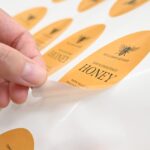
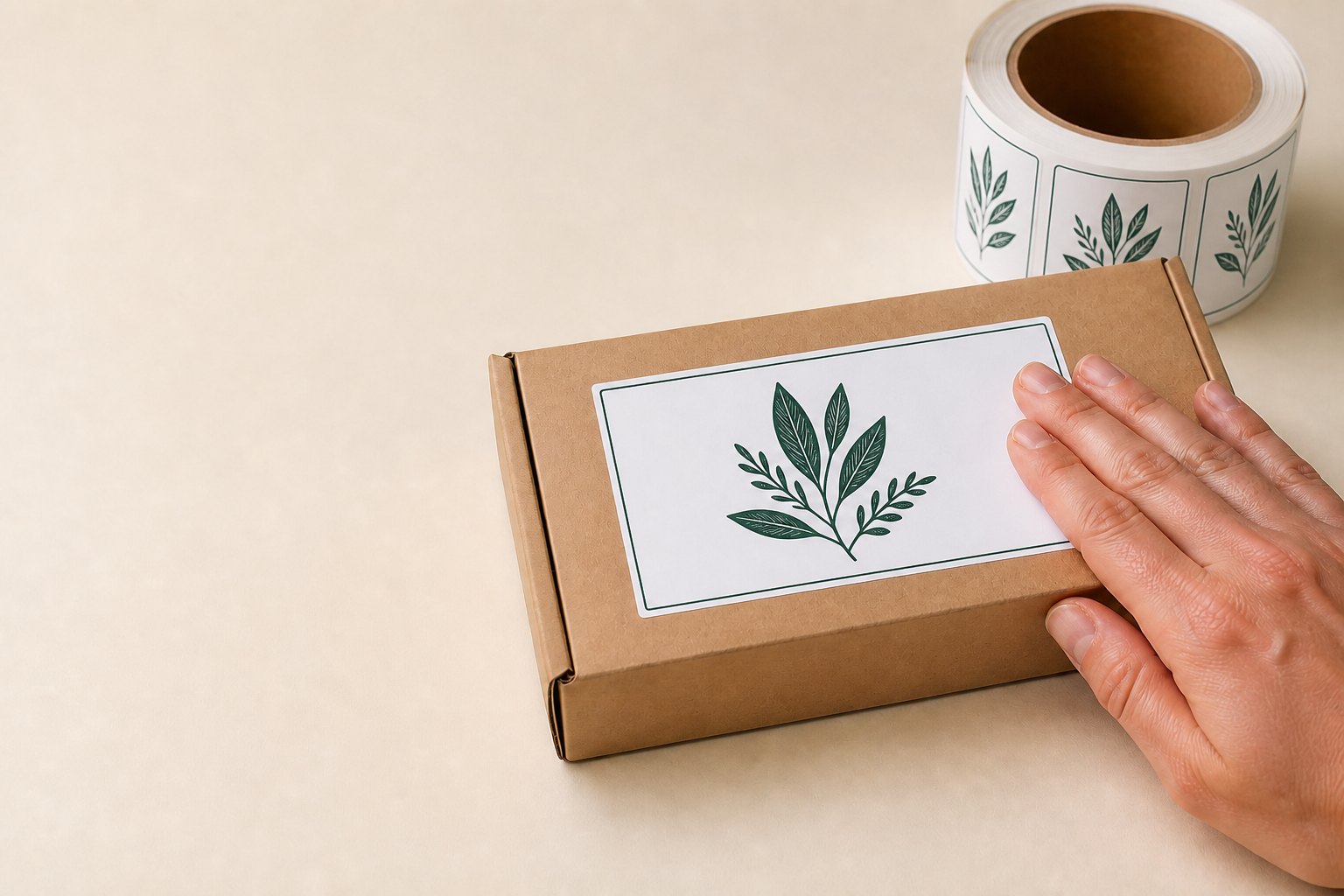
The sticker is a separate line item. You pay to produce a run of stickers at whatever quantity makes sense, apply one to each box as you pack, and reorder stickers when you run out. The per-sticker cost does fall at higher quantities, but the cost of applying each sticker, which is your time or your team’s time, does not fall at all. It is a fixed cost per box, every box, indefinitely.
The result is a cost curve that is low and predictable at any volume. You can use a different sticker next month, change your design for a seasonal campaign, or apply different stickers to different product lines without touching your box stock.
The custom printed box route
A custom printed box bundles the branding into the box itself at the point of printing. There is a setup cost covering the press, the dieline, and the print run, and that setup cost is spread across the full quantity ordered. This is why the per-box price falls at every quantity break. The bigger the run, the thinner the setup cost per unit.
The difference between a small-batch digital run and a volume offset run is not just a quantity discount. The two tiers run on different presses, which is why the per-box price drops sharply between 250 and 500 units: the press changes, and so does the economics of the job. Once the boxes arrive, there is no application step. You pack, fold, and ship.
The result is a higher entry cost per unit at low quantities, a per-box price that falls as you scale, and no ongoing application labour once the run arrives.
The term everyone forgets: labour
This is where most comparisons between the two routes go wrong. They compare box price against sticker price, add them up, and stop there. The analysis is incomplete by exactly one term.
If you apply a sticker to a box by hand, that takes time. The time per sticker varies depending on your workflow, your sticker format, and whether the sticker is a small round seal on the tuck flap or a larger panel covering the lid. Whatever your number is, multiply it by every box you send this month, then multiply that by twelve. That figure is how much time per year someone in your business spends doing nothing except pressing stickers onto boxes.
That time has a real cost. If your fulfilment is handled by casual staff, those minutes show up on a payroll. If it is you doing it, the cost is the value of what you could have been doing instead. Every calculation that leaves out labour understates the true cost of the sticker route by whatever that number is for your business.
This is not an argument against stickers. It is an argument for including the full cost when you compare. The plain-box route does not eliminate labour from packaging. It relocates the labour cost from the printer to your packing bench.
Three verdicts by stage
The question “are custom printed boxes worth it?” has a different answer depending on where your business is. Here are three honest verdicts.
Just launching or shipping low volumes
Plain box plus a die-cut sticker is the right call for most businesses at this stage. Your brand identity may still shift. Your product mix may change. Your packaging needs next year could look completely different from what they are now. Locking capital into a run of custom printed boxes before you have established what your brand looks and feels like is an avoidable risk.
That does not mean printed boxes are off the table. If you want to hold a printed design in your hands before committing to volume, custom full-colour mailer boxes are available from 10 units on the digital press. That is an unusually low starting point for custom corrugated packaging, and it exists specifically to let brands test a printed design without a large outlay. A small run at this stage is a research exercise, not a cost-saving strategy.
The sticker route also suits you if your packaging is a testing ground. Trying different seal designs, different colour combinations, or different formats is inexpensive when the only thing you are reprinting is a sticker sheet.
Growing with predictable order volume
This is where the inequality starts to close, and sometimes flip. When your monthly volume is stable and your brand identity is settled, it is worth running the full calculation rather than assuming either route is obviously cheaper.
The method is straightforward. Calculate your monthly labour cost: boxes sent per month, multiplied by your time per sticker in seconds, divided by 3,600, multiplied by your hourly labour rate. Add your monthly sticker cost: boxes sent per month multiplied by your cost per sticker. That total is your true monthly spend on the plain-box-plus-sticker route.
Then look at the per-box price on a custom printed box at a quantity equivalent to three or four months of your volume, which is a typical run for a growing brand. If the annualised box cost is lower than your annualised sticker-plus-labour figure, the printed box pays for itself in operational savings, not just in aesthetics.
The crossover is not a fixed number. It depends on your volume, your labour rate, your sticker cost, and how much of the setup cost you are spreading across the run. If you want to understand what is actually driving the box price on our side, read our article on what drives the price of a custom box, which walks through the key variables in detail.
Established volume
At regular, predictable volume, a printed box almost always wins on total cost once labour is properly included. The per-box price at volume offset quantities is substantially lower than at small-batch digital quantities, there is no sticker cost, and there is no application time. The labour saving alone can offset the per-box cost difference at meaningful scale.
If you are at this stage, kraft mailer boxes are worth pricing. They print from 500 units in one or two spot colours using flexographic printing on natural unbleached brown board. If your logo works in a single colour and the kraft aesthetic suits your brand, a kraft box at volume is typically the lowest-cost branded box you can make, lower per unit than full colour at the same quantity because spot-colour flexo uses far less ink and carries no white-liner coating.
What the numbers miss
Per-unit cost is the right starting point but the wrong finishing point. There are things a printed box does that a sticker cannot, and things a sticker does that a printed box cannot, and neither shows up cleanly in a cost comparison.
What a printed box does at first impression
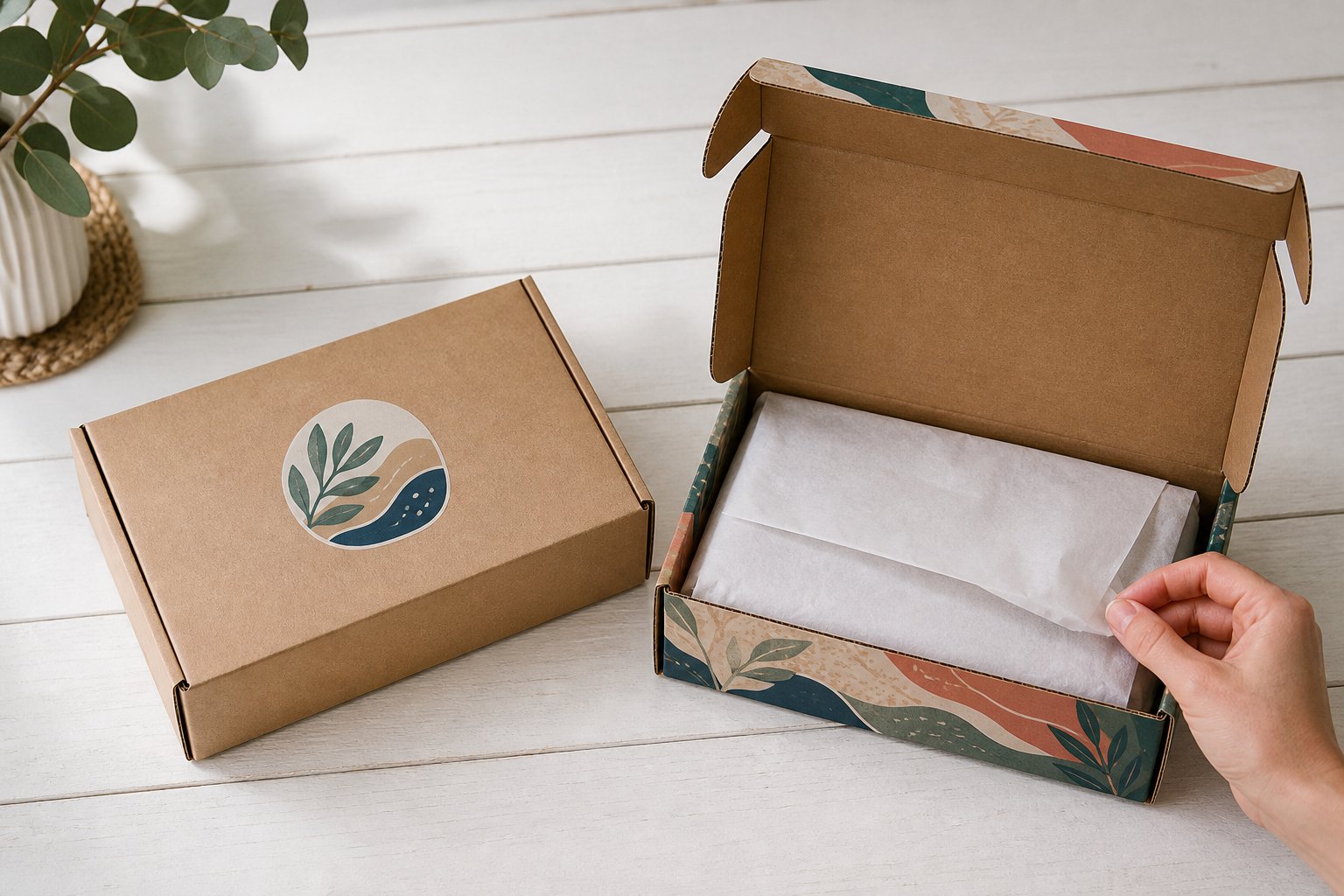
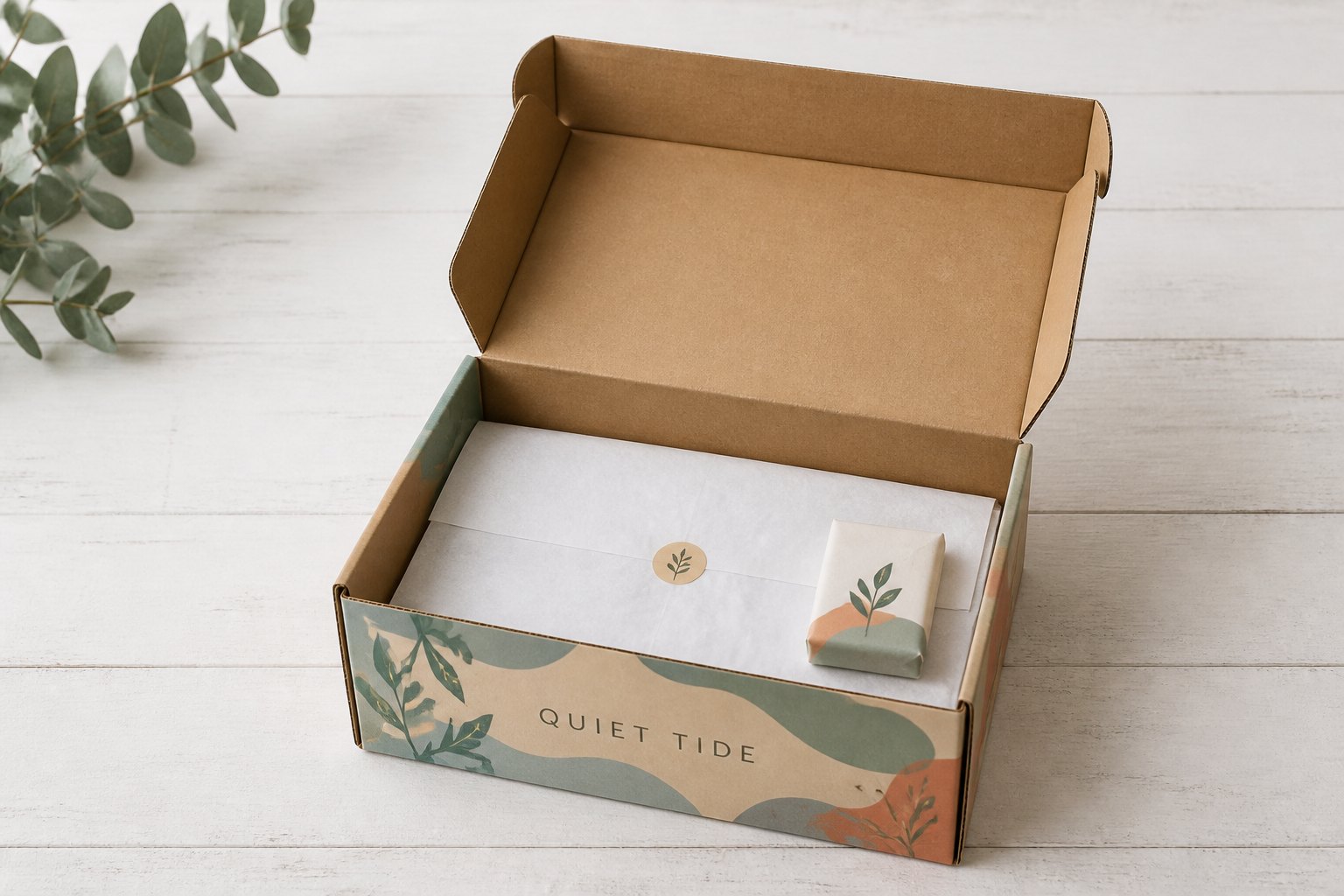
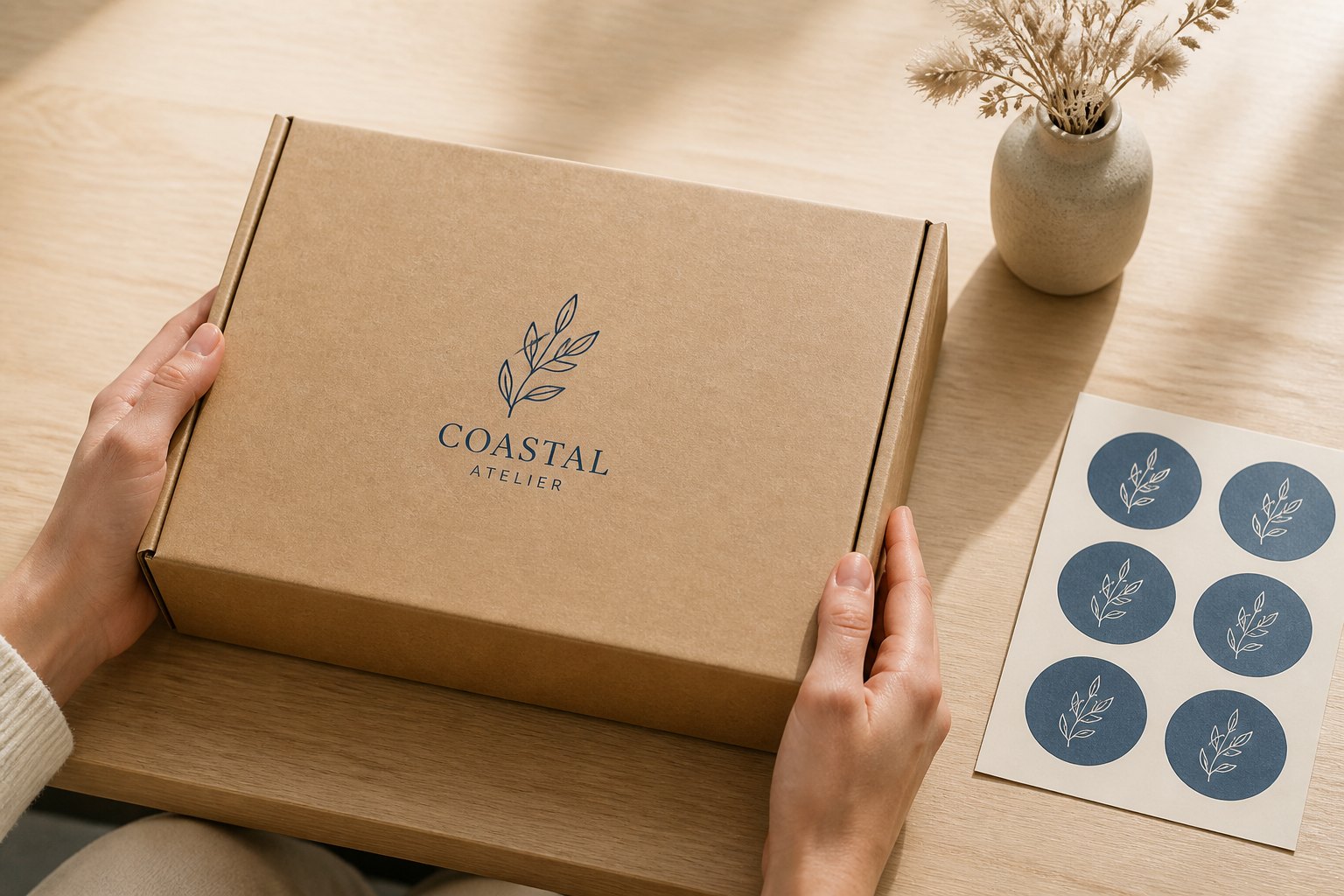
A printed box is your brand the moment your customer first sees the parcel. Before it is touched, before it is opened, the exterior panels carry your artwork edge to edge. On a retail shelf, at a market, or arriving at a customer’s door, a full-colour printed box reads differently from a plain box with a sticker on the lid, and not just incrementally differently. The branding wraps every exterior panel at the same time, with the same artwork, in a way no sticker achieves without covering most of the box at considerable cost.
For brands where perceived premium matters, where the box is part of a gift experience, or where unboxing content is part of the brand strategy, this is a genuine commercial advantage, not a cosmetic one. It belongs in the calculation even if it resists easy quantification.
What a sticker does that a printed box cannot
A sticker is not permanently committed to a run of boxes. You can produce a seasonal design for the Christmas peak in late November and December, swap back to your standard design in January, change your logo mid-year without writing off box stock, or test whether a different seal shape photographs better for your product listings. Each of those things costs a new sticker run, not a full box reprint.
If your brand is still finding its visual identity, or if you operate in a market where seasonal variation is part of the offer, the flexibility of a sticker is a real advantage. It does not appear on a per-unit spreadsheet, but it belongs in the decision nonetheless.
Branded tissue paper sits in the same category of thinking. It is a print layer you can change without writing off box stock, and on a plain box it carries the interior brand moment that a printed board would otherwise do. The trade is the production window: 16 to 18 working days from artwork approval, so it is ordered ahead rather than reactively.
Two types of printed box and what changes between them
If you decide a printed box is the right direction, there is a second decision: full colour or kraft. They are different products with different minimum quantities, different printing methods, and a different aesthetic.
Full-colour boxes print CMYK across all exterior panels on a smooth white liner, which gives sharp, vivid reproduction of logos, photography, and brand colour. Small-batch runs from 10 to 250 units use digital printing: low setup cost, faster turnaround of 3 to 7 working days from proof approval, and good for launches or limited drops. Volume runs at 500 and 1,000 units move to offset printing, which produces the lowest per-box cost and the crispest result. It is worth knowing that the two tiers run on different presses, so colour reproduction can differ slightly between a digital run and an offset run. A small-batch digital order is an accurate preview of what a digital run looks like, not a perfect preview of the same artwork on the offset press.
Kraft boxes use flexographic printing in one or two spot colours on natural brown board. The ink sits over the kraft tone, which is part of the aesthetic rather than a drawback. The minimum order is 500 units, with better per-box pricing at 1,000, 2,500, and 5,000. Lead time is 2 to 3 weeks from proof approval. Logos, wordmarks, and line art work well on kraft. Photography and fine gradients do not.
Both products use B-flute corrugated board in a roll end tuck front design that folds from flat in seconds, requires no tape or glue to hold closed, and is kerbside recyclable.
How to run the inequality for your business
You do not need a complex model. You need four numbers: how many boxes you send each month, how long your sticker application takes per box, the hourly cost of whoever does the applying, and your per-sticker cost.
Multiply those into a monthly total for the plain-box route and compare it against the annualised per-box cost at a printed-box quantity that matches your volume. The live price calculators on both box pages let you pick a size and a quantity, and the per-box price updates in real time. There is no signup required to see the numbers.
If you are reading this as part of a broader look at your packaging decisions, the guide to packaging on a budget covers the full picture across every packaging type, including when to move on from plain stock boxes and what to prioritise when you do. And if you have not yet decided whether corrugated is the right format for your product at all, the comparison of a box against a poly mailer is worth reading before you commit to either option.
Frequently asked questions
Is it cheaper to use a plain box with a sticker than a custom printed box?
At low volumes, typically yes. A plain box with a sticker has a lower upfront cost and no minimum print run for the box itself. At higher volumes, the comparison depends on how you account for labour. If someone is applying stickers by hand at meaningful scale, the true monthly cost of the plain-box route is higher than the sticker price alone suggests. The crossover point depends on your volume, sticker cost, and the hourly rate of whoever does the applying.
Can I start with stickers and switch to printed boxes later?
Yes, and many brands do exactly that. The sticker route is the lowest-commitment way to brand your packaging while your brand identity and order volume are still developing. When both of those are stable, the economics of a printed box become easier to justify and easier to calculate with confidence.
Do printed boxes require a large minimum order?
It depends on the product. Custom full-colour mailer boxes are available from 10 units on the digital press. Kraft mailer boxes start at 500 units because flexographic printing carries a higher setup cost that only amortises sensibly at volume. If you are at an early stage and need a low-minimum option, full colour is the more accessible starting point.
Does the size of the sticker change the calculation?
Significantly. A small round seal on the tuck flap of a plain box is a different cost and visual outcome from a large sticker covering most of the lid. The bigger and more complex the sticker, the closer the per-unit cost gets to the cheaper end of a printed-box run, which narrows the gap in the cost comparison. The labour time also increases with sticker size.
Is kraft cheaper than full colour at the same volume?
Per box, yes. Kraft uses one or two spot colours on uncoated board with no white-liner coating, which costs less to produce than a full-colour CMYK print. The trade-off is that kraft suits simpler artwork and gives a different aesthetic. It is a different product with a different look, not a downgraded version of full colour.
Can I change my design without reprinting all my existing box stock?
If you are on the plain-box-plus-sticker route, yes. Print a new sticker run and your existing box stock stays usable. If you have custom printed boxes, a design change means a new box run, which is one reason the sticker route remains sensible for brands whose visual identity is still evolving.
How do I choose the right box size for my product?
Measure your product as it will be packed, including any tissue paper, padding, or inserts, and allow roughly 15 to 25mm of clearance on each side. Small boxes (265 x 200 x 90mm for full colour) suit a folded garment, a candle, or a single-product gift. Medium suits a skincare kit, a book, or a standard monthly subscription box. Large suits shoes, apparel bundles, or corporate hampers.