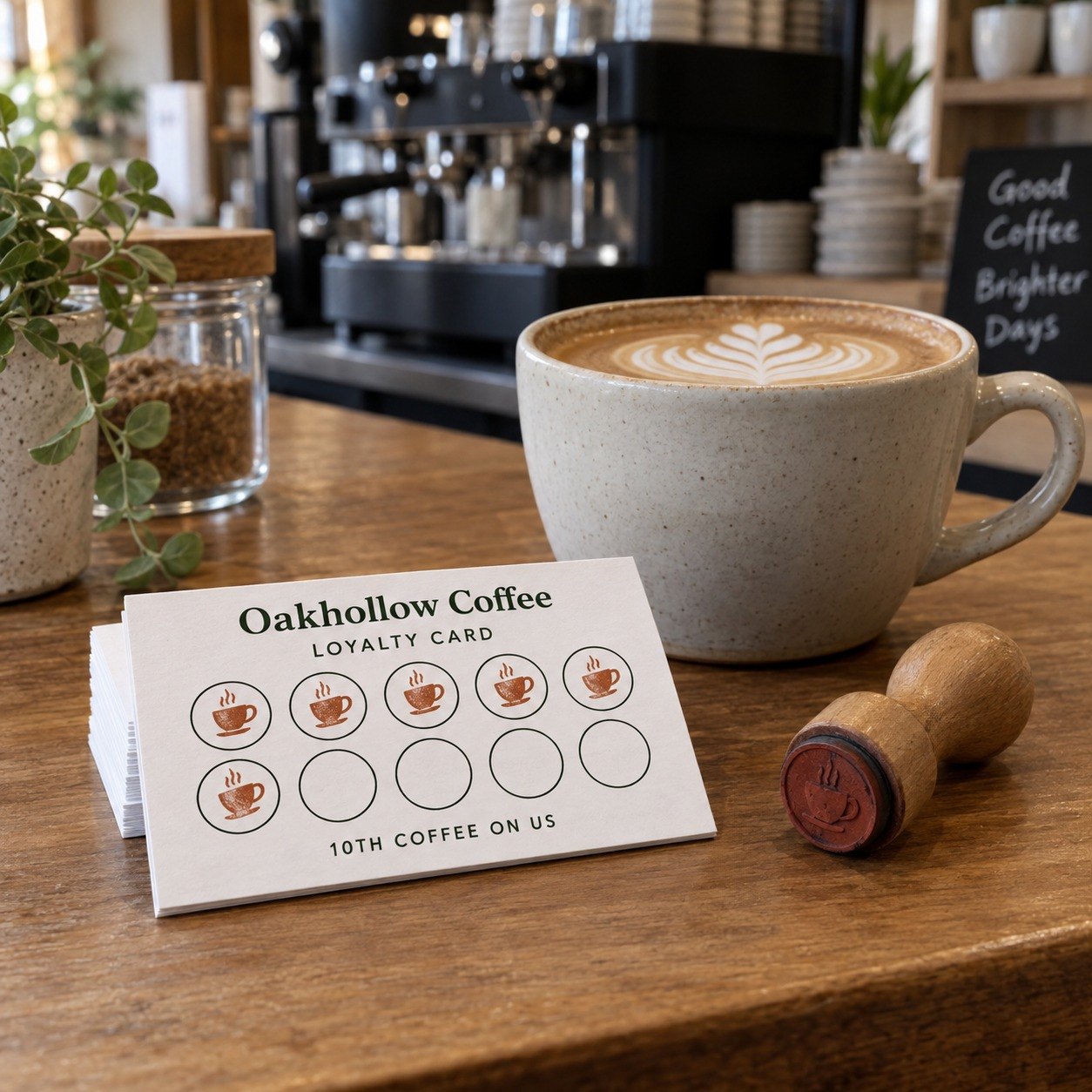
The queue has reached the coffee machine, the regular has their wallet open, and the stamp comes down on the card and smears into the next empty box. A stamp card only works if the person holding it can read the reward in the time it takes to close the wallet.
When you order loyalty cards, the same three decisions shape how the card behaves at the counter: the grid, the reward wording and the paper.
This guide works through those decisions, then shows a cafe card and a salon card you can brief a designer with. It is written for owners and managers of cafes, salons, barbers, groomers and other repeat-visit businesses.
The short version
- Size the boxes to the actual stamp you will use, with a little room to spare, and use fewer boxes rather than shrinking them.
- Put the reward in one plain sentence a customer reads in a single glance.
- Keep any conditions to one short line in readable type.
- Order an unlaminated stock so a stamp and a pen mark the surface cleanly.
- Put the grid on the back and the brand on the front.
What a stamp card has to do at the counter
A stamp card is carried in a wallet, marked on repeat visits, and read by the customer in a moment. At 90 x 55 mm it matches the standard Australian business card size, so it fits a wallet, a cardholder and a business card file.
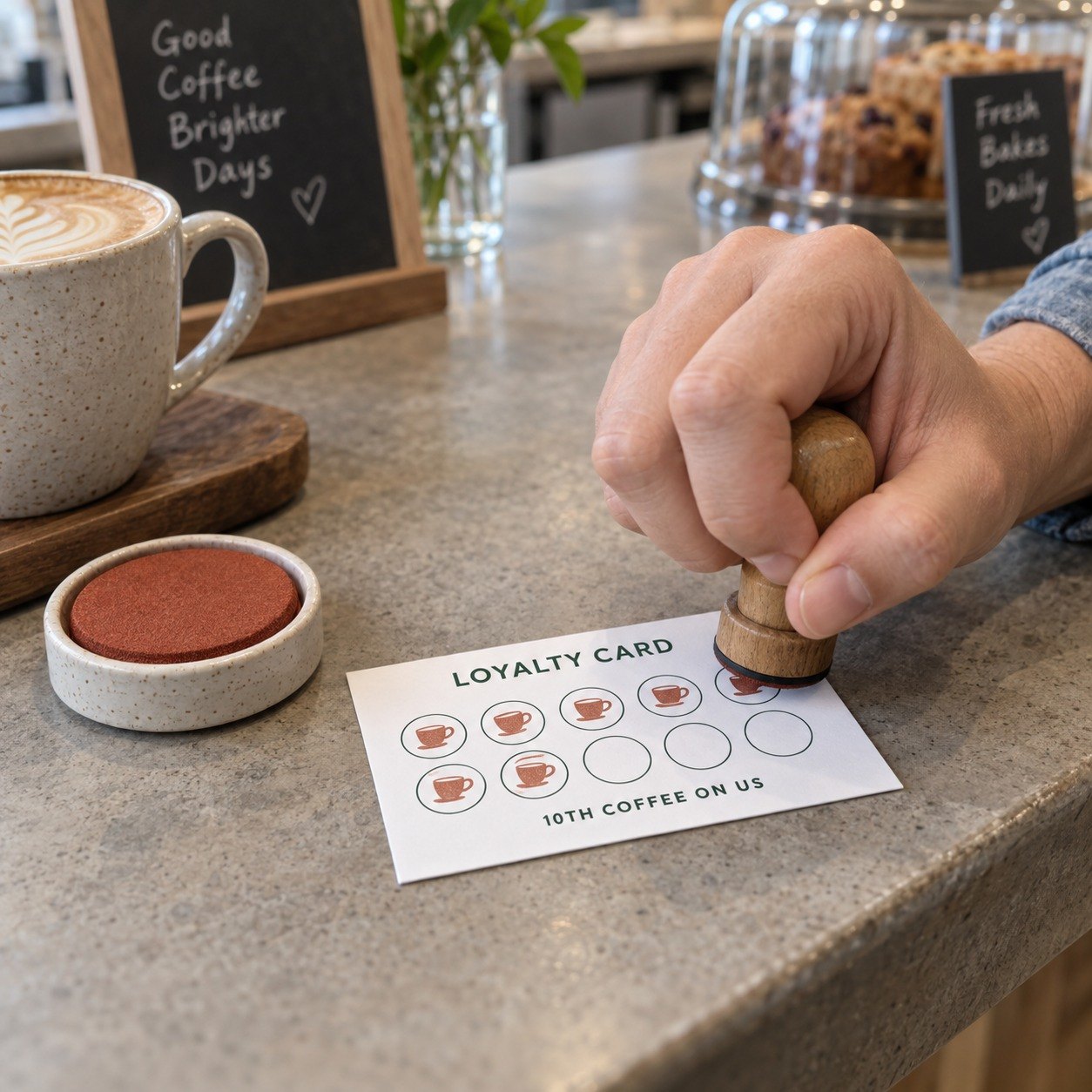
That size is why the format suits cafes, salons, barbers, groomers and other repeat-visit businesses: every visit earns a stamp, a tick or a scribble toward the next reward. The mark itself is the next test, and because the surface is supplied without laminate, a stamp and a pen will mark it cleanly. A card that resists ink or smears above the surface fails at the one moment that matters.
Laying out the stamp grid
Most of the problems in loyalty card design come back to one thing: a grid drawn without the stamp in hand. The grid is the card’s scoreboard, and it has to fit the tool that will mark it.
The card is 90 x 55 mm. With names, numbers, grids and ruled lines kept at least 4 mm inside the trim, the live area inside the margin is 82 x 47 mm. A ten-box grid of 13 x 13 mm boxes in two rows of five with 3 mm gaps takes up 77 x 29 mm, which leaves about 18 mm of height for a reward line and a conditions line.
If your stamp is bigger than that box, use fewer boxes rather than shrinking them. Size every box to the stamp you will actually use, with a little room to spare, and number the boxes or mark the final one as the reward.
| Element | What to decide | Why it matters |
|---|---|---|
| Number of spaces | Count the visits to the reward and give each visit its own box. If the stamp is bigger, use fewer boxes rather than shrinking them. | A grid that fits the stamp stays neat. |
| Box size | Size every box to the actual stamp, with a little room to spare, and number the boxes or mark the final one. | A stamp that overlaps the lines looks messy. |
| Reward line | One plain sentence naming the reward and the visit it lands on, set larger than anything except the logo, on the same side as the grid. | Customers see the goal at a glance. |
| Conditions line | One short line in readable type, such as one stamp per visit or not exchangeable for cash. | Readable conditions prevent counter arguments. |
| Business details | Decide which contact details to include, keeping the name clear and leaving the grid room to breathe. | Too much text competes with the reward. |
| Front and back split | Choose front only or front and back with independent artwork. Keep names, numbers, grids and ruled lines at least 4 mm inside the trim. | It decides whether brand and grid share one face. |
Writing the reward so customers read it the same way you do
The reward line is the second thing a customer looks for, and often the first thing they care about. It should be one plain sentence naming the reward and the visit it lands on.
Put it on the same side as the grid and set it larger than anything except the logo. A customer who sees “free coffee on the tenth visit” does not have to decode points, star values or a tier chart.
Keep conditions to one short line if there are any. “One stamp per visit” and “not exchangeable for cash” should sit in readable type, not small print that needs a magnifier. The goal is to prevent a disagreement at the counter.
Choosing paper that takes a stamp and a pen
Paper decides whether the card works at the moment of the stamp and the pen. The loyalty cards are offered in three 300 GSM stocks: 300 GSM Matte, smooth, low glare and bright white; 300 GSM Linen, with a visible linen texture and an ultra white base; and 300 GSM Cotton, an uncoated off white cotton blend that prints well and writes well.
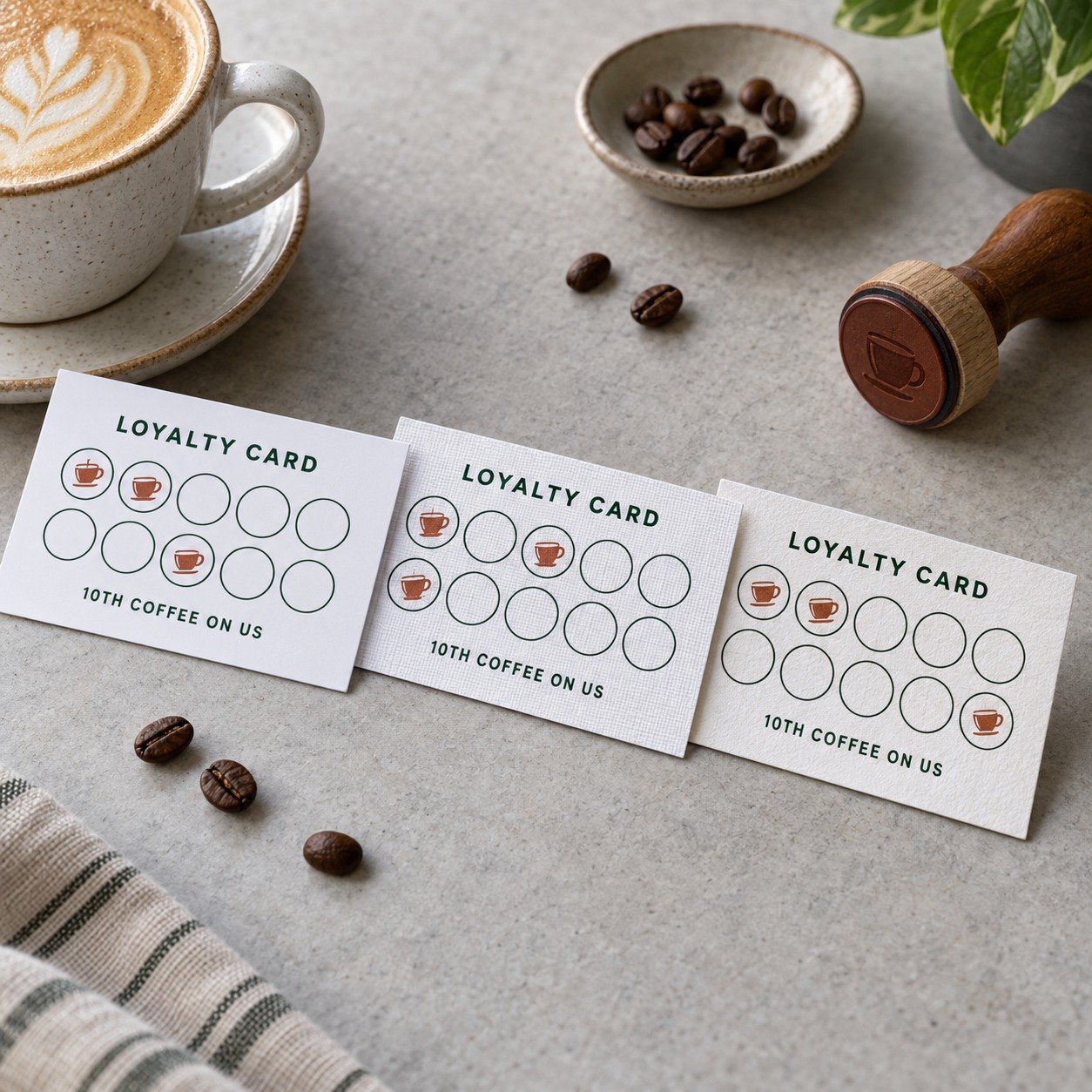
All three are supplied with no laminate. That matters because an unlaminated surface takes rubber stamp ink and ballpoint or gel pen ink. A laminated or velvet finished card resists ink, which is why no laminate is offered on these cards.
If speed matters, 300 GSM Matte runs on 24 hour production after proof approval. 300 GSM Linen and 300 GSM Cotton run on 3 to 5 business days after proof approval. All three are printed at the Melbourne studio.
Order the business cards sample pack if you want to compare the stocks before a full run.
Two worked layouts: a cafe card and a salon card
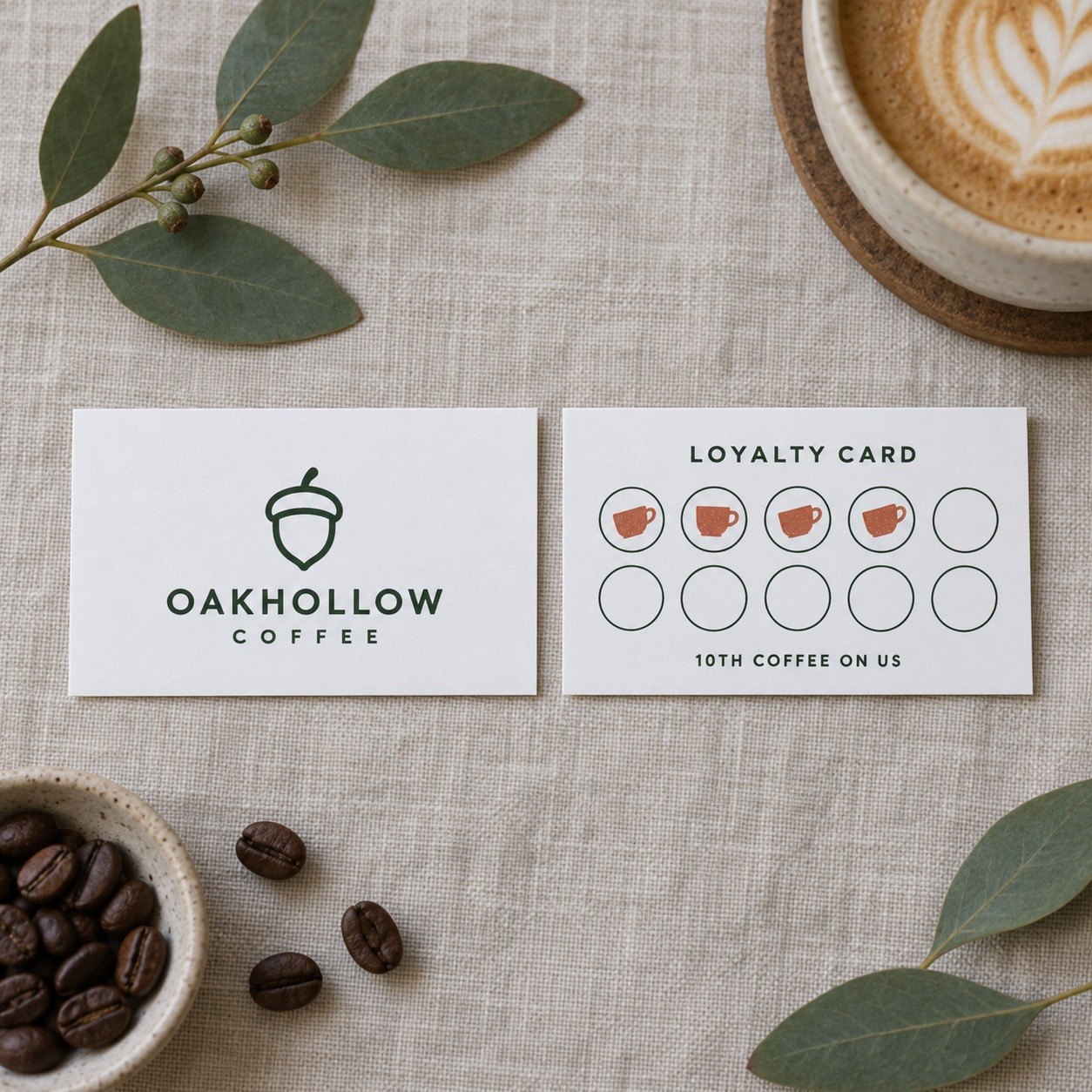
A coffee loyalty card usually needs more boxes because visits pile up quickly. The cafe layout starts with the front showing the logo and cafe name only, so the card stays clean beside the till.
On the back, a ten-box grid of coffee-cup outlines carries the stamp marks. The reward line names the free coffee on the final box, and one conditions line sits beneath it. Order 300 GSM Matte for a crisp stamp and the fastest turnaround.
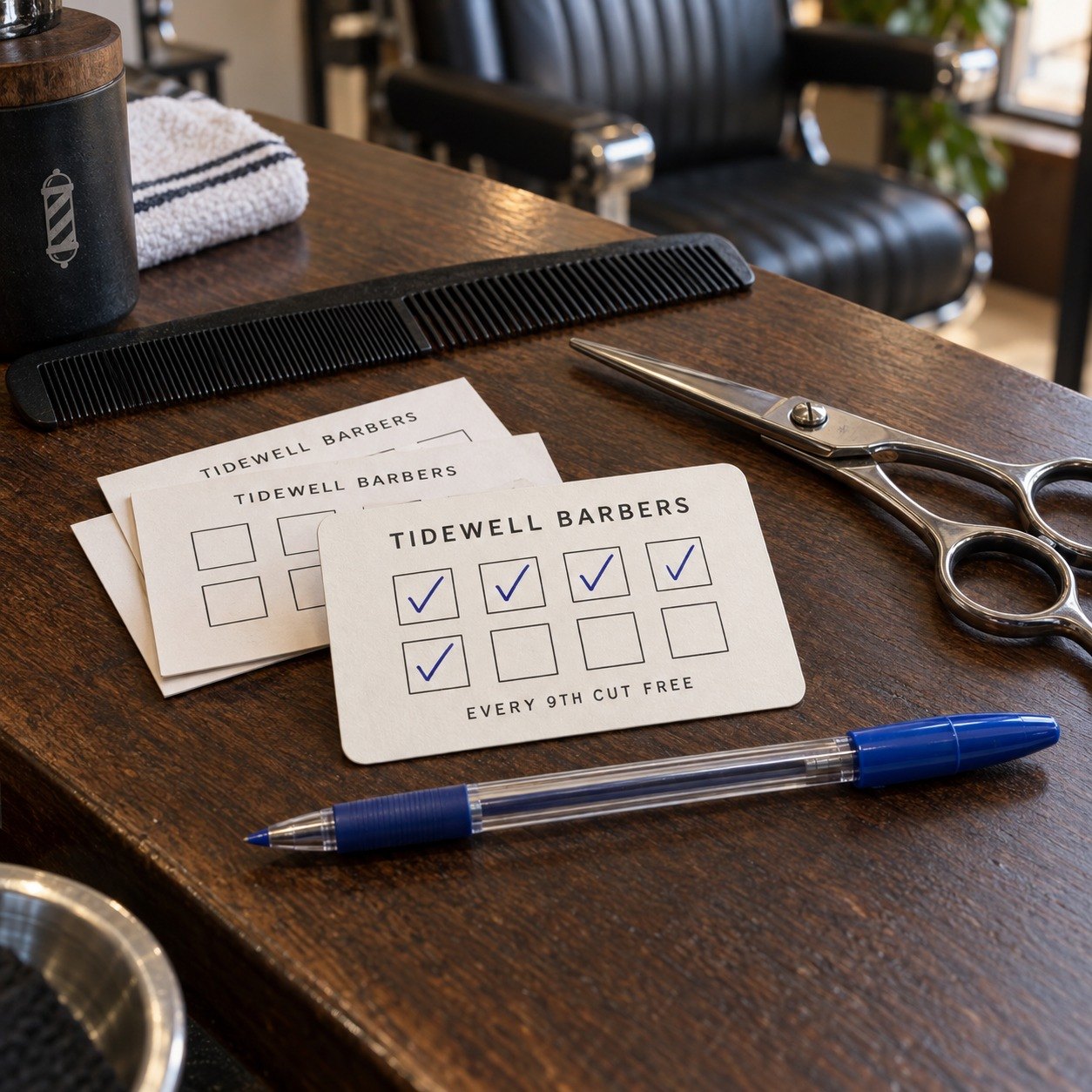
A salon card works to a slower rhythm. The front keeps the salon name and logo, and the back carries a shorter grid of six or eight boxes. The reward line names a treatment or a discount on the final visit, with space for the stylist to tick or initial in pen instead of stamping. 300 GSM Cotton or Linen gives a softer, premium feel, ordered with 3 to 5 business days to spare.
Preparing the artwork and ordering
The card prints exactly the artwork supplied. There is no template or ready-made layout supplied, so the grid is designed by the business or its designer before upload. If the artwork is not print ready, the Design Artwork Package closes that gap.
Shape and sides come next. The card can be a rectangle with square corners or one with rounded corners, both 90 x 55 mm. You can order front only, which leaves the back as bare paper, or front and back with independent artwork on each side.
Prepare the file at 96 x 61 mm for the 90 x 55 mm card, giving 3 mm bleed on all four sides. Keep names, numbers, grids and ruled lines at least 4 mm inside the trim. PDF, SVG and Adobe Illustrator are preferred, with fonts outlined and artwork at 100% scale. A high resolution PNG or TIFF at 300 dpi is also accepted.
Every order gets a free pre-press file check and an emailed digital proof within 1 to 2 business days. Nothing prints until you approve it. The minimum order is 50 cards, and the quantity selector runs up to 5,000.
If you are assembling a cafe and restaurant print kit or a salon, spa and barber print kit, follow the same file standards so the cards, stickers and signage stay consistent.
Frequently asked questions
How many stamp spaces should a loyalty card have?
Count the visits to the reward and give each visit its own box. Size every box to the actual stamp, with a little room to spare. If the stamp is bigger than the box, use fewer boxes rather than shrinking them, and number the boxes or mark the final one as the reward.
Does a rubber stamp work on the card or will it smudge?
A rubber stamp works on the unlaminated cards. The 300 GSM Matte, Linen and Cotton stocks are all supplied with no laminate, so a stamp or a ballpoint or gel pen will mark them cleanly. A laminated or velvet finished card resists ink, which is why no laminate is offered.
Should the stamp grid go on the front or the back?
Either is possible. You can order front and back with independent artwork on each side, or front only with the back left as bare paper. The usual choice is a branded face on the front and a reward grid on the back, so the reward side stays easy to read.
Which paper should I choose for a stamp card?
300 GSM Matte is smooth, low glare and bright white, and it runs on 24 hour production after proof approval. 300 GSM Linen has a visible texture and an ultra white base, and 300 GSM Cotton is an uncoated off white cotton blend. Both Linen and Cotton run on 3 to 5 business days after proof approval. All three are unlaminated and take a stamp and a pen.
Is a template supplied with the order?
No. No ready-made layout or template is supplied. You upload print-ready artwork, or order the Design Artwork Package if the artwork is not print ready. The grid is designed by the business or its designer before upload.
What is the minimum order for a stamp card?
The minimum order is 50 cards, and the quantity selector runs up to 5,000.