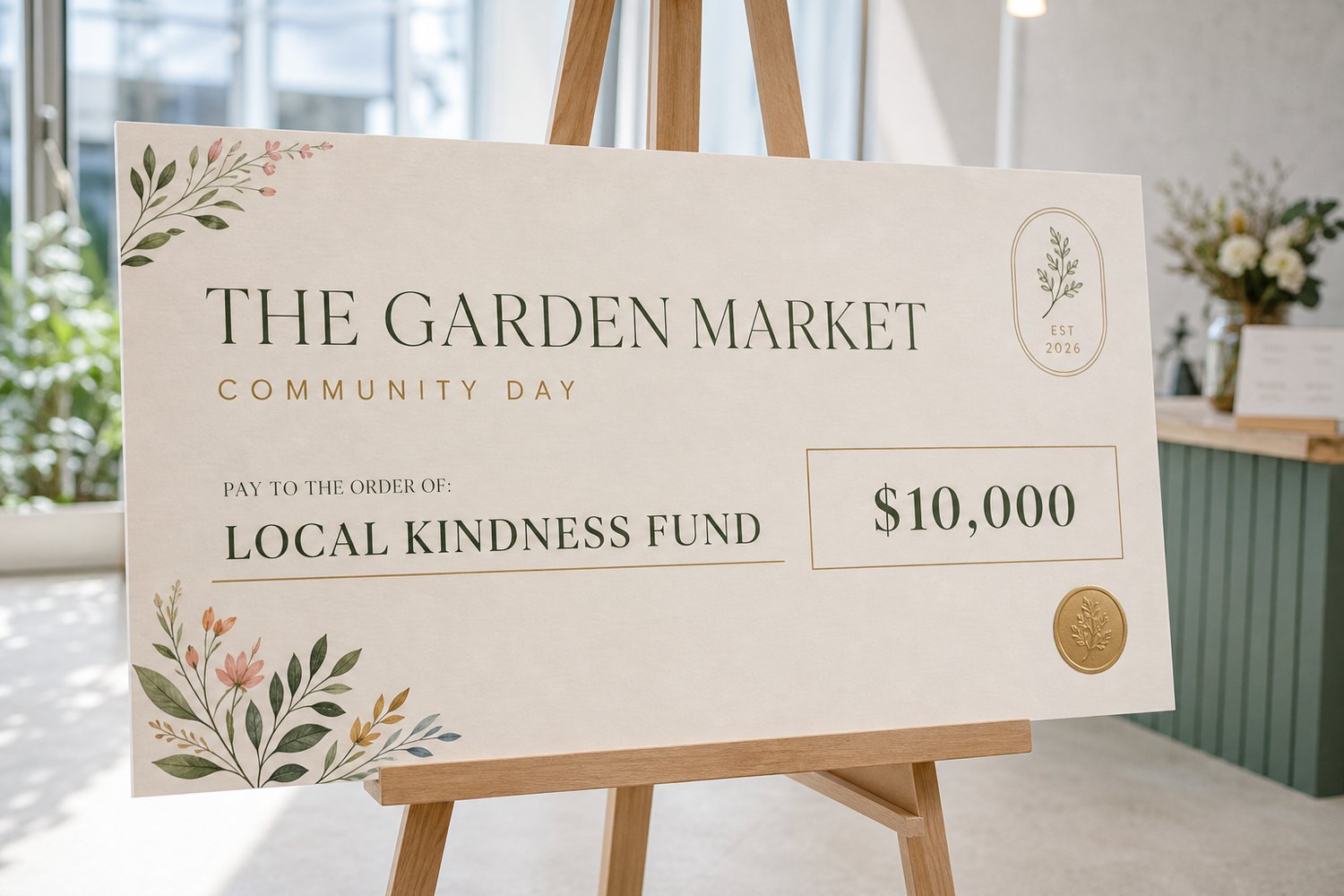
Whether you are presenting a $10,000 donation at a fundraiser, handing over a sports prize at an awards night, or wrapping up a corporate sponsorship on camera, a giant novelty cheque turns a financial moment into a shareable, media-ready visual. You might also see it called a presentation cheque, oversized cheque, big cheque or large cheque, the terms all describe the same large-format printed cheque. This guide covers everything Australian buyers need to know: standard sizes, what to fill in, board types, reusable versus one-off options, and how to set up for that perfect handover photo.
CHEAT SHEET
- The most common size is 1000mm wide x 450mm high, fitting most indoor and outdoor event stages without being unwieldy.
- Rigid board (5mm TEKpvc foamboard) is the go-to for a clean print surface and enough stiffness to hold shape during handover photos.
- Every cheque needs six fields: date, payee name, amount in numerals, amount in words, presenting organisation name, and a signature line.
- Order reusable if you run regular events; order one-off if the amount or recipient changes each time.
Standard Novelty Cheque Sizes in Australia
Most AU suppliers produce giant cheques in two size brackets. The table below shows the common options alongside their typical use cases.
| Size (W x H) | Approx. equivalent | Best for |
|---|---|---|
| 1000mm x 450mm | 100cm x 45cm | Single presenter, indoor stages, media backdrops |
| 1400mm x 600mm | 140cm x 60cm | Group presentations, outdoor venues, large audiences |
| Custom | Quote on request | Roadshows, branded sets, unusually large venues |
Paperlust’s novelty cheque is produced at 1000mm x 450mm as the standard option. If you need a different dimension, check the product page for custom sizing availability or contact the team before placing your order.
How to choose your size:
- Think about the distance between the presenters and the camera. A 1000mm cheque reads clearly from 3-5 metres. For venues wider than 10 metres, a 1400mm cheque gives the photographer more to work with.
- Consider transport logistics. A 1000mm rigid board fits across the back seat of most sedans; a 1400mm board may need a wagon or ute tray.
- Think about branding. Larger boards give more white space around logos and copy, making the design feel premium rather than crowded.
What Goes on a Novelty Cheque
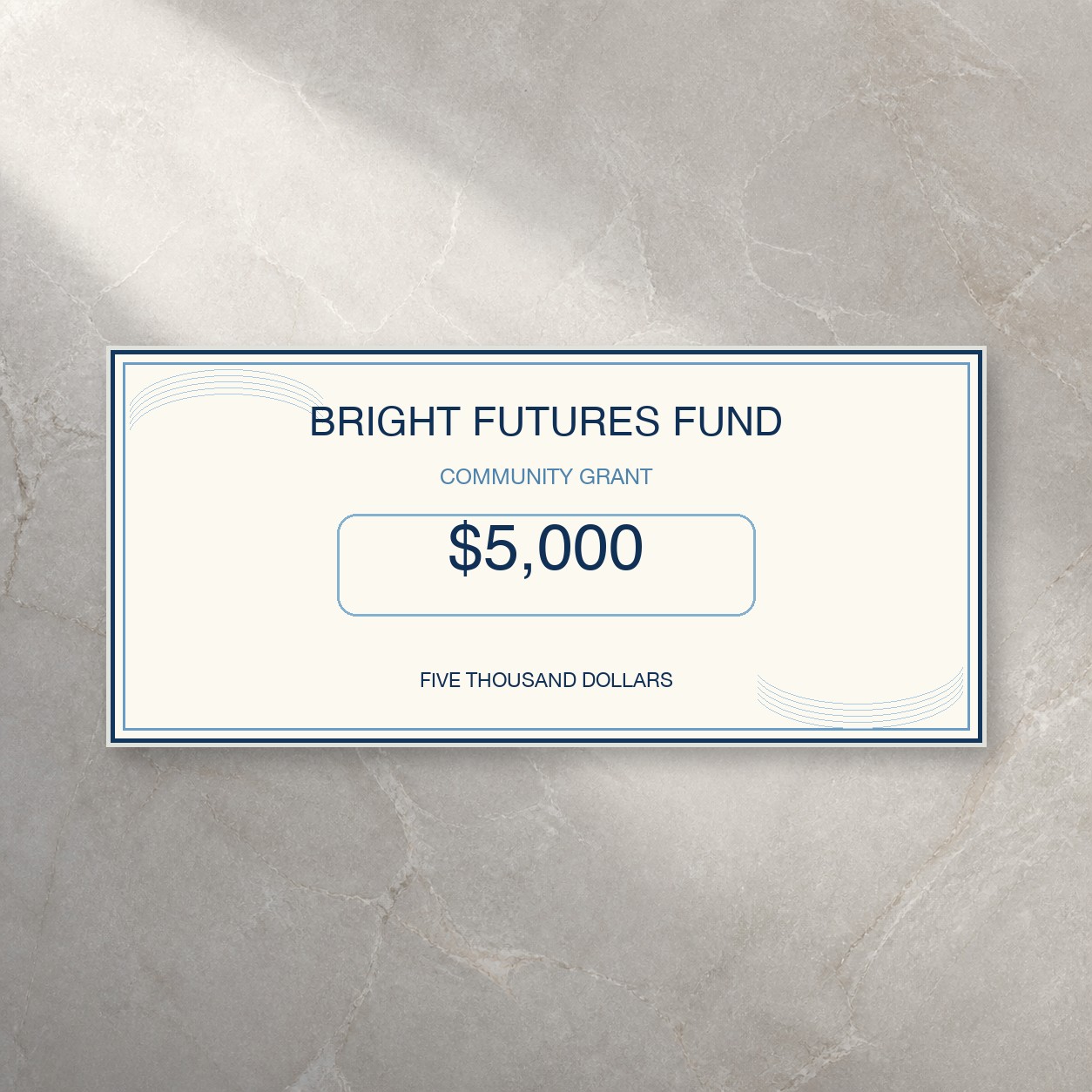
A convincing novelty cheque mirrors the layout of a real banking cheque while scaling up the key elements. Most AU suppliers follow a standard six-field layout:
The six essential fields
- Date – Top right corner. Use the date of the event, not the date of printing.
- Pay to / Pay to the order of – The recipient’s name: a person, charity, team, or cause.
- Amount in numerals – The large figure inside the amount box, e.g. $50,000.00.
- Amount in words – The written-out equivalent on the amount line, e.g. Fifty thousand dollars and zero cents.
- Presenting organisation – Your company name or event brand, typically positioned where a bank name would sit.
- Authorised signature – A real or stylised signature line. For reusable cheques, this is often left blank to be signed at the event.
Optional design elements
- Memo line – Useful for noting the purpose: “Community Garden Fund 2026” or “Player of the Season.”
- Cheque number – Adds a realistic touch and can be tied to internal event numbering.
- Bank logo or event logo – Many clients print a fictional bank name (e.g. “First National Sponsorship Bank”) for a polished, humorous feel.
- Sponsor or co-presenter logo – Ideal when multiple brands are involved in the donation.
Keep the font size on the amount generous: at least 80-100pt for the numeral figure so it photographs cleanly from 5+ metres.
Board and Material Options
The material your cheque is printed on determines its rigidity, print quality, and how well it holds up during the event.
5mm TEKpvc foamboard (Paperlust standard)
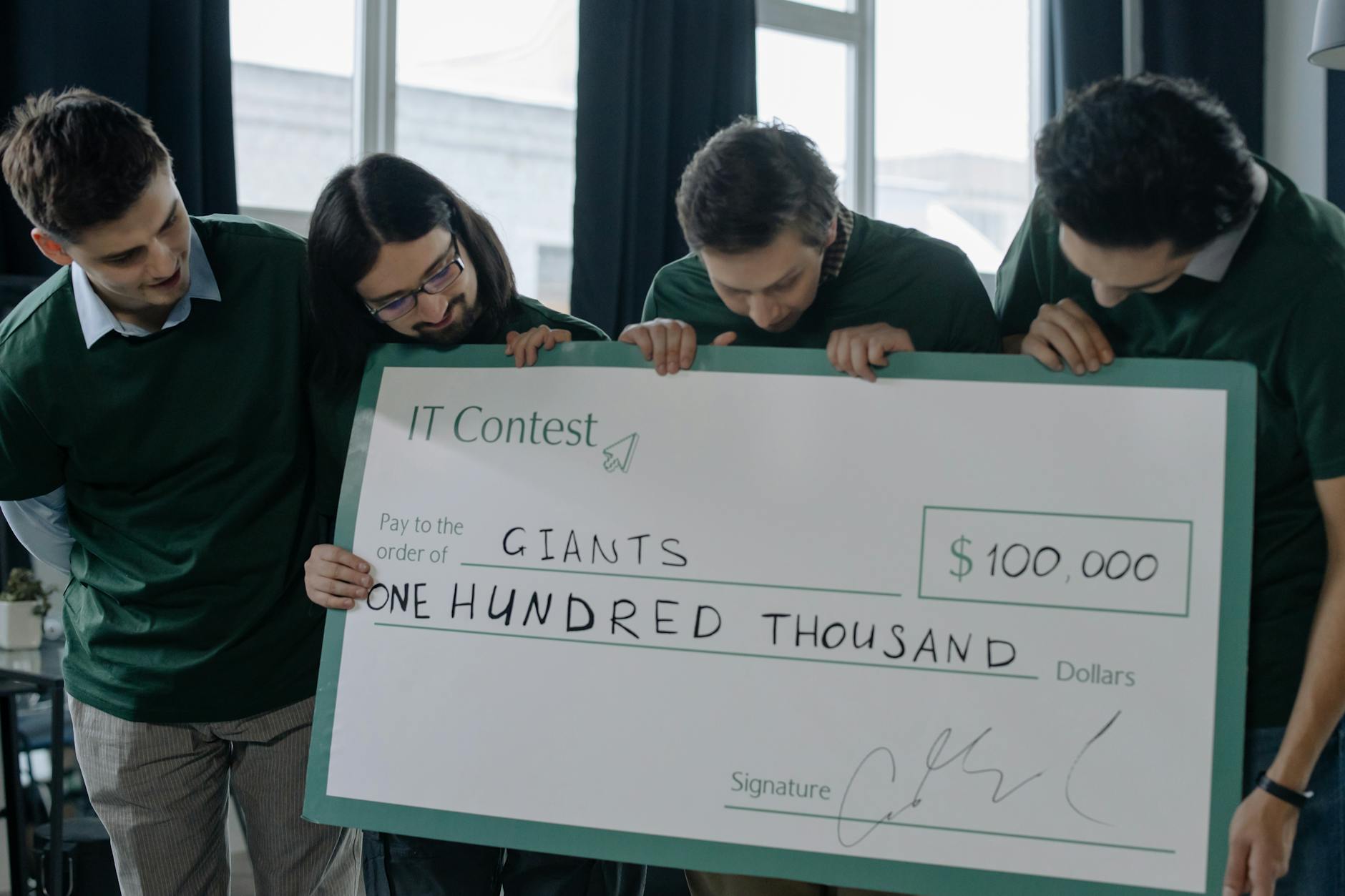
Paperlust prints novelty cheques on 5mm TEKpvc foamboard: a rigid PVC foam core with a smooth, clean print surface. Compared to corflute (corrugated plastic), foamboard produces a noticeably sharper printed result because the surface has no flute texture. It is lightweight enough to hold comfortably during a two-minute handover, and stiff enough to stay flat without a frame or backing structure.
Durability note: TEKpvc foamboard handles indoor conditions well and can manage a single outdoor event on a calm day. For events held in direct sun or wind, keep the board in its packaging until the moment of presentation.
Corflute (industry alternative)
Some budget suppliers print on 5mm corflute. The corrugated internal structure makes it very impact-resistant and weather-tolerant, but the fluted texture is visible in close-up photography. For media-facing events where print sharpness matters, foamboard is the better choice.
Laminated cardboard (Kwik Kopy-style)
A minority of local printers mount cheques on heavy cardboard and laminate the face. This keeps costs low but produces a lighter, less rigid result. Not suitable for outdoor use or events where the cheque needs to be held at arm’s length.
Bottom line for most events: TEKpvc foamboard gives the best balance of print clarity, rigidity, and weight for a standard Australian charity or awards presentation.
Reusable vs One-Off Novelty Cheques
The answer depends on how often you run events and whether your amounts and recipients vary.
| Use case | Recommended approach |
|---|---|
| Annual charity gala, amount changes each year | One-off print with full details |
| Quarterly award presentations, same dollar value | Reusable base with blank amount field |
| Recurring sponsorship with fixed naming rights | Reusable with laminated write-on/wipe-off surface |
| One-time prize presentation | One-off, no need for reuse spec |
Reusable options to discuss with your print supplier:
- Lamination over blank fields, allowing a dry-erase marker for the amount and payee.
- Leaving the amount line and payee fields unprinted, with a write-on line instead.
- Printing a base design with your logo and event branding, then adding a detachable printed insert for the variable fields.
For most one-off charity events, a full-colour single-use cheque printed at a fixed amount and recipient is the simplest and sharpest result.
Lead Times and Ordering in Australia
Paperlust’s standard production time for novelty cheques is 3-4 working days after design proof approval. A 48-hour production option is also available if your event date is closer.
Shipping after production:
- Metro areas: 1-2 business days (express) or 2-5 business days (standard)
- Regional areas: 3-5 business days (express) or 4-6 business days (standard)
Planning your order timeline:
Recommended lead time by event type
- Charity fundraiser (evening event): Order at least 2 weeks ahead to allow for design back-and-forth and comfortable transit time.
- Sports award night (fixed date): Order 10-14 days ahead. If you are also ordering premium pull up banners or posters for the same event, bundle the orders early so they arrive together. The same award night usually needs printed award certificates for recipients, available from $49.00 for 25.
- Corporate sponsorship announcement (PR-sensitive): Allow 3 weeks minimum. Proofs for this kind of high-visibility piece deserve two rounds of review before approval.
Novelty cheque orders are Australia-only for shipping purposes.
Artwork Setup: File Prep Tips
A cheque printed at 1000mm wide needs to be set up at a high enough resolution to look sharp at arm’s length and in close-up photos.
Key file setup requirements
- Resolution: 300 DPI at print size is the minimum for large-format items like novelty cheques.
- Colour mode: CMYK, not RGB. Colours set in RGB can shift when converted to CMYK at print, and reds in particular can turn orange.
- Bleed: Add 3-5mm of bleed around all edges. This allows for minor cutting tolerance without a white border appearing on the finished board.
- Fonts: Embed or outline all fonts before supplying artwork. Supplier systems do not always have access to the same font libraries.
- File format: PDF (print-ready) or high-resolution JPG/PNG. Avoid Word documents or PowerPoint exports: they recompress images and embed screen-res assets.
If you do not have design software, Paperlust’s artwork services team can build your cheque design from a brief. Artwork service fees may apply.
Presentation Tips for Charity and Award Photos
A well-printed cheque on the wrong backdrop or with the wrong number of people in frame can still produce a flat photo. Here is how to set up the handover moment for maximum impact.
Positioning and framing
- Hold the cheque at chest height, tilted 5-10 degrees toward the camera. Holding it flat (parallel to the floor) produces glare from overhead lighting.
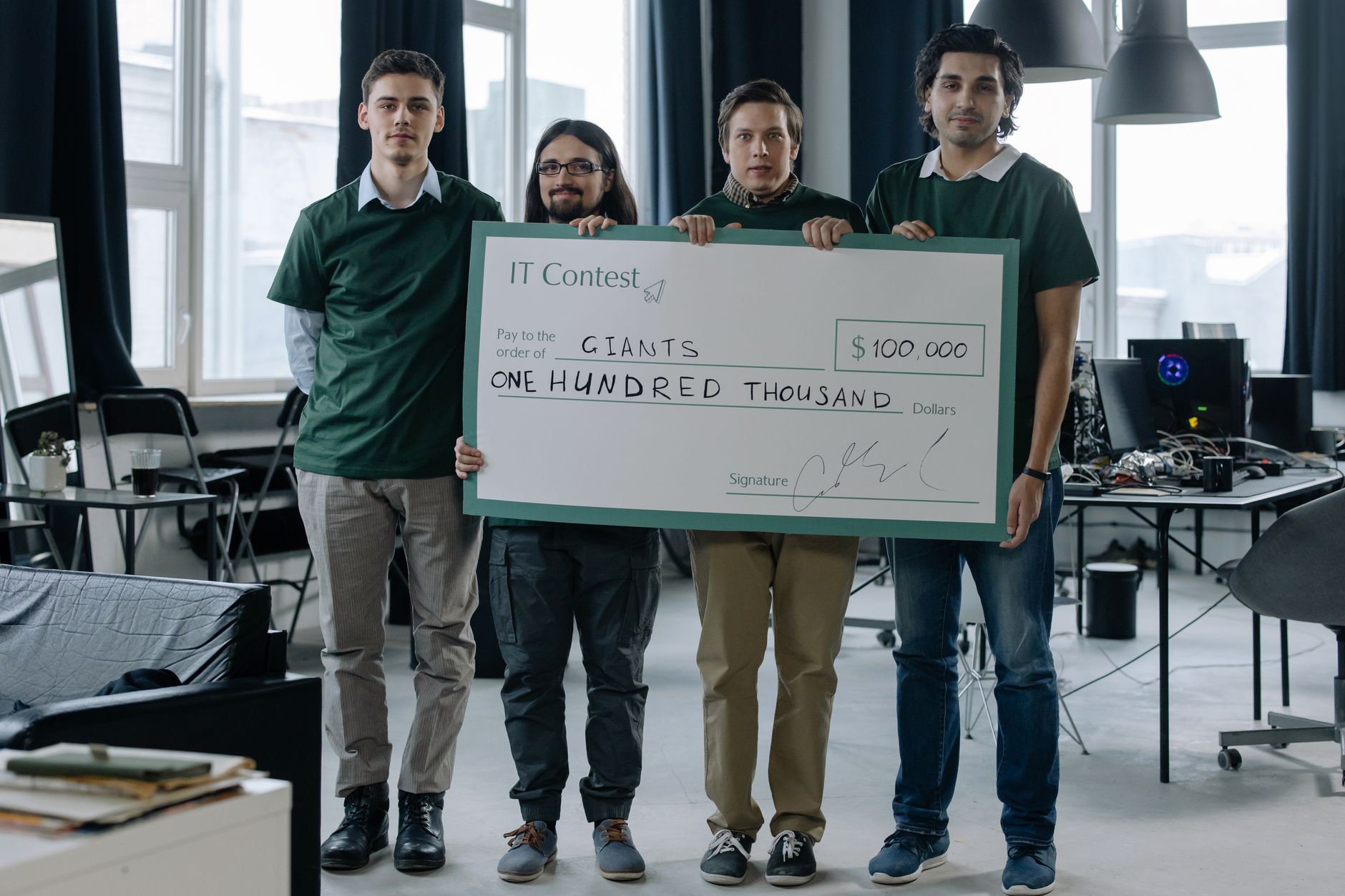
- Three is the magic number for presenters. One donor and one recipient looks transactional. Three people (donor, recipient, and a third stakeholder or emcee) creates a natural, celebratory grouping that crops well for portrait and landscape formats.
- Hands under, not over. Presenters should grip the lower edge of the board, keeping fingers below the printed content.
Backdrop and lighting
- A plain, dark backdrop (navy or black drape) lets the cheque’s white face and colour printing pop in photographs. Busy branded walls compete with the cheque.
- Avoid positioning the cheque in front of bright windows or strong backlighting: the gloss face will catch lens flare.
- If the venue has overhead spotlights, test the angle before the event. Move presenters forward (away from the backdrop) to keep the light falling on the front of the cheque rather than the top edge.
After the handover
Store novelty cheques flat or standing upright (leaning against a wall, not face-in). Do not stack heavy items on top of foamboard: sustained pressure can bow the face. Kept dry and stored flat, a TEKpvc foamboard cheque will last for years as a keepsake or display piece.
Frequently Asked Questions
What is the standard size for a giant novelty cheque in Australia?
The most widely used size is 1000mm wide x 450mm high (approximately 100cm x 45cm). This size is large enough to photograph well at typical event distances and manageable for two people to hold comfortably. Some suppliers also offer a larger 1400mm x 600mm format for bigger stages or group presentations. Paperlust produces its novelty cheque at the 1000mm x 450mm standard.
How much does novelty cheque printing cost in Australia?
One Paperlust novelty cheque is $97.82 inc. GST. The per-cheque price decreases with quantity, for example five at $44.00 each, ten at $37.27 each, and twenty at $33.90 each. Check the novelty cheques product page for a live quote based on your quantity.
What material is a novelty cheque printed on?
Paperlust prints novelty cheques on 5mm TEKpvc foamboard, a rigid PVC foam core that delivers a smooth, clean print surface. This produces sharper results than corflute alternatives, which have a textured fluted surface that can show in close-up photography. The board is lightweight enough to hold comfortably during presentations while remaining stiff enough to stay flat without a frame.
Can I get a blank or reusable novelty cheque?
Yes, many suppliers including Paperlust can accommodate reusable cheques by leaving variable fields (amount, payee) blank or by applying a laminated finish that allows dry-erase marker use. Discuss your requirements at the order stage so the design is set up with blank fields in the right positions. If you run annual or quarterly events with different recipients each time, a reusable base design saves on repeat print costs.
How early should I order a novelty cheque before my event?
For standard production, allow at least 10-14 days from order to delivery to be comfortable. Paperlust’s standard production time is 3-4 working days after design proof approval, with a 48-hour production option available for urgent orders. Add metro shipping time of 1-2 business days (express) or 2-5 business days (standard) on top of production. For regional deliveries, allow an extra 2-3 days.
What file format should I supply for novelty cheque printing?
Supply a print-ready PDF at 300 DPI, set up in CMYK colour mode with 3-5mm bleed on all edges. Outline or embed all fonts. Avoid RGB files (colours can shift at print) and Office application exports (they embed low-resolution assets). If you do not have print-ready artwork, Paperlust’s artwork services team can build your design from a brief.