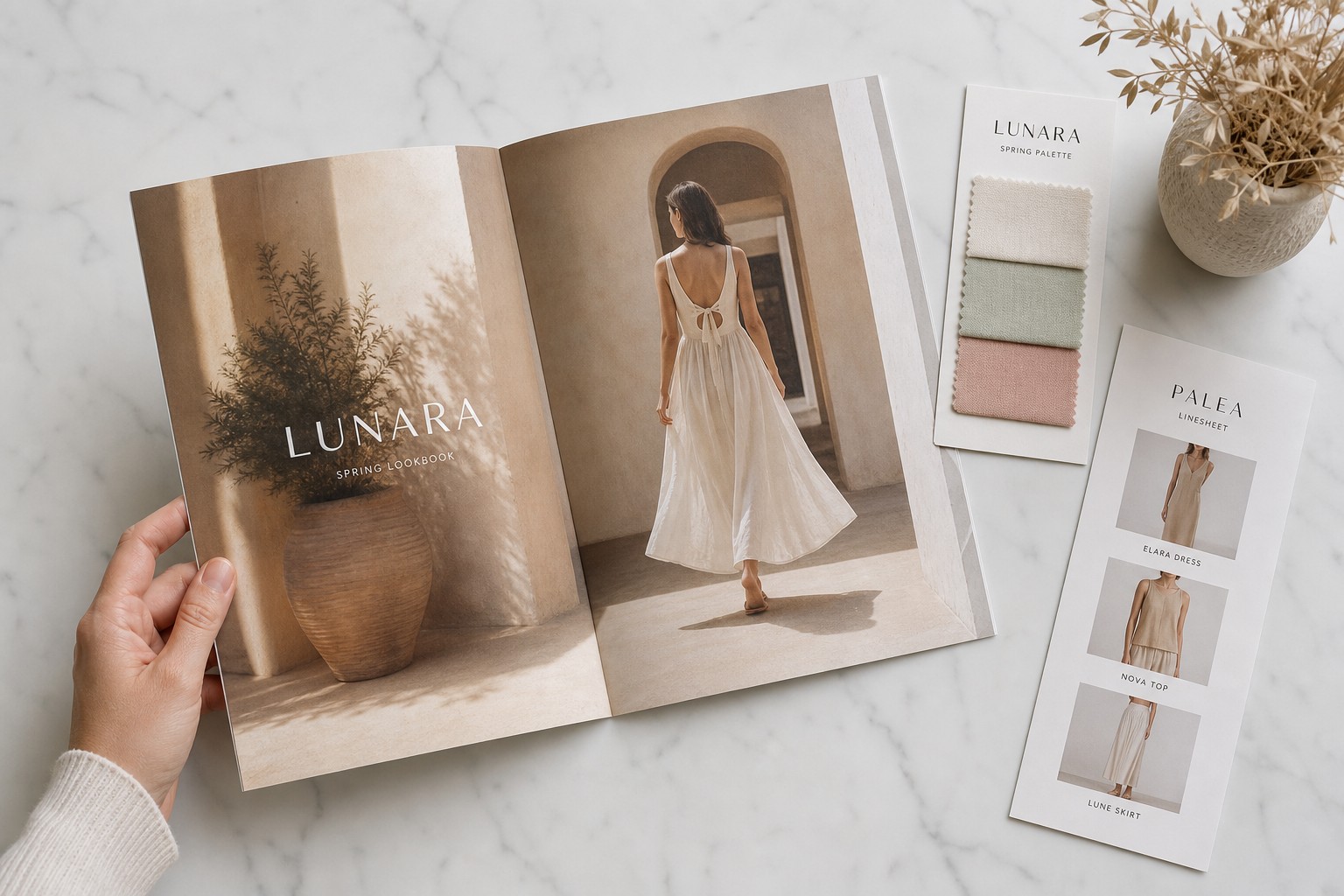
A printed lookbook still opens doors that digital cannot. For Australian fashion labels, photographers, and independent creators, handing a wholesale buyer or stylist a beautifully produced booklet is a tangible signal of your brand’s quality before they read a single line of copy.
Getting the print right matters. The wrong paper weight dulls your photography. The wrong finish creates glare under showroom lighting. The wrong size makes your linesheet awkward to carry to a trade appointment. This guide covers exactly what to specify when ordering lookbook printing in Australia, so your final piece works as hard as your imagery does.
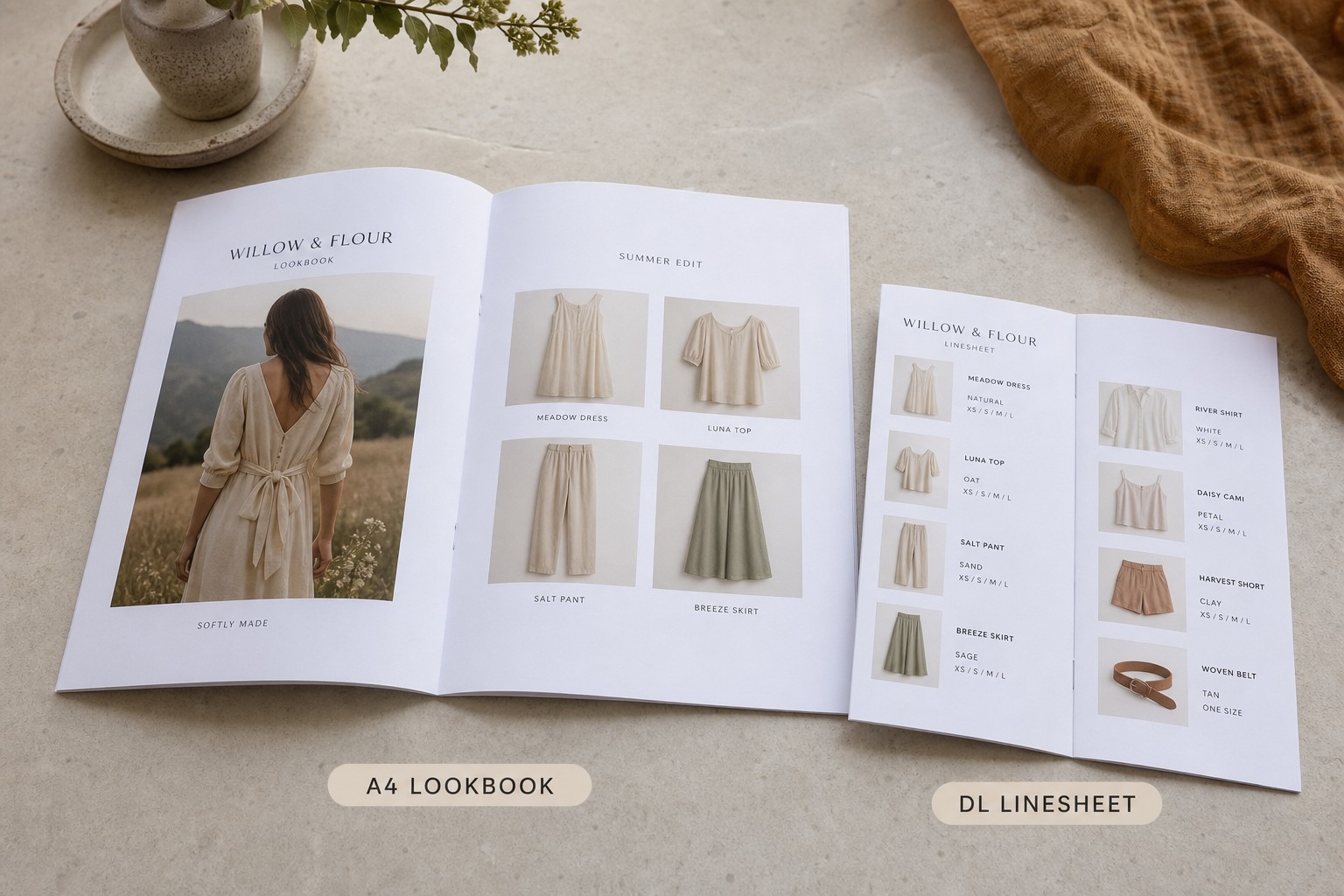
– Best size: A4 (210 x 297mm) for editorial lookbooks; DL (99 x 210mm) for linesheets and press inserts
– Cover stock: 250gsm with matte or gloss lamination for durability and a premium feel
– Finish for photography: Matte lamination reduces glare and reads as editorial; gloss adds vibrancy for bold colour stories
– Image resolution: 300dpi minimum at final print size, exported as CMYK
– Page counts (A4): 8, 24, 32, 48, or 64 pages; plan your collection around these multiples
– Turnaround: Proof in 1-2 business days, then 3-7 working days production after approval
– Start here: A4 lookbook printing from $17.71 inc. GST
What makes a lookbook different from a standard booklet
Most printed booklets carry text-heavy content: event programs, training manuals, product catalogues with specifications and price points. A lookbook does something different. Its primary job is to communicate aesthetic and mood through photography, and every production decision should flow from that purpose.
That shift changes how you specify your print job. Standard booklet guides focus on binding mechanics and page count rules, but for fashion and creative content the more important decisions are finish, paper weight, colour setup, and how the piece will actually be used. This guide covers those decisions specifically.
Choosing the right size for your lookbook
A4 (210 x 297mm) for editorial lookbooks
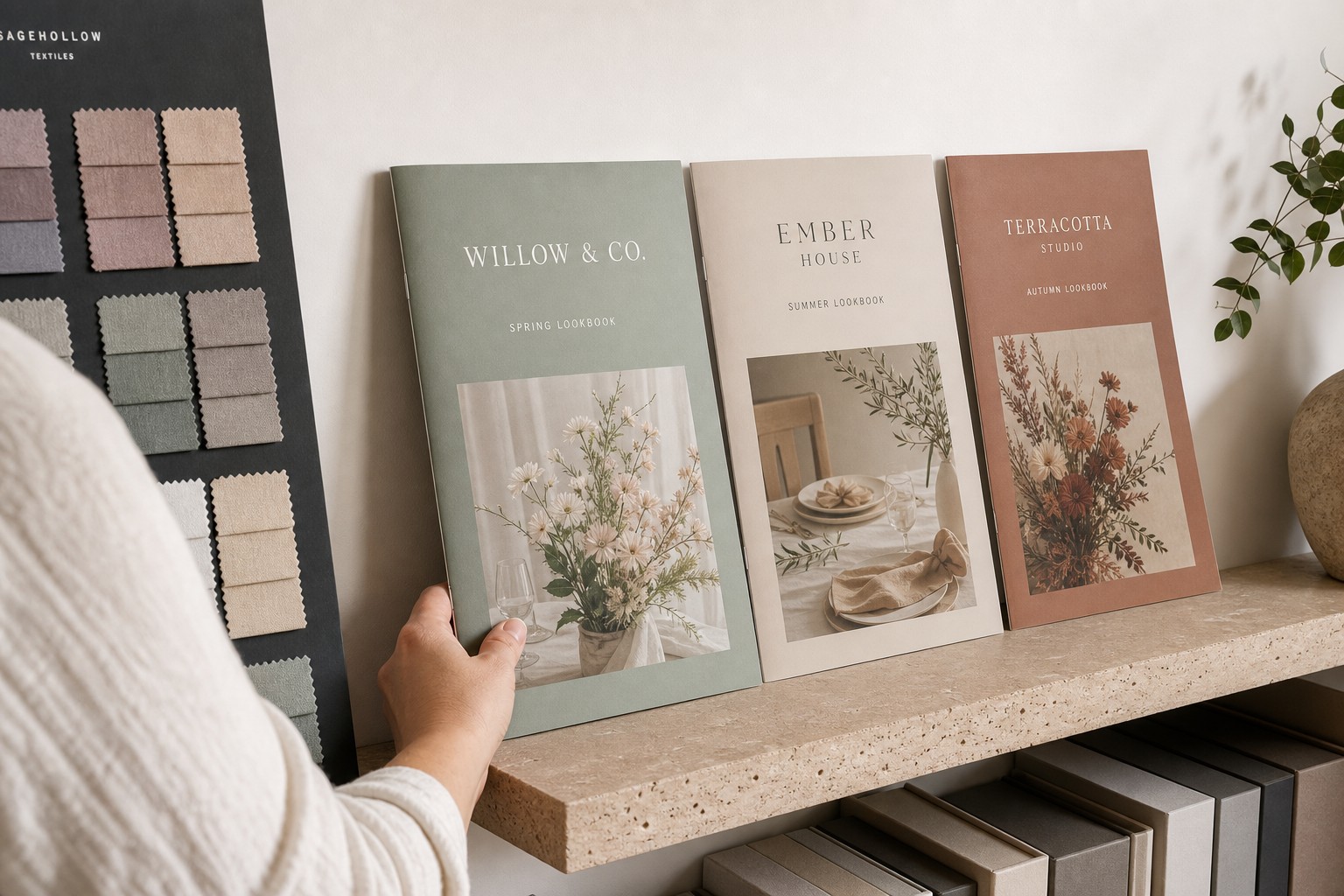
A4 is the dominant lookbook size for Australian fashion labels. It gives full-bleed photography room to have real impact, fits naturally in a standard A4 sleeve or portfolio, and is the format wholesale buyers expect at trade appointments and showroom calls.
For editorial-style content, A4 allows double-page spreads where a single campaign image runs across both pages at approximately 420 x 297mm. That kind of presentation closes the gap between a branded booklet and a coffee-table piece.
Paperlust’s A4 booklets are saddle-stitched with a 250gsm laminated cover, available in page counts of 8, 24, 32, 48, or 64 pages. For a typical seasonal lookbook covering campaign imagery, product shots, and a brand story spread, 24 or 32 pages is the practical range.
DL (99 x 210mm) for linesheets and press inserts
A DL booklet (99 x 210mm) fits a standard DL envelope, which makes it cost-effective to post as part of a press kit or wholesale buyer package. It is also the standard format for a fashion linesheet: the product-by-product document buyers use to place orders, typically tucked inside or alongside the main lookbook.
DL booklets from Paperlust Print Shop start from $16.54 inc. GST, with options across 170gsm and 250gsm stocks in matte or gloss, laminated or unlaminated. For a linesheet that feels as polished as the lookbook it accompanies, the 250gsm matte laminated option is the right specification.
Paper weight and finish for photo-rich fashion content
The cover finish is the decision that most affects how your photography reads in the hand, and under the lighting conditions where the book will be reviewed.
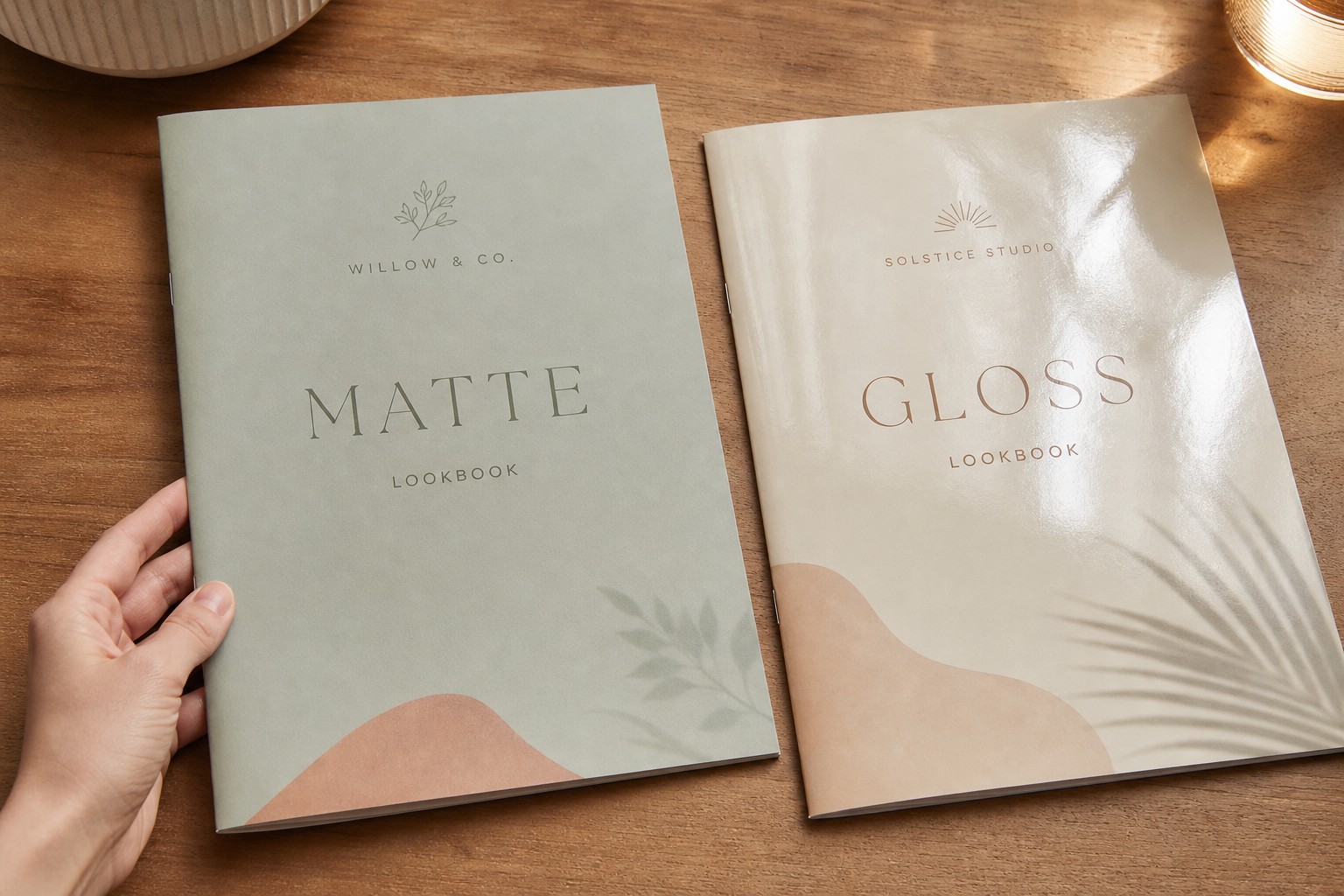
Matte lamination
Matte lamination gives a soft, flat surface that diffuses light rather than reflecting it. Under trade fair fluorescents or showroom track lighting, a gloss surface creates hot spots where the light source bounces directly into the viewer’s eye. Matte eliminates those reflections.
Matte is also the finish most associated with premium editorial print. High-end brand books, luxury fashion catalogues, and museum exhibition pieces almost universally use matte or soft-touch laminates. If your brand sits in the premium or contemporary segment, matte lamination signals that positioning before a buyer reads a word.
One practical note: matte can make very dark, contrasty images appear slightly less punchy than they would on gloss. If your collection features bold, saturated colour stories, requesting a proof before committing to a large run is worthwhile.
Gloss lamination
Gloss lamination adds a high-shine surface that makes colours appear more vibrant and increases perceived contrast in print. This suits lookbooks with bright, saturated palettes or swimwear and activewear collections shot in strong natural light.
The trade-off is that gloss shows fingerprints readily and can feel less premium than matte over repeated handling. For a showroom piece that lives on a counter and gets picked up multiple times a day, matte holds up better aesthetically.
Both matte and gloss lamination are available on the 250gsm cover across the Paperlust Print Shop booklet range.
Setting up your images for rich print results
Well-produced fashion photography can still look flat or colour-shifted in print if the file preparation is incorrect. Three setup points matter most.
Resolution: 300dpi at final print size
Images need to be 300 dots per inch (dpi) at the actual printed size, not the display size. An image that looks sharp on screen at 72 or 96 dpi will print noticeably soft. For a full-page image on A4 (210 x 297mm), your file needs to be at least 2,480 x 3,508 pixels.
Digital camera files typically have more than enough resolution for A4 lookbooks. The issue usually arises when creators pull images from social media, which compresses and resizes files, or from screenshots. Always work from the highest-resolution export your photographer can provide.
Colour mode: convert to CMYK before exporting
Print uses CMYK colour (cyan, magenta, yellow, black). Digital files and camera RAW exports use RGB, which has a wider colour range. Some RGB colours, particularly vivid blues and saturated reds, cannot be exactly reproduced in CMYK. If you export your PDF without converting, the press makes the conversion automatically, and the result may not match what you expect on screen.
Converting images to CMYK in Adobe Photoshop or Lightroom before finalising your layout lets you see exactly how colours will shift and make corrections before sending to print.
Bleed: extend full-bleed images 3mm beyond the trim
For images that run to the edge of the page, extend the background 3mm beyond the trim line on every bleeding edge. For an A4 booklet, set your artwork document at 216 x 303mm (210 x 297mm plus 3mm bleed on all four sides). This 3mm is trimmed during production but prevents a thin white border appearing if the cut is even slightly off position.
How printed lookbooks are used in the fashion industry
Wholesale buyer appointments
At trade fairs, agency showrooms, and direct buyer calls, buyers review dozens of brands in a day. A well-printed lookbook gives them a physical reference to take away, annotate, and share internally with their team. Pair it with a DL linesheet that buyers can use for actual order placement, keeping the main lookbook clean from price and stock-code clutter.
A page count of 24 to 32 pages covers most collections comfortably: brand story spread, campaign imagery, and product shots with style codes. That keeps the piece dense enough to feel substantial without padding.
Press kits and media packages
Stylists, journalists, and influencer managers receive a significant amount of print collateral during launch periods. A lookbook in a physical press kit, alongside a DL linesheet and a sample, signals professionalism and production quality that a PDF email cannot replicate.
For press kit quantities, shorter print runs of 25 to 50 copies are typical. Saddle-stitched binding is practical at these quantities and gives a clean, flat result suited to mailing.
Showroom and stockist displays
For showroom display, a laminated 250gsm cover keeps the booklet looking fresh under repeated handling. Many labels print a new lookbook each season and display the current range alongside carry-over pieces.
Printing your lookbook at Paperlust Print Shop
Paperlust Print Shop prints A4 lookbooks and DL linesheets with a 100% print guarantee, flat-rate shipping Australia-wide, and a design proof delivered within 1-2 business days of placing your order. Production runs 3-7 working days after you approve your proof, with express metro delivery available.
Upload a print-ready PDF, SVG, or Adobe Illustrator file with 3mm bleed on all edges, fonts outlined, and images at 300dpi in CMYK. For other marketing materials to accompany your lookbook, including brochures and promotional pieces, see the full marketing materials range.
Related reading: Booklet printing in Australia covers binding method comparison (saddle stitch vs perfect bound) in detail. Catalogue printing in Australia covers B2B product catalogue production if you need a more spec-heavy piece alongside your lookbook.
Frequently asked questions about lookbook printing in Australia
What paper stock is best for a fashion lookbook?
A 250gsm cover with matte lamination is the standard choice for fashion lookbooks in Australia. Matte reduces glare under showroom and trade fair lighting and gives the piece a premium, editorial feel. For interior pages, the standard stock included with A4 saddle-stitched booklets provides good colour reproduction for photography at commercial print quality.
What size should a fashion lookbook be?
A4 (210 x 297mm) is the standard size for fashion lookbooks. It gives full-bleed photography room to have genuine impact, fits standard portfolios and sleeves, and is what wholesale buyers expect. For linesheets and press inserts that need to be mailed cost-effectively, DL (99 x 210mm) fits a standard DL envelope and works well as a companion piece.
How many pages does a lookbook need?
A typical seasonal lookbook runs between 24 and 32 pages, covering a brand story spread, campaign imagery, and product shots with style codes. Page counts for saddle-stitched booklets must be in multiples of 4. Available A4 page counts at Paperlust are 8, 24, 32, 48, and 64 pages.
Should I use matte or gloss finish for a lookbook?
Matte lamination is generally preferred for fashion lookbooks because it eliminates glare and reads as more editorial and premium. Gloss makes colours appear more vibrant and suits bold, saturated collections. If you are unsure, request a proof in both finishes before placing your full order.
What resolution do lookbook photos need to be?
300dpi at the final printed size. For a full A4 page, that is a minimum of 2,480 x 3,508 pixels. Work from the highest-resolution export your photographer can supply and avoid pulling images from social media platforms, which compress files well below print-quality resolution.
How long does lookbook printing take in Australia?
At Paperlust Print Shop, your design proof arrives within 1-2 business days of ordering. Production takes 3-7 working days after proof approval, with express delivery to metro areas taking 1-2 business days. Allow 2-3 weeks from order to delivery as a comfortable planning window, or approximately 10-12 business days if you need express production and shipping.